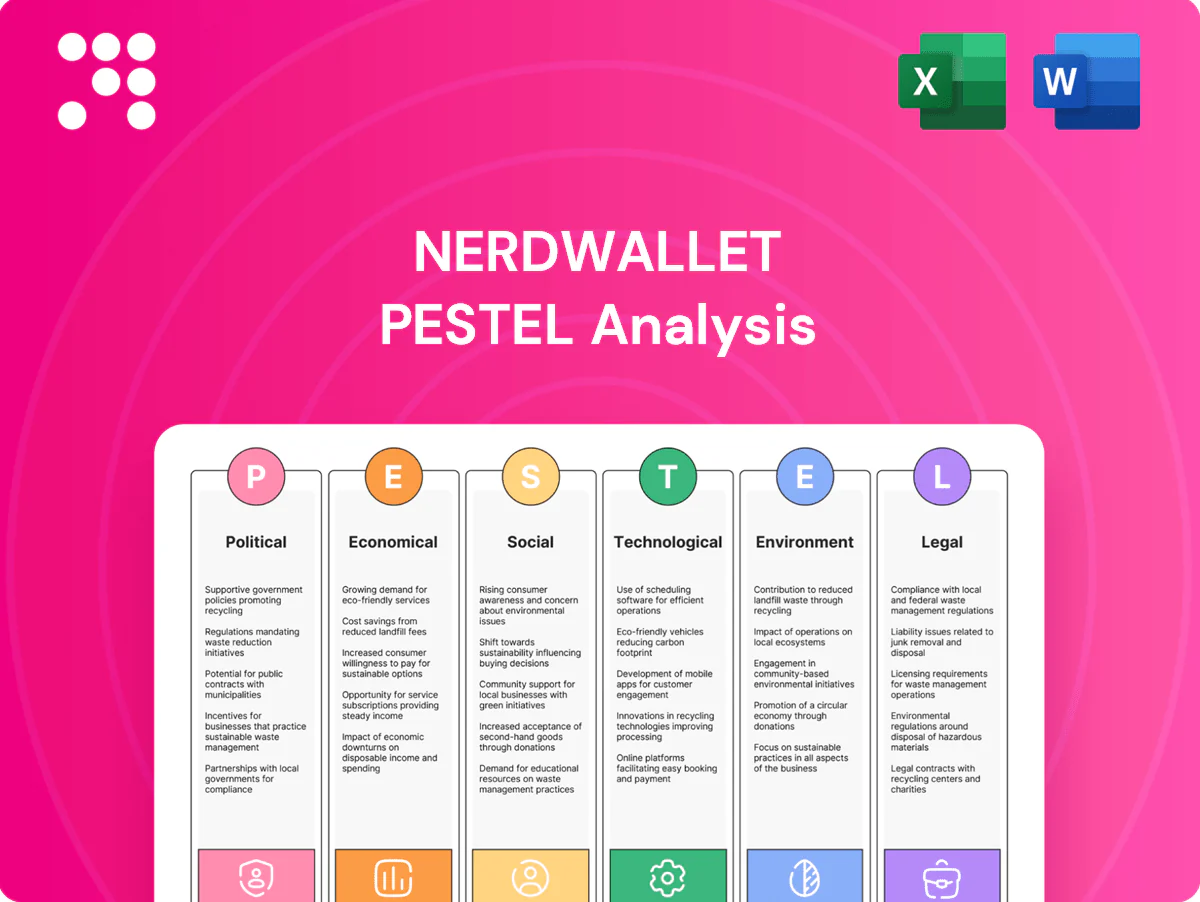
NerdWallet PESTLE Analysis

Your Competitive Advantage Starts with This Report
Unlock strategic clarity with our PESTLE Analysis of NerdWallet—three to five-page-depth insights revealing how political, economic, social, technological, legal, and environmental forces shape its prospects. Ideal for investors and strategists, this report saves research time and supports confident decisions. Purchase the full analysis now for immediate, editable intelligence you can act on.
Political factors

Consumer protection focus
Shifts in U.S. and EU consumer-protection agendas — e.g., the EU Digital Services/Markets Acts adopted in 2022 and the CFPB's proposed junk-fees rule (announced Aug 2023) — are changing how financial products can be marketed and compared. Stronger CFPB oversight tightens disclosure rules for affiliate links and rankings, raising compliance workload and constraining monetization options. Predictable, transparent policies support user trust and partner stability.
Open banking policy
Government-backed frameworks like EU PSD2 (2018) and UK CMA9 expand data access and interoperability, helping NerdWallet enhance comparison tools and personalization as the open banking market — valued around $7.3 billion in 2023 — grows rapidly. Wider data portability improves engagement and conversion, but meeting technical and security standards increases compliance costs. Policy delays or fragmentation across regions complicate product roadmaps and time-to-market.

Election-driven shifts
Changes in administration can reorient financial regulation, antitrust stances, and privacy priorities, as seen after the 2024 US election when regulatory agendas shifted and compliance reviews increased. Tax incentives or relief programs reshape demand for credit and banking—US consumer credit outstanding reached about $4.8 trillion in Q4 2024. Policy uncertainty elevates planning risk for content and partnerships, and rapid pivots necessitate agile editorial and compliance responses.

Advertising scrutiny
Political pressure on big tech and digital advertising — driven by the EU Digital Markets Act (effective 2023) and the Digital Services Act enforcement — is forcing platform policy changes; DMA fines can reach up to 10% of global turnover and DSA up to 6%, affecting targeting and transparency rules and affiliate efficacy.
- Diversify channels
- Prioritize first-party data
- Compliance strengthens trust
Financial inclusion agendas
- Policy push: FDIC 4.5% unbanked (2022)
- Opportunity: targeted content/tools for 18.7% underbanked
- Growth vector: incentives & partnerships
- Product impact: fee/risk disclosure changes comparison methods
Regulatory tightening and open-banking growth force higher compliance and security spend
Regulatory shifts (EU DMA/DSA, CFPB rulemaking) tighten marketing, disclosure and affiliate monetization, raising compliance costs. Open-banking mandates (PSD2, CMA9) and a $7.3B 2023 market expand data-driven personalization but increase security/tech spend. US consumer credit hit $4.8T in Q4 2024; FDIC reported 4.5% unbanked and 18.7% underbanked (2022), boosting demand for inclusion-focused tools.
| Metric | Value |
|---|---|
| DMA fine | up to 10% |
| DSA fine | up to 6% |
| Open banking market | $7.3B (2023) |
| US consumer credit | $4.8T (Q4 2024) |
| Unbanked | 4.5% (FDIC 2022) |
| Underbanked | 18.7% (FDIC 2022) |
What is included in the product
 Detailed Word Document
Explores how external macro-environmental factors uniquely affect NerdWallet across six dimensions: Political, Economic, Social, Technological, Environmental, and Legal. Backed by current data and forward-looking insights, it highlights threats and opportunities to guide executives, consultants, and investors in strategy, scenario planning, and fundraising materials.

 Customizable Excel Spreadsheet
A concise, visually segmented NerdWallet PESTLE summary that’s easily shareable and editable, helping teams quickly align on external risks, market positioning, and action items for planning sessions, presentations, or client reports.
Economic factors

Rate cycle impacts
Interest rate moves—policy rates near 5.25–5.50% in 2024–25—reshape credit card offers, with average credit card APRs around 20–22% and online savings yields climbing to ~4%+, while 30‑year mortgage rates hovering 6.5–7% have depressed refinance volume. Higher rates boost deposit product engagement but cut refinance traffic dramatically. Affiliate payouts shift with issuer margins and acquisition priorities, forcing NerdWallet to rebalance focus across card, deposit, and mortgage verticals.
Ad and affiliate budgets
Macroeconomic slowdowns often push financial partners to trim marketing budgets, compressing RPMs and lowering affiliate conversion rates; US digital ad spend was about $226B in 2023 (Insider Intelligence), showing sensitivity to cycle shifts. In expansions, ad budgets and promotional offers rise, lifting monetization and CPCs. Diversifying partners cushions revenue volatility by spreading CPM and conversion risk.

Consumer credit health
Delinquency trends and credit availability shape card approvals and payouts — revolving credit hit roughly $1.08 trillion in late 2024, while 30+ day delinquencies ticked higher, prompting tighter underwriting that has cut subprime conversion rates by about 5%. A still-strong labor market (US unemployment ~3.7% mid-2025) boosts approval odds and purchase intent. Editorial focus may shift toward debt-management content during downturns.

Housing market dynamics
Housing dynamics shape NerdWallet traffic: national home prices rose about 5% YoY in 2024 while inventory hovered near 2.5 months, and 30-year mortgage rates averaged ~6.8% late 2024—wider mortgage spreads and volatile affordability cut application volume and affiliate value. Rising homeowner insurance costs linked to climate losses push interest in product comparisons. Timely how-to guides capture cyclical demand spikes.
- home prices ~+5% (2024)
- inventory ~2.5 months
- 30y rate ~6.8%
- insurance costs ↑ with climate risk
Inflation and real incomes
Inflation shifted consumers toward tighter budgets, savings and high-yield accounts after US CPI rose 3.4% YoY in 2024; real wage growth remained muted (real average weekly earnings up ~0.6% in 2024), reducing appetite for discretionary credit and equity risk. Partners adjusted sign-up bonuses and rates as cost pressures rose; pricing sensitivity increases demand for fee-focused comparisons.
- US CPI 2024: +3.4%
- Real wages: +0.6% (2024)
- Higher demand for high-yield savings
Regulatory tightening and open-banking growth force higher compliance and security spend
Higher policy rates (~5.25–5.50% 2024–25) elevated credit APRs (~20–22%) and 30y mortgage rates (~6.5–6.8%), shifting traffic from refinance to deposits. Ad budgets and affiliate RPMs contract in slowdowns while delinquencies and tighter underwriting reduce subprime conversions. Strong labor market (unemployment ~3.7% mid‑2025) supports card spend; CPI 2024 +3.4% trims discretionary demand.
| Metric | Value |
|---|---|
| Policy rate | 5.25–5.50% |
| Credit card APR | 20–22% |
| 30y mortgage | 6.5–6.8% |
| Revolving credit | $1.08T |
| Unemployment | ~3.7% |
| CPI 2024 | +3.4% |
Preview Before You Purchase
NerdWallet PESTLE Analysis
This preview of the NerdWallet PESTLE Analysis is the exact document you’ll receive after purchase—fully formatted and ready to use. The layout, content, and structure shown are identical to the downloadable file. No placeholders or surprises; you’ll get instant access to this finished file after payment.

Your Competitive Advantage Starts with This Report
Unlock strategic clarity with our PESTLE Analysis of NerdWallet—three to five-page-depth insights revealing how political, economic, social, technological, legal, and environmental forces shape its prospects. Ideal for investors and strategists, this report saves research time and supports confident decisions. Purchase the full analysis now for immediate, editable intelligence you can act on.
Political factors
Consumer protection focus
Shifts in U.S. and EU consumer-protection agendas — e.g., the EU Digital Services/Markets Acts adopted in 2022 and the CFPB's proposed junk-fees rule (announced Aug 2023) — are changing how financial products can be marketed and compared. Stronger CFPB oversight tightens disclosure rules for affiliate links and rankings, raising compliance workload and constraining monetization options. Predictable, transparent policies support user trust and partner stability.
Open banking policy
Government-backed frameworks like EU PSD2 (2018) and UK CMA9 expand data access and interoperability, helping NerdWallet enhance comparison tools and personalization as the open banking market — valued around $7.3 billion in 2023 — grows rapidly. Wider data portability improves engagement and conversion, but meeting technical and security standards increases compliance costs. Policy delays or fragmentation across regions complicate product roadmaps and time-to-market.
Election-driven shifts
Changes in administration can reorient financial regulation, antitrust stances, and privacy priorities, as seen after the 2024 US election when regulatory agendas shifted and compliance reviews increased. Tax incentives or relief programs reshape demand for credit and banking—US consumer credit outstanding reached about $4.8 trillion in Q4 2024. Policy uncertainty elevates planning risk for content and partnerships, and rapid pivots necessitate agile editorial and compliance responses.
Advertising scrutiny
Political pressure on big tech and digital advertising — driven by the EU Digital Markets Act (effective 2023) and the Digital Services Act enforcement — is forcing platform policy changes; DMA fines can reach up to 10% of global turnover and DSA up to 6%, affecting targeting and transparency rules and affiliate efficacy.
- Diversify channels
- Prioritize first-party data
- Compliance strengthens trust
Financial inclusion agendas
- Policy push: FDIC 4.5% unbanked (2022)
- Opportunity: targeted content/tools for 18.7% underbanked
- Growth vector: incentives & partnerships
- Product impact: fee/risk disclosure changes comparison methods
Regulatory tightening and open-banking growth force higher compliance and security spend
Regulatory shifts (EU DMA/DSA, CFPB rulemaking) tighten marketing, disclosure and affiliate monetization, raising compliance costs. Open-banking mandates (PSD2, CMA9) and a $7.3B 2023 market expand data-driven personalization but increase security/tech spend. US consumer credit hit $4.8T in Q4 2024; FDIC reported 4.5% unbanked and 18.7% underbanked (2022), boosting demand for inclusion-focused tools.
| Metric | Value |
|---|---|
| DMA fine | up to 10% |
| DSA fine | up to 6% |
| Open banking market | $7.3B (2023) |
| US consumer credit | $4.8T (Q4 2024) |
| Unbanked | 4.5% (FDIC 2022) |
| Underbanked | 18.7% (FDIC 2022) |
What is included in the product
Detailed Word Document
Explores how external macro-environmental factors uniquely affect NerdWallet across six dimensions: Political, Economic, Social, Technological, Environmental, and Legal. Backed by current data and forward-looking insights, it highlights threats and opportunities to guide executives, consultants, and investors in strategy, scenario planning, and fundraising materials.
Customizable Excel Spreadsheet
A concise, visually segmented NerdWallet PESTLE summary that’s easily shareable and editable, helping teams quickly align on external risks, market positioning, and action items for planning sessions, presentations, or client reports.
Economic factors
Rate cycle impacts
Interest rate moves—policy rates near 5.25–5.50% in 2024–25—reshape credit card offers, with average credit card APRs around 20–22% and online savings yields climbing to ~4%+, while 30‑year mortgage rates hovering 6.5–7% have depressed refinance volume. Higher rates boost deposit product engagement but cut refinance traffic dramatically. Affiliate payouts shift with issuer margins and acquisition priorities, forcing NerdWallet to rebalance focus across card, deposit, and mortgage verticals.
Ad and affiliate budgets
Macroeconomic slowdowns often push financial partners to trim marketing budgets, compressing RPMs and lowering affiliate conversion rates; US digital ad spend was about $226B in 2023 (Insider Intelligence), showing sensitivity to cycle shifts. In expansions, ad budgets and promotional offers rise, lifting monetization and CPCs. Diversifying partners cushions revenue volatility by spreading CPM and conversion risk.
Consumer credit health
Delinquency trends and credit availability shape card approvals and payouts — revolving credit hit roughly $1.08 trillion in late 2024, while 30+ day delinquencies ticked higher, prompting tighter underwriting that has cut subprime conversion rates by about 5%. A still-strong labor market (US unemployment ~3.7% mid-2025) boosts approval odds and purchase intent. Editorial focus may shift toward debt-management content during downturns.
Housing market dynamics
Housing dynamics shape NerdWallet traffic: national home prices rose about 5% YoY in 2024 while inventory hovered near 2.5 months, and 30-year mortgage rates averaged ~6.8% late 2024—wider mortgage spreads and volatile affordability cut application volume and affiliate value. Rising homeowner insurance costs linked to climate losses push interest in product comparisons. Timely how-to guides capture cyclical demand spikes.
- home prices ~+5% (2024)
- inventory ~2.5 months
- 30y rate ~6.8%
- insurance costs ↑ with climate risk
Inflation and real incomes
Inflation shifted consumers toward tighter budgets, savings and high-yield accounts after US CPI rose 3.4% YoY in 2024; real wage growth remained muted (real average weekly earnings up ~0.6% in 2024), reducing appetite for discretionary credit and equity risk. Partners adjusted sign-up bonuses and rates as cost pressures rose; pricing sensitivity increases demand for fee-focused comparisons.
- US CPI 2024: +3.4%
- Real wages: +0.6% (2024)
- Higher demand for high-yield savings
Regulatory tightening and open-banking growth force higher compliance and security spend
Higher policy rates (~5.25–5.50% 2024–25) elevated credit APRs (~20–22%) and 30y mortgage rates (~6.5–6.8%), shifting traffic from refinance to deposits. Ad budgets and affiliate RPMs contract in slowdowns while delinquencies and tighter underwriting reduce subprime conversions. Strong labor market (unemployment ~3.7% mid‑2025) supports card spend; CPI 2024 +3.4% trims discretionary demand.
| Metric | Value |
|---|---|
| Policy rate | 5.25–5.50% |
| Credit card APR | 20–22% |
| 30y mortgage | 6.5–6.8% |
| Revolving credit | $1.08T |
| Unemployment | ~3.7% |
| CPI 2024 | +3.4% |
Preview Before You Purchase
NerdWallet PESTLE Analysis
This preview of the NerdWallet PESTLE Analysis is the exact document you’ll receive after purchase—fully formatted and ready to use. The layout, content, and structure shown are identical to the downloadable file. No placeholders or surprises; you’ll get instant access to this finished file after payment.
Original: $10.00
-65%$10.00
$3.50Description
Your Competitive Advantage Starts with This Report
Unlock strategic clarity with our PESTLE Analysis of NerdWallet—three to five-page-depth insights revealing how political, economic, social, technological, legal, and environmental forces shape its prospects. Ideal for investors and strategists, this report saves research time and supports confident decisions. Purchase the full analysis now for immediate, editable intelligence you can act on.
Political factors
Consumer protection focus
Shifts in U.S. and EU consumer-protection agendas — e.g., the EU Digital Services/Markets Acts adopted in 2022 and the CFPB's proposed junk-fees rule (announced Aug 2023) — are changing how financial products can be marketed and compared. Stronger CFPB oversight tightens disclosure rules for affiliate links and rankings, raising compliance workload and constraining monetization options. Predictable, transparent policies support user trust and partner stability.
Open banking policy
Government-backed frameworks like EU PSD2 (2018) and UK CMA9 expand data access and interoperability, helping NerdWallet enhance comparison tools and personalization as the open banking market — valued around $7.3 billion in 2023 — grows rapidly. Wider data portability improves engagement and conversion, but meeting technical and security standards increases compliance costs. Policy delays or fragmentation across regions complicate product roadmaps and time-to-market.
Election-driven shifts
Changes in administration can reorient financial regulation, antitrust stances, and privacy priorities, as seen after the 2024 US election when regulatory agendas shifted and compliance reviews increased. Tax incentives or relief programs reshape demand for credit and banking—US consumer credit outstanding reached about $4.8 trillion in Q4 2024. Policy uncertainty elevates planning risk for content and partnerships, and rapid pivots necessitate agile editorial and compliance responses.
Advertising scrutiny
Political pressure on big tech and digital advertising — driven by the EU Digital Markets Act (effective 2023) and the Digital Services Act enforcement — is forcing platform policy changes; DMA fines can reach up to 10% of global turnover and DSA up to 6%, affecting targeting and transparency rules and affiliate efficacy.
- Diversify channels
- Prioritize first-party data
- Compliance strengthens trust
Financial inclusion agendas
- Policy push: FDIC 4.5% unbanked (2022)
- Opportunity: targeted content/tools for 18.7% underbanked
- Growth vector: incentives & partnerships
- Product impact: fee/risk disclosure changes comparison methods
Regulatory tightening and open-banking growth force higher compliance and security spend
Regulatory shifts (EU DMA/DSA, CFPB rulemaking) tighten marketing, disclosure and affiliate monetization, raising compliance costs. Open-banking mandates (PSD2, CMA9) and a $7.3B 2023 market expand data-driven personalization but increase security/tech spend. US consumer credit hit $4.8T in Q4 2024; FDIC reported 4.5% unbanked and 18.7% underbanked (2022), boosting demand for inclusion-focused tools.
| Metric | Value |
|---|---|
| DMA fine | up to 10% |
| DSA fine | up to 6% |
| Open banking market | $7.3B (2023) |
| US consumer credit | $4.8T (Q4 2024) |
| Unbanked | 4.5% (FDIC 2022) |
| Underbanked | 18.7% (FDIC 2022) |
What is included in the product
Detailed Word Document
Explores how external macro-environmental factors uniquely affect NerdWallet across six dimensions: Political, Economic, Social, Technological, Environmental, and Legal. Backed by current data and forward-looking insights, it highlights threats and opportunities to guide executives, consultants, and investors in strategy, scenario planning, and fundraising materials.
Customizable Excel Spreadsheet
A concise, visually segmented NerdWallet PESTLE summary that’s easily shareable and editable, helping teams quickly align on external risks, market positioning, and action items for planning sessions, presentations, or client reports.
Economic factors
Rate cycle impacts
Interest rate moves—policy rates near 5.25–5.50% in 2024–25—reshape credit card offers, with average credit card APRs around 20–22% and online savings yields climbing to ~4%+, while 30‑year mortgage rates hovering 6.5–7% have depressed refinance volume. Higher rates boost deposit product engagement but cut refinance traffic dramatically. Affiliate payouts shift with issuer margins and acquisition priorities, forcing NerdWallet to rebalance focus across card, deposit, and mortgage verticals.
Ad and affiliate budgets
Macroeconomic slowdowns often push financial partners to trim marketing budgets, compressing RPMs and lowering affiliate conversion rates; US digital ad spend was about $226B in 2023 (Insider Intelligence), showing sensitivity to cycle shifts. In expansions, ad budgets and promotional offers rise, lifting monetization and CPCs. Diversifying partners cushions revenue volatility by spreading CPM and conversion risk.
Consumer credit health
Delinquency trends and credit availability shape card approvals and payouts — revolving credit hit roughly $1.08 trillion in late 2024, while 30+ day delinquencies ticked higher, prompting tighter underwriting that has cut subprime conversion rates by about 5%. A still-strong labor market (US unemployment ~3.7% mid-2025) boosts approval odds and purchase intent. Editorial focus may shift toward debt-management content during downturns.
Housing market dynamics
Housing dynamics shape NerdWallet traffic: national home prices rose about 5% YoY in 2024 while inventory hovered near 2.5 months, and 30-year mortgage rates averaged ~6.8% late 2024—wider mortgage spreads and volatile affordability cut application volume and affiliate value. Rising homeowner insurance costs linked to climate losses push interest in product comparisons. Timely how-to guides capture cyclical demand spikes.
- home prices ~+5% (2024)
- inventory ~2.5 months
- 30y rate ~6.8%
- insurance costs ↑ with climate risk
Inflation and real incomes
Inflation shifted consumers toward tighter budgets, savings and high-yield accounts after US CPI rose 3.4% YoY in 2024; real wage growth remained muted (real average weekly earnings up ~0.6% in 2024), reducing appetite for discretionary credit and equity risk. Partners adjusted sign-up bonuses and rates as cost pressures rose; pricing sensitivity increases demand for fee-focused comparisons.
- US CPI 2024: +3.4%
- Real wages: +0.6% (2024)
- Higher demand for high-yield savings
Regulatory tightening and open-banking growth force higher compliance and security spend
Higher policy rates (~5.25–5.50% 2024–25) elevated credit APRs (~20–22%) and 30y mortgage rates (~6.5–6.8%), shifting traffic from refinance to deposits. Ad budgets and affiliate RPMs contract in slowdowns while delinquencies and tighter underwriting reduce subprime conversions. Strong labor market (unemployment ~3.7% mid‑2025) supports card spend; CPI 2024 +3.4% trims discretionary demand.
| Metric | Value |
|---|---|
| Policy rate | 5.25–5.50% |
| Credit card APR | 20–22% |
| 30y mortgage | 6.5–6.8% |
| Revolving credit | $1.08T |
| Unemployment | ~3.7% |
| CPI 2024 | +3.4% |
Preview Before You Purchase
NerdWallet PESTLE Analysis
This preview of the NerdWallet PESTLE Analysis is the exact document you’ll receive after purchase—fully formatted and ready to use. The layout, content, and structure shown are identical to the downloadable file. No placeholders or surprises; you’ll get instant access to this finished file after payment.











