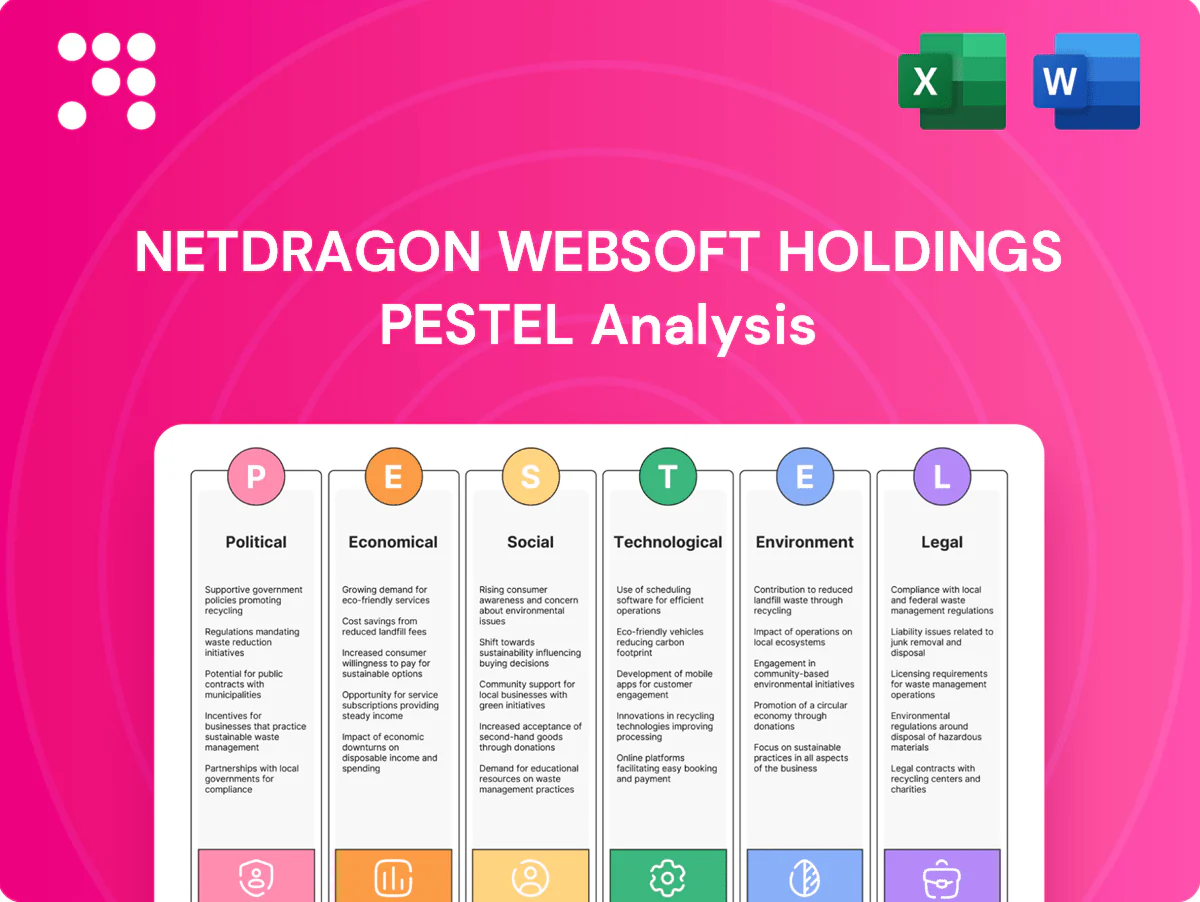
NetDragon Websoft Holdings PESTLE Analysis

Plan Smarter. Present Sharper. Compete Stronger.
Gain a competitive edge with our PESTLE analysis of NetDragon Websoft Holdings—clear insights on political, economic, social, technological, legal and environmental drivers shaping its future. Buy the full report for actionable, ready-to-use intelligence.
Political factors

China game approval regime
China’s licensing process and strict content controls frequently delay NetDragon launches and constrain pipeline timing, with regulatory review cycles often stretching several months and occasional multi-month approval pauses since 2018. Quota-driven approvals and review pauses compress revenue timing and force marketing plan reworks, affecting forecast reliability. Aligning content and compliance reduces rejection risk but increases pre-launch lead time and development costs. Diversifying titles and overseas markets hedges approval volatility and softens China-centric revenue risk.
Edtech policy priorities
Post-2021 tutoring reforms removed profit-making K‑12 tutoring for core subjects and precipitated revenue declines exceeding 50% among major listed tutoring firms, shifting demand toward public-interest digital education. Government procurement and city-level pilot programs have created scaling channels and have enrolled millions in state-backed platforms. Alignment with national curriculum standards and teacher enablement is essential, while regional funding cycles and policy variance determine adoption speed.

US‑China geopolitics
Since US export controls announced Oct 7, 2022, and subsequent 2023–25 measures, restrictions on high‑end chips, cloud access and AI tool imports have raised cross‑border uncertainty for NetDragon, potentially constraining R&D and deployment. Enhanced investment scrutiny—via CFIUS/FIRRMA frameworks and similar foreign review regimes—means overseas M&A and partnerships need deeper due diligence. Growing sanctions and political risks make reputation and political risk management strategic priorities.

Data sovereignty & localization
China’s 2021 Personal Information Protection Law and Data Security Law enforce local hosting, CAC security reviews for cross‑border transfers and tight controls on important data since 2022; education data (about 167 million compulsory‑education students in 2023) is treated as highly sensitive. Architecture must separate regional clouds and pipelines, raising operating complexity and costs but improving regulator trust.
- Regulation: PIPL & DSL (2021) + CAC cross‑border reviews (since 2022)
- Scope: ~167M compulsory education students (2023)
- Action: regional clouds & separate pipelines
- Impact: higher infra complexity, greater regulatory trust
Subsidies & digital infrastructure
Public funding for digital education and rural connectivity can catalyze adoption, supported by China’s 1.05 billion internet users reported in 2023 and ongoing Digital China/education modernization drives; alignment with smart‑campus and VR lab pilots that map to national strategies enhances tender success. Incentives for domestic tech stacks lower import reliance, while irregular program cadence reduces revenue visibility for vendors.
- Funding impact: higher bid win rates
- Strategic fit: smart‑campus/VR favored
- Risk: program cadence → cashflow volatility
Regulatory, tutoring and export controls delay launches and increase costs
Regulatory controls (PIPL/DSL 2021; CAC cross‑border reviews since 2022) and content licensing delays compress launch timing and raise costs. 2021 tutoring curbs cut sector revenues >50% for major firms, shifting demand to public digital education and procurement. US export controls (from Oct 7, 2022) and chip/cloud limits heighten supply/R&D risk. Data rules affect ~167M compulsory students and 1.05B internet users (2023).
| Factor | Key data | Impact |
|---|---|---|
| Regulation | PIPL/DSL 2021; CAC reviews 2022+ | Longer approvals, higher compliance cost |
| Tutoring reform | Revenue drop >50% (peers) | Shift to public procurement |
| Export controls | Since Oct 7, 2022 | R&D/supply constraints |
| Data scope | 167M students; 1.05B users (2023) | Local hosting, higher infra cost |
What is included in the product
 Detailed Word Document
Provides a focused PESTLE assessment of NetDragon Websoft Holdings, examining Political, Economic, Social, Technological, Environmental and Legal forces shaping its China-centric gaming, education tech and international expansion strategies. Each dimension links trends and data to actionable risks and opportunities for executives, investors and strategists.

 Customizable Excel Spreadsheet
A concise PESTLE snapshot for NetDragon Websoft Holdings that distills regulatory, technological, economic and social risks into a presentation-ready slide, enabling quick alignment in meetings and easy annotation for regional or product-specific notes.
Economic factors

Consumer spending cycles
Discretionary game spending is sensitive to macro slowdowns in China and abroad, as seen when China recorded 5.2% GDP growth in 2023, which pressures in‑game purchases. Live‑ops events and diversified genres can stabilize ARPU. Education revenues are more budget‑driven and less cyclical but slower to ramp, so a balanced mix smooths cash flows.
FX and geographic mix
NetDragon reports revenue across multiple currencies, creating translation and transaction risk as FX moves across its gaming and education businesses. USD-denominated costs for cloud services, digital advertising and game engines can compress margins when the CNY weakens. The company uses natural hedges from diversified operations and formal hedging programs to mitigate volatility. Greater localization and onshore monetization can deepen non-CNY revenue streams.

Platform fees and distribution
App store commissions materially affect take rates: Apple typically charges 30% or 15% under its Small Business Program and for subscriptions after one year, Google Play charges 15% on the first $1M of revenue and 15% on many subscriptions, while PC channels like Steam use tiered cuts (commonly 30% down to 20% at volume). Direct channels, PC clients and web distribution bypass these fees and can boost gross margins. Shifting toward Education SaaS and subscriptions increases recurring revenue stability, and negotiating bundled procurement for schools or platforms can improve unit economics through lower per-user costs.

Talent and R&D intensity
AI, engine, and content teams create high fixed R&D costs at NetDragon, concentrating spend on algorithms and game/education engines and raising break-even for new titles and products.
Wage inflation and fierce competition for senior engineers push operating expenses higher, especially in Beijing/Guangzhou talent markets.
Reuse of IP and internal toolchains raises productivity and margins; capitalizing development costs requires matching spend to hit-driven revenue risk.
- Fixed-cost R&D
- Talent-driven opex pressure
- IP/toolchain productivity
- Capitalization vs hit-risk
Cloud and CDN costs
Latency‑sensitive games and rich‑media classrooms demand sub‑50 ms round‑trip latency and sustained bandwidth; video already comprised about 82% of global IP traffic in 2022 (Cisco VNI), driving spikes in usage‑based cloud/CDN bills as concurrency and video uptake rise.
- Usage pressure: video = 82% of IP traffic (Cisco VNI 2022)
- Latency target: <50 ms for responsive gameplay/interactive classes
- Cost mitigations: multi‑cloud, edge and predictive scaling cut unit costs and overprovisioning
Regulatory, tutoring and export controls delay launches and increase costs
Discretionary gaming spend is cyclical—China GDP grew 5.2% in 2023—pressuring in‑game monetization; Education SaaS offers steadier, slower revenue. FX and USD‑costs (cloud/ads) compress margins when CNY weakens; app‑store fees (Apple 30/15, Google ~15) hit take‑rates. Video/latency drive cloud/CDN usage—Cisco VNI reports 82% of IP traffic was video in 2022.
| Metric | Value |
|---|---|
| China GDP (2023) | 5.2% |
| Global games market (2024) | $197B (Newzoo) |
| Video share (2022) | 82% (Cisco VNI) |
| App store cuts | Apple 30/15, Google ~15% |
What You See Is What You Get
NetDragon Websoft Holdings PESTLE Analysis
The NetDragon Websoft Holdings PESTLE Analysis preview shown here is the exact document you’ll receive after purchase—fully formatted and ready to use. It contains the complete political, economic, social, technological, legal, and environmental assessment as presented. No placeholders or edits are needed; this is the final file for immediate download.

Plan Smarter. Present Sharper. Compete Stronger.
Gain a competitive edge with our PESTLE analysis of NetDragon Websoft Holdings—clear insights on political, economic, social, technological, legal and environmental drivers shaping its future. Buy the full report for actionable, ready-to-use intelligence.
Political factors
China game approval regime
China’s licensing process and strict content controls frequently delay NetDragon launches and constrain pipeline timing, with regulatory review cycles often stretching several months and occasional multi-month approval pauses since 2018. Quota-driven approvals and review pauses compress revenue timing and force marketing plan reworks, affecting forecast reliability. Aligning content and compliance reduces rejection risk but increases pre-launch lead time and development costs. Diversifying titles and overseas markets hedges approval volatility and softens China-centric revenue risk.
Edtech policy priorities
Post-2021 tutoring reforms removed profit-making K‑12 tutoring for core subjects and precipitated revenue declines exceeding 50% among major listed tutoring firms, shifting demand toward public-interest digital education. Government procurement and city-level pilot programs have created scaling channels and have enrolled millions in state-backed platforms. Alignment with national curriculum standards and teacher enablement is essential, while regional funding cycles and policy variance determine adoption speed.
US‑China geopolitics
Since US export controls announced Oct 7, 2022, and subsequent 2023–25 measures, restrictions on high‑end chips, cloud access and AI tool imports have raised cross‑border uncertainty for NetDragon, potentially constraining R&D and deployment. Enhanced investment scrutiny—via CFIUS/FIRRMA frameworks and similar foreign review regimes—means overseas M&A and partnerships need deeper due diligence. Growing sanctions and political risks make reputation and political risk management strategic priorities.
Data sovereignty & localization
China’s 2021 Personal Information Protection Law and Data Security Law enforce local hosting, CAC security reviews for cross‑border transfers and tight controls on important data since 2022; education data (about 167 million compulsory‑education students in 2023) is treated as highly sensitive. Architecture must separate regional clouds and pipelines, raising operating complexity and costs but improving regulator trust.
- Regulation: PIPL & DSL (2021) + CAC cross‑border reviews (since 2022)
- Scope: ~167M compulsory education students (2023)
- Action: regional clouds & separate pipelines
- Impact: higher infra complexity, greater regulatory trust
Subsidies & digital infrastructure
Public funding for digital education and rural connectivity can catalyze adoption, supported by China’s 1.05 billion internet users reported in 2023 and ongoing Digital China/education modernization drives; alignment with smart‑campus and VR lab pilots that map to national strategies enhances tender success. Incentives for domestic tech stacks lower import reliance, while irregular program cadence reduces revenue visibility for vendors.
- Funding impact: higher bid win rates
- Strategic fit: smart‑campus/VR favored
- Risk: program cadence → cashflow volatility
Regulatory, tutoring and export controls delay launches and increase costs
Regulatory controls (PIPL/DSL 2021; CAC cross‑border reviews since 2022) and content licensing delays compress launch timing and raise costs. 2021 tutoring curbs cut sector revenues >50% for major firms, shifting demand to public digital education and procurement. US export controls (from Oct 7, 2022) and chip/cloud limits heighten supply/R&D risk. Data rules affect ~167M compulsory students and 1.05B internet users (2023).
| Factor | Key data | Impact |
|---|---|---|
| Regulation | PIPL/DSL 2021; CAC reviews 2022+ | Longer approvals, higher compliance cost |
| Tutoring reform | Revenue drop >50% (peers) | Shift to public procurement |
| Export controls | Since Oct 7, 2022 | R&D/supply constraints |
| Data scope | 167M students; 1.05B users (2023) | Local hosting, higher infra cost |
What is included in the product
Detailed Word Document
Provides a focused PESTLE assessment of NetDragon Websoft Holdings, examining Political, Economic, Social, Technological, Environmental and Legal forces shaping its China-centric gaming, education tech and international expansion strategies. Each dimension links trends and data to actionable risks and opportunities for executives, investors and strategists.
Customizable Excel Spreadsheet
A concise PESTLE snapshot for NetDragon Websoft Holdings that distills regulatory, technological, economic and social risks into a presentation-ready slide, enabling quick alignment in meetings and easy annotation for regional or product-specific notes.
Economic factors
Consumer spending cycles
Discretionary game spending is sensitive to macro slowdowns in China and abroad, as seen when China recorded 5.2% GDP growth in 2023, which pressures in‑game purchases. Live‑ops events and diversified genres can stabilize ARPU. Education revenues are more budget‑driven and less cyclical but slower to ramp, so a balanced mix smooths cash flows.
FX and geographic mix
NetDragon reports revenue across multiple currencies, creating translation and transaction risk as FX moves across its gaming and education businesses. USD-denominated costs for cloud services, digital advertising and game engines can compress margins when the CNY weakens. The company uses natural hedges from diversified operations and formal hedging programs to mitigate volatility. Greater localization and onshore monetization can deepen non-CNY revenue streams.
Platform fees and distribution
App store commissions materially affect take rates: Apple typically charges 30% or 15% under its Small Business Program and for subscriptions after one year, Google Play charges 15% on the first $1M of revenue and 15% on many subscriptions, while PC channels like Steam use tiered cuts (commonly 30% down to 20% at volume). Direct channels, PC clients and web distribution bypass these fees and can boost gross margins. Shifting toward Education SaaS and subscriptions increases recurring revenue stability, and negotiating bundled procurement for schools or platforms can improve unit economics through lower per-user costs.
Talent and R&D intensity
AI, engine, and content teams create high fixed R&D costs at NetDragon, concentrating spend on algorithms and game/education engines and raising break-even for new titles and products.
Wage inflation and fierce competition for senior engineers push operating expenses higher, especially in Beijing/Guangzhou talent markets.
Reuse of IP and internal toolchains raises productivity and margins; capitalizing development costs requires matching spend to hit-driven revenue risk.
- Fixed-cost R&D
- Talent-driven opex pressure
- IP/toolchain productivity
- Capitalization vs hit-risk
Cloud and CDN costs
Latency‑sensitive games and rich‑media classrooms demand sub‑50 ms round‑trip latency and sustained bandwidth; video already comprised about 82% of global IP traffic in 2022 (Cisco VNI), driving spikes in usage‑based cloud/CDN bills as concurrency and video uptake rise.
- Usage pressure: video = 82% of IP traffic (Cisco VNI 2022)
- Latency target: <50 ms for responsive gameplay/interactive classes
- Cost mitigations: multi‑cloud, edge and predictive scaling cut unit costs and overprovisioning
Regulatory, tutoring and export controls delay launches and increase costs
Discretionary gaming spend is cyclical—China GDP grew 5.2% in 2023—pressuring in‑game monetization; Education SaaS offers steadier, slower revenue. FX and USD‑costs (cloud/ads) compress margins when CNY weakens; app‑store fees (Apple 30/15, Google ~15) hit take‑rates. Video/latency drive cloud/CDN usage—Cisco VNI reports 82% of IP traffic was video in 2022.
| Metric | Value |
|---|---|
| China GDP (2023) | 5.2% |
| Global games market (2024) | $197B (Newzoo) |
| Video share (2022) | 82% (Cisco VNI) |
| App store cuts | Apple 30/15, Google ~15% |
What You See Is What You Get
NetDragon Websoft Holdings PESTLE Analysis
The NetDragon Websoft Holdings PESTLE Analysis preview shown here is the exact document you’ll receive after purchase—fully formatted and ready to use. It contains the complete political, economic, social, technological, legal, and environmental assessment as presented. No placeholders or edits are needed; this is the final file for immediate download.
Original: $10.00
-65%$10.00
$3.50Description
Plan Smarter. Present Sharper. Compete Stronger.
Gain a competitive edge with our PESTLE analysis of NetDragon Websoft Holdings—clear insights on political, economic, social, technological, legal and environmental drivers shaping its future. Buy the full report for actionable, ready-to-use intelligence.
Political factors
China game approval regime
China’s licensing process and strict content controls frequently delay NetDragon launches and constrain pipeline timing, with regulatory review cycles often stretching several months and occasional multi-month approval pauses since 2018. Quota-driven approvals and review pauses compress revenue timing and force marketing plan reworks, affecting forecast reliability. Aligning content and compliance reduces rejection risk but increases pre-launch lead time and development costs. Diversifying titles and overseas markets hedges approval volatility and softens China-centric revenue risk.
Edtech policy priorities
Post-2021 tutoring reforms removed profit-making K‑12 tutoring for core subjects and precipitated revenue declines exceeding 50% among major listed tutoring firms, shifting demand toward public-interest digital education. Government procurement and city-level pilot programs have created scaling channels and have enrolled millions in state-backed platforms. Alignment with national curriculum standards and teacher enablement is essential, while regional funding cycles and policy variance determine adoption speed.
US‑China geopolitics
Since US export controls announced Oct 7, 2022, and subsequent 2023–25 measures, restrictions on high‑end chips, cloud access and AI tool imports have raised cross‑border uncertainty for NetDragon, potentially constraining R&D and deployment. Enhanced investment scrutiny—via CFIUS/FIRRMA frameworks and similar foreign review regimes—means overseas M&A and partnerships need deeper due diligence. Growing sanctions and political risks make reputation and political risk management strategic priorities.
Data sovereignty & localization
China’s 2021 Personal Information Protection Law and Data Security Law enforce local hosting, CAC security reviews for cross‑border transfers and tight controls on important data since 2022; education data (about 167 million compulsory‑education students in 2023) is treated as highly sensitive. Architecture must separate regional clouds and pipelines, raising operating complexity and costs but improving regulator trust.
- Regulation: PIPL & DSL (2021) + CAC cross‑border reviews (since 2022)
- Scope: ~167M compulsory education students (2023)
- Action: regional clouds & separate pipelines
- Impact: higher infra complexity, greater regulatory trust
Subsidies & digital infrastructure
Public funding for digital education and rural connectivity can catalyze adoption, supported by China’s 1.05 billion internet users reported in 2023 and ongoing Digital China/education modernization drives; alignment with smart‑campus and VR lab pilots that map to national strategies enhances tender success. Incentives for domestic tech stacks lower import reliance, while irregular program cadence reduces revenue visibility for vendors.
- Funding impact: higher bid win rates
- Strategic fit: smart‑campus/VR favored
- Risk: program cadence → cashflow volatility
Regulatory, tutoring and export controls delay launches and increase costs
Regulatory controls (PIPL/DSL 2021; CAC cross‑border reviews since 2022) and content licensing delays compress launch timing and raise costs. 2021 tutoring curbs cut sector revenues >50% for major firms, shifting demand to public digital education and procurement. US export controls (from Oct 7, 2022) and chip/cloud limits heighten supply/R&D risk. Data rules affect ~167M compulsory students and 1.05B internet users (2023).
| Factor | Key data | Impact |
|---|---|---|
| Regulation | PIPL/DSL 2021; CAC reviews 2022+ | Longer approvals, higher compliance cost |
| Tutoring reform | Revenue drop >50% (peers) | Shift to public procurement |
| Export controls | Since Oct 7, 2022 | R&D/supply constraints |
| Data scope | 167M students; 1.05B users (2023) | Local hosting, higher infra cost |
What is included in the product
Detailed Word Document
Provides a focused PESTLE assessment of NetDragon Websoft Holdings, examining Political, Economic, Social, Technological, Environmental and Legal forces shaping its China-centric gaming, education tech and international expansion strategies. Each dimension links trends and data to actionable risks and opportunities for executives, investors and strategists.
Customizable Excel Spreadsheet
A concise PESTLE snapshot for NetDragon Websoft Holdings that distills regulatory, technological, economic and social risks into a presentation-ready slide, enabling quick alignment in meetings and easy annotation for regional or product-specific notes.
Economic factors
Consumer spending cycles
Discretionary game spending is sensitive to macro slowdowns in China and abroad, as seen when China recorded 5.2% GDP growth in 2023, which pressures in‑game purchases. Live‑ops events and diversified genres can stabilize ARPU. Education revenues are more budget‑driven and less cyclical but slower to ramp, so a balanced mix smooths cash flows.
FX and geographic mix
NetDragon reports revenue across multiple currencies, creating translation and transaction risk as FX moves across its gaming and education businesses. USD-denominated costs for cloud services, digital advertising and game engines can compress margins when the CNY weakens. The company uses natural hedges from diversified operations and formal hedging programs to mitigate volatility. Greater localization and onshore monetization can deepen non-CNY revenue streams.
Platform fees and distribution
App store commissions materially affect take rates: Apple typically charges 30% or 15% under its Small Business Program and for subscriptions after one year, Google Play charges 15% on the first $1M of revenue and 15% on many subscriptions, while PC channels like Steam use tiered cuts (commonly 30% down to 20% at volume). Direct channels, PC clients and web distribution bypass these fees and can boost gross margins. Shifting toward Education SaaS and subscriptions increases recurring revenue stability, and negotiating bundled procurement for schools or platforms can improve unit economics through lower per-user costs.
Talent and R&D intensity
AI, engine, and content teams create high fixed R&D costs at NetDragon, concentrating spend on algorithms and game/education engines and raising break-even for new titles and products.
Wage inflation and fierce competition for senior engineers push operating expenses higher, especially in Beijing/Guangzhou talent markets.
Reuse of IP and internal toolchains raises productivity and margins; capitalizing development costs requires matching spend to hit-driven revenue risk.
- Fixed-cost R&D
- Talent-driven opex pressure
- IP/toolchain productivity
- Capitalization vs hit-risk
Cloud and CDN costs
Latency‑sensitive games and rich‑media classrooms demand sub‑50 ms round‑trip latency and sustained bandwidth; video already comprised about 82% of global IP traffic in 2022 (Cisco VNI), driving spikes in usage‑based cloud/CDN bills as concurrency and video uptake rise.
- Usage pressure: video = 82% of IP traffic (Cisco VNI 2022)
- Latency target: <50 ms for responsive gameplay/interactive classes
- Cost mitigations: multi‑cloud, edge and predictive scaling cut unit costs and overprovisioning
Regulatory, tutoring and export controls delay launches and increase costs
Discretionary gaming spend is cyclical—China GDP grew 5.2% in 2023—pressuring in‑game monetization; Education SaaS offers steadier, slower revenue. FX and USD‑costs (cloud/ads) compress margins when CNY weakens; app‑store fees (Apple 30/15, Google ~15) hit take‑rates. Video/latency drive cloud/CDN usage—Cisco VNI reports 82% of IP traffic was video in 2022.
| Metric | Value |
|---|---|
| China GDP (2023) | 5.2% |
| Global games market (2024) | $197B (Newzoo) |
| Video share (2022) | 82% (Cisco VNI) |
| App store cuts | Apple 30/15, Google ~15% |
What You See Is What You Get
NetDragon Websoft Holdings PESTLE Analysis
The NetDragon Websoft Holdings PESTLE Analysis preview shown here is the exact document you’ll receive after purchase—fully formatted and ready to use. It contains the complete political, economic, social, technological, legal, and environmental assessment as presented. No placeholders or edits are needed; this is the final file for immediate download.











