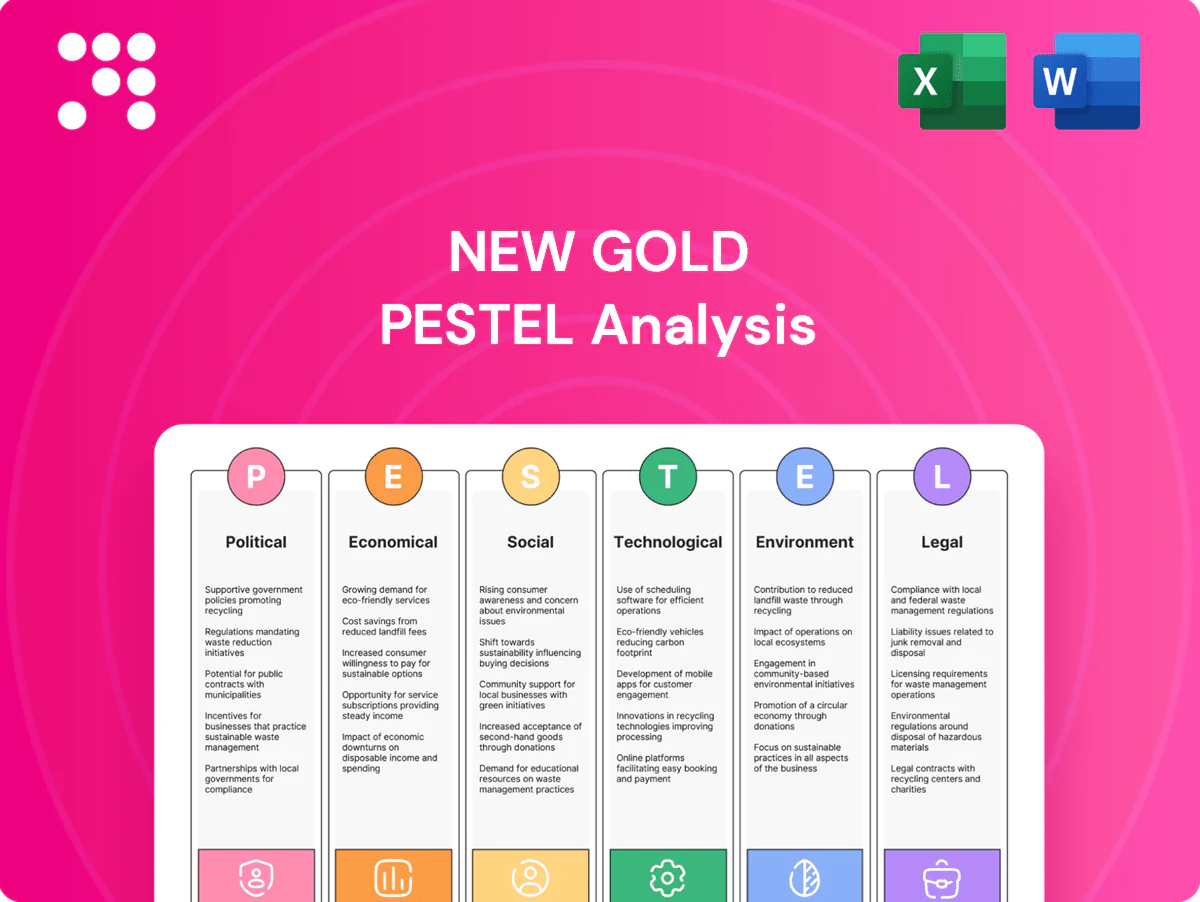
New Gold PESTLE Analysis

Make Smarter Strategic Decisions with a Complete PESTEL View
Discover how political shifts, commodity cycles, and environmental regulations are reshaping New Gold’s outlook in our concise PESTLE snapshot. This analysis highlights strategic risks and growth levers investors and planners need to know. Buy the full report for the complete, editable breakdown and actionable recommendations.
Political factors

Federal–provincial mining policy
Canada’s shared federal–provincial jurisdiction shapes permitting, royalties and oversight for New Gold’s Rainy River (Ontario) and New Afton (British Columbia) operations. Federal corporate tax is 15%, while provincial fiscal and royalty terms differ by province and can materially affect project timelines and costs. The federal Critical Minerals Strategy includes a CAD 3.8 billion support package, so evolving policy requires proactive government relations to anticipate changes.
Indigenous relations and IBAs
Strong partnerships and Impact Benefit Agreements with Indigenous Nations are essential for New Golds social licence to operate, aligning local employment and procurement goals with community priorities. Canada’s duty-to-consult, affirmed by the Supreme Court in Haida Nation v British Columbia (2004), shapes project amendments, expansions and access routes. Constructive engagement reduces litigation risk and delays and co-developed benefits bolster workforce stability and regional support; Indigenous people comprised 5% of Canada’s population in 2021.

Permitting timelines and approvals
Environmental assessments and amendments for New Gold projects can be resource-intensive and take one to several years, especially under Canada's Impact Assessment Act (in force since 2019). Clarity of scope, baseline data quality and breadth of stakeholder input materially affect approval speed and can create schedule risk. A political emphasis on environmental protection has tightened requirements at federal and provincial levels. Early, transparent filing and engagement can de-risk slippage.

Trade and export considerations
Gold and copper by-products are sold into global markets shaped by trade policy and sanctions; World Gold Council data show global gold demand ~4,100 tonnes in 2024, supporting robust bullion flows while sanctions (eg Russia) create regional dislocations. Canada maintains few formal export barriers for bullion and concentrates, but port and rail chokepoints can delay shipments. Currency controls in key markets alter timing and destination of sales; diversified offtake and multiple refining options improve resilience.
- Global gold demand 2024: ~4,100 tonnes (World Gold Council)
- Canada: minimal bullion/concentrate export controls
- Risk: port/rail logistics chokepoints
- Mitigation: diversified offtake and refining partners
Public infrastructure and regional support
Government investment in roads, power and broadband—notably Canada’s Investing in Canada Plan (CAD 180 billion through 2028) and the CAD 2.75 billion Universal Broadband Fund—directly affects New Gold’s operating reliability and unit costs, while northern and rural infrastructure programs improve mine uptime and supply-chain resilience.
- Infrastructure spend: CAD 180B plan
- Broadband fund: CAD 2.75B
- Benefit: higher uptime, lower transport/power costs
- Risk: political reallocation of regional funds
- Mitigation: engage in regional planning
15% federal tax, CAD 3.8B critical minerals fund and CAD 180B infrastructure reshape mine economics
Federal–provincial jurisdiction, 15% federal tax and province-specific royalties shape Rainy River and New Afton economics; CAD 3.8B Critical Minerals funding (federal) creates opportunities. Strong Impact Benefit Agreements and duty-to-consult reduce litigation risk; Indigenous people ~5% (2021). Infrastructure spend (CAD 180B) and broadband (CAD 2.75B) affect uptime and costs.
| Item | 2024/2025 |
|---|---|
| Gold demand | ~4,100 t (2024) |
| Federal tax | 15% |
| Critical Minerals | CAD 3.8B |
What is included in the product
 Detailed Word Document
Explores how political, economic, social, technological, environmental and legal forces uniquely impact New Gold, combining data-driven trends and region-specific regulatory context to reveal risks and opportunities. Designed for executives and investors, it includes forward-looking insights for scenario planning and strategic decision-making.

 Customizable Excel Spreadsheet
A concise, visually segmented PESTLE summary tailored to New Gold that streamlines meetings and presentations, supports quick external-risk discussion and decision-making, and is easily shareable and editable for team alignment or client reports.
Economic factors

Gold price volatility
Revenue is highly sensitive to spot and realized gold prices; New Gold's margins swing materially as spot gold moved from about $1,900/oz to roughly $2,300/oz between 2022 and July 2025, implying >20% variability. Macro drivers include inflation, central-bank rates and risk sentiment—Fed policy and CPI trends drove 2024–25 rallies. Hedging smooths cash flows but caps upside; scenario planning should stress-test margins at $1,600–1,800/oz decks.
Copper by-product leverage
New Afton’s copper output provides meaningful revenue diversification for New Gold, with by-product copper sales contributing significant credits to site economics. Copper prices closely track global growth, electrification demand and supply disruptions, driving cyclical upside. By-product credits materially lower AISC and improve resilience in weak gold markets. Correlated price moves can either buffer or amplify group earnings volatility.

CAD/USD exchange rate
New Gold incurs most operating costs in CAD while revenues track USD metal prices, with mid-2025 market FX around 1 USD = 1.35 CAD; a weaker CAD (higher USD/CAD) therefore boosts margins, a stronger CAD compresses them. FX hedging programs can blunt swings but add premium and operational complexity. Budget models should include sensitivity bands, e.g., ±5–10% FX scenarios tied to metal price shocks.

Inflation and input costs
Diesel, explosives, steel, reagents and contractor rates faced inflationary pressure; U.S. on‑highway diesel averaged about $3.95/gal in 2024 (EIA), increasing fuel-driven operating cost for New Gold. Supply‑chain tightness has extended lead times and working capital needs. Productivity programs and procurement scale reduce cost creep, while long‑term contracts stabilize key input pricing.
- Diesel: $3.95/gal (2024, EIA)
- Higher lead times → more WC
- Procurement scale offsets inflation
- Long‑term contracts stabilize inputs
Capital access and interest rates
Rising global policy rates — US federal funds 5.25–5.50% and Bank of Canada 5.00% (July 2025) — lift New Golds debt service and raise internal hurdle rates, tightening economics for expansions or pushbacks. Lender appetite now hinges on commodity outlook and ESG performance; maintaining liquidity and conservative leverage preserves strategic optionality, while transparent project economics secure better financing terms.
15% federal tax, CAD 3.8B critical minerals fund and CAD 180B infrastructure reshape mine economics
Revenue and margins track spot gold (~2,300/oz Jul 2025) and are sensitive to ±20% swings; hedging smooths but caps upside. New Afton copper diversifies revenue and provides by‑product credits, improving AISC resilience. Costs largely CAD while sales in USD (USD/CAD ≈1.35 Jul 2025), with diesel at $3.95/gal (2024 EIA) and policy rates US 5.25–5.50%/CA 5.00% (Jul 2025).
| Metric | Value | Note |
|---|---|---|
| Gold | $2,300/oz | Jul 2025 |
| USD/CAD | 1.35 | Jul 2025 |
| Diesel | $3.95/gal | 2024 EIA |
| Policy rates | US 5.25–5.50%, CA 5.00% | Jul 2025 |
Same Document Delivered
New Gold PESTLE Analysis
The preview shown here is the exact New Gold PESTLE Analysis document you’ll receive after purchase—fully formatted and ready to use. The content, layout and structure in this preview match the downloadable file with no placeholders. After payment you’ll instantly get this same final file.

Make Smarter Strategic Decisions with a Complete PESTEL View
Discover how political shifts, commodity cycles, and environmental regulations are reshaping New Gold’s outlook in our concise PESTLE snapshot. This analysis highlights strategic risks and growth levers investors and planners need to know. Buy the full report for the complete, editable breakdown and actionable recommendations.
Political factors
Federal–provincial mining policy
Canada’s shared federal–provincial jurisdiction shapes permitting, royalties and oversight for New Gold’s Rainy River (Ontario) and New Afton (British Columbia) operations. Federal corporate tax is 15%, while provincial fiscal and royalty terms differ by province and can materially affect project timelines and costs. The federal Critical Minerals Strategy includes a CAD 3.8 billion support package, so evolving policy requires proactive government relations to anticipate changes.
Indigenous relations and IBAs
Strong partnerships and Impact Benefit Agreements with Indigenous Nations are essential for New Golds social licence to operate, aligning local employment and procurement goals with community priorities. Canada’s duty-to-consult, affirmed by the Supreme Court in Haida Nation v British Columbia (2004), shapes project amendments, expansions and access routes. Constructive engagement reduces litigation risk and delays and co-developed benefits bolster workforce stability and regional support; Indigenous people comprised 5% of Canada’s population in 2021.
Permitting timelines and approvals
Environmental assessments and amendments for New Gold projects can be resource-intensive and take one to several years, especially under Canada's Impact Assessment Act (in force since 2019). Clarity of scope, baseline data quality and breadth of stakeholder input materially affect approval speed and can create schedule risk. A political emphasis on environmental protection has tightened requirements at federal and provincial levels. Early, transparent filing and engagement can de-risk slippage.
Trade and export considerations
Gold and copper by-products are sold into global markets shaped by trade policy and sanctions; World Gold Council data show global gold demand ~4,100 tonnes in 2024, supporting robust bullion flows while sanctions (eg Russia) create regional dislocations. Canada maintains few formal export barriers for bullion and concentrates, but port and rail chokepoints can delay shipments. Currency controls in key markets alter timing and destination of sales; diversified offtake and multiple refining options improve resilience.
- Global gold demand 2024: ~4,100 tonnes (World Gold Council)
- Canada: minimal bullion/concentrate export controls
- Risk: port/rail logistics chokepoints
- Mitigation: diversified offtake and refining partners
Public infrastructure and regional support
Government investment in roads, power and broadband—notably Canada’s Investing in Canada Plan (CAD 180 billion through 2028) and the CAD 2.75 billion Universal Broadband Fund—directly affects New Gold’s operating reliability and unit costs, while northern and rural infrastructure programs improve mine uptime and supply-chain resilience.
- Infrastructure spend: CAD 180B plan
- Broadband fund: CAD 2.75B
- Benefit: higher uptime, lower transport/power costs
- Risk: political reallocation of regional funds
- Mitigation: engage in regional planning
15% federal tax, CAD 3.8B critical minerals fund and CAD 180B infrastructure reshape mine economics
Federal–provincial jurisdiction, 15% federal tax and province-specific royalties shape Rainy River and New Afton economics; CAD 3.8B Critical Minerals funding (federal) creates opportunities. Strong Impact Benefit Agreements and duty-to-consult reduce litigation risk; Indigenous people ~5% (2021). Infrastructure spend (CAD 180B) and broadband (CAD 2.75B) affect uptime and costs.
| Item | 2024/2025 |
|---|---|
| Gold demand | ~4,100 t (2024) |
| Federal tax | 15% |
| Critical Minerals | CAD 3.8B |
What is included in the product
Detailed Word Document
Explores how political, economic, social, technological, environmental and legal forces uniquely impact New Gold, combining data-driven trends and region-specific regulatory context to reveal risks and opportunities. Designed for executives and investors, it includes forward-looking insights for scenario planning and strategic decision-making.
Customizable Excel Spreadsheet
A concise, visually segmented PESTLE summary tailored to New Gold that streamlines meetings and presentations, supports quick external-risk discussion and decision-making, and is easily shareable and editable for team alignment or client reports.
Economic factors
Gold price volatility
Revenue is highly sensitive to spot and realized gold prices; New Gold's margins swing materially as spot gold moved from about $1,900/oz to roughly $2,300/oz between 2022 and July 2025, implying >20% variability. Macro drivers include inflation, central-bank rates and risk sentiment—Fed policy and CPI trends drove 2024–25 rallies. Hedging smooths cash flows but caps upside; scenario planning should stress-test margins at $1,600–1,800/oz decks.
Copper by-product leverage
New Afton’s copper output provides meaningful revenue diversification for New Gold, with by-product copper sales contributing significant credits to site economics. Copper prices closely track global growth, electrification demand and supply disruptions, driving cyclical upside. By-product credits materially lower AISC and improve resilience in weak gold markets. Correlated price moves can either buffer or amplify group earnings volatility.
CAD/USD exchange rate
New Gold incurs most operating costs in CAD while revenues track USD metal prices, with mid-2025 market FX around 1 USD = 1.35 CAD; a weaker CAD (higher USD/CAD) therefore boosts margins, a stronger CAD compresses them. FX hedging programs can blunt swings but add premium and operational complexity. Budget models should include sensitivity bands, e.g., ±5–10% FX scenarios tied to metal price shocks.
Inflation and input costs
Diesel, explosives, steel, reagents and contractor rates faced inflationary pressure; U.S. on‑highway diesel averaged about $3.95/gal in 2024 (EIA), increasing fuel-driven operating cost for New Gold. Supply‑chain tightness has extended lead times and working capital needs. Productivity programs and procurement scale reduce cost creep, while long‑term contracts stabilize key input pricing.
- Diesel: $3.95/gal (2024, EIA)
- Higher lead times → more WC
- Procurement scale offsets inflation
- Long‑term contracts stabilize inputs
Capital access and interest rates
Rising global policy rates — US federal funds 5.25–5.50% and Bank of Canada 5.00% (July 2025) — lift New Golds debt service and raise internal hurdle rates, tightening economics for expansions or pushbacks. Lender appetite now hinges on commodity outlook and ESG performance; maintaining liquidity and conservative leverage preserves strategic optionality, while transparent project economics secure better financing terms.
15% federal tax, CAD 3.8B critical minerals fund and CAD 180B infrastructure reshape mine economics
Revenue and margins track spot gold (~2,300/oz Jul 2025) and are sensitive to ±20% swings; hedging smooths but caps upside. New Afton copper diversifies revenue and provides by‑product credits, improving AISC resilience. Costs largely CAD while sales in USD (USD/CAD ≈1.35 Jul 2025), with diesel at $3.95/gal (2024 EIA) and policy rates US 5.25–5.50%/CA 5.00% (Jul 2025).
| Metric | Value | Note |
|---|---|---|
| Gold | $2,300/oz | Jul 2025 |
| USD/CAD | 1.35 | Jul 2025 |
| Diesel | $3.95/gal | 2024 EIA |
| Policy rates | US 5.25–5.50%, CA 5.00% | Jul 2025 |
Same Document Delivered
New Gold PESTLE Analysis
The preview shown here is the exact New Gold PESTLE Analysis document you’ll receive after purchase—fully formatted and ready to use. The content, layout and structure in this preview match the downloadable file with no placeholders. After payment you’ll instantly get this same final file.
Description
Make Smarter Strategic Decisions with a Complete PESTEL View
Discover how political shifts, commodity cycles, and environmental regulations are reshaping New Gold’s outlook in our concise PESTLE snapshot. This analysis highlights strategic risks and growth levers investors and planners need to know. Buy the full report for the complete, editable breakdown and actionable recommendations.
Political factors
Federal–provincial mining policy
Canada’s shared federal–provincial jurisdiction shapes permitting, royalties and oversight for New Gold’s Rainy River (Ontario) and New Afton (British Columbia) operations. Federal corporate tax is 15%, while provincial fiscal and royalty terms differ by province and can materially affect project timelines and costs. The federal Critical Minerals Strategy includes a CAD 3.8 billion support package, so evolving policy requires proactive government relations to anticipate changes.
Indigenous relations and IBAs
Strong partnerships and Impact Benefit Agreements with Indigenous Nations are essential for New Golds social licence to operate, aligning local employment and procurement goals with community priorities. Canada’s duty-to-consult, affirmed by the Supreme Court in Haida Nation v British Columbia (2004), shapes project amendments, expansions and access routes. Constructive engagement reduces litigation risk and delays and co-developed benefits bolster workforce stability and regional support; Indigenous people comprised 5% of Canada’s population in 2021.
Permitting timelines and approvals
Environmental assessments and amendments for New Gold projects can be resource-intensive and take one to several years, especially under Canada's Impact Assessment Act (in force since 2019). Clarity of scope, baseline data quality and breadth of stakeholder input materially affect approval speed and can create schedule risk. A political emphasis on environmental protection has tightened requirements at federal and provincial levels. Early, transparent filing and engagement can de-risk slippage.
Trade and export considerations
Gold and copper by-products are sold into global markets shaped by trade policy and sanctions; World Gold Council data show global gold demand ~4,100 tonnes in 2024, supporting robust bullion flows while sanctions (eg Russia) create regional dislocations. Canada maintains few formal export barriers for bullion and concentrates, but port and rail chokepoints can delay shipments. Currency controls in key markets alter timing and destination of sales; diversified offtake and multiple refining options improve resilience.
- Global gold demand 2024: ~4,100 tonnes (World Gold Council)
- Canada: minimal bullion/concentrate export controls
- Risk: port/rail logistics chokepoints
- Mitigation: diversified offtake and refining partners
Public infrastructure and regional support
Government investment in roads, power and broadband—notably Canada’s Investing in Canada Plan (CAD 180 billion through 2028) and the CAD 2.75 billion Universal Broadband Fund—directly affects New Gold’s operating reliability and unit costs, while northern and rural infrastructure programs improve mine uptime and supply-chain resilience.
- Infrastructure spend: CAD 180B plan
- Broadband fund: CAD 2.75B
- Benefit: higher uptime, lower transport/power costs
- Risk: political reallocation of regional funds
- Mitigation: engage in regional planning
15% federal tax, CAD 3.8B critical minerals fund and CAD 180B infrastructure reshape mine economics
Federal–provincial jurisdiction, 15% federal tax and province-specific royalties shape Rainy River and New Afton economics; CAD 3.8B Critical Minerals funding (federal) creates opportunities. Strong Impact Benefit Agreements and duty-to-consult reduce litigation risk; Indigenous people ~5% (2021). Infrastructure spend (CAD 180B) and broadband (CAD 2.75B) affect uptime and costs.
| Item | 2024/2025 |
|---|---|
| Gold demand | ~4,100 t (2024) |
| Federal tax | 15% |
| Critical Minerals | CAD 3.8B |
What is included in the product
Detailed Word Document
Explores how political, economic, social, technological, environmental and legal forces uniquely impact New Gold, combining data-driven trends and region-specific regulatory context to reveal risks and opportunities. Designed for executives and investors, it includes forward-looking insights for scenario planning and strategic decision-making.
Customizable Excel Spreadsheet
A concise, visually segmented PESTLE summary tailored to New Gold that streamlines meetings and presentations, supports quick external-risk discussion and decision-making, and is easily shareable and editable for team alignment or client reports.
Economic factors
Gold price volatility
Revenue is highly sensitive to spot and realized gold prices; New Gold's margins swing materially as spot gold moved from about $1,900/oz to roughly $2,300/oz between 2022 and July 2025, implying >20% variability. Macro drivers include inflation, central-bank rates and risk sentiment—Fed policy and CPI trends drove 2024–25 rallies. Hedging smooths cash flows but caps upside; scenario planning should stress-test margins at $1,600–1,800/oz decks.
Copper by-product leverage
New Afton’s copper output provides meaningful revenue diversification for New Gold, with by-product copper sales contributing significant credits to site economics. Copper prices closely track global growth, electrification demand and supply disruptions, driving cyclical upside. By-product credits materially lower AISC and improve resilience in weak gold markets. Correlated price moves can either buffer or amplify group earnings volatility.
CAD/USD exchange rate
New Gold incurs most operating costs in CAD while revenues track USD metal prices, with mid-2025 market FX around 1 USD = 1.35 CAD; a weaker CAD (higher USD/CAD) therefore boosts margins, a stronger CAD compresses them. FX hedging programs can blunt swings but add premium and operational complexity. Budget models should include sensitivity bands, e.g., ±5–10% FX scenarios tied to metal price shocks.
Inflation and input costs
Diesel, explosives, steel, reagents and contractor rates faced inflationary pressure; U.S. on‑highway diesel averaged about $3.95/gal in 2024 (EIA), increasing fuel-driven operating cost for New Gold. Supply‑chain tightness has extended lead times and working capital needs. Productivity programs and procurement scale reduce cost creep, while long‑term contracts stabilize key input pricing.
- Diesel: $3.95/gal (2024, EIA)
- Higher lead times → more WC
- Procurement scale offsets inflation
- Long‑term contracts stabilize inputs
Capital access and interest rates
Rising global policy rates — US federal funds 5.25–5.50% and Bank of Canada 5.00% (July 2025) — lift New Golds debt service and raise internal hurdle rates, tightening economics for expansions or pushbacks. Lender appetite now hinges on commodity outlook and ESG performance; maintaining liquidity and conservative leverage preserves strategic optionality, while transparent project economics secure better financing terms.
15% federal tax, CAD 3.8B critical minerals fund and CAD 180B infrastructure reshape mine economics
Revenue and margins track spot gold (~2,300/oz Jul 2025) and are sensitive to ±20% swings; hedging smooths but caps upside. New Afton copper diversifies revenue and provides by‑product credits, improving AISC resilience. Costs largely CAD while sales in USD (USD/CAD ≈1.35 Jul 2025), with diesel at $3.95/gal (2024 EIA) and policy rates US 5.25–5.50%/CA 5.00% (Jul 2025).
| Metric | Value | Note |
|---|---|---|
| Gold | $2,300/oz | Jul 2025 |
| USD/CAD | 1.35 | Jul 2025 |
| Diesel | $3.95/gal | 2024 EIA |
| Policy rates | US 5.25–5.50%, CA 5.00% | Jul 2025 |
Same Document Delivered
New Gold PESTLE Analysis
The preview shown here is the exact New Gold PESTLE Analysis document you’ll receive after purchase—fully formatted and ready to use. The content, layout and structure in this preview match the downloadable file with no placeholders. After payment you’ll instantly get this same final file.











