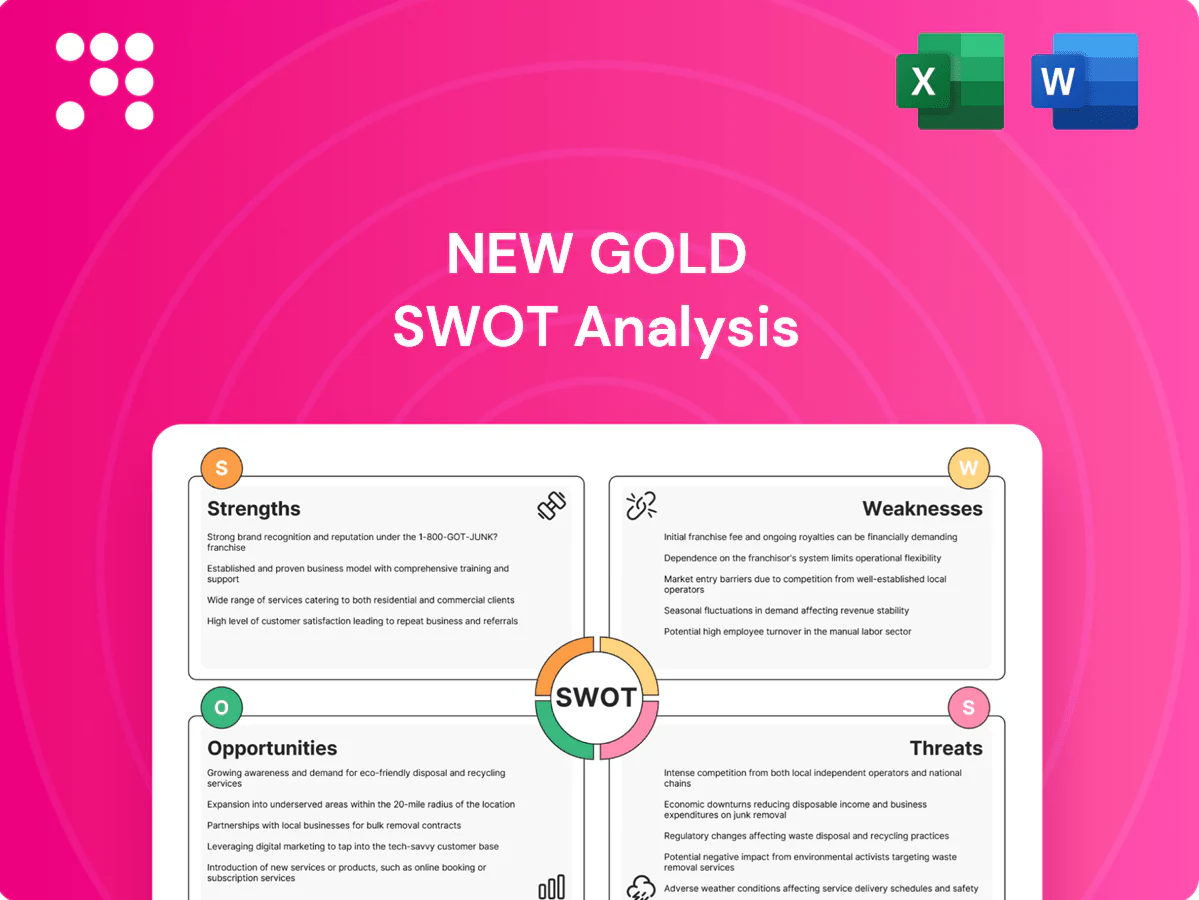
New Gold SWOT Analysis

Your Strategic Toolkit Starts Here
New Gold's SWOT highlights solid cash flow from diversified operations, reserve quality concerns, and exposure to metal price cycles. Management actions and ESG progress offer upside while geopolitical and operational risks may pressure margins. Purchase the full SWOT to get a research-backed, editable Word and Excel package with actionable investor recommendations.
Strengths

Canadian jurisdiction
Operating solely in Canada leverages a S&P AA+ sovereign rating (2025) and strong rule of law, delivering predictable permitting and lower sovereign risk that supports multi‑year mine planning and easier access to financing. This stability reduces investor country-risk premia and allows lower discount-rate assumptions. Proximity to established supply chains and logistics hubs in Ontario and BC improves input reliability and cost control.
Two producing mines
New Gold operates two producing mines, Rainy River (in production since 2017) and New Afton (since 2012), creating a balanced intermediate-scale base; multiple assets smooth operational variability and maintenance downtime, enhancing cash-flow resilience and mine-scheduling optionality while enabling shared technical expertise and procurement synergies.

Gold with copper credits
New Afton, New Gold’s copper-gold mine in British Columbia, generates copper by-product credits that materially offset gold AISC. With copper averaging about US$3.95/lb in 2024, these credits can trim unit gold costs and bolster margins. Multi-metal exposure diversifies revenue streams and supports free cash flow resilience when gold softens. It also attracts both gold and base-metal investors, broadening market interest.

Operational know-how
New Gold's operational know-how spans acquisition, exploration, development and operation, reducing execution risk across its Rainy River and New Afton mines. Established processes and site learnings have driven continuous improvements in recovery and throughput. Centralized technical teams transfer best practices between assets to support consistent performance and cost optimization.
- Two operating mines: Rainy River, New Afton
- Centralized technical teams enable knowledge transfer
- Ongoing recovery and throughput improvements
Responsible mining focus
New Gold's commitment to ESG and sustainable operations strengthens its social license to operate, with proactive stakeholder engagement helping expedite permitting and cut disruption risk; ESG-aligned firms attracted global capital pools exceeding $40 trillion by 2024 (Global Sustainable Investment Alliance). Strong environmental stewardship can lower regulatory friction and potential liabilities while appealing to responsible-investment mandates.
- ESG-driven permitting: faster approvals
- Lower regulatory risk: reduced liabilities
- Access to ESG capital: >$40T global AUM (2024)
- Stakeholder trust: fewer community disruptions
Canadian dual-mine platform reduces sovereign risk, smooths cash flow and attracts ESG capital
Operating solely in Canada (S&P AA+ sovereign, 2025) reduces sovereign risk and eases financing; two operating mines (Rainy River since 2017, New Afton since 2012) diversify production and smooth cash flow. Copper by‑product (avg US$3.95/lb in 2024) materially lowers gold AISC. ESG alignment taps >$40T sustainable AUM (2024), aiding permitting and investor access.
| Metric | Value |
|---|---|
| Mines | 2 |
| Sovereign rating | AA+ (2025) |
| Copper (2024) | US$3.95/lb |
| ESG AUM (2024) | >$40T |
What is included in the product
 Detailed Word Document
Provides a strategic overview of New Gold’s internal strengths and weaknesses and external opportunities and threats, highlighting operational capabilities, reserve base, cost structure, and key market, regulatory, and commodity-price risks to assess its competitive position and growth prospects.

 Customizable Excel Spreadsheet
Provides a concise, investor-focused SWOT matrix for New Gold that streamlines strategic alignment and risk assessment for fast, confident decision-making.
Weaknesses

Asset concentration
New Gold’s production and reserves are concentrated entirely in two Canadian operations—Rainy River and New Afton—meaning 100% of output hinges on these assets. Any prolonged disruption at either site can materially hit annual output and cash flow. Limited geographic diversification increases exposure to local regulatory, permitting or labour actions and constrains flexibility versus peers with multi-jurisdictional portfolios.
Grade & recovery variability
Open-pit and underground ore bodies at New Gold show grade volatility and metallurgical complexity that have driven quarterly production and cash-cost swings of up to ±20% versus block-model forecasts. Variance from models increased Rainy River and New Afton operating-cost pressure in recent quarters, requiring ongoing recovery optimization and capital programs (mill tweaks, reagent and metallurgical testwork). Misalignment with guidance undermines credibility and investor confidence.

Capital intensity
Capital intensity at New Gold requires steady funding for sustaining capital, tailings expansions and underground development, particularly in 2024–2025. Periodic capex spikes have compressed free cash flow and reduced balance sheet flexibility. Cost overruns or delays can erode project returns and heighten sensitivity to commodity prices and timing of cash inflows.

Mid-tier scale limits
New Gold’s intermediate scale — operating two commercial mines (Rainy River and New Afton) — limits bargaining power with suppliers and contractors compared with major peers and can translate into higher unit costs.
Smaller issuer status can constrain access to lowest-cost capital markets and project financing, raising required returns versus larger producers.
With a thinner internal pipeline for replacement projects and extensions, the company faces higher hurdles to sustain organic growth and long-term mine-life.
- Assets: two operating mines
- Scale impact: higher unit/service costs vs majors
- Capital access: comparatively pricier financing
- Pipeline: limited internal project depth
Commodity dependence
Revenue for New Gold is heavily concentrated in gold with only secondary exposure to copper, making cash flow highly sensitive to bullion prices.
Gold price downturns can rapidly compress margins and curb capital spending; hedging scope is often constrained by loan covenants and market liquidity, limiting downside protection.
Resulting earnings volatility complicates long-term planning and can depress valuation multiples during weak metal cycles.
- Commodity concentration: gold-focused revenue
- Price risk: margin and capex sensitivity
- Hedging limits: covenant and market constraints
- Volatility impact: planning and multiples
Canada-focused gold miner: single-country risk, grade variability and capital strain
New Gold’s weaknesses center on single-country concentration—two Canadian mines (Rainy River, New Afton)—creating operational, permitting and labour exposure and cash-flow risk. Metallurgical and grade variability has driven quarter-to-quarter production and cost swings, pressuring guidance credibility. Capital intensity and intermediate scale restrict financing terms, bargaining power and organic pipeline depth.
| Metric | Fact |
|---|---|
| Operating mines | 2 (Rainy River, New Afton) |
| Geography | Canada-only |
| Revenue mix | Gold-dominant |
| Scale | Intermediate; higher unit/service costs |
Same Document Delivered
New Gold SWOT Analysis
This is the actual New Gold SWOT analysis document you’ll receive upon purchase—no surprises, just professional quality. The preview below is taken directly from the full report you'll get, covering strengths, weaknesses, opportunities and threats. Purchase unlocks the complete, editable version ready for download and use immediately after checkout.

Your Strategic Toolkit Starts Here
New Gold's SWOT highlights solid cash flow from diversified operations, reserve quality concerns, and exposure to metal price cycles. Management actions and ESG progress offer upside while geopolitical and operational risks may pressure margins. Purchase the full SWOT to get a research-backed, editable Word and Excel package with actionable investor recommendations.
Strengths
Canadian jurisdiction
Operating solely in Canada leverages a S&P AA+ sovereign rating (2025) and strong rule of law, delivering predictable permitting and lower sovereign risk that supports multi‑year mine planning and easier access to financing. This stability reduces investor country-risk premia and allows lower discount-rate assumptions. Proximity to established supply chains and logistics hubs in Ontario and BC improves input reliability and cost control.
Two producing mines
New Gold operates two producing mines, Rainy River (in production since 2017) and New Afton (since 2012), creating a balanced intermediate-scale base; multiple assets smooth operational variability and maintenance downtime, enhancing cash-flow resilience and mine-scheduling optionality while enabling shared technical expertise and procurement synergies.
Gold with copper credits
New Afton, New Gold’s copper-gold mine in British Columbia, generates copper by-product credits that materially offset gold AISC. With copper averaging about US$3.95/lb in 2024, these credits can trim unit gold costs and bolster margins. Multi-metal exposure diversifies revenue streams and supports free cash flow resilience when gold softens. It also attracts both gold and base-metal investors, broadening market interest.
Operational know-how
New Gold's operational know-how spans acquisition, exploration, development and operation, reducing execution risk across its Rainy River and New Afton mines. Established processes and site learnings have driven continuous improvements in recovery and throughput. Centralized technical teams transfer best practices between assets to support consistent performance and cost optimization.
- Two operating mines: Rainy River, New Afton
- Centralized technical teams enable knowledge transfer
- Ongoing recovery and throughput improvements
Responsible mining focus
New Gold's commitment to ESG and sustainable operations strengthens its social license to operate, with proactive stakeholder engagement helping expedite permitting and cut disruption risk; ESG-aligned firms attracted global capital pools exceeding $40 trillion by 2024 (Global Sustainable Investment Alliance). Strong environmental stewardship can lower regulatory friction and potential liabilities while appealing to responsible-investment mandates.
- ESG-driven permitting: faster approvals
- Lower regulatory risk: reduced liabilities
- Access to ESG capital: >$40T global AUM (2024)
- Stakeholder trust: fewer community disruptions
Canadian dual-mine platform reduces sovereign risk, smooths cash flow and attracts ESG capital
Operating solely in Canada (S&P AA+ sovereign, 2025) reduces sovereign risk and eases financing; two operating mines (Rainy River since 2017, New Afton since 2012) diversify production and smooth cash flow. Copper by‑product (avg US$3.95/lb in 2024) materially lowers gold AISC. ESG alignment taps >$40T sustainable AUM (2024), aiding permitting and investor access.
| Metric | Value |
|---|---|
| Mines | 2 |
| Sovereign rating | AA+ (2025) |
| Copper (2024) | US$3.95/lb |
| ESG AUM (2024) | >$40T |
What is included in the product
Detailed Word Document
Provides a strategic overview of New Gold’s internal strengths and weaknesses and external opportunities and threats, highlighting operational capabilities, reserve base, cost structure, and key market, regulatory, and commodity-price risks to assess its competitive position and growth prospects.
Customizable Excel Spreadsheet
Provides a concise, investor-focused SWOT matrix for New Gold that streamlines strategic alignment and risk assessment for fast, confident decision-making.
Weaknesses
Asset concentration
New Gold’s production and reserves are concentrated entirely in two Canadian operations—Rainy River and New Afton—meaning 100% of output hinges on these assets. Any prolonged disruption at either site can materially hit annual output and cash flow. Limited geographic diversification increases exposure to local regulatory, permitting or labour actions and constrains flexibility versus peers with multi-jurisdictional portfolios.
Grade & recovery variability
Open-pit and underground ore bodies at New Gold show grade volatility and metallurgical complexity that have driven quarterly production and cash-cost swings of up to ±20% versus block-model forecasts. Variance from models increased Rainy River and New Afton operating-cost pressure in recent quarters, requiring ongoing recovery optimization and capital programs (mill tweaks, reagent and metallurgical testwork). Misalignment with guidance undermines credibility and investor confidence.
Capital intensity
Capital intensity at New Gold requires steady funding for sustaining capital, tailings expansions and underground development, particularly in 2024–2025. Periodic capex spikes have compressed free cash flow and reduced balance sheet flexibility. Cost overruns or delays can erode project returns and heighten sensitivity to commodity prices and timing of cash inflows.
Mid-tier scale limits
New Gold’s intermediate scale — operating two commercial mines (Rainy River and New Afton) — limits bargaining power with suppliers and contractors compared with major peers and can translate into higher unit costs.
Smaller issuer status can constrain access to lowest-cost capital markets and project financing, raising required returns versus larger producers.
With a thinner internal pipeline for replacement projects and extensions, the company faces higher hurdles to sustain organic growth and long-term mine-life.
- Assets: two operating mines
- Scale impact: higher unit/service costs vs majors
- Capital access: comparatively pricier financing
- Pipeline: limited internal project depth
Commodity dependence
Revenue for New Gold is heavily concentrated in gold with only secondary exposure to copper, making cash flow highly sensitive to bullion prices.
Gold price downturns can rapidly compress margins and curb capital spending; hedging scope is often constrained by loan covenants and market liquidity, limiting downside protection.
Resulting earnings volatility complicates long-term planning and can depress valuation multiples during weak metal cycles.
- Commodity concentration: gold-focused revenue
- Price risk: margin and capex sensitivity
- Hedging limits: covenant and market constraints
- Volatility impact: planning and multiples
Canada-focused gold miner: single-country risk, grade variability and capital strain
New Gold’s weaknesses center on single-country concentration—two Canadian mines (Rainy River, New Afton)—creating operational, permitting and labour exposure and cash-flow risk. Metallurgical and grade variability has driven quarter-to-quarter production and cost swings, pressuring guidance credibility. Capital intensity and intermediate scale restrict financing terms, bargaining power and organic pipeline depth.
| Metric | Fact |
|---|---|
| Operating mines | 2 (Rainy River, New Afton) |
| Geography | Canada-only |
| Revenue mix | Gold-dominant |
| Scale | Intermediate; higher unit/service costs |
Same Document Delivered
New Gold SWOT Analysis
This is the actual New Gold SWOT analysis document you’ll receive upon purchase—no surprises, just professional quality. The preview below is taken directly from the full report you'll get, covering strengths, weaknesses, opportunities and threats. Purchase unlocks the complete, editable version ready for download and use immediately after checkout.
Original: $10.00
-65%$10.00
$3.50Description
Your Strategic Toolkit Starts Here
New Gold's SWOT highlights solid cash flow from diversified operations, reserve quality concerns, and exposure to metal price cycles. Management actions and ESG progress offer upside while geopolitical and operational risks may pressure margins. Purchase the full SWOT to get a research-backed, editable Word and Excel package with actionable investor recommendations.
Strengths
Canadian jurisdiction
Operating solely in Canada leverages a S&P AA+ sovereign rating (2025) and strong rule of law, delivering predictable permitting and lower sovereign risk that supports multi‑year mine planning and easier access to financing. This stability reduces investor country-risk premia and allows lower discount-rate assumptions. Proximity to established supply chains and logistics hubs in Ontario and BC improves input reliability and cost control.
Two producing mines
New Gold operates two producing mines, Rainy River (in production since 2017) and New Afton (since 2012), creating a balanced intermediate-scale base; multiple assets smooth operational variability and maintenance downtime, enhancing cash-flow resilience and mine-scheduling optionality while enabling shared technical expertise and procurement synergies.
Gold with copper credits
New Afton, New Gold’s copper-gold mine in British Columbia, generates copper by-product credits that materially offset gold AISC. With copper averaging about US$3.95/lb in 2024, these credits can trim unit gold costs and bolster margins. Multi-metal exposure diversifies revenue streams and supports free cash flow resilience when gold softens. It also attracts both gold and base-metal investors, broadening market interest.
Operational know-how
New Gold's operational know-how spans acquisition, exploration, development and operation, reducing execution risk across its Rainy River and New Afton mines. Established processes and site learnings have driven continuous improvements in recovery and throughput. Centralized technical teams transfer best practices between assets to support consistent performance and cost optimization.
- Two operating mines: Rainy River, New Afton
- Centralized technical teams enable knowledge transfer
- Ongoing recovery and throughput improvements
Responsible mining focus
New Gold's commitment to ESG and sustainable operations strengthens its social license to operate, with proactive stakeholder engagement helping expedite permitting and cut disruption risk; ESG-aligned firms attracted global capital pools exceeding $40 trillion by 2024 (Global Sustainable Investment Alliance). Strong environmental stewardship can lower regulatory friction and potential liabilities while appealing to responsible-investment mandates.
- ESG-driven permitting: faster approvals
- Lower regulatory risk: reduced liabilities
- Access to ESG capital: >$40T global AUM (2024)
- Stakeholder trust: fewer community disruptions
Canadian dual-mine platform reduces sovereign risk, smooths cash flow and attracts ESG capital
Operating solely in Canada (S&P AA+ sovereign, 2025) reduces sovereign risk and eases financing; two operating mines (Rainy River since 2017, New Afton since 2012) diversify production and smooth cash flow. Copper by‑product (avg US$3.95/lb in 2024) materially lowers gold AISC. ESG alignment taps >$40T sustainable AUM (2024), aiding permitting and investor access.
| Metric | Value |
|---|---|
| Mines | 2 |
| Sovereign rating | AA+ (2025) |
| Copper (2024) | US$3.95/lb |
| ESG AUM (2024) | >$40T |
What is included in the product
Detailed Word Document
Provides a strategic overview of New Gold’s internal strengths and weaknesses and external opportunities and threats, highlighting operational capabilities, reserve base, cost structure, and key market, regulatory, and commodity-price risks to assess its competitive position and growth prospects.
Customizable Excel Spreadsheet
Provides a concise, investor-focused SWOT matrix for New Gold that streamlines strategic alignment and risk assessment for fast, confident decision-making.
Weaknesses
Asset concentration
New Gold’s production and reserves are concentrated entirely in two Canadian operations—Rainy River and New Afton—meaning 100% of output hinges on these assets. Any prolonged disruption at either site can materially hit annual output and cash flow. Limited geographic diversification increases exposure to local regulatory, permitting or labour actions and constrains flexibility versus peers with multi-jurisdictional portfolios.
Grade & recovery variability
Open-pit and underground ore bodies at New Gold show grade volatility and metallurgical complexity that have driven quarterly production and cash-cost swings of up to ±20% versus block-model forecasts. Variance from models increased Rainy River and New Afton operating-cost pressure in recent quarters, requiring ongoing recovery optimization and capital programs (mill tweaks, reagent and metallurgical testwork). Misalignment with guidance undermines credibility and investor confidence.
Capital intensity
Capital intensity at New Gold requires steady funding for sustaining capital, tailings expansions and underground development, particularly in 2024–2025. Periodic capex spikes have compressed free cash flow and reduced balance sheet flexibility. Cost overruns or delays can erode project returns and heighten sensitivity to commodity prices and timing of cash inflows.
Mid-tier scale limits
New Gold’s intermediate scale — operating two commercial mines (Rainy River and New Afton) — limits bargaining power with suppliers and contractors compared with major peers and can translate into higher unit costs.
Smaller issuer status can constrain access to lowest-cost capital markets and project financing, raising required returns versus larger producers.
With a thinner internal pipeline for replacement projects and extensions, the company faces higher hurdles to sustain organic growth and long-term mine-life.
- Assets: two operating mines
- Scale impact: higher unit/service costs vs majors
- Capital access: comparatively pricier financing
- Pipeline: limited internal project depth
Commodity dependence
Revenue for New Gold is heavily concentrated in gold with only secondary exposure to copper, making cash flow highly sensitive to bullion prices.
Gold price downturns can rapidly compress margins and curb capital spending; hedging scope is often constrained by loan covenants and market liquidity, limiting downside protection.
Resulting earnings volatility complicates long-term planning and can depress valuation multiples during weak metal cycles.
- Commodity concentration: gold-focused revenue
- Price risk: margin and capex sensitivity
- Hedging limits: covenant and market constraints
- Volatility impact: planning and multiples
Canada-focused gold miner: single-country risk, grade variability and capital strain
New Gold’s weaknesses center on single-country concentration—two Canadian mines (Rainy River, New Afton)—creating operational, permitting and labour exposure and cash-flow risk. Metallurgical and grade variability has driven quarter-to-quarter production and cost swings, pressuring guidance credibility. Capital intensity and intermediate scale restrict financing terms, bargaining power and organic pipeline depth.
| Metric | Fact |
|---|---|
| Operating mines | 2 (Rainy River, New Afton) |
| Geography | Canada-only |
| Revenue mix | Gold-dominant |
| Scale | Intermediate; higher unit/service costs |
Same Document Delivered
New Gold SWOT Analysis
This is the actual New Gold SWOT analysis document you’ll receive upon purchase—no surprises, just professional quality. The preview below is taken directly from the full report you'll get, covering strengths, weaknesses, opportunities and threats. Purchase unlocks the complete, editable version ready for download and use immediately after checkout.











