Nexi S.p.A. Porter's Five Forces Analysis

From Overview to Strategy Blueprint
Nexi S.p.A. faces intense rivalry and moderate supplier power within a fast-evolving European payments market, while regulatory scrutiny and digital disruption raise barriers and opportunities. Buyer power is significant among large merchants but scale and network effects protect incumbents. Threats from fintech entrants and substitutes are real but manageable with innovation. This brief snapshot only scratches the surface—unlock the full Porter's Five Forces Analysis to explore Nexi’s competitive dynamics in detail.
Suppliers Bargaining Power

Card networks’ fee leverage
Global schemes Visa and Mastercard account for over 80% of card scheme volume, setting interchange and network fees that largely flow through Nexi’s economics; in the EU interchange is capped at 0.2% for debit and 0.3% for credit. Nexi must follow scheme mandates and periodic certification cycles, limiting its negotiating levers. Diversification into local schemes and closed-loop rails only partly offsets this concentrated fee leverage.
Technology and cloud dependence
Nexi depends on hyperscale cloud, cybersecurity and payment-processing vendors, with hyperscalers holding the majority market share (AWS ~32%, Azure ~22%, GCP ~10% in 2024 per Synergy Research), making supplier leverage high; switching core tech is costly and risky due to certifications, uptime SLAs and complex migrations; vendors with superior security/resilience can command premiums; multi-vendor setups reduce but do not remove dependence.

POS hardware and connectivity
Terminal makers, SIM/telecom providers and gateway vendors drive POS device costs and uptime, with certification and logistics creating onboarding stickiness for Nexi; Android POS accounted for over 70% of new deployments in 2024, reducing supplier concentration. Multiple qualified hardware vendors and SIM providers limit single-supplier power, while Nexi’s scale and volume purchasing give it counter-leverage on pricing.

Data, fraud, and compliance tooling
Specialized KYC/AML, fraud scoring, and tokenization tools are critical for Nexi given its scale; Nexi reported pro forma 2023 revenues of €1.98bn. High switching costs arise from model retraining, integration, and regulatory validation, locking platforms to incumbents. Best-in-class providers extract value via measurable false-positive reductions and throughput gains, while in-house analytics development can gradually rebalance supplier power.
- Supplier lock-in: model retraining & regulatory revalidation
- Value extraction: performance differential drives pricing power
- Mitigation: in-house analytics reduces dependence over time
Bank partnerships as inputs
Bank issuing and processing mandates function as primary supply channels for Nexi, often driving 50–80% of acquiring volumes and shaping monthly TPV flows; banks can materially influence pricing, SLAs and integration priorities, while multi-year contracts (typically 3–7 years) stabilize margins but reduce flexibility. Joint ventures or exclusivity clauses can lock in scale and revenues yet constrain product agility and partner diversification.
- Bank volume dependence: 50–80%
- Contract length: 3–7 years
- Impact: pricing, SLAs, integrations
- JV/exclusivity: lock-in vs constraint
High supplier power: schemes >80%, interchange 0.2%/0.3%
Supplier power for Nexi is high: Visa/Mastercard drive >80% scheme volume with EU interchange caps 0.2%/0.3%, hyperscalers dominate cloud (AWS ~32%, Azure ~22%, GCP ~10% in 2024), and banks account for 50–80% acquiring volumes under 3–7 year contracts; Nexi pro forma 2023 revenues €1.98bn and Android POS ~70% of new deployments in 2024 partially mitigate risks.
| Metric | Value |
|---|---|
| Scheme share | >80% |
| EU interchange | 0.2%/0.3% |
| Cloud share (2024) | AWS 32%/Azure 22%/GCP 10% |
| Bank volume | 50–80% |
| Revenue (pro forma 2023) | €1.98bn |
What is included in the product
 Detailed Word Document
Uncovers key drivers of competition, customer influence, and market entry risks tailored to Nexi S.p.A., detailing supplier and buyer power, substitutes and disruptive threats that challenge market share, and barriers protecting incumbents—fully editable for reports, investor materials, and strategy decks.

 Customizable Excel Spreadsheet
Clear one-sheet Porter's Five Forces for Nexi S.p.A.—instantly highlights competitive pressures, regulatory risks and stakeholder bargaining power so decision-makers act fast.
Customers Bargaining Power

Large merchants negotiate hard
Large enterprise retailers and marketplaces use scale to push MDR and gateway fees down, with top merchants accounting for roughly 40% of Italian card acquiring volumes (2024), forcing Nexi to offer bespoke integrations, SLA credits and advanced omnichannel features. Multi-homing across PSPs—common among large merchants—intensifies price pressure and shifts retention to value-added services and routing optimization.
Banks and FIs have clout
Banks and FIs source issuing and processing via competitive RFPs—commonly 3–7 year contracts—where volume commitments amplify negotiating power. Contract length plus high volumes let clients extract fee concessions and, if economics shift, insource or switch providers, potentially pressuring fees by 50–150 basis points. Nexi leans on deep product roadmaps and compliance excellence to defend margins and limit client churn (under 5% reported in 2024).

SMEs are price-sensitive
SMEs, which represent about 99% of EU businesses, focus on headline MDR, terminal costs and settlement speed, with EU interchange caps at 0.2% for debit and 0.3% for credit shaping merchant expectations. Churn rises where onboarding is commoditized, while bundled invoicing/POS apps reduce price elasticity. Transparent pricing and rapid support measurably curb attrition.

Switching and multi-homing ease
Modern APIs and standardized integrations lower switching barriers, enabling merchants to multi-home and route transactions across PSPs to optimize cost and acceptance. This reduces lock-in and compresses take rates; Nexi reported pro forma revenues of about €2.5bn in 2023, highlighting scale but margin pressure from routing competition. Differentiation via acceptance breadth and advanced risk/fraud tools counters pricing pressure.
- APIs enable easy switching and multi-homing
- Merchant routing lowers PSP take rates
- Nexi pro forma revenues ~€2.5bn (2023)
- Acceptance breadth and risk tools = key defense
Demand for value-add
- Demand: analytics, loyalty, BNPL, alt-pay
- Risk: migration to niche providers
- Counter: cross-sell increases switching costs
- Driver: product velocity alters buyer power
Large merchants hold ≈40%; MDR caps debit 0.2% / credit 0.3%
Large merchants (≈40% of Italian acquiring volumes, 2024) and banks use scale/3–7yr RFPs to push fees—concessions of 50–150bps reported—while SMEs react to MDR caps (EU: debit 0.2%, credit 0.3%). APIs and routing enable multi-homing; Nexi pro forma revenues ≈€2.5bn (2023) but churn <5% (2024) due to cross-sell and risk tools.
| Metric | Value |
|---|---|
| Top merchant share | ≈40% |
| Nexi rev | ≈€2.5bn (2023) |
| Churn | <5% (2024) |
| Interchange caps | Debit 0.2% / Credit 0.3% |
Same Document Delivered
Nexi S.p.A. Porter's Five Forces Analysis
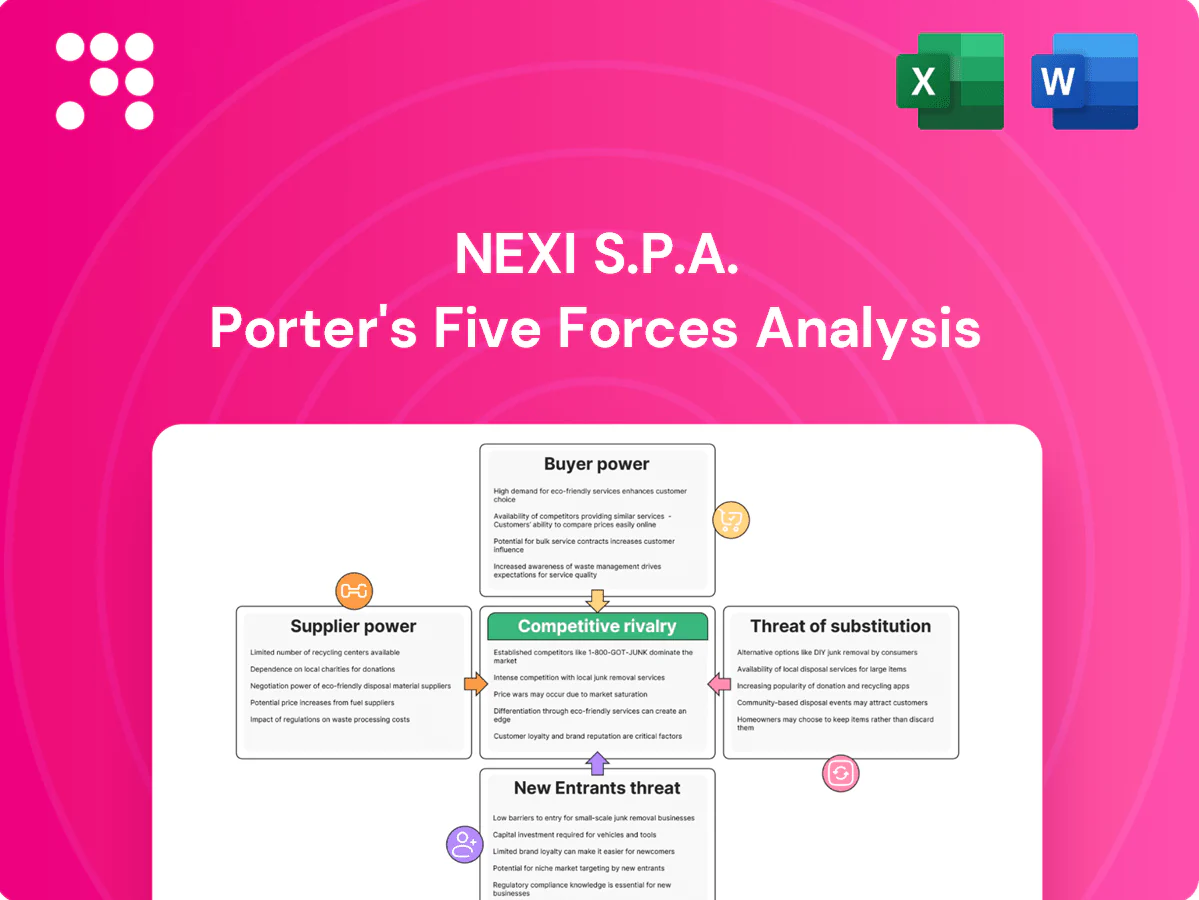
This preview shows the exact Porter's Five Forces analysis of Nexi S.p.A. you'll receive—no surprises, fully formatted. The report evaluates competitive rivalry, buyer and supplier power, and the threats of new entrants and substitutes, with strategic implications for Nexi's position in payments and fintech markets. You’ll get this exact file instantly after purchase.

From Overview to Strategy Blueprint
Nexi S.p.A. faces intense rivalry and moderate supplier power within a fast-evolving European payments market, while regulatory scrutiny and digital disruption raise barriers and opportunities. Buyer power is significant among large merchants but scale and network effects protect incumbents. Threats from fintech entrants and substitutes are real but manageable with innovation. This brief snapshot only scratches the surface—unlock the full Porter's Five Forces Analysis to explore Nexi’s competitive dynamics in detail.
Suppliers Bargaining Power
Card networks’ fee leverage
Global schemes Visa and Mastercard account for over 80% of card scheme volume, setting interchange and network fees that largely flow through Nexi’s economics; in the EU interchange is capped at 0.2% for debit and 0.3% for credit. Nexi must follow scheme mandates and periodic certification cycles, limiting its negotiating levers. Diversification into local schemes and closed-loop rails only partly offsets this concentrated fee leverage.
Technology and cloud dependence
Nexi depends on hyperscale cloud, cybersecurity and payment-processing vendors, with hyperscalers holding the majority market share (AWS ~32%, Azure ~22%, GCP ~10% in 2024 per Synergy Research), making supplier leverage high; switching core tech is costly and risky due to certifications, uptime SLAs and complex migrations; vendors with superior security/resilience can command premiums; multi-vendor setups reduce but do not remove dependence.
POS hardware and connectivity
Terminal makers, SIM/telecom providers and gateway vendors drive POS device costs and uptime, with certification and logistics creating onboarding stickiness for Nexi; Android POS accounted for over 70% of new deployments in 2024, reducing supplier concentration. Multiple qualified hardware vendors and SIM providers limit single-supplier power, while Nexi’s scale and volume purchasing give it counter-leverage on pricing.
Data, fraud, and compliance tooling
Specialized KYC/AML, fraud scoring, and tokenization tools are critical for Nexi given its scale; Nexi reported pro forma 2023 revenues of €1.98bn. High switching costs arise from model retraining, integration, and regulatory validation, locking platforms to incumbents. Best-in-class providers extract value via measurable false-positive reductions and throughput gains, while in-house analytics development can gradually rebalance supplier power.
- Supplier lock-in: model retraining & regulatory revalidation
- Value extraction: performance differential drives pricing power
- Mitigation: in-house analytics reduces dependence over time
Bank partnerships as inputs
Bank issuing and processing mandates function as primary supply channels for Nexi, often driving 50–80% of acquiring volumes and shaping monthly TPV flows; banks can materially influence pricing, SLAs and integration priorities, while multi-year contracts (typically 3–7 years) stabilize margins but reduce flexibility. Joint ventures or exclusivity clauses can lock in scale and revenues yet constrain product agility and partner diversification.
- Bank volume dependence: 50–80%
- Contract length: 3–7 years
- Impact: pricing, SLAs, integrations
- JV/exclusivity: lock-in vs constraint
High supplier power: schemes >80%, interchange 0.2%/0.3%
Supplier power for Nexi is high: Visa/Mastercard drive >80% scheme volume with EU interchange caps 0.2%/0.3%, hyperscalers dominate cloud (AWS ~32%, Azure ~22%, GCP ~10% in 2024), and banks account for 50–80% acquiring volumes under 3–7 year contracts; Nexi pro forma 2023 revenues €1.98bn and Android POS ~70% of new deployments in 2024 partially mitigate risks.
| Metric | Value |
|---|---|
| Scheme share | >80% |
| EU interchange | 0.2%/0.3% |
| Cloud share (2024) | AWS 32%/Azure 22%/GCP 10% |
| Bank volume | 50–80% |
| Revenue (pro forma 2023) | €1.98bn |
What is included in the product
Detailed Word Document
Uncovers key drivers of competition, customer influence, and market entry risks tailored to Nexi S.p.A., detailing supplier and buyer power, substitutes and disruptive threats that challenge market share, and barriers protecting incumbents—fully editable for reports, investor materials, and strategy decks.
Customizable Excel Spreadsheet
Clear one-sheet Porter's Five Forces for Nexi S.p.A.—instantly highlights competitive pressures, regulatory risks and stakeholder bargaining power so decision-makers act fast.
Customers Bargaining Power
Large merchants negotiate hard
Large enterprise retailers and marketplaces use scale to push MDR and gateway fees down, with top merchants accounting for roughly 40% of Italian card acquiring volumes (2024), forcing Nexi to offer bespoke integrations, SLA credits and advanced omnichannel features. Multi-homing across PSPs—common among large merchants—intensifies price pressure and shifts retention to value-added services and routing optimization.
Banks and FIs have clout
Banks and FIs source issuing and processing via competitive RFPs—commonly 3–7 year contracts—where volume commitments amplify negotiating power. Contract length plus high volumes let clients extract fee concessions and, if economics shift, insource or switch providers, potentially pressuring fees by 50–150 basis points. Nexi leans on deep product roadmaps and compliance excellence to defend margins and limit client churn (under 5% reported in 2024).
SMEs are price-sensitive
SMEs, which represent about 99% of EU businesses, focus on headline MDR, terminal costs and settlement speed, with EU interchange caps at 0.2% for debit and 0.3% for credit shaping merchant expectations. Churn rises where onboarding is commoditized, while bundled invoicing/POS apps reduce price elasticity. Transparent pricing and rapid support measurably curb attrition.
Switching and multi-homing ease
Modern APIs and standardized integrations lower switching barriers, enabling merchants to multi-home and route transactions across PSPs to optimize cost and acceptance. This reduces lock-in and compresses take rates; Nexi reported pro forma revenues of about €2.5bn in 2023, highlighting scale but margin pressure from routing competition. Differentiation via acceptance breadth and advanced risk/fraud tools counters pricing pressure.
- APIs enable easy switching and multi-homing
- Merchant routing lowers PSP take rates
- Nexi pro forma revenues ~€2.5bn (2023)
- Acceptance breadth and risk tools = key defense
Demand for value-add
- Demand: analytics, loyalty, BNPL, alt-pay
- Risk: migration to niche providers
- Counter: cross-sell increases switching costs
- Driver: product velocity alters buyer power
Large merchants hold ≈40%; MDR caps debit 0.2% / credit 0.3%
Large merchants (≈40% of Italian acquiring volumes, 2024) and banks use scale/3–7yr RFPs to push fees—concessions of 50–150bps reported—while SMEs react to MDR caps (EU: debit 0.2%, credit 0.3%). APIs and routing enable multi-homing; Nexi pro forma revenues ≈€2.5bn (2023) but churn <5% (2024) due to cross-sell and risk tools.
| Metric | Value |
|---|---|
| Top merchant share | ≈40% |
| Nexi rev | ≈€2.5bn (2023) |
| Churn | <5% (2024) |
| Interchange caps | Debit 0.2% / Credit 0.3% |
Same Document Delivered
Nexi S.p.A. Porter's Five Forces Analysis
This preview shows the exact Porter's Five Forces analysis of Nexi S.p.A. you'll receive—no surprises, fully formatted. The report evaluates competitive rivalry, buyer and supplier power, and the threats of new entrants and substitutes, with strategic implications for Nexi's position in payments and fintech markets. You’ll get this exact file instantly after purchase.
Original: $10.00
-65%$10.00
$3.50Description
From Overview to Strategy Blueprint
Nexi S.p.A. faces intense rivalry and moderate supplier power within a fast-evolving European payments market, while regulatory scrutiny and digital disruption raise barriers and opportunities. Buyer power is significant among large merchants but scale and network effects protect incumbents. Threats from fintech entrants and substitutes are real but manageable with innovation. This brief snapshot only scratches the surface—unlock the full Porter's Five Forces Analysis to explore Nexi’s competitive dynamics in detail.
Suppliers Bargaining Power
Card networks’ fee leverage
Global schemes Visa and Mastercard account for over 80% of card scheme volume, setting interchange and network fees that largely flow through Nexi’s economics; in the EU interchange is capped at 0.2% for debit and 0.3% for credit. Nexi must follow scheme mandates and periodic certification cycles, limiting its negotiating levers. Diversification into local schemes and closed-loop rails only partly offsets this concentrated fee leverage.
Technology and cloud dependence
Nexi depends on hyperscale cloud, cybersecurity and payment-processing vendors, with hyperscalers holding the majority market share (AWS ~32%, Azure ~22%, GCP ~10% in 2024 per Synergy Research), making supplier leverage high; switching core tech is costly and risky due to certifications, uptime SLAs and complex migrations; vendors with superior security/resilience can command premiums; multi-vendor setups reduce but do not remove dependence.
POS hardware and connectivity
Terminal makers, SIM/telecom providers and gateway vendors drive POS device costs and uptime, with certification and logistics creating onboarding stickiness for Nexi; Android POS accounted for over 70% of new deployments in 2024, reducing supplier concentration. Multiple qualified hardware vendors and SIM providers limit single-supplier power, while Nexi’s scale and volume purchasing give it counter-leverage on pricing.
Data, fraud, and compliance tooling
Specialized KYC/AML, fraud scoring, and tokenization tools are critical for Nexi given its scale; Nexi reported pro forma 2023 revenues of €1.98bn. High switching costs arise from model retraining, integration, and regulatory validation, locking platforms to incumbents. Best-in-class providers extract value via measurable false-positive reductions and throughput gains, while in-house analytics development can gradually rebalance supplier power.
- Supplier lock-in: model retraining & regulatory revalidation
- Value extraction: performance differential drives pricing power
- Mitigation: in-house analytics reduces dependence over time
Bank partnerships as inputs
Bank issuing and processing mandates function as primary supply channels for Nexi, often driving 50–80% of acquiring volumes and shaping monthly TPV flows; banks can materially influence pricing, SLAs and integration priorities, while multi-year contracts (typically 3–7 years) stabilize margins but reduce flexibility. Joint ventures or exclusivity clauses can lock in scale and revenues yet constrain product agility and partner diversification.
- Bank volume dependence: 50–80%
- Contract length: 3–7 years
- Impact: pricing, SLAs, integrations
- JV/exclusivity: lock-in vs constraint
High supplier power: schemes >80%, interchange 0.2%/0.3%
Supplier power for Nexi is high: Visa/Mastercard drive >80% scheme volume with EU interchange caps 0.2%/0.3%, hyperscalers dominate cloud (AWS ~32%, Azure ~22%, GCP ~10% in 2024), and banks account for 50–80% acquiring volumes under 3–7 year contracts; Nexi pro forma 2023 revenues €1.98bn and Android POS ~70% of new deployments in 2024 partially mitigate risks.
| Metric | Value |
|---|---|
| Scheme share | >80% |
| EU interchange | 0.2%/0.3% |
| Cloud share (2024) | AWS 32%/Azure 22%/GCP 10% |
| Bank volume | 50–80% |
| Revenue (pro forma 2023) | €1.98bn |
What is included in the product
Detailed Word Document
Uncovers key drivers of competition, customer influence, and market entry risks tailored to Nexi S.p.A., detailing supplier and buyer power, substitutes and disruptive threats that challenge market share, and barriers protecting incumbents—fully editable for reports, investor materials, and strategy decks.
Customizable Excel Spreadsheet
Clear one-sheet Porter's Five Forces for Nexi S.p.A.—instantly highlights competitive pressures, regulatory risks and stakeholder bargaining power so decision-makers act fast.
Customers Bargaining Power
Large merchants negotiate hard
Large enterprise retailers and marketplaces use scale to push MDR and gateway fees down, with top merchants accounting for roughly 40% of Italian card acquiring volumes (2024), forcing Nexi to offer bespoke integrations, SLA credits and advanced omnichannel features. Multi-homing across PSPs—common among large merchants—intensifies price pressure and shifts retention to value-added services and routing optimization.
Banks and FIs have clout
Banks and FIs source issuing and processing via competitive RFPs—commonly 3–7 year contracts—where volume commitments amplify negotiating power. Contract length plus high volumes let clients extract fee concessions and, if economics shift, insource or switch providers, potentially pressuring fees by 50–150 basis points. Nexi leans on deep product roadmaps and compliance excellence to defend margins and limit client churn (under 5% reported in 2024).
SMEs are price-sensitive
SMEs, which represent about 99% of EU businesses, focus on headline MDR, terminal costs and settlement speed, with EU interchange caps at 0.2% for debit and 0.3% for credit shaping merchant expectations. Churn rises where onboarding is commoditized, while bundled invoicing/POS apps reduce price elasticity. Transparent pricing and rapid support measurably curb attrition.
Switching and multi-homing ease
Modern APIs and standardized integrations lower switching barriers, enabling merchants to multi-home and route transactions across PSPs to optimize cost and acceptance. This reduces lock-in and compresses take rates; Nexi reported pro forma revenues of about €2.5bn in 2023, highlighting scale but margin pressure from routing competition. Differentiation via acceptance breadth and advanced risk/fraud tools counters pricing pressure.
- APIs enable easy switching and multi-homing
- Merchant routing lowers PSP take rates
- Nexi pro forma revenues ~€2.5bn (2023)
- Acceptance breadth and risk tools = key defense
Demand for value-add
- Demand: analytics, loyalty, BNPL, alt-pay
- Risk: migration to niche providers
- Counter: cross-sell increases switching costs
- Driver: product velocity alters buyer power
Large merchants hold ≈40%; MDR caps debit 0.2% / credit 0.3%
Large merchants (≈40% of Italian acquiring volumes, 2024) and banks use scale/3–7yr RFPs to push fees—concessions of 50–150bps reported—while SMEs react to MDR caps (EU: debit 0.2%, credit 0.3%). APIs and routing enable multi-homing; Nexi pro forma revenues ≈€2.5bn (2023) but churn <5% (2024) due to cross-sell and risk tools.
| Metric | Value |
|---|---|
| Top merchant share | ≈40% |
| Nexi rev | ≈€2.5bn (2023) |
| Churn | <5% (2024) |
| Interchange caps | Debit 0.2% / Credit 0.3% |
Same Document Delivered
Nexi S.p.A. Porter's Five Forces Analysis
This preview shows the exact Porter's Five Forces analysis of Nexi S.p.A. you'll receive—no surprises, fully formatted. The report evaluates competitive rivalry, buyer and supplier power, and the threats of new entrants and substitutes, with strategic implications for Nexi's position in payments and fintech markets. You’ll get this exact file instantly after purchase.











