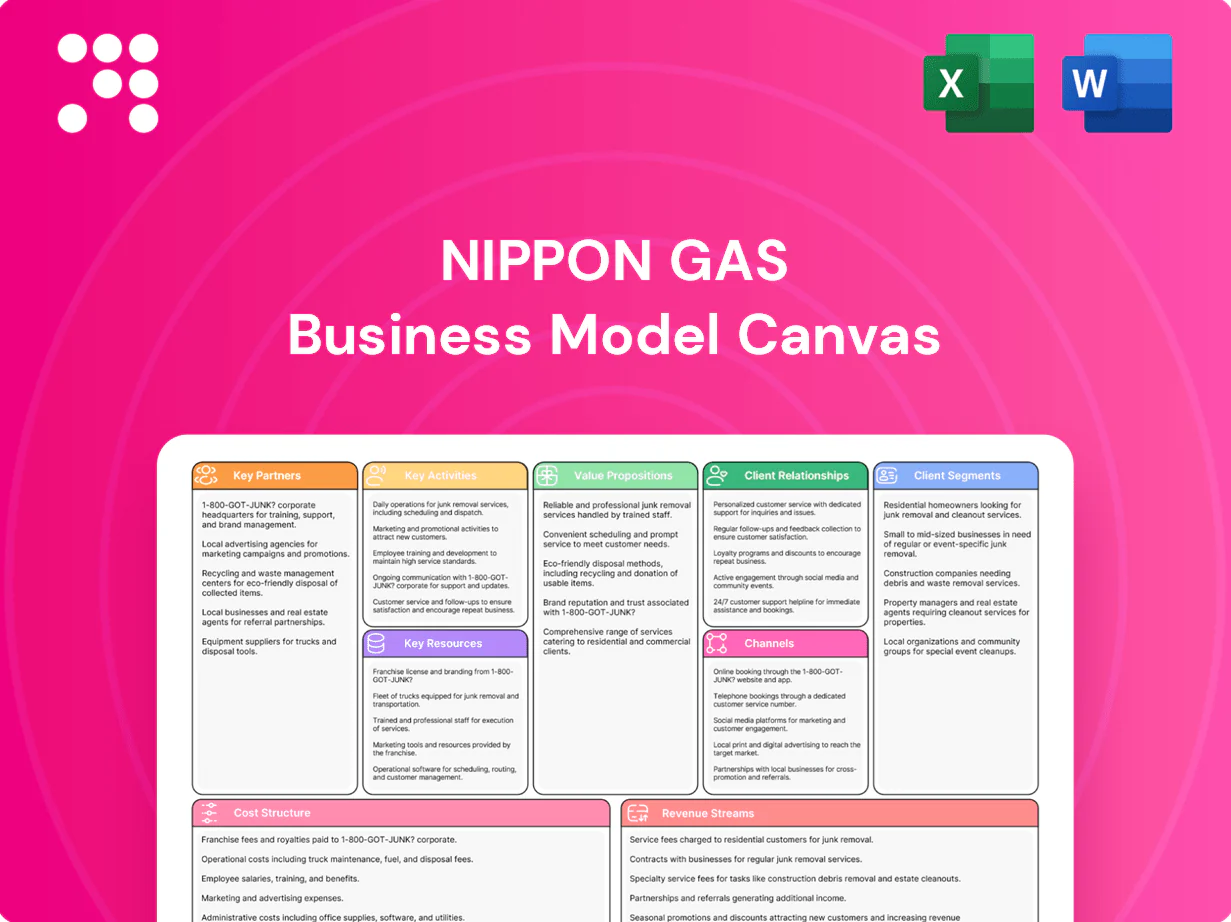
Nippon Gas Business Model Canvas

Unlock the business model canvas for a leading LPG and energy services company
Unlock the full strategic blueprint behind Nippon Gas’s business model with our in-depth Business Model Canvas. It maps value propositions, customer segments, key partners, channels and revenue streams in a single, actionable view. Ideal for investors, consultants and founders seeking competitive advantage. Download the editable Word/Excel canvas to accelerate your analysis and strategy.
Partnerships

LP gas producers and importers
In 2024 Nippon Gas secures reliable LP gas supply through long-term contracts with domestic and international producers, ensuring continuity of volumes. These partners provide contractual volume flexibility to manage seasonal demand spikes. Strategic sourcing and hedging programs help stabilize costs and mitigate commodity volatility. Collaboration also covers alignment on quality and safety standards with suppliers.
Pipeline operators and city gas utilities
Access to city gas for Nippon Gas hinges on pipeline infrastructure and interconnection agreements with operators and utilities, with joint protocols targeting pipeline uptime above 99% and pressure management within regulatory tolerances. Partnerships cover metering, compliant delivery and coordinated maintenance to minimize outages and protect service continuity. Co-marketing pilots in 2024 expanded regional customer reach by about 12%, improving load factor and reducing acquisition cost.

Power generators and wholesale markets
Electricity offerings rely on long-term contracts with generators and active participation in the Japan power exchange (JEPX) to secure supply within a national market that produced about 1,000 TWh in 2024. Diverse generation partners—thermal, nuclear, and renewables—balance cost, carbon intensity, and reliability across portfolios. Hedging via forward and spot purchases manages price risk, while demand response partners provide flexibility during peak events.

Equipment manufacturers and installers
Appliance OEMs and certified installers enable Nippon Gas to bundle meters, boilers, heaters and safety devices, supporting package sales across Japan (population ~125.5 million in 2024). Co-development with manufacturers drives energy-efficient units and integrated smart monitoring, while certified installers preserve compliance and warranty integrity; joint promotions increase retrofit and upgrade uptake.
- Bundling: meters+boilers+heaters+safety
- Co-dev: efficiency+IoT monitoring
- Installers: compliance & warranty
- Marketing: joint promotions to boost adoption
Regulators, municipalities, and ESG partners
Close engagement with regulators and municipalities ensures safety, pricing stability, and environmental compliance aligned with Japan’s 2030 target of a 46% GHG reduction; municipal ties strengthen disaster readiness and last-mile service in seismic zones. ESG alliances and carbon-offset providers (voluntary market ~US$2.5bn in 2024) bolster decarbonization, while academic and tech partners drive R&D on efficiency and grid integration.
- Regulators: policy alignment, safety
- Municipalities: disaster readiness, last-mile
- ESG partners: offsets, reporting
- Academia/tech: R&D, efficiency
Secure LPG contracts, >99% uptime and JEPX hedges power resilient, low-carbon cities
Nippon Gas secures LP gas via long-term contracts (volume flexibility) and hedges to stabilize costs; city-gas interconnects target >99% uptime. Electricity sourcing mixes thermal/nuclear/renewables via JEPX (Japan ~1,000 TWh in 2024) with forward hedges; appliance OEMs/installers drive retrofit uptake in a 125.5M population. ESG/municipal ties support disaster readiness and carbon programs (voluntary market ~US$2.5bn in 2024).
| Partner Type | 2024 KPI | Impact |
|---|---|---|
| Gas suppliers | Long-term contracts, flex volumes | Supply continuity |
| Pipeline operators | Uptime >99% | Service reliability |
| Generators/JEPX | Market ~1,000 TWh | Price & carbon balance |
| OEMs/installers | Retrofit growth +12% | Sales & efficiency |
| ESG partners | Voluntary market US$2.5bn | Decarbonization |
What is included in the product
 Detailed Word Document
A comprehensive Business Model Canvas for Nippon Gas detailing customer segments, channels, value propositions and the 9 BMC blocks with real-world operations, competitive advantages and linked SWOT/PESTLE insights—ideal for investor presentations, strategic planning and validation.

 Customizable Excel Spreadsheet
High-level, editable Business Model Canvas for Nippon Gas that quickly surfaces operational bottlenecks and strategic gaps, enabling teams to pinpoint and resolve supply, pricing, or distribution pain points. Perfect for collaborative workshops, board reviews, or rapid slide decks to streamline decision-making and save hours on formatting.
Activities

Procurement and supply portfolio management
Nippon Gas manages multi-source LP gas, city gas and power contracts, balancing long-term and spot volumes to optimize cost and reliability; industry spot procurement rose to about 25% in 2024 as buyers sought flexibility. Continuous hedging programs in 2024 reduced commodity and FX exposure across core volumes. Supplier performance is monitored with KPI-based audits for quality and safety.
Distribution, logistics, and last-mile delivery
LP cylinders, bulk deliveries and pipeline operations demand precise logistics to move millions of liters safely; industry route-optimization programs cut delivery mileage and related CO2 emissions by up to 20% (2024 studies). Fleet-management and telematics reduce operating costs 8–12% while improving on-time rates. Regular safety inspections and continuous leak-detection are standard; emergency-response readiness limits customer exposure and asset losses.

Metering, billing, and customer service
Accurate metering underpins fair billing and trust, supported by smart-meter penetration in Japan surpassing 90% by 2024 (METI), reducing estimation errors and revenue leakage. Billing systems consolidate multi-utility bundles and digital payments—cashless transactions reached roughly 40% of POS payments in 2024—simplifying reconciliation. Contact centers and self-service portals target sub-24-hour resolution and quick issue triage. Proactive SMS/email notifications improve transparency during outages or maintenance, cutting complaint rates.

Energy efficiency and solution deployment
Nippon Gas conducts audits and consultations that in 2024 pilot programs identified average energy savings of 14% for homes and SMEs. The firm installs high-efficiency appliances and smart controls, while data analytics continuously optimize consumption patterns and peak management. Ongoing education campaigns raise safe, sustainable use and uptake of retrofit measures.
- 2024 pilots: 14% average savings
- High-efficiency appliances + smart controls
- Analytics-driven load optimization
- Education campaigns for safe, sustainable use
Compliance, safety, and ESG management
Safety protocols cover storage, transport, and installation, with procedures aligned to ISO standards and emergency response plans. Regular training and third-party audits ensure regulatory adherence; ISSB IFRS S1/S2 adoption advanced in 2024, shaping disclosures. ESG reporting tracks emissions, waste, and community impact using scope 1–3 metrics. Continuous improvement programs use KPIs and PDCA cycles to steadily raise performance.
- ISO-aligned safety systems
- Quarterly training & audits
- IFRS S1/S2-informed ESG reporting (2024)
- Scope 1–3 emissions tracking
Procurement spot ~25%, hedging & logistics cut CO2 ~20%, meters >90%
Nippon Gas optimizes multi-source procurement (spot ~25% in 2024) with continuous hedging to cut commodity/FX exposure, while supplier KPIs ensure safety. Logistics use route optimization (CO2 ↓20%) and telematics (Opex ↓8–12%). Smart meters >90% (2024) enable accurate billing; efficiency pilots saved ~14%.
| Metric | 2024 |
|---|---|
| Spot procurement | ~25% |
| Smart-meter penetration | >90% |
| Fleet Opex reduction | 8–12% |
| Route CO2 reduction | ~20% |
| Efficiency pilot savings | ~14% |
Full Document Unlocks After Purchase
Business Model Canvas
The Nippon Gas Business Model Canvas preview you see is the actual deliverable, not a mockup. Upon purchase you'll receive this same complete document—formatted and editable—ready for presentation and analysis in Word and Excel. No placeholders, no surprises: what you preview is exactly what you'll download and use.

Unlock the business model canvas for a leading LPG and energy services company
Unlock the full strategic blueprint behind Nippon Gas’s business model with our in-depth Business Model Canvas. It maps value propositions, customer segments, key partners, channels and revenue streams in a single, actionable view. Ideal for investors, consultants and founders seeking competitive advantage. Download the editable Word/Excel canvas to accelerate your analysis and strategy.
Partnerships
LP gas producers and importers
In 2024 Nippon Gas secures reliable LP gas supply through long-term contracts with domestic and international producers, ensuring continuity of volumes. These partners provide contractual volume flexibility to manage seasonal demand spikes. Strategic sourcing and hedging programs help stabilize costs and mitigate commodity volatility. Collaboration also covers alignment on quality and safety standards with suppliers.
Pipeline operators and city gas utilities
Access to city gas for Nippon Gas hinges on pipeline infrastructure and interconnection agreements with operators and utilities, with joint protocols targeting pipeline uptime above 99% and pressure management within regulatory tolerances. Partnerships cover metering, compliant delivery and coordinated maintenance to minimize outages and protect service continuity. Co-marketing pilots in 2024 expanded regional customer reach by about 12%, improving load factor and reducing acquisition cost.
Power generators and wholesale markets
Electricity offerings rely on long-term contracts with generators and active participation in the Japan power exchange (JEPX) to secure supply within a national market that produced about 1,000 TWh in 2024. Diverse generation partners—thermal, nuclear, and renewables—balance cost, carbon intensity, and reliability across portfolios. Hedging via forward and spot purchases manages price risk, while demand response partners provide flexibility during peak events.
Equipment manufacturers and installers
Appliance OEMs and certified installers enable Nippon Gas to bundle meters, boilers, heaters and safety devices, supporting package sales across Japan (population ~125.5 million in 2024). Co-development with manufacturers drives energy-efficient units and integrated smart monitoring, while certified installers preserve compliance and warranty integrity; joint promotions increase retrofit and upgrade uptake.
- Bundling: meters+boilers+heaters+safety
- Co-dev: efficiency+IoT monitoring
- Installers: compliance & warranty
- Marketing: joint promotions to boost adoption
Regulators, municipalities, and ESG partners
Close engagement with regulators and municipalities ensures safety, pricing stability, and environmental compliance aligned with Japan’s 2030 target of a 46% GHG reduction; municipal ties strengthen disaster readiness and last-mile service in seismic zones. ESG alliances and carbon-offset providers (voluntary market ~US$2.5bn in 2024) bolster decarbonization, while academic and tech partners drive R&D on efficiency and grid integration.
- Regulators: policy alignment, safety
- Municipalities: disaster readiness, last-mile
- ESG partners: offsets, reporting
- Academia/tech: R&D, efficiency
Secure LPG contracts, >99% uptime and JEPX hedges power resilient, low-carbon cities
Nippon Gas secures LP gas via long-term contracts (volume flexibility) and hedges to stabilize costs; city-gas interconnects target >99% uptime. Electricity sourcing mixes thermal/nuclear/renewables via JEPX (Japan ~1,000 TWh in 2024) with forward hedges; appliance OEMs/installers drive retrofit uptake in a 125.5M population. ESG/municipal ties support disaster readiness and carbon programs (voluntary market ~US$2.5bn in 2024).
| Partner Type | 2024 KPI | Impact |
|---|---|---|
| Gas suppliers | Long-term contracts, flex volumes | Supply continuity |
| Pipeline operators | Uptime >99% | Service reliability |
| Generators/JEPX | Market ~1,000 TWh | Price & carbon balance |
| OEMs/installers | Retrofit growth +12% | Sales & efficiency |
| ESG partners | Voluntary market US$2.5bn | Decarbonization |
What is included in the product
Detailed Word Document
A comprehensive Business Model Canvas for Nippon Gas detailing customer segments, channels, value propositions and the 9 BMC blocks with real-world operations, competitive advantages and linked SWOT/PESTLE insights—ideal for investor presentations, strategic planning and validation.
Customizable Excel Spreadsheet
High-level, editable Business Model Canvas for Nippon Gas that quickly surfaces operational bottlenecks and strategic gaps, enabling teams to pinpoint and resolve supply, pricing, or distribution pain points. Perfect for collaborative workshops, board reviews, or rapid slide decks to streamline decision-making and save hours on formatting.
Activities
Procurement and supply portfolio management
Nippon Gas manages multi-source LP gas, city gas and power contracts, balancing long-term and spot volumes to optimize cost and reliability; industry spot procurement rose to about 25% in 2024 as buyers sought flexibility. Continuous hedging programs in 2024 reduced commodity and FX exposure across core volumes. Supplier performance is monitored with KPI-based audits for quality and safety.
Distribution, logistics, and last-mile delivery
LP cylinders, bulk deliveries and pipeline operations demand precise logistics to move millions of liters safely; industry route-optimization programs cut delivery mileage and related CO2 emissions by up to 20% (2024 studies). Fleet-management and telematics reduce operating costs 8–12% while improving on-time rates. Regular safety inspections and continuous leak-detection are standard; emergency-response readiness limits customer exposure and asset losses.
Metering, billing, and customer service
Accurate metering underpins fair billing and trust, supported by smart-meter penetration in Japan surpassing 90% by 2024 (METI), reducing estimation errors and revenue leakage. Billing systems consolidate multi-utility bundles and digital payments—cashless transactions reached roughly 40% of POS payments in 2024—simplifying reconciliation. Contact centers and self-service portals target sub-24-hour resolution and quick issue triage. Proactive SMS/email notifications improve transparency during outages or maintenance, cutting complaint rates.
Energy efficiency and solution deployment
Nippon Gas conducts audits and consultations that in 2024 pilot programs identified average energy savings of 14% for homes and SMEs. The firm installs high-efficiency appliances and smart controls, while data analytics continuously optimize consumption patterns and peak management. Ongoing education campaigns raise safe, sustainable use and uptake of retrofit measures.
- 2024 pilots: 14% average savings
- High-efficiency appliances + smart controls
- Analytics-driven load optimization
- Education campaigns for safe, sustainable use
Compliance, safety, and ESG management
Safety protocols cover storage, transport, and installation, with procedures aligned to ISO standards and emergency response plans. Regular training and third-party audits ensure regulatory adherence; ISSB IFRS S1/S2 adoption advanced in 2024, shaping disclosures. ESG reporting tracks emissions, waste, and community impact using scope 1–3 metrics. Continuous improvement programs use KPIs and PDCA cycles to steadily raise performance.
- ISO-aligned safety systems
- Quarterly training & audits
- IFRS S1/S2-informed ESG reporting (2024)
- Scope 1–3 emissions tracking
Procurement spot ~25%, hedging & logistics cut CO2 ~20%, meters >90%
Nippon Gas optimizes multi-source procurement (spot ~25% in 2024) with continuous hedging to cut commodity/FX exposure, while supplier KPIs ensure safety. Logistics use route optimization (CO2 ↓20%) and telematics (Opex ↓8–12%). Smart meters >90% (2024) enable accurate billing; efficiency pilots saved ~14%.
| Metric | 2024 |
|---|---|
| Spot procurement | ~25% |
| Smart-meter penetration | >90% |
| Fleet Opex reduction | 8–12% |
| Route CO2 reduction | ~20% |
| Efficiency pilot savings | ~14% |
Full Document Unlocks After Purchase
Business Model Canvas
The Nippon Gas Business Model Canvas preview you see is the actual deliverable, not a mockup. Upon purchase you'll receive this same complete document—formatted and editable—ready for presentation and analysis in Word and Excel. No placeholders, no surprises: what you preview is exactly what you'll download and use.
Description
Unlock the business model canvas for a leading LPG and energy services company
Unlock the full strategic blueprint behind Nippon Gas’s business model with our in-depth Business Model Canvas. It maps value propositions, customer segments, key partners, channels and revenue streams in a single, actionable view. Ideal for investors, consultants and founders seeking competitive advantage. Download the editable Word/Excel canvas to accelerate your analysis and strategy.
Partnerships
LP gas producers and importers
In 2024 Nippon Gas secures reliable LP gas supply through long-term contracts with domestic and international producers, ensuring continuity of volumes. These partners provide contractual volume flexibility to manage seasonal demand spikes. Strategic sourcing and hedging programs help stabilize costs and mitigate commodity volatility. Collaboration also covers alignment on quality and safety standards with suppliers.
Pipeline operators and city gas utilities
Access to city gas for Nippon Gas hinges on pipeline infrastructure and interconnection agreements with operators and utilities, with joint protocols targeting pipeline uptime above 99% and pressure management within regulatory tolerances. Partnerships cover metering, compliant delivery and coordinated maintenance to minimize outages and protect service continuity. Co-marketing pilots in 2024 expanded regional customer reach by about 12%, improving load factor and reducing acquisition cost.
Power generators and wholesale markets
Electricity offerings rely on long-term contracts with generators and active participation in the Japan power exchange (JEPX) to secure supply within a national market that produced about 1,000 TWh in 2024. Diverse generation partners—thermal, nuclear, and renewables—balance cost, carbon intensity, and reliability across portfolios. Hedging via forward and spot purchases manages price risk, while demand response partners provide flexibility during peak events.
Equipment manufacturers and installers
Appliance OEMs and certified installers enable Nippon Gas to bundle meters, boilers, heaters and safety devices, supporting package sales across Japan (population ~125.5 million in 2024). Co-development with manufacturers drives energy-efficient units and integrated smart monitoring, while certified installers preserve compliance and warranty integrity; joint promotions increase retrofit and upgrade uptake.
- Bundling: meters+boilers+heaters+safety
- Co-dev: efficiency+IoT monitoring
- Installers: compliance & warranty
- Marketing: joint promotions to boost adoption
Regulators, municipalities, and ESG partners
Close engagement with regulators and municipalities ensures safety, pricing stability, and environmental compliance aligned with Japan’s 2030 target of a 46% GHG reduction; municipal ties strengthen disaster readiness and last-mile service in seismic zones. ESG alliances and carbon-offset providers (voluntary market ~US$2.5bn in 2024) bolster decarbonization, while academic and tech partners drive R&D on efficiency and grid integration.
- Regulators: policy alignment, safety
- Municipalities: disaster readiness, last-mile
- ESG partners: offsets, reporting
- Academia/tech: R&D, efficiency
Secure LPG contracts, >99% uptime and JEPX hedges power resilient, low-carbon cities
Nippon Gas secures LP gas via long-term contracts (volume flexibility) and hedges to stabilize costs; city-gas interconnects target >99% uptime. Electricity sourcing mixes thermal/nuclear/renewables via JEPX (Japan ~1,000 TWh in 2024) with forward hedges; appliance OEMs/installers drive retrofit uptake in a 125.5M population. ESG/municipal ties support disaster readiness and carbon programs (voluntary market ~US$2.5bn in 2024).
| Partner Type | 2024 KPI | Impact |
|---|---|---|
| Gas suppliers | Long-term contracts, flex volumes | Supply continuity |
| Pipeline operators | Uptime >99% | Service reliability |
| Generators/JEPX | Market ~1,000 TWh | Price & carbon balance |
| OEMs/installers | Retrofit growth +12% | Sales & efficiency |
| ESG partners | Voluntary market US$2.5bn | Decarbonization |
What is included in the product
Detailed Word Document
A comprehensive Business Model Canvas for Nippon Gas detailing customer segments, channels, value propositions and the 9 BMC blocks with real-world operations, competitive advantages and linked SWOT/PESTLE insights—ideal for investor presentations, strategic planning and validation.
Customizable Excel Spreadsheet
High-level, editable Business Model Canvas for Nippon Gas that quickly surfaces operational bottlenecks and strategic gaps, enabling teams to pinpoint and resolve supply, pricing, or distribution pain points. Perfect for collaborative workshops, board reviews, or rapid slide decks to streamline decision-making and save hours on formatting.
Activities
Procurement and supply portfolio management
Nippon Gas manages multi-source LP gas, city gas and power contracts, balancing long-term and spot volumes to optimize cost and reliability; industry spot procurement rose to about 25% in 2024 as buyers sought flexibility. Continuous hedging programs in 2024 reduced commodity and FX exposure across core volumes. Supplier performance is monitored with KPI-based audits for quality and safety.
Distribution, logistics, and last-mile delivery
LP cylinders, bulk deliveries and pipeline operations demand precise logistics to move millions of liters safely; industry route-optimization programs cut delivery mileage and related CO2 emissions by up to 20% (2024 studies). Fleet-management and telematics reduce operating costs 8–12% while improving on-time rates. Regular safety inspections and continuous leak-detection are standard; emergency-response readiness limits customer exposure and asset losses.
Metering, billing, and customer service
Accurate metering underpins fair billing and trust, supported by smart-meter penetration in Japan surpassing 90% by 2024 (METI), reducing estimation errors and revenue leakage. Billing systems consolidate multi-utility bundles and digital payments—cashless transactions reached roughly 40% of POS payments in 2024—simplifying reconciliation. Contact centers and self-service portals target sub-24-hour resolution and quick issue triage. Proactive SMS/email notifications improve transparency during outages or maintenance, cutting complaint rates.
Energy efficiency and solution deployment
Nippon Gas conducts audits and consultations that in 2024 pilot programs identified average energy savings of 14% for homes and SMEs. The firm installs high-efficiency appliances and smart controls, while data analytics continuously optimize consumption patterns and peak management. Ongoing education campaigns raise safe, sustainable use and uptake of retrofit measures.
- 2024 pilots: 14% average savings
- High-efficiency appliances + smart controls
- Analytics-driven load optimization
- Education campaigns for safe, sustainable use
Compliance, safety, and ESG management
Safety protocols cover storage, transport, and installation, with procedures aligned to ISO standards and emergency response plans. Regular training and third-party audits ensure regulatory adherence; ISSB IFRS S1/S2 adoption advanced in 2024, shaping disclosures. ESG reporting tracks emissions, waste, and community impact using scope 1–3 metrics. Continuous improvement programs use KPIs and PDCA cycles to steadily raise performance.
- ISO-aligned safety systems
- Quarterly training & audits
- IFRS S1/S2-informed ESG reporting (2024)
- Scope 1–3 emissions tracking
Procurement spot ~25%, hedging & logistics cut CO2 ~20%, meters >90%
Nippon Gas optimizes multi-source procurement (spot ~25% in 2024) with continuous hedging to cut commodity/FX exposure, while supplier KPIs ensure safety. Logistics use route optimization (CO2 ↓20%) and telematics (Opex ↓8–12%). Smart meters >90% (2024) enable accurate billing; efficiency pilots saved ~14%.
| Metric | 2024 |
|---|---|
| Spot procurement | ~25% |
| Smart-meter penetration | >90% |
| Fleet Opex reduction | 8–12% |
| Route CO2 reduction | ~20% |
| Efficiency pilot savings | ~14% |
Full Document Unlocks After Purchase
Business Model Canvas
The Nippon Gas Business Model Canvas preview you see is the actual deliverable, not a mockup. Upon purchase you'll receive this same complete document—formatted and editable—ready for presentation and analysis in Word and Excel. No placeholders, no surprises: what you preview is exactly what you'll download and use.











