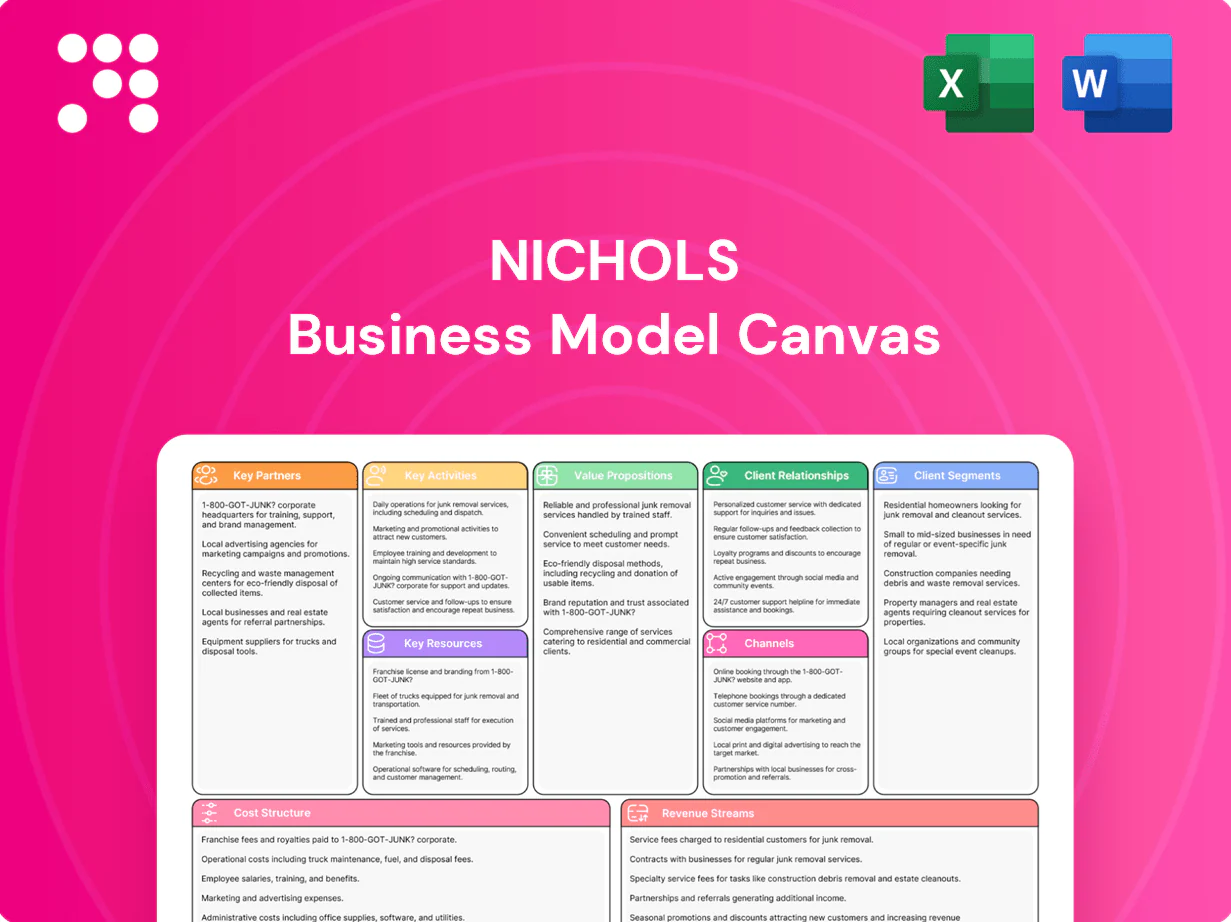
Nichols Business Model Canvas

Business Model Canvas: Create Value, Scale Distribution, Sustain Competitive Advantage
Discover how Nichols creates value, scales distribution, and sustains competitive advantage with our concise Business Model Canvas. This 9-block analysis maps customer segments, key partners, revenue streams and cost drivers in clear, actionable terms. Perfect for investors, consultants, and founders seeking a proven framework. Purchase the full, editable Canvas to benchmark strategy and accelerate decision-making.
Partnerships

Global and regional bottlers
As of 2024 Nichols leverages global and regional contract bottlers and co-packers to expand capacity across still, carbonated and canned formats, enabling rapid response to seasonal peaks and promotional spikes. Shared quality systems with these partners ensure product consistency across markets. These arrangements also drive cost optimization through scale and line-efficiency improvements.
Packaging and ingredient suppliers
Core inputs for Nichols—PET, aluminum cans, closures, cartons, sweeteners and flavor houses—drive packaging and COGS; global PET demand was roughly 30 million tonnes in 2024, keeping resin availability central to procurement. Strategic sourcing locks supply and hedges commodity volatility through forward contracts and index-linked buys. Joint innovation with suppliers yields new formats and reformulations, while sustainability collaboration focuses on reducing packaging weight and improving recyclability to meet circularity targets.

Route-to-market distributors and wholesalers
Route-to-market distributors and wholesalers extend Nichols reach into UK retail, convenience (around 47,000 convenience stores), and out-of-home channels and into international markets, aggregating demand and managing thousands of local relationships. They provide last-mile logistics and inventory management, with performance-based agreements tying fees to volume, mix and on-shelf availability. Real-time data sharing improves forecasting accuracy and service levels, reducing stockouts and promotional waste.

Out-of-home operators and system partners
- Partners: QSR, cinemas, pubs, leisure, contract caterers
- Contracts: long-term pour and equipment placements
- Activation: joint menu drives rate-of-sale
- Service: technical partners ensure uptime
Licensing and brand alliance partners
Licensors and licensees expand Nichols’ portfolio and geographic footprint by enabling brand entry through proven partners while preserving core product identity. Royalty frameworks tie payments to performance and include clauses enforcing brand standards and growth targets. Local partners adapt flavors and formats to cultural preferences and market trends, with compliance processes safeguarding brand equity and regulatory adherence.
- Licensing expands reach
- Royalties enforce standards
- Local adaptation boosts relevance
- Compliance protects equity
Contract bottlers, PET forward buys and distributors scale convenience & OOH reach
Nichols leverages contract bottlers/co-packers for peak capacity, secures PET (≈30,000,000 t global demand in 2024) via forward buys, uses distributors to reach ~47,000 UK convenience outlets, and locks OOH pour/equipment deals and licensing with royalty frameworks to protect brand standards.
| Partner | Role | 2024 metric | Contract |
|---|---|---|---|
| Bottlers | Capacity/quality | Peak flex | Co-pack |
| Suppliers | Inputs | PET 30M t | Forward buys |
| Distributors | Route-to-market | 47,000 stores | Performance fees |
| OOH | Placement | Long-term pours | Pour/equipment |
| Licensees | Market entry | Royalty-linked | Licensing |
What is included in the product
 Detailed Word Document
A comprehensive, pre-written Nichols Business Model Canvas organized into the nine classic BMC blocks with full narratives, value propositions, customer segments, channels and revenue streams, plus linked SWOT and competitive-advantage analysis to support validation, presentations, funding discussions and informed decision-making.

 Customizable Excel Spreadsheet
High-level editable one-page snapshot that condenses your company strategy into a clean, boardroom-ready layout. Saves hours of formatting and makes comparing multiple models or sharing actionable insights with teams fast and effortless.
Activities

Brand building and demand generation
Investing in Vimto and portfolio brands across ATL, digital and in-store drives awareness and trial through coordinated reach and experiential activations. Shopper marketing converts consideration at point-of-sale with targeted promos and merchandising. Occasion-led campaigns activate retail and out-of-home around seasonal moments. Performance analytics continually optimizes media mix and ROI.
Product and format innovation
R&D crafts new flavors, zero-sugar variants and limited editions while supporting exports to over 60 countries (2024). Packaging innovation covers PET, cans, multipacks and post-mix formats. Sensory testing and rapid prototyping de-risk launches through iterative consumer panels and pilot runs. Compliance and nutrition workstreams ensure regulatory readiness and label accuracy across markets.

Manufacturing and quality operations
Batching, filling and warehousing deliver consistent quality at scale while lean practices lift OEE from industry averages near 60% toward world-class ~85%, reducing waste and downtime. Rigorous QA/QC, full traceability and certifications like BRCGS or FSSC 22000 protect consumers. Continuous improvement programs drive lower unit costs and faster fill-to-ship service.

Route-to-market and logistics management
Integrated planning synchronizes demand, production and inventory, cutting stockouts below 3% and lifting forecast accuracy toward 90% in 2024. Transport and depot networks support c.95% on-shelf availability; distributor management drives c.98% outlet reach and execution consistency. Revenue growth management (price, promo, pack architecture) delivered a 3–5% net revenue uplift in 2024.
- Integrated planning: stockouts <3%, forecast ≈90%
- Logistics: on-shelf availability ≈95%
- Distributor reach: ≈98% outlets
- RGM impact: +3–5% net revenue (2024)
International and licensing management
Market selection and partner onboarding accelerate international expansion through targeted entry and fast ramp-up, while contracting, brand governance, and structured training safeguard consistency across territories. Localized activation ensures cultural relevance and retail resonance, supported by standard operating procedures and digital toolkits. Ongoing audits and joint business plans track delivery, compliance, and performance against KPIs.
- Market selection
- Partner onboarding
- Contracting & brand governance
- Localized activation
- Audits & joint business plans
Innovation, near-perfect availability and ~85% OEE drive +3–5% RGM uplift
Marketing drives awareness and trial via ATL, digital and shopper activations, supporting 95% on-shelf availability and c.98% outlet reach (2024).
R&D launches flavors, zero-sugar and packaging for 60+ export markets; sensory panels and pilots de-risk rollouts.
Operations target ~85% OEE, stockouts <3% and forecast accuracy ≈90%, delivering RGM uplift of +3–5% (2024).
| Metric | 2024 |
|---|---|
| Export markets | 60+ |
| On-shelf availability | ≈95% |
| Outlet reach | ≈98% |
| OEE | ~85% |
| Stockouts | <3% |
| Forecast accuracy | ≈90% |
| RGM uplift | +3–5% |
Full Version Awaits
Business Model Canvas
The Nichols Business Model Canvas previewed here is the actual deliverable, not a mockup or placeholder, and shows the same content and layout you’ll receive after purchase. When you complete your order you’ll get the full, editable file in the same professional format ready for presentation, editing, and sharing. No surprises—what you see is what you’ll own.

Business Model Canvas: Create Value, Scale Distribution, Sustain Competitive Advantage
Discover how Nichols creates value, scales distribution, and sustains competitive advantage with our concise Business Model Canvas. This 9-block analysis maps customer segments, key partners, revenue streams and cost drivers in clear, actionable terms. Perfect for investors, consultants, and founders seeking a proven framework. Purchase the full, editable Canvas to benchmark strategy and accelerate decision-making.
Partnerships
Global and regional bottlers
As of 2024 Nichols leverages global and regional contract bottlers and co-packers to expand capacity across still, carbonated and canned formats, enabling rapid response to seasonal peaks and promotional spikes. Shared quality systems with these partners ensure product consistency across markets. These arrangements also drive cost optimization through scale and line-efficiency improvements.
Packaging and ingredient suppliers
Core inputs for Nichols—PET, aluminum cans, closures, cartons, sweeteners and flavor houses—drive packaging and COGS; global PET demand was roughly 30 million tonnes in 2024, keeping resin availability central to procurement. Strategic sourcing locks supply and hedges commodity volatility through forward contracts and index-linked buys. Joint innovation with suppliers yields new formats and reformulations, while sustainability collaboration focuses on reducing packaging weight and improving recyclability to meet circularity targets.
Route-to-market distributors and wholesalers
Route-to-market distributors and wholesalers extend Nichols reach into UK retail, convenience (around 47,000 convenience stores), and out-of-home channels and into international markets, aggregating demand and managing thousands of local relationships. They provide last-mile logistics and inventory management, with performance-based agreements tying fees to volume, mix and on-shelf availability. Real-time data sharing improves forecasting accuracy and service levels, reducing stockouts and promotional waste.
Out-of-home operators and system partners
- Partners: QSR, cinemas, pubs, leisure, contract caterers
- Contracts: long-term pour and equipment placements
- Activation: joint menu drives rate-of-sale
- Service: technical partners ensure uptime
Licensing and brand alliance partners
Licensors and licensees expand Nichols’ portfolio and geographic footprint by enabling brand entry through proven partners while preserving core product identity. Royalty frameworks tie payments to performance and include clauses enforcing brand standards and growth targets. Local partners adapt flavors and formats to cultural preferences and market trends, with compliance processes safeguarding brand equity and regulatory adherence.
- Licensing expands reach
- Royalties enforce standards
- Local adaptation boosts relevance
- Compliance protects equity
Contract bottlers, PET forward buys and distributors scale convenience & OOH reach
Nichols leverages contract bottlers/co-packers for peak capacity, secures PET (≈30,000,000 t global demand in 2024) via forward buys, uses distributors to reach ~47,000 UK convenience outlets, and locks OOH pour/equipment deals and licensing with royalty frameworks to protect brand standards.
| Partner | Role | 2024 metric | Contract |
|---|---|---|---|
| Bottlers | Capacity/quality | Peak flex | Co-pack |
| Suppliers | Inputs | PET 30M t | Forward buys |
| Distributors | Route-to-market | 47,000 stores | Performance fees |
| OOH | Placement | Long-term pours | Pour/equipment |
| Licensees | Market entry | Royalty-linked | Licensing |
What is included in the product
Detailed Word Document
A comprehensive, pre-written Nichols Business Model Canvas organized into the nine classic BMC blocks with full narratives, value propositions, customer segments, channels and revenue streams, plus linked SWOT and competitive-advantage analysis to support validation, presentations, funding discussions and informed decision-making.
Customizable Excel Spreadsheet
High-level editable one-page snapshot that condenses your company strategy into a clean, boardroom-ready layout. Saves hours of formatting and makes comparing multiple models or sharing actionable insights with teams fast and effortless.
Activities
Brand building and demand generation
Investing in Vimto and portfolio brands across ATL, digital and in-store drives awareness and trial through coordinated reach and experiential activations. Shopper marketing converts consideration at point-of-sale with targeted promos and merchandising. Occasion-led campaigns activate retail and out-of-home around seasonal moments. Performance analytics continually optimizes media mix and ROI.
Product and format innovation
R&D crafts new flavors, zero-sugar variants and limited editions while supporting exports to over 60 countries (2024). Packaging innovation covers PET, cans, multipacks and post-mix formats. Sensory testing and rapid prototyping de-risk launches through iterative consumer panels and pilot runs. Compliance and nutrition workstreams ensure regulatory readiness and label accuracy across markets.
Manufacturing and quality operations
Batching, filling and warehousing deliver consistent quality at scale while lean practices lift OEE from industry averages near 60% toward world-class ~85%, reducing waste and downtime. Rigorous QA/QC, full traceability and certifications like BRCGS or FSSC 22000 protect consumers. Continuous improvement programs drive lower unit costs and faster fill-to-ship service.
Route-to-market and logistics management
Integrated planning synchronizes demand, production and inventory, cutting stockouts below 3% and lifting forecast accuracy toward 90% in 2024. Transport and depot networks support c.95% on-shelf availability; distributor management drives c.98% outlet reach and execution consistency. Revenue growth management (price, promo, pack architecture) delivered a 3–5% net revenue uplift in 2024.
- Integrated planning: stockouts <3%, forecast ≈90%
- Logistics: on-shelf availability ≈95%
- Distributor reach: ≈98% outlets
- RGM impact: +3–5% net revenue (2024)
International and licensing management
Market selection and partner onboarding accelerate international expansion through targeted entry and fast ramp-up, while contracting, brand governance, and structured training safeguard consistency across territories. Localized activation ensures cultural relevance and retail resonance, supported by standard operating procedures and digital toolkits. Ongoing audits and joint business plans track delivery, compliance, and performance against KPIs.
- Market selection
- Partner onboarding
- Contracting & brand governance
- Localized activation
- Audits & joint business plans
Innovation, near-perfect availability and ~85% OEE drive +3–5% RGM uplift
Marketing drives awareness and trial via ATL, digital and shopper activations, supporting 95% on-shelf availability and c.98% outlet reach (2024).
R&D launches flavors, zero-sugar and packaging for 60+ export markets; sensory panels and pilots de-risk rollouts.
Operations target ~85% OEE, stockouts <3% and forecast accuracy ≈90%, delivering RGM uplift of +3–5% (2024).
| Metric | 2024 |
|---|---|
| Export markets | 60+ |
| On-shelf availability | ≈95% |
| Outlet reach | ≈98% |
| OEE | ~85% |
| Stockouts | <3% |
| Forecast accuracy | ≈90% |
| RGM uplift | +3–5% |
Full Version Awaits
Business Model Canvas
The Nichols Business Model Canvas previewed here is the actual deliverable, not a mockup or placeholder, and shows the same content and layout you’ll receive after purchase. When you complete your order you’ll get the full, editable file in the same professional format ready for presentation, editing, and sharing. No surprises—what you see is what you’ll own.
Description
Business Model Canvas: Create Value, Scale Distribution, Sustain Competitive Advantage
Discover how Nichols creates value, scales distribution, and sustains competitive advantage with our concise Business Model Canvas. This 9-block analysis maps customer segments, key partners, revenue streams and cost drivers in clear, actionable terms. Perfect for investors, consultants, and founders seeking a proven framework. Purchase the full, editable Canvas to benchmark strategy and accelerate decision-making.
Partnerships
Global and regional bottlers
As of 2024 Nichols leverages global and regional contract bottlers and co-packers to expand capacity across still, carbonated and canned formats, enabling rapid response to seasonal peaks and promotional spikes. Shared quality systems with these partners ensure product consistency across markets. These arrangements also drive cost optimization through scale and line-efficiency improvements.
Packaging and ingredient suppliers
Core inputs for Nichols—PET, aluminum cans, closures, cartons, sweeteners and flavor houses—drive packaging and COGS; global PET demand was roughly 30 million tonnes in 2024, keeping resin availability central to procurement. Strategic sourcing locks supply and hedges commodity volatility through forward contracts and index-linked buys. Joint innovation with suppliers yields new formats and reformulations, while sustainability collaboration focuses on reducing packaging weight and improving recyclability to meet circularity targets.
Route-to-market distributors and wholesalers
Route-to-market distributors and wholesalers extend Nichols reach into UK retail, convenience (around 47,000 convenience stores), and out-of-home channels and into international markets, aggregating demand and managing thousands of local relationships. They provide last-mile logistics and inventory management, with performance-based agreements tying fees to volume, mix and on-shelf availability. Real-time data sharing improves forecasting accuracy and service levels, reducing stockouts and promotional waste.
Out-of-home operators and system partners
- Partners: QSR, cinemas, pubs, leisure, contract caterers
- Contracts: long-term pour and equipment placements
- Activation: joint menu drives rate-of-sale
- Service: technical partners ensure uptime
Licensing and brand alliance partners
Licensors and licensees expand Nichols’ portfolio and geographic footprint by enabling brand entry through proven partners while preserving core product identity. Royalty frameworks tie payments to performance and include clauses enforcing brand standards and growth targets. Local partners adapt flavors and formats to cultural preferences and market trends, with compliance processes safeguarding brand equity and regulatory adherence.
- Licensing expands reach
- Royalties enforce standards
- Local adaptation boosts relevance
- Compliance protects equity
Contract bottlers, PET forward buys and distributors scale convenience & OOH reach
Nichols leverages contract bottlers/co-packers for peak capacity, secures PET (≈30,000,000 t global demand in 2024) via forward buys, uses distributors to reach ~47,000 UK convenience outlets, and locks OOH pour/equipment deals and licensing with royalty frameworks to protect brand standards.
| Partner | Role | 2024 metric | Contract |
|---|---|---|---|
| Bottlers | Capacity/quality | Peak flex | Co-pack |
| Suppliers | Inputs | PET 30M t | Forward buys |
| Distributors | Route-to-market | 47,000 stores | Performance fees |
| OOH | Placement | Long-term pours | Pour/equipment |
| Licensees | Market entry | Royalty-linked | Licensing |
What is included in the product
Detailed Word Document
A comprehensive, pre-written Nichols Business Model Canvas organized into the nine classic BMC blocks with full narratives, value propositions, customer segments, channels and revenue streams, plus linked SWOT and competitive-advantage analysis to support validation, presentations, funding discussions and informed decision-making.
Customizable Excel Spreadsheet
High-level editable one-page snapshot that condenses your company strategy into a clean, boardroom-ready layout. Saves hours of formatting and makes comparing multiple models or sharing actionable insights with teams fast and effortless.
Activities
Brand building and demand generation
Investing in Vimto and portfolio brands across ATL, digital and in-store drives awareness and trial through coordinated reach and experiential activations. Shopper marketing converts consideration at point-of-sale with targeted promos and merchandising. Occasion-led campaigns activate retail and out-of-home around seasonal moments. Performance analytics continually optimizes media mix and ROI.
Product and format innovation
R&D crafts new flavors, zero-sugar variants and limited editions while supporting exports to over 60 countries (2024). Packaging innovation covers PET, cans, multipacks and post-mix formats. Sensory testing and rapid prototyping de-risk launches through iterative consumer panels and pilot runs. Compliance and nutrition workstreams ensure regulatory readiness and label accuracy across markets.
Manufacturing and quality operations
Batching, filling and warehousing deliver consistent quality at scale while lean practices lift OEE from industry averages near 60% toward world-class ~85%, reducing waste and downtime. Rigorous QA/QC, full traceability and certifications like BRCGS or FSSC 22000 protect consumers. Continuous improvement programs drive lower unit costs and faster fill-to-ship service.
Route-to-market and logistics management
Integrated planning synchronizes demand, production and inventory, cutting stockouts below 3% and lifting forecast accuracy toward 90% in 2024. Transport and depot networks support c.95% on-shelf availability; distributor management drives c.98% outlet reach and execution consistency. Revenue growth management (price, promo, pack architecture) delivered a 3–5% net revenue uplift in 2024.
- Integrated planning: stockouts <3%, forecast ≈90%
- Logistics: on-shelf availability ≈95%
- Distributor reach: ≈98% outlets
- RGM impact: +3–5% net revenue (2024)
International and licensing management
Market selection and partner onboarding accelerate international expansion through targeted entry and fast ramp-up, while contracting, brand governance, and structured training safeguard consistency across territories. Localized activation ensures cultural relevance and retail resonance, supported by standard operating procedures and digital toolkits. Ongoing audits and joint business plans track delivery, compliance, and performance against KPIs.
- Market selection
- Partner onboarding
- Contracting & brand governance
- Localized activation
- Audits & joint business plans
Innovation, near-perfect availability and ~85% OEE drive +3–5% RGM uplift
Marketing drives awareness and trial via ATL, digital and shopper activations, supporting 95% on-shelf availability and c.98% outlet reach (2024).
R&D launches flavors, zero-sugar and packaging for 60+ export markets; sensory panels and pilots de-risk rollouts.
Operations target ~85% OEE, stockouts <3% and forecast accuracy ≈90%, delivering RGM uplift of +3–5% (2024).
| Metric | 2024 |
|---|---|
| Export markets | 60+ |
| On-shelf availability | ≈95% |
| Outlet reach | ≈98% |
| OEE | ~85% |
| Stockouts | <3% |
| Forecast accuracy | ≈90% |
| RGM uplift | +3–5% |
Full Version Awaits
Business Model Canvas
The Nichols Business Model Canvas previewed here is the actual deliverable, not a mockup or placeholder, and shows the same content and layout you’ll receive after purchase. When you complete your order you’ll get the full, editable file in the same professional format ready for presentation, editing, and sharing. No surprises—what you see is what you’ll own.











