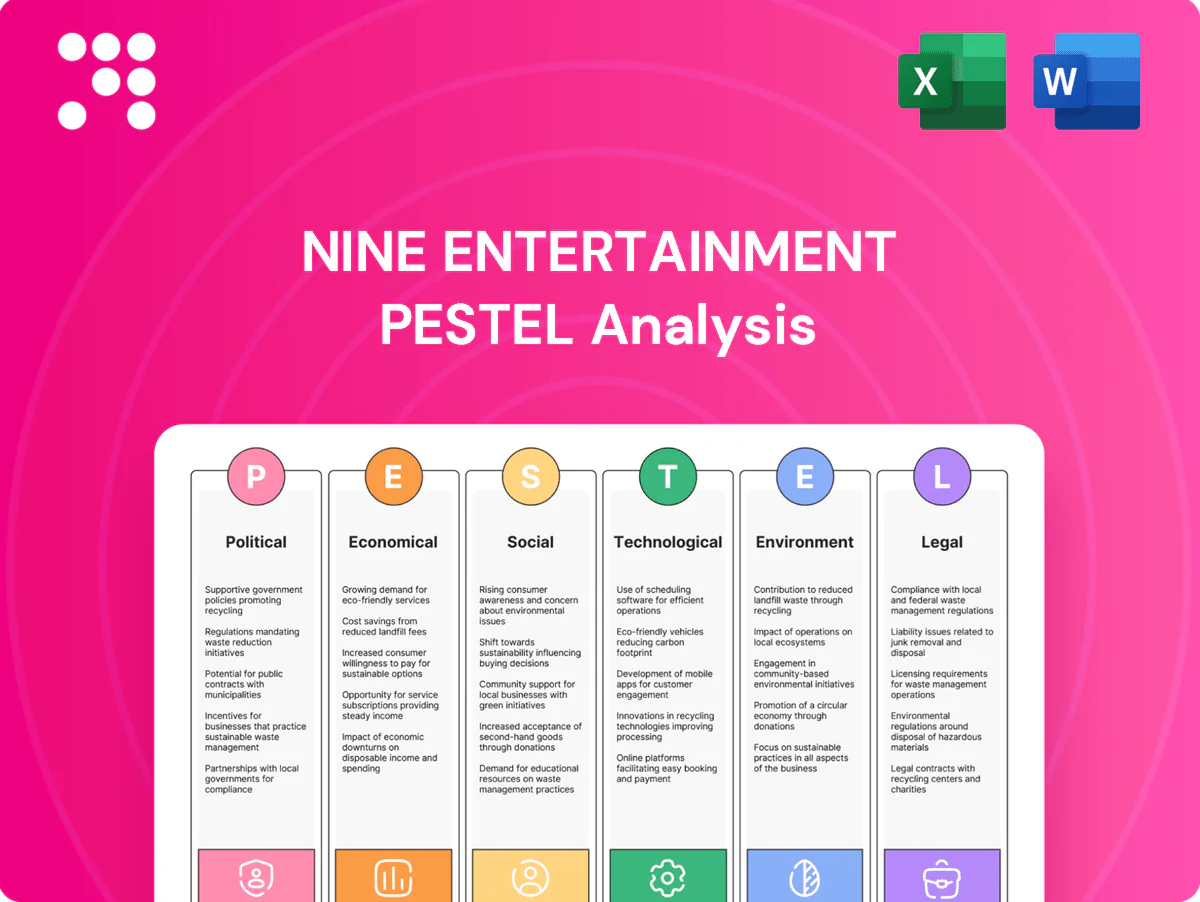
Nine Entertainment PESTLE Analysis

Your Competitive Advantage Starts with This Report
Gain a strategic edge with our concise PESTLE analysis of Nine Entertainment, revealing how political shifts, economic headwinds, digital disruption and regulatory change shape its outlook. These expertly distilled insights highlight risks and growth levers for investors and strategists. Purchase the full report to access the complete, actionable breakdown and Excel-ready data now.
Political factors

Media regulation
ACMA tightly oversees Australian broadcasting under the Broadcasting Services Act, shaping content standards and licensing obligations that directly affect Nine. Shifts in classification, advertising rules or spectrum policy can change cost structures and ad revenue for the three major commercial metropolitan networks. Nine must monitor government reviews and inquiries into media diversity and public interest journalism. Regulatory stability aids scheduling and investment planning, while sudden reforms can force rapid format and schedule changes.
Public broadcasters
ABC and SBS receive ongoing government funding—ABC’s 2024 appropriation was about AUD 1.2 billion and SBS around AUD 420 million—creating well-resourced public competitors for audience share and advertising-adjacent influence. Changes in the 2024–25 federal budget or charter mandates can shift this balance, with increased funding intensifying competition in news and local programming. Conversely, budget cuts would free audience and talent opportunities for Nine, potentially boosting commercial ad revenue and recruitment prospects.

Content quotas
Local content quotas and the Australian Screen Production Incentive shape Nine’s commissioning, with the Producer Offset providing 40% for feature films and 20% for most television production, influencing budget allocation for drama, children’s and documentary slots. Changes to quota hours raise production costs and scheduling pressure, while incentives help offset spend on Stan Originals and Channel 9 commissions. Policy shifts alter talent pipelines and push more regional shoots to capture location and PDV benefits.

Election cycles
Election cycles (federal poll 21 May 2022) lift political ad spend across TV, radio and digital, creating short-term revenue uplifts for Nine while pre-election policy uncertainty can delay commercial buys. Editorial scrutiny rises, heightening reputational and compliance risk, and campaign periods strain newsroom resources and logistics.
- Revenue boost: higher political ad demand
- Risk: delayed commercial campaigns
- Compliance: increased editorial scrutiny
- Operational: newsroom resourcing pressure
Competition policy
ACCC’s firm stance on media mergers and enforcement of the mandatory News Media Bargaining Code (introduced 2021) shapes Nine’s strategic options; bargaining frameworks with Big Tech—which account for roughly 70% of Australian digital ad spend (IAB 2023)—determine news remuneration, while tougher antitrust positions constrain consolidation synergies and clearer, flexible regimes could enable portfolio optimisation and regional scale.
- ACCC enforcement: tight
- News Media Bargaining Code: active since 2021
- Big Tech share: ~70% digital ad spend (IAB 2023)
- Risk: limited consolidation synergies
- Opportunity: flexible rules enable regional scale
Regulation, public funding and Big Tech ad dominance reshape Australian commercial TV economics
Regulatory oversight (ACMA, Broadcasting Services Act) and ACCC merger scrutiny constrain Nine’s licensing, scheduling and consolidation options. Public funding in 2024 (ABC ~AUD1.2bn, SBS ~AUD420m) sustains strong public competitors; Big Tech captures ~70% of digital ad spend, pressuring ad revenue. News Media Bargaining Code and Producer Offset (40% film, 20% TV) materially affect revenue and commissioning.
| Factor | 2024/25 data |
|---|---|
| ABC appropriation | AUD 1.2bn (2024) |
| SBS appropriation | AUD 420m (2024) |
| Big Tech ad share | ~70% digital ad spend (IAB 2023) |
| Producer Offset | 40% film / 20% TV |
What is included in the product
 Detailed Word Document
Explores how macro-environmental factors uniquely affect Nine Entertainment across Political, Economic, Social, Technological, Environmental and Legal dimensions, with data-backed insights and trend analysis. Designed for executives and investors, it reflects regional market and regulatory dynamics, offers forward-looking scenarios, and is ready for inclusion in decks or reports.

 Customizable Excel Spreadsheet
Visually segmented by PESTLE categories for Nine Entertainment, this concise analysis enables quick interpretation at a glance and supports fast alignment in meetings or presentations. It’s easily shareable and editable so teams can adapt risks and opportunities to their region or business line.
Economic factors

Ad market cyclicality
Advertising closely tracks GDP and business confidence; in Australia digital now represents over 50% of ad spend, so downturns typically compress TV and print first while digital shows relative resilience. Recoveries often spark rapid rebounds in brand and retail categories. Nine must balance high fixed broadcast and content costs against volatile ad demand to protect margins.
Consumer spend
Household budgets drive demand for Stan (≈2.2m subscribers in FY24) and event pay-per-view, with Australian CPI easing to about 3.6% in 2024 while annual wage growth ran near 4%, shaping churn and ARPU tactics. Discounting can sustain volume but erodes margins; Nine reported margin pressure in streaming segments. Strategic premium content windows help defend pricing power and limit churn by preserving perceived value.

Sports rights inflation
Premium sports rights are inflating—global sports media rights spending reached roughly US$60bn in 2023—squeezing Nine’s margins as guaranteed rights fees outpace advertising growth. Wins (AFL, cricket) drive audience share and cross-platform sales, while losses risk rapid erosion of viewers and advertiser demand. Long-term deals reduce revenue uncertainty but constrain programming flexibility and upside. Co-rights and sublicensing arrangements help de-risk cash outflows by sharing cost and revenue exposure.

Currency exposure
USD content licensing and global tech contracts expose Nine to FX volatility; with AUD trading around 0.65 USD in mid-2025 a weaker AUD raises the AUD cost of imported content and cloud services, pressuring margins. Hedging reduces cash-flow volatility but increases financial complexity and hedging costs. Local production spend partially offsets USD exposure by converting procurement into AUD.
- FX exposure: USD contracts
- Rate: AUD ≈ 0.65 USD (mid-2025)
- Impact: higher imported content/cloud costs
- Mitigation: hedging (cost/complexity) + local production natural hedge
Interest rates
Higher interest rates raise Nine Entertainment’s financing costs and increase discount rates for multi-year content investments; Australia’s 10-year government bond hovered around 4.0% in mid-2024, tightening returns on long-dated rights. Rising yields compress debt capacity for rights acquisition and M&A, while lower rates historically support valuation multiples and enable larger, long-dated deals. Active treasury management — hedging, refinancing and liquidity buffers — is crucial to navigate rate cycles.
- Rate backdrop: Aus 10y ~4.0% (mid-2024)
- Impact: higher discount rates, tighter M&A debt
- Opportunity: lower rates lift valuation multiples
- Action: prioritize hedging, refinancing, liquidity
Regulation, public funding and Big Tech ad dominance reshape Australian commercial TV economics
Advertising tracks GDP; digital >50% ad spend so TV/print vulnerable in downturns, recoveries spark rapid ad rebounds. Stan ≈2.2m subs (FY24) — ARPU/churn shaped by CPI ~3.6% (2024) and wages ~4%. Sports rights intense (global ~$60bn 2023) and FX AUD≈0.65 USD (mid-2025) raise imported content costs; Aus 10y ~4.0% (mid-2024) lifts financing costs.
| Metric | Value | Impact |
|---|---|---|
| Stan subs | ≈2.2m (FY24) | Revenue/churn pressure |
| Ad mix | Digital >50% | Resilience vs TV |
| FX | AUD ≈0.65 USD | Higher import costs |
| Rates | Aus 10y ~4.0% | Higher discounting |
What You See Is What You Get
Nine Entertainment PESTLE Analysis
The preview shown here is the exact Nine Entertainment PESTLE Analysis you’ll receive after purchase—fully formatted and ready to use. The layout, content, and structure visible are exactly what you’ll download immediately after buying. No placeholders or teasers—this is the final, professionally structured file.

Your Competitive Advantage Starts with This Report
Gain a strategic edge with our concise PESTLE analysis of Nine Entertainment, revealing how political shifts, economic headwinds, digital disruption and regulatory change shape its outlook. These expertly distilled insights highlight risks and growth levers for investors and strategists. Purchase the full report to access the complete, actionable breakdown and Excel-ready data now.
Political factors
Media regulation
ACMA tightly oversees Australian broadcasting under the Broadcasting Services Act, shaping content standards and licensing obligations that directly affect Nine. Shifts in classification, advertising rules or spectrum policy can change cost structures and ad revenue for the three major commercial metropolitan networks. Nine must monitor government reviews and inquiries into media diversity and public interest journalism. Regulatory stability aids scheduling and investment planning, while sudden reforms can force rapid format and schedule changes.
Public broadcasters
ABC and SBS receive ongoing government funding—ABC’s 2024 appropriation was about AUD 1.2 billion and SBS around AUD 420 million—creating well-resourced public competitors for audience share and advertising-adjacent influence. Changes in the 2024–25 federal budget or charter mandates can shift this balance, with increased funding intensifying competition in news and local programming. Conversely, budget cuts would free audience and talent opportunities for Nine, potentially boosting commercial ad revenue and recruitment prospects.
Content quotas
Local content quotas and the Australian Screen Production Incentive shape Nine’s commissioning, with the Producer Offset providing 40% for feature films and 20% for most television production, influencing budget allocation for drama, children’s and documentary slots. Changes to quota hours raise production costs and scheduling pressure, while incentives help offset spend on Stan Originals and Channel 9 commissions. Policy shifts alter talent pipelines and push more regional shoots to capture location and PDV benefits.
Election cycles
Election cycles (federal poll 21 May 2022) lift political ad spend across TV, radio and digital, creating short-term revenue uplifts for Nine while pre-election policy uncertainty can delay commercial buys. Editorial scrutiny rises, heightening reputational and compliance risk, and campaign periods strain newsroom resources and logistics.
- Revenue boost: higher political ad demand
- Risk: delayed commercial campaigns
- Compliance: increased editorial scrutiny
- Operational: newsroom resourcing pressure
Competition policy
ACCC’s firm stance on media mergers and enforcement of the mandatory News Media Bargaining Code (introduced 2021) shapes Nine’s strategic options; bargaining frameworks with Big Tech—which account for roughly 70% of Australian digital ad spend (IAB 2023)—determine news remuneration, while tougher antitrust positions constrain consolidation synergies and clearer, flexible regimes could enable portfolio optimisation and regional scale.
- ACCC enforcement: tight
- News Media Bargaining Code: active since 2021
- Big Tech share: ~70% digital ad spend (IAB 2023)
- Risk: limited consolidation synergies
- Opportunity: flexible rules enable regional scale
Regulation, public funding and Big Tech ad dominance reshape Australian commercial TV economics
Regulatory oversight (ACMA, Broadcasting Services Act) and ACCC merger scrutiny constrain Nine’s licensing, scheduling and consolidation options. Public funding in 2024 (ABC ~AUD1.2bn, SBS ~AUD420m) sustains strong public competitors; Big Tech captures ~70% of digital ad spend, pressuring ad revenue. News Media Bargaining Code and Producer Offset (40% film, 20% TV) materially affect revenue and commissioning.
| Factor | 2024/25 data |
|---|---|
| ABC appropriation | AUD 1.2bn (2024) |
| SBS appropriation | AUD 420m (2024) |
| Big Tech ad share | ~70% digital ad spend (IAB 2023) |
| Producer Offset | 40% film / 20% TV |
What is included in the product
Detailed Word Document
Explores how macro-environmental factors uniquely affect Nine Entertainment across Political, Economic, Social, Technological, Environmental and Legal dimensions, with data-backed insights and trend analysis. Designed for executives and investors, it reflects regional market and regulatory dynamics, offers forward-looking scenarios, and is ready for inclusion in decks or reports.
Customizable Excel Spreadsheet
Visually segmented by PESTLE categories for Nine Entertainment, this concise analysis enables quick interpretation at a glance and supports fast alignment in meetings or presentations. It’s easily shareable and editable so teams can adapt risks and opportunities to their region or business line.
Economic factors
Ad market cyclicality
Advertising closely tracks GDP and business confidence; in Australia digital now represents over 50% of ad spend, so downturns typically compress TV and print first while digital shows relative resilience. Recoveries often spark rapid rebounds in brand and retail categories. Nine must balance high fixed broadcast and content costs against volatile ad demand to protect margins.
Consumer spend
Household budgets drive demand for Stan (≈2.2m subscribers in FY24) and event pay-per-view, with Australian CPI easing to about 3.6% in 2024 while annual wage growth ran near 4%, shaping churn and ARPU tactics. Discounting can sustain volume but erodes margins; Nine reported margin pressure in streaming segments. Strategic premium content windows help defend pricing power and limit churn by preserving perceived value.
Sports rights inflation
Premium sports rights are inflating—global sports media rights spending reached roughly US$60bn in 2023—squeezing Nine’s margins as guaranteed rights fees outpace advertising growth. Wins (AFL, cricket) drive audience share and cross-platform sales, while losses risk rapid erosion of viewers and advertiser demand. Long-term deals reduce revenue uncertainty but constrain programming flexibility and upside. Co-rights and sublicensing arrangements help de-risk cash outflows by sharing cost and revenue exposure.
Currency exposure
USD content licensing and global tech contracts expose Nine to FX volatility; with AUD trading around 0.65 USD in mid-2025 a weaker AUD raises the AUD cost of imported content and cloud services, pressuring margins. Hedging reduces cash-flow volatility but increases financial complexity and hedging costs. Local production spend partially offsets USD exposure by converting procurement into AUD.
- FX exposure: USD contracts
- Rate: AUD ≈ 0.65 USD (mid-2025)
- Impact: higher imported content/cloud costs
- Mitigation: hedging (cost/complexity) + local production natural hedge
Interest rates
Higher interest rates raise Nine Entertainment’s financing costs and increase discount rates for multi-year content investments; Australia’s 10-year government bond hovered around 4.0% in mid-2024, tightening returns on long-dated rights. Rising yields compress debt capacity for rights acquisition and M&A, while lower rates historically support valuation multiples and enable larger, long-dated deals. Active treasury management — hedging, refinancing and liquidity buffers — is crucial to navigate rate cycles.
- Rate backdrop: Aus 10y ~4.0% (mid-2024)
- Impact: higher discount rates, tighter M&A debt
- Opportunity: lower rates lift valuation multiples
- Action: prioritize hedging, refinancing, liquidity
Regulation, public funding and Big Tech ad dominance reshape Australian commercial TV economics
Advertising tracks GDP; digital >50% ad spend so TV/print vulnerable in downturns, recoveries spark rapid ad rebounds. Stan ≈2.2m subs (FY24) — ARPU/churn shaped by CPI ~3.6% (2024) and wages ~4%. Sports rights intense (global ~$60bn 2023) and FX AUD≈0.65 USD (mid-2025) raise imported content costs; Aus 10y ~4.0% (mid-2024) lifts financing costs.
| Metric | Value | Impact |
|---|---|---|
| Stan subs | ≈2.2m (FY24) | Revenue/churn pressure |
| Ad mix | Digital >50% | Resilience vs TV |
| FX | AUD ≈0.65 USD | Higher import costs |
| Rates | Aus 10y ~4.0% | Higher discounting |
What You See Is What You Get
Nine Entertainment PESTLE Analysis
The preview shown here is the exact Nine Entertainment PESTLE Analysis you’ll receive after purchase—fully formatted and ready to use. The layout, content, and structure visible are exactly what you’ll download immediately after buying. No placeholders or teasers—this is the final, professionally structured file.
Original: $10.00
-65%$10.00
$3.50Description
Your Competitive Advantage Starts with This Report
Gain a strategic edge with our concise PESTLE analysis of Nine Entertainment, revealing how political shifts, economic headwinds, digital disruption and regulatory change shape its outlook. These expertly distilled insights highlight risks and growth levers for investors and strategists. Purchase the full report to access the complete, actionable breakdown and Excel-ready data now.
Political factors
Media regulation
ACMA tightly oversees Australian broadcasting under the Broadcasting Services Act, shaping content standards and licensing obligations that directly affect Nine. Shifts in classification, advertising rules or spectrum policy can change cost structures and ad revenue for the three major commercial metropolitan networks. Nine must monitor government reviews and inquiries into media diversity and public interest journalism. Regulatory stability aids scheduling and investment planning, while sudden reforms can force rapid format and schedule changes.
Public broadcasters
ABC and SBS receive ongoing government funding—ABC’s 2024 appropriation was about AUD 1.2 billion and SBS around AUD 420 million—creating well-resourced public competitors for audience share and advertising-adjacent influence. Changes in the 2024–25 federal budget or charter mandates can shift this balance, with increased funding intensifying competition in news and local programming. Conversely, budget cuts would free audience and talent opportunities for Nine, potentially boosting commercial ad revenue and recruitment prospects.
Content quotas
Local content quotas and the Australian Screen Production Incentive shape Nine’s commissioning, with the Producer Offset providing 40% for feature films and 20% for most television production, influencing budget allocation for drama, children’s and documentary slots. Changes to quota hours raise production costs and scheduling pressure, while incentives help offset spend on Stan Originals and Channel 9 commissions. Policy shifts alter talent pipelines and push more regional shoots to capture location and PDV benefits.
Election cycles
Election cycles (federal poll 21 May 2022) lift political ad spend across TV, radio and digital, creating short-term revenue uplifts for Nine while pre-election policy uncertainty can delay commercial buys. Editorial scrutiny rises, heightening reputational and compliance risk, and campaign periods strain newsroom resources and logistics.
- Revenue boost: higher political ad demand
- Risk: delayed commercial campaigns
- Compliance: increased editorial scrutiny
- Operational: newsroom resourcing pressure
Competition policy
ACCC’s firm stance on media mergers and enforcement of the mandatory News Media Bargaining Code (introduced 2021) shapes Nine’s strategic options; bargaining frameworks with Big Tech—which account for roughly 70% of Australian digital ad spend (IAB 2023)—determine news remuneration, while tougher antitrust positions constrain consolidation synergies and clearer, flexible regimes could enable portfolio optimisation and regional scale.
- ACCC enforcement: tight
- News Media Bargaining Code: active since 2021
- Big Tech share: ~70% digital ad spend (IAB 2023)
- Risk: limited consolidation synergies
- Opportunity: flexible rules enable regional scale
Regulation, public funding and Big Tech ad dominance reshape Australian commercial TV economics
Regulatory oversight (ACMA, Broadcasting Services Act) and ACCC merger scrutiny constrain Nine’s licensing, scheduling and consolidation options. Public funding in 2024 (ABC ~AUD1.2bn, SBS ~AUD420m) sustains strong public competitors; Big Tech captures ~70% of digital ad spend, pressuring ad revenue. News Media Bargaining Code and Producer Offset (40% film, 20% TV) materially affect revenue and commissioning.
| Factor | 2024/25 data |
|---|---|
| ABC appropriation | AUD 1.2bn (2024) |
| SBS appropriation | AUD 420m (2024) |
| Big Tech ad share | ~70% digital ad spend (IAB 2023) |
| Producer Offset | 40% film / 20% TV |
What is included in the product
Detailed Word Document
Explores how macro-environmental factors uniquely affect Nine Entertainment across Political, Economic, Social, Technological, Environmental and Legal dimensions, with data-backed insights and trend analysis. Designed for executives and investors, it reflects regional market and regulatory dynamics, offers forward-looking scenarios, and is ready for inclusion in decks or reports.
Customizable Excel Spreadsheet
Visually segmented by PESTLE categories for Nine Entertainment, this concise analysis enables quick interpretation at a glance and supports fast alignment in meetings or presentations. It’s easily shareable and editable so teams can adapt risks and opportunities to their region or business line.
Economic factors
Ad market cyclicality
Advertising closely tracks GDP and business confidence; in Australia digital now represents over 50% of ad spend, so downturns typically compress TV and print first while digital shows relative resilience. Recoveries often spark rapid rebounds in brand and retail categories. Nine must balance high fixed broadcast and content costs against volatile ad demand to protect margins.
Consumer spend
Household budgets drive demand for Stan (≈2.2m subscribers in FY24) and event pay-per-view, with Australian CPI easing to about 3.6% in 2024 while annual wage growth ran near 4%, shaping churn and ARPU tactics. Discounting can sustain volume but erodes margins; Nine reported margin pressure in streaming segments. Strategic premium content windows help defend pricing power and limit churn by preserving perceived value.
Sports rights inflation
Premium sports rights are inflating—global sports media rights spending reached roughly US$60bn in 2023—squeezing Nine’s margins as guaranteed rights fees outpace advertising growth. Wins (AFL, cricket) drive audience share and cross-platform sales, while losses risk rapid erosion of viewers and advertiser demand. Long-term deals reduce revenue uncertainty but constrain programming flexibility and upside. Co-rights and sublicensing arrangements help de-risk cash outflows by sharing cost and revenue exposure.
Currency exposure
USD content licensing and global tech contracts expose Nine to FX volatility; with AUD trading around 0.65 USD in mid-2025 a weaker AUD raises the AUD cost of imported content and cloud services, pressuring margins. Hedging reduces cash-flow volatility but increases financial complexity and hedging costs. Local production spend partially offsets USD exposure by converting procurement into AUD.
- FX exposure: USD contracts
- Rate: AUD ≈ 0.65 USD (mid-2025)
- Impact: higher imported content/cloud costs
- Mitigation: hedging (cost/complexity) + local production natural hedge
Interest rates
Higher interest rates raise Nine Entertainment’s financing costs and increase discount rates for multi-year content investments; Australia’s 10-year government bond hovered around 4.0% in mid-2024, tightening returns on long-dated rights. Rising yields compress debt capacity for rights acquisition and M&A, while lower rates historically support valuation multiples and enable larger, long-dated deals. Active treasury management — hedging, refinancing and liquidity buffers — is crucial to navigate rate cycles.
- Rate backdrop: Aus 10y ~4.0% (mid-2024)
- Impact: higher discount rates, tighter M&A debt
- Opportunity: lower rates lift valuation multiples
- Action: prioritize hedging, refinancing, liquidity
Regulation, public funding and Big Tech ad dominance reshape Australian commercial TV economics
Advertising tracks GDP; digital >50% ad spend so TV/print vulnerable in downturns, recoveries spark rapid ad rebounds. Stan ≈2.2m subs (FY24) — ARPU/churn shaped by CPI ~3.6% (2024) and wages ~4%. Sports rights intense (global ~$60bn 2023) and FX AUD≈0.65 USD (mid-2025) raise imported content costs; Aus 10y ~4.0% (mid-2024) lifts financing costs.
| Metric | Value | Impact |
|---|---|---|
| Stan subs | ≈2.2m (FY24) | Revenue/churn pressure |
| Ad mix | Digital >50% | Resilience vs TV |
| FX | AUD ≈0.65 USD | Higher import costs |
| Rates | Aus 10y ~4.0% | Higher discounting |
What You See Is What You Get
Nine Entertainment PESTLE Analysis
The preview shown here is the exact Nine Entertainment PESTLE Analysis you’ll receive after purchase—fully formatted and ready to use. The layout, content, and structure visible are exactly what you’ll download immediately after buying. No placeholders or teasers—this is the final, professionally structured file.











