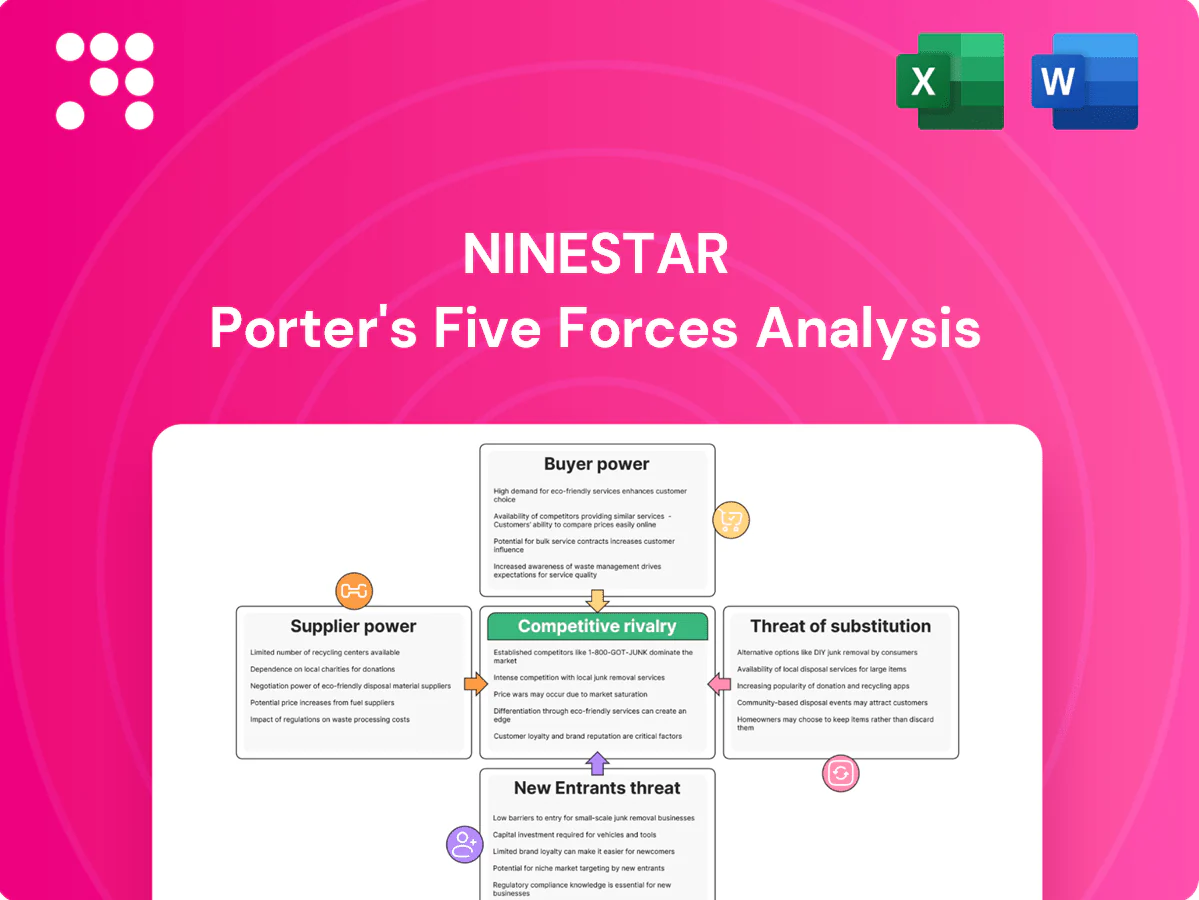
Ninestar Porter's Five Forces Analysis

A Must-Have Tool for Decision-Makers
Ninestar's competitive landscape is shaped by intense rivalry and the constant threat of substitutes, impacting its pricing power and market share. Understanding these dynamics is crucial for any business operating within or adjacent to this sector.
The complete report reveals the real forces shaping Ninestar’s industry—from supplier influence to threat of new entrants. Gain actionable insights to drive smarter decision-making.
Suppliers Bargaining Power

Supplier Concentration
Ninestar's reliance on a concentrated supplier base for critical components significantly impacts its bargaining power. For instance, specialized integrated circuits, essential for printer functionality, are often sourced from a limited number of manufacturers. If these suppliers are few and large, they can dictate terms, increasing costs for Ninestar.
The market for unique chemical formulations used in ink and toner also presents a similar challenge. A small number of chemical companies with proprietary processes can wield considerable influence. This means Ninestar may face higher input prices or less favorable supply agreements if these specialized chemical suppliers have limited competition.
Similarly, the availability and cost of proprietary printer mechanisms can be a point of leverage for their suppliers. If Ninestar depends on a few specialized firms for these intricate parts, these suppliers gain substantial bargaining power. A diverse supplier landscape, conversely, would allow Ninestar to negotiate better terms and mitigate supply chain risks.
Uniqueness of Inputs and Switching Costs
Ninestar's reliance on highly specialized inputs, particularly in advanced semiconductor manufacturing and specific chemical compounds, significantly strengthens supplier bargaining power. For instance, the scarcity of certain rare earth elements crucial for high-performance chips, with limited global extraction sites, means Ninestar has few alternative sources, driving up input costs. In 2023, the global supply of gallium, a key component in certain semiconductor applications, experienced price volatility due to production constraints, impacting companies like Ninestar.
The costs and complexities associated with switching suppliers for these specialized inputs are substantial. This includes the need for extensive retooling of manufacturing processes, rigorous quality control recalibration to ensure compatibility, and potential contract termination penalties. For example, a shift in a critical chemical supplier might require months of testing and validation to guarantee product consistency, representing a significant financial and operational hurdle for Ninestar, thereby increasing supplier leverage.

Threat of Forward Integration by Suppliers
The threat of forward integration by Ninestar's suppliers is a significant concern. If key component providers, such as those supplying toner, chips, or printer mechanisms, were to develop their own printing solutions, they could directly compete with Ninestar. This would not only disrupt Ninestar's supply chain but also introduce powerful new rivals with established manufacturing capabilities.
The likelihood of this happening depends on suppliers' existing technological prowess and their strategic goals. For instance, a supplier with advanced R&D in print technology and a strong understanding of the end-user market might see forward integration as a logical next step to capture more value. This potential forces Ninestar to offer favorable terms and foster strong, collaborative relationships to mitigate this risk.

Importance of Ninestar to Suppliers
Ninestar's significance to its suppliers plays a crucial role in determining their bargaining power. If Ninestar constitutes a major portion of a supplier's total sales, that supplier may have less leverage, as they are dependent on Ninestar's business. For instance, if a key component supplier derives over 30% of its revenue from Ninestar, its ability to dictate terms or raise prices would likely be constrained.
Conversely, if Ninestar represents only a small fraction of a supplier's customer base, the supplier is in a stronger position. They can more readily afford to lose Ninestar as a client and may be less inclined to accommodate Ninestar's demands regarding pricing or delivery schedules. This dynamic shifts the balance of power.
- Supplier Dependence: If Ninestar accounts for a substantial percentage of a supplier's revenue, the supplier's bargaining power is diminished.
- Ninestar's Customer Size: When Ninestar is a minor customer for a supplier, the supplier gains more influence.
- Market Share Impact: A supplier heavily reliant on Ninestar might face pressure to maintain competitive pricing to retain Ninestar's business.
- Diversification of Suppliers: Ninestar's ability to source from multiple suppliers can reduce the bargaining power of any single supplier.
Availability of Substitute Inputs
The availability of substitute inputs significantly impacts Ninestar's bargaining power with its suppliers. If Ninestar can readily source alternative raw materials or components, the leverage of a dominant supplier is considerably weakened. For instance, in the printer consumables market, if a key supplier of toner powder were to increase prices substantially, Ninestar's ability to switch to a different, equally effective toner formulation or even a different type of printing technology (like inkjet if feasible for certain product lines) would limit that supplier's pricing power.
Conversely, if Ninestar relies on highly specialized or proprietary components for which there are no viable substitutes, the supplier of that input holds substantial bargaining power. This is particularly true if the component is protected by patents or unique manufacturing processes. For example, if a specific imaging drum technology used in Ninestar's printers is patented and only available from a single manufacturer, that supplier can dictate terms, potentially impacting Ninestar's cost of goods sold and profitability. In 2024, the semiconductor shortage, though easing, highlighted how the lack of substitutes for critical chips could grant significant power to chip manufacturers.
- Limited Substitutes: If Ninestar's core products rely on unique or patented components with no readily available alternatives, the supplier of these components gains significant bargaining power.
- Ease of Switching: The ease with which Ninestar can switch to alternative suppliers or substitute materials directly reduces supplier leverage.
- Technological Dependence: Reliance on a supplier's proprietary technology without the ability to design around it or find alternatives amplifies the supplier's power.
- Market Trends: In 2024, the ongoing evolution of printing technology means that Ninestar must continually assess the availability of substitute inputs across various component categories, from print heads to ink formulations.
Supplier Power: Impact on Component Sourcing and Costs
Ninestar's bargaining power with its suppliers is constrained by its dependence on specialized components and limited substitutes. For instance, the scarcity of certain rare earth elements crucial for high-performance chips, with limited global extraction sites, means Ninestar has few alternative sources, driving up input costs. In 2023, the global supply of gallium, a key component in certain semiconductor applications, experienced price volatility due to production constraints, impacting companies like Ninestar.
The costs and complexities associated with switching suppliers for these specialized inputs are substantial, including retooling and validation. For example, a shift in a critical chemical supplier might require months of testing and validation to guarantee product consistency, representing a significant financial and operational hurdle for Ninestar, thereby increasing supplier leverage.
The threat of forward integration by Ninestar's suppliers is a significant concern, as suppliers with advanced R&D in print technology could become direct competitors. This potential forces Ninestar to offer favorable terms and foster strong, collaborative relationships to mitigate this risk.
Ninestar's bargaining power with suppliers is also influenced by its own significance to their business. If Ninestar accounts for a substantial percentage of a supplier's revenue, that supplier's leverage is diminished, potentially leading to more favorable terms for Ninestar.
What is included in the product
 Detailed Word Document
This Ninestar Porter's Five Forces analysis dissects the competitive intensity within its industry, examining buyer and supplier power, the threat of new entrants and substitutes, and the rivalry among existing firms.

 Customizable Excel Spreadsheet
Effortlessly identify and quantify competitive pressures, transforming abstract market dynamics into actionable insights for strategic advantage.
Customers Bargaining Power

Customer Price Sensitivity
Ninestar's customers, ranging from individual consumers to large businesses and distributors, exhibit significant price sensitivity, particularly concerning printer consumables. In a competitive landscape where numerous alternatives exist, this sensitivity directly translates to increased bargaining power for customers.
The market for printers and consumables is characterized by a wide array of brands and compatible options, making it easier for customers to switch based on price. For instance, the global printer consumables market was valued at approximately $45 billion in 2023, with a significant portion driven by aftermarket and compatible cartridges, indicating a strong customer preference for cost-effective solutions.
Economic downturns or periods of reduced consumer spending further amplify this price sensitivity. During such times, customers are more inclined to seek out lower-priced alternatives, putting downward pressure on Ninestar's pricing strategies and margins.
Availability of Substitute Products for Customers
Customers have significant power when it comes to Ninestar due to the wide array of readily available substitute products. They can easily switch between Ninestar's Lexmark branded cartridges, compatible third-party options, or remanufactured cartridges. This ease of switching is amplified by the presence of numerous other third-party manufacturers offering similar consumables, directly impacting Ninestar's pricing flexibility.
The perceived quality and cost-effectiveness of these substitutes are key drivers of customer choice. Many compatible and remanufactured cartridges are priced considerably lower than OEM options, making them attractive alternatives for budget-conscious consumers and businesses. For instance, in 2024, the compatible printer cartridge market continued to grow, with consumers actively seeking cost savings, which directly challenges Ninestar's premium offerings.

Customer Volume and Concentration
Ninestar's customer volume and concentration significantly influence its bargaining power. If a few major clients, such as large office supply chains or major printer manufacturers, represent a substantial percentage of Ninestar's revenue, these customers gain leverage to negotiate lower prices or more favorable payment terms. For instance, if the top 10 customers accounted for over 40% of Ninestar's sales in 2023, their collective purchasing power would be considerable.

Customer Switching Costs
Customer switching costs for Ninestar's products are generally low, which can weaken their bargaining power. This is particularly true for standard printer models and consumables where alternatives are readily available. For instance, many third-party ink and toner cartridges are compatible with a wide range of printers, minimizing the financial penalty for switching.
The ease with which customers can find compatible and often cheaper consumables from competitors directly impacts Ninestar's pricing power. If a customer can easily switch to a different brand of toner for their Ninestar printer without significant effort or cost, they are less likely to accept higher prices from Ninestar. This dynamic is a key factor in the competitive landscape of the printer supplies market.
- Low Switching Costs: Customers can readily find compatible third-party ink and toner cartridges, reducing the financial and operational barriers to switching away from Ninestar's proprietary consumables.
- Availability of Alternatives: The market offers a wide array of printer models from various manufacturers, many of which use standard consumables, making it simple for customers to choose competitors if Ninestar's offerings become less attractive.
- Minimal Non-Monetary Costs: For most standard office and home use, there are few non-monetary costs associated with switching, such as retraining or significant integration efforts, further empowering customer choice.
Threat of Backward Integration by Customers
The threat of backward integration by customers in the printing consumables market, particularly for manufacturers like Ninestar, can significantly impact pricing and supplier relationships. Large corporate clients or major distributors possess the financial and organizational capacity to consider producing their own printing supplies or acquiring existing cartridge manufacturers. This potential, even if not fully realized, grants them considerable bargaining leverage during price negotiations.
For instance, a large enterprise might analyze the costs associated with setting up in-house production versus continuing to purchase from Ninestar. The feasibility of this integration hinges on factors like the capital investment required for manufacturing facilities, the availability of specialized technology, and the cost of sourcing raw materials. If the economics favor in-house production, or if a compatible manufacturer is available for acquisition at a reasonable price, the threat becomes more concrete.
- Customer Integration Feasibility: Evaluating the capital expenditure and operational expertise needed for customers to manufacture printing consumables.
- Cost-Benefit Analysis: Assessing whether a customer's internal production costs would be lower than Ninestar's current pricing.
- Market Dynamics: Considering the impact of potential customer integration on Ninestar's market share and pricing power.
- Strategic Partnerships: Exploring how Ninestar might mitigate this threat through exclusive supply agreements or joint ventures with key customers.
Customer Power: The Ultimate Price Setter in Printer Consumables
Ninestar's customers wield considerable power, largely driven by the abundance of readily available substitutes for printer consumables. The ease with which consumers and businesses can switch to compatible or remanufactured cartridges, often at a lower price point, significantly limits Ninestar's pricing flexibility. This dynamic is further intensified by low switching costs, as there are minimal non-monetary barriers to adopting alternative brands.
The bargaining power of Ninestar's customers is substantial due to the high degree of price sensitivity in the printer consumables market. With a vast array of brands and compatible options, customers can easily shift to more cost-effective solutions, especially during economic downturns. For example, the global compatible printer cartridge market saw continued growth in 2024 as consumers actively sought savings, directly impacting Ninestar's pricing strategies.
Key customer segments, such as large distributors or office supply chains, can exert significant leverage if they represent a large portion of Ninestar's sales volume. Their ability to negotiate lower prices or more favorable terms is amplified by the threat of backward integration, where they might consider producing their own consumables or acquiring smaller manufacturers. This potential for self-sufficiency or acquisition grants them considerable bargaining power.
The bargaining power of Ninestar's customers is a significant force, primarily fueled by the widespread availability of lower-cost alternatives and minimal switching costs. Customers can easily opt for compatible or remanufactured cartridges, which are often substantially cheaper than OEM products. This trend was particularly evident in 2024, with consumers actively prioritizing cost savings in their purchasing decisions, thereby pressuring Ninestar's pricing and profitability.
Same Document Delivered
Ninestar Porter's Five Forces Analysis
This preview showcases the complete Ninestar Porter's Five Forces Analysis, offering a detailed examination of the competitive landscape within its industry. You are viewing the exact, professionally crafted document that will be delivered to you instantly upon purchase, ensuring no discrepancies or missing information. This comprehensive analysis is formatted and ready for immediate application to your strategic planning needs.

A Must-Have Tool for Decision-Makers
Ninestar's competitive landscape is shaped by intense rivalry and the constant threat of substitutes, impacting its pricing power and market share. Understanding these dynamics is crucial for any business operating within or adjacent to this sector.
The complete report reveals the real forces shaping Ninestar’s industry—from supplier influence to threat of new entrants. Gain actionable insights to drive smarter decision-making.
Suppliers Bargaining Power
Supplier Concentration
Ninestar's reliance on a concentrated supplier base for critical components significantly impacts its bargaining power. For instance, specialized integrated circuits, essential for printer functionality, are often sourced from a limited number of manufacturers. If these suppliers are few and large, they can dictate terms, increasing costs for Ninestar.
The market for unique chemical formulations used in ink and toner also presents a similar challenge. A small number of chemical companies with proprietary processes can wield considerable influence. This means Ninestar may face higher input prices or less favorable supply agreements if these specialized chemical suppliers have limited competition.
Similarly, the availability and cost of proprietary printer mechanisms can be a point of leverage for their suppliers. If Ninestar depends on a few specialized firms for these intricate parts, these suppliers gain substantial bargaining power. A diverse supplier landscape, conversely, would allow Ninestar to negotiate better terms and mitigate supply chain risks.
Uniqueness of Inputs and Switching Costs
Ninestar's reliance on highly specialized inputs, particularly in advanced semiconductor manufacturing and specific chemical compounds, significantly strengthens supplier bargaining power. For instance, the scarcity of certain rare earth elements crucial for high-performance chips, with limited global extraction sites, means Ninestar has few alternative sources, driving up input costs. In 2023, the global supply of gallium, a key component in certain semiconductor applications, experienced price volatility due to production constraints, impacting companies like Ninestar.
The costs and complexities associated with switching suppliers for these specialized inputs are substantial. This includes the need for extensive retooling of manufacturing processes, rigorous quality control recalibration to ensure compatibility, and potential contract termination penalties. For example, a shift in a critical chemical supplier might require months of testing and validation to guarantee product consistency, representing a significant financial and operational hurdle for Ninestar, thereby increasing supplier leverage.
Threat of Forward Integration by Suppliers
The threat of forward integration by Ninestar's suppliers is a significant concern. If key component providers, such as those supplying toner, chips, or printer mechanisms, were to develop their own printing solutions, they could directly compete with Ninestar. This would not only disrupt Ninestar's supply chain but also introduce powerful new rivals with established manufacturing capabilities.
The likelihood of this happening depends on suppliers' existing technological prowess and their strategic goals. For instance, a supplier with advanced R&D in print technology and a strong understanding of the end-user market might see forward integration as a logical next step to capture more value. This potential forces Ninestar to offer favorable terms and foster strong, collaborative relationships to mitigate this risk.
Importance of Ninestar to Suppliers
Ninestar's significance to its suppliers plays a crucial role in determining their bargaining power. If Ninestar constitutes a major portion of a supplier's total sales, that supplier may have less leverage, as they are dependent on Ninestar's business. For instance, if a key component supplier derives over 30% of its revenue from Ninestar, its ability to dictate terms or raise prices would likely be constrained.
Conversely, if Ninestar represents only a small fraction of a supplier's customer base, the supplier is in a stronger position. They can more readily afford to lose Ninestar as a client and may be less inclined to accommodate Ninestar's demands regarding pricing or delivery schedules. This dynamic shifts the balance of power.
- Supplier Dependence: If Ninestar accounts for a substantial percentage of a supplier's revenue, the supplier's bargaining power is diminished.
- Ninestar's Customer Size: When Ninestar is a minor customer for a supplier, the supplier gains more influence.
- Market Share Impact: A supplier heavily reliant on Ninestar might face pressure to maintain competitive pricing to retain Ninestar's business.
- Diversification of Suppliers: Ninestar's ability to source from multiple suppliers can reduce the bargaining power of any single supplier.
Availability of Substitute Inputs
The availability of substitute inputs significantly impacts Ninestar's bargaining power with its suppliers. If Ninestar can readily source alternative raw materials or components, the leverage of a dominant supplier is considerably weakened. For instance, in the printer consumables market, if a key supplier of toner powder were to increase prices substantially, Ninestar's ability to switch to a different, equally effective toner formulation or even a different type of printing technology (like inkjet if feasible for certain product lines) would limit that supplier's pricing power.
Conversely, if Ninestar relies on highly specialized or proprietary components for which there are no viable substitutes, the supplier of that input holds substantial bargaining power. This is particularly true if the component is protected by patents or unique manufacturing processes. For example, if a specific imaging drum technology used in Ninestar's printers is patented and only available from a single manufacturer, that supplier can dictate terms, potentially impacting Ninestar's cost of goods sold and profitability. In 2024, the semiconductor shortage, though easing, highlighted how the lack of substitutes for critical chips could grant significant power to chip manufacturers.
- Limited Substitutes: If Ninestar's core products rely on unique or patented components with no readily available alternatives, the supplier of these components gains significant bargaining power.
- Ease of Switching: The ease with which Ninestar can switch to alternative suppliers or substitute materials directly reduces supplier leverage.
- Technological Dependence: Reliance on a supplier's proprietary technology without the ability to design around it or find alternatives amplifies the supplier's power.
- Market Trends: In 2024, the ongoing evolution of printing technology means that Ninestar must continually assess the availability of substitute inputs across various component categories, from print heads to ink formulations.
Supplier Power: Impact on Component Sourcing and Costs
Ninestar's bargaining power with its suppliers is constrained by its dependence on specialized components and limited substitutes. For instance, the scarcity of certain rare earth elements crucial for high-performance chips, with limited global extraction sites, means Ninestar has few alternative sources, driving up input costs. In 2023, the global supply of gallium, a key component in certain semiconductor applications, experienced price volatility due to production constraints, impacting companies like Ninestar.
The costs and complexities associated with switching suppliers for these specialized inputs are substantial, including retooling and validation. For example, a shift in a critical chemical supplier might require months of testing and validation to guarantee product consistency, representing a significant financial and operational hurdle for Ninestar, thereby increasing supplier leverage.
The threat of forward integration by Ninestar's suppliers is a significant concern, as suppliers with advanced R&D in print technology could become direct competitors. This potential forces Ninestar to offer favorable terms and foster strong, collaborative relationships to mitigate this risk.
Ninestar's bargaining power with suppliers is also influenced by its own significance to their business. If Ninestar accounts for a substantial percentage of a supplier's revenue, that supplier's leverage is diminished, potentially leading to more favorable terms for Ninestar.
What is included in the product
Detailed Word Document
This Ninestar Porter's Five Forces analysis dissects the competitive intensity within its industry, examining buyer and supplier power, the threat of new entrants and substitutes, and the rivalry among existing firms.
Customizable Excel Spreadsheet
Effortlessly identify and quantify competitive pressures, transforming abstract market dynamics into actionable insights for strategic advantage.
Customers Bargaining Power
Customer Price Sensitivity
Ninestar's customers, ranging from individual consumers to large businesses and distributors, exhibit significant price sensitivity, particularly concerning printer consumables. In a competitive landscape where numerous alternatives exist, this sensitivity directly translates to increased bargaining power for customers.
The market for printers and consumables is characterized by a wide array of brands and compatible options, making it easier for customers to switch based on price. For instance, the global printer consumables market was valued at approximately $45 billion in 2023, with a significant portion driven by aftermarket and compatible cartridges, indicating a strong customer preference for cost-effective solutions.
Economic downturns or periods of reduced consumer spending further amplify this price sensitivity. During such times, customers are more inclined to seek out lower-priced alternatives, putting downward pressure on Ninestar's pricing strategies and margins.
Availability of Substitute Products for Customers
Customers have significant power when it comes to Ninestar due to the wide array of readily available substitute products. They can easily switch between Ninestar's Lexmark branded cartridges, compatible third-party options, or remanufactured cartridges. This ease of switching is amplified by the presence of numerous other third-party manufacturers offering similar consumables, directly impacting Ninestar's pricing flexibility.
The perceived quality and cost-effectiveness of these substitutes are key drivers of customer choice. Many compatible and remanufactured cartridges are priced considerably lower than OEM options, making them attractive alternatives for budget-conscious consumers and businesses. For instance, in 2024, the compatible printer cartridge market continued to grow, with consumers actively seeking cost savings, which directly challenges Ninestar's premium offerings.
Customer Volume and Concentration
Ninestar's customer volume and concentration significantly influence its bargaining power. If a few major clients, such as large office supply chains or major printer manufacturers, represent a substantial percentage of Ninestar's revenue, these customers gain leverage to negotiate lower prices or more favorable payment terms. For instance, if the top 10 customers accounted for over 40% of Ninestar's sales in 2023, their collective purchasing power would be considerable.
Customer Switching Costs
Customer switching costs for Ninestar's products are generally low, which can weaken their bargaining power. This is particularly true for standard printer models and consumables where alternatives are readily available. For instance, many third-party ink and toner cartridges are compatible with a wide range of printers, minimizing the financial penalty for switching.
The ease with which customers can find compatible and often cheaper consumables from competitors directly impacts Ninestar's pricing power. If a customer can easily switch to a different brand of toner for their Ninestar printer without significant effort or cost, they are less likely to accept higher prices from Ninestar. This dynamic is a key factor in the competitive landscape of the printer supplies market.
- Low Switching Costs: Customers can readily find compatible third-party ink and toner cartridges, reducing the financial and operational barriers to switching away from Ninestar's proprietary consumables.
- Availability of Alternatives: The market offers a wide array of printer models from various manufacturers, many of which use standard consumables, making it simple for customers to choose competitors if Ninestar's offerings become less attractive.
- Minimal Non-Monetary Costs: For most standard office and home use, there are few non-monetary costs associated with switching, such as retraining or significant integration efforts, further empowering customer choice.
Threat of Backward Integration by Customers
The threat of backward integration by customers in the printing consumables market, particularly for manufacturers like Ninestar, can significantly impact pricing and supplier relationships. Large corporate clients or major distributors possess the financial and organizational capacity to consider producing their own printing supplies or acquiring existing cartridge manufacturers. This potential, even if not fully realized, grants them considerable bargaining leverage during price negotiations.
For instance, a large enterprise might analyze the costs associated with setting up in-house production versus continuing to purchase from Ninestar. The feasibility of this integration hinges on factors like the capital investment required for manufacturing facilities, the availability of specialized technology, and the cost of sourcing raw materials. If the economics favor in-house production, or if a compatible manufacturer is available for acquisition at a reasonable price, the threat becomes more concrete.
- Customer Integration Feasibility: Evaluating the capital expenditure and operational expertise needed for customers to manufacture printing consumables.
- Cost-Benefit Analysis: Assessing whether a customer's internal production costs would be lower than Ninestar's current pricing.
- Market Dynamics: Considering the impact of potential customer integration on Ninestar's market share and pricing power.
- Strategic Partnerships: Exploring how Ninestar might mitigate this threat through exclusive supply agreements or joint ventures with key customers.
Customer Power: The Ultimate Price Setter in Printer Consumables
Ninestar's customers wield considerable power, largely driven by the abundance of readily available substitutes for printer consumables. The ease with which consumers and businesses can switch to compatible or remanufactured cartridges, often at a lower price point, significantly limits Ninestar's pricing flexibility. This dynamic is further intensified by low switching costs, as there are minimal non-monetary barriers to adopting alternative brands.
The bargaining power of Ninestar's customers is substantial due to the high degree of price sensitivity in the printer consumables market. With a vast array of brands and compatible options, customers can easily shift to more cost-effective solutions, especially during economic downturns. For example, the global compatible printer cartridge market saw continued growth in 2024 as consumers actively sought savings, directly impacting Ninestar's pricing strategies.
Key customer segments, such as large distributors or office supply chains, can exert significant leverage if they represent a large portion of Ninestar's sales volume. Their ability to negotiate lower prices or more favorable terms is amplified by the threat of backward integration, where they might consider producing their own consumables or acquiring smaller manufacturers. This potential for self-sufficiency or acquisition grants them considerable bargaining power.
The bargaining power of Ninestar's customers is a significant force, primarily fueled by the widespread availability of lower-cost alternatives and minimal switching costs. Customers can easily opt for compatible or remanufactured cartridges, which are often substantially cheaper than OEM products. This trend was particularly evident in 2024, with consumers actively prioritizing cost savings in their purchasing decisions, thereby pressuring Ninestar's pricing and profitability.
Same Document Delivered
Ninestar Porter's Five Forces Analysis
This preview showcases the complete Ninestar Porter's Five Forces Analysis, offering a detailed examination of the competitive landscape within its industry. You are viewing the exact, professionally crafted document that will be delivered to you instantly upon purchase, ensuring no discrepancies or missing information. This comprehensive analysis is formatted and ready for immediate application to your strategic planning needs.
Description
A Must-Have Tool for Decision-Makers
Ninestar's competitive landscape is shaped by intense rivalry and the constant threat of substitutes, impacting its pricing power and market share. Understanding these dynamics is crucial for any business operating within or adjacent to this sector.
The complete report reveals the real forces shaping Ninestar’s industry—from supplier influence to threat of new entrants. Gain actionable insights to drive smarter decision-making.
Suppliers Bargaining Power
Supplier Concentration
Ninestar's reliance on a concentrated supplier base for critical components significantly impacts its bargaining power. For instance, specialized integrated circuits, essential for printer functionality, are often sourced from a limited number of manufacturers. If these suppliers are few and large, they can dictate terms, increasing costs for Ninestar.
The market for unique chemical formulations used in ink and toner also presents a similar challenge. A small number of chemical companies with proprietary processes can wield considerable influence. This means Ninestar may face higher input prices or less favorable supply agreements if these specialized chemical suppliers have limited competition.
Similarly, the availability and cost of proprietary printer mechanisms can be a point of leverage for their suppliers. If Ninestar depends on a few specialized firms for these intricate parts, these suppliers gain substantial bargaining power. A diverse supplier landscape, conversely, would allow Ninestar to negotiate better terms and mitigate supply chain risks.
Uniqueness of Inputs and Switching Costs
Ninestar's reliance on highly specialized inputs, particularly in advanced semiconductor manufacturing and specific chemical compounds, significantly strengthens supplier bargaining power. For instance, the scarcity of certain rare earth elements crucial for high-performance chips, with limited global extraction sites, means Ninestar has few alternative sources, driving up input costs. In 2023, the global supply of gallium, a key component in certain semiconductor applications, experienced price volatility due to production constraints, impacting companies like Ninestar.
The costs and complexities associated with switching suppliers for these specialized inputs are substantial. This includes the need for extensive retooling of manufacturing processes, rigorous quality control recalibration to ensure compatibility, and potential contract termination penalties. For example, a shift in a critical chemical supplier might require months of testing and validation to guarantee product consistency, representing a significant financial and operational hurdle for Ninestar, thereby increasing supplier leverage.
Threat of Forward Integration by Suppliers
The threat of forward integration by Ninestar's suppliers is a significant concern. If key component providers, such as those supplying toner, chips, or printer mechanisms, were to develop their own printing solutions, they could directly compete with Ninestar. This would not only disrupt Ninestar's supply chain but also introduce powerful new rivals with established manufacturing capabilities.
The likelihood of this happening depends on suppliers' existing technological prowess and their strategic goals. For instance, a supplier with advanced R&D in print technology and a strong understanding of the end-user market might see forward integration as a logical next step to capture more value. This potential forces Ninestar to offer favorable terms and foster strong, collaborative relationships to mitigate this risk.
Importance of Ninestar to Suppliers
Ninestar's significance to its suppliers plays a crucial role in determining their bargaining power. If Ninestar constitutes a major portion of a supplier's total sales, that supplier may have less leverage, as they are dependent on Ninestar's business. For instance, if a key component supplier derives over 30% of its revenue from Ninestar, its ability to dictate terms or raise prices would likely be constrained.
Conversely, if Ninestar represents only a small fraction of a supplier's customer base, the supplier is in a stronger position. They can more readily afford to lose Ninestar as a client and may be less inclined to accommodate Ninestar's demands regarding pricing or delivery schedules. This dynamic shifts the balance of power.
- Supplier Dependence: If Ninestar accounts for a substantial percentage of a supplier's revenue, the supplier's bargaining power is diminished.
- Ninestar's Customer Size: When Ninestar is a minor customer for a supplier, the supplier gains more influence.
- Market Share Impact: A supplier heavily reliant on Ninestar might face pressure to maintain competitive pricing to retain Ninestar's business.
- Diversification of Suppliers: Ninestar's ability to source from multiple suppliers can reduce the bargaining power of any single supplier.
Availability of Substitute Inputs
The availability of substitute inputs significantly impacts Ninestar's bargaining power with its suppliers. If Ninestar can readily source alternative raw materials or components, the leverage of a dominant supplier is considerably weakened. For instance, in the printer consumables market, if a key supplier of toner powder were to increase prices substantially, Ninestar's ability to switch to a different, equally effective toner formulation or even a different type of printing technology (like inkjet if feasible for certain product lines) would limit that supplier's pricing power.
Conversely, if Ninestar relies on highly specialized or proprietary components for which there are no viable substitutes, the supplier of that input holds substantial bargaining power. This is particularly true if the component is protected by patents or unique manufacturing processes. For example, if a specific imaging drum technology used in Ninestar's printers is patented and only available from a single manufacturer, that supplier can dictate terms, potentially impacting Ninestar's cost of goods sold and profitability. In 2024, the semiconductor shortage, though easing, highlighted how the lack of substitutes for critical chips could grant significant power to chip manufacturers.
- Limited Substitutes: If Ninestar's core products rely on unique or patented components with no readily available alternatives, the supplier of these components gains significant bargaining power.
- Ease of Switching: The ease with which Ninestar can switch to alternative suppliers or substitute materials directly reduces supplier leverage.
- Technological Dependence: Reliance on a supplier's proprietary technology without the ability to design around it or find alternatives amplifies the supplier's power.
- Market Trends: In 2024, the ongoing evolution of printing technology means that Ninestar must continually assess the availability of substitute inputs across various component categories, from print heads to ink formulations.
Supplier Power: Impact on Component Sourcing and Costs
Ninestar's bargaining power with its suppliers is constrained by its dependence on specialized components and limited substitutes. For instance, the scarcity of certain rare earth elements crucial for high-performance chips, with limited global extraction sites, means Ninestar has few alternative sources, driving up input costs. In 2023, the global supply of gallium, a key component in certain semiconductor applications, experienced price volatility due to production constraints, impacting companies like Ninestar.
The costs and complexities associated with switching suppliers for these specialized inputs are substantial, including retooling and validation. For example, a shift in a critical chemical supplier might require months of testing and validation to guarantee product consistency, representing a significant financial and operational hurdle for Ninestar, thereby increasing supplier leverage.
The threat of forward integration by Ninestar's suppliers is a significant concern, as suppliers with advanced R&D in print technology could become direct competitors. This potential forces Ninestar to offer favorable terms and foster strong, collaborative relationships to mitigate this risk.
Ninestar's bargaining power with suppliers is also influenced by its own significance to their business. If Ninestar accounts for a substantial percentage of a supplier's revenue, that supplier's leverage is diminished, potentially leading to more favorable terms for Ninestar.
What is included in the product
Detailed Word Document
This Ninestar Porter's Five Forces analysis dissects the competitive intensity within its industry, examining buyer and supplier power, the threat of new entrants and substitutes, and the rivalry among existing firms.
Customizable Excel Spreadsheet
Effortlessly identify and quantify competitive pressures, transforming abstract market dynamics into actionable insights for strategic advantage.
Customers Bargaining Power
Customer Price Sensitivity
Ninestar's customers, ranging from individual consumers to large businesses and distributors, exhibit significant price sensitivity, particularly concerning printer consumables. In a competitive landscape where numerous alternatives exist, this sensitivity directly translates to increased bargaining power for customers.
The market for printers and consumables is characterized by a wide array of brands and compatible options, making it easier for customers to switch based on price. For instance, the global printer consumables market was valued at approximately $45 billion in 2023, with a significant portion driven by aftermarket and compatible cartridges, indicating a strong customer preference for cost-effective solutions.
Economic downturns or periods of reduced consumer spending further amplify this price sensitivity. During such times, customers are more inclined to seek out lower-priced alternatives, putting downward pressure on Ninestar's pricing strategies and margins.
Availability of Substitute Products for Customers
Customers have significant power when it comes to Ninestar due to the wide array of readily available substitute products. They can easily switch between Ninestar's Lexmark branded cartridges, compatible third-party options, or remanufactured cartridges. This ease of switching is amplified by the presence of numerous other third-party manufacturers offering similar consumables, directly impacting Ninestar's pricing flexibility.
The perceived quality and cost-effectiveness of these substitutes are key drivers of customer choice. Many compatible and remanufactured cartridges are priced considerably lower than OEM options, making them attractive alternatives for budget-conscious consumers and businesses. For instance, in 2024, the compatible printer cartridge market continued to grow, with consumers actively seeking cost savings, which directly challenges Ninestar's premium offerings.
Customer Volume and Concentration
Ninestar's customer volume and concentration significantly influence its bargaining power. If a few major clients, such as large office supply chains or major printer manufacturers, represent a substantial percentage of Ninestar's revenue, these customers gain leverage to negotiate lower prices or more favorable payment terms. For instance, if the top 10 customers accounted for over 40% of Ninestar's sales in 2023, their collective purchasing power would be considerable.
Customer Switching Costs
Customer switching costs for Ninestar's products are generally low, which can weaken their bargaining power. This is particularly true for standard printer models and consumables where alternatives are readily available. For instance, many third-party ink and toner cartridges are compatible with a wide range of printers, minimizing the financial penalty for switching.
The ease with which customers can find compatible and often cheaper consumables from competitors directly impacts Ninestar's pricing power. If a customer can easily switch to a different brand of toner for their Ninestar printer without significant effort or cost, they are less likely to accept higher prices from Ninestar. This dynamic is a key factor in the competitive landscape of the printer supplies market.
- Low Switching Costs: Customers can readily find compatible third-party ink and toner cartridges, reducing the financial and operational barriers to switching away from Ninestar's proprietary consumables.
- Availability of Alternatives: The market offers a wide array of printer models from various manufacturers, many of which use standard consumables, making it simple for customers to choose competitors if Ninestar's offerings become less attractive.
- Minimal Non-Monetary Costs: For most standard office and home use, there are few non-monetary costs associated with switching, such as retraining or significant integration efforts, further empowering customer choice.
Threat of Backward Integration by Customers
The threat of backward integration by customers in the printing consumables market, particularly for manufacturers like Ninestar, can significantly impact pricing and supplier relationships. Large corporate clients or major distributors possess the financial and organizational capacity to consider producing their own printing supplies or acquiring existing cartridge manufacturers. This potential, even if not fully realized, grants them considerable bargaining leverage during price negotiations.
For instance, a large enterprise might analyze the costs associated with setting up in-house production versus continuing to purchase from Ninestar. The feasibility of this integration hinges on factors like the capital investment required for manufacturing facilities, the availability of specialized technology, and the cost of sourcing raw materials. If the economics favor in-house production, or if a compatible manufacturer is available for acquisition at a reasonable price, the threat becomes more concrete.
- Customer Integration Feasibility: Evaluating the capital expenditure and operational expertise needed for customers to manufacture printing consumables.
- Cost-Benefit Analysis: Assessing whether a customer's internal production costs would be lower than Ninestar's current pricing.
- Market Dynamics: Considering the impact of potential customer integration on Ninestar's market share and pricing power.
- Strategic Partnerships: Exploring how Ninestar might mitigate this threat through exclusive supply agreements or joint ventures with key customers.
Customer Power: The Ultimate Price Setter in Printer Consumables
Ninestar's customers wield considerable power, largely driven by the abundance of readily available substitutes for printer consumables. The ease with which consumers and businesses can switch to compatible or remanufactured cartridges, often at a lower price point, significantly limits Ninestar's pricing flexibility. This dynamic is further intensified by low switching costs, as there are minimal non-monetary barriers to adopting alternative brands.
The bargaining power of Ninestar's customers is substantial due to the high degree of price sensitivity in the printer consumables market. With a vast array of brands and compatible options, customers can easily shift to more cost-effective solutions, especially during economic downturns. For example, the global compatible printer cartridge market saw continued growth in 2024 as consumers actively sought savings, directly impacting Ninestar's pricing strategies.
Key customer segments, such as large distributors or office supply chains, can exert significant leverage if they represent a large portion of Ninestar's sales volume. Their ability to negotiate lower prices or more favorable terms is amplified by the threat of backward integration, where they might consider producing their own consumables or acquiring smaller manufacturers. This potential for self-sufficiency or acquisition grants them considerable bargaining power.
The bargaining power of Ninestar's customers is a significant force, primarily fueled by the widespread availability of lower-cost alternatives and minimal switching costs. Customers can easily opt for compatible or remanufactured cartridges, which are often substantially cheaper than OEM products. This trend was particularly evident in 2024, with consumers actively prioritizing cost savings in their purchasing decisions, thereby pressuring Ninestar's pricing and profitability.
Same Document Delivered
Ninestar Porter's Five Forces Analysis
This preview showcases the complete Ninestar Porter's Five Forces Analysis, offering a detailed examination of the competitive landscape within its industry. You are viewing the exact, professionally crafted document that will be delivered to you instantly upon purchase, ensuring no discrepancies or missing information. This comprehensive analysis is formatted and ready for immediate application to your strategic planning needs.











