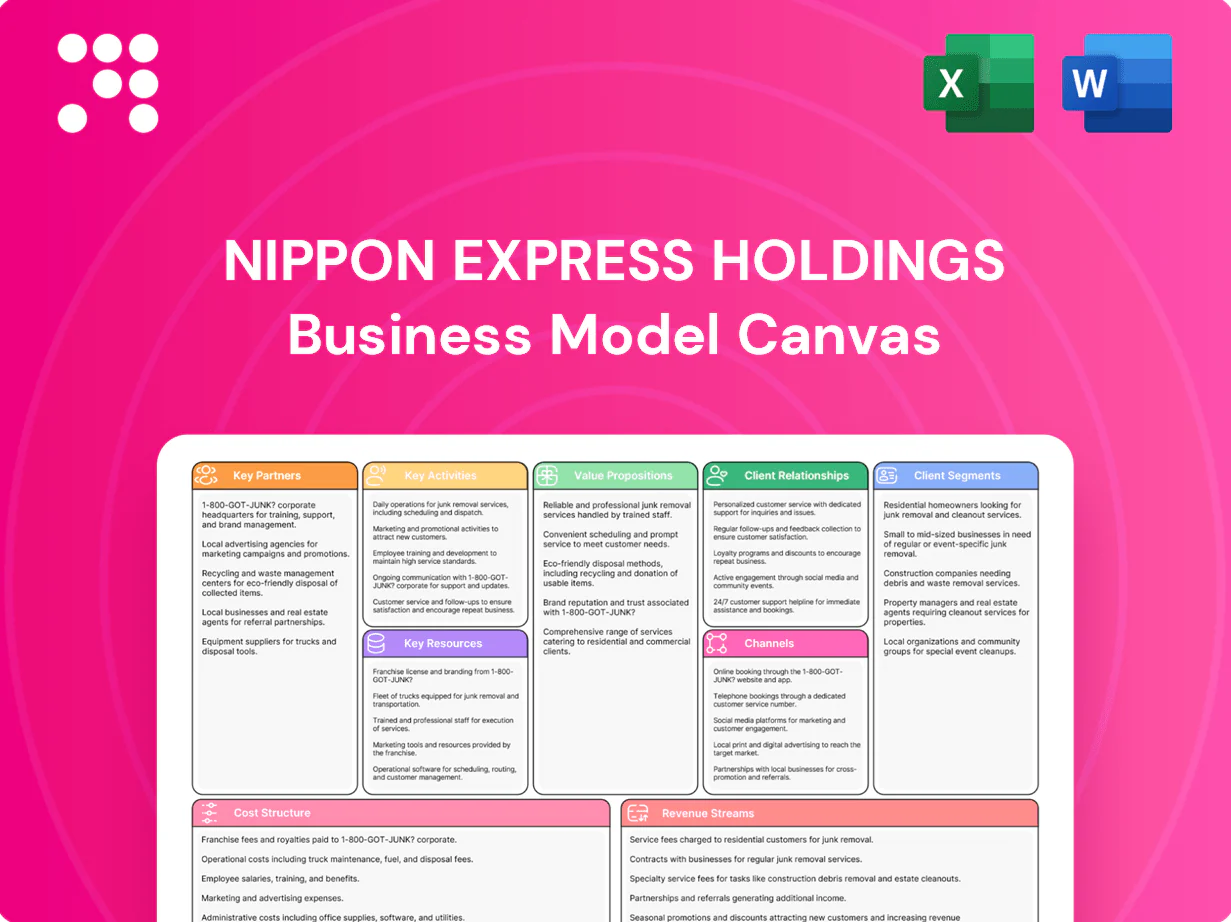
NIPPON EXPRESS HOLDINGS Business Model Canvas

Business Model Canvas for a global logistics leader - strategic blueprint
Unlock the full strategic blueprint behind NIPPON EXPRESS HOLDINGS’s business model with our detailed Business Model Canvas; discover how its logistics scale, partnerships drive margins, and customer segments are monetized. This concise yet powerful snapshot is ideal for investors, consultants, and executives seeking actionable insights. Purchase the full Word/Excel canvas to benchmark, strategize, and implement proven growth tactics.
Partnerships

Global carriers and airlines
Alliances with major airlines and ocean carriers secure seasonal capacity across key lanes, supporting Nippon Express Holdings, which reported consolidated revenue of about ¥2.1 trillion in FY2023. Preferential rates and reserved space improve on-time reliability during peak windows. Joint planning with carriers enables schedule optimization and contingency routing to reduce delays. Co-marketing drives sector-specific offerings for pharma and electronics customers.
Trucking and last-mile providers
Regional and local haulage partners extend Nippon Express' first-mile and last-mile reach across Japan and 40+ countries, supporting the group's consolidated revenue of JPY 1,772.8 billion in FY2023 (year ended March 2024). Flexible partner fleets allow rapid scaling for peak seasons and specialized equipment for oversize and temperature-sensitive cargo. Service-level alignment enables time-definite and cold-chain deliveries, while integrated dispatching and partner telemetry improve on-time performance and reduce unit costs.

Technology and visibility vendors
Partnerships with TMS/WMS, IoT and visibility platforms enable Nippon Express to deliver real-time tracking, with data integrations powering predictive ETAs and exception alerts; the global supply chain visibility market was roughly $3.5B in 2024. Advanced analytics drive demand forecasting and network optimization, while cybersecurity and cloud partners provide scalable, secure operations and compliance for enterprise logistics.

Customs brokers and regulatory bodies
Brokerage alliances streamline cross-border clearance and compliance, shortening dwell times and cutting detention costs; AEO/C-TPAT and GDP/GMP alignments in 2024 (coverage in over 90 countries) reduce inspection delays and operational risk for pharma and high-value cargo. Collaboration with authorities accelerates approvals for specialized cargo, while advisory input helps Nippon Express adapt rapidly to evolving trade rules and sanctions.
- Brokerage alliances: faster customs clearance
- AEO/C-TPAT & GDP/GMP: lower inspection delays (>90 countries 2024)
- Authority collaboration: expedited specialized approvals
- Advisory input: real-time sanctions & trade-rule adaptation
Industry specialists and infrastructure owners
Industry specialists—terminal operators, cold-chain providers, and packaging experts—deepen Nippon Express Holdings service capability, enabling joint solutions for automotive sequencing and clinical logistics; in 2024 the group leveraged 50+ bonded and temperature‑controlled hubs to tighten control over high‑value flows.
- Terminal operators: scalable throughput
- Cold‑chain: 50+ temp‑controlled hubs (2024)
- Packaging experts: reduced damage
- Co‑innovation: pilots for handling and sustainability
Cold‑chain scaled by TMS/IoT, 50+ temp hubs and customs ties; revenue JPY 1,772.8 bn
Strategic carrier, regional haulage, tech and customs partnerships enable Nippon Express Holdings to scale capacity, ensure cold‑chain integrity and cut cross‑border dwell (group revenue JPY 1,772.8 billion year ended Mar 2024). Integrated TMS/IoT and 50+ temp‑controlled hubs (2024) improve ETAs and reduce spoilage. Regulatory alignments (>90 countries) lower inspection risk and detention costs.
| Metric | Value |
|---|---|
| Revenue | JPY 1,772.8 bn (FY Mar 2024) |
| Temp hubs | 50+ (2024) |
| Visibility market | ~$3.5B (2024) |
What is included in the product
 Detailed Word Document
A comprehensive Business Model Canvas for NIPPON EXPRESS HOLDINGS detailing nine blocks—customer segments (corporates, import/export, e‑commerce), channels (multimodal network, digital platforms), value propositions (global logistics scale, integrated supply‑chain solutions, reliable IT), revenue streams, key partners/assets, cost structure, and governance; includes competitive advantages, SWOT-linked insights and polished narrative ideal for presentations and investor discussions.

 Customizable Excel Spreadsheet
High-level view of Nippon Express Holdings' logistics ecosystem with editable cells—quickly identify core components (global freight, warehousing, digital services) to relieve strategic planning and operational pain points.
Activities

Multimodal freight forwarding
Designing and executing end-to-end air, ocean and land shipments, Nippon Express coordinates carrier selection, booking, documentation and consolidation across its global network (about 40 countries, ~1,200 locations) to move cargo efficiently. Routing decisions explicitly balance speed, cost and risk to meet SLAs and reduce dwell times; in 2024 the group targeted a 5% reduction in transit times and a 3% cut in logistics costs. Robust exception management and real-time tracking minimize delays and penalties, lowering claim rates toward industry-leading levels.
Warehousing and distribution
Operating ambient and temperature-controlled facilities across over 40 countries, Nippon Express integrates inventory management, cross-docking and high-speed order fulfillment to maximize throughput. Value-added services—labeling, kitting and postponement—support customer-specific lead-time reduction and SKU customization. Continuous improvement programs raise picking accuracy and inventory turns, contributing to consolidated revenue of about JPY 2.1 trillion in FY2023.

Contract logistics design
Engineering tailored 3PL/4PL solutions for complex supply chains, aligning with a global 3PL market of about USD 1.1 trillion in 2024, focuses on network design and SOPs that set SLAs (commonly 99.5% on-time). Start-up management targets a 90-day ramp with training and tech deployment. Ongoing optimization aims to trim cost-to-serve by 10–15%.

Specialized handling and compliance
Digital integration and visibility
Implementing EDI/API with customers and partners enables real-time data exchange for Nippon Express, supporting its global operations alongside FY2023 consolidated revenue of 2.18 trillion JPY. Control towers monitor milestones and exceptions across the company's 40+ country network to drive operational resilience. Analytics feed forecasting and capacity planning while customer portals deliver quotes, bookings and live dashboards.
- EDI/API: real-time data
- Control towers: global milestone monitoring
- Analytics: forecasting & capacity planning
- Customer portals: quotes, bookings, dashboards
Global multimodal logistics network, JPY 2,360bn across ~40 countries
Nippon Express manages end-to-end air, ocean and land shipments across ~40 countries and ~1,200 locations, balancing speed, cost and risk to hit 2024 targets (−5% transit times, −3% logistics costs). Warehouse ops include ambient and temperature-controlled facilities, kitting and cross-docking supporting FY2023 revenue JPY 2,360bn. 3PL/4PL network design and control towers use EDI/API and analytics to reduce cost-to-serve 10–15%.
| Metric | 2024 / FY2023 |
|---|---|
| Revenue | JPY 2,360bn |
| Network | ~40 countries, ~1,200 locations |
| Transit target | −5% |
| Logistics cost target | −3% |
Full Version Awaits
Business Model Canvas
The NIPPON EXPRESS HOLDINGS Business Model Canvas shown here is a live preview of the exact deliverable, not a mockup. When you purchase, you’ll receive this same comprehensive document—fully formatted and complete—for immediate download. The file is ready to edit, present, and apply in your analysis and planning.

Business Model Canvas for a global logistics leader - strategic blueprint
Unlock the full strategic blueprint behind NIPPON EXPRESS HOLDINGS’s business model with our detailed Business Model Canvas; discover how its logistics scale, partnerships drive margins, and customer segments are monetized. This concise yet powerful snapshot is ideal for investors, consultants, and executives seeking actionable insights. Purchase the full Word/Excel canvas to benchmark, strategize, and implement proven growth tactics.
Partnerships
Global carriers and airlines
Alliances with major airlines and ocean carriers secure seasonal capacity across key lanes, supporting Nippon Express Holdings, which reported consolidated revenue of about ¥2.1 trillion in FY2023. Preferential rates and reserved space improve on-time reliability during peak windows. Joint planning with carriers enables schedule optimization and contingency routing to reduce delays. Co-marketing drives sector-specific offerings for pharma and electronics customers.
Trucking and last-mile providers
Regional and local haulage partners extend Nippon Express' first-mile and last-mile reach across Japan and 40+ countries, supporting the group's consolidated revenue of JPY 1,772.8 billion in FY2023 (year ended March 2024). Flexible partner fleets allow rapid scaling for peak seasons and specialized equipment for oversize and temperature-sensitive cargo. Service-level alignment enables time-definite and cold-chain deliveries, while integrated dispatching and partner telemetry improve on-time performance and reduce unit costs.
Technology and visibility vendors
Partnerships with TMS/WMS, IoT and visibility platforms enable Nippon Express to deliver real-time tracking, with data integrations powering predictive ETAs and exception alerts; the global supply chain visibility market was roughly $3.5B in 2024. Advanced analytics drive demand forecasting and network optimization, while cybersecurity and cloud partners provide scalable, secure operations and compliance for enterprise logistics.
Customs brokers and regulatory bodies
Brokerage alliances streamline cross-border clearance and compliance, shortening dwell times and cutting detention costs; AEO/C-TPAT and GDP/GMP alignments in 2024 (coverage in over 90 countries) reduce inspection delays and operational risk for pharma and high-value cargo. Collaboration with authorities accelerates approvals for specialized cargo, while advisory input helps Nippon Express adapt rapidly to evolving trade rules and sanctions.
- Brokerage alliances: faster customs clearance
- AEO/C-TPAT & GDP/GMP: lower inspection delays (>90 countries 2024)
- Authority collaboration: expedited specialized approvals
- Advisory input: real-time sanctions & trade-rule adaptation
Industry specialists and infrastructure owners
Industry specialists—terminal operators, cold-chain providers, and packaging experts—deepen Nippon Express Holdings service capability, enabling joint solutions for automotive sequencing and clinical logistics; in 2024 the group leveraged 50+ bonded and temperature‑controlled hubs to tighten control over high‑value flows.
- Terminal operators: scalable throughput
- Cold‑chain: 50+ temp‑controlled hubs (2024)
- Packaging experts: reduced damage
- Co‑innovation: pilots for handling and sustainability
Cold‑chain scaled by TMS/IoT, 50+ temp hubs and customs ties; revenue JPY 1,772.8 bn
Strategic carrier, regional haulage, tech and customs partnerships enable Nippon Express Holdings to scale capacity, ensure cold‑chain integrity and cut cross‑border dwell (group revenue JPY 1,772.8 billion year ended Mar 2024). Integrated TMS/IoT and 50+ temp‑controlled hubs (2024) improve ETAs and reduce spoilage. Regulatory alignments (>90 countries) lower inspection risk and detention costs.
| Metric | Value |
|---|---|
| Revenue | JPY 1,772.8 bn (FY Mar 2024) |
| Temp hubs | 50+ (2024) |
| Visibility market | ~$3.5B (2024) |
What is included in the product
Detailed Word Document
A comprehensive Business Model Canvas for NIPPON EXPRESS HOLDINGS detailing nine blocks—customer segments (corporates, import/export, e‑commerce), channels (multimodal network, digital platforms), value propositions (global logistics scale, integrated supply‑chain solutions, reliable IT), revenue streams, key partners/assets, cost structure, and governance; includes competitive advantages, SWOT-linked insights and polished narrative ideal for presentations and investor discussions.
Customizable Excel Spreadsheet
High-level view of Nippon Express Holdings' logistics ecosystem with editable cells—quickly identify core components (global freight, warehousing, digital services) to relieve strategic planning and operational pain points.
Activities
Multimodal freight forwarding
Designing and executing end-to-end air, ocean and land shipments, Nippon Express coordinates carrier selection, booking, documentation and consolidation across its global network (about 40 countries, ~1,200 locations) to move cargo efficiently. Routing decisions explicitly balance speed, cost and risk to meet SLAs and reduce dwell times; in 2024 the group targeted a 5% reduction in transit times and a 3% cut in logistics costs. Robust exception management and real-time tracking minimize delays and penalties, lowering claim rates toward industry-leading levels.
Warehousing and distribution
Operating ambient and temperature-controlled facilities across over 40 countries, Nippon Express integrates inventory management, cross-docking and high-speed order fulfillment to maximize throughput. Value-added services—labeling, kitting and postponement—support customer-specific lead-time reduction and SKU customization. Continuous improvement programs raise picking accuracy and inventory turns, contributing to consolidated revenue of about JPY 2.1 trillion in FY2023.
Contract logistics design
Engineering tailored 3PL/4PL solutions for complex supply chains, aligning with a global 3PL market of about USD 1.1 trillion in 2024, focuses on network design and SOPs that set SLAs (commonly 99.5% on-time). Start-up management targets a 90-day ramp with training and tech deployment. Ongoing optimization aims to trim cost-to-serve by 10–15%.
Specialized handling and compliance
Digital integration and visibility
Implementing EDI/API with customers and partners enables real-time data exchange for Nippon Express, supporting its global operations alongside FY2023 consolidated revenue of 2.18 trillion JPY. Control towers monitor milestones and exceptions across the company's 40+ country network to drive operational resilience. Analytics feed forecasting and capacity planning while customer portals deliver quotes, bookings and live dashboards.
- EDI/API: real-time data
- Control towers: global milestone monitoring
- Analytics: forecasting & capacity planning
- Customer portals: quotes, bookings, dashboards
Global multimodal logistics network, JPY 2,360bn across ~40 countries
Nippon Express manages end-to-end air, ocean and land shipments across ~40 countries and ~1,200 locations, balancing speed, cost and risk to hit 2024 targets (−5% transit times, −3% logistics costs). Warehouse ops include ambient and temperature-controlled facilities, kitting and cross-docking supporting FY2023 revenue JPY 2,360bn. 3PL/4PL network design and control towers use EDI/API and analytics to reduce cost-to-serve 10–15%.
| Metric | 2024 / FY2023 |
|---|---|
| Revenue | JPY 2,360bn |
| Network | ~40 countries, ~1,200 locations |
| Transit target | −5% |
| Logistics cost target | −3% |
Full Version Awaits
Business Model Canvas
The NIPPON EXPRESS HOLDINGS Business Model Canvas shown here is a live preview of the exact deliverable, not a mockup. When you purchase, you’ll receive this same comprehensive document—fully formatted and complete—for immediate download. The file is ready to edit, present, and apply in your analysis and planning.
Original: $10.00
-65%$10.00
$3.50Description
Business Model Canvas for a global logistics leader - strategic blueprint
Unlock the full strategic blueprint behind NIPPON EXPRESS HOLDINGS’s business model with our detailed Business Model Canvas; discover how its logistics scale, partnerships drive margins, and customer segments are monetized. This concise yet powerful snapshot is ideal for investors, consultants, and executives seeking actionable insights. Purchase the full Word/Excel canvas to benchmark, strategize, and implement proven growth tactics.
Partnerships
Global carriers and airlines
Alliances with major airlines and ocean carriers secure seasonal capacity across key lanes, supporting Nippon Express Holdings, which reported consolidated revenue of about ¥2.1 trillion in FY2023. Preferential rates and reserved space improve on-time reliability during peak windows. Joint planning with carriers enables schedule optimization and contingency routing to reduce delays. Co-marketing drives sector-specific offerings for pharma and electronics customers.
Trucking and last-mile providers
Regional and local haulage partners extend Nippon Express' first-mile and last-mile reach across Japan and 40+ countries, supporting the group's consolidated revenue of JPY 1,772.8 billion in FY2023 (year ended March 2024). Flexible partner fleets allow rapid scaling for peak seasons and specialized equipment for oversize and temperature-sensitive cargo. Service-level alignment enables time-definite and cold-chain deliveries, while integrated dispatching and partner telemetry improve on-time performance and reduce unit costs.
Technology and visibility vendors
Partnerships with TMS/WMS, IoT and visibility platforms enable Nippon Express to deliver real-time tracking, with data integrations powering predictive ETAs and exception alerts; the global supply chain visibility market was roughly $3.5B in 2024. Advanced analytics drive demand forecasting and network optimization, while cybersecurity and cloud partners provide scalable, secure operations and compliance for enterprise logistics.
Customs brokers and regulatory bodies
Brokerage alliances streamline cross-border clearance and compliance, shortening dwell times and cutting detention costs; AEO/C-TPAT and GDP/GMP alignments in 2024 (coverage in over 90 countries) reduce inspection delays and operational risk for pharma and high-value cargo. Collaboration with authorities accelerates approvals for specialized cargo, while advisory input helps Nippon Express adapt rapidly to evolving trade rules and sanctions.
- Brokerage alliances: faster customs clearance
- AEO/C-TPAT & GDP/GMP: lower inspection delays (>90 countries 2024)
- Authority collaboration: expedited specialized approvals
- Advisory input: real-time sanctions & trade-rule adaptation
Industry specialists and infrastructure owners
Industry specialists—terminal operators, cold-chain providers, and packaging experts—deepen Nippon Express Holdings service capability, enabling joint solutions for automotive sequencing and clinical logistics; in 2024 the group leveraged 50+ bonded and temperature‑controlled hubs to tighten control over high‑value flows.
- Terminal operators: scalable throughput
- Cold‑chain: 50+ temp‑controlled hubs (2024)
- Packaging experts: reduced damage
- Co‑innovation: pilots for handling and sustainability
Cold‑chain scaled by TMS/IoT, 50+ temp hubs and customs ties; revenue JPY 1,772.8 bn
Strategic carrier, regional haulage, tech and customs partnerships enable Nippon Express Holdings to scale capacity, ensure cold‑chain integrity and cut cross‑border dwell (group revenue JPY 1,772.8 billion year ended Mar 2024). Integrated TMS/IoT and 50+ temp‑controlled hubs (2024) improve ETAs and reduce spoilage. Regulatory alignments (>90 countries) lower inspection risk and detention costs.
| Metric | Value |
|---|---|
| Revenue | JPY 1,772.8 bn (FY Mar 2024) |
| Temp hubs | 50+ (2024) |
| Visibility market | ~$3.5B (2024) |
What is included in the product
Detailed Word Document
A comprehensive Business Model Canvas for NIPPON EXPRESS HOLDINGS detailing nine blocks—customer segments (corporates, import/export, e‑commerce), channels (multimodal network, digital platforms), value propositions (global logistics scale, integrated supply‑chain solutions, reliable IT), revenue streams, key partners/assets, cost structure, and governance; includes competitive advantages, SWOT-linked insights and polished narrative ideal for presentations and investor discussions.
Customizable Excel Spreadsheet
High-level view of Nippon Express Holdings' logistics ecosystem with editable cells—quickly identify core components (global freight, warehousing, digital services) to relieve strategic planning and operational pain points.
Activities
Multimodal freight forwarding
Designing and executing end-to-end air, ocean and land shipments, Nippon Express coordinates carrier selection, booking, documentation and consolidation across its global network (about 40 countries, ~1,200 locations) to move cargo efficiently. Routing decisions explicitly balance speed, cost and risk to meet SLAs and reduce dwell times; in 2024 the group targeted a 5% reduction in transit times and a 3% cut in logistics costs. Robust exception management and real-time tracking minimize delays and penalties, lowering claim rates toward industry-leading levels.
Warehousing and distribution
Operating ambient and temperature-controlled facilities across over 40 countries, Nippon Express integrates inventory management, cross-docking and high-speed order fulfillment to maximize throughput. Value-added services—labeling, kitting and postponement—support customer-specific lead-time reduction and SKU customization. Continuous improvement programs raise picking accuracy and inventory turns, contributing to consolidated revenue of about JPY 2.1 trillion in FY2023.
Contract logistics design
Engineering tailored 3PL/4PL solutions for complex supply chains, aligning with a global 3PL market of about USD 1.1 trillion in 2024, focuses on network design and SOPs that set SLAs (commonly 99.5% on-time). Start-up management targets a 90-day ramp with training and tech deployment. Ongoing optimization aims to trim cost-to-serve by 10–15%.
Specialized handling and compliance
Digital integration and visibility
Implementing EDI/API with customers and partners enables real-time data exchange for Nippon Express, supporting its global operations alongside FY2023 consolidated revenue of 2.18 trillion JPY. Control towers monitor milestones and exceptions across the company's 40+ country network to drive operational resilience. Analytics feed forecasting and capacity planning while customer portals deliver quotes, bookings and live dashboards.
- EDI/API: real-time data
- Control towers: global milestone monitoring
- Analytics: forecasting & capacity planning
- Customer portals: quotes, bookings, dashboards
Global multimodal logistics network, JPY 2,360bn across ~40 countries
Nippon Express manages end-to-end air, ocean and land shipments across ~40 countries and ~1,200 locations, balancing speed, cost and risk to hit 2024 targets (−5% transit times, −3% logistics costs). Warehouse ops include ambient and temperature-controlled facilities, kitting and cross-docking supporting FY2023 revenue JPY 2,360bn. 3PL/4PL network design and control towers use EDI/API and analytics to reduce cost-to-serve 10–15%.
| Metric | 2024 / FY2023 |
|---|---|
| Revenue | JPY 2,360bn |
| Network | ~40 countries, ~1,200 locations |
| Transit target | −5% |
| Logistics cost target | −3% |
Full Version Awaits
Business Model Canvas
The NIPPON EXPRESS HOLDINGS Business Model Canvas shown here is a live preview of the exact deliverable, not a mockup. When you purchase, you’ll receive this same comprehensive document—fully formatted and complete—for immediate download. The file is ready to edit, present, and apply in your analysis and planning.











