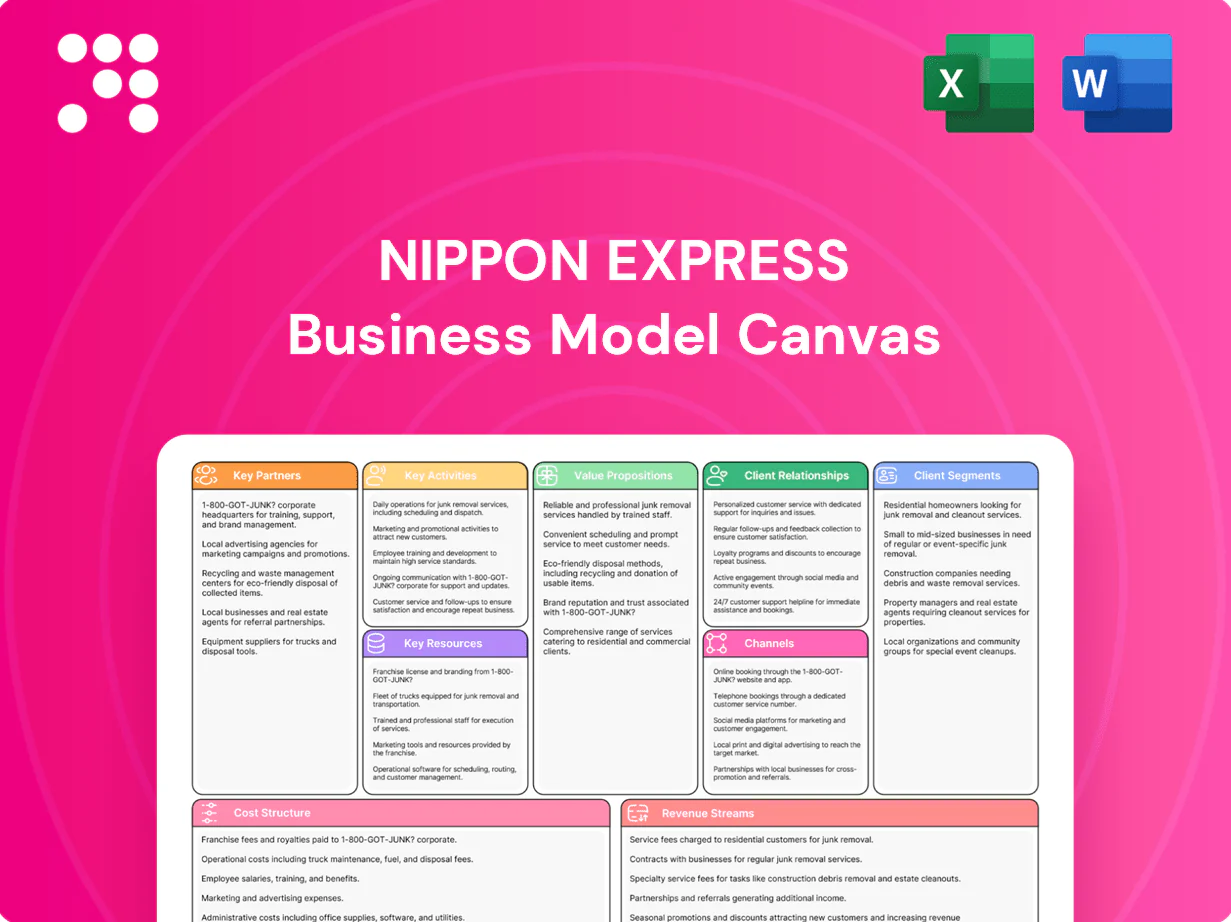
Nippon Express Business Model Canvas

Logistics Business Model Canvas: concise strategic blueprint for investors and founders
Unlock the full strategic blueprint behind Nippon Express’s business model in our detailed Business Model Canvas—three to five focused sentences that map value propositions, revenue streams, key partners and growth levers. Ideal for investors, consultants, and founders seeking actionable insights; download the full Word/Excel canvas to benchmark and apply proven logistics strategies.
Partnerships

Airlines and ocean carriers
Securing capacity and competitive rates with major air and ocean carriers underpins Nippon Expresss global routing flexibility, with strategic block-space and vessel-sharing agreements stabilizing service levels during peak seasons. These partnerships reduce transit variability and enhance multimodal options while enabling priority handling for time-sensitive cargo, supporting reliable lead times and customer SLAs.
Ports, terminals, and customs brokers
Relationships with port authorities, terminal operators and local brokers cut handoff friction across Nippon Express networks in over 40 countries and some 700+ global locations, accelerating cargo flow. Coordinated berth scheduling, drayage and yard operations reduce dwell time, supporting on-time performance across key trade lanes. Local brokerage expertise streamlines clearance and mitigates regulatory delays, sustaining reliable cross-border service in 2024.

Technology and data providers
Alliances with TMS/WMS, visibility, IoT and AI vendors power Nippon Expresss real-time tracking and optimization across its 40+ country network. Integrated data feeds improve ETA accuracy and exception management, reducing delays and driving operational KPIs. Cybersecurity partners harden platforms and protect customer data in line with 2024 compliance standards. These links enable scalable digital services globally.

3PL/4PL and last-mile partners
Complementary 3PL/4PL and last-mile partners extend Nippon Express reach into over 40 countries and enable new delivery models, covering cross-dock, parcel, white-glove and reverse logistics to maintain service continuity.
Partnerships provide flexible capacity to absorb demand spikes and seasonal surges, smoothing network utilization and reducing capital-intensive fleet expansion.
These alliances improve end-to-end continuity, reducing transit disruptions and improving final-mile delivery performance.
- coverage: over 40 countries
- services: cross-dock, parcel, white-glove, reverse
- benefit: flexible capacity for demand spikes
Industry bodies and compliance agencies
Engagement with IATA (about 290 member airlines representing roughly 82% of global air traffic), FIATA (active in ~150 countries), customs authorities and trade groups ensures Nippon Express adheres to evolving rules and global best practices. Active participation helps shape standards and anticipate regulatory shifts, while certifications and audits reinforce operational credibility and reduce compliance risk for customers.
- IATA: 290 airlines, ~82% air traffic
- FIATA: ~150 countries
- Certifications/audits: strengthen customer compliance assurance
Flexible global logistics: capacity across 700+ locations in 40+ countries
Securing carrier block-space and vessel-sharing deals plus 3PL/last-mile partners supports capacity flexibility across 700+ global locations in 40+ countries, absorbing seasonal surges without heavy fleet capex. Port, customs and trade-group ties (IATA 290 airlines ~82% traffic; FIATA ~150 countries) reduce dwell and compliance risk. Tech and cybersecurity alliances improve ETA accuracy and network visibility.
| Metric | Value (2024) |
|---|---|
| Global locations | 700+ |
| Countries served | 40+ |
| IATA coverage | 290 airlines / ~82% |
| FIATA presence | ~150 countries |
What is included in the product
 Detailed Word Document
A concise, pre-written Business Model Canvas for Nippon Express outlining customer segments, channels, value propositions and revenue streams across the 9 BMC blocks, reflecting its global logistics network, asset-light and asset-heavy service mix, competitive advantages, SWOT-linked insights and investor-ready narrative for strategy and funding discussions.

 Customizable Excel Spreadsheet
Clear, editable one-page Business Model Canvas that cuts through Nippon Express’s complex global logistics, multimodal operations, and regulatory pain points to reveal cost drivers and value propositions. Ideal for teams to quickly align strategy, streamline processes, and communicate improvements across stakeholders.
Activities

Global freight forwarding
Planning and executing air and ocean shipments across lanes is core, with Nippon Express coordinating carrier procurement, consolidation and documentation to maintain flow; the group operated in over 40 countries in 2024. Exception handling and dynamic re-routing protect service levels, while multimodal integration (sea/air/land) optimizes cost and transit speed.
Warehousing and distribution
Operating bonded and ambient/DC facilities enables Nippon Express to offer storage, picking and value-added services across a network spanning over 40 countries and 700 locations, supporting global trade compliance and local fulfillment. Cross-dock and regional distribution operations shorten lead times, often cutting transit time by 30–50% for regional flows. Tight inventory control and demand-aligned stock management improve turnover and reduce carrying costs, while network design balances service levels against cost to optimize total landed cost.

Customs clearance and trade compliance
Preparing accurate entries, tariff classifications and origin documentation speeds border passage by up to 30%, while sanctions screening and duty-optimization programs commonly reduce landed cost 1–3% and lower compliance fines. AEO/C-TPAT-aligned processes cut physical inspections roughly 20–40% and enhance security. Continuous monitoring tracks 1,000+ regulatory updates annually to adapt controls in real time.

Supply chain design and optimization
Engineering teams model networks, lanes, and inventory policies to optimize flow for Nippon Express, leveraging data from a global operator with about 2 trillion JPY revenue (FY2023); scenario analysis quantifies cost-to-serve and resilience across modal options, feeding KPI dashboards that track lead times, fill rates, and cost-per-shipment.
- Models: network, lanes, inventory
- Analysis: scenario cost-to-serve & resilience
- KPIs: lead time, fill rate, cost/ship
- Outcome: inputs to multi-year logistics strategy
Digital platform management and analytics
- Visibility: TMS/WMS uptime & SLA adherence
- Data: telematics + carrier events aggregation
- Analytics: predictive ETA, disruption mitigation
- Integration: REST APIs for customer systems
End-to-end global logistics: 700+ DCs, operations in 40+ countries, 30-50% faster transit
Core activities: execution of global air/ocean/land shipments with carrier procurement and exception handling across 40+ countries; operation of 700+ DCs for storage, cross-dock and value-added services; customs/compliance and duty optimization plus network engineering and TMS/WMS-driven visibility and analytics.
| Metric | Value (2024) |
|---|---|
| Consolidated revenue | 2,059 bn JPY (FY2023) |
| Countries | 40+ |
| Locations/DCs | 700+ |
| Inspection reduction | 20–40% |
| Transit time cut (regional) | 30–50% |
| Duty optimization | 1–3% landed cost |
Full Document Unlocks After Purchase
Business Model Canvas
The Nippon Express Business Model Canvas shown here is the actual deliverable, not a mockup, and reflects the full structure and content you’ll receive. Upon purchase you’ll get this exact file—complete, editable, and formatted for immediate use. No placeholders, no surprises.

Logistics Business Model Canvas: concise strategic blueprint for investors and founders
Unlock the full strategic blueprint behind Nippon Express’s business model in our detailed Business Model Canvas—three to five focused sentences that map value propositions, revenue streams, key partners and growth levers. Ideal for investors, consultants, and founders seeking actionable insights; download the full Word/Excel canvas to benchmark and apply proven logistics strategies.
Partnerships
Airlines and ocean carriers
Securing capacity and competitive rates with major air and ocean carriers underpins Nippon Expresss global routing flexibility, with strategic block-space and vessel-sharing agreements stabilizing service levels during peak seasons. These partnerships reduce transit variability and enhance multimodal options while enabling priority handling for time-sensitive cargo, supporting reliable lead times and customer SLAs.
Ports, terminals, and customs brokers
Relationships with port authorities, terminal operators and local brokers cut handoff friction across Nippon Express networks in over 40 countries and some 700+ global locations, accelerating cargo flow. Coordinated berth scheduling, drayage and yard operations reduce dwell time, supporting on-time performance across key trade lanes. Local brokerage expertise streamlines clearance and mitigates regulatory delays, sustaining reliable cross-border service in 2024.
Technology and data providers
Alliances with TMS/WMS, visibility, IoT and AI vendors power Nippon Expresss real-time tracking and optimization across its 40+ country network. Integrated data feeds improve ETA accuracy and exception management, reducing delays and driving operational KPIs. Cybersecurity partners harden platforms and protect customer data in line with 2024 compliance standards. These links enable scalable digital services globally.
3PL/4PL and last-mile partners
Complementary 3PL/4PL and last-mile partners extend Nippon Express reach into over 40 countries and enable new delivery models, covering cross-dock, parcel, white-glove and reverse logistics to maintain service continuity.
Partnerships provide flexible capacity to absorb demand spikes and seasonal surges, smoothing network utilization and reducing capital-intensive fleet expansion.
These alliances improve end-to-end continuity, reducing transit disruptions and improving final-mile delivery performance.
- coverage: over 40 countries
- services: cross-dock, parcel, white-glove, reverse
- benefit: flexible capacity for demand spikes
Industry bodies and compliance agencies
Engagement with IATA (about 290 member airlines representing roughly 82% of global air traffic), FIATA (active in ~150 countries), customs authorities and trade groups ensures Nippon Express adheres to evolving rules and global best practices. Active participation helps shape standards and anticipate regulatory shifts, while certifications and audits reinforce operational credibility and reduce compliance risk for customers.
- IATA: 290 airlines, ~82% air traffic
- FIATA: ~150 countries
- Certifications/audits: strengthen customer compliance assurance
Flexible global logistics: capacity across 700+ locations in 40+ countries
Securing carrier block-space and vessel-sharing deals plus 3PL/last-mile partners supports capacity flexibility across 700+ global locations in 40+ countries, absorbing seasonal surges without heavy fleet capex. Port, customs and trade-group ties (IATA 290 airlines ~82% traffic; FIATA ~150 countries) reduce dwell and compliance risk. Tech and cybersecurity alliances improve ETA accuracy and network visibility.
| Metric | Value (2024) |
|---|---|
| Global locations | 700+ |
| Countries served | 40+ |
| IATA coverage | 290 airlines / ~82% |
| FIATA presence | ~150 countries |
What is included in the product
Detailed Word Document
A concise, pre-written Business Model Canvas for Nippon Express outlining customer segments, channels, value propositions and revenue streams across the 9 BMC blocks, reflecting its global logistics network, asset-light and asset-heavy service mix, competitive advantages, SWOT-linked insights and investor-ready narrative for strategy and funding discussions.
Customizable Excel Spreadsheet
Clear, editable one-page Business Model Canvas that cuts through Nippon Express’s complex global logistics, multimodal operations, and regulatory pain points to reveal cost drivers and value propositions. Ideal for teams to quickly align strategy, streamline processes, and communicate improvements across stakeholders.
Activities
Global freight forwarding
Planning and executing air and ocean shipments across lanes is core, with Nippon Express coordinating carrier procurement, consolidation and documentation to maintain flow; the group operated in over 40 countries in 2024. Exception handling and dynamic re-routing protect service levels, while multimodal integration (sea/air/land) optimizes cost and transit speed.
Warehousing and distribution
Operating bonded and ambient/DC facilities enables Nippon Express to offer storage, picking and value-added services across a network spanning over 40 countries and 700 locations, supporting global trade compliance and local fulfillment. Cross-dock and regional distribution operations shorten lead times, often cutting transit time by 30–50% for regional flows. Tight inventory control and demand-aligned stock management improve turnover and reduce carrying costs, while network design balances service levels against cost to optimize total landed cost.
Customs clearance and trade compliance
Preparing accurate entries, tariff classifications and origin documentation speeds border passage by up to 30%, while sanctions screening and duty-optimization programs commonly reduce landed cost 1–3% and lower compliance fines. AEO/C-TPAT-aligned processes cut physical inspections roughly 20–40% and enhance security. Continuous monitoring tracks 1,000+ regulatory updates annually to adapt controls in real time.
Supply chain design and optimization
Engineering teams model networks, lanes, and inventory policies to optimize flow for Nippon Express, leveraging data from a global operator with about 2 trillion JPY revenue (FY2023); scenario analysis quantifies cost-to-serve and resilience across modal options, feeding KPI dashboards that track lead times, fill rates, and cost-per-shipment.
- Models: network, lanes, inventory
- Analysis: scenario cost-to-serve & resilience
- KPIs: lead time, fill rate, cost/ship
- Outcome: inputs to multi-year logistics strategy
Digital platform management and analytics
- Visibility: TMS/WMS uptime & SLA adherence
- Data: telematics + carrier events aggregation
- Analytics: predictive ETA, disruption mitigation
- Integration: REST APIs for customer systems
End-to-end global logistics: 700+ DCs, operations in 40+ countries, 30-50% faster transit
Core activities: execution of global air/ocean/land shipments with carrier procurement and exception handling across 40+ countries; operation of 700+ DCs for storage, cross-dock and value-added services; customs/compliance and duty optimization plus network engineering and TMS/WMS-driven visibility and analytics.
| Metric | Value (2024) |
|---|---|
| Consolidated revenue | 2,059 bn JPY (FY2023) |
| Countries | 40+ |
| Locations/DCs | 700+ |
| Inspection reduction | 20–40% |
| Transit time cut (regional) | 30–50% |
| Duty optimization | 1–3% landed cost |
Full Document Unlocks After Purchase
Business Model Canvas
The Nippon Express Business Model Canvas shown here is the actual deliverable, not a mockup, and reflects the full structure and content you’ll receive. Upon purchase you’ll get this exact file—complete, editable, and formatted for immediate use. No placeholders, no surprises.
Original: $10.00
-65%$10.00
$3.50Description
Logistics Business Model Canvas: concise strategic blueprint for investors and founders
Unlock the full strategic blueprint behind Nippon Express’s business model in our detailed Business Model Canvas—three to five focused sentences that map value propositions, revenue streams, key partners and growth levers. Ideal for investors, consultants, and founders seeking actionable insights; download the full Word/Excel canvas to benchmark and apply proven logistics strategies.
Partnerships
Airlines and ocean carriers
Securing capacity and competitive rates with major air and ocean carriers underpins Nippon Expresss global routing flexibility, with strategic block-space and vessel-sharing agreements stabilizing service levels during peak seasons. These partnerships reduce transit variability and enhance multimodal options while enabling priority handling for time-sensitive cargo, supporting reliable lead times and customer SLAs.
Ports, terminals, and customs brokers
Relationships with port authorities, terminal operators and local brokers cut handoff friction across Nippon Express networks in over 40 countries and some 700+ global locations, accelerating cargo flow. Coordinated berth scheduling, drayage and yard operations reduce dwell time, supporting on-time performance across key trade lanes. Local brokerage expertise streamlines clearance and mitigates regulatory delays, sustaining reliable cross-border service in 2024.
Technology and data providers
Alliances with TMS/WMS, visibility, IoT and AI vendors power Nippon Expresss real-time tracking and optimization across its 40+ country network. Integrated data feeds improve ETA accuracy and exception management, reducing delays and driving operational KPIs. Cybersecurity partners harden platforms and protect customer data in line with 2024 compliance standards. These links enable scalable digital services globally.
3PL/4PL and last-mile partners
Complementary 3PL/4PL and last-mile partners extend Nippon Express reach into over 40 countries and enable new delivery models, covering cross-dock, parcel, white-glove and reverse logistics to maintain service continuity.
Partnerships provide flexible capacity to absorb demand spikes and seasonal surges, smoothing network utilization and reducing capital-intensive fleet expansion.
These alliances improve end-to-end continuity, reducing transit disruptions and improving final-mile delivery performance.
- coverage: over 40 countries
- services: cross-dock, parcel, white-glove, reverse
- benefit: flexible capacity for demand spikes
Industry bodies and compliance agencies
Engagement with IATA (about 290 member airlines representing roughly 82% of global air traffic), FIATA (active in ~150 countries), customs authorities and trade groups ensures Nippon Express adheres to evolving rules and global best practices. Active participation helps shape standards and anticipate regulatory shifts, while certifications and audits reinforce operational credibility and reduce compliance risk for customers.
- IATA: 290 airlines, ~82% air traffic
- FIATA: ~150 countries
- Certifications/audits: strengthen customer compliance assurance
Flexible global logistics: capacity across 700+ locations in 40+ countries
Securing carrier block-space and vessel-sharing deals plus 3PL/last-mile partners supports capacity flexibility across 700+ global locations in 40+ countries, absorbing seasonal surges without heavy fleet capex. Port, customs and trade-group ties (IATA 290 airlines ~82% traffic; FIATA ~150 countries) reduce dwell and compliance risk. Tech and cybersecurity alliances improve ETA accuracy and network visibility.
| Metric | Value (2024) |
|---|---|
| Global locations | 700+ |
| Countries served | 40+ |
| IATA coverage | 290 airlines / ~82% |
| FIATA presence | ~150 countries |
What is included in the product
Detailed Word Document
A concise, pre-written Business Model Canvas for Nippon Express outlining customer segments, channels, value propositions and revenue streams across the 9 BMC blocks, reflecting its global logistics network, asset-light and asset-heavy service mix, competitive advantages, SWOT-linked insights and investor-ready narrative for strategy and funding discussions.
Customizable Excel Spreadsheet
Clear, editable one-page Business Model Canvas that cuts through Nippon Express’s complex global logistics, multimodal operations, and regulatory pain points to reveal cost drivers and value propositions. Ideal for teams to quickly align strategy, streamline processes, and communicate improvements across stakeholders.
Activities
Global freight forwarding
Planning and executing air and ocean shipments across lanes is core, with Nippon Express coordinating carrier procurement, consolidation and documentation to maintain flow; the group operated in over 40 countries in 2024. Exception handling and dynamic re-routing protect service levels, while multimodal integration (sea/air/land) optimizes cost and transit speed.
Warehousing and distribution
Operating bonded and ambient/DC facilities enables Nippon Express to offer storage, picking and value-added services across a network spanning over 40 countries and 700 locations, supporting global trade compliance and local fulfillment. Cross-dock and regional distribution operations shorten lead times, often cutting transit time by 30–50% for regional flows. Tight inventory control and demand-aligned stock management improve turnover and reduce carrying costs, while network design balances service levels against cost to optimize total landed cost.
Customs clearance and trade compliance
Preparing accurate entries, tariff classifications and origin documentation speeds border passage by up to 30%, while sanctions screening and duty-optimization programs commonly reduce landed cost 1–3% and lower compliance fines. AEO/C-TPAT-aligned processes cut physical inspections roughly 20–40% and enhance security. Continuous monitoring tracks 1,000+ regulatory updates annually to adapt controls in real time.
Supply chain design and optimization
Engineering teams model networks, lanes, and inventory policies to optimize flow for Nippon Express, leveraging data from a global operator with about 2 trillion JPY revenue (FY2023); scenario analysis quantifies cost-to-serve and resilience across modal options, feeding KPI dashboards that track lead times, fill rates, and cost-per-shipment.
- Models: network, lanes, inventory
- Analysis: scenario cost-to-serve & resilience
- KPIs: lead time, fill rate, cost/ship
- Outcome: inputs to multi-year logistics strategy
Digital platform management and analytics
- Visibility: TMS/WMS uptime & SLA adherence
- Data: telematics + carrier events aggregation
- Analytics: predictive ETA, disruption mitigation
- Integration: REST APIs for customer systems
End-to-end global logistics: 700+ DCs, operations in 40+ countries, 30-50% faster transit
Core activities: execution of global air/ocean/land shipments with carrier procurement and exception handling across 40+ countries; operation of 700+ DCs for storage, cross-dock and value-added services; customs/compliance and duty optimization plus network engineering and TMS/WMS-driven visibility and analytics.
| Metric | Value (2024) |
|---|---|
| Consolidated revenue | 2,059 bn JPY (FY2023) |
| Countries | 40+ |
| Locations/DCs | 700+ |
| Inspection reduction | 20–40% |
| Transit time cut (regional) | 30–50% |
| Duty optimization | 1–3% landed cost |
Full Document Unlocks After Purchase
Business Model Canvas
The Nippon Express Business Model Canvas shown here is the actual deliverable, not a mockup, and reflects the full structure and content you’ll receive. Upon purchase you’ll get this exact file—complete, editable, and formatted for immediate use. No placeholders, no surprises.











