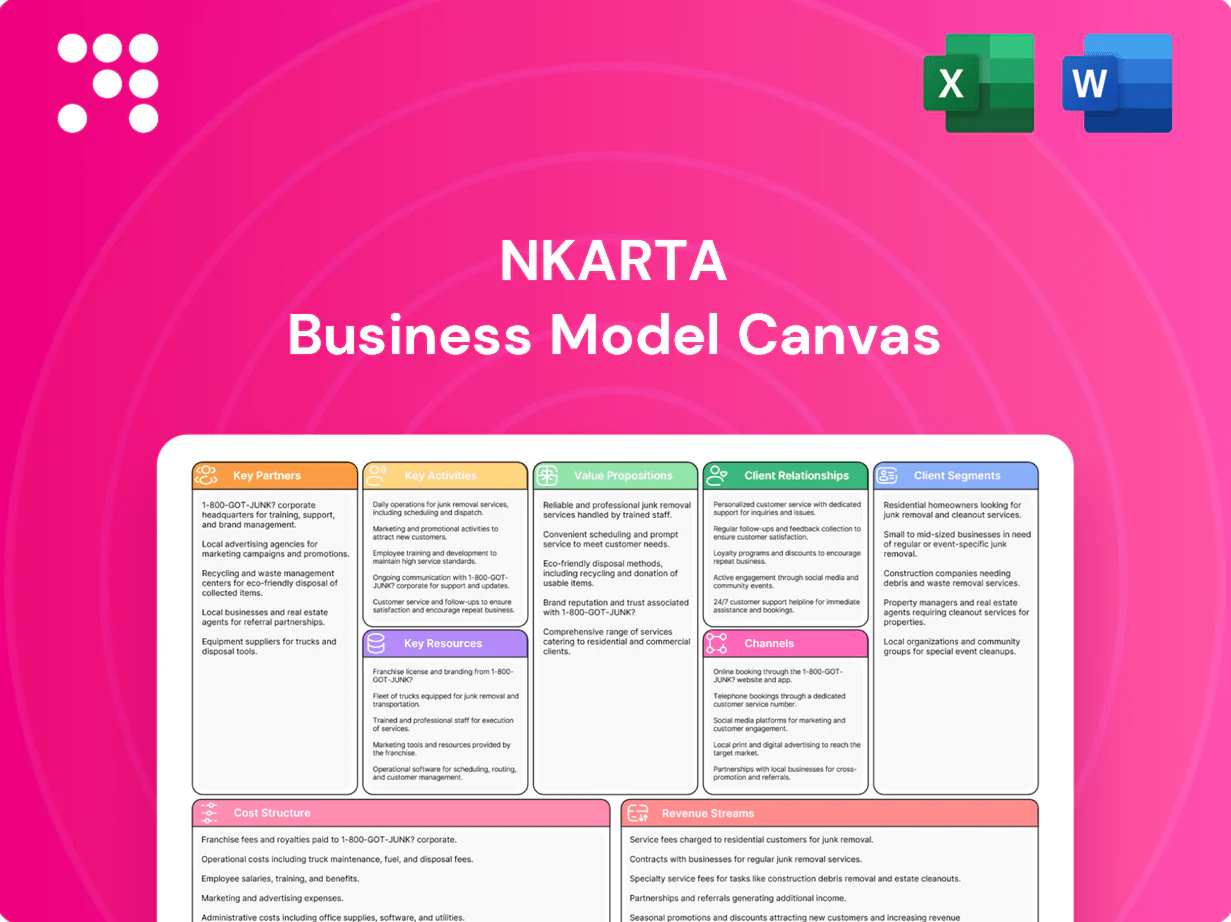
Nkarta Business Model Canvas

Unlock the strategic Business Model Canvas for a leading cell therapy company
Unlock the strategic blueprint behind Nkarta with our full Business Model Canvas—detailed, company-specific insight into value propositions, revenue streams, partnerships, and scaling levers. Ideal for investors, advisors, and founders seeking actionable guidance; download the editable Word & Excel files to benchmark, plan, and execute confidently.
Partnerships

Academic and clinical research centers
Collaborations with leading cancer institutes supply trial sites, scientific insight, and early patient access, enabling Nkarta to run iterative first-in-human studies in 2024. These centers support protocol design, translational research, and correlative studies that de-risk IND-enabling programs. KOL influence from academic partners accelerates clinical adoption and investigator-led uptake. Long-term alliances permit rapid NK construct iteration across successive cohorts.
CDMOs and GMP manufacturing partners
Specialized CDMOs supply viral vectors, gene‑editing services and scalable GMP production, with the biologics CDMO market estimated at about $80 billion in 2024, enabling Nkarta to outsource complex inputs and accelerate programs. These partners validate processes, support tech transfer and ensure lot‑to‑lot consistency under quality systems aligned to FDA and EMA GMP standards. Flexible capacity reduces Nkarta’s capex needs and shortens time‑to‑clinic.

Donor sourcing and cell banking organizations
Access to qualified donors and master cell banks underpins reliable allogeneic supply for Nkarta, aligning with over 200 active allogeneic cell therapy trials globally in 2024. Partners manage donor screening, informed consent and traceability, supporting GMP-compliant banks that enable scalable batch manufacturing and future-proofing. Ethical sourcing reduces regulatory risk and protects reputation.

Logistics and cold chain providers
Logistics and cold chain partners ensure cryopreserved Nkarta products maintain clinical-grade integrity from manufacturing to patient, leveraging validated shippers, real-time monitoring, and strict chain-of-custody protocols. Their global networks support multinational trials and commercial launches; the global cold chain market topped $300 billion in 2023. Rapid dispatch capabilities are essential to uphold Nkarta’s off-the-shelf delivery promise.
- Specialists preserve product integrity
- Validated shippers + real-time monitoring
- Chain-of-custody compliance
- Global reach for multinational trials
- Rapid dispatch to meet off-the-shelf timelines
Biopharma co-development and licensing partners
Biopharma co-development and licensing partners expand Nkarta’s indications, enable combination regimens, and open new geographies while contributing immuno-oncology assets, commercialization capabilities, and capital. Deal structures typically layer co-development, milestone payments, and royalties to align incentives. Joint programs accelerate evidence generation and speed market entry through shared trials and regulatory resources.
- Alliances: expand indications and geographies
- Contributions: IO assets, commercialization, capital
- Structures: co-dev, milestones, royalties
- Benefit: faster evidence and market access
Partners de-risk INDs; FIH24; CDMO $80B, cold-chain $300B
Strategic partnerships with cancer centers, CDMOs, donor banks and cold‑chain/logistics providers de‑risk IND programs, enable iterative first‑in‑human studies in 2024, and outsource capital‑intensive manufacturing. Market context: biologics CDMO ~$80B (2024), >200 active allogeneic trials (2024), cold‑chain >$300B (2023).
| Partner | Role | 2024 Metric |
|---|---|---|
| Academic centers | Trial sites/KOLs | First‑in‑human 2024 |
| CDMOs | GMP manufacture | $80B market |
| Donor banks | Allogeneic supply | >200 trials |
| Cold chain | Logistics | $300B (2023) |
What is included in the product
 Detailed Word Document
A comprehensive, pre-written business model tailored to Nkarta’s cell‑therapy strategy, covering customer segments, channels, value propositions, operations, partnerships and revenue streams across the 9 classic BMC blocks; includes competitive advantage analysis, SWOT-linked insights and investor-ready narratives to support funding and commercialization of off‑the‑shelf NK cell therapies.

 Customizable Excel Spreadsheet
High-level view of Nkarta’s business model with editable cells, relieving the pain of scattered strategy documents and accelerating alignment across R&D, commercialization, and partners.
Activities

NK cell engineering and process development
Designing CARs, cytokine support cassettes, and persistence-enhancing edits is core to NK cell programs, targeting improved cytotoxicity and durability; NK cell platforms in 2024 aim for 30%+ potency gains versus unmodified NKs. Process optimization focuses on yield, potency, and cost-per-dose (manufacturing often cited >$200,000 per patient for cell therapies). Closed-system automation reduces variability and labor, and continuous CMC improvements prepare scale-up to commercial batches in 2024 capacity planning.
Preclinical and translational research
Preclinical and translational research performs in vitro cytotoxicity assays and in vivo efficacy/safety studies to de-risk programs, with oncology historically showing ~5% approval rates from candidate to market. Biomarker discovery informs patient selection and can boost response rates in trials by enabling enriched cohorts. Resistance and combination studies shape go/no-go strategy, while PK/PD models guide dosing and schedules to optimize exposure and reduce toxicities.

Clinical development and trial execution
Phase 1–3 studies establish safety, efficacy and comparators, with rigorous protocol-driven endpoints to support regulatory filings. Site activation, monitoring and centralized data management ensure data integrity and reproducibility. Patient access and diversity are prioritized through targeted outreach and inclusion criteria, while adaptive trial designs accelerate learning and enable prespecified modifications to speed decisions.

Regulatory strategy and quality management
Regulatory strategy and quality management at Nkarta pursue IND and IMPD submissions and leverage RMAT/EMA PRIME pathways where applicable; CMC documentation and validation are rigorously maintained to support clinical and manufacturing readiness. The QMS spans GMP, GCP, and pharmacovigilance with global alignment to enable synchronized multi-region filings.
- IND/IMPD filings
- RMAT/PRIME pathways
- Robust CMC validation
- QMS: GMP, GCP, PV
- Global regulatory alignment
Supply chain and commercial readiness
Supply chain and commercial readiness at Nkarta in 2024 centers on batch planning, cryostorage, and release testing to enable reliable product availability across clinical sites.
Forecasting models connect observed clinical demand to manufacturing slot allocation to reduce patient wait times and slot wastage.
Access, pricing strategy, and HEOR groundwork are prepared for launches while medical affairs build scientific presence with KOL engagement and data dissemination.
- clinical-stage 2024 focus
- batch planning + cryostorage
- forecasting → manufacturing slots
- access, pricing, HEOR prep
- medical affairs: KOLs & data
CAR/CMC scale-up targets >30% potency; manufacturing aims to cut costs from >$200k/patient
Design and CMC scale-up deliver CARs, cytokine cassettes and persistence edits targeting >30% potency gains; manufacturing seeks cost reductions from >$200,000/patient in 2024 via closed-system automation. Preclinical PK/PD and biomarkers de-risk programs amid ~5% oncology approval baseline. Clinical/regulatory operations pursue IND/IMPD and RMAT/PRIME to enable commercial readiness.
| Metric | 2024 |
|---|---|
| Potency gain target | >30% |
| Manufacturing cost | >$200,000/patient |
| Oncology approval rate | ~5% |
Delivered as Displayed
Business Model Canvas
The Nkarta Business Model Canvas previewed here is the actual deliverable, not a mockup. When you purchase, you’ll receive this same complete, editable document formatted for immediate use in Word and Excel. No placeholders, no surprises—what you see is what you’ll download and own.

Unlock the strategic Business Model Canvas for a leading cell therapy company
Unlock the strategic blueprint behind Nkarta with our full Business Model Canvas—detailed, company-specific insight into value propositions, revenue streams, partnerships, and scaling levers. Ideal for investors, advisors, and founders seeking actionable guidance; download the editable Word & Excel files to benchmark, plan, and execute confidently.
Partnerships
Academic and clinical research centers
Collaborations with leading cancer institutes supply trial sites, scientific insight, and early patient access, enabling Nkarta to run iterative first-in-human studies in 2024. These centers support protocol design, translational research, and correlative studies that de-risk IND-enabling programs. KOL influence from academic partners accelerates clinical adoption and investigator-led uptake. Long-term alliances permit rapid NK construct iteration across successive cohorts.
CDMOs and GMP manufacturing partners
Specialized CDMOs supply viral vectors, gene‑editing services and scalable GMP production, with the biologics CDMO market estimated at about $80 billion in 2024, enabling Nkarta to outsource complex inputs and accelerate programs. These partners validate processes, support tech transfer and ensure lot‑to‑lot consistency under quality systems aligned to FDA and EMA GMP standards. Flexible capacity reduces Nkarta’s capex needs and shortens time‑to‑clinic.
Donor sourcing and cell banking organizations
Access to qualified donors and master cell banks underpins reliable allogeneic supply for Nkarta, aligning with over 200 active allogeneic cell therapy trials globally in 2024. Partners manage donor screening, informed consent and traceability, supporting GMP-compliant banks that enable scalable batch manufacturing and future-proofing. Ethical sourcing reduces regulatory risk and protects reputation.
Logistics and cold chain providers
Logistics and cold chain partners ensure cryopreserved Nkarta products maintain clinical-grade integrity from manufacturing to patient, leveraging validated shippers, real-time monitoring, and strict chain-of-custody protocols. Their global networks support multinational trials and commercial launches; the global cold chain market topped $300 billion in 2023. Rapid dispatch capabilities are essential to uphold Nkarta’s off-the-shelf delivery promise.
- Specialists preserve product integrity
- Validated shippers + real-time monitoring
- Chain-of-custody compliance
- Global reach for multinational trials
- Rapid dispatch to meet off-the-shelf timelines
Biopharma co-development and licensing partners
Biopharma co-development and licensing partners expand Nkarta’s indications, enable combination regimens, and open new geographies while contributing immuno-oncology assets, commercialization capabilities, and capital. Deal structures typically layer co-development, milestone payments, and royalties to align incentives. Joint programs accelerate evidence generation and speed market entry through shared trials and regulatory resources.
- Alliances: expand indications and geographies
- Contributions: IO assets, commercialization, capital
- Structures: co-dev, milestones, royalties
- Benefit: faster evidence and market access
Partners de-risk INDs; FIH24; CDMO $80B, cold-chain $300B
Strategic partnerships with cancer centers, CDMOs, donor banks and cold‑chain/logistics providers de‑risk IND programs, enable iterative first‑in‑human studies in 2024, and outsource capital‑intensive manufacturing. Market context: biologics CDMO ~$80B (2024), >200 active allogeneic trials (2024), cold‑chain >$300B (2023).
| Partner | Role | 2024 Metric |
|---|---|---|
| Academic centers | Trial sites/KOLs | First‑in‑human 2024 |
| CDMOs | GMP manufacture | $80B market |
| Donor banks | Allogeneic supply | >200 trials |
| Cold chain | Logistics | $300B (2023) |
What is included in the product
Detailed Word Document
A comprehensive, pre-written business model tailored to Nkarta’s cell‑therapy strategy, covering customer segments, channels, value propositions, operations, partnerships and revenue streams across the 9 classic BMC blocks; includes competitive advantage analysis, SWOT-linked insights and investor-ready narratives to support funding and commercialization of off‑the‑shelf NK cell therapies.
Customizable Excel Spreadsheet
High-level view of Nkarta’s business model with editable cells, relieving the pain of scattered strategy documents and accelerating alignment across R&D, commercialization, and partners.
Activities
NK cell engineering and process development
Designing CARs, cytokine support cassettes, and persistence-enhancing edits is core to NK cell programs, targeting improved cytotoxicity and durability; NK cell platforms in 2024 aim for 30%+ potency gains versus unmodified NKs. Process optimization focuses on yield, potency, and cost-per-dose (manufacturing often cited >$200,000 per patient for cell therapies). Closed-system automation reduces variability and labor, and continuous CMC improvements prepare scale-up to commercial batches in 2024 capacity planning.
Preclinical and translational research
Preclinical and translational research performs in vitro cytotoxicity assays and in vivo efficacy/safety studies to de-risk programs, with oncology historically showing ~5% approval rates from candidate to market. Biomarker discovery informs patient selection and can boost response rates in trials by enabling enriched cohorts. Resistance and combination studies shape go/no-go strategy, while PK/PD models guide dosing and schedules to optimize exposure and reduce toxicities.
Clinical development and trial execution
Phase 1–3 studies establish safety, efficacy and comparators, with rigorous protocol-driven endpoints to support regulatory filings. Site activation, monitoring and centralized data management ensure data integrity and reproducibility. Patient access and diversity are prioritized through targeted outreach and inclusion criteria, while adaptive trial designs accelerate learning and enable prespecified modifications to speed decisions.
Regulatory strategy and quality management
Regulatory strategy and quality management at Nkarta pursue IND and IMPD submissions and leverage RMAT/EMA PRIME pathways where applicable; CMC documentation and validation are rigorously maintained to support clinical and manufacturing readiness. The QMS spans GMP, GCP, and pharmacovigilance with global alignment to enable synchronized multi-region filings.
- IND/IMPD filings
- RMAT/PRIME pathways
- Robust CMC validation
- QMS: GMP, GCP, PV
- Global regulatory alignment
Supply chain and commercial readiness
Supply chain and commercial readiness at Nkarta in 2024 centers on batch planning, cryostorage, and release testing to enable reliable product availability across clinical sites.
Forecasting models connect observed clinical demand to manufacturing slot allocation to reduce patient wait times and slot wastage.
Access, pricing strategy, and HEOR groundwork are prepared for launches while medical affairs build scientific presence with KOL engagement and data dissemination.
- clinical-stage 2024 focus
- batch planning + cryostorage
- forecasting → manufacturing slots
- access, pricing, HEOR prep
- medical affairs: KOLs & data
CAR/CMC scale-up targets >30% potency; manufacturing aims to cut costs from >$200k/patient
Design and CMC scale-up deliver CARs, cytokine cassettes and persistence edits targeting >30% potency gains; manufacturing seeks cost reductions from >$200,000/patient in 2024 via closed-system automation. Preclinical PK/PD and biomarkers de-risk programs amid ~5% oncology approval baseline. Clinical/regulatory operations pursue IND/IMPD and RMAT/PRIME to enable commercial readiness.
| Metric | 2024 |
|---|---|
| Potency gain target | >30% |
| Manufacturing cost | >$200,000/patient |
| Oncology approval rate | ~5% |
Delivered as Displayed
Business Model Canvas
The Nkarta Business Model Canvas previewed here is the actual deliverable, not a mockup. When you purchase, you’ll receive this same complete, editable document formatted for immediate use in Word and Excel. No placeholders, no surprises—what you see is what you’ll download and own.
Original: $10.00
-65%$10.00
$3.50Description
Unlock the strategic Business Model Canvas for a leading cell therapy company
Unlock the strategic blueprint behind Nkarta with our full Business Model Canvas—detailed, company-specific insight into value propositions, revenue streams, partnerships, and scaling levers. Ideal for investors, advisors, and founders seeking actionable guidance; download the editable Word & Excel files to benchmark, plan, and execute confidently.
Partnerships
Academic and clinical research centers
Collaborations with leading cancer institutes supply trial sites, scientific insight, and early patient access, enabling Nkarta to run iterative first-in-human studies in 2024. These centers support protocol design, translational research, and correlative studies that de-risk IND-enabling programs. KOL influence from academic partners accelerates clinical adoption and investigator-led uptake. Long-term alliances permit rapid NK construct iteration across successive cohorts.
CDMOs and GMP manufacturing partners
Specialized CDMOs supply viral vectors, gene‑editing services and scalable GMP production, with the biologics CDMO market estimated at about $80 billion in 2024, enabling Nkarta to outsource complex inputs and accelerate programs. These partners validate processes, support tech transfer and ensure lot‑to‑lot consistency under quality systems aligned to FDA and EMA GMP standards. Flexible capacity reduces Nkarta’s capex needs and shortens time‑to‑clinic.
Donor sourcing and cell banking organizations
Access to qualified donors and master cell banks underpins reliable allogeneic supply for Nkarta, aligning with over 200 active allogeneic cell therapy trials globally in 2024. Partners manage donor screening, informed consent and traceability, supporting GMP-compliant banks that enable scalable batch manufacturing and future-proofing. Ethical sourcing reduces regulatory risk and protects reputation.
Logistics and cold chain providers
Logistics and cold chain partners ensure cryopreserved Nkarta products maintain clinical-grade integrity from manufacturing to patient, leveraging validated shippers, real-time monitoring, and strict chain-of-custody protocols. Their global networks support multinational trials and commercial launches; the global cold chain market topped $300 billion in 2023. Rapid dispatch capabilities are essential to uphold Nkarta’s off-the-shelf delivery promise.
- Specialists preserve product integrity
- Validated shippers + real-time monitoring
- Chain-of-custody compliance
- Global reach for multinational trials
- Rapid dispatch to meet off-the-shelf timelines
Biopharma co-development and licensing partners
Biopharma co-development and licensing partners expand Nkarta’s indications, enable combination regimens, and open new geographies while contributing immuno-oncology assets, commercialization capabilities, and capital. Deal structures typically layer co-development, milestone payments, and royalties to align incentives. Joint programs accelerate evidence generation and speed market entry through shared trials and regulatory resources.
- Alliances: expand indications and geographies
- Contributions: IO assets, commercialization, capital
- Structures: co-dev, milestones, royalties
- Benefit: faster evidence and market access
Partners de-risk INDs; FIH24; CDMO $80B, cold-chain $300B
Strategic partnerships with cancer centers, CDMOs, donor banks and cold‑chain/logistics providers de‑risk IND programs, enable iterative first‑in‑human studies in 2024, and outsource capital‑intensive manufacturing. Market context: biologics CDMO ~$80B (2024), >200 active allogeneic trials (2024), cold‑chain >$300B (2023).
| Partner | Role | 2024 Metric |
|---|---|---|
| Academic centers | Trial sites/KOLs | First‑in‑human 2024 |
| CDMOs | GMP manufacture | $80B market |
| Donor banks | Allogeneic supply | >200 trials |
| Cold chain | Logistics | $300B (2023) |
What is included in the product
Detailed Word Document
A comprehensive, pre-written business model tailored to Nkarta’s cell‑therapy strategy, covering customer segments, channels, value propositions, operations, partnerships and revenue streams across the 9 classic BMC blocks; includes competitive advantage analysis, SWOT-linked insights and investor-ready narratives to support funding and commercialization of off‑the‑shelf NK cell therapies.
Customizable Excel Spreadsheet
High-level view of Nkarta’s business model with editable cells, relieving the pain of scattered strategy documents and accelerating alignment across R&D, commercialization, and partners.
Activities
NK cell engineering and process development
Designing CARs, cytokine support cassettes, and persistence-enhancing edits is core to NK cell programs, targeting improved cytotoxicity and durability; NK cell platforms in 2024 aim for 30%+ potency gains versus unmodified NKs. Process optimization focuses on yield, potency, and cost-per-dose (manufacturing often cited >$200,000 per patient for cell therapies). Closed-system automation reduces variability and labor, and continuous CMC improvements prepare scale-up to commercial batches in 2024 capacity planning.
Preclinical and translational research
Preclinical and translational research performs in vitro cytotoxicity assays and in vivo efficacy/safety studies to de-risk programs, with oncology historically showing ~5% approval rates from candidate to market. Biomarker discovery informs patient selection and can boost response rates in trials by enabling enriched cohorts. Resistance and combination studies shape go/no-go strategy, while PK/PD models guide dosing and schedules to optimize exposure and reduce toxicities.
Clinical development and trial execution
Phase 1–3 studies establish safety, efficacy and comparators, with rigorous protocol-driven endpoints to support regulatory filings. Site activation, monitoring and centralized data management ensure data integrity and reproducibility. Patient access and diversity are prioritized through targeted outreach and inclusion criteria, while adaptive trial designs accelerate learning and enable prespecified modifications to speed decisions.
Regulatory strategy and quality management
Regulatory strategy and quality management at Nkarta pursue IND and IMPD submissions and leverage RMAT/EMA PRIME pathways where applicable; CMC documentation and validation are rigorously maintained to support clinical and manufacturing readiness. The QMS spans GMP, GCP, and pharmacovigilance with global alignment to enable synchronized multi-region filings.
- IND/IMPD filings
- RMAT/PRIME pathways
- Robust CMC validation
- QMS: GMP, GCP, PV
- Global regulatory alignment
Supply chain and commercial readiness
Supply chain and commercial readiness at Nkarta in 2024 centers on batch planning, cryostorage, and release testing to enable reliable product availability across clinical sites.
Forecasting models connect observed clinical demand to manufacturing slot allocation to reduce patient wait times and slot wastage.
Access, pricing strategy, and HEOR groundwork are prepared for launches while medical affairs build scientific presence with KOL engagement and data dissemination.
- clinical-stage 2024 focus
- batch planning + cryostorage
- forecasting → manufacturing slots
- access, pricing, HEOR prep
- medical affairs: KOLs & data
CAR/CMC scale-up targets >30% potency; manufacturing aims to cut costs from >$200k/patient
Design and CMC scale-up deliver CARs, cytokine cassettes and persistence edits targeting >30% potency gains; manufacturing seeks cost reductions from >$200,000/patient in 2024 via closed-system automation. Preclinical PK/PD and biomarkers de-risk programs amid ~5% oncology approval baseline. Clinical/regulatory operations pursue IND/IMPD and RMAT/PRIME to enable commercial readiness.
| Metric | 2024 |
|---|---|
| Potency gain target | >30% |
| Manufacturing cost | >$200,000/patient |
| Oncology approval rate | ~5% |
Delivered as Displayed
Business Model Canvas
The Nkarta Business Model Canvas previewed here is the actual deliverable, not a mockup. When you purchase, you’ll receive this same complete, editable document formatted for immediate use in Word and Excel. No placeholders, no surprises—what you see is what you’ll download and own.











