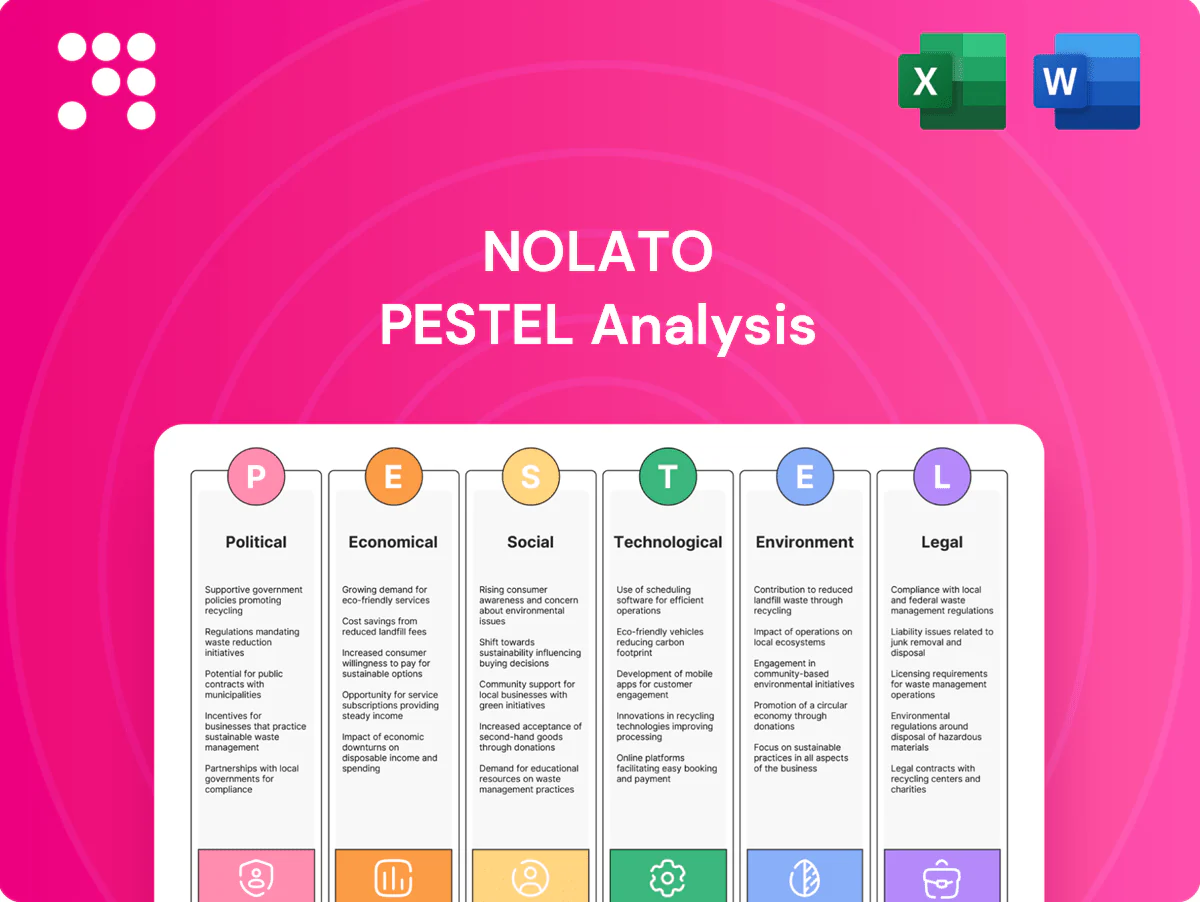
Nolato PESTLE Analysis

Plan Smarter. Present Sharper. Compete Stronger.
Unlock strategic clarity with our Nolato PESTLE Analysis—concise yet powerful insight into political, economic, social, technological, legal, and environmental forces shaping the company’s trajectory. Use these findings to anticipate risks, identify growth opportunities, and refine your investment or business strategy. Purchase the full report for the complete, editable breakdown and actionable recommendations ready for immediate use.
Political factors

Trade policy and tariffs
Shifts in tariffs on polymers, chemicals and components can materially change input costs and sourcing choices; US Section 301 tariffs affecting roughly 370 billion USD of Chinese imports remain a key example. Cross-border frictions raise lead-time volatility for medical, automotive and industrial customers, increasing inventory and buffer needs. Active monitoring of EU, US and Asian trade measures and a diversified supplier base mitigate political trade shocks.
Healthcare policy and public spending
Changes in national healthcare budgets influence medtech procurement volumes; Sweden’s health spending was about 11.0% of GDP in 2022–23 (OECD), with public financing ~82% of total, directly affecting demand for Nolato’s components. Reimbursement frameworks across EU markets can accelerate or delay product launches and uptake. Growing public-private partnerships and EU health-innovation funding in 2024–25 expand development opportunities. Policy stability supports multi-year supplier contracts and client retention.

Industrial and investment incentives
EU and national grants, backed by the EU Recovery and Resilience Facility (€723bn), and tax credits for advanced manufacturing favor capacity upgrades and capital investment decisions. Localization incentives across Europe, including regional investment aid, increasingly guide Nolato site selection and supply‑chain footprint. Public support for sustainable materials spurs R&D in bio‑based polymers, while alignment with industrial policy improves competitiveness in public tenders.

Geopolitical risk and supply security
Regional tensions risk disrupting specialty resin and silicone supply lines and can trigger supplier lead-time spikes and price volatility. Sanctions and export controls limit access to capital goods, testing equipment and specialized software. Political instability elevates freight rerouting, customs delays and insurance premiums; multi-region production decreases single-country exposure.
- Supply disruption risk
- Sanctions on equipment/software
- Higher logistics & insurance costs
- Multi-region production mitigates risk
Regulatory harmonization across markets
Differences between EU MDR (fully applied since 2021), US FDA pathways (510(k)/PMA) and evolving Asia/NMPA frameworks complicate compliance for Nolato’s global programs and require multiple certification tracks. Harmonization reduces duplicate testing and certification, lowering overhead and helping clients launch faster. Active participation in MedTech Europe, AdvaMed and regional bodies helps Nolato anticipate regulatory shifts early.
- Regulatory divergence: multiple pathways increase program cost and lead times
- Harmonization: fewer duplicate tests, faster client time-to-market
- Industry engagement: early visibility into rule changes via MedTech Europe/AdvaMed/NMPA
Tariff and resin/silicone supply shocks plus regulatory divergence tighten medtech margins
Tariff shifts (US Section 301 on ~370bn USD imports) and regional tensions raise resin/silicone cost and lead‑time volatility; Sweden health spend ~11.0% of GDP (2022–23), public ~82%—affecting medtech demand. EU RRF €723bn and tax incentives drive localization and capex; MDR/FDA divergence increases certification costs.
| Factor | Impact | Data |
|---|---|---|
| Trade tariffs | Input cost volatility | US Section 301 ~370bn USD |
| Healthcare budgets | Demand sensitivity | Sweden 11.0% GDP; public 82% |
| Industrial policy | Capex incentives | EU RRF €723bn |
What is included in the product
 Detailed Word Document
Explores how Political, Economic, Social, Technological, Environmental and Legal forces uniquely impact Nolato, with data-driven trends and region-/industry-specific examples; designed for executives and advisors, it includes forward-looking insights, scenario implications and ready-to-use formatting.

 Customizable Excel Spreadsheet
A concise, visually segmented Nolato PESTLE summary that condenses external risks and market drivers for quick reference in meetings or presentations. Easily shareable and editable so teams can align fast, add context-specific notes, and support strategic discussions on positioning and risk mitigation.
Economic factors

Global demand cycles
Cyclical swings in automotive and industrial sectors materially affect capacity utilization; global light-vehicle production was roughly 77 million units in 2024, creating visible demand volatility for contract manufacturers like Nolato.
Medtech demand proved more resilient in 2024—the global medtech market was about 520 billion USD—though elective procedure slowdowns can still dent volumes.
Balanced end-market exposure across automotive, industrial and medtech helped stabilize Nolato’s revenue mix in 2024, reducing quarter-to-quarter volatility.
Scenario planning in 2024–2025 focused on aligning staffing and inventory to demand scenarios, limiting excess capacity and working capital stress during downturns.
Raw material price volatility
Brent crude averaged about $85 per barrel in 2024, and oil/gas-driven feedstock moves transmitted to plastics, silicone and TPE prices, causing notable input volatility for Nolato.
Index-linked supplier contracts and financial hedging have been used to temper margin swings, while close supplier collaboration improved availability during 2024 tight markets.
Design-to-cost initiatives reduced sensitivity to raw-material spikes by allowing material substitution and optimized part geometry.

Currency fluctuations
Multi-currency revenues and costs expose Nolato to FX risk, reflected in the 2024 annual report where currency effects were highlighted as a material result driver. Regional production and sourcing provide natural hedges that reduce transactional exposure across SEK, EUR and USD corridors. Active pricing mechanisms and financial hedges (forwards, options) are used to protect margins. Transparent FX clauses in customer contracts strengthen trust and pass-through capacity.

Interest rates and capital costs
- Higher financing costs: ECB 4.00%, Fed 5.25–5.50%
- Longer paybacks for capex and energy projects
- Prioritize cash flow and staged capex
- Use customer co-investment to de-risk funding
Customer consolidation and pricing power
Large OEMs in medtech and auto exert strong procurement leverage, with the top 10 automakers producing about 70% of global light vehicles in 2024 and top medtech firms holding roughly 45% market share, pressuring margins. Long-term agreements often trade price for volume stability while value-added engineering enables Nolato to command premiums and protect margins. Diversifying the customer base reduces concentration risk.
- OEM leverage: high
- Volume vs price: long-term contracts
- Premiuming: VAE supports margins
- Concentration: diversification required
Tariff and resin/silicone supply shocks plus regulatory divergence tighten medtech margins
Cyclical swings in auto/industrial (global light‑vehicle ~77m units in 2024) drive capacity volatility for Nolato, while resilient medtech demand (global medtech ~USD 520bn in 2024) cushions downturns. Brent averaged ~USD85/bbl in 2024, feeding plastics/TPE cost swings; ECB deposit ~4.00% (Jun 2025), Fed 5.25–5.50% lengthen capex paybacks. OEM concentration (top10 autos ~70%, top medtech firms ~45%) pressures margins; FX and indexed contracts mitigate swings.
| Metric | Value |
|---|---|
| Light vehicles (2024) | ~77m |
| Medtech market (2024) | ~USD 520bn |
| Brent (2024 avg) | ~USD 85/bbl |
| ECB (Jun 2025) | 4.00% |
| Fed funds | 5.25–5.50% |
| Top10 auto share | ~70% |
| Top medtech share | ~45% |
Full Version Awaits
Nolato PESTLE Analysis
The preview shown here is the exact Nolato PESTLE document you’ll receive after purchase—fully formatted and ready to use. It contains the same content, structure and professional layout as the downloadable file. No placeholders or teasers, just the final, ready-to-download analysis. What you see is what you’ll own after checkout.

Plan Smarter. Present Sharper. Compete Stronger.
Unlock strategic clarity with our Nolato PESTLE Analysis—concise yet powerful insight into political, economic, social, technological, legal, and environmental forces shaping the company’s trajectory. Use these findings to anticipate risks, identify growth opportunities, and refine your investment or business strategy. Purchase the full report for the complete, editable breakdown and actionable recommendations ready for immediate use.
Political factors
Trade policy and tariffs
Shifts in tariffs on polymers, chemicals and components can materially change input costs and sourcing choices; US Section 301 tariffs affecting roughly 370 billion USD of Chinese imports remain a key example. Cross-border frictions raise lead-time volatility for medical, automotive and industrial customers, increasing inventory and buffer needs. Active monitoring of EU, US and Asian trade measures and a diversified supplier base mitigate political trade shocks.
Healthcare policy and public spending
Changes in national healthcare budgets influence medtech procurement volumes; Sweden’s health spending was about 11.0% of GDP in 2022–23 (OECD), with public financing ~82% of total, directly affecting demand for Nolato’s components. Reimbursement frameworks across EU markets can accelerate or delay product launches and uptake. Growing public-private partnerships and EU health-innovation funding in 2024–25 expand development opportunities. Policy stability supports multi-year supplier contracts and client retention.
Industrial and investment incentives
EU and national grants, backed by the EU Recovery and Resilience Facility (€723bn), and tax credits for advanced manufacturing favor capacity upgrades and capital investment decisions. Localization incentives across Europe, including regional investment aid, increasingly guide Nolato site selection and supply‑chain footprint. Public support for sustainable materials spurs R&D in bio‑based polymers, while alignment with industrial policy improves competitiveness in public tenders.
Geopolitical risk and supply security
Regional tensions risk disrupting specialty resin and silicone supply lines and can trigger supplier lead-time spikes and price volatility. Sanctions and export controls limit access to capital goods, testing equipment and specialized software. Political instability elevates freight rerouting, customs delays and insurance premiums; multi-region production decreases single-country exposure.
- Supply disruption risk
- Sanctions on equipment/software
- Higher logistics & insurance costs
- Multi-region production mitigates risk
Regulatory harmonization across markets
Differences between EU MDR (fully applied since 2021), US FDA pathways (510(k)/PMA) and evolving Asia/NMPA frameworks complicate compliance for Nolato’s global programs and require multiple certification tracks. Harmonization reduces duplicate testing and certification, lowering overhead and helping clients launch faster. Active participation in MedTech Europe, AdvaMed and regional bodies helps Nolato anticipate regulatory shifts early.
- Regulatory divergence: multiple pathways increase program cost and lead times
- Harmonization: fewer duplicate tests, faster client time-to-market
- Industry engagement: early visibility into rule changes via MedTech Europe/AdvaMed/NMPA
Tariff and resin/silicone supply shocks plus regulatory divergence tighten medtech margins
Tariff shifts (US Section 301 on ~370bn USD imports) and regional tensions raise resin/silicone cost and lead‑time volatility; Sweden health spend ~11.0% of GDP (2022–23), public ~82%—affecting medtech demand. EU RRF €723bn and tax incentives drive localization and capex; MDR/FDA divergence increases certification costs.
| Factor | Impact | Data |
|---|---|---|
| Trade tariffs | Input cost volatility | US Section 301 ~370bn USD |
| Healthcare budgets | Demand sensitivity | Sweden 11.0% GDP; public 82% |
| Industrial policy | Capex incentives | EU RRF €723bn |
What is included in the product
Detailed Word Document
Explores how Political, Economic, Social, Technological, Environmental and Legal forces uniquely impact Nolato, with data-driven trends and region-/industry-specific examples; designed for executives and advisors, it includes forward-looking insights, scenario implications and ready-to-use formatting.
Customizable Excel Spreadsheet
A concise, visually segmented Nolato PESTLE summary that condenses external risks and market drivers for quick reference in meetings or presentations. Easily shareable and editable so teams can align fast, add context-specific notes, and support strategic discussions on positioning and risk mitigation.
Economic factors
Global demand cycles
Cyclical swings in automotive and industrial sectors materially affect capacity utilization; global light-vehicle production was roughly 77 million units in 2024, creating visible demand volatility for contract manufacturers like Nolato.
Medtech demand proved more resilient in 2024—the global medtech market was about 520 billion USD—though elective procedure slowdowns can still dent volumes.
Balanced end-market exposure across automotive, industrial and medtech helped stabilize Nolato’s revenue mix in 2024, reducing quarter-to-quarter volatility.
Scenario planning in 2024–2025 focused on aligning staffing and inventory to demand scenarios, limiting excess capacity and working capital stress during downturns.
Raw material price volatility
Brent crude averaged about $85 per barrel in 2024, and oil/gas-driven feedstock moves transmitted to plastics, silicone and TPE prices, causing notable input volatility for Nolato.
Index-linked supplier contracts and financial hedging have been used to temper margin swings, while close supplier collaboration improved availability during 2024 tight markets.
Design-to-cost initiatives reduced sensitivity to raw-material spikes by allowing material substitution and optimized part geometry.
Currency fluctuations
Multi-currency revenues and costs expose Nolato to FX risk, reflected in the 2024 annual report where currency effects were highlighted as a material result driver. Regional production and sourcing provide natural hedges that reduce transactional exposure across SEK, EUR and USD corridors. Active pricing mechanisms and financial hedges (forwards, options) are used to protect margins. Transparent FX clauses in customer contracts strengthen trust and pass-through capacity.
Interest rates and capital costs
- Higher financing costs: ECB 4.00%, Fed 5.25–5.50%
- Longer paybacks for capex and energy projects
- Prioritize cash flow and staged capex
- Use customer co-investment to de-risk funding
Customer consolidation and pricing power
Large OEMs in medtech and auto exert strong procurement leverage, with the top 10 automakers producing about 70% of global light vehicles in 2024 and top medtech firms holding roughly 45% market share, pressuring margins. Long-term agreements often trade price for volume stability while value-added engineering enables Nolato to command premiums and protect margins. Diversifying the customer base reduces concentration risk.
- OEM leverage: high
- Volume vs price: long-term contracts
- Premiuming: VAE supports margins
- Concentration: diversification required
Tariff and resin/silicone supply shocks plus regulatory divergence tighten medtech margins
Cyclical swings in auto/industrial (global light‑vehicle ~77m units in 2024) drive capacity volatility for Nolato, while resilient medtech demand (global medtech ~USD 520bn in 2024) cushions downturns. Brent averaged ~USD85/bbl in 2024, feeding plastics/TPE cost swings; ECB deposit ~4.00% (Jun 2025), Fed 5.25–5.50% lengthen capex paybacks. OEM concentration (top10 autos ~70%, top medtech firms ~45%) pressures margins; FX and indexed contracts mitigate swings.
| Metric | Value |
|---|---|
| Light vehicles (2024) | ~77m |
| Medtech market (2024) | ~USD 520bn |
| Brent (2024 avg) | ~USD 85/bbl |
| ECB (Jun 2025) | 4.00% |
| Fed funds | 5.25–5.50% |
| Top10 auto share | ~70% |
| Top medtech share | ~45% |
Full Version Awaits
Nolato PESTLE Analysis
The preview shown here is the exact Nolato PESTLE document you’ll receive after purchase—fully formatted and ready to use. It contains the same content, structure and professional layout as the downloadable file. No placeholders or teasers, just the final, ready-to-download analysis. What you see is what you’ll own after checkout.
Original: $10.00
-65%$10.00
$3.50Description
Plan Smarter. Present Sharper. Compete Stronger.
Unlock strategic clarity with our Nolato PESTLE Analysis—concise yet powerful insight into political, economic, social, technological, legal, and environmental forces shaping the company’s trajectory. Use these findings to anticipate risks, identify growth opportunities, and refine your investment or business strategy. Purchase the full report for the complete, editable breakdown and actionable recommendations ready for immediate use.
Political factors
Trade policy and tariffs
Shifts in tariffs on polymers, chemicals and components can materially change input costs and sourcing choices; US Section 301 tariffs affecting roughly 370 billion USD of Chinese imports remain a key example. Cross-border frictions raise lead-time volatility for medical, automotive and industrial customers, increasing inventory and buffer needs. Active monitoring of EU, US and Asian trade measures and a diversified supplier base mitigate political trade shocks.
Healthcare policy and public spending
Changes in national healthcare budgets influence medtech procurement volumes; Sweden’s health spending was about 11.0% of GDP in 2022–23 (OECD), with public financing ~82% of total, directly affecting demand for Nolato’s components. Reimbursement frameworks across EU markets can accelerate or delay product launches and uptake. Growing public-private partnerships and EU health-innovation funding in 2024–25 expand development opportunities. Policy stability supports multi-year supplier contracts and client retention.
Industrial and investment incentives
EU and national grants, backed by the EU Recovery and Resilience Facility (€723bn), and tax credits for advanced manufacturing favor capacity upgrades and capital investment decisions. Localization incentives across Europe, including regional investment aid, increasingly guide Nolato site selection and supply‑chain footprint. Public support for sustainable materials spurs R&D in bio‑based polymers, while alignment with industrial policy improves competitiveness in public tenders.
Geopolitical risk and supply security
Regional tensions risk disrupting specialty resin and silicone supply lines and can trigger supplier lead-time spikes and price volatility. Sanctions and export controls limit access to capital goods, testing equipment and specialized software. Political instability elevates freight rerouting, customs delays and insurance premiums; multi-region production decreases single-country exposure.
- Supply disruption risk
- Sanctions on equipment/software
- Higher logistics & insurance costs
- Multi-region production mitigates risk
Regulatory harmonization across markets
Differences between EU MDR (fully applied since 2021), US FDA pathways (510(k)/PMA) and evolving Asia/NMPA frameworks complicate compliance for Nolato’s global programs and require multiple certification tracks. Harmonization reduces duplicate testing and certification, lowering overhead and helping clients launch faster. Active participation in MedTech Europe, AdvaMed and regional bodies helps Nolato anticipate regulatory shifts early.
- Regulatory divergence: multiple pathways increase program cost and lead times
- Harmonization: fewer duplicate tests, faster client time-to-market
- Industry engagement: early visibility into rule changes via MedTech Europe/AdvaMed/NMPA
Tariff and resin/silicone supply shocks plus regulatory divergence tighten medtech margins
Tariff shifts (US Section 301 on ~370bn USD imports) and regional tensions raise resin/silicone cost and lead‑time volatility; Sweden health spend ~11.0% of GDP (2022–23), public ~82%—affecting medtech demand. EU RRF €723bn and tax incentives drive localization and capex; MDR/FDA divergence increases certification costs.
| Factor | Impact | Data |
|---|---|---|
| Trade tariffs | Input cost volatility | US Section 301 ~370bn USD |
| Healthcare budgets | Demand sensitivity | Sweden 11.0% GDP; public 82% |
| Industrial policy | Capex incentives | EU RRF €723bn |
What is included in the product
Detailed Word Document
Explores how Political, Economic, Social, Technological, Environmental and Legal forces uniquely impact Nolato, with data-driven trends and region-/industry-specific examples; designed for executives and advisors, it includes forward-looking insights, scenario implications and ready-to-use formatting.
Customizable Excel Spreadsheet
A concise, visually segmented Nolato PESTLE summary that condenses external risks and market drivers for quick reference in meetings or presentations. Easily shareable and editable so teams can align fast, add context-specific notes, and support strategic discussions on positioning and risk mitigation.
Economic factors
Global demand cycles
Cyclical swings in automotive and industrial sectors materially affect capacity utilization; global light-vehicle production was roughly 77 million units in 2024, creating visible demand volatility for contract manufacturers like Nolato.
Medtech demand proved more resilient in 2024—the global medtech market was about 520 billion USD—though elective procedure slowdowns can still dent volumes.
Balanced end-market exposure across automotive, industrial and medtech helped stabilize Nolato’s revenue mix in 2024, reducing quarter-to-quarter volatility.
Scenario planning in 2024–2025 focused on aligning staffing and inventory to demand scenarios, limiting excess capacity and working capital stress during downturns.
Raw material price volatility
Brent crude averaged about $85 per barrel in 2024, and oil/gas-driven feedstock moves transmitted to plastics, silicone and TPE prices, causing notable input volatility for Nolato.
Index-linked supplier contracts and financial hedging have been used to temper margin swings, while close supplier collaboration improved availability during 2024 tight markets.
Design-to-cost initiatives reduced sensitivity to raw-material spikes by allowing material substitution and optimized part geometry.
Currency fluctuations
Multi-currency revenues and costs expose Nolato to FX risk, reflected in the 2024 annual report where currency effects were highlighted as a material result driver. Regional production and sourcing provide natural hedges that reduce transactional exposure across SEK, EUR and USD corridors. Active pricing mechanisms and financial hedges (forwards, options) are used to protect margins. Transparent FX clauses in customer contracts strengthen trust and pass-through capacity.
Interest rates and capital costs
- Higher financing costs: ECB 4.00%, Fed 5.25–5.50%
- Longer paybacks for capex and energy projects
- Prioritize cash flow and staged capex
- Use customer co-investment to de-risk funding
Customer consolidation and pricing power
Large OEMs in medtech and auto exert strong procurement leverage, with the top 10 automakers producing about 70% of global light vehicles in 2024 and top medtech firms holding roughly 45% market share, pressuring margins. Long-term agreements often trade price for volume stability while value-added engineering enables Nolato to command premiums and protect margins. Diversifying the customer base reduces concentration risk.
- OEM leverage: high
- Volume vs price: long-term contracts
- Premiuming: VAE supports margins
- Concentration: diversification required
Tariff and resin/silicone supply shocks plus regulatory divergence tighten medtech margins
Cyclical swings in auto/industrial (global light‑vehicle ~77m units in 2024) drive capacity volatility for Nolato, while resilient medtech demand (global medtech ~USD 520bn in 2024) cushions downturns. Brent averaged ~USD85/bbl in 2024, feeding plastics/TPE cost swings; ECB deposit ~4.00% (Jun 2025), Fed 5.25–5.50% lengthen capex paybacks. OEM concentration (top10 autos ~70%, top medtech firms ~45%) pressures margins; FX and indexed contracts mitigate swings.
| Metric | Value |
|---|---|
| Light vehicles (2024) | ~77m |
| Medtech market (2024) | ~USD 520bn |
| Brent (2024 avg) | ~USD 85/bbl |
| ECB (Jun 2025) | 4.00% |
| Fed funds | 5.25–5.50% |
| Top10 auto share | ~70% |
| Top medtech share | ~45% |
Full Version Awaits
Nolato PESTLE Analysis
The preview shown here is the exact Nolato PESTLE document you’ll receive after purchase—fully formatted and ready to use. It contains the same content, structure and professional layout as the downloadable file. No placeholders or teasers, just the final, ready-to-download analysis. What you see is what you’ll own after checkout.











