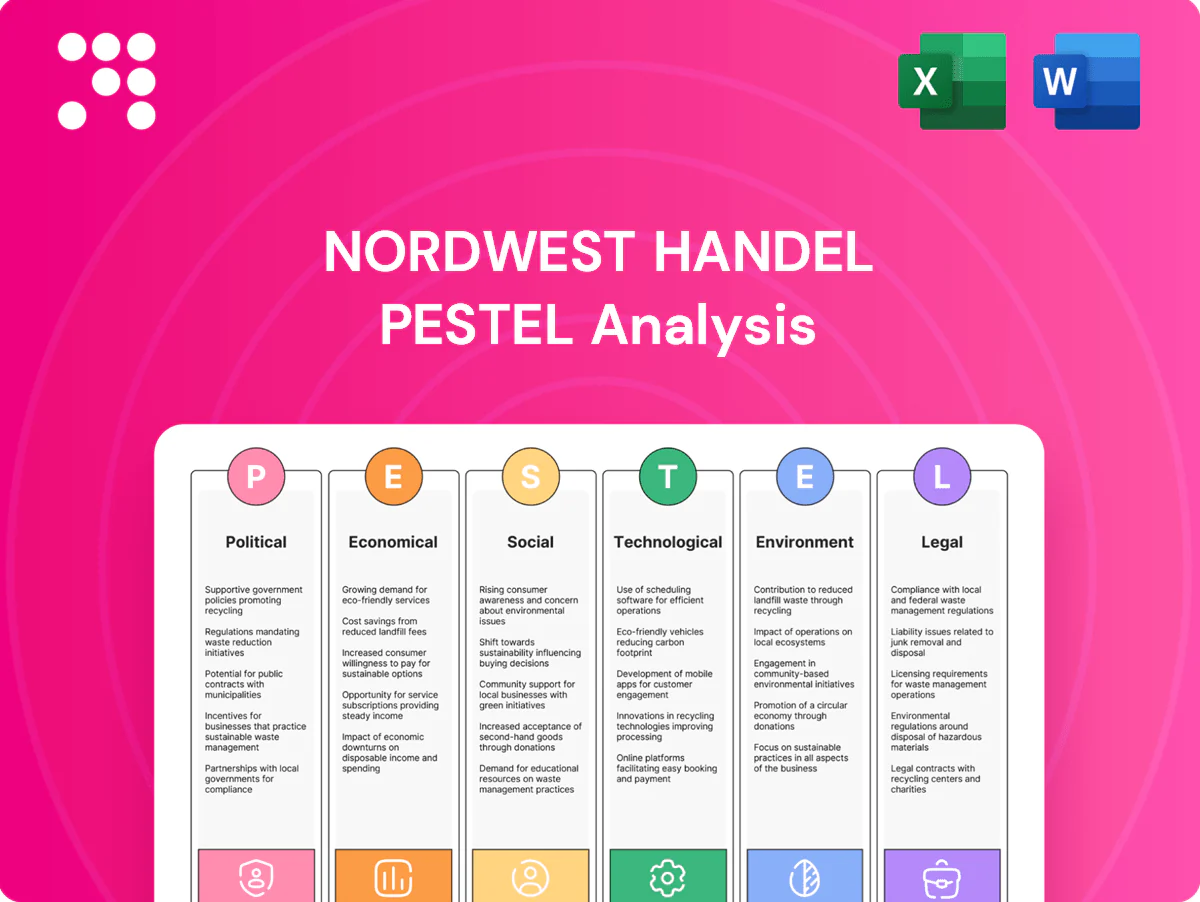
Nordwest Handel PESTLE Analysis

Plan Smarter. Present Sharper. Compete Stronger.
Unlock strategic clarity with our targeted PESTLE Analysis of Nordwest Handel—three to five concise insights into the political, economic, social, technological, legal and environmental forces shaping its future. Ideal for investors and strategists, this report translates trends into action. Purchase the full analysis to get the complete, ready-to-use breakdown and immediate download.
Political factors

EU trade policy and sanctions exposure
As a distributor linking manufacturers to dealers, Nordwest faces assortment disruption from EU sanctions and import controls — the EU has adopted more than a dozen Russia-related sanction packages since 2014, and EU goods exports to Russia fell roughly 70% in 2022 (Eurostat). Changes in tariff regimes or anti-dumping duties (which can add up to c.50% in some cases) materially alter landed costs and availability. The firm needs supplier diversification and automated compliance screening to maintain continuity. Proactive, transparent communication with members reduces disruption in sensitive categories.
German industrial and SME support programs
Public incentives such as the Mittelstand-Digital and Digital Jetzt programs (grants up to €50,000, co‑financing up to ~50%) and KfW energy-efficiency loans, plus Germany’s SME sector representing ~99% of firms and over 60% of employment, can boost demand for tools and industrial supplies. Nordwest can align product lines to eligibility, time marketing to grant windows, and work with chambers and agencies to help members access funds, lifting order volumes when cycles open.

Infrastructure and logistics policy
Federal rail, road and port allocations under Germany’s BVWP and transport plans (roughly €269bn through 2030) directly affect delivery reliability and transit times for Nordwest Handel. Ongoing construction and recent toll expansions in 2024 can raise freight costs and pressure SLAs. Nordwest should adjust route planning and warehouse footprints to mitigate delays and cost volatility. Active advocacy via industry associations can influence toll and investment outcomes.

Public procurement regulations
Municipal and federal tender rules demand sourcing, sustainability and transparency; public procurement accounted for about 14% of EU GDP (European Commission, 2021), expanding addressable government demand for Nordwest Handel members. Members on public projects require standardized documentation and certifications that Nordwest can centralize, while framework contracts can be configured for e-procurement portals to reduce bid friction.
- Sourcing requirements: compliance templates
- Sustainability: green procurement clauses
- Transparency: audit-ready documentation
- e-procurement: framework contracts for portals
Energy and climate policy direction
German and EU decarbonization targets (Germany net‑zero by 2045; EU -55% by 2030, climate neutrality by 2050) shift demand to more efficient tools and materials. EU ETS carbon price ~€80/t in 2024–25 increases transport and warehousing costs. Nordwest can scale low‑emission logistics and green assortments; policy-driven momentum supports premiumization with consumer willingness to pay ~10–20% more.
- Targets: Germany 2045; EU -55% by 2030
- Carbon price: ~€80/t (2024–25)
- Premiumization: willingness to pay ~10–20%
Distributor must diversify suppliers, automate compliance and align to grants and decarbonization
Nordwest faces assortment and cost shocks from EU sanctions and shifting tariffs (EU exports to Russia -70% in 2022; anti-dumping duties up to ~50%), requiring supplier diversification and compliance automation. Public incentives (Digital Jetzt, grants up to €50k) and KfW loans can boost SME demand; align assortments and timing to grant windows. Infrastructure plans (BVWP ~€269bn to 2030) and EU ETS (~€80/t in 2024–25) raise logistics costs and favor low‑emission offerings.
| Factor | Impact | Key data |
|---|---|---|
| Sanctions/Tariffs | Supply/cost risk | EU→Russia -70% (2022); duties up to ~50% |
| Grants/Loans | Demand uplift | Grants ≤€50k; KfW programs |
| Infrastructure | Transit/costs | BVWP ~€269bn to 2030 |
| Decarbonization | Logistics cost, premium demand | EU ETS ~€80/t (2024–25) |
What is included in the product
 Detailed Word Document
Explores how Political, Economic, Social, Technological, Environmental and Legal forces uniquely affect Nordwest Handel, using current data and regional market/regulatory context to identify threats and opportunities; delivered in clean, investor-ready format with forward-looking insights to support strategic planning and funding pitches.

 Customizable Excel Spreadsheet
A concise, visually segmented Nordwest Handel PESTLE summary that streamlines external risk discussions, is easily dropped into presentations or shared across teams for quick alignment, and can be annotated to reflect regional or business-line specifics.
Economic factors

Construction and industrial cycle sensitivity
Demand for building materials and industrial supplies closely follows construction PMI and permits; the Eurozone Construction PMI averaged 47.3 in 2024 and EU building permits fell about 6.5% year-on-year, compressing volumes and intensifying price competition among dealers. Nordwest can deploy counter-cyclical promotions and vendor-managed inventory to smooth sales swings and protect margins. Leading indicators should drive stocking and rebate calendars to reduce markdown risk and optimize working capital.
Inflation and interest rate environment
Price inflation — euro area CPI eased to about 2.4% in 2024 — raises Nordwest Handel input costs and weakens dealer purchasing power, while policy rates around 4% in 2024–25 increase financing costs for renovations and capex. Timely updated price lists and clear communication enable passing through rises; early-payment programs and dynamic rebates preserve liquidity. Hedging freight and energy surcharges helps stabilize margins.

FX and commodity volatility
Imports expose the basket to euro-dollar and raw-material fluctuations, with EUR/USD averaging about 1.09 in H1 2025. Longer lead times amplify risk of mismatches between purchase and sell prices. Forward contracts and indexed pricing with members reduce pricing surprises. A supplier mix balancing EU and non-EU sources adds resilience against regional supply shocks.

Consolidation and bargaining power shifts
As consolidation lets large retailers and e-commerce platforms press margins, Nordwest’s collective purchasing restores leverage for independents by aggregating demand across members; Germany’s online retail share rose to about 15% in 2024, increasing platform bargaining power. Tiered bonuses and exclusive private-label brands protect member margins while data-sharing improved joint negotiation outcomes with manufacturers.
- Collective purchasing: restores leverage
- 15%: Germany online retail share 2024
- Tiered bonuses & exclusive brands: margin defense
- Data-sharing: strengthens manufacturer negotiations
Logistics capacity and freight rates
Tight trucking capacity and seasonal peaks (EU HGV driver shortfall ~400,000 in 2024) make Nordwest Handel delivery windows less predictable and support higher spot freight rates. Rising warehousing labor and outsourcing fees — European logistics rents up ~7% in 2024 (CBRE) — push service charges. Slotting optimization and multi-carrier routing reduce peak exposure, while transparent SLAs let members trade cost for speed.
- Capacity: EU driver gap ~400,000 (2024)
- Costs: logistics rents +7% YoY (2024, CBRE)
- Mitigation: slotting, multi-carrier, tiered SLAs
Distributor must diversify suppliers, automate compliance and align to grants and decarbonization
Construction PMI weakness and -6.5% EU permits in 2024 cut volumes; Eurozone CPI ~2.4% and policy rates ~4% raise input and financing costs. EUR/USD ~1.09 H1 2025 and supply lead times elevate price risk; logistics costs and driver gap (~400,000 in 2024) squeeze service margins. Collective purchasing, private labels and indexed contracts mitigate pressures.
| Metric | Value |
|---|---|
| EU building permits YoY 2024 | -6.5% |
| Eurozone CPI 2024 | 2.4% |
| Policy rates 2024–25 | ~4% |
| EUR/USD H1 2025 | ~1.09 |
| EU HGV driver gap 2024 | ~400,000 |
What You See Is What You Get
Nordwest Handel PESTLE Analysis
The preview shown here is the exact Nordwest Handel PESTLE Analysis you’ll receive after purchase—fully formatted and ready to use. The content, layout, and structure visible are identical to the downloadable file. No placeholders or teasers—this is the final, professional document.

Plan Smarter. Present Sharper. Compete Stronger.
Unlock strategic clarity with our targeted PESTLE Analysis of Nordwest Handel—three to five concise insights into the political, economic, social, technological, legal and environmental forces shaping its future. Ideal for investors and strategists, this report translates trends into action. Purchase the full analysis to get the complete, ready-to-use breakdown and immediate download.
Political factors
EU trade policy and sanctions exposure
As a distributor linking manufacturers to dealers, Nordwest faces assortment disruption from EU sanctions and import controls — the EU has adopted more than a dozen Russia-related sanction packages since 2014, and EU goods exports to Russia fell roughly 70% in 2022 (Eurostat). Changes in tariff regimes or anti-dumping duties (which can add up to c.50% in some cases) materially alter landed costs and availability. The firm needs supplier diversification and automated compliance screening to maintain continuity. Proactive, transparent communication with members reduces disruption in sensitive categories.
German industrial and SME support programs
Public incentives such as the Mittelstand-Digital and Digital Jetzt programs (grants up to €50,000, co‑financing up to ~50%) and KfW energy-efficiency loans, plus Germany’s SME sector representing ~99% of firms and over 60% of employment, can boost demand for tools and industrial supplies. Nordwest can align product lines to eligibility, time marketing to grant windows, and work with chambers and agencies to help members access funds, lifting order volumes when cycles open.
Infrastructure and logistics policy
Federal rail, road and port allocations under Germany’s BVWP and transport plans (roughly €269bn through 2030) directly affect delivery reliability and transit times for Nordwest Handel. Ongoing construction and recent toll expansions in 2024 can raise freight costs and pressure SLAs. Nordwest should adjust route planning and warehouse footprints to mitigate delays and cost volatility. Active advocacy via industry associations can influence toll and investment outcomes.
Public procurement regulations
Municipal and federal tender rules demand sourcing, sustainability and transparency; public procurement accounted for about 14% of EU GDP (European Commission, 2021), expanding addressable government demand for Nordwest Handel members. Members on public projects require standardized documentation and certifications that Nordwest can centralize, while framework contracts can be configured for e-procurement portals to reduce bid friction.
- Sourcing requirements: compliance templates
- Sustainability: green procurement clauses
- Transparency: audit-ready documentation
- e-procurement: framework contracts for portals
Energy and climate policy direction
German and EU decarbonization targets (Germany net‑zero by 2045; EU -55% by 2030, climate neutrality by 2050) shift demand to more efficient tools and materials. EU ETS carbon price ~€80/t in 2024–25 increases transport and warehousing costs. Nordwest can scale low‑emission logistics and green assortments; policy-driven momentum supports premiumization with consumer willingness to pay ~10–20% more.
- Targets: Germany 2045; EU -55% by 2030
- Carbon price: ~€80/t (2024–25)
- Premiumization: willingness to pay ~10–20%
Distributor must diversify suppliers, automate compliance and align to grants and decarbonization
Nordwest faces assortment and cost shocks from EU sanctions and shifting tariffs (EU exports to Russia -70% in 2022; anti-dumping duties up to ~50%), requiring supplier diversification and compliance automation. Public incentives (Digital Jetzt, grants up to €50k) and KfW loans can boost SME demand; align assortments and timing to grant windows. Infrastructure plans (BVWP ~€269bn to 2030) and EU ETS (~€80/t in 2024–25) raise logistics costs and favor low‑emission offerings.
| Factor | Impact | Key data |
|---|---|---|
| Sanctions/Tariffs | Supply/cost risk | EU→Russia -70% (2022); duties up to ~50% |
| Grants/Loans | Demand uplift | Grants ≤€50k; KfW programs |
| Infrastructure | Transit/costs | BVWP ~€269bn to 2030 |
| Decarbonization | Logistics cost, premium demand | EU ETS ~€80/t (2024–25) |
What is included in the product
Detailed Word Document
Explores how Political, Economic, Social, Technological, Environmental and Legal forces uniquely affect Nordwest Handel, using current data and regional market/regulatory context to identify threats and opportunities; delivered in clean, investor-ready format with forward-looking insights to support strategic planning and funding pitches.
Customizable Excel Spreadsheet
A concise, visually segmented Nordwest Handel PESTLE summary that streamlines external risk discussions, is easily dropped into presentations or shared across teams for quick alignment, and can be annotated to reflect regional or business-line specifics.
Economic factors
Construction and industrial cycle sensitivity
Demand for building materials and industrial supplies closely follows construction PMI and permits; the Eurozone Construction PMI averaged 47.3 in 2024 and EU building permits fell about 6.5% year-on-year, compressing volumes and intensifying price competition among dealers. Nordwest can deploy counter-cyclical promotions and vendor-managed inventory to smooth sales swings and protect margins. Leading indicators should drive stocking and rebate calendars to reduce markdown risk and optimize working capital.
Inflation and interest rate environment
Price inflation — euro area CPI eased to about 2.4% in 2024 — raises Nordwest Handel input costs and weakens dealer purchasing power, while policy rates around 4% in 2024–25 increase financing costs for renovations and capex. Timely updated price lists and clear communication enable passing through rises; early-payment programs and dynamic rebates preserve liquidity. Hedging freight and energy surcharges helps stabilize margins.
FX and commodity volatility
Imports expose the basket to euro-dollar and raw-material fluctuations, with EUR/USD averaging about 1.09 in H1 2025. Longer lead times amplify risk of mismatches between purchase and sell prices. Forward contracts and indexed pricing with members reduce pricing surprises. A supplier mix balancing EU and non-EU sources adds resilience against regional supply shocks.
Consolidation and bargaining power shifts
As consolidation lets large retailers and e-commerce platforms press margins, Nordwest’s collective purchasing restores leverage for independents by aggregating demand across members; Germany’s online retail share rose to about 15% in 2024, increasing platform bargaining power. Tiered bonuses and exclusive private-label brands protect member margins while data-sharing improved joint negotiation outcomes with manufacturers.
- Collective purchasing: restores leverage
- 15%: Germany online retail share 2024
- Tiered bonuses & exclusive brands: margin defense
- Data-sharing: strengthens manufacturer negotiations
Logistics capacity and freight rates
Tight trucking capacity and seasonal peaks (EU HGV driver shortfall ~400,000 in 2024) make Nordwest Handel delivery windows less predictable and support higher spot freight rates. Rising warehousing labor and outsourcing fees — European logistics rents up ~7% in 2024 (CBRE) — push service charges. Slotting optimization and multi-carrier routing reduce peak exposure, while transparent SLAs let members trade cost for speed.
- Capacity: EU driver gap ~400,000 (2024)
- Costs: logistics rents +7% YoY (2024, CBRE)
- Mitigation: slotting, multi-carrier, tiered SLAs
Distributor must diversify suppliers, automate compliance and align to grants and decarbonization
Construction PMI weakness and -6.5% EU permits in 2024 cut volumes; Eurozone CPI ~2.4% and policy rates ~4% raise input and financing costs. EUR/USD ~1.09 H1 2025 and supply lead times elevate price risk; logistics costs and driver gap (~400,000 in 2024) squeeze service margins. Collective purchasing, private labels and indexed contracts mitigate pressures.
| Metric | Value |
|---|---|
| EU building permits YoY 2024 | -6.5% |
| Eurozone CPI 2024 | 2.4% |
| Policy rates 2024–25 | ~4% |
| EUR/USD H1 2025 | ~1.09 |
| EU HGV driver gap 2024 | ~400,000 |
What You See Is What You Get
Nordwest Handel PESTLE Analysis
The preview shown here is the exact Nordwest Handel PESTLE Analysis you’ll receive after purchase—fully formatted and ready to use. The content, layout, and structure visible are identical to the downloadable file. No placeholders or teasers—this is the final, professional document.
Original: $10.00
-65%$10.00
$3.50Description
Plan Smarter. Present Sharper. Compete Stronger.
Unlock strategic clarity with our targeted PESTLE Analysis of Nordwest Handel—three to five concise insights into the political, economic, social, technological, legal and environmental forces shaping its future. Ideal for investors and strategists, this report translates trends into action. Purchase the full analysis to get the complete, ready-to-use breakdown and immediate download.
Political factors
EU trade policy and sanctions exposure
As a distributor linking manufacturers to dealers, Nordwest faces assortment disruption from EU sanctions and import controls — the EU has adopted more than a dozen Russia-related sanction packages since 2014, and EU goods exports to Russia fell roughly 70% in 2022 (Eurostat). Changes in tariff regimes or anti-dumping duties (which can add up to c.50% in some cases) materially alter landed costs and availability. The firm needs supplier diversification and automated compliance screening to maintain continuity. Proactive, transparent communication with members reduces disruption in sensitive categories.
German industrial and SME support programs
Public incentives such as the Mittelstand-Digital and Digital Jetzt programs (grants up to €50,000, co‑financing up to ~50%) and KfW energy-efficiency loans, plus Germany’s SME sector representing ~99% of firms and over 60% of employment, can boost demand for tools and industrial supplies. Nordwest can align product lines to eligibility, time marketing to grant windows, and work with chambers and agencies to help members access funds, lifting order volumes when cycles open.
Infrastructure and logistics policy
Federal rail, road and port allocations under Germany’s BVWP and transport plans (roughly €269bn through 2030) directly affect delivery reliability and transit times for Nordwest Handel. Ongoing construction and recent toll expansions in 2024 can raise freight costs and pressure SLAs. Nordwest should adjust route planning and warehouse footprints to mitigate delays and cost volatility. Active advocacy via industry associations can influence toll and investment outcomes.
Public procurement regulations
Municipal and federal tender rules demand sourcing, sustainability and transparency; public procurement accounted for about 14% of EU GDP (European Commission, 2021), expanding addressable government demand for Nordwest Handel members. Members on public projects require standardized documentation and certifications that Nordwest can centralize, while framework contracts can be configured for e-procurement portals to reduce bid friction.
- Sourcing requirements: compliance templates
- Sustainability: green procurement clauses
- Transparency: audit-ready documentation
- e-procurement: framework contracts for portals
Energy and climate policy direction
German and EU decarbonization targets (Germany net‑zero by 2045; EU -55% by 2030, climate neutrality by 2050) shift demand to more efficient tools and materials. EU ETS carbon price ~€80/t in 2024–25 increases transport and warehousing costs. Nordwest can scale low‑emission logistics and green assortments; policy-driven momentum supports premiumization with consumer willingness to pay ~10–20% more.
- Targets: Germany 2045; EU -55% by 2030
- Carbon price: ~€80/t (2024–25)
- Premiumization: willingness to pay ~10–20%
Distributor must diversify suppliers, automate compliance and align to grants and decarbonization
Nordwest faces assortment and cost shocks from EU sanctions and shifting tariffs (EU exports to Russia -70% in 2022; anti-dumping duties up to ~50%), requiring supplier diversification and compliance automation. Public incentives (Digital Jetzt, grants up to €50k) and KfW loans can boost SME demand; align assortments and timing to grant windows. Infrastructure plans (BVWP ~€269bn to 2030) and EU ETS (~€80/t in 2024–25) raise logistics costs and favor low‑emission offerings.
| Factor | Impact | Key data |
|---|---|---|
| Sanctions/Tariffs | Supply/cost risk | EU→Russia -70% (2022); duties up to ~50% |
| Grants/Loans | Demand uplift | Grants ≤€50k; KfW programs |
| Infrastructure | Transit/costs | BVWP ~€269bn to 2030 |
| Decarbonization | Logistics cost, premium demand | EU ETS ~€80/t (2024–25) |
What is included in the product
Detailed Word Document
Explores how Political, Economic, Social, Technological, Environmental and Legal forces uniquely affect Nordwest Handel, using current data and regional market/regulatory context to identify threats and opportunities; delivered in clean, investor-ready format with forward-looking insights to support strategic planning and funding pitches.
Customizable Excel Spreadsheet
A concise, visually segmented Nordwest Handel PESTLE summary that streamlines external risk discussions, is easily dropped into presentations or shared across teams for quick alignment, and can be annotated to reflect regional or business-line specifics.
Economic factors
Construction and industrial cycle sensitivity
Demand for building materials and industrial supplies closely follows construction PMI and permits; the Eurozone Construction PMI averaged 47.3 in 2024 and EU building permits fell about 6.5% year-on-year, compressing volumes and intensifying price competition among dealers. Nordwest can deploy counter-cyclical promotions and vendor-managed inventory to smooth sales swings and protect margins. Leading indicators should drive stocking and rebate calendars to reduce markdown risk and optimize working capital.
Inflation and interest rate environment
Price inflation — euro area CPI eased to about 2.4% in 2024 — raises Nordwest Handel input costs and weakens dealer purchasing power, while policy rates around 4% in 2024–25 increase financing costs for renovations and capex. Timely updated price lists and clear communication enable passing through rises; early-payment programs and dynamic rebates preserve liquidity. Hedging freight and energy surcharges helps stabilize margins.
FX and commodity volatility
Imports expose the basket to euro-dollar and raw-material fluctuations, with EUR/USD averaging about 1.09 in H1 2025. Longer lead times amplify risk of mismatches between purchase and sell prices. Forward contracts and indexed pricing with members reduce pricing surprises. A supplier mix balancing EU and non-EU sources adds resilience against regional supply shocks.
Consolidation and bargaining power shifts
As consolidation lets large retailers and e-commerce platforms press margins, Nordwest’s collective purchasing restores leverage for independents by aggregating demand across members; Germany’s online retail share rose to about 15% in 2024, increasing platform bargaining power. Tiered bonuses and exclusive private-label brands protect member margins while data-sharing improved joint negotiation outcomes with manufacturers.
- Collective purchasing: restores leverage
- 15%: Germany online retail share 2024
- Tiered bonuses & exclusive brands: margin defense
- Data-sharing: strengthens manufacturer negotiations
Logistics capacity and freight rates
Tight trucking capacity and seasonal peaks (EU HGV driver shortfall ~400,000 in 2024) make Nordwest Handel delivery windows less predictable and support higher spot freight rates. Rising warehousing labor and outsourcing fees — European logistics rents up ~7% in 2024 (CBRE) — push service charges. Slotting optimization and multi-carrier routing reduce peak exposure, while transparent SLAs let members trade cost for speed.
- Capacity: EU driver gap ~400,000 (2024)
- Costs: logistics rents +7% YoY (2024, CBRE)
- Mitigation: slotting, multi-carrier, tiered SLAs
Distributor must diversify suppliers, automate compliance and align to grants and decarbonization
Construction PMI weakness and -6.5% EU permits in 2024 cut volumes; Eurozone CPI ~2.4% and policy rates ~4% raise input and financing costs. EUR/USD ~1.09 H1 2025 and supply lead times elevate price risk; logistics costs and driver gap (~400,000 in 2024) squeeze service margins. Collective purchasing, private labels and indexed contracts mitigate pressures.
| Metric | Value |
|---|---|
| EU building permits YoY 2024 | -6.5% |
| Eurozone CPI 2024 | 2.4% |
| Policy rates 2024–25 | ~4% |
| EUR/USD H1 2025 | ~1.09 |
| EU HGV driver gap 2024 | ~400,000 |
What You See Is What You Get
Nordwest Handel PESTLE Analysis
The preview shown here is the exact Nordwest Handel PESTLE Analysis you’ll receive after purchase—fully formatted and ready to use. The content, layout, and structure visible are identical to the downloadable file. No placeholders or teasers—this is the final, professional document.











