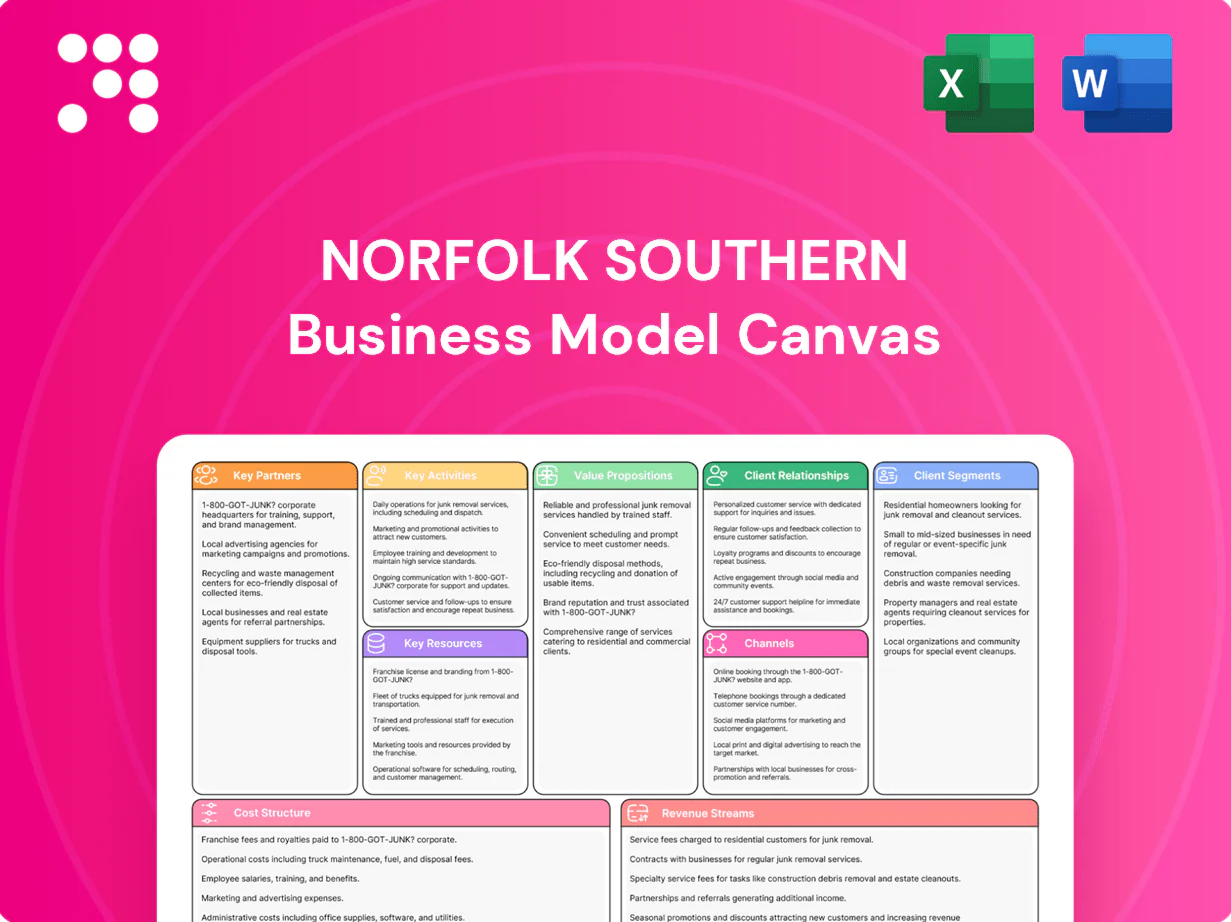
Norfolk Southern Business Model Canvas

Unlock a leading rail carrier’s Business Model Canvas for investors and strategists
Unlock Norfolk Southern’s strategic blueprint with our concise Business Model Canvas—three to five clear sentences that map value propositions, customer segments, key partners and revenue streams to real-world rail logistics execution. This professional, downloadable canvas reveals operational levers and growth opportunities for investors, consultants, and executives. Purchase the full Word/Excel canvas to access detailed, section-by-section insights and ready-to-use analysis tools.
Partnerships

Port authorities and terminal operators
Collaborations with East and Gulf Coast port authorities (eg Port of NY/NJ ~7.8M TEUs and Savannah ~5.2M TEUs in 2023) enable Norfolk Southern to link docks to inland markets with scheduled rail connections. Terminal operators align berth windows and train slots to speed container and bulk transfers, cutting interchange delays. Joint capacity planning and capital projects raise throughput and reduce dwell, underpinning intermodal growth and export/import flows.
Class I and short line railroads
Interchange agreements with Class I and short line railroads extend Norfolk Southern’s 19,500-route-mile network and enable seamless long-haul routes. Trackage rights and haulage arrangements optimize asset use and expand service options across key corridors. Short line feeders aggregate local volumes into mainline trains, with NS connecting to more than 500 short lines. Coordinated schedules reduce interchange delays and boost reliability.

Trucking and drayage providers
Motor carrier partners enable first/last-mile moves for intermodal and carload shipments while Norfolk Southern’s ~19,400 route miles across 22 states link national lanes; integrated dispatch reduces handoff friction and cycle times, joint service standards boost equipment availability and on-time performance, and this blend delivers true door-to-door logistics as trucking moves ~72.5% of U.S. freight by weight (ATA 2024).

Equipment, technology, and infrastructure suppliers
Locomotive OEMs, railcar lessors and component vendors keep Norfolk Southern fleets modern and regulatory-compliant, while technology partners deliver TMS, EDI/API, visibility, PTC and analytics for real-time operations; PTC remains the regulatory standard across Class I mainlines in 2024. Construction and engineering firms drive track, bridge, terminal and signaling upgrades to reduce outages and improve safety; vendor ecosystems cut downtime and lower maintenance costs.
- OEMs/lessors: fleet renewal & compliance
- Tech: TMS, EDI/API, visibility, PTC, analytics
- Construction: track, bridges, terminals, signaling
- Outcome: reduced downtime, enhanced safety
Public agencies and economic development groups
Partnerships with state DOTs, the FRA (via CRISI and other grant programs), and local authorities unlock federal and state grants and PPPs that fund capacity projects; Norfolk Southern, a Class I with $12.8B revenue in 2023, leverages these programs to scale corridor investments. Industrial development teams coordinate site selection and rail-served buildouts, while permitting and compliance support shortens timelines and creates new regional freight demand.
- FRA/CRISI grants support capacity upgrades
- State DOTs enable matching funds/PPPs
- Industrial teams drive site and facility delivery
- Compliance shortens project timelines
Partnerships with ports, carriers and rail to scale intermodal throughput and cut dwell
NS partners with port authorities (Port NY/NJ 7.8M TEUs 2023; Savannah 5.2M 2023), Class I/short lines (≈19,500 route miles), motor carriers (truck freight 72.5% by weight ATA 2024) and vendors (PTC standard 2024) to boost intermodal throughput, cut dwell and scale capacity; 2023 revenue $12.8B underpins grant-matched investments.
| Metric | Value |
|---|---|
| Route miles | ≈19,500 |
| 2023 Rev | $12.8B |
| Port TEUs (NY/NJ) | 7.8M (2023) |
What is included in the product
 Detailed Word Document
A comprehensive Business Model Canvas for Norfolk Southern detailing customer segments, channels, value propositions, key activities (rail network operations, intermodal, freight logistics), resources, partnerships, revenue streams and cost structure across 9 BMC blocks, with linked competitive advantages and SWOT insights—ideal for presentations, investor discussions and strategic decision-making.

 Customizable Excel Spreadsheet
High-level view of Norfolk Southern’s business model with editable cells to quickly pinpoint operational bottlenecks and efficiency levers; perfect for boardrooms, teams, or teaching to align strategy and execution. Saves hours of formatting and structures insights for fast comparison, collaboration, and rapid decision-making.
Activities

Train operations and dispatching
Daily planning, crew assignment, and locomotive utilization keep Norfolk Southern trains moving on time across approximately 19,500 route miles serving 22 states and Washington, D.C., ensuring asset availability during peak demand. Centralized dispatch manages meets, passes, and network fluidity to minimize delays. Yard and terminal operations build, break, and block trains efficiently, while precision scheduling introduced in 2019 aligns assets with demand peaks.
Network maintenance and capital improvements
Track, bridge, signal, and terminal maintenance underpin safety and reliability, with Norfolk Southern allocating a 2024 capital plan of about $2.6 billion to network and fleet investments. Predictive and scheduled work programs reduce service interruptions and derailment risk. Targeted capacity expansions relieve bottlenecks and unlock growth corridors. Comprehensive fleet overhauls sustain fuel efficiency and regulatory compliance.

Customer service and shipment visibility
Proactive communication addresses exceptions and ETA changes across Norfolk Southern's ~19,500 route miles serving 22 states and D.C., enabling immediate rerouting and customer alerts. Tracking via EDI/API feeds and customer portals delivers real-time status and shipment documents. Robust claims handling and service recovery protect customer value and trust. Collaborative planning aligns shipments to available capacity to optimize asset utilization.

Pricing, yield, and contract management
Safety, compliance, and risk management
Training and auditing enforce FRA, OSHA, and hazmat standards across Norfolk Southern, with mandatory recurrent programs and third-party audits; the railroad completed Positive Train Control deployment ahead of the FRA 2020 deadline to cut human-error incidents. Regular track, equipment, and operational inspections plus strict operating rules reduce derailments and releases. Emergency preparedness, community alerting, and rapid incident response protect people and assets, while insurance placements and enterprise risk programs limit financial exposure.
- FRA deadline met: PTC implemented by 2020
- Recurrent training and third-party audits
- Insured risk transfer and enterprise risk management
- Emergency response and community protection programs
Precision dispatch across ~19,500 miles and $2.6B capex
Daily dispatch, yards, and precision scheduling move traffic across ~19,500 route miles in 22 states/DC; crew and locomotive utilization target on-time performance. 2024 capex ~$2.6B for track, bridges, terminals and fleet; predictive maintenance and capacity projects cut delays. Real-time EDI/API tracking, 3–5yr contracts and fuel surcharge (diesel ~$3.80/gal 2024) align revenue and service.
| Metric | Value |
|---|---|
| Route miles | ~19,500 |
| States/DC | 22 |
| 2024 capex | $2.6B |
| Diesel (2024) | $3.80/gal |
| PTC | Implemented by 2020 |
Full Document Unlocks After Purchase
Business Model Canvas
The Business Model Canvas for Norfolk Southern shown here is the actual deliverable, not a sample or mockup. When you purchase, you’ll receive this identical file with all sections included, formatted and ready to edit. It’s downloadable in the exact layout you see, ready for presentation, analysis, and implementation.

Unlock a leading rail carrier’s Business Model Canvas for investors and strategists
Unlock Norfolk Southern’s strategic blueprint with our concise Business Model Canvas—three to five clear sentences that map value propositions, customer segments, key partners and revenue streams to real-world rail logistics execution. This professional, downloadable canvas reveals operational levers and growth opportunities for investors, consultants, and executives. Purchase the full Word/Excel canvas to access detailed, section-by-section insights and ready-to-use analysis tools.
Partnerships
Port authorities and terminal operators
Collaborations with East and Gulf Coast port authorities (eg Port of NY/NJ ~7.8M TEUs and Savannah ~5.2M TEUs in 2023) enable Norfolk Southern to link docks to inland markets with scheduled rail connections. Terminal operators align berth windows and train slots to speed container and bulk transfers, cutting interchange delays. Joint capacity planning and capital projects raise throughput and reduce dwell, underpinning intermodal growth and export/import flows.
Class I and short line railroads
Interchange agreements with Class I and short line railroads extend Norfolk Southern’s 19,500-route-mile network and enable seamless long-haul routes. Trackage rights and haulage arrangements optimize asset use and expand service options across key corridors. Short line feeders aggregate local volumes into mainline trains, with NS connecting to more than 500 short lines. Coordinated schedules reduce interchange delays and boost reliability.
Trucking and drayage providers
Motor carrier partners enable first/last-mile moves for intermodal and carload shipments while Norfolk Southern’s ~19,400 route miles across 22 states link national lanes; integrated dispatch reduces handoff friction and cycle times, joint service standards boost equipment availability and on-time performance, and this blend delivers true door-to-door logistics as trucking moves ~72.5% of U.S. freight by weight (ATA 2024).
Equipment, technology, and infrastructure suppliers
Locomotive OEMs, railcar lessors and component vendors keep Norfolk Southern fleets modern and regulatory-compliant, while technology partners deliver TMS, EDI/API, visibility, PTC and analytics for real-time operations; PTC remains the regulatory standard across Class I mainlines in 2024. Construction and engineering firms drive track, bridge, terminal and signaling upgrades to reduce outages and improve safety; vendor ecosystems cut downtime and lower maintenance costs.
- OEMs/lessors: fleet renewal & compliance
- Tech: TMS, EDI/API, visibility, PTC, analytics
- Construction: track, bridges, terminals, signaling
- Outcome: reduced downtime, enhanced safety
Public agencies and economic development groups
Partnerships with state DOTs, the FRA (via CRISI and other grant programs), and local authorities unlock federal and state grants and PPPs that fund capacity projects; Norfolk Southern, a Class I with $12.8B revenue in 2023, leverages these programs to scale corridor investments. Industrial development teams coordinate site selection and rail-served buildouts, while permitting and compliance support shortens timelines and creates new regional freight demand.
- FRA/CRISI grants support capacity upgrades
- State DOTs enable matching funds/PPPs
- Industrial teams drive site and facility delivery
- Compliance shortens project timelines
Partnerships with ports, carriers and rail to scale intermodal throughput and cut dwell
NS partners with port authorities (Port NY/NJ 7.8M TEUs 2023; Savannah 5.2M 2023), Class I/short lines (≈19,500 route miles), motor carriers (truck freight 72.5% by weight ATA 2024) and vendors (PTC standard 2024) to boost intermodal throughput, cut dwell and scale capacity; 2023 revenue $12.8B underpins grant-matched investments.
| Metric | Value |
|---|---|
| Route miles | ≈19,500 |
| 2023 Rev | $12.8B |
| Port TEUs (NY/NJ) | 7.8M (2023) |
What is included in the product
Detailed Word Document
A comprehensive Business Model Canvas for Norfolk Southern detailing customer segments, channels, value propositions, key activities (rail network operations, intermodal, freight logistics), resources, partnerships, revenue streams and cost structure across 9 BMC blocks, with linked competitive advantages and SWOT insights—ideal for presentations, investor discussions and strategic decision-making.
Customizable Excel Spreadsheet
High-level view of Norfolk Southern’s business model with editable cells to quickly pinpoint operational bottlenecks and efficiency levers; perfect for boardrooms, teams, or teaching to align strategy and execution. Saves hours of formatting and structures insights for fast comparison, collaboration, and rapid decision-making.
Activities
Train operations and dispatching
Daily planning, crew assignment, and locomotive utilization keep Norfolk Southern trains moving on time across approximately 19,500 route miles serving 22 states and Washington, D.C., ensuring asset availability during peak demand. Centralized dispatch manages meets, passes, and network fluidity to minimize delays. Yard and terminal operations build, break, and block trains efficiently, while precision scheduling introduced in 2019 aligns assets with demand peaks.
Network maintenance and capital improvements
Track, bridge, signal, and terminal maintenance underpin safety and reliability, with Norfolk Southern allocating a 2024 capital plan of about $2.6 billion to network and fleet investments. Predictive and scheduled work programs reduce service interruptions and derailment risk. Targeted capacity expansions relieve bottlenecks and unlock growth corridors. Comprehensive fleet overhauls sustain fuel efficiency and regulatory compliance.
Customer service and shipment visibility
Proactive communication addresses exceptions and ETA changes across Norfolk Southern's ~19,500 route miles serving 22 states and D.C., enabling immediate rerouting and customer alerts. Tracking via EDI/API feeds and customer portals delivers real-time status and shipment documents. Robust claims handling and service recovery protect customer value and trust. Collaborative planning aligns shipments to available capacity to optimize asset utilization.
Pricing, yield, and contract management
Safety, compliance, and risk management
Training and auditing enforce FRA, OSHA, and hazmat standards across Norfolk Southern, with mandatory recurrent programs and third-party audits; the railroad completed Positive Train Control deployment ahead of the FRA 2020 deadline to cut human-error incidents. Regular track, equipment, and operational inspections plus strict operating rules reduce derailments and releases. Emergency preparedness, community alerting, and rapid incident response protect people and assets, while insurance placements and enterprise risk programs limit financial exposure.
- FRA deadline met: PTC implemented by 2020
- Recurrent training and third-party audits
- Insured risk transfer and enterprise risk management
- Emergency response and community protection programs
Precision dispatch across ~19,500 miles and $2.6B capex
Daily dispatch, yards, and precision scheduling move traffic across ~19,500 route miles in 22 states/DC; crew and locomotive utilization target on-time performance. 2024 capex ~$2.6B for track, bridges, terminals and fleet; predictive maintenance and capacity projects cut delays. Real-time EDI/API tracking, 3–5yr contracts and fuel surcharge (diesel ~$3.80/gal 2024) align revenue and service.
| Metric | Value |
|---|---|
| Route miles | ~19,500 |
| States/DC | 22 |
| 2024 capex | $2.6B |
| Diesel (2024) | $3.80/gal |
| PTC | Implemented by 2020 |
Full Document Unlocks After Purchase
Business Model Canvas
The Business Model Canvas for Norfolk Southern shown here is the actual deliverable, not a sample or mockup. When you purchase, you’ll receive this identical file with all sections included, formatted and ready to edit. It’s downloadable in the exact layout you see, ready for presentation, analysis, and implementation.
Original: $10.00
-65%$10.00
$3.50Description
Unlock a leading rail carrier’s Business Model Canvas for investors and strategists
Unlock Norfolk Southern’s strategic blueprint with our concise Business Model Canvas—three to five clear sentences that map value propositions, customer segments, key partners and revenue streams to real-world rail logistics execution. This professional, downloadable canvas reveals operational levers and growth opportunities for investors, consultants, and executives. Purchase the full Word/Excel canvas to access detailed, section-by-section insights and ready-to-use analysis tools.
Partnerships
Port authorities and terminal operators
Collaborations with East and Gulf Coast port authorities (eg Port of NY/NJ ~7.8M TEUs and Savannah ~5.2M TEUs in 2023) enable Norfolk Southern to link docks to inland markets with scheduled rail connections. Terminal operators align berth windows and train slots to speed container and bulk transfers, cutting interchange delays. Joint capacity planning and capital projects raise throughput and reduce dwell, underpinning intermodal growth and export/import flows.
Class I and short line railroads
Interchange agreements with Class I and short line railroads extend Norfolk Southern’s 19,500-route-mile network and enable seamless long-haul routes. Trackage rights and haulage arrangements optimize asset use and expand service options across key corridors. Short line feeders aggregate local volumes into mainline trains, with NS connecting to more than 500 short lines. Coordinated schedules reduce interchange delays and boost reliability.
Trucking and drayage providers
Motor carrier partners enable first/last-mile moves for intermodal and carload shipments while Norfolk Southern’s ~19,400 route miles across 22 states link national lanes; integrated dispatch reduces handoff friction and cycle times, joint service standards boost equipment availability and on-time performance, and this blend delivers true door-to-door logistics as trucking moves ~72.5% of U.S. freight by weight (ATA 2024).
Equipment, technology, and infrastructure suppliers
Locomotive OEMs, railcar lessors and component vendors keep Norfolk Southern fleets modern and regulatory-compliant, while technology partners deliver TMS, EDI/API, visibility, PTC and analytics for real-time operations; PTC remains the regulatory standard across Class I mainlines in 2024. Construction and engineering firms drive track, bridge, terminal and signaling upgrades to reduce outages and improve safety; vendor ecosystems cut downtime and lower maintenance costs.
- OEMs/lessors: fleet renewal & compliance
- Tech: TMS, EDI/API, visibility, PTC, analytics
- Construction: track, bridges, terminals, signaling
- Outcome: reduced downtime, enhanced safety
Public agencies and economic development groups
Partnerships with state DOTs, the FRA (via CRISI and other grant programs), and local authorities unlock federal and state grants and PPPs that fund capacity projects; Norfolk Southern, a Class I with $12.8B revenue in 2023, leverages these programs to scale corridor investments. Industrial development teams coordinate site selection and rail-served buildouts, while permitting and compliance support shortens timelines and creates new regional freight demand.
- FRA/CRISI grants support capacity upgrades
- State DOTs enable matching funds/PPPs
- Industrial teams drive site and facility delivery
- Compliance shortens project timelines
Partnerships with ports, carriers and rail to scale intermodal throughput and cut dwell
NS partners with port authorities (Port NY/NJ 7.8M TEUs 2023; Savannah 5.2M 2023), Class I/short lines (≈19,500 route miles), motor carriers (truck freight 72.5% by weight ATA 2024) and vendors (PTC standard 2024) to boost intermodal throughput, cut dwell and scale capacity; 2023 revenue $12.8B underpins grant-matched investments.
| Metric | Value |
|---|---|
| Route miles | ≈19,500 |
| 2023 Rev | $12.8B |
| Port TEUs (NY/NJ) | 7.8M (2023) |
What is included in the product
Detailed Word Document
A comprehensive Business Model Canvas for Norfolk Southern detailing customer segments, channels, value propositions, key activities (rail network operations, intermodal, freight logistics), resources, partnerships, revenue streams and cost structure across 9 BMC blocks, with linked competitive advantages and SWOT insights—ideal for presentations, investor discussions and strategic decision-making.
Customizable Excel Spreadsheet
High-level view of Norfolk Southern’s business model with editable cells to quickly pinpoint operational bottlenecks and efficiency levers; perfect for boardrooms, teams, or teaching to align strategy and execution. Saves hours of formatting and structures insights for fast comparison, collaboration, and rapid decision-making.
Activities
Train operations and dispatching
Daily planning, crew assignment, and locomotive utilization keep Norfolk Southern trains moving on time across approximately 19,500 route miles serving 22 states and Washington, D.C., ensuring asset availability during peak demand. Centralized dispatch manages meets, passes, and network fluidity to minimize delays. Yard and terminal operations build, break, and block trains efficiently, while precision scheduling introduced in 2019 aligns assets with demand peaks.
Network maintenance and capital improvements
Track, bridge, signal, and terminal maintenance underpin safety and reliability, with Norfolk Southern allocating a 2024 capital plan of about $2.6 billion to network and fleet investments. Predictive and scheduled work programs reduce service interruptions and derailment risk. Targeted capacity expansions relieve bottlenecks and unlock growth corridors. Comprehensive fleet overhauls sustain fuel efficiency and regulatory compliance.
Customer service and shipment visibility
Proactive communication addresses exceptions and ETA changes across Norfolk Southern's ~19,500 route miles serving 22 states and D.C., enabling immediate rerouting and customer alerts. Tracking via EDI/API feeds and customer portals delivers real-time status and shipment documents. Robust claims handling and service recovery protect customer value and trust. Collaborative planning aligns shipments to available capacity to optimize asset utilization.
Pricing, yield, and contract management
Safety, compliance, and risk management
Training and auditing enforce FRA, OSHA, and hazmat standards across Norfolk Southern, with mandatory recurrent programs and third-party audits; the railroad completed Positive Train Control deployment ahead of the FRA 2020 deadline to cut human-error incidents. Regular track, equipment, and operational inspections plus strict operating rules reduce derailments and releases. Emergency preparedness, community alerting, and rapid incident response protect people and assets, while insurance placements and enterprise risk programs limit financial exposure.
- FRA deadline met: PTC implemented by 2020
- Recurrent training and third-party audits
- Insured risk transfer and enterprise risk management
- Emergency response and community protection programs
Precision dispatch across ~19,500 miles and $2.6B capex
Daily dispatch, yards, and precision scheduling move traffic across ~19,500 route miles in 22 states/DC; crew and locomotive utilization target on-time performance. 2024 capex ~$2.6B for track, bridges, terminals and fleet; predictive maintenance and capacity projects cut delays. Real-time EDI/API tracking, 3–5yr contracts and fuel surcharge (diesel ~$3.80/gal 2024) align revenue and service.
| Metric | Value |
|---|---|
| Route miles | ~19,500 |
| States/DC | 22 |
| 2024 capex | $2.6B |
| Diesel (2024) | $3.80/gal |
| PTC | Implemented by 2020 |
Full Document Unlocks After Purchase
Business Model Canvas
The Business Model Canvas for Norfolk Southern shown here is the actual deliverable, not a sample or mockup. When you purchase, you’ll receive this identical file with all sections included, formatted and ready to edit. It’s downloadable in the exact layout you see, ready for presentation, analysis, and implementation.











