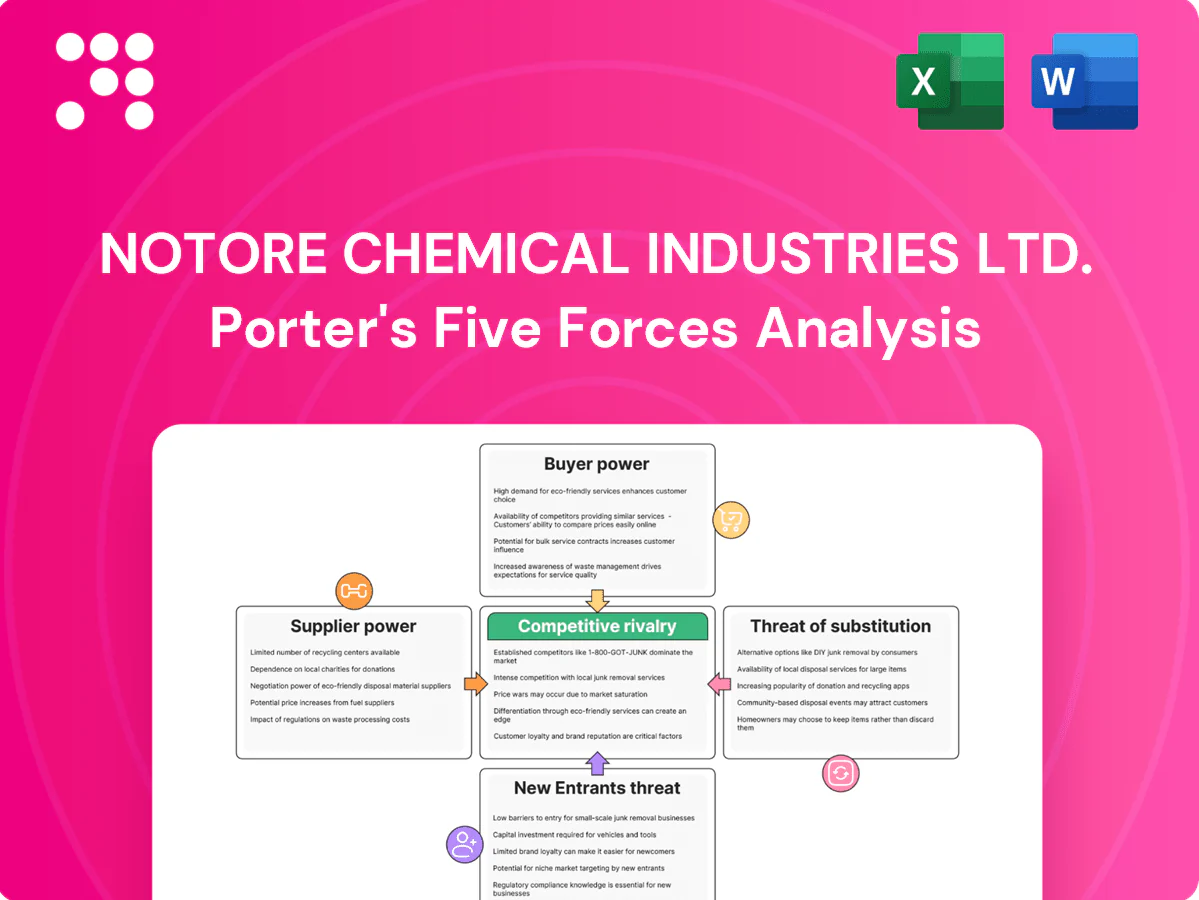
Notore Chemical Industries Ltd. Porter's Five Forces Analysis

Elevate Your Analysis with the Complete Porter's Five Forces Analysis
Notore faces moderate supplier power due to specialized feedstock and strong buyer sensitivity to fertilizer prices; rivalry is high among local agrochemical producers. Barriers to entry are moderate given capital intensity but attractive market demand; substitutes and regulatory shifts pose material threats. This brief snapshot only scratches the surface—unlock the full Porter's Five Forces Analysis to explore Notore Chemical Industries Ltd.’s competitive dynamics and strategic opportunities in depth.
Suppliers Bargaining Power

Gas feedstock concentration
Ammonia-urea output at Notore depends on steady Nigerian natural gas supply, which is concentrated among a small set of upstream producers and pipeline operators, giving suppliers strong pricing and contract leverage. Pipeline interruptions have historically halted fertiliser plants and raised feedstock costs, while long-term take-or-pay contracts lock Notore into volume and cost exposure. This concentration elevates supplier bargaining power and operational risk.
Power and utilities reliability
Nigeria’s grid instability forces Notore to rely on captive power and diesel backup, with installed capacity of 12,522 MW but available generation often under 4,000–5,000 MW in 2024, pushing energy supplier leverage higher. Utility volatility raises operating costs and supplier bargaining power for fuel and power services, while outages cut plant utilization and negotiating flexibility. Securing stable power contracts is strategic but adds significant capital and OPEX pressure.

Imported spares and catalysts
Critical catalysts, spare parts and feed chemicals for Notore are largely imported, giving foreign vendors strong bargaining power amid Nigeria’s persistent FX scarcity and constrained access to dollars in 2024. Extended import lead times and shipment delays have tightened suppliers’ terms and periodically forced maintenance deferrals, reducing plant throughput. Hedging and vendor diversification have only partially mitigated supply and FX risks.

Packaging and logistics inputs
Packaging and logistics inputs — urea bagging materials and transport — materially affect Notore’s landed cost, with 2024 showing continued pressure from limited quality suppliers and recurring Lagos/Onne port and road bottlenecks that heighten dependence on few vendors. Fuel price volatility after Nigeria’s 2023 subsidy changes amplified logistics vendors’ bargaining power, while seasonal planting peaks tightened capacity and pushed spot rates higher.
- Bagging & transport: concentrated suppliers increase switching costs
- Port/road bottlenecks: raise lead times and demurrage risk
- Fuel volatility 2024: uplifts logistics margins
- Seasonal peaks: capacity squeeze raises spot rates
Regulatory and JV dependencies
Regulatory and JV dependencies heighten supplier power for Notore as state-linked entities such as the Nigerian National Petroleum Company retain control over gas allocation and pricing; 2024 gas-pricing reforms increased negotiation leverage for suppliers. Where supply contracts involve quasi-state actors, asymmetry grows and approvals timelines create hold-up risk. Sudden policy shifts in 2024 can reprice feedstock economics abruptly, raising input-cost volatility.
- State control: NNPC gas allocation influences supply security
- 2024 reforms: increased supplier leverage on pricing
- Compliance lag: approvals extend counterparty bargaining power
Gas supplier leverage: 12,522 MW/~4,000-5,000 MW
Notore’s ammonia-urea output is highly exposed to concentrated gas suppliers and pipeline operators, creating strong supplier pricing and contract leverage. Grid instability left Nigeria with 12,522 MW installed but only ~4,000–5,000 MW available in 2024, raising captive power and fuel vendor bargaining power. FX scarcity and import lead times in 2024 further strengthened foreign vendor leverage, raising OPEX and downtime risk.
| Metric | 2024 Value |
|---|---|
| Installed generation | 12,522 MW |
| Available generation | ~4,000–5,000 MW |
What is included in the product
 Detailed Word Document
Tailored exclusively for Notore Chemical Industries Ltd., this Porter's Five Forces analysis uncovers key drivers of competition, supplier and buyer power, entry barriers, and substitute threats while identifying disruptive trends and strategic levers to protect margins. Fully editable Word format for seamless inclusion in investor decks, business plans, or academic projects.

 Customizable Excel Spreadsheet
A clear, one-sheet summary of all five forces for Notore Chemical Industries Ltd—perfect for quick decision-making and highlighting supplier concentration, regulatory risks, and competitive intensity at a glance.
Customers Bargaining Power

Price-sensitive smallholders
In 2024 core customers of Notore are price-sensitive smallholder farmers whose income seasonality and thin margins intensify bargaining for discounts. Demand falls sharply when fertilizer prices rise or rural credit tightens, causing volume volatility. Notore’s advisory and credit-linked programs soften price pushback but do not eliminate farmers’ resistance to higher retail prices.
Distributor consolidation
Regional distributors and agro-dealers aggregate volume, allowing large buyers to negotiate better pricing, credit terms and extended delivery windows with Notore; this concentration raises buyer leverage. Frequent switching between domestic brands and imports amplifies bargaining power, forcing Notore to offer performance incentives and promotional margins to retain share. Retention increasingly requires tailored credit and logistics support.

Government and institutional programs
Government and institutional programs and NGOs can place bulk orders that give them strong bargaining power over Notore, forcing competitive tenders, strict compliance and favorable payment terms. Program schedules often dictate production and delivery timing, raising operational rigidity. Heavy dependence on such contracts exposes Notore to delayed payments and abrupt policy shifts that can strain cash flow and utilization.

Product commoditization
Urea, containing about 46% nitrogen, is largely undifferentiated on nutrient content, so standardization makes price and logistics the primary comparison points. Buyers can switch suppliers readily when quality and granulation are comparable, compressing margins for Notore. To sustain pricing power, Notore must monetize value-added services such as blended formulations, logistics guarantees and farmer support programs.
- 46% N nutrient standard
- Price-driven purchasing
- Switching ease cuts margins
- Value-added services required
Access to imports
Availability of imported urea expands buyer choice, meaning Notore faces stronger price pressure when ports operate and foreign exchange is accessible, enabling buyers to substitute domestic supply with imports quickly. International price movements transmit rapidly into local bargaining, forcing Notore to either match import pricing or justify a premium through superior logistics, offtake reliability and credit terms.
Price-sensitive smallholders and import pressure demand monetized blends, advisory and offtake
In 2024 core buyers (smallholder farmers) remain price-sensitive, amplifying discount demands and volume volatility. Distributors, institutions and imports concentrate bargaining leverage, forcing promotional margins, credit and logistics concessions. Notore must monetize blended products, advisory and reliable offtake to defend margins versus imports.
| Metric | 2024 Status |
|---|---|
| Urea nutrient standard | 46% N |
| Buyer sensitivity | High |
| Import pressure | Elevated when ports/Fx open |
Full Version Awaits
Notore Chemical Industries Ltd. Porter's Five Forces Analysis
This Porter's Five Forces analysis of Notore Chemical Industries Ltd examines supplier and buyer power, competitive rivalry, threat of new entrants and substitutes, and strategic implications for margins and market positioning. This preview is the exact, fully formatted document you’ll receive immediately after purchase—no placeholders, ready to use.

Elevate Your Analysis with the Complete Porter's Five Forces Analysis
Notore faces moderate supplier power due to specialized feedstock and strong buyer sensitivity to fertilizer prices; rivalry is high among local agrochemical producers. Barriers to entry are moderate given capital intensity but attractive market demand; substitutes and regulatory shifts pose material threats. This brief snapshot only scratches the surface—unlock the full Porter's Five Forces Analysis to explore Notore Chemical Industries Ltd.’s competitive dynamics and strategic opportunities in depth.
Suppliers Bargaining Power
Gas feedstock concentration
Ammonia-urea output at Notore depends on steady Nigerian natural gas supply, which is concentrated among a small set of upstream producers and pipeline operators, giving suppliers strong pricing and contract leverage. Pipeline interruptions have historically halted fertiliser plants and raised feedstock costs, while long-term take-or-pay contracts lock Notore into volume and cost exposure. This concentration elevates supplier bargaining power and operational risk.
Power and utilities reliability
Nigeria’s grid instability forces Notore to rely on captive power and diesel backup, with installed capacity of 12,522 MW but available generation often under 4,000–5,000 MW in 2024, pushing energy supplier leverage higher. Utility volatility raises operating costs and supplier bargaining power for fuel and power services, while outages cut plant utilization and negotiating flexibility. Securing stable power contracts is strategic but adds significant capital and OPEX pressure.
Imported spares and catalysts
Critical catalysts, spare parts and feed chemicals for Notore are largely imported, giving foreign vendors strong bargaining power amid Nigeria’s persistent FX scarcity and constrained access to dollars in 2024. Extended import lead times and shipment delays have tightened suppliers’ terms and periodically forced maintenance deferrals, reducing plant throughput. Hedging and vendor diversification have only partially mitigated supply and FX risks.
Packaging and logistics inputs
Packaging and logistics inputs — urea bagging materials and transport — materially affect Notore’s landed cost, with 2024 showing continued pressure from limited quality suppliers and recurring Lagos/Onne port and road bottlenecks that heighten dependence on few vendors. Fuel price volatility after Nigeria’s 2023 subsidy changes amplified logistics vendors’ bargaining power, while seasonal planting peaks tightened capacity and pushed spot rates higher.
- Bagging & transport: concentrated suppliers increase switching costs
- Port/road bottlenecks: raise lead times and demurrage risk
- Fuel volatility 2024: uplifts logistics margins
- Seasonal peaks: capacity squeeze raises spot rates
Regulatory and JV dependencies
Regulatory and JV dependencies heighten supplier power for Notore as state-linked entities such as the Nigerian National Petroleum Company retain control over gas allocation and pricing; 2024 gas-pricing reforms increased negotiation leverage for suppliers. Where supply contracts involve quasi-state actors, asymmetry grows and approvals timelines create hold-up risk. Sudden policy shifts in 2024 can reprice feedstock economics abruptly, raising input-cost volatility.
- State control: NNPC gas allocation influences supply security
- 2024 reforms: increased supplier leverage on pricing
- Compliance lag: approvals extend counterparty bargaining power
Gas supplier leverage: 12,522 MW/~4,000-5,000 MW
Notore’s ammonia-urea output is highly exposed to concentrated gas suppliers and pipeline operators, creating strong supplier pricing and contract leverage. Grid instability left Nigeria with 12,522 MW installed but only ~4,000–5,000 MW available in 2024, raising captive power and fuel vendor bargaining power. FX scarcity and import lead times in 2024 further strengthened foreign vendor leverage, raising OPEX and downtime risk.
| Metric | 2024 Value |
|---|---|
| Installed generation | 12,522 MW |
| Available generation | ~4,000–5,000 MW |
What is included in the product
Detailed Word Document
Tailored exclusively for Notore Chemical Industries Ltd., this Porter's Five Forces analysis uncovers key drivers of competition, supplier and buyer power, entry barriers, and substitute threats while identifying disruptive trends and strategic levers to protect margins. Fully editable Word format for seamless inclusion in investor decks, business plans, or academic projects.
Customizable Excel Spreadsheet
A clear, one-sheet summary of all five forces for Notore Chemical Industries Ltd—perfect for quick decision-making and highlighting supplier concentration, regulatory risks, and competitive intensity at a glance.
Customers Bargaining Power
Price-sensitive smallholders
In 2024 core customers of Notore are price-sensitive smallholder farmers whose income seasonality and thin margins intensify bargaining for discounts. Demand falls sharply when fertilizer prices rise or rural credit tightens, causing volume volatility. Notore’s advisory and credit-linked programs soften price pushback but do not eliminate farmers’ resistance to higher retail prices.
Distributor consolidation
Regional distributors and agro-dealers aggregate volume, allowing large buyers to negotiate better pricing, credit terms and extended delivery windows with Notore; this concentration raises buyer leverage. Frequent switching between domestic brands and imports amplifies bargaining power, forcing Notore to offer performance incentives and promotional margins to retain share. Retention increasingly requires tailored credit and logistics support.
Government and institutional programs
Government and institutional programs and NGOs can place bulk orders that give them strong bargaining power over Notore, forcing competitive tenders, strict compliance and favorable payment terms. Program schedules often dictate production and delivery timing, raising operational rigidity. Heavy dependence on such contracts exposes Notore to delayed payments and abrupt policy shifts that can strain cash flow and utilization.
Product commoditization
Urea, containing about 46% nitrogen, is largely undifferentiated on nutrient content, so standardization makes price and logistics the primary comparison points. Buyers can switch suppliers readily when quality and granulation are comparable, compressing margins for Notore. To sustain pricing power, Notore must monetize value-added services such as blended formulations, logistics guarantees and farmer support programs.
- 46% N nutrient standard
- Price-driven purchasing
- Switching ease cuts margins
- Value-added services required
Access to imports
Availability of imported urea expands buyer choice, meaning Notore faces stronger price pressure when ports operate and foreign exchange is accessible, enabling buyers to substitute domestic supply with imports quickly. International price movements transmit rapidly into local bargaining, forcing Notore to either match import pricing or justify a premium through superior logistics, offtake reliability and credit terms.
Price-sensitive smallholders and import pressure demand monetized blends, advisory and offtake
In 2024 core buyers (smallholder farmers) remain price-sensitive, amplifying discount demands and volume volatility. Distributors, institutions and imports concentrate bargaining leverage, forcing promotional margins, credit and logistics concessions. Notore must monetize blended products, advisory and reliable offtake to defend margins versus imports.
| Metric | 2024 Status |
|---|---|
| Urea nutrient standard | 46% N |
| Buyer sensitivity | High |
| Import pressure | Elevated when ports/Fx open |
Full Version Awaits
Notore Chemical Industries Ltd. Porter's Five Forces Analysis
This Porter's Five Forces analysis of Notore Chemical Industries Ltd examines supplier and buyer power, competitive rivalry, threat of new entrants and substitutes, and strategic implications for margins and market positioning. This preview is the exact, fully formatted document you’ll receive immediately after purchase—no placeholders, ready to use.
Description
Elevate Your Analysis with the Complete Porter's Five Forces Analysis
Notore faces moderate supplier power due to specialized feedstock and strong buyer sensitivity to fertilizer prices; rivalry is high among local agrochemical producers. Barriers to entry are moderate given capital intensity but attractive market demand; substitutes and regulatory shifts pose material threats. This brief snapshot only scratches the surface—unlock the full Porter's Five Forces Analysis to explore Notore Chemical Industries Ltd.’s competitive dynamics and strategic opportunities in depth.
Suppliers Bargaining Power
Gas feedstock concentration
Ammonia-urea output at Notore depends on steady Nigerian natural gas supply, which is concentrated among a small set of upstream producers and pipeline operators, giving suppliers strong pricing and contract leverage. Pipeline interruptions have historically halted fertiliser plants and raised feedstock costs, while long-term take-or-pay contracts lock Notore into volume and cost exposure. This concentration elevates supplier bargaining power and operational risk.
Power and utilities reliability
Nigeria’s grid instability forces Notore to rely on captive power and diesel backup, with installed capacity of 12,522 MW but available generation often under 4,000–5,000 MW in 2024, pushing energy supplier leverage higher. Utility volatility raises operating costs and supplier bargaining power for fuel and power services, while outages cut plant utilization and negotiating flexibility. Securing stable power contracts is strategic but adds significant capital and OPEX pressure.
Imported spares and catalysts
Critical catalysts, spare parts and feed chemicals for Notore are largely imported, giving foreign vendors strong bargaining power amid Nigeria’s persistent FX scarcity and constrained access to dollars in 2024. Extended import lead times and shipment delays have tightened suppliers’ terms and periodically forced maintenance deferrals, reducing plant throughput. Hedging and vendor diversification have only partially mitigated supply and FX risks.
Packaging and logistics inputs
Packaging and logistics inputs — urea bagging materials and transport — materially affect Notore’s landed cost, with 2024 showing continued pressure from limited quality suppliers and recurring Lagos/Onne port and road bottlenecks that heighten dependence on few vendors. Fuel price volatility after Nigeria’s 2023 subsidy changes amplified logistics vendors’ bargaining power, while seasonal planting peaks tightened capacity and pushed spot rates higher.
- Bagging & transport: concentrated suppliers increase switching costs
- Port/road bottlenecks: raise lead times and demurrage risk
- Fuel volatility 2024: uplifts logistics margins
- Seasonal peaks: capacity squeeze raises spot rates
Regulatory and JV dependencies
Regulatory and JV dependencies heighten supplier power for Notore as state-linked entities such as the Nigerian National Petroleum Company retain control over gas allocation and pricing; 2024 gas-pricing reforms increased negotiation leverage for suppliers. Where supply contracts involve quasi-state actors, asymmetry grows and approvals timelines create hold-up risk. Sudden policy shifts in 2024 can reprice feedstock economics abruptly, raising input-cost volatility.
- State control: NNPC gas allocation influences supply security
- 2024 reforms: increased supplier leverage on pricing
- Compliance lag: approvals extend counterparty bargaining power
Gas supplier leverage: 12,522 MW/~4,000-5,000 MW
Notore’s ammonia-urea output is highly exposed to concentrated gas suppliers and pipeline operators, creating strong supplier pricing and contract leverage. Grid instability left Nigeria with 12,522 MW installed but only ~4,000–5,000 MW available in 2024, raising captive power and fuel vendor bargaining power. FX scarcity and import lead times in 2024 further strengthened foreign vendor leverage, raising OPEX and downtime risk.
| Metric | 2024 Value |
|---|---|
| Installed generation | 12,522 MW |
| Available generation | ~4,000–5,000 MW |
What is included in the product
Detailed Word Document
Tailored exclusively for Notore Chemical Industries Ltd., this Porter's Five Forces analysis uncovers key drivers of competition, supplier and buyer power, entry barriers, and substitute threats while identifying disruptive trends and strategic levers to protect margins. Fully editable Word format for seamless inclusion in investor decks, business plans, or academic projects.
Customizable Excel Spreadsheet
A clear, one-sheet summary of all five forces for Notore Chemical Industries Ltd—perfect for quick decision-making and highlighting supplier concentration, regulatory risks, and competitive intensity at a glance.
Customers Bargaining Power
Price-sensitive smallholders
In 2024 core customers of Notore are price-sensitive smallholder farmers whose income seasonality and thin margins intensify bargaining for discounts. Demand falls sharply when fertilizer prices rise or rural credit tightens, causing volume volatility. Notore’s advisory and credit-linked programs soften price pushback but do not eliminate farmers’ resistance to higher retail prices.
Distributor consolidation
Regional distributors and agro-dealers aggregate volume, allowing large buyers to negotiate better pricing, credit terms and extended delivery windows with Notore; this concentration raises buyer leverage. Frequent switching between domestic brands and imports amplifies bargaining power, forcing Notore to offer performance incentives and promotional margins to retain share. Retention increasingly requires tailored credit and logistics support.
Government and institutional programs
Government and institutional programs and NGOs can place bulk orders that give them strong bargaining power over Notore, forcing competitive tenders, strict compliance and favorable payment terms. Program schedules often dictate production and delivery timing, raising operational rigidity. Heavy dependence on such contracts exposes Notore to delayed payments and abrupt policy shifts that can strain cash flow and utilization.
Product commoditization
Urea, containing about 46% nitrogen, is largely undifferentiated on nutrient content, so standardization makes price and logistics the primary comparison points. Buyers can switch suppliers readily when quality and granulation are comparable, compressing margins for Notore. To sustain pricing power, Notore must monetize value-added services such as blended formulations, logistics guarantees and farmer support programs.
- 46% N nutrient standard
- Price-driven purchasing
- Switching ease cuts margins
- Value-added services required
Access to imports
Availability of imported urea expands buyer choice, meaning Notore faces stronger price pressure when ports operate and foreign exchange is accessible, enabling buyers to substitute domestic supply with imports quickly. International price movements transmit rapidly into local bargaining, forcing Notore to either match import pricing or justify a premium through superior logistics, offtake reliability and credit terms.
Price-sensitive smallholders and import pressure demand monetized blends, advisory and offtake
In 2024 core buyers (smallholder farmers) remain price-sensitive, amplifying discount demands and volume volatility. Distributors, institutions and imports concentrate bargaining leverage, forcing promotional margins, credit and logistics concessions. Notore must monetize blended products, advisory and reliable offtake to defend margins versus imports.
| Metric | 2024 Status |
|---|---|
| Urea nutrient standard | 46% N |
| Buyer sensitivity | High |
| Import pressure | Elevated when ports/Fx open |
Full Version Awaits
Notore Chemical Industries Ltd. Porter's Five Forces Analysis
This Porter's Five Forces analysis of Notore Chemical Industries Ltd examines supplier and buyer power, competitive rivalry, threat of new entrants and substitutes, and strategic implications for margins and market positioning. This preview is the exact, fully formatted document you’ll receive immediately after purchase—no placeholders, ready to use.











