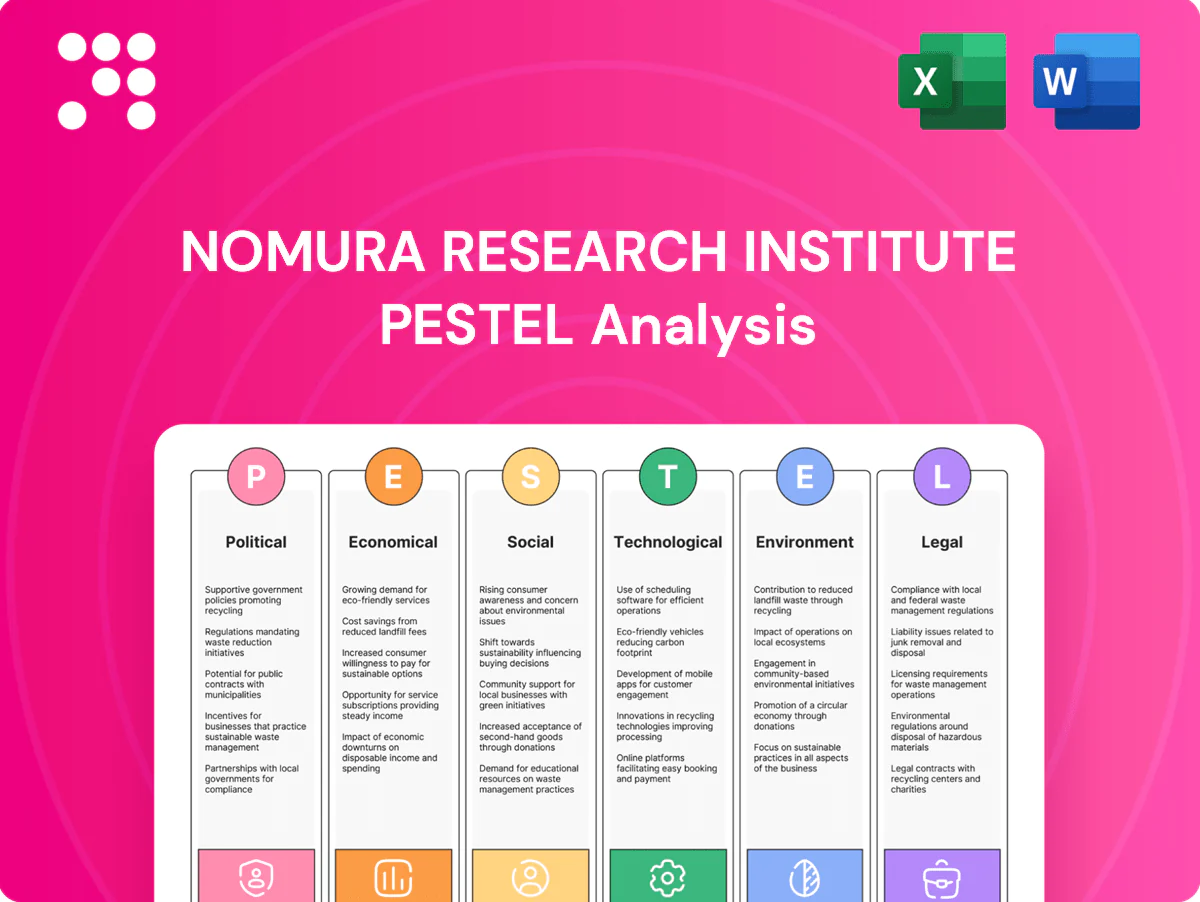
Nomura Research Institute PESTLE Analysis

Skip the Research. Get the Strategy.
Gain strategic foresight with our PESTLE Analysis of Nomura Research Institute, revealing the political, economic, social, technological, legal, and environmental forces shaping its trajectory. Ideal for investors and strategists seeking actionable insights and risk forecasts. Purchase the full report to access detailed evidence, scenario implications, and ready-to-use strategic outputs.
Political factors

Regulatory shifts in financial services
Regulatory shifts in banking, capital markets and payments—notably 2024–2025 prudential and AML/KYC updates—are driving demand for compliance, risk and core system upgrades. NRI can position consulting and IT solutions to help institutions meet enhanced reporting and prudential standards. Government-led financial infrastructure modernization programs in 2024–2025 create clear project pipelines, so close policy monitoring informs proactive offering roadmaps.
Government digital transformation agendas
National and local e-government initiatives, led in Japan by the Digital Agency established in 2021, are accelerating system integration, data platforms and citizen service portals. NRI can capture public-sector projects by aligning to policy priorities such as digital identity, interoperability and cybersecurity, and by demonstrating measurable policy impact and value-for-money. Public procurement rules and political cycles continue to shape timing and contract scope.

Geopolitics and supply chain security
US–China tech tensions and a growing data-sovereignty agenda since 2020 are forcing clients to re-architect systems and switch vendors, with firms increasingly localizing data and apps across 2023–24. NRI can advise on localization, resilience and risk diversification while adapting its delivery footprint and creating market-specific solution variants to navigate export controls and standards fragmentation. Political-risk management is emerging as a consulting growth area.

Fiscal policy and stimulus programs
Fiscal stimulus for infrastructure, green transition and innovation in 2024–25 has expanded subsidy pools that spill into IT modernization budgets, and NRI can align proposals to subsidy-eligible categories to unlock client capex. Conversely, austerity or budget freezes—with Japan's public debt over 250% of GDP—can delay public deals. Portfolio balancing across sectors mitigates fiscal cyclicality.
- Align bids to green/GX and digital subsidy categories
- Target projects with high capex subsidy uptake
- Hedge sector exposure to public spending cycles
- Monitor budget revisions and freeze risks
Policy research influence and advocacy
NRI’s think-tank function shapes discourse on demographics, productivity and digital policy, publishing policy analysis through 2024 that informs public debate. Its thought leadership helps shape regulator views and build trust with decision-makers while participation in councils and standards bodies raises visibility. Perceived policy stances must be balanced to preserve neutrality.
- role: think-tank (policy analysis 2024)
- impact: informs regulators, builds trust
- visibility: council and standards participation
- risk: maintain neutrality to avoid bias
Japan compliance boom: debt pressures, digital ID, data localization and GX subsidies
Regulatory shifts (2024–25 prudential and AML/KYC updates) and Japan public debt >250% of GDP drive demand for compliance, risk and core-system upgrades. Digital Agency (est.2021) accelerates e‑government, digital ID and cybersecurity projects. US–China tech tensions and a data‑sovereignty agenda (since 2020) push localization and political‑risk advisory. 2024–25 fiscal stimulus opened multi‑trillion‑yen subsidy pools for GX and IT.
| Indicator | Value |
|---|---|
| Japan public debt | >250% GDP |
| Digital Agency | est. 2021 |
| US–China tensions | since 2020 |
What is included in the product
 Detailed Word Document
Explores how macro-environmental factors uniquely affect Nomura Research Institute across Political, Economic, Social, Technological, Environmental and Legal dimensions, with data-backed trends and forward-looking insights tailored to its industry and region. Designed for executives and advisors to identify strategic risks and opportunities.

 Customizable Excel Spreadsheet
A clean, summarized version of the full Nomura Research Institute PESTLE analysis for easy referencing during meetings or presentations. Allows users to modify or add notes specific to their own context, region, or business line.
Economic factors

Macroeconomic cycles and IT spend
Macroeconomic cycles—with global GDP growth around 3.1% (IMF 2024) and policy rates such as the US fed funds near 5.25–5.50% in 2024–25—shape enterprise and government IT budgets via borrowing costs and credit conditions. In downturns demand pivots to cost optimization and managed services; in upcycles it shifts to transformation and growth programs. NRI can flex between efficiency and innovation, using multi-year contracts to smooth revenue volatility.
Financial sector health
Banks, insurers and asset managers—NRI core clients—drive project flow; global asset managers' AUM exceeded roughly 120 trillion USD in 2024, while Japanese bank ROEs averaged low-single digits, constraining discretionary IT spend. Regulatory capital rules and fee pressure are accelerating digitization and automation investments. 2022–24 market volatility increased demand for risk analytics and trading systems, and sector consolidation both trims vendor counts and creates large integration mandates.

Labor costs and talent availability
Wage inflation for consultants, data scientists and engineers tightened margins as tech salary growth ran about 6–8% in 2024, while LinkedIn reported ~22% YoY demand growth for data science roles. Near/offshore delivery and automation reduced cost-to-serve by shifting ~25–40% of hours offshore in large projects. Persistent talent scarcity gives vendors pricing power and can extend delivery timelines, so NRI’s investment in training and retention stabilizes utilization and billable rates.

Currency fluctuations
Revenue and costs split between Japan and overseas expose Nomura Research Institute to FX risk, with JPY volatility intensified in 2023–2024 (annual swings exceeding 20%), affecting competitiveness and translated earnings.
Hedging policies, local pricing and invoicing in client currencies help mitigate short-term volatility; NRI uses forward contracts and natural hedges per corporate disclosures in FY2024.
Contract clauses allowing currency adjustments and pass-through pricing protect margins on multi-year projects and overseas services.
- FX exposure: Japan-heavy revenue with growing overseas share
- Market context: JPY volatile in 2023–2024 (~20% range)
- Mitigants: hedging, local pricing, invoice currency
- Protection: currency adjustment clauses in contracts
Client cost optimization trends
Enterprises prioritize opex transparency, outcome-based pricing and SaaS over capex; enterprise SaaS renewal rates commonly exceed 80%, driving demand for measurable ROI and managed services NRI can package into outcome contracts; FinOps adoption and vendor consolidation favor partners with end-to-end capabilities and clear value metrics to boost renewals and expansions.
- Opex transparency
- Outcome pricing
- SaaS preference
- FinOps & vendor consolidation
Japan compliance boom: debt pressures, digital ID, data localization and GX subsidies
Global GDP ~3.1% (IMF 2024) and policy rates (US 5.25–5.50% 2024–25) shape IT budgets toward cost optimization in downturns and transformation in upcycles; core clients (AUM ~120T USD 2024) push digitization; tech wage inflation ~6–8% (2024) and JPY volatility ~20% (2023–24) pressure margins, mitigated by hedging, local pricing and currency clauses.
| Metric | Value (year) |
|---|---|
| Global GDP | 3.1% (IMF 2024) |
| US policy rate | 5.25–5.50% (2024–25) |
| Global AUM | ~120T USD (2024) |
| Tech salary growth | 6–8% (2024) |
| JPY volatility | ~20% range (2023–24) |
| SaaS renewals | >80% (2024) |
Full Version Awaits
Nomura Research Institute PESTLE Analysis
The Nomura Research Institute PESTLE Analysis preview shown here is the exact document you’ll receive after purchase, fully formatted and ready to use. This real screenshot reflects the final file with no placeholders or surprises. After checkout you’ll download this same professionally structured report instantly.

Skip the Research. Get the Strategy.
Gain strategic foresight with our PESTLE Analysis of Nomura Research Institute, revealing the political, economic, social, technological, legal, and environmental forces shaping its trajectory. Ideal for investors and strategists seeking actionable insights and risk forecasts. Purchase the full report to access detailed evidence, scenario implications, and ready-to-use strategic outputs.
Political factors
Regulatory shifts in financial services
Regulatory shifts in banking, capital markets and payments—notably 2024–2025 prudential and AML/KYC updates—are driving demand for compliance, risk and core system upgrades. NRI can position consulting and IT solutions to help institutions meet enhanced reporting and prudential standards. Government-led financial infrastructure modernization programs in 2024–2025 create clear project pipelines, so close policy monitoring informs proactive offering roadmaps.
Government digital transformation agendas
National and local e-government initiatives, led in Japan by the Digital Agency established in 2021, are accelerating system integration, data platforms and citizen service portals. NRI can capture public-sector projects by aligning to policy priorities such as digital identity, interoperability and cybersecurity, and by demonstrating measurable policy impact and value-for-money. Public procurement rules and political cycles continue to shape timing and contract scope.
Geopolitics and supply chain security
US–China tech tensions and a growing data-sovereignty agenda since 2020 are forcing clients to re-architect systems and switch vendors, with firms increasingly localizing data and apps across 2023–24. NRI can advise on localization, resilience and risk diversification while adapting its delivery footprint and creating market-specific solution variants to navigate export controls and standards fragmentation. Political-risk management is emerging as a consulting growth area.
Fiscal policy and stimulus programs
Fiscal stimulus for infrastructure, green transition and innovation in 2024–25 has expanded subsidy pools that spill into IT modernization budgets, and NRI can align proposals to subsidy-eligible categories to unlock client capex. Conversely, austerity or budget freezes—with Japan's public debt over 250% of GDP—can delay public deals. Portfolio balancing across sectors mitigates fiscal cyclicality.
- Align bids to green/GX and digital subsidy categories
- Target projects with high capex subsidy uptake
- Hedge sector exposure to public spending cycles
- Monitor budget revisions and freeze risks
Policy research influence and advocacy
NRI’s think-tank function shapes discourse on demographics, productivity and digital policy, publishing policy analysis through 2024 that informs public debate. Its thought leadership helps shape regulator views and build trust with decision-makers while participation in councils and standards bodies raises visibility. Perceived policy stances must be balanced to preserve neutrality.
- role: think-tank (policy analysis 2024)
- impact: informs regulators, builds trust
- visibility: council and standards participation
- risk: maintain neutrality to avoid bias
Japan compliance boom: debt pressures, digital ID, data localization and GX subsidies
Regulatory shifts (2024–25 prudential and AML/KYC updates) and Japan public debt >250% of GDP drive demand for compliance, risk and core-system upgrades. Digital Agency (est.2021) accelerates e‑government, digital ID and cybersecurity projects. US–China tech tensions and a data‑sovereignty agenda (since 2020) push localization and political‑risk advisory. 2024–25 fiscal stimulus opened multi‑trillion‑yen subsidy pools for GX and IT.
| Indicator | Value |
|---|---|
| Japan public debt | >250% GDP |
| Digital Agency | est. 2021 |
| US–China tensions | since 2020 |
What is included in the product
Detailed Word Document
Explores how macro-environmental factors uniquely affect Nomura Research Institute across Political, Economic, Social, Technological, Environmental and Legal dimensions, with data-backed trends and forward-looking insights tailored to its industry and region. Designed for executives and advisors to identify strategic risks and opportunities.
Customizable Excel Spreadsheet
A clean, summarized version of the full Nomura Research Institute PESTLE analysis for easy referencing during meetings or presentations. Allows users to modify or add notes specific to their own context, region, or business line.
Economic factors
Macroeconomic cycles and IT spend
Macroeconomic cycles—with global GDP growth around 3.1% (IMF 2024) and policy rates such as the US fed funds near 5.25–5.50% in 2024–25—shape enterprise and government IT budgets via borrowing costs and credit conditions. In downturns demand pivots to cost optimization and managed services; in upcycles it shifts to transformation and growth programs. NRI can flex between efficiency and innovation, using multi-year contracts to smooth revenue volatility.
Financial sector health
Banks, insurers and asset managers—NRI core clients—drive project flow; global asset managers' AUM exceeded roughly 120 trillion USD in 2024, while Japanese bank ROEs averaged low-single digits, constraining discretionary IT spend. Regulatory capital rules and fee pressure are accelerating digitization and automation investments. 2022–24 market volatility increased demand for risk analytics and trading systems, and sector consolidation both trims vendor counts and creates large integration mandates.
Labor costs and talent availability
Wage inflation for consultants, data scientists and engineers tightened margins as tech salary growth ran about 6–8% in 2024, while LinkedIn reported ~22% YoY demand growth for data science roles. Near/offshore delivery and automation reduced cost-to-serve by shifting ~25–40% of hours offshore in large projects. Persistent talent scarcity gives vendors pricing power and can extend delivery timelines, so NRI’s investment in training and retention stabilizes utilization and billable rates.
Currency fluctuations
Revenue and costs split between Japan and overseas expose Nomura Research Institute to FX risk, with JPY volatility intensified in 2023–2024 (annual swings exceeding 20%), affecting competitiveness and translated earnings.
Hedging policies, local pricing and invoicing in client currencies help mitigate short-term volatility; NRI uses forward contracts and natural hedges per corporate disclosures in FY2024.
Contract clauses allowing currency adjustments and pass-through pricing protect margins on multi-year projects and overseas services.
- FX exposure: Japan-heavy revenue with growing overseas share
- Market context: JPY volatile in 2023–2024 (~20% range)
- Mitigants: hedging, local pricing, invoice currency
- Protection: currency adjustment clauses in contracts
Client cost optimization trends
Enterprises prioritize opex transparency, outcome-based pricing and SaaS over capex; enterprise SaaS renewal rates commonly exceed 80%, driving demand for measurable ROI and managed services NRI can package into outcome contracts; FinOps adoption and vendor consolidation favor partners with end-to-end capabilities and clear value metrics to boost renewals and expansions.
- Opex transparency
- Outcome pricing
- SaaS preference
- FinOps & vendor consolidation
Japan compliance boom: debt pressures, digital ID, data localization and GX subsidies
Global GDP ~3.1% (IMF 2024) and policy rates (US 5.25–5.50% 2024–25) shape IT budgets toward cost optimization in downturns and transformation in upcycles; core clients (AUM ~120T USD 2024) push digitization; tech wage inflation ~6–8% (2024) and JPY volatility ~20% (2023–24) pressure margins, mitigated by hedging, local pricing and currency clauses.
| Metric | Value (year) |
|---|---|
| Global GDP | 3.1% (IMF 2024) |
| US policy rate | 5.25–5.50% (2024–25) |
| Global AUM | ~120T USD (2024) |
| Tech salary growth | 6–8% (2024) |
| JPY volatility | ~20% range (2023–24) |
| SaaS renewals | >80% (2024) |
Full Version Awaits
Nomura Research Institute PESTLE Analysis
The Nomura Research Institute PESTLE Analysis preview shown here is the exact document you’ll receive after purchase, fully formatted and ready to use. This real screenshot reflects the final file with no placeholders or surprises. After checkout you’ll download this same professionally structured report instantly.
Original: $10.00
-65%$10.00
$3.50Description
Skip the Research. Get the Strategy.
Gain strategic foresight with our PESTLE Analysis of Nomura Research Institute, revealing the political, economic, social, technological, legal, and environmental forces shaping its trajectory. Ideal for investors and strategists seeking actionable insights and risk forecasts. Purchase the full report to access detailed evidence, scenario implications, and ready-to-use strategic outputs.
Political factors
Regulatory shifts in financial services
Regulatory shifts in banking, capital markets and payments—notably 2024–2025 prudential and AML/KYC updates—are driving demand for compliance, risk and core system upgrades. NRI can position consulting and IT solutions to help institutions meet enhanced reporting and prudential standards. Government-led financial infrastructure modernization programs in 2024–2025 create clear project pipelines, so close policy monitoring informs proactive offering roadmaps.
Government digital transformation agendas
National and local e-government initiatives, led in Japan by the Digital Agency established in 2021, are accelerating system integration, data platforms and citizen service portals. NRI can capture public-sector projects by aligning to policy priorities such as digital identity, interoperability and cybersecurity, and by demonstrating measurable policy impact and value-for-money. Public procurement rules and political cycles continue to shape timing and contract scope.
Geopolitics and supply chain security
US–China tech tensions and a growing data-sovereignty agenda since 2020 are forcing clients to re-architect systems and switch vendors, with firms increasingly localizing data and apps across 2023–24. NRI can advise on localization, resilience and risk diversification while adapting its delivery footprint and creating market-specific solution variants to navigate export controls and standards fragmentation. Political-risk management is emerging as a consulting growth area.
Fiscal policy and stimulus programs
Fiscal stimulus for infrastructure, green transition and innovation in 2024–25 has expanded subsidy pools that spill into IT modernization budgets, and NRI can align proposals to subsidy-eligible categories to unlock client capex. Conversely, austerity or budget freezes—with Japan's public debt over 250% of GDP—can delay public deals. Portfolio balancing across sectors mitigates fiscal cyclicality.
- Align bids to green/GX and digital subsidy categories
- Target projects with high capex subsidy uptake
- Hedge sector exposure to public spending cycles
- Monitor budget revisions and freeze risks
Policy research influence and advocacy
NRI’s think-tank function shapes discourse on demographics, productivity and digital policy, publishing policy analysis through 2024 that informs public debate. Its thought leadership helps shape regulator views and build trust with decision-makers while participation in councils and standards bodies raises visibility. Perceived policy stances must be balanced to preserve neutrality.
- role: think-tank (policy analysis 2024)
- impact: informs regulators, builds trust
- visibility: council and standards participation
- risk: maintain neutrality to avoid bias
Japan compliance boom: debt pressures, digital ID, data localization and GX subsidies
Regulatory shifts (2024–25 prudential and AML/KYC updates) and Japan public debt >250% of GDP drive demand for compliance, risk and core-system upgrades. Digital Agency (est.2021) accelerates e‑government, digital ID and cybersecurity projects. US–China tech tensions and a data‑sovereignty agenda (since 2020) push localization and political‑risk advisory. 2024–25 fiscal stimulus opened multi‑trillion‑yen subsidy pools for GX and IT.
| Indicator | Value |
|---|---|
| Japan public debt | >250% GDP |
| Digital Agency | est. 2021 |
| US–China tensions | since 2020 |
What is included in the product
Detailed Word Document
Explores how macro-environmental factors uniquely affect Nomura Research Institute across Political, Economic, Social, Technological, Environmental and Legal dimensions, with data-backed trends and forward-looking insights tailored to its industry and region. Designed for executives and advisors to identify strategic risks and opportunities.
Customizable Excel Spreadsheet
A clean, summarized version of the full Nomura Research Institute PESTLE analysis for easy referencing during meetings or presentations. Allows users to modify or add notes specific to their own context, region, or business line.
Economic factors
Macroeconomic cycles and IT spend
Macroeconomic cycles—with global GDP growth around 3.1% (IMF 2024) and policy rates such as the US fed funds near 5.25–5.50% in 2024–25—shape enterprise and government IT budgets via borrowing costs and credit conditions. In downturns demand pivots to cost optimization and managed services; in upcycles it shifts to transformation and growth programs. NRI can flex between efficiency and innovation, using multi-year contracts to smooth revenue volatility.
Financial sector health
Banks, insurers and asset managers—NRI core clients—drive project flow; global asset managers' AUM exceeded roughly 120 trillion USD in 2024, while Japanese bank ROEs averaged low-single digits, constraining discretionary IT spend. Regulatory capital rules and fee pressure are accelerating digitization and automation investments. 2022–24 market volatility increased demand for risk analytics and trading systems, and sector consolidation both trims vendor counts and creates large integration mandates.
Labor costs and talent availability
Wage inflation for consultants, data scientists and engineers tightened margins as tech salary growth ran about 6–8% in 2024, while LinkedIn reported ~22% YoY demand growth for data science roles. Near/offshore delivery and automation reduced cost-to-serve by shifting ~25–40% of hours offshore in large projects. Persistent talent scarcity gives vendors pricing power and can extend delivery timelines, so NRI’s investment in training and retention stabilizes utilization and billable rates.
Currency fluctuations
Revenue and costs split between Japan and overseas expose Nomura Research Institute to FX risk, with JPY volatility intensified in 2023–2024 (annual swings exceeding 20%), affecting competitiveness and translated earnings.
Hedging policies, local pricing and invoicing in client currencies help mitigate short-term volatility; NRI uses forward contracts and natural hedges per corporate disclosures in FY2024.
Contract clauses allowing currency adjustments and pass-through pricing protect margins on multi-year projects and overseas services.
- FX exposure: Japan-heavy revenue with growing overseas share
- Market context: JPY volatile in 2023–2024 (~20% range)
- Mitigants: hedging, local pricing, invoice currency
- Protection: currency adjustment clauses in contracts
Client cost optimization trends
Enterprises prioritize opex transparency, outcome-based pricing and SaaS over capex; enterprise SaaS renewal rates commonly exceed 80%, driving demand for measurable ROI and managed services NRI can package into outcome contracts; FinOps adoption and vendor consolidation favor partners with end-to-end capabilities and clear value metrics to boost renewals and expansions.
- Opex transparency
- Outcome pricing
- SaaS preference
- FinOps & vendor consolidation
Japan compliance boom: debt pressures, digital ID, data localization and GX subsidies
Global GDP ~3.1% (IMF 2024) and policy rates (US 5.25–5.50% 2024–25) shape IT budgets toward cost optimization in downturns and transformation in upcycles; core clients (AUM ~120T USD 2024) push digitization; tech wage inflation ~6–8% (2024) and JPY volatility ~20% (2023–24) pressure margins, mitigated by hedging, local pricing and currency clauses.
| Metric | Value (year) |
|---|---|
| Global GDP | 3.1% (IMF 2024) |
| US policy rate | 5.25–5.50% (2024–25) |
| Global AUM | ~120T USD (2024) |
| Tech salary growth | 6–8% (2024) |
| JPY volatility | ~20% range (2023–24) |
| SaaS renewals | >80% (2024) |
Full Version Awaits
Nomura Research Institute PESTLE Analysis
The Nomura Research Institute PESTLE Analysis preview shown here is the exact document you’ll receive after purchase, fully formatted and ready to use. This real screenshot reflects the final file with no placeholders or surprises. After checkout you’ll download this same professionally structured report instantly.











