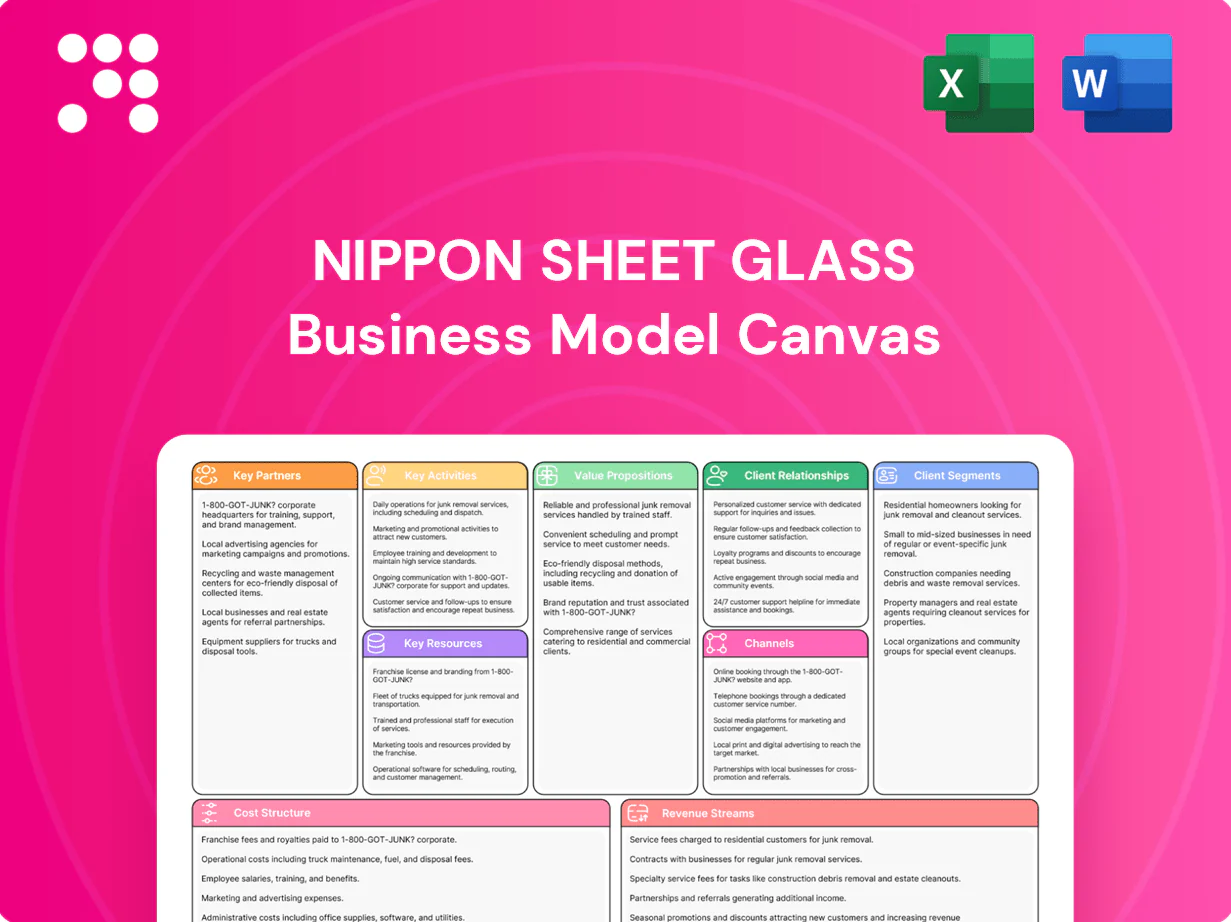
Nippon Sheet Glass Business Model Canvas

Complete Business Model Canvas for Glass & Specialty Materials: Strategy, Revenue & Partners
Unlock the full strategic blueprint behind Nippon Sheet Glass with our complete Business Model Canvas—detailing value propositions, key partners, revenue streams and cost structure. Ideal for investors, consultants and founders seeking actionable insights; download the editable Word/Excel version to accelerate strategy and benchmarking.
Partnerships

Automotive OEM and Tier-1 alliances
Collaborations with global OEMs and Tier-1s secure design-ins and multi-year supply programs, with NSG supplying glazing to over 20 major automakers and automotive sales contributing about 35% of FY2024 group revenue. Joint development aligns glass specs to safety, NVH, ADAS and HUD requirements, enabling platform-level standardization across models. These partnerships stabilize demand, accelerate regional certification and shorten time-to-market.
Architectural contractors and façade engineers
Strategic ties with EPCs, glazing contractors and façade consultants drive project wins for Nippon Sheet Glass, tapping a global architectural glass market estimated at about USD 74 billion in 2024. Early engagement lets NSG influence U-value, SHGC, acoustic and fire specs to meet tender requirements. Partnerships streamline on-site logistics and QA, reducing rework risk, and enable lifecycle service and replacement revenue streams.

Raw material and energy suppliers
Securing soda ash, silica, coatings, interlayers and hydrogen/natural gas is critical to maintain furnace uptime and product quality for Nippon Sheet Glass; supply disruptions can halt lines that serve automotive and architectural segments. Long-term contracts and joint efficiency programs with suppliers reduce price and supply volatility and support continuous operations. Co-development agreements with chemical partners enhance coating and interlayer performance. Energy partnerships enable decarbonization and cost stability while supporting NSG’s ~25,000 global workforce.

Equipment and technology providers
Alliances with furnace OEMs, float‑line specialists and robotics vendors raise yield and throughput; co‑developed coating, tempering and lamination tech delivers step gains. Predictive maintenance and digital twins cut downtime up to 30% and can boost throughput 10–15%. Partners enable low‑carbon processes and recycling, with 2024 pilots showing ~25% CO2 reduction.
- Furnace OEMs: thermal efficiency
- Float specialists: yield, fewer rejects
- Robotics: throughput, safety
- Digital twins/PdM: −30% downtime, +10–15% throughput
- Co‑dev: advanced coatings, lamination, ~25% CO2 cut (2024)
Universities and research institutes
Universities and research institutes drive open innovation for Nippon Sheet Glass, accelerating new glass chemistries, advanced coatings, and integrated smart functionalities through collaborative R&D and shared facilities.
- Joint labs shorten time-to-market for electrochromic and photovoltaic integrations
- Grants and consortia lower R&D risk and cost
- Build talent pipelines and IP portfolios
OEM alliances drive 35% auto revenue; digital furnaces -30% downtime, -25% CO2
Key partnerships with 20+ OEMs drive automotive revenue ~35% of FY2024, joint R&D standardizes ADAS/HUD glass; EPCs and façade partners tap a global architectural glass market ~USD 74bn (2024). Suppliers ensure soda ash/silica/energy continuity for ~25,000 staff; furnace/robotics/digital twins cut downtime −30% and raise throughput +10–15%, 2024 pilots show ~25% CO2 cut.
| Partner | Role | 2024 metric |
|---|---|---|
| OEMs | Design-ins/supply | 20+ automakers; 35% rev |
| Suppliers | Raw materials/energy | Continuous furnace uptime |
| Tech vendors | Yield/efficiency | −30% downtime/+10–15% |
What is included in the product
 Detailed Word Document
A concise, pre-written Business Model Canvas for Nippon Sheet Glass outlining customer segments, channels, value propositions, revenue streams and key resources; aligned with real-world operations, competitive advantages, SWOT-linked insights and investor-ready presentation format.

 Customizable Excel Spreadsheet
High-level view of Nippon Sheet Glass’s business model with editable cells, condensing strategy into a digestible one-page snapshot that saves hours of structuring, enables team collaboration, and is perfect for boardrooms, comparisons, and rapid decision-making.
Activities

Float glass manufacturing and processing
Operating float lines and downstream processes—cutting, tempering, laminating and insulated unit assembly—anchor NSG’s volume and quality delivery, with 2024 continuous-improvement programs reporting yield uplifts of 1–3% and energy savings up to 5%. Strict process control sustains optical clarity and flatness within industry tolerances, while automated inspection and SPC drive consistent output and reduced rework.
Coating and functionalization
Low-E, solar-control, anti-reflective and hydrophilic coatings deliver measurable performance: Low-E can cut heat loss by up to 50% and solar-control can reduce cooling load by as much as 30–70% depending on glazing. Sputter and pyrolytic lines are optimized for durability and aesthetics, supporting tempering and laminated processes. Recipes are tailored per climate and application to meet regional specs. Robust QA with inline metrology ensures consistency across production sites.

Design-in and application engineering
Design-in and application engineering with OEMs and architects secures specification and homologation, leveraging NSG Group's operations across more than 30 countries in 2024. Simulation and prototyping validate thermal, acoustic and structural targets to meet performance benchmarks. Application engineering adapts products to local codes and field support ensures fit, finish and in-service performance.

Supply chain and logistics orchestration
Coordinating JIT deliveries and jumbo-to-size optimization reduced scrap and inventory, cutting material waste and on-site stock by up to 30% in 2024 pilots; cold chain-like handling preserves coated surfaces through transport and storage; regional hubs shortened lead times to project sites and OEM plants, accelerating order fulfilment; data-driven planning smoothed furnace campaigns and changeovers, raising yield consistency.
- JIT: up to 30% inventory/waste reduction
- Cold-chain handling: protects coatings
- Regional hubs: shorter lead times
- Data planning: smoother furnace campaigns
R&D and sustainability initiatives
R&D focuses on lighter laminates, higher-selectivity coatings and smart glass prototypes to boost energy performance and lower transport/installation costs.
Energy-transition projects in 2024 aim to cut furnace emissions and raise cullet use across factories, improving carbon intensity per ton produced.
Circularity programs reclaim and recycle post-consumer glass while LCA work underpins green building certification support for customers.
- R&D: lighter laminates, selective coatings, smart glass
- Energy: furnace emissions reduction, higher cullet rates
- Circularity: post-consumer glass recycling programs
- LCA: supports green building certifications
1–3% yield, up to 5% energy, 30% waste cut in 30+ countries
Operating float, coating and downstream tempering/laminating sustain volume and quality, with 2024 CI delivering 1–3% yield uplift and up to 5% energy savings. Design-in engineering, regional hubs and JIT logistics cut on-site stock/waste by up to 30% and shorten lead times across 30+ countries in 2024. R&D and circularity scale lighter laminates, smart-glass pilots and cullet reuse to lower carbon intensity.
| Metric | 2024 Value |
|---|---|
| Yield uplift | 1–3% |
| Energy savings | up to 5% |
| Inventory/waste reduction | up to 30% |
| Operational footprint | 30+ countries |
Full Version Awaits
Business Model Canvas
The document previewed here is the actual Nippon Sheet Glass Business Model Canvas, not a mockup or sample. When you purchase, you’ll receive this same complete, editable file formatted for immediate use. No surprises—what you see in the preview is the exact deliverable you’ll download and apply.

Complete Business Model Canvas for Glass & Specialty Materials: Strategy, Revenue & Partners
Unlock the full strategic blueprint behind Nippon Sheet Glass with our complete Business Model Canvas—detailing value propositions, key partners, revenue streams and cost structure. Ideal for investors, consultants and founders seeking actionable insights; download the editable Word/Excel version to accelerate strategy and benchmarking.
Partnerships
Automotive OEM and Tier-1 alliances
Collaborations with global OEMs and Tier-1s secure design-ins and multi-year supply programs, with NSG supplying glazing to over 20 major automakers and automotive sales contributing about 35% of FY2024 group revenue. Joint development aligns glass specs to safety, NVH, ADAS and HUD requirements, enabling platform-level standardization across models. These partnerships stabilize demand, accelerate regional certification and shorten time-to-market.
Architectural contractors and façade engineers
Strategic ties with EPCs, glazing contractors and façade consultants drive project wins for Nippon Sheet Glass, tapping a global architectural glass market estimated at about USD 74 billion in 2024. Early engagement lets NSG influence U-value, SHGC, acoustic and fire specs to meet tender requirements. Partnerships streamline on-site logistics and QA, reducing rework risk, and enable lifecycle service and replacement revenue streams.
Raw material and energy suppliers
Securing soda ash, silica, coatings, interlayers and hydrogen/natural gas is critical to maintain furnace uptime and product quality for Nippon Sheet Glass; supply disruptions can halt lines that serve automotive and architectural segments. Long-term contracts and joint efficiency programs with suppliers reduce price and supply volatility and support continuous operations. Co-development agreements with chemical partners enhance coating and interlayer performance. Energy partnerships enable decarbonization and cost stability while supporting NSG’s ~25,000 global workforce.
Equipment and technology providers
Alliances with furnace OEMs, float‑line specialists and robotics vendors raise yield and throughput; co‑developed coating, tempering and lamination tech delivers step gains. Predictive maintenance and digital twins cut downtime up to 30% and can boost throughput 10–15%. Partners enable low‑carbon processes and recycling, with 2024 pilots showing ~25% CO2 reduction.
- Furnace OEMs: thermal efficiency
- Float specialists: yield, fewer rejects
- Robotics: throughput, safety
- Digital twins/PdM: −30% downtime, +10–15% throughput
- Co‑dev: advanced coatings, lamination, ~25% CO2 cut (2024)
Universities and research institutes
Universities and research institutes drive open innovation for Nippon Sheet Glass, accelerating new glass chemistries, advanced coatings, and integrated smart functionalities through collaborative R&D and shared facilities.
- Joint labs shorten time-to-market for electrochromic and photovoltaic integrations
- Grants and consortia lower R&D risk and cost
- Build talent pipelines and IP portfolios
OEM alliances drive 35% auto revenue; digital furnaces -30% downtime, -25% CO2
Key partnerships with 20+ OEMs drive automotive revenue ~35% of FY2024, joint R&D standardizes ADAS/HUD glass; EPCs and façade partners tap a global architectural glass market ~USD 74bn (2024). Suppliers ensure soda ash/silica/energy continuity for ~25,000 staff; furnace/robotics/digital twins cut downtime −30% and raise throughput +10–15%, 2024 pilots show ~25% CO2 cut.
| Partner | Role | 2024 metric |
|---|---|---|
| OEMs | Design-ins/supply | 20+ automakers; 35% rev |
| Suppliers | Raw materials/energy | Continuous furnace uptime |
| Tech vendors | Yield/efficiency | −30% downtime/+10–15% |
What is included in the product
Detailed Word Document
A concise, pre-written Business Model Canvas for Nippon Sheet Glass outlining customer segments, channels, value propositions, revenue streams and key resources; aligned with real-world operations, competitive advantages, SWOT-linked insights and investor-ready presentation format.
Customizable Excel Spreadsheet
High-level view of Nippon Sheet Glass’s business model with editable cells, condensing strategy into a digestible one-page snapshot that saves hours of structuring, enables team collaboration, and is perfect for boardrooms, comparisons, and rapid decision-making.
Activities
Float glass manufacturing and processing
Operating float lines and downstream processes—cutting, tempering, laminating and insulated unit assembly—anchor NSG’s volume and quality delivery, with 2024 continuous-improvement programs reporting yield uplifts of 1–3% and energy savings up to 5%. Strict process control sustains optical clarity and flatness within industry tolerances, while automated inspection and SPC drive consistent output and reduced rework.
Coating and functionalization
Low-E, solar-control, anti-reflective and hydrophilic coatings deliver measurable performance: Low-E can cut heat loss by up to 50% and solar-control can reduce cooling load by as much as 30–70% depending on glazing. Sputter and pyrolytic lines are optimized for durability and aesthetics, supporting tempering and laminated processes. Recipes are tailored per climate and application to meet regional specs. Robust QA with inline metrology ensures consistency across production sites.
Design-in and application engineering
Design-in and application engineering with OEMs and architects secures specification and homologation, leveraging NSG Group's operations across more than 30 countries in 2024. Simulation and prototyping validate thermal, acoustic and structural targets to meet performance benchmarks. Application engineering adapts products to local codes and field support ensures fit, finish and in-service performance.
Supply chain and logistics orchestration
Coordinating JIT deliveries and jumbo-to-size optimization reduced scrap and inventory, cutting material waste and on-site stock by up to 30% in 2024 pilots; cold chain-like handling preserves coated surfaces through transport and storage; regional hubs shortened lead times to project sites and OEM plants, accelerating order fulfilment; data-driven planning smoothed furnace campaigns and changeovers, raising yield consistency.
- JIT: up to 30% inventory/waste reduction
- Cold-chain handling: protects coatings
- Regional hubs: shorter lead times
- Data planning: smoother furnace campaigns
R&D and sustainability initiatives
R&D focuses on lighter laminates, higher-selectivity coatings and smart glass prototypes to boost energy performance and lower transport/installation costs.
Energy-transition projects in 2024 aim to cut furnace emissions and raise cullet use across factories, improving carbon intensity per ton produced.
Circularity programs reclaim and recycle post-consumer glass while LCA work underpins green building certification support for customers.
- R&D: lighter laminates, selective coatings, smart glass
- Energy: furnace emissions reduction, higher cullet rates
- Circularity: post-consumer glass recycling programs
- LCA: supports green building certifications
1–3% yield, up to 5% energy, 30% waste cut in 30+ countries
Operating float, coating and downstream tempering/laminating sustain volume and quality, with 2024 CI delivering 1–3% yield uplift and up to 5% energy savings. Design-in engineering, regional hubs and JIT logistics cut on-site stock/waste by up to 30% and shorten lead times across 30+ countries in 2024. R&D and circularity scale lighter laminates, smart-glass pilots and cullet reuse to lower carbon intensity.
| Metric | 2024 Value |
|---|---|
| Yield uplift | 1–3% |
| Energy savings | up to 5% |
| Inventory/waste reduction | up to 30% |
| Operational footprint | 30+ countries |
Full Version Awaits
Business Model Canvas
The document previewed here is the actual Nippon Sheet Glass Business Model Canvas, not a mockup or sample. When you purchase, you’ll receive this same complete, editable file formatted for immediate use. No surprises—what you see in the preview is the exact deliverable you’ll download and apply.
Description
Complete Business Model Canvas for Glass & Specialty Materials: Strategy, Revenue & Partners
Unlock the full strategic blueprint behind Nippon Sheet Glass with our complete Business Model Canvas—detailing value propositions, key partners, revenue streams and cost structure. Ideal for investors, consultants and founders seeking actionable insights; download the editable Word/Excel version to accelerate strategy and benchmarking.
Partnerships
Automotive OEM and Tier-1 alliances
Collaborations with global OEMs and Tier-1s secure design-ins and multi-year supply programs, with NSG supplying glazing to over 20 major automakers and automotive sales contributing about 35% of FY2024 group revenue. Joint development aligns glass specs to safety, NVH, ADAS and HUD requirements, enabling platform-level standardization across models. These partnerships stabilize demand, accelerate regional certification and shorten time-to-market.
Architectural contractors and façade engineers
Strategic ties with EPCs, glazing contractors and façade consultants drive project wins for Nippon Sheet Glass, tapping a global architectural glass market estimated at about USD 74 billion in 2024. Early engagement lets NSG influence U-value, SHGC, acoustic and fire specs to meet tender requirements. Partnerships streamline on-site logistics and QA, reducing rework risk, and enable lifecycle service and replacement revenue streams.
Raw material and energy suppliers
Securing soda ash, silica, coatings, interlayers and hydrogen/natural gas is critical to maintain furnace uptime and product quality for Nippon Sheet Glass; supply disruptions can halt lines that serve automotive and architectural segments. Long-term contracts and joint efficiency programs with suppliers reduce price and supply volatility and support continuous operations. Co-development agreements with chemical partners enhance coating and interlayer performance. Energy partnerships enable decarbonization and cost stability while supporting NSG’s ~25,000 global workforce.
Equipment and technology providers
Alliances with furnace OEMs, float‑line specialists and robotics vendors raise yield and throughput; co‑developed coating, tempering and lamination tech delivers step gains. Predictive maintenance and digital twins cut downtime up to 30% and can boost throughput 10–15%. Partners enable low‑carbon processes and recycling, with 2024 pilots showing ~25% CO2 reduction.
- Furnace OEMs: thermal efficiency
- Float specialists: yield, fewer rejects
- Robotics: throughput, safety
- Digital twins/PdM: −30% downtime, +10–15% throughput
- Co‑dev: advanced coatings, lamination, ~25% CO2 cut (2024)
Universities and research institutes
Universities and research institutes drive open innovation for Nippon Sheet Glass, accelerating new glass chemistries, advanced coatings, and integrated smart functionalities through collaborative R&D and shared facilities.
- Joint labs shorten time-to-market for electrochromic and photovoltaic integrations
- Grants and consortia lower R&D risk and cost
- Build talent pipelines and IP portfolios
OEM alliances drive 35% auto revenue; digital furnaces -30% downtime, -25% CO2
Key partnerships with 20+ OEMs drive automotive revenue ~35% of FY2024, joint R&D standardizes ADAS/HUD glass; EPCs and façade partners tap a global architectural glass market ~USD 74bn (2024). Suppliers ensure soda ash/silica/energy continuity for ~25,000 staff; furnace/robotics/digital twins cut downtime −30% and raise throughput +10–15%, 2024 pilots show ~25% CO2 cut.
| Partner | Role | 2024 metric |
|---|---|---|
| OEMs | Design-ins/supply | 20+ automakers; 35% rev |
| Suppliers | Raw materials/energy | Continuous furnace uptime |
| Tech vendors | Yield/efficiency | −30% downtime/+10–15% |
What is included in the product
Detailed Word Document
A concise, pre-written Business Model Canvas for Nippon Sheet Glass outlining customer segments, channels, value propositions, revenue streams and key resources; aligned with real-world operations, competitive advantages, SWOT-linked insights and investor-ready presentation format.
Customizable Excel Spreadsheet
High-level view of Nippon Sheet Glass’s business model with editable cells, condensing strategy into a digestible one-page snapshot that saves hours of structuring, enables team collaboration, and is perfect for boardrooms, comparisons, and rapid decision-making.
Activities
Float glass manufacturing and processing
Operating float lines and downstream processes—cutting, tempering, laminating and insulated unit assembly—anchor NSG’s volume and quality delivery, with 2024 continuous-improvement programs reporting yield uplifts of 1–3% and energy savings up to 5%. Strict process control sustains optical clarity and flatness within industry tolerances, while automated inspection and SPC drive consistent output and reduced rework.
Coating and functionalization
Low-E, solar-control, anti-reflective and hydrophilic coatings deliver measurable performance: Low-E can cut heat loss by up to 50% and solar-control can reduce cooling load by as much as 30–70% depending on glazing. Sputter and pyrolytic lines are optimized for durability and aesthetics, supporting tempering and laminated processes. Recipes are tailored per climate and application to meet regional specs. Robust QA with inline metrology ensures consistency across production sites.
Design-in and application engineering
Design-in and application engineering with OEMs and architects secures specification and homologation, leveraging NSG Group's operations across more than 30 countries in 2024. Simulation and prototyping validate thermal, acoustic and structural targets to meet performance benchmarks. Application engineering adapts products to local codes and field support ensures fit, finish and in-service performance.
Supply chain and logistics orchestration
Coordinating JIT deliveries and jumbo-to-size optimization reduced scrap and inventory, cutting material waste and on-site stock by up to 30% in 2024 pilots; cold chain-like handling preserves coated surfaces through transport and storage; regional hubs shortened lead times to project sites and OEM plants, accelerating order fulfilment; data-driven planning smoothed furnace campaigns and changeovers, raising yield consistency.
- JIT: up to 30% inventory/waste reduction
- Cold-chain handling: protects coatings
- Regional hubs: shorter lead times
- Data planning: smoother furnace campaigns
R&D and sustainability initiatives
R&D focuses on lighter laminates, higher-selectivity coatings and smart glass prototypes to boost energy performance and lower transport/installation costs.
Energy-transition projects in 2024 aim to cut furnace emissions and raise cullet use across factories, improving carbon intensity per ton produced.
Circularity programs reclaim and recycle post-consumer glass while LCA work underpins green building certification support for customers.
- R&D: lighter laminates, selective coatings, smart glass
- Energy: furnace emissions reduction, higher cullet rates
- Circularity: post-consumer glass recycling programs
- LCA: supports green building certifications
1–3% yield, up to 5% energy, 30% waste cut in 30+ countries
Operating float, coating and downstream tempering/laminating sustain volume and quality, with 2024 CI delivering 1–3% yield uplift and up to 5% energy savings. Design-in engineering, regional hubs and JIT logistics cut on-site stock/waste by up to 30% and shorten lead times across 30+ countries in 2024. R&D and circularity scale lighter laminates, smart-glass pilots and cullet reuse to lower carbon intensity.
| Metric | 2024 Value |
|---|---|
| Yield uplift | 1–3% |
| Energy savings | up to 5% |
| Inventory/waste reduction | up to 30% |
| Operational footprint | 30+ countries |
Full Version Awaits
Business Model Canvas
The document previewed here is the actual Nippon Sheet Glass Business Model Canvas, not a mockup or sample. When you purchase, you’ll receive this same complete, editable file formatted for immediate use. No surprises—what you see in the preview is the exact deliverable you’ll download and apply.











