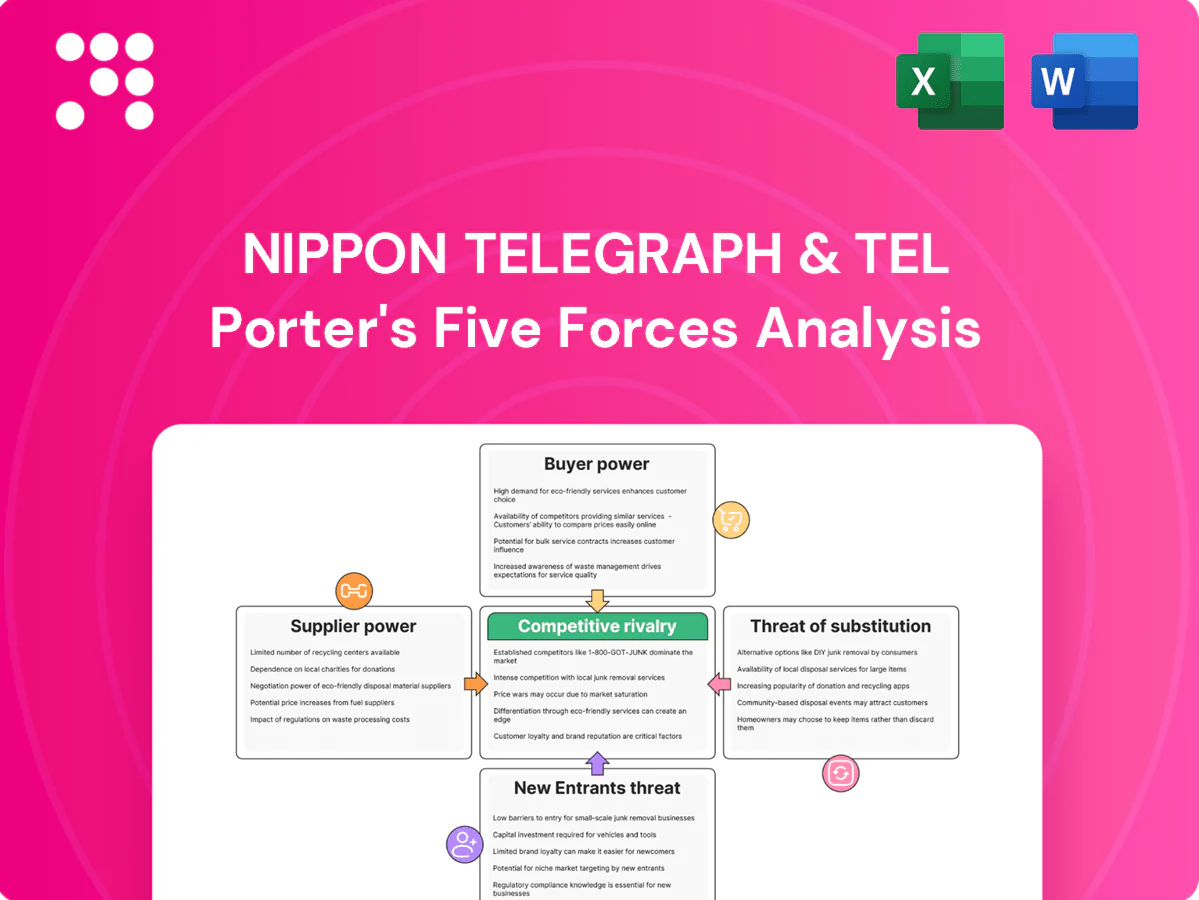
Nippon Telegraph & Tel Porter's Five Forces Analysis

A Must-Have Tool for Decision-Makers
Nippon Telegraph & Tel faces intense rivalry from global telcos, moderate supplier power for network equipment, rising buyer expectations for integrated services, low threat of new entrants but mounting substitute pressure from OTT players; regulatory factors and scale advantage shape margins. This snapshot highlights strategic pressure points and growth levers. Unlock the full Porter's Five Forces Analysis for force-by-force ratings, visuals, and actionable strategy guidance.
Suppliers Bargaining Power

Critical network equipment vendors
NTT depends on a concentrated set of global OEMs (Cisco, Nokia, Juniper, Huawei) that together hold over 60% of core routing/switching market, giving suppliers negotiating leverage. Multi-vendor strategies reduce lock-in but raise integration costs and complexity, often increasing operational expenses by mid-single digits. Long product lifecycles (7–10 years) and strict certifications heighten switching barriers. NTT’s scale—¥11.9 trillion revenue in FY2023—and multi‑year contracts secure volume discounts and roadmap influence.
Spectrum and right-of-way gatekeepers
Access to licensed spectrum and municipal rights-of-way in Japan is tightly controlled by national regulators and roughly 1,700 local municipalities, with regulatory timelines and permit fees often delaying deployments and acting like supplier power. These processes can raise costs and compress margins via auction prices and permit bottlenecks. NTT’s incumbency and compliance track record—NTT DOCOMO serving about 80 million mobile subscribers in 2024—helps secure better access terms, but auctions and permit delays still pressure rollout schedules.

Cloud and hyperscaler dependencies
As services converge, NTT increasingly partners with hyperscalers for cloud, CDN and edge capabilities, exposing it to providers that together held ~66% of global cloud infrastructure market in 2024 (AWS 32%, Microsoft 23%, Google 11%, Synergy Research).
That concentration lets large platforms influence technical standards and pricing, though co-selling and joint solutions with hyperscalers partially balance supplier power.
NTT’s extensive global data center and edge footprint gives it tangible negotiation leverage versus pure-play hyperscalers.

Software and OSS/BSS providers
Proprietary billing, orchestration and security software create high switching costs and integration risk, with vendors leveraging licensing, support renewals and roadmap control; NTT Group reported about 12.0 trillion yen in consolidated revenue for FY2023 (ended Mar 2024), underpinning its SI scale. Cloud-native, open RAN and open-source trends are reducing lock-in, and NTT’s R&D and systems-integration capabilities enable custom builds that rebalance supplier power.
- Switching cost: high
- Vendor power: licensing, renewals, roadmap
- Lock-in trend: decreasing via cloud-native/Open RAN
- NTT leverage: R&D + SI to lower dependence
Tower, fiber, and data center landlords
Passive tower, fiber and data‑center landlords control high‑demand sites and dark‑fiber routes, often locking customers into long‑term IRU/lease contracts that commonly run 10–25 years with annual escalators, creating recurring obligations and limited short‑term bargaining leverage for NTT. NTT’s sizeable owned fiber and DC footprint reduces dependence on external landlords, while portfolio diversification and build‑to‑suit programs temper price pressure.
- IRU/leases: 10–25 years with escalators
- Landlords control scarce dark‑fiber/routes, pushing premiums
- NTT ownership and build‑to‑suit lower external exposure
Major telco faces high supplier power: OEMs >60%, hyperscalers 66%, IRUs 10–25y
NTT faces moderate–high supplier power: core network OEMs hold >60% routing/switching share, hyperscalers ~66% cloud share (2024), and landlords control IRU leases (10–25y), raising costs and switching barriers. NTT scale (¥11.9T FY2023; NTT DOCOMO ~80M subs 2024) and owned fiber/DC assets partially offset supplier leverage.
| Supplier | Power | 2024 datapoint |
|---|---|---|
| OEMs | High | >60% core market |
| Hyperscalers | High | 66% cloud share |
| Landlords | Medium | IRU 10–25y |
What is included in the product
 Detailed Word Document
Uncovers key drivers of competition, customer influence, and market entry risks tailored to Nippon Telegraph & Tel, identifying disruptive forces, emerging substitutes, and supplier/buyer power that shape pricing and profitability.

 Customizable Excel Spreadsheet
A single-sheet Porter's Five Forces summary for Nippon Telegraph & Tel—clarifying regulatory, supplier, buyer, substitute, and rivalry pressures so executives quickly identify and prioritize strategic pain-point fixes.
Customers Bargaining Power

Enterprise and government buyers
Large enterprise and government RFPs for ICT, SI and managed services are highly price-sensitive, with buyers demanding SLAs and volume discounts that boost their leverage and force competitive bidding. Multi-year contracts provide revenue stability but typically compress margins for providers. As of 2024 NTT operates in over 70 countries and defends pricing through end-to-end solutions, integrated security and global delivery.
Wholesale carriers and OTTs
Wholesale customers buy bandwidth and multi-home, enabling price benchmarking and raising churn risk; contract flexibility increased across 2024. Large buyers trade traffic commitments for lower unit pricing, pressuring margins. NTT reported ¥11.6 trillion revenue in FY2023 (year ended Mar 2024) and leverages its global backbone, peering and subsea footprint to retain share.

Mobile and broadband consumers
Consumers face low switching costs due to number portability and aggressive promotions; Japan mobile subscriptions exceed 115 per 100 inhabitants (2024), facilitating churn. Bundles and device financing reduce churn but raise handset subsidy costs, with NTT DOCOMO holding about 42% market share (2024). Coverage quality, peak speeds and content perks drive loyalty, while MIC scrutiny of fees and subsidy rules strengthens consumer bargaining power.

Systems integration clients
Systems integration clients push for heavy customization, legacy-system integration and outcome-based pricing, with scope creep and shifted acceptance milestones increasing buyer leverage while moving delivery risk to vendors; NTT reported consolidated revenue of ¥11.2 trillion for FY2024, underpinning its investment in domain expertise that lowers perceived delivery risk and supports premium pricing.
- Customization demands heighten buyer power
- Scope creep shifts risk to vendors
- NTT domain expertise and modular offerings protect margins
Global MNC accounts
Global MNCs push for unified SLAs and vendor consolidation to gain leverage, driving negotiations on volume tiers and downtime penalties; NTT’s managed network services and global footprint in 70+ countries address these demands. Co-innovation and dedicated support teams help NTT retain contracts despite pricing pressure.
- Unified SLAs: consolidated vendors
- Negotiation: volume tiers, downtime penalties
- NTT reach: 70+ countries
- Retention: co-innovation, dedicated support
Buyers squeeze margins Japan mobile >115/100, leader ~42%
Buyers exert strong price and SLA pressure in enterprise RFPs and wholesale bandwidth markets, compressing margins despite multi‑year contracts. Consumer churn is high—Japan mobile subscriptions >115/100 in 2024—while DOCOMO holds ~42% share, elevating retail bargaining power. NTT’s 70+ country footprint and FY2023 revenue ¥11.6 trillion (FY2024 ¥11.2T) and global backbone mitigate but do not eliminate buyer leverage.
| Metric | Value |
|---|---|
| FY2023 revenue | ¥11.6T |
| FY2024 revenue | ¥11.2T |
| Countries | 70+ |
| Japan mobile subs (2024) | >115/100 |
| DOCOMO market share (2024) | ~42% |
Same Document Delivered
Nippon Telegraph & Tel Porter's Five Forces Analysis
This preview shows the exact Porter's Five Forces analysis for Nippon Telegraph & Tel you’ll receive—no samples or placeholders. The document is the final, professionally formatted file covering competitive rivalry, supplier and buyer power, entry barriers, and substitutes. Purchase grants immediate access to this identical downloadable report.

A Must-Have Tool for Decision-Makers
Nippon Telegraph & Tel faces intense rivalry from global telcos, moderate supplier power for network equipment, rising buyer expectations for integrated services, low threat of new entrants but mounting substitute pressure from OTT players; regulatory factors and scale advantage shape margins. This snapshot highlights strategic pressure points and growth levers. Unlock the full Porter's Five Forces Analysis for force-by-force ratings, visuals, and actionable strategy guidance.
Suppliers Bargaining Power
Critical network equipment vendors
NTT depends on a concentrated set of global OEMs (Cisco, Nokia, Juniper, Huawei) that together hold over 60% of core routing/switching market, giving suppliers negotiating leverage. Multi-vendor strategies reduce lock-in but raise integration costs and complexity, often increasing operational expenses by mid-single digits. Long product lifecycles (7–10 years) and strict certifications heighten switching barriers. NTT’s scale—¥11.9 trillion revenue in FY2023—and multi‑year contracts secure volume discounts and roadmap influence.
Spectrum and right-of-way gatekeepers
Access to licensed spectrum and municipal rights-of-way in Japan is tightly controlled by national regulators and roughly 1,700 local municipalities, with regulatory timelines and permit fees often delaying deployments and acting like supplier power. These processes can raise costs and compress margins via auction prices and permit bottlenecks. NTT’s incumbency and compliance track record—NTT DOCOMO serving about 80 million mobile subscribers in 2024—helps secure better access terms, but auctions and permit delays still pressure rollout schedules.
Cloud and hyperscaler dependencies
As services converge, NTT increasingly partners with hyperscalers for cloud, CDN and edge capabilities, exposing it to providers that together held ~66% of global cloud infrastructure market in 2024 (AWS 32%, Microsoft 23%, Google 11%, Synergy Research).
That concentration lets large platforms influence technical standards and pricing, though co-selling and joint solutions with hyperscalers partially balance supplier power.
NTT’s extensive global data center and edge footprint gives it tangible negotiation leverage versus pure-play hyperscalers.
Software and OSS/BSS providers
Proprietary billing, orchestration and security software create high switching costs and integration risk, with vendors leveraging licensing, support renewals and roadmap control; NTT Group reported about 12.0 trillion yen in consolidated revenue for FY2023 (ended Mar 2024), underpinning its SI scale. Cloud-native, open RAN and open-source trends are reducing lock-in, and NTT’s R&D and systems-integration capabilities enable custom builds that rebalance supplier power.
- Switching cost: high
- Vendor power: licensing, renewals, roadmap
- Lock-in trend: decreasing via cloud-native/Open RAN
- NTT leverage: R&D + SI to lower dependence
Tower, fiber, and data center landlords
Passive tower, fiber and data‑center landlords control high‑demand sites and dark‑fiber routes, often locking customers into long‑term IRU/lease contracts that commonly run 10–25 years with annual escalators, creating recurring obligations and limited short‑term bargaining leverage for NTT. NTT’s sizeable owned fiber and DC footprint reduces dependence on external landlords, while portfolio diversification and build‑to‑suit programs temper price pressure.
- IRU/leases: 10–25 years with escalators
- Landlords control scarce dark‑fiber/routes, pushing premiums
- NTT ownership and build‑to‑suit lower external exposure
Major telco faces high supplier power: OEMs >60%, hyperscalers 66%, IRUs 10–25y
NTT faces moderate–high supplier power: core network OEMs hold >60% routing/switching share, hyperscalers ~66% cloud share (2024), and landlords control IRU leases (10–25y), raising costs and switching barriers. NTT scale (¥11.9T FY2023; NTT DOCOMO ~80M subs 2024) and owned fiber/DC assets partially offset supplier leverage.
| Supplier | Power | 2024 datapoint |
|---|---|---|
| OEMs | High | >60% core market |
| Hyperscalers | High | 66% cloud share |
| Landlords | Medium | IRU 10–25y |
What is included in the product
Detailed Word Document
Uncovers key drivers of competition, customer influence, and market entry risks tailored to Nippon Telegraph & Tel, identifying disruptive forces, emerging substitutes, and supplier/buyer power that shape pricing and profitability.
Customizable Excel Spreadsheet
A single-sheet Porter's Five Forces summary for Nippon Telegraph & Tel—clarifying regulatory, supplier, buyer, substitute, and rivalry pressures so executives quickly identify and prioritize strategic pain-point fixes.
Customers Bargaining Power
Enterprise and government buyers
Large enterprise and government RFPs for ICT, SI and managed services are highly price-sensitive, with buyers demanding SLAs and volume discounts that boost their leverage and force competitive bidding. Multi-year contracts provide revenue stability but typically compress margins for providers. As of 2024 NTT operates in over 70 countries and defends pricing through end-to-end solutions, integrated security and global delivery.
Wholesale carriers and OTTs
Wholesale customers buy bandwidth and multi-home, enabling price benchmarking and raising churn risk; contract flexibility increased across 2024. Large buyers trade traffic commitments for lower unit pricing, pressuring margins. NTT reported ¥11.6 trillion revenue in FY2023 (year ended Mar 2024) and leverages its global backbone, peering and subsea footprint to retain share.
Mobile and broadband consumers
Consumers face low switching costs due to number portability and aggressive promotions; Japan mobile subscriptions exceed 115 per 100 inhabitants (2024), facilitating churn. Bundles and device financing reduce churn but raise handset subsidy costs, with NTT DOCOMO holding about 42% market share (2024). Coverage quality, peak speeds and content perks drive loyalty, while MIC scrutiny of fees and subsidy rules strengthens consumer bargaining power.
Systems integration clients
Systems integration clients push for heavy customization, legacy-system integration and outcome-based pricing, with scope creep and shifted acceptance milestones increasing buyer leverage while moving delivery risk to vendors; NTT reported consolidated revenue of ¥11.2 trillion for FY2024, underpinning its investment in domain expertise that lowers perceived delivery risk and supports premium pricing.
- Customization demands heighten buyer power
- Scope creep shifts risk to vendors
- NTT domain expertise and modular offerings protect margins
Global MNC accounts
Global MNCs push for unified SLAs and vendor consolidation to gain leverage, driving negotiations on volume tiers and downtime penalties; NTT’s managed network services and global footprint in 70+ countries address these demands. Co-innovation and dedicated support teams help NTT retain contracts despite pricing pressure.
- Unified SLAs: consolidated vendors
- Negotiation: volume tiers, downtime penalties
- NTT reach: 70+ countries
- Retention: co-innovation, dedicated support
Buyers squeeze margins Japan mobile >115/100, leader ~42%
Buyers exert strong price and SLA pressure in enterprise RFPs and wholesale bandwidth markets, compressing margins despite multi‑year contracts. Consumer churn is high—Japan mobile subscriptions >115/100 in 2024—while DOCOMO holds ~42% share, elevating retail bargaining power. NTT’s 70+ country footprint and FY2023 revenue ¥11.6 trillion (FY2024 ¥11.2T) and global backbone mitigate but do not eliminate buyer leverage.
| Metric | Value |
|---|---|
| FY2023 revenue | ¥11.6T |
| FY2024 revenue | ¥11.2T |
| Countries | 70+ |
| Japan mobile subs (2024) | >115/100 |
| DOCOMO market share (2024) | ~42% |
Same Document Delivered
Nippon Telegraph & Tel Porter's Five Forces Analysis
This preview shows the exact Porter's Five Forces analysis for Nippon Telegraph & Tel you’ll receive—no samples or placeholders. The document is the final, professionally formatted file covering competitive rivalry, supplier and buyer power, entry barriers, and substitutes. Purchase grants immediate access to this identical downloadable report.
Original: $10.00
-65%$10.00
$3.50Description
A Must-Have Tool for Decision-Makers
Nippon Telegraph & Tel faces intense rivalry from global telcos, moderate supplier power for network equipment, rising buyer expectations for integrated services, low threat of new entrants but mounting substitute pressure from OTT players; regulatory factors and scale advantage shape margins. This snapshot highlights strategic pressure points and growth levers. Unlock the full Porter's Five Forces Analysis for force-by-force ratings, visuals, and actionable strategy guidance.
Suppliers Bargaining Power
Critical network equipment vendors
NTT depends on a concentrated set of global OEMs (Cisco, Nokia, Juniper, Huawei) that together hold over 60% of core routing/switching market, giving suppliers negotiating leverage. Multi-vendor strategies reduce lock-in but raise integration costs and complexity, often increasing operational expenses by mid-single digits. Long product lifecycles (7–10 years) and strict certifications heighten switching barriers. NTT’s scale—¥11.9 trillion revenue in FY2023—and multi‑year contracts secure volume discounts and roadmap influence.
Spectrum and right-of-way gatekeepers
Access to licensed spectrum and municipal rights-of-way in Japan is tightly controlled by national regulators and roughly 1,700 local municipalities, with regulatory timelines and permit fees often delaying deployments and acting like supplier power. These processes can raise costs and compress margins via auction prices and permit bottlenecks. NTT’s incumbency and compliance track record—NTT DOCOMO serving about 80 million mobile subscribers in 2024—helps secure better access terms, but auctions and permit delays still pressure rollout schedules.
Cloud and hyperscaler dependencies
As services converge, NTT increasingly partners with hyperscalers for cloud, CDN and edge capabilities, exposing it to providers that together held ~66% of global cloud infrastructure market in 2024 (AWS 32%, Microsoft 23%, Google 11%, Synergy Research).
That concentration lets large platforms influence technical standards and pricing, though co-selling and joint solutions with hyperscalers partially balance supplier power.
NTT’s extensive global data center and edge footprint gives it tangible negotiation leverage versus pure-play hyperscalers.
Software and OSS/BSS providers
Proprietary billing, orchestration and security software create high switching costs and integration risk, with vendors leveraging licensing, support renewals and roadmap control; NTT Group reported about 12.0 trillion yen in consolidated revenue for FY2023 (ended Mar 2024), underpinning its SI scale. Cloud-native, open RAN and open-source trends are reducing lock-in, and NTT’s R&D and systems-integration capabilities enable custom builds that rebalance supplier power.
- Switching cost: high
- Vendor power: licensing, renewals, roadmap
- Lock-in trend: decreasing via cloud-native/Open RAN
- NTT leverage: R&D + SI to lower dependence
Tower, fiber, and data center landlords
Passive tower, fiber and data‑center landlords control high‑demand sites and dark‑fiber routes, often locking customers into long‑term IRU/lease contracts that commonly run 10–25 years with annual escalators, creating recurring obligations and limited short‑term bargaining leverage for NTT. NTT’s sizeable owned fiber and DC footprint reduces dependence on external landlords, while portfolio diversification and build‑to‑suit programs temper price pressure.
- IRU/leases: 10–25 years with escalators
- Landlords control scarce dark‑fiber/routes, pushing premiums
- NTT ownership and build‑to‑suit lower external exposure
Major telco faces high supplier power: OEMs >60%, hyperscalers 66%, IRUs 10–25y
NTT faces moderate–high supplier power: core network OEMs hold >60% routing/switching share, hyperscalers ~66% cloud share (2024), and landlords control IRU leases (10–25y), raising costs and switching barriers. NTT scale (¥11.9T FY2023; NTT DOCOMO ~80M subs 2024) and owned fiber/DC assets partially offset supplier leverage.
| Supplier | Power | 2024 datapoint |
|---|---|---|
| OEMs | High | >60% core market |
| Hyperscalers | High | 66% cloud share |
| Landlords | Medium | IRU 10–25y |
What is included in the product
Detailed Word Document
Uncovers key drivers of competition, customer influence, and market entry risks tailored to Nippon Telegraph & Tel, identifying disruptive forces, emerging substitutes, and supplier/buyer power that shape pricing and profitability.
Customizable Excel Spreadsheet
A single-sheet Porter's Five Forces summary for Nippon Telegraph & Tel—clarifying regulatory, supplier, buyer, substitute, and rivalry pressures so executives quickly identify and prioritize strategic pain-point fixes.
Customers Bargaining Power
Enterprise and government buyers
Large enterprise and government RFPs for ICT, SI and managed services are highly price-sensitive, with buyers demanding SLAs and volume discounts that boost their leverage and force competitive bidding. Multi-year contracts provide revenue stability but typically compress margins for providers. As of 2024 NTT operates in over 70 countries and defends pricing through end-to-end solutions, integrated security and global delivery.
Wholesale carriers and OTTs
Wholesale customers buy bandwidth and multi-home, enabling price benchmarking and raising churn risk; contract flexibility increased across 2024. Large buyers trade traffic commitments for lower unit pricing, pressuring margins. NTT reported ¥11.6 trillion revenue in FY2023 (year ended Mar 2024) and leverages its global backbone, peering and subsea footprint to retain share.
Mobile and broadband consumers
Consumers face low switching costs due to number portability and aggressive promotions; Japan mobile subscriptions exceed 115 per 100 inhabitants (2024), facilitating churn. Bundles and device financing reduce churn but raise handset subsidy costs, with NTT DOCOMO holding about 42% market share (2024). Coverage quality, peak speeds and content perks drive loyalty, while MIC scrutiny of fees and subsidy rules strengthens consumer bargaining power.
Systems integration clients
Systems integration clients push for heavy customization, legacy-system integration and outcome-based pricing, with scope creep and shifted acceptance milestones increasing buyer leverage while moving delivery risk to vendors; NTT reported consolidated revenue of ¥11.2 trillion for FY2024, underpinning its investment in domain expertise that lowers perceived delivery risk and supports premium pricing.
- Customization demands heighten buyer power
- Scope creep shifts risk to vendors
- NTT domain expertise and modular offerings protect margins
Global MNC accounts
Global MNCs push for unified SLAs and vendor consolidation to gain leverage, driving negotiations on volume tiers and downtime penalties; NTT’s managed network services and global footprint in 70+ countries address these demands. Co-innovation and dedicated support teams help NTT retain contracts despite pricing pressure.
- Unified SLAs: consolidated vendors
- Negotiation: volume tiers, downtime penalties
- NTT reach: 70+ countries
- Retention: co-innovation, dedicated support
Buyers squeeze margins Japan mobile >115/100, leader ~42%
Buyers exert strong price and SLA pressure in enterprise RFPs and wholesale bandwidth markets, compressing margins despite multi‑year contracts. Consumer churn is high—Japan mobile subscriptions >115/100 in 2024—while DOCOMO holds ~42% share, elevating retail bargaining power. NTT’s 70+ country footprint and FY2023 revenue ¥11.6 trillion (FY2024 ¥11.2T) and global backbone mitigate but do not eliminate buyer leverage.
| Metric | Value |
|---|---|
| FY2023 revenue | ¥11.6T |
| FY2024 revenue | ¥11.2T |
| Countries | 70+ |
| Japan mobile subs (2024) | >115/100 |
| DOCOMO market share (2024) | ~42% |
Same Document Delivered
Nippon Telegraph & Tel Porter's Five Forces Analysis
This preview shows the exact Porter's Five Forces analysis for Nippon Telegraph & Tel you’ll receive—no samples or placeholders. The document is the final, professionally formatted file covering competitive rivalry, supplier and buyer power, entry barriers, and substitutes. Purchase grants immediate access to this identical downloadable report.











