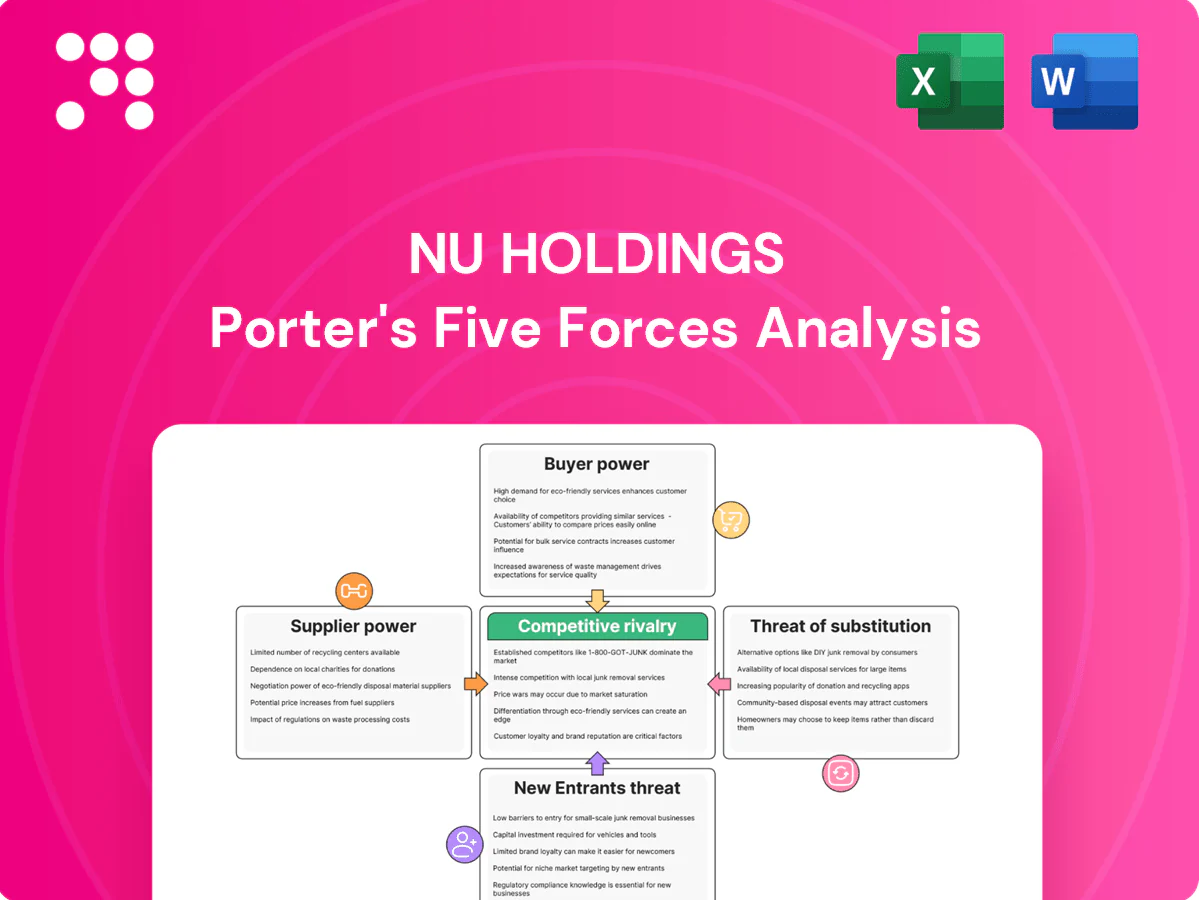
Nu Holdings Porter's Five Forces Analysis

Don't Miss the Bigger Picture
Nu Holdings faces intense rivalry from global fintechs and incumbent banks, shifting buyer power, and moderate supplier leverage; regulatory scrutiny and tech-driven substitutes shape entry barriers and threat levels. This snapshot highlights key pressure points and strategic levers. Want tactical ratings, visuals, and force-by-force implications? Unlock the full Porter's Five Forces Analysis for a consultant-grade, actionable report.
Suppliers Bargaining Power

Concentration of card networks
Nu relies on global schemes such as Mastercard and Visa for issuance, processing and acceptance; Visa and Mastercard together handled over 80% of global card transaction volume in 2023–24, concentrating pricing and rule-setting power. Contract terms and compliance requirements from these networks are often stringent. Nu’s customer scale and regional footprint provide some bargaining leverage when negotiating fees and routing arrangements.
Dependence on cloud infrastructure
Nu Holdings runs core operations on a few hyperscalers, concentrating supplier risk given AWS, Microsoft Azure and Google Cloud held roughly 32%, 23% and 11% of global cloud market in 2024 (≈66% combined). Switching core providers entails high migration costs and operational risk, while vendors extract value via reserved-capacity discounts and egress fees that can reach about $0.09/GB. Multi-cloud adoption reduces single-vendor exposure but does not remove pricing or migration leverage held by hyperscalers.

Data, fraud, and credit bureaus
Access to bureau data, identity verification, and fraud tools are essential to underwriting and KYC. Three major global bureaus (Equifax, Experian, TransUnion) and local oligopolies give providers fee-setting power. Integrated models create vendor lock-in—switching often requires months of re-engineering. Nu can diversify vendors and develop in-house models to reduce dependence.

Funding and liquidity partners
Wholesale funding lines, securitizations and partner banks shape Nu Holdings cost of capital; in tight markets these providers tighten spreads and impose stricter covenants, increasing supplier bargaining power. As Nu’s deposit base grows, reliance on wholesale funding falls, improving pricing and covenant flexibility. LatAm macro volatility can quickly swing leverage back to suppliers during stress.
- funding diversification
- deposit growth reduces supplier power
- tight markets raise spreads and covenants
- LatAm volatility reverses dynamics
App stores and payment rails
Distribution and payments for Nu depend on Apple/Google app stores and national rails like Pix; app-store commissions remain 15–30% in 2024 while Pix handled over 8 billion transactions annually (2023–24), concentrating leverage with gatekeepers. Gatekeepers can change fees, rules and technical requirements, raising compliance costs and switching barriers. Direct web channels and deep links reduce but do not fully bypass this supplier power.
Neobank squeezed by card networks, app-store fees and hyperscaler lock-in amid rising deposits
Nu faces concentrated supplier power: Visa/Mastercard >80% global card volume (2023–24) and app-store fees 15–30% (2024) constrain pricing; hyperscalers AWS 32%/Azure 23%/GCP 11% (2024) create migration costs; bureaus and Pix (>8bn txns 2023–24) add lock-in; deposit growth reduces funding supplier leverage.
| Supplier | 2023–24 |
|---|---|
| Visa/Mastercard | >80% volume |
| AWS/Azure/GCP | 32%/23%/11% |
| Pix | >8bn txns |
What is included in the product
 Detailed Word Document
Concise Porter's Five Forces assessment for Nu Holdings, highlighting competitive rivalry, buyer and supplier power, threat of new entrants and substitutes, plus strategic implications for pricing, margins, and market defense.

 Customizable Excel Spreadsheet
A concise, one-sheet Porter’s Five Forces for Nu Holdings that highlights competitive pressures and regulatory risks—perfect for quick boardroom decisions. Editable pressure levels and a radar export simplify scenario testing and make slide-ready reporting effortless.
Customers Bargaining Power

Price-sensitive mass retail
LatAm consumers are highly price-sensitive, increasing buyer power and forcing Nu (listed on NYSE as NU) to offer transparent, low-cost products that constrain pricing latitude. Economic downturns historically raise fee sensitivity and churn risk, pressuring margins. Nu counters with operational efficiency and tiered value propositions to retain customers.
Low switching costs, high multi-homing
Low switching costs and easy onboarding let customers open accounts across multiple apps, enabling comparisons and churn; Nu reported over 80 million customers by 2024, reflecting intense multi-homing. Promotions and rewards amplify hopping behavior, pressuring margins and raising acquisition costs. Nu's ecosystem bundling and loyalty features (credit, investment, insurance) increase stickiness and mitigate churn.

User experience as leverage
Customers value instant service and intuitive UX; Nu reported about 80 million customers by mid‑2024, so poor experiences trigger fast exits and churn visible at scale. Social media magnifies complaints — banking complaints spike virality — raising reputational stakes and acquisition costs. Nu’s reported NPS of ~74 in 2024 helps temper buyer power by increasing perceived switching costs, but continuous UX investment is required to sustain that moat.

Regulatory fee caps and transparency
Rules on interchange, overdraft limits, and mandatory disclosure enacted by Brazil’s Central Bank strengthen customer bargaining power by limiting fees and increasing price transparency; by 2024 Open Finance portability was operational, lowering switching costs. Standardized data formats enable straightforward rate shopping, and Nu can capture rivals’ customers under the same regime.
- Regulatory caps and disclosure bolster bargaining
- Open Finance portability (operational in 2024) eases switching
- Standardized data enables rate shopping
- Nu positioned to acquire rivals’ customers
SME segment expectations
SME customers demand near-continuous payments uptime, low merchant discount rates, and accessible working capital; they leverage volume pricing and frequently threaten processor migration, so service reliability materially increases their bargaining power. Bundling bank accounts, payouts and credit reduces churn by creating switching costs and can lock SMEs into Nu Holdings’ ecosystem.
- Expectation: high uptime, low MDR, credit access
- Leverage: volume negotiation, switching threat
- Mitigation: bundled banking+payouts+credit reduces attrition
Open Finance boosts buyer power; 80m, NPS 74
LatAm price sensitivity, regulatory caps and Open Finance (operational 2024) boost buyer bargaining; Nu had ~80m customers by mid‑2024 and NPS ~74, increasing multi‑homing risk. Low switching costs and promotions pressure margins. Bundled credit, investments and SME services raise stickiness, mitigating churn.
| Metric | Value |
|---|---|
| Customers (mid‑2024) | ~80m |
| NPS (2024) | ~74 |
| Open Finance | Operational 2024 |
Same Document Delivered
Nu Holdings Porter's Five Forces Analysis
This preview is the exact Porter’s Five Forces analysis of Nu Holdings you'll receive—fully formatted, complete, and ready for immediate download upon purchase. It includes strategic assessments of competitive rivalry, supplier and buyer power, threat of substitutes, and barriers to entry. No placeholders, no excerpts—what you see is the final deliverable. Instant access is granted once payment is completed.

Don't Miss the Bigger Picture
Nu Holdings faces intense rivalry from global fintechs and incumbent banks, shifting buyer power, and moderate supplier leverage; regulatory scrutiny and tech-driven substitutes shape entry barriers and threat levels. This snapshot highlights key pressure points and strategic levers. Want tactical ratings, visuals, and force-by-force implications? Unlock the full Porter's Five Forces Analysis for a consultant-grade, actionable report.
Suppliers Bargaining Power
Concentration of card networks
Nu relies on global schemes such as Mastercard and Visa for issuance, processing and acceptance; Visa and Mastercard together handled over 80% of global card transaction volume in 2023–24, concentrating pricing and rule-setting power. Contract terms and compliance requirements from these networks are often stringent. Nu’s customer scale and regional footprint provide some bargaining leverage when negotiating fees and routing arrangements.
Dependence on cloud infrastructure
Nu Holdings runs core operations on a few hyperscalers, concentrating supplier risk given AWS, Microsoft Azure and Google Cloud held roughly 32%, 23% and 11% of global cloud market in 2024 (≈66% combined). Switching core providers entails high migration costs and operational risk, while vendors extract value via reserved-capacity discounts and egress fees that can reach about $0.09/GB. Multi-cloud adoption reduces single-vendor exposure but does not remove pricing or migration leverage held by hyperscalers.
Data, fraud, and credit bureaus
Access to bureau data, identity verification, and fraud tools are essential to underwriting and KYC. Three major global bureaus (Equifax, Experian, TransUnion) and local oligopolies give providers fee-setting power. Integrated models create vendor lock-in—switching often requires months of re-engineering. Nu can diversify vendors and develop in-house models to reduce dependence.
Funding and liquidity partners
Wholesale funding lines, securitizations and partner banks shape Nu Holdings cost of capital; in tight markets these providers tighten spreads and impose stricter covenants, increasing supplier bargaining power. As Nu’s deposit base grows, reliance on wholesale funding falls, improving pricing and covenant flexibility. LatAm macro volatility can quickly swing leverage back to suppliers during stress.
- funding diversification
- deposit growth reduces supplier power
- tight markets raise spreads and covenants
- LatAm volatility reverses dynamics
App stores and payment rails
Distribution and payments for Nu depend on Apple/Google app stores and national rails like Pix; app-store commissions remain 15–30% in 2024 while Pix handled over 8 billion transactions annually (2023–24), concentrating leverage with gatekeepers. Gatekeepers can change fees, rules and technical requirements, raising compliance costs and switching barriers. Direct web channels and deep links reduce but do not fully bypass this supplier power.
Neobank squeezed by card networks, app-store fees and hyperscaler lock-in amid rising deposits
Nu faces concentrated supplier power: Visa/Mastercard >80% global card volume (2023–24) and app-store fees 15–30% (2024) constrain pricing; hyperscalers AWS 32%/Azure 23%/GCP 11% (2024) create migration costs; bureaus and Pix (>8bn txns 2023–24) add lock-in; deposit growth reduces funding supplier leverage.
| Supplier | 2023–24 |
|---|---|
| Visa/Mastercard | >80% volume |
| AWS/Azure/GCP | 32%/23%/11% |
| Pix | >8bn txns |
What is included in the product
Detailed Word Document
Concise Porter's Five Forces assessment for Nu Holdings, highlighting competitive rivalry, buyer and supplier power, threat of new entrants and substitutes, plus strategic implications for pricing, margins, and market defense.
Customizable Excel Spreadsheet
A concise, one-sheet Porter’s Five Forces for Nu Holdings that highlights competitive pressures and regulatory risks—perfect for quick boardroom decisions. Editable pressure levels and a radar export simplify scenario testing and make slide-ready reporting effortless.
Customers Bargaining Power
Price-sensitive mass retail
LatAm consumers are highly price-sensitive, increasing buyer power and forcing Nu (listed on NYSE as NU) to offer transparent, low-cost products that constrain pricing latitude. Economic downturns historically raise fee sensitivity and churn risk, pressuring margins. Nu counters with operational efficiency and tiered value propositions to retain customers.
Low switching costs, high multi-homing
Low switching costs and easy onboarding let customers open accounts across multiple apps, enabling comparisons and churn; Nu reported over 80 million customers by 2024, reflecting intense multi-homing. Promotions and rewards amplify hopping behavior, pressuring margins and raising acquisition costs. Nu's ecosystem bundling and loyalty features (credit, investment, insurance) increase stickiness and mitigate churn.
User experience as leverage
Customers value instant service and intuitive UX; Nu reported about 80 million customers by mid‑2024, so poor experiences trigger fast exits and churn visible at scale. Social media magnifies complaints — banking complaints spike virality — raising reputational stakes and acquisition costs. Nu’s reported NPS of ~74 in 2024 helps temper buyer power by increasing perceived switching costs, but continuous UX investment is required to sustain that moat.
Regulatory fee caps and transparency
Rules on interchange, overdraft limits, and mandatory disclosure enacted by Brazil’s Central Bank strengthen customer bargaining power by limiting fees and increasing price transparency; by 2024 Open Finance portability was operational, lowering switching costs. Standardized data formats enable straightforward rate shopping, and Nu can capture rivals’ customers under the same regime.
- Regulatory caps and disclosure bolster bargaining
- Open Finance portability (operational in 2024) eases switching
- Standardized data enables rate shopping
- Nu positioned to acquire rivals’ customers
SME segment expectations
SME customers demand near-continuous payments uptime, low merchant discount rates, and accessible working capital; they leverage volume pricing and frequently threaten processor migration, so service reliability materially increases their bargaining power. Bundling bank accounts, payouts and credit reduces churn by creating switching costs and can lock SMEs into Nu Holdings’ ecosystem.
- Expectation: high uptime, low MDR, credit access
- Leverage: volume negotiation, switching threat
- Mitigation: bundled banking+payouts+credit reduces attrition
Open Finance boosts buyer power; 80m, NPS 74
LatAm price sensitivity, regulatory caps and Open Finance (operational 2024) boost buyer bargaining; Nu had ~80m customers by mid‑2024 and NPS ~74, increasing multi‑homing risk. Low switching costs and promotions pressure margins. Bundled credit, investments and SME services raise stickiness, mitigating churn.
| Metric | Value |
|---|---|
| Customers (mid‑2024) | ~80m |
| NPS (2024) | ~74 |
| Open Finance | Operational 2024 |
Same Document Delivered
Nu Holdings Porter's Five Forces Analysis
This preview is the exact Porter’s Five Forces analysis of Nu Holdings you'll receive—fully formatted, complete, and ready for immediate download upon purchase. It includes strategic assessments of competitive rivalry, supplier and buyer power, threat of substitutes, and barriers to entry. No placeholders, no excerpts—what you see is the final deliverable. Instant access is granted once payment is completed.
Original: $10.00
-65%$10.00
$3.50Description
Don't Miss the Bigger Picture
Nu Holdings faces intense rivalry from global fintechs and incumbent banks, shifting buyer power, and moderate supplier leverage; regulatory scrutiny and tech-driven substitutes shape entry barriers and threat levels. This snapshot highlights key pressure points and strategic levers. Want tactical ratings, visuals, and force-by-force implications? Unlock the full Porter's Five Forces Analysis for a consultant-grade, actionable report.
Suppliers Bargaining Power
Concentration of card networks
Nu relies on global schemes such as Mastercard and Visa for issuance, processing and acceptance; Visa and Mastercard together handled over 80% of global card transaction volume in 2023–24, concentrating pricing and rule-setting power. Contract terms and compliance requirements from these networks are often stringent. Nu’s customer scale and regional footprint provide some bargaining leverage when negotiating fees and routing arrangements.
Dependence on cloud infrastructure
Nu Holdings runs core operations on a few hyperscalers, concentrating supplier risk given AWS, Microsoft Azure and Google Cloud held roughly 32%, 23% and 11% of global cloud market in 2024 (≈66% combined). Switching core providers entails high migration costs and operational risk, while vendors extract value via reserved-capacity discounts and egress fees that can reach about $0.09/GB. Multi-cloud adoption reduces single-vendor exposure but does not remove pricing or migration leverage held by hyperscalers.
Data, fraud, and credit bureaus
Access to bureau data, identity verification, and fraud tools are essential to underwriting and KYC. Three major global bureaus (Equifax, Experian, TransUnion) and local oligopolies give providers fee-setting power. Integrated models create vendor lock-in—switching often requires months of re-engineering. Nu can diversify vendors and develop in-house models to reduce dependence.
Funding and liquidity partners
Wholesale funding lines, securitizations and partner banks shape Nu Holdings cost of capital; in tight markets these providers tighten spreads and impose stricter covenants, increasing supplier bargaining power. As Nu’s deposit base grows, reliance on wholesale funding falls, improving pricing and covenant flexibility. LatAm macro volatility can quickly swing leverage back to suppliers during stress.
- funding diversification
- deposit growth reduces supplier power
- tight markets raise spreads and covenants
- LatAm volatility reverses dynamics
App stores and payment rails
Distribution and payments for Nu depend on Apple/Google app stores and national rails like Pix; app-store commissions remain 15–30% in 2024 while Pix handled over 8 billion transactions annually (2023–24), concentrating leverage with gatekeepers. Gatekeepers can change fees, rules and technical requirements, raising compliance costs and switching barriers. Direct web channels and deep links reduce but do not fully bypass this supplier power.
Neobank squeezed by card networks, app-store fees and hyperscaler lock-in amid rising deposits
Nu faces concentrated supplier power: Visa/Mastercard >80% global card volume (2023–24) and app-store fees 15–30% (2024) constrain pricing; hyperscalers AWS 32%/Azure 23%/GCP 11% (2024) create migration costs; bureaus and Pix (>8bn txns 2023–24) add lock-in; deposit growth reduces funding supplier leverage.
| Supplier | 2023–24 |
|---|---|
| Visa/Mastercard | >80% volume |
| AWS/Azure/GCP | 32%/23%/11% |
| Pix | >8bn txns |
What is included in the product
Detailed Word Document
Concise Porter's Five Forces assessment for Nu Holdings, highlighting competitive rivalry, buyer and supplier power, threat of new entrants and substitutes, plus strategic implications for pricing, margins, and market defense.
Customizable Excel Spreadsheet
A concise, one-sheet Porter’s Five Forces for Nu Holdings that highlights competitive pressures and regulatory risks—perfect for quick boardroom decisions. Editable pressure levels and a radar export simplify scenario testing and make slide-ready reporting effortless.
Customers Bargaining Power
Price-sensitive mass retail
LatAm consumers are highly price-sensitive, increasing buyer power and forcing Nu (listed on NYSE as NU) to offer transparent, low-cost products that constrain pricing latitude. Economic downturns historically raise fee sensitivity and churn risk, pressuring margins. Nu counters with operational efficiency and tiered value propositions to retain customers.
Low switching costs, high multi-homing
Low switching costs and easy onboarding let customers open accounts across multiple apps, enabling comparisons and churn; Nu reported over 80 million customers by 2024, reflecting intense multi-homing. Promotions and rewards amplify hopping behavior, pressuring margins and raising acquisition costs. Nu's ecosystem bundling and loyalty features (credit, investment, insurance) increase stickiness and mitigate churn.
User experience as leverage
Customers value instant service and intuitive UX; Nu reported about 80 million customers by mid‑2024, so poor experiences trigger fast exits and churn visible at scale. Social media magnifies complaints — banking complaints spike virality — raising reputational stakes and acquisition costs. Nu’s reported NPS of ~74 in 2024 helps temper buyer power by increasing perceived switching costs, but continuous UX investment is required to sustain that moat.
Regulatory fee caps and transparency
Rules on interchange, overdraft limits, and mandatory disclosure enacted by Brazil’s Central Bank strengthen customer bargaining power by limiting fees and increasing price transparency; by 2024 Open Finance portability was operational, lowering switching costs. Standardized data formats enable straightforward rate shopping, and Nu can capture rivals’ customers under the same regime.
- Regulatory caps and disclosure bolster bargaining
- Open Finance portability (operational in 2024) eases switching
- Standardized data enables rate shopping
- Nu positioned to acquire rivals’ customers
SME segment expectations
SME customers demand near-continuous payments uptime, low merchant discount rates, and accessible working capital; they leverage volume pricing and frequently threaten processor migration, so service reliability materially increases their bargaining power. Bundling bank accounts, payouts and credit reduces churn by creating switching costs and can lock SMEs into Nu Holdings’ ecosystem.
- Expectation: high uptime, low MDR, credit access
- Leverage: volume negotiation, switching threat
- Mitigation: bundled banking+payouts+credit reduces attrition
Open Finance boosts buyer power; 80m, NPS 74
LatAm price sensitivity, regulatory caps and Open Finance (operational 2024) boost buyer bargaining; Nu had ~80m customers by mid‑2024 and NPS ~74, increasing multi‑homing risk. Low switching costs and promotions pressure margins. Bundled credit, investments and SME services raise stickiness, mitigating churn.
| Metric | Value |
|---|---|
| Customers (mid‑2024) | ~80m |
| NPS (2024) | ~74 |
| Open Finance | Operational 2024 |
Same Document Delivered
Nu Holdings Porter's Five Forces Analysis
This preview is the exact Porter’s Five Forces analysis of Nu Holdings you'll receive—fully formatted, complete, and ready for immediate download upon purchase. It includes strategic assessments of competitive rivalry, supplier and buyer power, threat of substitutes, and barriers to entry. No placeholders, no excerpts—what you see is the final deliverable. Instant access is granted once payment is completed.











