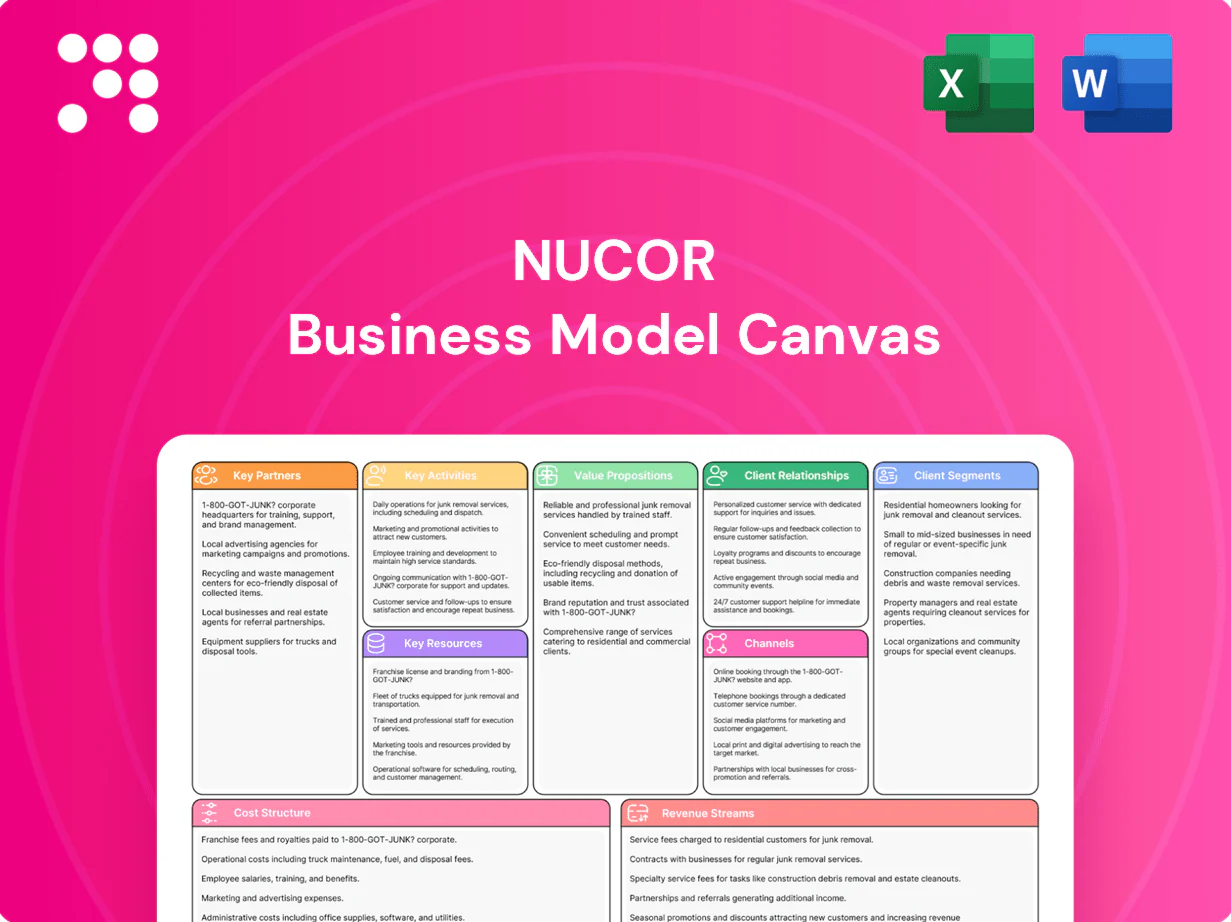
Nucor Business Model Canvas

Business Model Canvas: strategic playbook for a leading steelmaker
Unlock Nucor’s strategic playbook with a concise Business Model Canvas that maps its value propositions, cost structure, and growth levers in clear detail. This 3–5 sentence preview highlights why Nucor scales efficiently—purchase the full, editable Canvas to access all nine blocks, financial implications, and actionable insights for investors and strategists.
Partnerships

Scrap suppliers network
Strategic relationships with industrial scrap dealers and demolition firms secure steady raw material for Nucor’s electric arc furnaces, leveraging EAF technology that can use up to 100% recycled scrap. Long-term contracts lock in quality grades and dampen price volatility across cycles. Regional scrap partners align supply with mill locations to reduce logistics and inventory costs.
DRI and raw materials vendors
Alliances with iron ore pellet producers and DRI technology providers enable Nucor to scale direct reduced iron production, maintaining feedstock diversity as prime scrap tightness rose in 2024. Reliable DRI inputs stabilize melt chemistry and product quality when scrap premiums spike. Technical collaboration has demonstrated DRI routes can cut CO2 intensity roughly 40% versus blast furnace baselines, improving yield and energy efficiency.

Logistics and rail carriers
Partnerships with railroads, barge operators, and trucking fleets enable Nucor to optimize inbound scrap and outbound finished goods flows, supporting the largest US steelmaker’s integrated network and 31,000 employees in 2024. Coordinated scheduling across carriers shortens lead times to customers, improving on-time deliveries by streamlining transfers and yard dwell. Multi-modal options add resilience during disruptions by providing alternative routes and capacity flex.

Equipment and technology OEMs
- 2024 capex: $2.7B
- Downtime reduction: ~15%
- Throughput lift in trials: ~8%
Downstream fabricators and service centers
Alliances with rebar fabricators, beam service centers, and coil processors extend Nucor’s market reach and downstream penetration; co-planning ensures sizing, coating, and slit-to-width specifications are met, while shared forecasting smooths production and inventory; Nucor — the largest U.S. steelmaker — shipped exceeding 20 million tons in 2024, supporting tight downstream integration.
- Alliances: rebar, beams, coil processors
- Co-planning: sizing, coating, slit-to-width
- Shared forecasts: smoother production & inventory
Alliances secure uptime; capex $2.7B, DRI -40% CO2, 20M+ tons shipped
Strategic scrap and DRI suppliers plus OEMs and logistics partners secured feedstock and uptime; 2024 capex $2.7B supported modernization. Long-term contracts and regional scrap networks reduced price volatility and logistics costs while DRI lowered CO2 intensity ~40%. Downstream alliances helped ship >20M tons in 2024, improving delivery and inventory alignment.
| Partnership | 2024 metric | Impact |
|---|---|---|
| Capex/OEMs | $2.7B | -15% downtime |
| DRI/scrap | DRI CO2 -40% | Feedstock resilience |
| Logistics | >20M tons shipped | Improved OT delivery |
What is included in the product
 Detailed Word Document
A comprehensive Business Model Canvas for Nucor outlining customer segments, channels, value propositions, revenue streams, key resources, activities, partners, cost structure and competitive advantages in nine blocks; designed for analysts and investors, includes SWOT-linked insights and practical validation using real-world operational data.

 Customizable Excel Spreadsheet
High-level view of Nucor’s business model with editable cells, condensing its steelmaking strategy into a one-page snapshot to relieve structuring and collaboration pain points for teams, boardrooms, and fast deliverables.
Activities

EAF steelmaking and casting
Melting scrap and DRI in electric arc furnaces is Nucor’s core step, with EAFs using roughly 350–400 kWh per ton to melt feedstock and enable rapid melt cycles. Continuous casting then converts molten steel into slabs, blooms and billets with casting yields typically above 95%. Tight process control—chemistry, inclusion management and thermal profiles—drives cleanliness, consistent mechanical properties and mill-wide yields often exceeding 90%.
Rolling and finishing
Hot rolling, cold rolling and plate/beam rolling convert cast slabs into final dimensions for construction and automotive use, with cold rolling achieving tight tolerances often within +/-0.01 inch. Finishing — galvanizing (coating mass commonly 55–275 g/m2), painting and heat treating — adds corrosion resistance and mechanical properties. Nucor’s integrated rolling and finishing supports application-ready steel throughput consistent with its 2024 focus on downstream value-added products.

Recycling and scrap procurement
Collecting, sorting, and preparing ferrous scrap underpins Nucor’s cost structure and sustainability by feeding electric-arc furnaces with high-quality inputs and reducing ore dependence. Blending recipes are continuously adjusted to match product specs and market conditions, optimizing yield and margin. Strategic procurement hedges price risk and secures continuity of supply across cycles. Nucor leads US steelmaking with a scrap-focused EAF model.

Quality assurance and certification
Quality assurance and certification—testing, mill certifications, and compliance documentation—build customer trust at Nucor; in 2024 Nucor reported $38.5 billion in revenue, supporting expanded QA capacity. Lab analysis validates mechanical and chemical properties to ASTM standards, while continuous improvement initiatives drive defect and scrap reduction across mills.
- Testing: ASTM lab validation
- Certifications: mill-level ISO/industry accreditations
- Documentation: traceability and compliance records
- CI: defect/scrap reduction programs
Customer service and demand planning
Account management coordinates orders, forecasts and delivery windows, enabling Nucor to meet customer timelines while supporting its 2024 throughput and commercial targets; EDI and customer portals accelerate confirmations and status updates, reducing manual order cycle times. S&OP synchronizes mill schedules with demand signals to optimize inventory and on-time delivery performance.
- Account management: centralized order/forecast coordination
- EDI/portals: faster confirmations & status
- S&OP: aligns mill schedules with customer timelines
EAF 350–400 kWh/t, casting >95%, mill >90% support $38.5B
EAF melting of scrap/DRI (350–400 kWh/ton) + continuous casting (>95% yield) and mill yields >90% underpin production.
Hot/cold rolling to +/-0.01 inch tolerances; finishing (galv 55–275 g/m2) supports downstream value-add.
Scrap sourcing, S&OP, EDI and QA support $38.5B 2024 revenue and on-time delivery.
| Metric | 2024 |
|---|---|
| Revenue | $38.5B |
| EAF energy | 350–400 kWh/ton |
Full Document Unlocks After Purchase
Business Model Canvas
The Nucor Business Model Canvas shown here is the actual deliverable, not a mockup—what you see is a direct extract from the final file. After purchase you’ll receive this same document in full, formatted and ready to edit, present, or share without alteration. No surprises, just the complete, professional canvas you previewed.

Business Model Canvas: strategic playbook for a leading steelmaker
Unlock Nucor’s strategic playbook with a concise Business Model Canvas that maps its value propositions, cost structure, and growth levers in clear detail. This 3–5 sentence preview highlights why Nucor scales efficiently—purchase the full, editable Canvas to access all nine blocks, financial implications, and actionable insights for investors and strategists.
Partnerships
Scrap suppliers network
Strategic relationships with industrial scrap dealers and demolition firms secure steady raw material for Nucor’s electric arc furnaces, leveraging EAF technology that can use up to 100% recycled scrap. Long-term contracts lock in quality grades and dampen price volatility across cycles. Regional scrap partners align supply with mill locations to reduce logistics and inventory costs.
DRI and raw materials vendors
Alliances with iron ore pellet producers and DRI technology providers enable Nucor to scale direct reduced iron production, maintaining feedstock diversity as prime scrap tightness rose in 2024. Reliable DRI inputs stabilize melt chemistry and product quality when scrap premiums spike. Technical collaboration has demonstrated DRI routes can cut CO2 intensity roughly 40% versus blast furnace baselines, improving yield and energy efficiency.
Logistics and rail carriers
Partnerships with railroads, barge operators, and trucking fleets enable Nucor to optimize inbound scrap and outbound finished goods flows, supporting the largest US steelmaker’s integrated network and 31,000 employees in 2024. Coordinated scheduling across carriers shortens lead times to customers, improving on-time deliveries by streamlining transfers and yard dwell. Multi-modal options add resilience during disruptions by providing alternative routes and capacity flex.
Equipment and technology OEMs
- 2024 capex: $2.7B
- Downtime reduction: ~15%
- Throughput lift in trials: ~8%
Downstream fabricators and service centers
Alliances with rebar fabricators, beam service centers, and coil processors extend Nucor’s market reach and downstream penetration; co-planning ensures sizing, coating, and slit-to-width specifications are met, while shared forecasting smooths production and inventory; Nucor — the largest U.S. steelmaker — shipped exceeding 20 million tons in 2024, supporting tight downstream integration.
- Alliances: rebar, beams, coil processors
- Co-planning: sizing, coating, slit-to-width
- Shared forecasts: smoother production & inventory
Alliances secure uptime; capex $2.7B, DRI -40% CO2, 20M+ tons shipped
Strategic scrap and DRI suppliers plus OEMs and logistics partners secured feedstock and uptime; 2024 capex $2.7B supported modernization. Long-term contracts and regional scrap networks reduced price volatility and logistics costs while DRI lowered CO2 intensity ~40%. Downstream alliances helped ship >20M tons in 2024, improving delivery and inventory alignment.
| Partnership | 2024 metric | Impact |
|---|---|---|
| Capex/OEMs | $2.7B | -15% downtime |
| DRI/scrap | DRI CO2 -40% | Feedstock resilience |
| Logistics | >20M tons shipped | Improved OT delivery |
What is included in the product
Detailed Word Document
A comprehensive Business Model Canvas for Nucor outlining customer segments, channels, value propositions, revenue streams, key resources, activities, partners, cost structure and competitive advantages in nine blocks; designed for analysts and investors, includes SWOT-linked insights and practical validation using real-world operational data.
Customizable Excel Spreadsheet
High-level view of Nucor’s business model with editable cells, condensing its steelmaking strategy into a one-page snapshot to relieve structuring and collaboration pain points for teams, boardrooms, and fast deliverables.
Activities
EAF steelmaking and casting
Melting scrap and DRI in electric arc furnaces is Nucor’s core step, with EAFs using roughly 350–400 kWh per ton to melt feedstock and enable rapid melt cycles. Continuous casting then converts molten steel into slabs, blooms and billets with casting yields typically above 95%. Tight process control—chemistry, inclusion management and thermal profiles—drives cleanliness, consistent mechanical properties and mill-wide yields often exceeding 90%.
Rolling and finishing
Hot rolling, cold rolling and plate/beam rolling convert cast slabs into final dimensions for construction and automotive use, with cold rolling achieving tight tolerances often within +/-0.01 inch. Finishing — galvanizing (coating mass commonly 55–275 g/m2), painting and heat treating — adds corrosion resistance and mechanical properties. Nucor’s integrated rolling and finishing supports application-ready steel throughput consistent with its 2024 focus on downstream value-added products.
Recycling and scrap procurement
Collecting, sorting, and preparing ferrous scrap underpins Nucor’s cost structure and sustainability by feeding electric-arc furnaces with high-quality inputs and reducing ore dependence. Blending recipes are continuously adjusted to match product specs and market conditions, optimizing yield and margin. Strategic procurement hedges price risk and secures continuity of supply across cycles. Nucor leads US steelmaking with a scrap-focused EAF model.
Quality assurance and certification
Quality assurance and certification—testing, mill certifications, and compliance documentation—build customer trust at Nucor; in 2024 Nucor reported $38.5 billion in revenue, supporting expanded QA capacity. Lab analysis validates mechanical and chemical properties to ASTM standards, while continuous improvement initiatives drive defect and scrap reduction across mills.
- Testing: ASTM lab validation
- Certifications: mill-level ISO/industry accreditations
- Documentation: traceability and compliance records
- CI: defect/scrap reduction programs
Customer service and demand planning
Account management coordinates orders, forecasts and delivery windows, enabling Nucor to meet customer timelines while supporting its 2024 throughput and commercial targets; EDI and customer portals accelerate confirmations and status updates, reducing manual order cycle times. S&OP synchronizes mill schedules with demand signals to optimize inventory and on-time delivery performance.
- Account management: centralized order/forecast coordination
- EDI/portals: faster confirmations & status
- S&OP: aligns mill schedules with customer timelines
EAF 350–400 kWh/t, casting >95%, mill >90% support $38.5B
EAF melting of scrap/DRI (350–400 kWh/ton) + continuous casting (>95% yield) and mill yields >90% underpin production.
Hot/cold rolling to +/-0.01 inch tolerances; finishing (galv 55–275 g/m2) supports downstream value-add.
Scrap sourcing, S&OP, EDI and QA support $38.5B 2024 revenue and on-time delivery.
| Metric | 2024 |
|---|---|
| Revenue | $38.5B |
| EAF energy | 350–400 kWh/ton |
Full Document Unlocks After Purchase
Business Model Canvas
The Nucor Business Model Canvas shown here is the actual deliverable, not a mockup—what you see is a direct extract from the final file. After purchase you’ll receive this same document in full, formatted and ready to edit, present, or share without alteration. No surprises, just the complete, professional canvas you previewed.
Original: $10.00
-65%$10.00
$3.50Description
Business Model Canvas: strategic playbook for a leading steelmaker
Unlock Nucor’s strategic playbook with a concise Business Model Canvas that maps its value propositions, cost structure, and growth levers in clear detail. This 3–5 sentence preview highlights why Nucor scales efficiently—purchase the full, editable Canvas to access all nine blocks, financial implications, and actionable insights for investors and strategists.
Partnerships
Scrap suppliers network
Strategic relationships with industrial scrap dealers and demolition firms secure steady raw material for Nucor’s electric arc furnaces, leveraging EAF technology that can use up to 100% recycled scrap. Long-term contracts lock in quality grades and dampen price volatility across cycles. Regional scrap partners align supply with mill locations to reduce logistics and inventory costs.
DRI and raw materials vendors
Alliances with iron ore pellet producers and DRI technology providers enable Nucor to scale direct reduced iron production, maintaining feedstock diversity as prime scrap tightness rose in 2024. Reliable DRI inputs stabilize melt chemistry and product quality when scrap premiums spike. Technical collaboration has demonstrated DRI routes can cut CO2 intensity roughly 40% versus blast furnace baselines, improving yield and energy efficiency.
Logistics and rail carriers
Partnerships with railroads, barge operators, and trucking fleets enable Nucor to optimize inbound scrap and outbound finished goods flows, supporting the largest US steelmaker’s integrated network and 31,000 employees in 2024. Coordinated scheduling across carriers shortens lead times to customers, improving on-time deliveries by streamlining transfers and yard dwell. Multi-modal options add resilience during disruptions by providing alternative routes and capacity flex.
Equipment and technology OEMs
- 2024 capex: $2.7B
- Downtime reduction: ~15%
- Throughput lift in trials: ~8%
Downstream fabricators and service centers
Alliances with rebar fabricators, beam service centers, and coil processors extend Nucor’s market reach and downstream penetration; co-planning ensures sizing, coating, and slit-to-width specifications are met, while shared forecasting smooths production and inventory; Nucor — the largest U.S. steelmaker — shipped exceeding 20 million tons in 2024, supporting tight downstream integration.
- Alliances: rebar, beams, coil processors
- Co-planning: sizing, coating, slit-to-width
- Shared forecasts: smoother production & inventory
Alliances secure uptime; capex $2.7B, DRI -40% CO2, 20M+ tons shipped
Strategic scrap and DRI suppliers plus OEMs and logistics partners secured feedstock and uptime; 2024 capex $2.7B supported modernization. Long-term contracts and regional scrap networks reduced price volatility and logistics costs while DRI lowered CO2 intensity ~40%. Downstream alliances helped ship >20M tons in 2024, improving delivery and inventory alignment.
| Partnership | 2024 metric | Impact |
|---|---|---|
| Capex/OEMs | $2.7B | -15% downtime |
| DRI/scrap | DRI CO2 -40% | Feedstock resilience |
| Logistics | >20M tons shipped | Improved OT delivery |
What is included in the product
Detailed Word Document
A comprehensive Business Model Canvas for Nucor outlining customer segments, channels, value propositions, revenue streams, key resources, activities, partners, cost structure and competitive advantages in nine blocks; designed for analysts and investors, includes SWOT-linked insights and practical validation using real-world operational data.
Customizable Excel Spreadsheet
High-level view of Nucor’s business model with editable cells, condensing its steelmaking strategy into a one-page snapshot to relieve structuring and collaboration pain points for teams, boardrooms, and fast deliverables.
Activities
EAF steelmaking and casting
Melting scrap and DRI in electric arc furnaces is Nucor’s core step, with EAFs using roughly 350–400 kWh per ton to melt feedstock and enable rapid melt cycles. Continuous casting then converts molten steel into slabs, blooms and billets with casting yields typically above 95%. Tight process control—chemistry, inclusion management and thermal profiles—drives cleanliness, consistent mechanical properties and mill-wide yields often exceeding 90%.
Rolling and finishing
Hot rolling, cold rolling and plate/beam rolling convert cast slabs into final dimensions for construction and automotive use, with cold rolling achieving tight tolerances often within +/-0.01 inch. Finishing — galvanizing (coating mass commonly 55–275 g/m2), painting and heat treating — adds corrosion resistance and mechanical properties. Nucor’s integrated rolling and finishing supports application-ready steel throughput consistent with its 2024 focus on downstream value-added products.
Recycling and scrap procurement
Collecting, sorting, and preparing ferrous scrap underpins Nucor’s cost structure and sustainability by feeding electric-arc furnaces with high-quality inputs and reducing ore dependence. Blending recipes are continuously adjusted to match product specs and market conditions, optimizing yield and margin. Strategic procurement hedges price risk and secures continuity of supply across cycles. Nucor leads US steelmaking with a scrap-focused EAF model.
Quality assurance and certification
Quality assurance and certification—testing, mill certifications, and compliance documentation—build customer trust at Nucor; in 2024 Nucor reported $38.5 billion in revenue, supporting expanded QA capacity. Lab analysis validates mechanical and chemical properties to ASTM standards, while continuous improvement initiatives drive defect and scrap reduction across mills.
- Testing: ASTM lab validation
- Certifications: mill-level ISO/industry accreditations
- Documentation: traceability and compliance records
- CI: defect/scrap reduction programs
Customer service and demand planning
Account management coordinates orders, forecasts and delivery windows, enabling Nucor to meet customer timelines while supporting its 2024 throughput and commercial targets; EDI and customer portals accelerate confirmations and status updates, reducing manual order cycle times. S&OP synchronizes mill schedules with demand signals to optimize inventory and on-time delivery performance.
- Account management: centralized order/forecast coordination
- EDI/portals: faster confirmations & status
- S&OP: aligns mill schedules with customer timelines
EAF 350–400 kWh/t, casting >95%, mill >90% support $38.5B
EAF melting of scrap/DRI (350–400 kWh/ton) + continuous casting (>95% yield) and mill yields >90% underpin production.
Hot/cold rolling to +/-0.01 inch tolerances; finishing (galv 55–275 g/m2) supports downstream value-add.
Scrap sourcing, S&OP, EDI and QA support $38.5B 2024 revenue and on-time delivery.
| Metric | 2024 |
|---|---|
| Revenue | $38.5B |
| EAF energy | 350–400 kWh/ton |
Full Document Unlocks After Purchase
Business Model Canvas
The Nucor Business Model Canvas shown here is the actual deliverable, not a mockup—what you see is a direct extract from the final file. After purchase you’ll receive this same document in full, formatted and ready to edit, present, or share without alteration. No surprises, just the complete, professional canvas you previewed.











