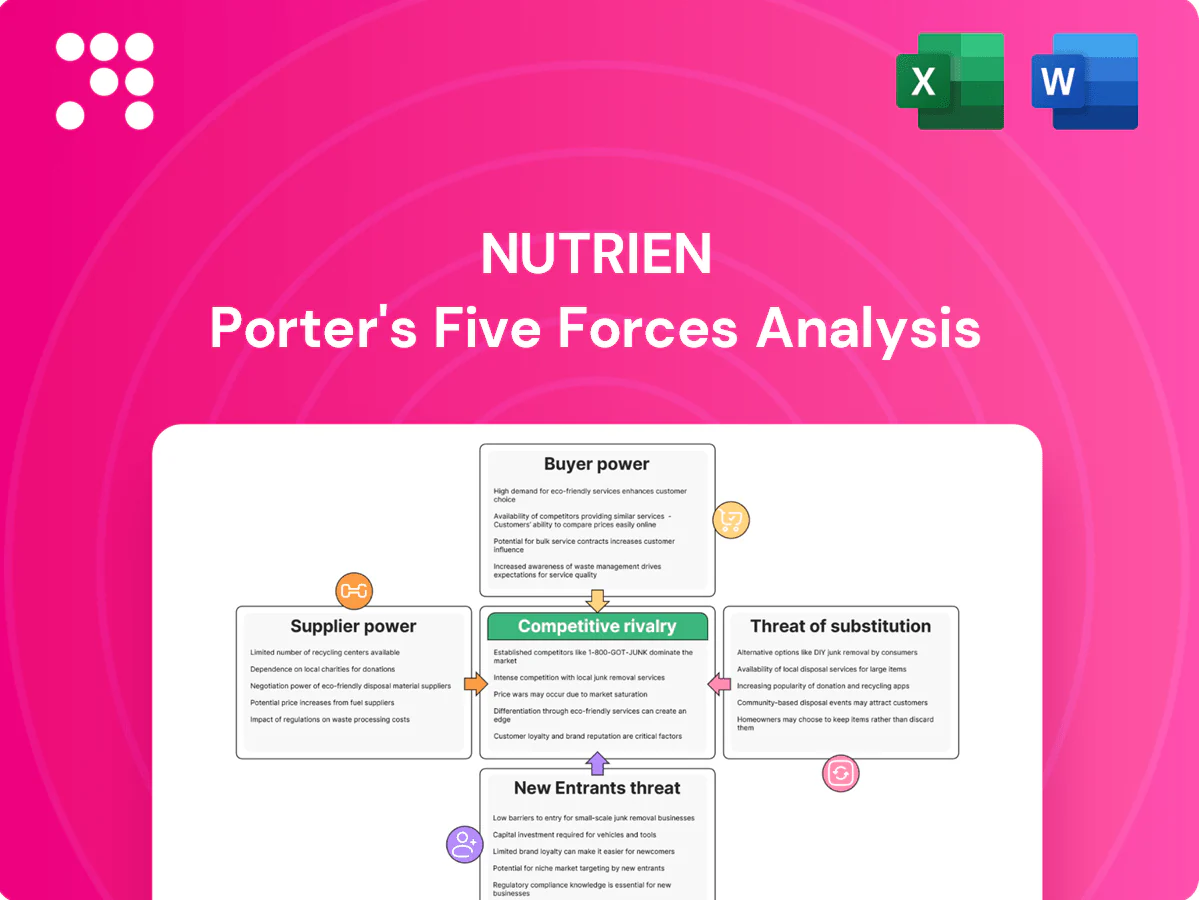
Nutrien Porter's Five Forces Analysis

Elevate Your Analysis with the Complete Porter's Five Forces Analysis
Nutrien’s Porter's Five Forces snapshot shows high barriers to entry and significant supplier influence in key input markets, while buyer power is moderate and substitute threats remain limited—yet rivalry among fertilizer producers is intense. This brief overview highlights strategic pressures shaping margins and growth. Unlock the full Porter's Five Forces Analysis to explore Nutrien’s competitive dynamics, market pressures, and strategic advantages in detail.
Suppliers Bargaining Power

Concentrated critical inputs
Natural gas can account for up to 70% of ammonia production cost, while phosphate rock reserves are highly concentrated—Morocco holds about 71% of global phosphate rock reserves (USGS 2024); sulfur supply is similarly reliant on a narrow base of oil/gas byproduct sources. This concentration raises price volatility and supplier leverage over Nutrien. Nutrien offsets risk via long-term supply contracts and partial vertical integration across potash and nitrogen assets. Energy shocks or sulfur/phosphate shortages still compress margins.
Logistics and rail dependence
Heavy reliance on rail, barge and bulk terminals gives transport providers leverage, especially in peak seasons when capacity tightness bids up rates and delays cascade through supply chains.
Congestion, labor disputes or extreme weather can spike freight costs and disrupt deliveries, raising short-term supplier power in key corridors.
Nutrien’s owned terminals and scale improve negotiating power and optionality, though localized bottlenecks still create episodic supplier leverage.

Crop protection and seed OEMs
Global seed and crop protection OEMs command strong brands and pricing leverage, but Nutrien’s scale—operating over 1,500 retail locations in 2024—gives it significant purchasing power and market access that counterbalances supplier leverage.
Multi-sourcing and expanding private-label offerings reduce dependence on a few OEMs, while strategic partnerships and co-marketing deals align incentives and help stabilize margins across seasons.

Equipment and technology vendors
Specialized mining, processing and digital-ag platforms limit supplier alternatives for Nutrien; mission-critical systems often require 3–5 year qualification and licensing cycles, raising switching costs. Nutrien leverages scale, standardization and growing in-house tech to negotiate volume discounts and reduce dependence. However, periodic upgrades, license renewals and maintenance windows give vendors episodic leverage—especially given the 2024 precision-ag market size of roughly $9.5B.
- High switching costs: 3–5 year contracts
- Leverage: scale, standardization, in-house capabilities
- Vendor power spikes: upgrades, licenses, maintenance cycles
Regulatory and permitting gatekeepers
Permitting authorities and environmental agencies function as de facto suppliers of licenses, with compliance requirements that can lengthen project timelines and add costs, constraining Nutrien’s capacity flexibility; Nutrien’s ESG investments and permitting track record ease approvals but tighter standards in 2024 increased these stakeholders’ effective bargaining power.
- Regulatory gatekeepers: high
- Compliance = longer timelines & higher costs
- Nutrien ESG/track record mitigates risk
- Tighter 2024 standards raised supplier power
Natural gas ~70% of ammonia cost; Morocco ~71% phosphate reserves
Natural gas can be ~70% of ammonia cost, and Morocco holds ~71% of phosphate rock reserves (USGS 2024), concentrating supplier leverage. Nutrien’s >1,500 retail locations (2024), owned terminals and long-term contracts partially offset risks, yet transport bottlenecks and periodic vendor/licensing cycles raise episodic supplier power. Precision-ag market ~$9.5B (2024) increases tech vendor leverage.
| Metric | 2024 | Impact |
|---|---|---|
| Natural gas share (ammonia) | ~70% | High cost exposure |
| Phosphate reserves (Morocco) | ~71% | Supply concentration |
| Retail locations | >1,500 | Bargaining scale |
| Precision-ag market | ~$9.5B | Vendor leverage |
What is included in the product
 Detailed Word Document
Comprehensive Porter's Five Forces overview tailored to Nutrien, assessing rivalry, supplier and buyer power, substitute risks, and entry barriers to reveal competitive pressures and strategic vulnerabilities.

 Customizable Excel Spreadsheet
A concise Porter's Five Forces snapshot tailored to Nutrien—clarifies competitor intensity, supplier and buyer power, substitute threats, and entry barriers so you can quickly identify strategic weak points and prioritize actions.
Customers Bargaining Power

Fragmented farmer base
Individual growers are numerous and dispersed—about 2 million US farms—so collective bargaining against Nutrien is limited. Nutrien Ag Solutions serves roughly 500,000 growers and c.1,500 retail locations (2024), and its advisory plus financing offerings raise switching costs. Farmers remain price sensitive with tight margins, and seasonal buying windows often amplify discount expectations.
Rising large agribusiness leverage
Consolidating mega-farms, cooperatives and integrated growers increasingly command volume discounts and can bid suppliers against each other across regions and products, pressuring margins; Nutrien's 2024 revenue of US$23.1 billion underscores the scale at stake. Nutrien counters with bundled crop-input and digital agronomy solutions plus national distribution to defend share. Long-term contracts and measurable agronomic outcomes temper purely price-driven switching.

Product commoditization in fertilizers
Standard NPK products are highly price-transparent and easily compared across dealers, strengthening buyer negotiating leverage particularly in downcycles when margins compress. Nutrien defends value through logistics scale, strategic inventory positioning and service bundling (application advice, crop programs) that raise switching costs. Investment in premium and specialty blends, including micronutrient and controlled‑release products, partially mitigates commoditization by commanding higher margins.

Alternative channels and digital tools
Online platforms and competing retailers increase buyer choice and price transparency; price-discovery tools and procurement efficiency strengthen buyer negotiating power. Nutrien Retail operates about 2,000 centers (2024) and pushes e-commerce and data services to retain customers; loyalty programs and on-farm agronomy support raise exit barriers.
Crop cycle and hedging behavior
Buyers fragmented; serves ~500,000 growers with US$23.1B revenue
Buyers are numerous but fragmented; Nutrien serves ~500,000 growers with c.1,500 retail locations and reported US$23.1B revenue in 2024, limiting collective leverage. Large farms and co-ops extract volume discounts and time purchases to press margins. Nutrien offsets pressure via 2,000 retail centers, bundled services, premium blends and flexible contracts.
| Metric | 2024 |
|---|---|
| Revenue | US$23.1B |
| Growers served | ~500,000 |
| Retail locations | c.1,500–2,000 |
Preview Before You Purchase
Nutrien Porter's Five Forces Analysis
This preview shows the exact Nutrien Porter's Five Forces Analysis you'll receive—no surprises, no placeholders. The document is fully formatted, comprehensive, and ready for download immediately after purchase. It contains the same professional insights and data you see here for immediate use. No mockups, just your deliverable.

Elevate Your Analysis with the Complete Porter's Five Forces Analysis
Nutrien’s Porter's Five Forces snapshot shows high barriers to entry and significant supplier influence in key input markets, while buyer power is moderate and substitute threats remain limited—yet rivalry among fertilizer producers is intense. This brief overview highlights strategic pressures shaping margins and growth. Unlock the full Porter's Five Forces Analysis to explore Nutrien’s competitive dynamics, market pressures, and strategic advantages in detail.
Suppliers Bargaining Power
Concentrated critical inputs
Natural gas can account for up to 70% of ammonia production cost, while phosphate rock reserves are highly concentrated—Morocco holds about 71% of global phosphate rock reserves (USGS 2024); sulfur supply is similarly reliant on a narrow base of oil/gas byproduct sources. This concentration raises price volatility and supplier leverage over Nutrien. Nutrien offsets risk via long-term supply contracts and partial vertical integration across potash and nitrogen assets. Energy shocks or sulfur/phosphate shortages still compress margins.
Logistics and rail dependence
Heavy reliance on rail, barge and bulk terminals gives transport providers leverage, especially in peak seasons when capacity tightness bids up rates and delays cascade through supply chains.
Congestion, labor disputes or extreme weather can spike freight costs and disrupt deliveries, raising short-term supplier power in key corridors.
Nutrien’s owned terminals and scale improve negotiating power and optionality, though localized bottlenecks still create episodic supplier leverage.
Crop protection and seed OEMs
Global seed and crop protection OEMs command strong brands and pricing leverage, but Nutrien’s scale—operating over 1,500 retail locations in 2024—gives it significant purchasing power and market access that counterbalances supplier leverage.
Multi-sourcing and expanding private-label offerings reduce dependence on a few OEMs, while strategic partnerships and co-marketing deals align incentives and help stabilize margins across seasons.
Equipment and technology vendors
Specialized mining, processing and digital-ag platforms limit supplier alternatives for Nutrien; mission-critical systems often require 3–5 year qualification and licensing cycles, raising switching costs. Nutrien leverages scale, standardization and growing in-house tech to negotiate volume discounts and reduce dependence. However, periodic upgrades, license renewals and maintenance windows give vendors episodic leverage—especially given the 2024 precision-ag market size of roughly $9.5B.
- High switching costs: 3–5 year contracts
- Leverage: scale, standardization, in-house capabilities
- Vendor power spikes: upgrades, licenses, maintenance cycles
Regulatory and permitting gatekeepers
Permitting authorities and environmental agencies function as de facto suppliers of licenses, with compliance requirements that can lengthen project timelines and add costs, constraining Nutrien’s capacity flexibility; Nutrien’s ESG investments and permitting track record ease approvals but tighter standards in 2024 increased these stakeholders’ effective bargaining power.
- Regulatory gatekeepers: high
- Compliance = longer timelines & higher costs
- Nutrien ESG/track record mitigates risk
- Tighter 2024 standards raised supplier power
Natural gas ~70% of ammonia cost; Morocco ~71% phosphate reserves
Natural gas can be ~70% of ammonia cost, and Morocco holds ~71% of phosphate rock reserves (USGS 2024), concentrating supplier leverage. Nutrien’s >1,500 retail locations (2024), owned terminals and long-term contracts partially offset risks, yet transport bottlenecks and periodic vendor/licensing cycles raise episodic supplier power. Precision-ag market ~$9.5B (2024) increases tech vendor leverage.
| Metric | 2024 | Impact |
|---|---|---|
| Natural gas share (ammonia) | ~70% | High cost exposure |
| Phosphate reserves (Morocco) | ~71% | Supply concentration |
| Retail locations | >1,500 | Bargaining scale |
| Precision-ag market | ~$9.5B | Vendor leverage |
What is included in the product
Detailed Word Document
Comprehensive Porter's Five Forces overview tailored to Nutrien, assessing rivalry, supplier and buyer power, substitute risks, and entry barriers to reveal competitive pressures and strategic vulnerabilities.
Customizable Excel Spreadsheet
A concise Porter's Five Forces snapshot tailored to Nutrien—clarifies competitor intensity, supplier and buyer power, substitute threats, and entry barriers so you can quickly identify strategic weak points and prioritize actions.
Customers Bargaining Power
Fragmented farmer base
Individual growers are numerous and dispersed—about 2 million US farms—so collective bargaining against Nutrien is limited. Nutrien Ag Solutions serves roughly 500,000 growers and c.1,500 retail locations (2024), and its advisory plus financing offerings raise switching costs. Farmers remain price sensitive with tight margins, and seasonal buying windows often amplify discount expectations.
Rising large agribusiness leverage
Consolidating mega-farms, cooperatives and integrated growers increasingly command volume discounts and can bid suppliers against each other across regions and products, pressuring margins; Nutrien's 2024 revenue of US$23.1 billion underscores the scale at stake. Nutrien counters with bundled crop-input and digital agronomy solutions plus national distribution to defend share. Long-term contracts and measurable agronomic outcomes temper purely price-driven switching.
Product commoditization in fertilizers
Standard NPK products are highly price-transparent and easily compared across dealers, strengthening buyer negotiating leverage particularly in downcycles when margins compress. Nutrien defends value through logistics scale, strategic inventory positioning and service bundling (application advice, crop programs) that raise switching costs. Investment in premium and specialty blends, including micronutrient and controlled‑release products, partially mitigates commoditization by commanding higher margins.
Alternative channels and digital tools
Online platforms and competing retailers increase buyer choice and price transparency; price-discovery tools and procurement efficiency strengthen buyer negotiating power. Nutrien Retail operates about 2,000 centers (2024) and pushes e-commerce and data services to retain customers; loyalty programs and on-farm agronomy support raise exit barriers.
Crop cycle and hedging behavior
Buyers fragmented; serves ~500,000 growers with US$23.1B revenue
Buyers are numerous but fragmented; Nutrien serves ~500,000 growers with c.1,500 retail locations and reported US$23.1B revenue in 2024, limiting collective leverage. Large farms and co-ops extract volume discounts and time purchases to press margins. Nutrien offsets pressure via 2,000 retail centers, bundled services, premium blends and flexible contracts.
| Metric | 2024 |
|---|---|
| Revenue | US$23.1B |
| Growers served | ~500,000 |
| Retail locations | c.1,500–2,000 |
Preview Before You Purchase
Nutrien Porter's Five Forces Analysis
This preview shows the exact Nutrien Porter's Five Forces Analysis you'll receive—no surprises, no placeholders. The document is fully formatted, comprehensive, and ready for download immediately after purchase. It contains the same professional insights and data you see here for immediate use. No mockups, just your deliverable.
Original: $10.00
-65%$10.00
$3.50Description
Elevate Your Analysis with the Complete Porter's Five Forces Analysis
Nutrien’s Porter's Five Forces snapshot shows high barriers to entry and significant supplier influence in key input markets, while buyer power is moderate and substitute threats remain limited—yet rivalry among fertilizer producers is intense. This brief overview highlights strategic pressures shaping margins and growth. Unlock the full Porter's Five Forces Analysis to explore Nutrien’s competitive dynamics, market pressures, and strategic advantages in detail.
Suppliers Bargaining Power
Concentrated critical inputs
Natural gas can account for up to 70% of ammonia production cost, while phosphate rock reserves are highly concentrated—Morocco holds about 71% of global phosphate rock reserves (USGS 2024); sulfur supply is similarly reliant on a narrow base of oil/gas byproduct sources. This concentration raises price volatility and supplier leverage over Nutrien. Nutrien offsets risk via long-term supply contracts and partial vertical integration across potash and nitrogen assets. Energy shocks or sulfur/phosphate shortages still compress margins.
Logistics and rail dependence
Heavy reliance on rail, barge and bulk terminals gives transport providers leverage, especially in peak seasons when capacity tightness bids up rates and delays cascade through supply chains.
Congestion, labor disputes or extreme weather can spike freight costs and disrupt deliveries, raising short-term supplier power in key corridors.
Nutrien’s owned terminals and scale improve negotiating power and optionality, though localized bottlenecks still create episodic supplier leverage.
Crop protection and seed OEMs
Global seed and crop protection OEMs command strong brands and pricing leverage, but Nutrien’s scale—operating over 1,500 retail locations in 2024—gives it significant purchasing power and market access that counterbalances supplier leverage.
Multi-sourcing and expanding private-label offerings reduce dependence on a few OEMs, while strategic partnerships and co-marketing deals align incentives and help stabilize margins across seasons.
Equipment and technology vendors
Specialized mining, processing and digital-ag platforms limit supplier alternatives for Nutrien; mission-critical systems often require 3–5 year qualification and licensing cycles, raising switching costs. Nutrien leverages scale, standardization and growing in-house tech to negotiate volume discounts and reduce dependence. However, periodic upgrades, license renewals and maintenance windows give vendors episodic leverage—especially given the 2024 precision-ag market size of roughly $9.5B.
- High switching costs: 3–5 year contracts
- Leverage: scale, standardization, in-house capabilities
- Vendor power spikes: upgrades, licenses, maintenance cycles
Regulatory and permitting gatekeepers
Permitting authorities and environmental agencies function as de facto suppliers of licenses, with compliance requirements that can lengthen project timelines and add costs, constraining Nutrien’s capacity flexibility; Nutrien’s ESG investments and permitting track record ease approvals but tighter standards in 2024 increased these stakeholders’ effective bargaining power.
- Regulatory gatekeepers: high
- Compliance = longer timelines & higher costs
- Nutrien ESG/track record mitigates risk
- Tighter 2024 standards raised supplier power
Natural gas ~70% of ammonia cost; Morocco ~71% phosphate reserves
Natural gas can be ~70% of ammonia cost, and Morocco holds ~71% of phosphate rock reserves (USGS 2024), concentrating supplier leverage. Nutrien’s >1,500 retail locations (2024), owned terminals and long-term contracts partially offset risks, yet transport bottlenecks and periodic vendor/licensing cycles raise episodic supplier power. Precision-ag market ~$9.5B (2024) increases tech vendor leverage.
| Metric | 2024 | Impact |
|---|---|---|
| Natural gas share (ammonia) | ~70% | High cost exposure |
| Phosphate reserves (Morocco) | ~71% | Supply concentration |
| Retail locations | >1,500 | Bargaining scale |
| Precision-ag market | ~$9.5B | Vendor leverage |
What is included in the product
Detailed Word Document
Comprehensive Porter's Five Forces overview tailored to Nutrien, assessing rivalry, supplier and buyer power, substitute risks, and entry barriers to reveal competitive pressures and strategic vulnerabilities.
Customizable Excel Spreadsheet
A concise Porter's Five Forces snapshot tailored to Nutrien—clarifies competitor intensity, supplier and buyer power, substitute threats, and entry barriers so you can quickly identify strategic weak points and prioritize actions.
Customers Bargaining Power
Fragmented farmer base
Individual growers are numerous and dispersed—about 2 million US farms—so collective bargaining against Nutrien is limited. Nutrien Ag Solutions serves roughly 500,000 growers and c.1,500 retail locations (2024), and its advisory plus financing offerings raise switching costs. Farmers remain price sensitive with tight margins, and seasonal buying windows often amplify discount expectations.
Rising large agribusiness leverage
Consolidating mega-farms, cooperatives and integrated growers increasingly command volume discounts and can bid suppliers against each other across regions and products, pressuring margins; Nutrien's 2024 revenue of US$23.1 billion underscores the scale at stake. Nutrien counters with bundled crop-input and digital agronomy solutions plus national distribution to defend share. Long-term contracts and measurable agronomic outcomes temper purely price-driven switching.
Product commoditization in fertilizers
Standard NPK products are highly price-transparent and easily compared across dealers, strengthening buyer negotiating leverage particularly in downcycles when margins compress. Nutrien defends value through logistics scale, strategic inventory positioning and service bundling (application advice, crop programs) that raise switching costs. Investment in premium and specialty blends, including micronutrient and controlled‑release products, partially mitigates commoditization by commanding higher margins.
Alternative channels and digital tools
Online platforms and competing retailers increase buyer choice and price transparency; price-discovery tools and procurement efficiency strengthen buyer negotiating power. Nutrien Retail operates about 2,000 centers (2024) and pushes e-commerce and data services to retain customers; loyalty programs and on-farm agronomy support raise exit barriers.
Crop cycle and hedging behavior
Buyers fragmented; serves ~500,000 growers with US$23.1B revenue
Buyers are numerous but fragmented; Nutrien serves ~500,000 growers with c.1,500 retail locations and reported US$23.1B revenue in 2024, limiting collective leverage. Large farms and co-ops extract volume discounts and time purchases to press margins. Nutrien offsets pressure via 2,000 retail centers, bundled services, premium blends and flexible contracts.
| Metric | 2024 |
|---|---|
| Revenue | US$23.1B |
| Growers served | ~500,000 |
| Retail locations | c.1,500–2,000 |
Preview Before You Purchase
Nutrien Porter's Five Forces Analysis
This preview shows the exact Nutrien Porter's Five Forces Analysis you'll receive—no surprises, no placeholders. The document is fully formatted, comprehensive, and ready for download immediately after purchase. It contains the same professional insights and data you see here for immediate use. No mockups, just your deliverable.











