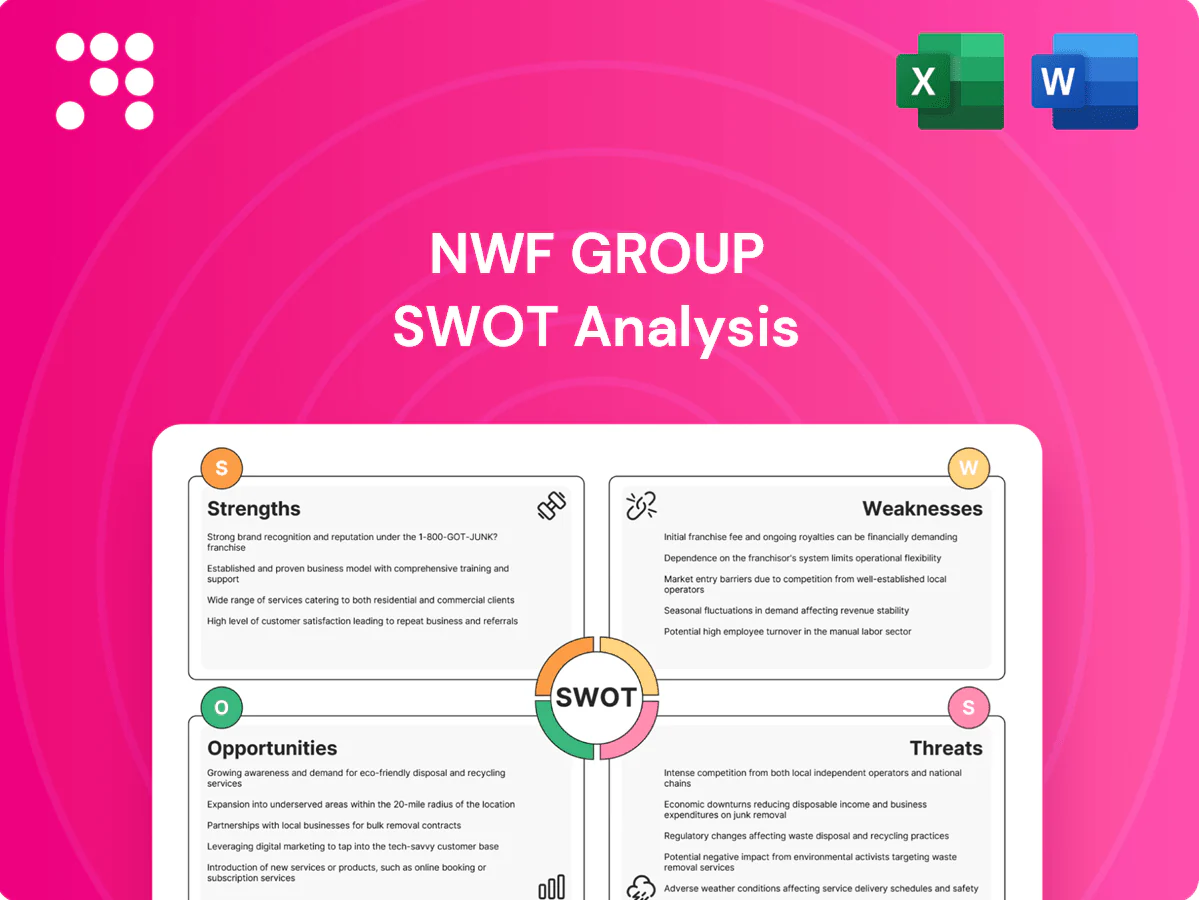
NWF Group SWOT Analysis

Your Strategic Toolkit Starts Here
NWF Group faces resilient regional demand and diversified agri-logistics strengths, yet margin pressure and regulatory shifts pose clear risks. Our concise summary highlights key competitive advantages, vulnerabilities, and growth levers. Discover the full SWOT analysis—purchase the complete, editable report for detailed insights, financial context, and strategic recommendations.
Strengths

Diversified but synergistic portfolio
NWF Group operates three divisions—fuels, feeds and food logistics—which balance cyclical swings across commodities and services. Its focus on essential end-markets such as retail food and agricultural supply underpins baseline demand resilience. Shared logistics and centralised procurement deliver cost leverage across operations. Cross-division knowledge enhances planning and risk management across the listed NWF Group on the LSE.
National distribution footprint
NWF's 30+ depot and warehouse network delivers high service levels across the UK, underpinning FY2024 group scale. Dense routes lower unit delivery costs in fuels and food through higher drop density and backhauls. Close proximity to customers shortens lead times and reduces churn, while scale secures better supplier terms and improved capacity utilization.

Strong ambient warehousing platform
Boughey provides sizable ambient capacity across multiple UK locations combined with integrated transport, underpinning stable volumes through sticky FMCG relationships and multi-year contracts. Value-added services such as co-packing and inventory management deepen share-of-wallet and margin capture. Location, high capex requirements, and specialized operational expertise create strong barriers to entry, protecting market position.

Established agricultural relationships
Feeds benefit from NWF Group’s long-standing farm and merchant ties, with technical advisory and tailored rations strengthening customer loyalty and retention. Recurring demand from livestock producers smooths volumes and reduces seasonality risk, while local depots enable rapid service and informed credit insight that supports farmer cashflow.
- Long-term partnerships
- Technical advisory-led retention
- Stable recurring demand
- Local presence for service & credit
Operational know-how in regulated markets
Operational know-how across fuel, food safety and animal feed reduces regulatory and compliance risk, with standardized procedures ensuring consistent quality and traceability. A strong safety culture lowers incidents and downtime, protecting margins and service delivery. Industry-recognized certifications bolster credibility with blue-chip clients and support contract retention.
- Regulatory navigation: lowers compliance risk
- Standardization: consistent quality
- Safety culture: fewer incidents, less downtime
- Certifications: trusted by blue-chip clients
Three-division logistics group with 30+ depots and resilient FMCG margins
NWF Group’s three divisions—fuels, feeds and food logistics—provide revenue diversification and demand resilience. A 30+ depot and warehouse network lowers delivery unit costs and supports high service levels. Boughey’s ambient capacity and multi-year FMCG contracts drive stable volumes and sticky margins; strong regulatory and safety credentials protect blue-chip relationships.
| Metric | Value |
|---|---|
| Divisions | 3 |
| Depots/warehouses | 30+ |
| Listed | LSE (NWF) |
What is included in the product
 Detailed Word Document
Provides a strategic overview of NWF Group’s internal strengths and weaknesses and external opportunities and threats, mapping its competitive position, key growth drivers and operational risks shaping the company’s future.

 Customizable Excel Spreadsheet
Provides a concise, at-a-glance SWOT matrix for NWF Group to speed strategic alignment, relieve analysis bottlenecks, and enable quick updates for shifting operational priorities.
Weaknesses

Margin pressure in commodity-linked businesses
Fuels and feeds are exposed to intense price competition and immediate pass-through dynamics, constraining NWF Group's pricing power and limiting differentiation; small errors in commodity buying or pricing can quickly compress already tight margins, while rapid mix shifts toward lower-margin volumes can dilute profitability in short order.
Working capital and cash flow seasonality
Inventory and receivables rise sharply around commodity spikes and winter peaks, straining short-term liquidity. Cash conversion can be volatile quarter-to-quarter, amplifying working capital swings. Credit risk elevates in agricultural downturns as customer arrears increase. Financing costs rose in 2024 with Bank Rate at c.5.25%, tightening margins.

Exposure to diesel and transport costs
NWFs distribution model is highly sensitive to fuel and driver wage inflation; UK diesel averaged about £1.60/litre in 2024 and HGV driver shortfalls remained near 100,000, pushing market wages higher. Fuel and wage surcharges historically lag cost moves, compressing margins. Urban congestion and rising compliance (ULEZ/low‑emission zones) add measurable operating cost per route. Network inefficiencies can quickly erode route economics.

Concentration in UK market
NWF Group remains heavily UK-focused, so macro or regulatory shocks in the UK can disproportionately hit results; limited geographic diversification reduces natural hedging of demand cycles and regional weather patterns can swing volumes in feed and fuel businesses. Boughey’s role in the group raises potential customer concentration risk within the agribusiness segment.
- UK market concentration
- Limited geographic hedging
- Customer concentration: Boughey
- Weather-driven volume volatility
Capex intensity and asset age
Warehousing, vehicle fleets and plant require continual investment; aging assets elevate maintenance costs and increase downtime risk. Automation upgrades demand significant upfront spend and integration time. Payback on capex is contingent on sustained volume commitments and long-term customer contracts, constraining near-term free cash flow and financial flexibility.
- High recurring capex burden
- Aging asset-related downtime risk
- Large upfront automation costs
- Payback tied to sustained volumes
Tight margins, rising financing costs and HGV shortage squeeze UK transport profits
Intense commodity price competition and pass-through dynamics compress margins and make small buying errors costly. Working capital and receivables spike seasonally; financing costs rose with Bank Rate near 5.25% in 2024, tightening liquidity. Wage and fuel inflation (UK diesel ~£1.60/l in 2024) plus ~100,000 HGV shortfall raise operating costs. Heavy UK concentration (>90% revenue) amplifies regional/regulatory risk.
| Metric | Value (2024/25) |
|---|---|
| Bank Rate | c.5.25% |
| UK diesel | £1.60/l |
| HGV shortfall | ~100,000 |
| UK revenue share | >90% |
Full Version Awaits
NWF Group SWOT Analysis
This is the actual NWF Group SWOT analysis document you’ll receive upon purchase—no surprises, just professional quality. The preview below is taken directly from the full report; buying unlocks the entire in-depth, editable version. You’re viewing a live excerpt of the real file, ready for immediate download after checkout.

Your Strategic Toolkit Starts Here
NWF Group faces resilient regional demand and diversified agri-logistics strengths, yet margin pressure and regulatory shifts pose clear risks. Our concise summary highlights key competitive advantages, vulnerabilities, and growth levers. Discover the full SWOT analysis—purchase the complete, editable report for detailed insights, financial context, and strategic recommendations.
Strengths
Diversified but synergistic portfolio
NWF Group operates three divisions—fuels, feeds and food logistics—which balance cyclical swings across commodities and services. Its focus on essential end-markets such as retail food and agricultural supply underpins baseline demand resilience. Shared logistics and centralised procurement deliver cost leverage across operations. Cross-division knowledge enhances planning and risk management across the listed NWF Group on the LSE.
National distribution footprint
NWF's 30+ depot and warehouse network delivers high service levels across the UK, underpinning FY2024 group scale. Dense routes lower unit delivery costs in fuels and food through higher drop density and backhauls. Close proximity to customers shortens lead times and reduces churn, while scale secures better supplier terms and improved capacity utilization.
Strong ambient warehousing platform
Boughey provides sizable ambient capacity across multiple UK locations combined with integrated transport, underpinning stable volumes through sticky FMCG relationships and multi-year contracts. Value-added services such as co-packing and inventory management deepen share-of-wallet and margin capture. Location, high capex requirements, and specialized operational expertise create strong barriers to entry, protecting market position.
Established agricultural relationships
Feeds benefit from NWF Group’s long-standing farm and merchant ties, with technical advisory and tailored rations strengthening customer loyalty and retention. Recurring demand from livestock producers smooths volumes and reduces seasonality risk, while local depots enable rapid service and informed credit insight that supports farmer cashflow.
- Long-term partnerships
- Technical advisory-led retention
- Stable recurring demand
- Local presence for service & credit
Operational know-how in regulated markets
Operational know-how across fuel, food safety and animal feed reduces regulatory and compliance risk, with standardized procedures ensuring consistent quality and traceability. A strong safety culture lowers incidents and downtime, protecting margins and service delivery. Industry-recognized certifications bolster credibility with blue-chip clients and support contract retention.
- Regulatory navigation: lowers compliance risk
- Standardization: consistent quality
- Safety culture: fewer incidents, less downtime
- Certifications: trusted by blue-chip clients
Three-division logistics group with 30+ depots and resilient FMCG margins
NWF Group’s three divisions—fuels, feeds and food logistics—provide revenue diversification and demand resilience. A 30+ depot and warehouse network lowers delivery unit costs and supports high service levels. Boughey’s ambient capacity and multi-year FMCG contracts drive stable volumes and sticky margins; strong regulatory and safety credentials protect blue-chip relationships.
| Metric | Value |
|---|---|
| Divisions | 3 |
| Depots/warehouses | 30+ |
| Listed | LSE (NWF) |
What is included in the product
Detailed Word Document
Provides a strategic overview of NWF Group’s internal strengths and weaknesses and external opportunities and threats, mapping its competitive position, key growth drivers and operational risks shaping the company’s future.
Customizable Excel Spreadsheet
Provides a concise, at-a-glance SWOT matrix for NWF Group to speed strategic alignment, relieve analysis bottlenecks, and enable quick updates for shifting operational priorities.
Weaknesses
Margin pressure in commodity-linked businesses
Fuels and feeds are exposed to intense price competition and immediate pass-through dynamics, constraining NWF Group's pricing power and limiting differentiation; small errors in commodity buying or pricing can quickly compress already tight margins, while rapid mix shifts toward lower-margin volumes can dilute profitability in short order.
Working capital and cash flow seasonality
Inventory and receivables rise sharply around commodity spikes and winter peaks, straining short-term liquidity. Cash conversion can be volatile quarter-to-quarter, amplifying working capital swings. Credit risk elevates in agricultural downturns as customer arrears increase. Financing costs rose in 2024 with Bank Rate at c.5.25%, tightening margins.
Exposure to diesel and transport costs
NWFs distribution model is highly sensitive to fuel and driver wage inflation; UK diesel averaged about £1.60/litre in 2024 and HGV driver shortfalls remained near 100,000, pushing market wages higher. Fuel and wage surcharges historically lag cost moves, compressing margins. Urban congestion and rising compliance (ULEZ/low‑emission zones) add measurable operating cost per route. Network inefficiencies can quickly erode route economics.
Concentration in UK market
NWF Group remains heavily UK-focused, so macro or regulatory shocks in the UK can disproportionately hit results; limited geographic diversification reduces natural hedging of demand cycles and regional weather patterns can swing volumes in feed and fuel businesses. Boughey’s role in the group raises potential customer concentration risk within the agribusiness segment.
- UK market concentration
- Limited geographic hedging
- Customer concentration: Boughey
- Weather-driven volume volatility
Capex intensity and asset age
Warehousing, vehicle fleets and plant require continual investment; aging assets elevate maintenance costs and increase downtime risk. Automation upgrades demand significant upfront spend and integration time. Payback on capex is contingent on sustained volume commitments and long-term customer contracts, constraining near-term free cash flow and financial flexibility.
- High recurring capex burden
- Aging asset-related downtime risk
- Large upfront automation costs
- Payback tied to sustained volumes
Tight margins, rising financing costs and HGV shortage squeeze UK transport profits
Intense commodity price competition and pass-through dynamics compress margins and make small buying errors costly. Working capital and receivables spike seasonally; financing costs rose with Bank Rate near 5.25% in 2024, tightening liquidity. Wage and fuel inflation (UK diesel ~£1.60/l in 2024) plus ~100,000 HGV shortfall raise operating costs. Heavy UK concentration (>90% revenue) amplifies regional/regulatory risk.
| Metric | Value (2024/25) |
|---|---|
| Bank Rate | c.5.25% |
| UK diesel | £1.60/l |
| HGV shortfall | ~100,000 |
| UK revenue share | >90% |
Full Version Awaits
NWF Group SWOT Analysis
This is the actual NWF Group SWOT analysis document you’ll receive upon purchase—no surprises, just professional quality. The preview below is taken directly from the full report; buying unlocks the entire in-depth, editable version. You’re viewing a live excerpt of the real file, ready for immediate download after checkout.
Original: $10.00
-65%$10.00
$3.50Description
Your Strategic Toolkit Starts Here
NWF Group faces resilient regional demand and diversified agri-logistics strengths, yet margin pressure and regulatory shifts pose clear risks. Our concise summary highlights key competitive advantages, vulnerabilities, and growth levers. Discover the full SWOT analysis—purchase the complete, editable report for detailed insights, financial context, and strategic recommendations.
Strengths
Diversified but synergistic portfolio
NWF Group operates three divisions—fuels, feeds and food logistics—which balance cyclical swings across commodities and services. Its focus on essential end-markets such as retail food and agricultural supply underpins baseline demand resilience. Shared logistics and centralised procurement deliver cost leverage across operations. Cross-division knowledge enhances planning and risk management across the listed NWF Group on the LSE.
National distribution footprint
NWF's 30+ depot and warehouse network delivers high service levels across the UK, underpinning FY2024 group scale. Dense routes lower unit delivery costs in fuels and food through higher drop density and backhauls. Close proximity to customers shortens lead times and reduces churn, while scale secures better supplier terms and improved capacity utilization.
Strong ambient warehousing platform
Boughey provides sizable ambient capacity across multiple UK locations combined with integrated transport, underpinning stable volumes through sticky FMCG relationships and multi-year contracts. Value-added services such as co-packing and inventory management deepen share-of-wallet and margin capture. Location, high capex requirements, and specialized operational expertise create strong barriers to entry, protecting market position.
Established agricultural relationships
Feeds benefit from NWF Group’s long-standing farm and merchant ties, with technical advisory and tailored rations strengthening customer loyalty and retention. Recurring demand from livestock producers smooths volumes and reduces seasonality risk, while local depots enable rapid service and informed credit insight that supports farmer cashflow.
- Long-term partnerships
- Technical advisory-led retention
- Stable recurring demand
- Local presence for service & credit
Operational know-how in regulated markets
Operational know-how across fuel, food safety and animal feed reduces regulatory and compliance risk, with standardized procedures ensuring consistent quality and traceability. A strong safety culture lowers incidents and downtime, protecting margins and service delivery. Industry-recognized certifications bolster credibility with blue-chip clients and support contract retention.
- Regulatory navigation: lowers compliance risk
- Standardization: consistent quality
- Safety culture: fewer incidents, less downtime
- Certifications: trusted by blue-chip clients
Three-division logistics group with 30+ depots and resilient FMCG margins
NWF Group’s three divisions—fuels, feeds and food logistics—provide revenue diversification and demand resilience. A 30+ depot and warehouse network lowers delivery unit costs and supports high service levels. Boughey’s ambient capacity and multi-year FMCG contracts drive stable volumes and sticky margins; strong regulatory and safety credentials protect blue-chip relationships.
| Metric | Value |
|---|---|
| Divisions | 3 |
| Depots/warehouses | 30+ |
| Listed | LSE (NWF) |
What is included in the product
Detailed Word Document
Provides a strategic overview of NWF Group’s internal strengths and weaknesses and external opportunities and threats, mapping its competitive position, key growth drivers and operational risks shaping the company’s future.
Customizable Excel Spreadsheet
Provides a concise, at-a-glance SWOT matrix for NWF Group to speed strategic alignment, relieve analysis bottlenecks, and enable quick updates for shifting operational priorities.
Weaknesses
Margin pressure in commodity-linked businesses
Fuels and feeds are exposed to intense price competition and immediate pass-through dynamics, constraining NWF Group's pricing power and limiting differentiation; small errors in commodity buying or pricing can quickly compress already tight margins, while rapid mix shifts toward lower-margin volumes can dilute profitability in short order.
Working capital and cash flow seasonality
Inventory and receivables rise sharply around commodity spikes and winter peaks, straining short-term liquidity. Cash conversion can be volatile quarter-to-quarter, amplifying working capital swings. Credit risk elevates in agricultural downturns as customer arrears increase. Financing costs rose in 2024 with Bank Rate at c.5.25%, tightening margins.
Exposure to diesel and transport costs
NWFs distribution model is highly sensitive to fuel and driver wage inflation; UK diesel averaged about £1.60/litre in 2024 and HGV driver shortfalls remained near 100,000, pushing market wages higher. Fuel and wage surcharges historically lag cost moves, compressing margins. Urban congestion and rising compliance (ULEZ/low‑emission zones) add measurable operating cost per route. Network inefficiencies can quickly erode route economics.
Concentration in UK market
NWF Group remains heavily UK-focused, so macro or regulatory shocks in the UK can disproportionately hit results; limited geographic diversification reduces natural hedging of demand cycles and regional weather patterns can swing volumes in feed and fuel businesses. Boughey’s role in the group raises potential customer concentration risk within the agribusiness segment.
- UK market concentration
- Limited geographic hedging
- Customer concentration: Boughey
- Weather-driven volume volatility
Capex intensity and asset age
Warehousing, vehicle fleets and plant require continual investment; aging assets elevate maintenance costs and increase downtime risk. Automation upgrades demand significant upfront spend and integration time. Payback on capex is contingent on sustained volume commitments and long-term customer contracts, constraining near-term free cash flow and financial flexibility.
- High recurring capex burden
- Aging asset-related downtime risk
- Large upfront automation costs
- Payback tied to sustained volumes
Tight margins, rising financing costs and HGV shortage squeeze UK transport profits
Intense commodity price competition and pass-through dynamics compress margins and make small buying errors costly. Working capital and receivables spike seasonally; financing costs rose with Bank Rate near 5.25% in 2024, tightening liquidity. Wage and fuel inflation (UK diesel ~£1.60/l in 2024) plus ~100,000 HGV shortfall raise operating costs. Heavy UK concentration (>90% revenue) amplifies regional/regulatory risk.
| Metric | Value (2024/25) |
|---|---|
| Bank Rate | c.5.25% |
| UK diesel | £1.60/l |
| HGV shortfall | ~100,000 |
| UK revenue share | >90% |
Full Version Awaits
NWF Group SWOT Analysis
This is the actual NWF Group SWOT analysis document you’ll receive upon purchase—no surprises, just professional quality. The preview below is taken directly from the full report; buying unlocks the entire in-depth, editable version. You’re viewing a live excerpt of the real file, ready for immediate download after checkout.











