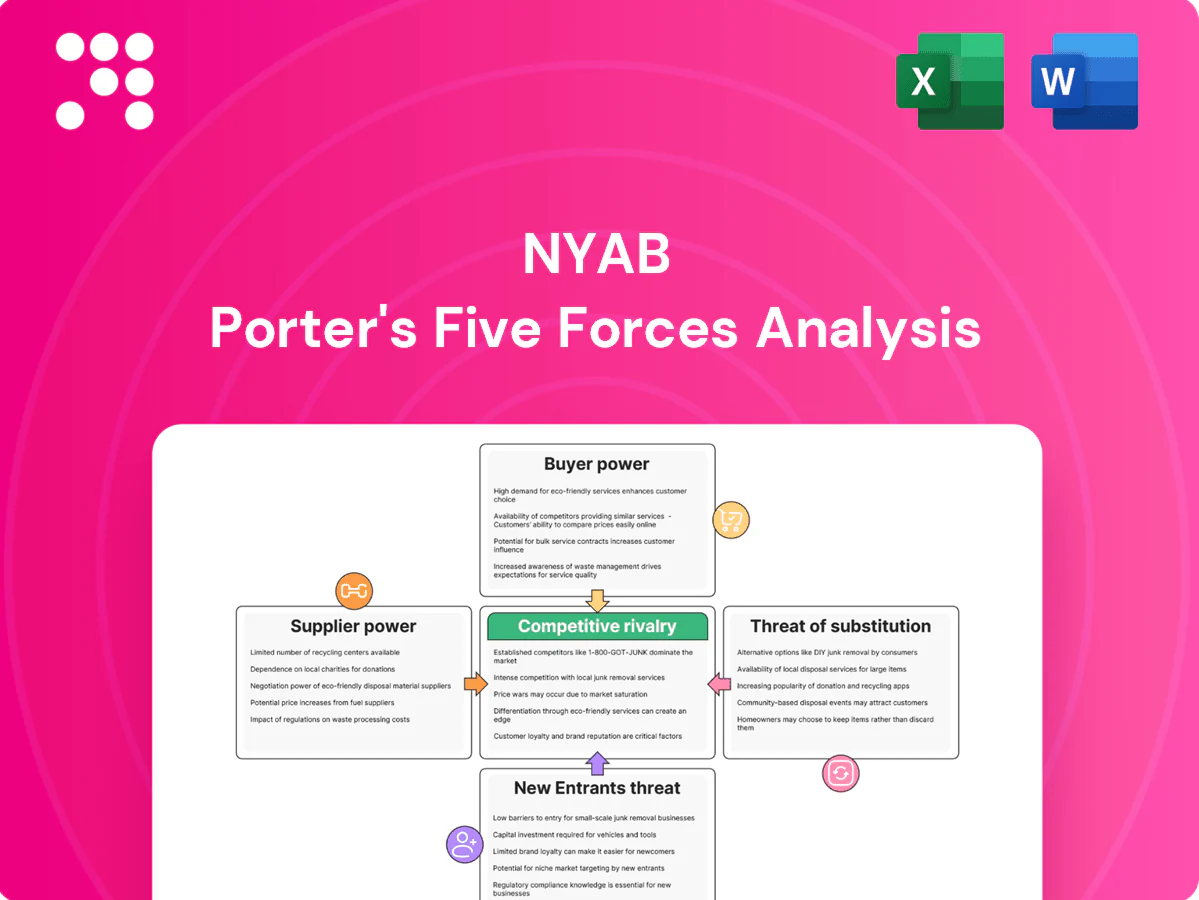
NYAB Porter's Five Forces Analysis

Elevate Your Analysis with the Complete Porter's Five Forces Analysis
NYAB's competitive landscape is shaped by intense rivalry and the significant bargaining power of its buyers. Understanding the threat of new entrants and the availability of substitutes is crucial for navigating this market.
The complete report reveals the real forces shaping NYAB’s industry—from supplier influence to threat of new entrants. Gain actionable insights to drive smarter decision-making.
Suppliers Bargaining Power

Specialized Materials and Components
NYAB's dependence on highly specialized materials for its renewable energy and industrial ventures, like advanced composites for wind turbine blades or specific high-performance alloys for demanding industrial applications, grants considerable power to its niche suppliers. The scarcity of suppliers capable of producing these advanced components can lead to increased costs and less favorable contract terms for NYAB.
Skilled Labor and Subcontractors
The demand for highly skilled labor, such as certified engineers and specialized construction workers, remains robust in Northern Europe, especially for ambitious infrastructure and renewable energy ventures. This high demand, coupled with existing shortages, translates into increased labor costs and grants specialized subcontractors significant leverage.
In 2024, the construction sector in Northern Europe experienced a notable skills gap. For instance, a report indicated that over 60% of construction firms struggled to find adequately skilled workers for complex projects. This scarcity directly empowers subcontractors with specialized expertise, allowing them to command higher rates and dictate terms.
NYAB's success hinges on its capacity to secure and retain this vital talent. The ability to attract and keep top-tier engineers and project managers is not merely about filling positions; it's a critical factor in ensuring efficient project execution and maintaining healthy profit margins in a competitive market.

Commodity Price Volatility
The construction sector, including companies like NYAB, faces significant risk from commodity price volatility. Fluctuations in the cost of steel, concrete, timber, and fuel directly impact project profitability. For instance, a 10% increase in steel prices, a common occurrence in recent years, can substantially erode margins on fixed-price contracts.

Technology and Equipment Providers
NYAB’s reliance on technology and equipment providers for advanced design, construction techniques, and specialized machinery means these suppliers can wield significant power. If suppliers offer unique, proprietary solutions or hold a dominant market share, they can influence pricing and contract terms. For instance, the heavy machinery rental market, crucial for large infrastructure projects, saw rental rates increase by an average of 5-10% in 2024 due to high demand and limited availability of specialized equipment.
This supplier power extends to ongoing operational costs. Upgrades to existing machinery, essential for maintaining competitive efficiency, and licensing agreements for specialized software or construction methodologies become recurring expenses. In 2023, the global construction equipment market was valued at approximately $210 billion, with a significant portion attributed to advanced technological components and proprietary systems, indicating the embedded value and potential leverage of these suppliers.
- Proprietary Solutions: Suppliers offering unique technologies or patented processes can command higher prices and stricter terms.
- Market Dominance: A few key suppliers controlling specialized equipment or advanced software can dictate market conditions.
- Lifecycle Costs: The power of suppliers is also evident in ongoing maintenance, upgrades, and licensing fees, which contribute to the total cost of ownership for NYAB.
Logistics and Transportation Services
For a company like NYAB, operating across Northern Europe, the bargaining power of logistics and transportation suppliers is significant. Their ability to move materials and equipment efficiently, especially to remote or challenging project sites, makes them indispensable. This is particularly true in 2024, where global supply chain disruptions continue to influence service availability and pricing.
Suppliers with established, extensive networks across Northern Europe, or those possessing specialized heavy-haul or cold-chain capabilities, hold considerable sway. Their expertise in navigating difficult terrains or extreme weather conditions, common in regions where NYAB operates, allows them to command premium rates. For instance, the cost of specialized transport in Arctic regions can be substantially higher due to the unique equipment and skilled personnel required.
- Criticality of Service: Reliable logistics are essential for project timelines and cost management, giving suppliers leverage.
- Specialized Capabilities: Providers with unique assets (e.g., ice-class vessels, heavy-lift cranes) for challenging Northern European environments have greater power.
- Market Concentration: In specific remote areas, a limited number of logistics providers can lead to higher prices.
- 2024 Cost Factors: Fuel price volatility and driver shortages in 2024 continue to impact transportation costs, strengthening supplier positions.
Navigating Supplier Leverage in Northern European Construction
NYAB's reliance on specialized materials and skilled labor gives its suppliers and subcontractors considerable bargaining power. This is amplified by the scarcity of providers for advanced components and the high demand for specialized construction talent in Northern Europe. For instance, in 2024, a significant portion of construction firms reported difficulties in finding skilled workers, enabling these specialists to negotiate higher rates and more favorable terms.
The company's dependence on technology providers for advanced machinery and software also translates into supplier leverage. Companies offering proprietary solutions or holding dominant market positions can influence pricing and contract conditions. In 2023, the global construction equipment market, valued at approximately $210 billion, highlighted the embedded value and potential power of these technology-focused suppliers.
Logistics and transportation suppliers are also critical, especially for projects in remote Northern European locations. Their ability to provide specialized transport, such as heavy-haul or cold-chain capabilities, grants them considerable influence, particularly when market conditions like fuel price volatility and driver shortages, prevalent in 2024, increase operational costs.
| Supplier Category | Key Factors Influencing Power | Impact on NYAB | 2024 Context/Data |
|---|---|---|---|
| Specialized Materials | Scarcity of advanced components, proprietary technologies | Increased material costs, potential project delays | High demand for renewable energy components |
| Skilled Labor/Subcontractors | Shortage of specialized engineers and construction workers | Higher labor costs, negotiation leverage for subcontractors | Over 60% of firms struggled to find skilled workers in Northern Europe (2024) |
| Technology & Equipment Providers | Proprietary solutions, market dominance | Influence on pricing, potential for higher equipment rental/licensing fees | Global construction equipment market valued at ~$210 billion (2023) |
| Logistics & Transportation | Specialized capabilities (heavy-haul, cold-chain), network reach | Premium rates for challenging routes, dependence on timely delivery | Fuel price volatility and driver shortages impacting costs |
What is included in the product
 Detailed Word Document
Analyzes the competitive intensity and profitability potential for NYAB by examining industry rivalry, buyer and supplier power, new entrant threats, and the availability of substitutes.

 Customizable Excel Spreadsheet
Quickly identify and mitigate competitive threats with a visual representation of all five forces, enabling proactive strategy adjustments.
Customers Bargaining Power

Large Project Scale and Client Sophistication
NYAB's focus on large-scale infrastructure, renewable energy, and industrial projects means its clients are typically sophisticated, well-resourced entities like national governments or major energy corporations. These clients command significant financial clout, often managing budgets in the hundreds of millions or even billions of dollars for a single project, which inherently gives them substantial bargaining power.
Tendering and Competitive Bidding Processes
For major construction projects, customers commonly use detailed tendering and competitive bidding. This process involves asking many qualified contractors, including companies like NYAB, to present their proposals.
By comparing bids on factors such as cost, quality, and project timelines, customers can significantly influence the profit margins for service providers. The open nature of these bidding procedures amplifies customer influence.
In 2023, the average number of bids received per public construction project in the US was approximately 5.7, highlighting the competitive landscape contractors face.

Long-Term Relationships and Strategic Importance
NYAB's focus on long-term relationships in major infrastructure and energy projects means clients, often large utility companies or government entities, hold significant bargaining power. These clients, undertaking multi-billion dollar projects, demand absolute reliability and adherence to strict timelines, giving them leverage to negotiate favorable terms. For instance, a delay on a critical power grid upgrade could cost a utility millions daily, making NYAB's performance paramount.

Customization and Project Specificity
The bargaining power of customers is significantly influenced by the high degree of customization inherent in many of NYAB's projects. Because each project is tailored to unique client requirements and specific site conditions, NYAB faces challenges in standardizing its offerings or efficiently reallocating resources. This bespoke nature of the work can give clients leverage to dictate precise specifications and request modifications mid-project, knowing that deviations can be costly for NYAB.
This project-specific demand empowers customers to negotiate terms more aggressively. For instance, in the construction sector, which is relevant to NYAB's operations, significant project changes requested by clients can lead to cost overruns and delays. A 2024 report indicated that change orders in large construction projects could add an average of 8% to the total project cost, highlighting the financial impact of customer-driven modifications and strengthening their negotiating position.
- Customization Limits Replicability: NYAB's reliance on bespoke solutions restricts its ability to achieve economies of scale or quickly pivot between clients.
- Customer Leverage on Specifications: The unique demands of each project allow clients to enforce stringent specifications and control project scope.
- Negotiating Power from Specificity: The singular nature of custom projects often places customers in a stronger position to negotiate pricing and terms.
- Impact of Change Orders: In 2024, construction projects saw an average of 8% cost increase due to client-requested changes, underscoring customer influence.
Financial and Performance Guarantees
Large clients, particularly in sectors like infrastructure and construction where NYAB operates, frequently demand substantial financial and performance guarantees. These can include performance bonds, letters of credit, and stringent contractual stipulations concerning project delivery timelines, quality standards, and safety protocols. For instance, in 2024, major government tenders often require contractors to secure performance bonds equivalent to 10-20% of the contract value, a significant financial commitment.
These demands effectively transfer a considerable portion of project-related risks from the client to NYAB, thereby diminishing NYAB's leverage in negotiations. The need to collateralize these guarantees ties up capital that could otherwise be deployed for growth or operational efficiency.
Furthermore, the ability of customers to withhold payments or impose substantial penalties for any deviation from contractual terms significantly amplifies their bargaining power. This financial leverage means clients can exert considerable pressure on contractors to meet demanding specifications, even if it strains NYAB's profitability.
- Performance Bonds: Typically range from 10% to 20% of contract value in large projects.
- Payment Withholding: Clients can retain a percentage of progress payments until final project acceptance.
- Penalty Clauses: Contractual penalties for delays or non-compliance can be severe, impacting NYAB's bottom line.
- Risk Transfer: Guarantees shift financial and operational risks to NYAB, reducing its negotiating strength.
Client Leverage Dominates Infrastructure and Energy Contracts
NYAB's clients, often large government bodies or major corporations in infrastructure and energy, possess significant bargaining power due to the sheer scale of their projects, frequently valued in the hundreds of millions or billions. This financial muscle allows them to negotiate favorable terms, especially given the competitive bidding processes common in these sectors. For example, in 2023, US public construction projects saw an average of 5.7 bids, indicating a robust competitive environment that benefits buyers.
The highly customized nature of NYAB's work further empowers customers. Because each project is unique, clients can dictate specific requirements and control the scope, knowing that mid-project changes can be costly for NYAB. A 2024 report highlighted that change orders in large construction projects could add an average of 8% to the total cost, demonstrating the financial leverage customers gain through modifications.
Additionally, clients demand substantial performance guarantees, such as bonds typically ranging from 10-20% of contract value in 2024, and can withhold payments or impose penalties for non-compliance. This risk transfer and financial leverage significantly reduce NYAB's negotiating strength.
| Factor | Impact on NYAB | Client Leverage | Supporting Data (2023-2024) |
| Project Scale & Budgets | Higher dependence on large contracts | Significant financial clout | Multi-billion dollar projects common |
| Competitive Bidding | Pressure on margins | Ability to select lowest bidder | Average 5.7 bids per US public construction project (2023) |
| Customization & Change Orders | Increased project risk and cost | Control over specifications and scope | 8% average cost increase from change orders in construction (2024) |
| Performance Guarantees & Penalties | Capital tied up, risk exposure | Leverage through risk transfer and payment withholding | 10-20% performance bonds common in government tenders (2024) |
Full Version Awaits
NYAB Porter's Five Forces Analysis
This preview showcases the comprehensive Porter's Five Forces Analysis for NYAB, detailing the competitive landscape and strategic implications. The document displayed here is the exact, fully formatted analysis you’ll receive immediately after purchase, offering immediate insights into the industry's power dynamics. You're looking at the actual, professionally crafted document, ensuring you get precisely the information needed to understand NYAB's competitive environment without any alterations or missing sections.

Elevate Your Analysis with the Complete Porter's Five Forces Analysis
NYAB's competitive landscape is shaped by intense rivalry and the significant bargaining power of its buyers. Understanding the threat of new entrants and the availability of substitutes is crucial for navigating this market.
The complete report reveals the real forces shaping NYAB’s industry—from supplier influence to threat of new entrants. Gain actionable insights to drive smarter decision-making.
Suppliers Bargaining Power
Specialized Materials and Components
NYAB's dependence on highly specialized materials for its renewable energy and industrial ventures, like advanced composites for wind turbine blades or specific high-performance alloys for demanding industrial applications, grants considerable power to its niche suppliers. The scarcity of suppliers capable of producing these advanced components can lead to increased costs and less favorable contract terms for NYAB.
Skilled Labor and Subcontractors
The demand for highly skilled labor, such as certified engineers and specialized construction workers, remains robust in Northern Europe, especially for ambitious infrastructure and renewable energy ventures. This high demand, coupled with existing shortages, translates into increased labor costs and grants specialized subcontractors significant leverage.
In 2024, the construction sector in Northern Europe experienced a notable skills gap. For instance, a report indicated that over 60% of construction firms struggled to find adequately skilled workers for complex projects. This scarcity directly empowers subcontractors with specialized expertise, allowing them to command higher rates and dictate terms.
NYAB's success hinges on its capacity to secure and retain this vital talent. The ability to attract and keep top-tier engineers and project managers is not merely about filling positions; it's a critical factor in ensuring efficient project execution and maintaining healthy profit margins in a competitive market.
Commodity Price Volatility
The construction sector, including companies like NYAB, faces significant risk from commodity price volatility. Fluctuations in the cost of steel, concrete, timber, and fuel directly impact project profitability. For instance, a 10% increase in steel prices, a common occurrence in recent years, can substantially erode margins on fixed-price contracts.
Technology and Equipment Providers
NYAB’s reliance on technology and equipment providers for advanced design, construction techniques, and specialized machinery means these suppliers can wield significant power. If suppliers offer unique, proprietary solutions or hold a dominant market share, they can influence pricing and contract terms. For instance, the heavy machinery rental market, crucial for large infrastructure projects, saw rental rates increase by an average of 5-10% in 2024 due to high demand and limited availability of specialized equipment.
This supplier power extends to ongoing operational costs. Upgrades to existing machinery, essential for maintaining competitive efficiency, and licensing agreements for specialized software or construction methodologies become recurring expenses. In 2023, the global construction equipment market was valued at approximately $210 billion, with a significant portion attributed to advanced technological components and proprietary systems, indicating the embedded value and potential leverage of these suppliers.
- Proprietary Solutions: Suppliers offering unique technologies or patented processes can command higher prices and stricter terms.
- Market Dominance: A few key suppliers controlling specialized equipment or advanced software can dictate market conditions.
- Lifecycle Costs: The power of suppliers is also evident in ongoing maintenance, upgrades, and licensing fees, which contribute to the total cost of ownership for NYAB.
Logistics and Transportation Services
For a company like NYAB, operating across Northern Europe, the bargaining power of logistics and transportation suppliers is significant. Their ability to move materials and equipment efficiently, especially to remote or challenging project sites, makes them indispensable. This is particularly true in 2024, where global supply chain disruptions continue to influence service availability and pricing.
Suppliers with established, extensive networks across Northern Europe, or those possessing specialized heavy-haul or cold-chain capabilities, hold considerable sway. Their expertise in navigating difficult terrains or extreme weather conditions, common in regions where NYAB operates, allows them to command premium rates. For instance, the cost of specialized transport in Arctic regions can be substantially higher due to the unique equipment and skilled personnel required.
- Criticality of Service: Reliable logistics are essential for project timelines and cost management, giving suppliers leverage.
- Specialized Capabilities: Providers with unique assets (e.g., ice-class vessels, heavy-lift cranes) for challenging Northern European environments have greater power.
- Market Concentration: In specific remote areas, a limited number of logistics providers can lead to higher prices.
- 2024 Cost Factors: Fuel price volatility and driver shortages in 2024 continue to impact transportation costs, strengthening supplier positions.
Navigating Supplier Leverage in Northern European Construction
NYAB's reliance on specialized materials and skilled labor gives its suppliers and subcontractors considerable bargaining power. This is amplified by the scarcity of providers for advanced components and the high demand for specialized construction talent in Northern Europe. For instance, in 2024, a significant portion of construction firms reported difficulties in finding skilled workers, enabling these specialists to negotiate higher rates and more favorable terms.
The company's dependence on technology providers for advanced machinery and software also translates into supplier leverage. Companies offering proprietary solutions or holding dominant market positions can influence pricing and contract conditions. In 2023, the global construction equipment market, valued at approximately $210 billion, highlighted the embedded value and potential power of these technology-focused suppliers.
Logistics and transportation suppliers are also critical, especially for projects in remote Northern European locations. Their ability to provide specialized transport, such as heavy-haul or cold-chain capabilities, grants them considerable influence, particularly when market conditions like fuel price volatility and driver shortages, prevalent in 2024, increase operational costs.
| Supplier Category | Key Factors Influencing Power | Impact on NYAB | 2024 Context/Data |
|---|---|---|---|
| Specialized Materials | Scarcity of advanced components, proprietary technologies | Increased material costs, potential project delays | High demand for renewable energy components |
| Skilled Labor/Subcontractors | Shortage of specialized engineers and construction workers | Higher labor costs, negotiation leverage for subcontractors | Over 60% of firms struggled to find skilled workers in Northern Europe (2024) |
| Technology & Equipment Providers | Proprietary solutions, market dominance | Influence on pricing, potential for higher equipment rental/licensing fees | Global construction equipment market valued at ~$210 billion (2023) |
| Logistics & Transportation | Specialized capabilities (heavy-haul, cold-chain), network reach | Premium rates for challenging routes, dependence on timely delivery | Fuel price volatility and driver shortages impacting costs |
What is included in the product
Detailed Word Document
Analyzes the competitive intensity and profitability potential for NYAB by examining industry rivalry, buyer and supplier power, new entrant threats, and the availability of substitutes.
Customizable Excel Spreadsheet
Quickly identify and mitigate competitive threats with a visual representation of all five forces, enabling proactive strategy adjustments.
Customers Bargaining Power
Large Project Scale and Client Sophistication
NYAB's focus on large-scale infrastructure, renewable energy, and industrial projects means its clients are typically sophisticated, well-resourced entities like national governments or major energy corporations. These clients command significant financial clout, often managing budgets in the hundreds of millions or even billions of dollars for a single project, which inherently gives them substantial bargaining power.
Tendering and Competitive Bidding Processes
For major construction projects, customers commonly use detailed tendering and competitive bidding. This process involves asking many qualified contractors, including companies like NYAB, to present their proposals.
By comparing bids on factors such as cost, quality, and project timelines, customers can significantly influence the profit margins for service providers. The open nature of these bidding procedures amplifies customer influence.
In 2023, the average number of bids received per public construction project in the US was approximately 5.7, highlighting the competitive landscape contractors face.
Long-Term Relationships and Strategic Importance
NYAB's focus on long-term relationships in major infrastructure and energy projects means clients, often large utility companies or government entities, hold significant bargaining power. These clients, undertaking multi-billion dollar projects, demand absolute reliability and adherence to strict timelines, giving them leverage to negotiate favorable terms. For instance, a delay on a critical power grid upgrade could cost a utility millions daily, making NYAB's performance paramount.
Customization and Project Specificity
The bargaining power of customers is significantly influenced by the high degree of customization inherent in many of NYAB's projects. Because each project is tailored to unique client requirements and specific site conditions, NYAB faces challenges in standardizing its offerings or efficiently reallocating resources. This bespoke nature of the work can give clients leverage to dictate precise specifications and request modifications mid-project, knowing that deviations can be costly for NYAB.
This project-specific demand empowers customers to negotiate terms more aggressively. For instance, in the construction sector, which is relevant to NYAB's operations, significant project changes requested by clients can lead to cost overruns and delays. A 2024 report indicated that change orders in large construction projects could add an average of 8% to the total project cost, highlighting the financial impact of customer-driven modifications and strengthening their negotiating position.
- Customization Limits Replicability: NYAB's reliance on bespoke solutions restricts its ability to achieve economies of scale or quickly pivot between clients.
- Customer Leverage on Specifications: The unique demands of each project allow clients to enforce stringent specifications and control project scope.
- Negotiating Power from Specificity: The singular nature of custom projects often places customers in a stronger position to negotiate pricing and terms.
- Impact of Change Orders: In 2024, construction projects saw an average of 8% cost increase due to client-requested changes, underscoring customer influence.
Financial and Performance Guarantees
Large clients, particularly in sectors like infrastructure and construction where NYAB operates, frequently demand substantial financial and performance guarantees. These can include performance bonds, letters of credit, and stringent contractual stipulations concerning project delivery timelines, quality standards, and safety protocols. For instance, in 2024, major government tenders often require contractors to secure performance bonds equivalent to 10-20% of the contract value, a significant financial commitment.
These demands effectively transfer a considerable portion of project-related risks from the client to NYAB, thereby diminishing NYAB's leverage in negotiations. The need to collateralize these guarantees ties up capital that could otherwise be deployed for growth or operational efficiency.
Furthermore, the ability of customers to withhold payments or impose substantial penalties for any deviation from contractual terms significantly amplifies their bargaining power. This financial leverage means clients can exert considerable pressure on contractors to meet demanding specifications, even if it strains NYAB's profitability.
- Performance Bonds: Typically range from 10% to 20% of contract value in large projects.
- Payment Withholding: Clients can retain a percentage of progress payments until final project acceptance.
- Penalty Clauses: Contractual penalties for delays or non-compliance can be severe, impacting NYAB's bottom line.
- Risk Transfer: Guarantees shift financial and operational risks to NYAB, reducing its negotiating strength.
Client Leverage Dominates Infrastructure and Energy Contracts
NYAB's clients, often large government bodies or major corporations in infrastructure and energy, possess significant bargaining power due to the sheer scale of their projects, frequently valued in the hundreds of millions or billions. This financial muscle allows them to negotiate favorable terms, especially given the competitive bidding processes common in these sectors. For example, in 2023, US public construction projects saw an average of 5.7 bids, indicating a robust competitive environment that benefits buyers.
The highly customized nature of NYAB's work further empowers customers. Because each project is unique, clients can dictate specific requirements and control the scope, knowing that mid-project changes can be costly for NYAB. A 2024 report highlighted that change orders in large construction projects could add an average of 8% to the total cost, demonstrating the financial leverage customers gain through modifications.
Additionally, clients demand substantial performance guarantees, such as bonds typically ranging from 10-20% of contract value in 2024, and can withhold payments or impose penalties for non-compliance. This risk transfer and financial leverage significantly reduce NYAB's negotiating strength.
| Factor | Impact on NYAB | Client Leverage | Supporting Data (2023-2024) |
| Project Scale & Budgets | Higher dependence on large contracts | Significant financial clout | Multi-billion dollar projects common |
| Competitive Bidding | Pressure on margins | Ability to select lowest bidder | Average 5.7 bids per US public construction project (2023) |
| Customization & Change Orders | Increased project risk and cost | Control over specifications and scope | 8% average cost increase from change orders in construction (2024) |
| Performance Guarantees & Penalties | Capital tied up, risk exposure | Leverage through risk transfer and payment withholding | 10-20% performance bonds common in government tenders (2024) |
Full Version Awaits
NYAB Porter's Five Forces Analysis
This preview showcases the comprehensive Porter's Five Forces Analysis for NYAB, detailing the competitive landscape and strategic implications. The document displayed here is the exact, fully formatted analysis you’ll receive immediately after purchase, offering immediate insights into the industry's power dynamics. You're looking at the actual, professionally crafted document, ensuring you get precisely the information needed to understand NYAB's competitive environment without any alterations or missing sections.
Description
Elevate Your Analysis with the Complete Porter's Five Forces Analysis
NYAB's competitive landscape is shaped by intense rivalry and the significant bargaining power of its buyers. Understanding the threat of new entrants and the availability of substitutes is crucial for navigating this market.
The complete report reveals the real forces shaping NYAB’s industry—from supplier influence to threat of new entrants. Gain actionable insights to drive smarter decision-making.
Suppliers Bargaining Power
Specialized Materials and Components
NYAB's dependence on highly specialized materials for its renewable energy and industrial ventures, like advanced composites for wind turbine blades or specific high-performance alloys for demanding industrial applications, grants considerable power to its niche suppliers. The scarcity of suppliers capable of producing these advanced components can lead to increased costs and less favorable contract terms for NYAB.
Skilled Labor and Subcontractors
The demand for highly skilled labor, such as certified engineers and specialized construction workers, remains robust in Northern Europe, especially for ambitious infrastructure and renewable energy ventures. This high demand, coupled with existing shortages, translates into increased labor costs and grants specialized subcontractors significant leverage.
In 2024, the construction sector in Northern Europe experienced a notable skills gap. For instance, a report indicated that over 60% of construction firms struggled to find adequately skilled workers for complex projects. This scarcity directly empowers subcontractors with specialized expertise, allowing them to command higher rates and dictate terms.
NYAB's success hinges on its capacity to secure and retain this vital talent. The ability to attract and keep top-tier engineers and project managers is not merely about filling positions; it's a critical factor in ensuring efficient project execution and maintaining healthy profit margins in a competitive market.
Commodity Price Volatility
The construction sector, including companies like NYAB, faces significant risk from commodity price volatility. Fluctuations in the cost of steel, concrete, timber, and fuel directly impact project profitability. For instance, a 10% increase in steel prices, a common occurrence in recent years, can substantially erode margins on fixed-price contracts.
Technology and Equipment Providers
NYAB’s reliance on technology and equipment providers for advanced design, construction techniques, and specialized machinery means these suppliers can wield significant power. If suppliers offer unique, proprietary solutions or hold a dominant market share, they can influence pricing and contract terms. For instance, the heavy machinery rental market, crucial for large infrastructure projects, saw rental rates increase by an average of 5-10% in 2024 due to high demand and limited availability of specialized equipment.
This supplier power extends to ongoing operational costs. Upgrades to existing machinery, essential for maintaining competitive efficiency, and licensing agreements for specialized software or construction methodologies become recurring expenses. In 2023, the global construction equipment market was valued at approximately $210 billion, with a significant portion attributed to advanced technological components and proprietary systems, indicating the embedded value and potential leverage of these suppliers.
- Proprietary Solutions: Suppliers offering unique technologies or patented processes can command higher prices and stricter terms.
- Market Dominance: A few key suppliers controlling specialized equipment or advanced software can dictate market conditions.
- Lifecycle Costs: The power of suppliers is also evident in ongoing maintenance, upgrades, and licensing fees, which contribute to the total cost of ownership for NYAB.
Logistics and Transportation Services
For a company like NYAB, operating across Northern Europe, the bargaining power of logistics and transportation suppliers is significant. Their ability to move materials and equipment efficiently, especially to remote or challenging project sites, makes them indispensable. This is particularly true in 2024, where global supply chain disruptions continue to influence service availability and pricing.
Suppliers with established, extensive networks across Northern Europe, or those possessing specialized heavy-haul or cold-chain capabilities, hold considerable sway. Their expertise in navigating difficult terrains or extreme weather conditions, common in regions where NYAB operates, allows them to command premium rates. For instance, the cost of specialized transport in Arctic regions can be substantially higher due to the unique equipment and skilled personnel required.
- Criticality of Service: Reliable logistics are essential for project timelines and cost management, giving suppliers leverage.
- Specialized Capabilities: Providers with unique assets (e.g., ice-class vessels, heavy-lift cranes) for challenging Northern European environments have greater power.
- Market Concentration: In specific remote areas, a limited number of logistics providers can lead to higher prices.
- 2024 Cost Factors: Fuel price volatility and driver shortages in 2024 continue to impact transportation costs, strengthening supplier positions.
Navigating Supplier Leverage in Northern European Construction
NYAB's reliance on specialized materials and skilled labor gives its suppliers and subcontractors considerable bargaining power. This is amplified by the scarcity of providers for advanced components and the high demand for specialized construction talent in Northern Europe. For instance, in 2024, a significant portion of construction firms reported difficulties in finding skilled workers, enabling these specialists to negotiate higher rates and more favorable terms.
The company's dependence on technology providers for advanced machinery and software also translates into supplier leverage. Companies offering proprietary solutions or holding dominant market positions can influence pricing and contract conditions. In 2023, the global construction equipment market, valued at approximately $210 billion, highlighted the embedded value and potential power of these technology-focused suppliers.
Logistics and transportation suppliers are also critical, especially for projects in remote Northern European locations. Their ability to provide specialized transport, such as heavy-haul or cold-chain capabilities, grants them considerable influence, particularly when market conditions like fuel price volatility and driver shortages, prevalent in 2024, increase operational costs.
| Supplier Category | Key Factors Influencing Power | Impact on NYAB | 2024 Context/Data |
|---|---|---|---|
| Specialized Materials | Scarcity of advanced components, proprietary technologies | Increased material costs, potential project delays | High demand for renewable energy components |
| Skilled Labor/Subcontractors | Shortage of specialized engineers and construction workers | Higher labor costs, negotiation leverage for subcontractors | Over 60% of firms struggled to find skilled workers in Northern Europe (2024) |
| Technology & Equipment Providers | Proprietary solutions, market dominance | Influence on pricing, potential for higher equipment rental/licensing fees | Global construction equipment market valued at ~$210 billion (2023) |
| Logistics & Transportation | Specialized capabilities (heavy-haul, cold-chain), network reach | Premium rates for challenging routes, dependence on timely delivery | Fuel price volatility and driver shortages impacting costs |
What is included in the product
Detailed Word Document
Analyzes the competitive intensity and profitability potential for NYAB by examining industry rivalry, buyer and supplier power, new entrant threats, and the availability of substitutes.
Customizable Excel Spreadsheet
Quickly identify and mitigate competitive threats with a visual representation of all five forces, enabling proactive strategy adjustments.
Customers Bargaining Power
Large Project Scale and Client Sophistication
NYAB's focus on large-scale infrastructure, renewable energy, and industrial projects means its clients are typically sophisticated, well-resourced entities like national governments or major energy corporations. These clients command significant financial clout, often managing budgets in the hundreds of millions or even billions of dollars for a single project, which inherently gives them substantial bargaining power.
Tendering and Competitive Bidding Processes
For major construction projects, customers commonly use detailed tendering and competitive bidding. This process involves asking many qualified contractors, including companies like NYAB, to present their proposals.
By comparing bids on factors such as cost, quality, and project timelines, customers can significantly influence the profit margins for service providers. The open nature of these bidding procedures amplifies customer influence.
In 2023, the average number of bids received per public construction project in the US was approximately 5.7, highlighting the competitive landscape contractors face.
Long-Term Relationships and Strategic Importance
NYAB's focus on long-term relationships in major infrastructure and energy projects means clients, often large utility companies or government entities, hold significant bargaining power. These clients, undertaking multi-billion dollar projects, demand absolute reliability and adherence to strict timelines, giving them leverage to negotiate favorable terms. For instance, a delay on a critical power grid upgrade could cost a utility millions daily, making NYAB's performance paramount.
Customization and Project Specificity
The bargaining power of customers is significantly influenced by the high degree of customization inherent in many of NYAB's projects. Because each project is tailored to unique client requirements and specific site conditions, NYAB faces challenges in standardizing its offerings or efficiently reallocating resources. This bespoke nature of the work can give clients leverage to dictate precise specifications and request modifications mid-project, knowing that deviations can be costly for NYAB.
This project-specific demand empowers customers to negotiate terms more aggressively. For instance, in the construction sector, which is relevant to NYAB's operations, significant project changes requested by clients can lead to cost overruns and delays. A 2024 report indicated that change orders in large construction projects could add an average of 8% to the total project cost, highlighting the financial impact of customer-driven modifications and strengthening their negotiating position.
- Customization Limits Replicability: NYAB's reliance on bespoke solutions restricts its ability to achieve economies of scale or quickly pivot between clients.
- Customer Leverage on Specifications: The unique demands of each project allow clients to enforce stringent specifications and control project scope.
- Negotiating Power from Specificity: The singular nature of custom projects often places customers in a stronger position to negotiate pricing and terms.
- Impact of Change Orders: In 2024, construction projects saw an average of 8% cost increase due to client-requested changes, underscoring customer influence.
Financial and Performance Guarantees
Large clients, particularly in sectors like infrastructure and construction where NYAB operates, frequently demand substantial financial and performance guarantees. These can include performance bonds, letters of credit, and stringent contractual stipulations concerning project delivery timelines, quality standards, and safety protocols. For instance, in 2024, major government tenders often require contractors to secure performance bonds equivalent to 10-20% of the contract value, a significant financial commitment.
These demands effectively transfer a considerable portion of project-related risks from the client to NYAB, thereby diminishing NYAB's leverage in negotiations. The need to collateralize these guarantees ties up capital that could otherwise be deployed for growth or operational efficiency.
Furthermore, the ability of customers to withhold payments or impose substantial penalties for any deviation from contractual terms significantly amplifies their bargaining power. This financial leverage means clients can exert considerable pressure on contractors to meet demanding specifications, even if it strains NYAB's profitability.
- Performance Bonds: Typically range from 10% to 20% of contract value in large projects.
- Payment Withholding: Clients can retain a percentage of progress payments until final project acceptance.
- Penalty Clauses: Contractual penalties for delays or non-compliance can be severe, impacting NYAB's bottom line.
- Risk Transfer: Guarantees shift financial and operational risks to NYAB, reducing its negotiating strength.
Client Leverage Dominates Infrastructure and Energy Contracts
NYAB's clients, often large government bodies or major corporations in infrastructure and energy, possess significant bargaining power due to the sheer scale of their projects, frequently valued in the hundreds of millions or billions. This financial muscle allows them to negotiate favorable terms, especially given the competitive bidding processes common in these sectors. For example, in 2023, US public construction projects saw an average of 5.7 bids, indicating a robust competitive environment that benefits buyers.
The highly customized nature of NYAB's work further empowers customers. Because each project is unique, clients can dictate specific requirements and control the scope, knowing that mid-project changes can be costly for NYAB. A 2024 report highlighted that change orders in large construction projects could add an average of 8% to the total cost, demonstrating the financial leverage customers gain through modifications.
Additionally, clients demand substantial performance guarantees, such as bonds typically ranging from 10-20% of contract value in 2024, and can withhold payments or impose penalties for non-compliance. This risk transfer and financial leverage significantly reduce NYAB's negotiating strength.
| Factor | Impact on NYAB | Client Leverage | Supporting Data (2023-2024) |
| Project Scale & Budgets | Higher dependence on large contracts | Significant financial clout | Multi-billion dollar projects common |
| Competitive Bidding | Pressure on margins | Ability to select lowest bidder | Average 5.7 bids per US public construction project (2023) |
| Customization & Change Orders | Increased project risk and cost | Control over specifications and scope | 8% average cost increase from change orders in construction (2024) |
| Performance Guarantees & Penalties | Capital tied up, risk exposure | Leverage through risk transfer and payment withholding | 10-20% performance bonds common in government tenders (2024) |
Full Version Awaits
NYAB Porter's Five Forces Analysis
This preview showcases the comprehensive Porter's Five Forces Analysis for NYAB, detailing the competitive landscape and strategic implications. The document displayed here is the exact, fully formatted analysis you’ll receive immediately after purchase, offering immediate insights into the industry's power dynamics. You're looking at the actual, professionally crafted document, ensuring you get precisely the information needed to understand NYAB's competitive environment without any alterations or missing sections.











