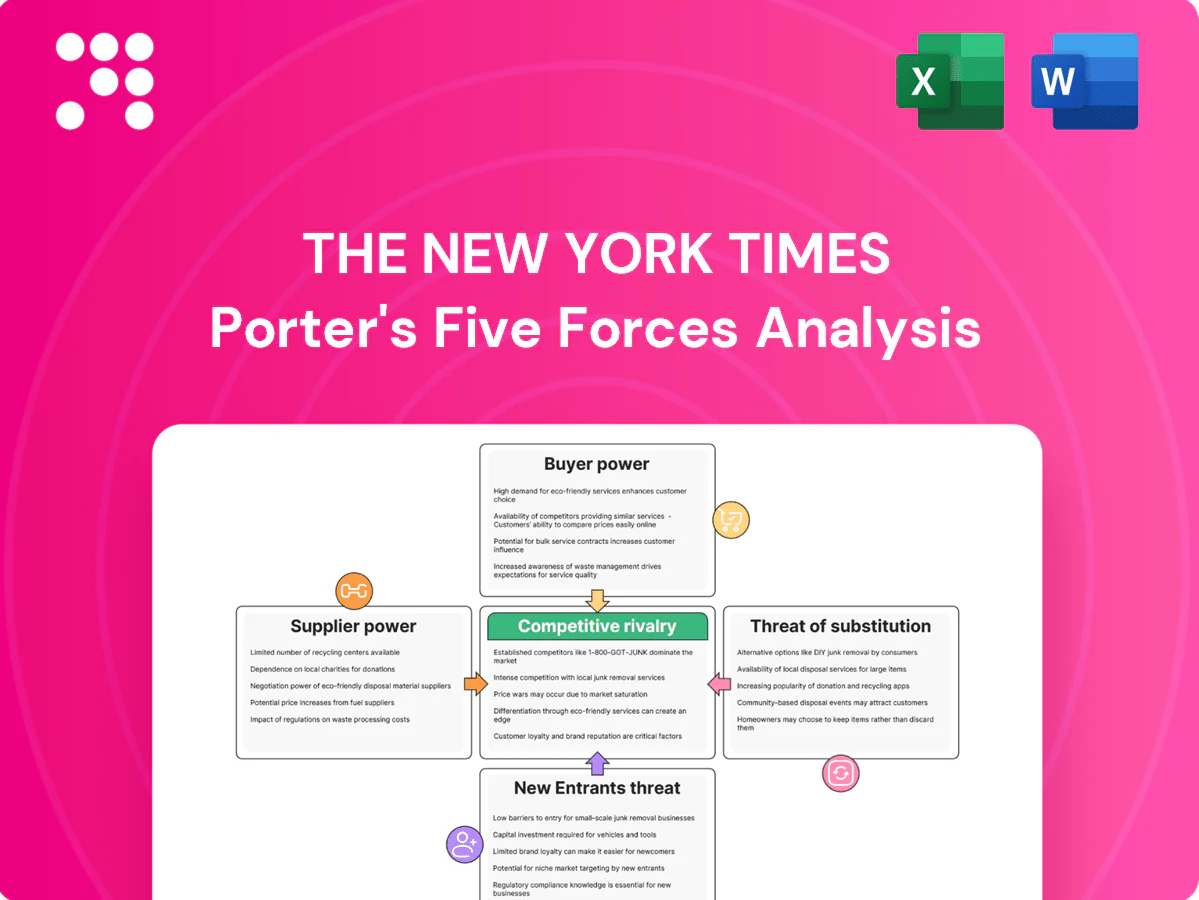
The New York Times Porter's Five Forces Analysis

Don't Miss the Bigger Picture
The New York Times faces intense digital competition, shifting advertiser dynamics, strong subscriber bargaining power, and growing substitute news sources that pressure margins and growth; its premium brand and scale are key defenses. This brief snapshot only scratches the surface. Unlock the full Porter's Five Forces Analysis to explore The New York Times’s competitive dynamics, market pressures, and strategic advantages in detail.
Suppliers Bargaining Power

Star journalist leverage
High-profile reporters, editors and podcast hosts at The New York Times can command premium pay—often reaching seven-figure packages for marquee talent—giving them leverage over the paper. Their personal brands materially affect subscriber acquisition and retention amid roughly 10 million paid subscribers in 2024, creating dependency. Contract talks and union dynamics have raised newsroom costs and limited flexibility, and losing marquee talent risks measurable audience churn and content dilution.
Printing and distribution vendors
Printing and distribution vendors hold strong leverage over NYT: specialized presses, newsprint mills and last‑mile carriers offer few alternatives, raising switching costs through long‑term contracts and capacity constraints. Input cost volatility in paper and fuel can compress margins and force price hikes; supply tightness and price spikes have been material since 2021. Declining print volumes and NYT's shift toward roughly 11 million total subscribers in 2024 weaken its bargaining position.

Tech stack and platform reliance
Cloud, CDN, analytics, paywall and ad-tech vendors are core to digital delivery, creating dependency for The New York Times. Hyperscalers remain concentrated — Synergy Research 2024: AWS ~32%, Azure ~23%, Google Cloud ~11% — while eMarketer 2024 shows Google and Meta control ~50%+ of US digital ad spend, elevating supplier leverage. Flexera 2024 finds 92% of enterprises use multi-cloud, making interoperability and migration costly and switching barriers high, and platform policy shifts can instantly alter traffic and monetization.

Wire services and content licensing
Wire agencies (AP, Reuters), photo libraries and data vendors supply timely text, images and feeds that extend The New York Times’ original reporting; exclusive or premium feeds concentrate dependence during major news events and breaking cycles. License fees and usage restrictions can be material in aggregate, and loss of access would noticeably impair the paper’s breadth and speed—important for a publisher serving over 10 million subscribers in 2024.
- Agencies: AP, Reuters — core real-time text and images
- Costs: aggregate license fees can be material to newsroom ops
- Risk: exclusive feeds heighten reliance during major cycles
- Impact: loss of access reduces coverage breadth and speed
Audio production and studio partners
Podcast success depends on producers, studios and distribution platforms that control production quality, placement and monetization; talent profit-sharing deals commonly claim 20–50% of ad revenue and platform placement or exclusivity can carry seven-figure guarantees in headline shows. Fragmented measurement raises bargaining frictions, while algorithm shifts compress discovery and can swing CPMs by 20–30%, amplifying supplier influence.
- Talent splits: 20–50%
- Top platforms control ~70%+ downloads
- CPM volatility: ±20–30%
Seven-figure talent costs, 11M subs and hyperscaler lock-in constrain bargaining power
High-profile journalists command seven-figure pay, creating leverage given ~11M subscribers in 2024. Printing, wire services and hyperscalers (AWS 32%, Azure 23%, GCP 11% in 2024) concentrate supplier power and raise switching costs. Podcast/platform splits 20–50% and ad concentration (Google+Meta >50% US spend) further constrain NYT bargaining.
| Supplier | 2024 stat | Impact |
|---|---|---|
| Talent | 7‑figure deals | High churn risk |
| Hyperscalers | AWS32%/AZ23%/GCP11% | Switch costs |
| Ads/Pods | Google+Meta>50% / splits20–50% | Revenue pressure |
What is included in the product
 Detailed Word Document
Comprehensive Porter’s Five Forces assessment of The New York Times uncovering competitive drivers, buyer/supplier power, substitute threats and entry barriers, highlighting disruptive digital entrants and advertising shifts that impact pricing, market share and profitability.

 Customizable Excel Spreadsheet
A concise, one-sheet Porter's Five Forces for The New York Times—instantly highlights competitive pressures and strategic levers so executives and analysts can make faster editorial and business decisions.
Customers Bargaining Power

Low switching costs for readers
Low switching costs let digital readers cancel and move to rivals or free sources with minimal friction; The New York Times faced roughly 10.9 million paid subscribers in 2024, but industry monthly churn near 1–2% amplifies revenue volatility. Promotional bundles and aggressive trialing across publishers intensify churn risk, while paywall circumvention and aggregators erode pricing leverage. NYT must continuously justify value through exclusives, podcasts and differentiated products to sustain ARPU.
Advertiser optionality
Brands in 2024 shifted budgets fluidly across social, search, programmatic, CTV and influencer channels, with social plus search capturing roughly 70% of digital ad spend, shrinking the distinctiveness of NYT inventory outside premium contexts. Brand-safety and contextual quality support higher CPMs, but CPMs face downward pressure in downturns (swinging ~10% or more). Large buyers use volume to secure materially better rates.

Institutional and education accounts
Libraries, universities, and enterprises negotiate multi-seat licenses that often span dozens to thousands of seats, giving institutional buyers strong bargaining leverage. Volume-based pricing and renewal cycles produce lumpy revenue and entrenched discount expectations for The New York Times, which had over 10 million subscribers by 2024. Competitive bids from alternatives and aggregator deals further amplify buyer power. Demonstrable engagement metrics and learning/outcome proofs are pivotal in closing and renewing large institutional contracts.

Bundle-savvy consumers
Bundle-savvy consumers compare NYT against Big Tech and telco bundles as the publisher pushes multi-product bundles (News, Games, Cooking, Wirecutter) that the company says helped reach roughly 9.6 million paid subscriptions by 2024, lowering churn but complicating pricing and metrics. Customers demand ongoing feature expansion at flat or lower prices, and observed elasticity constraints force cautious list-price moves to avoid subscriber loss.
- Compare: Big Tech/telco bundles
- 9.6M paid subs (2024)
- Bundles cut churn, add pricing complexity
- Elasticity limits price increases
Global audience heterogeneity
International users show varied price sensitivity and payment norms, forcing The New York Times to tailor regional pricing and payment methods; the publisher reported about 10.9 million total subscriptions in 2024, highlighting growth but uneven regional ARPU. Currency volatility and local competitors (including state-supported outlets) compress perceived value and willingness to pay, raising localization and compliance costs. In markets with free or state-funded news, conversion rates to paid subs lag significantly.
- Price sensitivity: high in emerging markets
- Currency risk: impacts ARPU and revenue recognition
- Localization cost: increases operating margin pressure
- Free/state news: lowers conversion to paid subscriptions
Low switching, 1–2% monthly churn and global price pressure squeeze publishers' ARPU
Low switching costs let readers churn to rivals or free sources; NYT had ~10.9M paid subscribers in 2024, but 1–2% monthly churn raises revenue volatility. Institutional and bundle buyers wield strong leverage, pressuring discounts and CPMs. Global price sensitivity and currency risk compress ARPU, forcing localized pricing and product differentiation.
| Metric | 2024 |
|---|---|
| Paid subs | 10.9M |
| Monthly churn | 1–2% |
| Share of ad spend (social+search) | ~70% |
Preview the Actual Deliverable
The New York Times Porter's Five Forces Analysis
This preview shows the exact New York Times Porter's Five Forces analysis you'll receive immediately after purchase—no placeholders or mockups. The document displayed is fully formatted and ready to download and use the moment you buy. You're getting the final, complete deliverable with no surprises.

Don't Miss the Bigger Picture
The New York Times faces intense digital competition, shifting advertiser dynamics, strong subscriber bargaining power, and growing substitute news sources that pressure margins and growth; its premium brand and scale are key defenses. This brief snapshot only scratches the surface. Unlock the full Porter's Five Forces Analysis to explore The New York Times’s competitive dynamics, market pressures, and strategic advantages in detail.
Suppliers Bargaining Power
Star journalist leverage
High-profile reporters, editors and podcast hosts at The New York Times can command premium pay—often reaching seven-figure packages for marquee talent—giving them leverage over the paper. Their personal brands materially affect subscriber acquisition and retention amid roughly 10 million paid subscribers in 2024, creating dependency. Contract talks and union dynamics have raised newsroom costs and limited flexibility, and losing marquee talent risks measurable audience churn and content dilution.
Printing and distribution vendors
Printing and distribution vendors hold strong leverage over NYT: specialized presses, newsprint mills and last‑mile carriers offer few alternatives, raising switching costs through long‑term contracts and capacity constraints. Input cost volatility in paper and fuel can compress margins and force price hikes; supply tightness and price spikes have been material since 2021. Declining print volumes and NYT's shift toward roughly 11 million total subscribers in 2024 weaken its bargaining position.
Tech stack and platform reliance
Cloud, CDN, analytics, paywall and ad-tech vendors are core to digital delivery, creating dependency for The New York Times. Hyperscalers remain concentrated — Synergy Research 2024: AWS ~32%, Azure ~23%, Google Cloud ~11% — while eMarketer 2024 shows Google and Meta control ~50%+ of US digital ad spend, elevating supplier leverage. Flexera 2024 finds 92% of enterprises use multi-cloud, making interoperability and migration costly and switching barriers high, and platform policy shifts can instantly alter traffic and monetization.
Wire services and content licensing
Wire agencies (AP, Reuters), photo libraries and data vendors supply timely text, images and feeds that extend The New York Times’ original reporting; exclusive or premium feeds concentrate dependence during major news events and breaking cycles. License fees and usage restrictions can be material in aggregate, and loss of access would noticeably impair the paper’s breadth and speed—important for a publisher serving over 10 million subscribers in 2024.
- Agencies: AP, Reuters — core real-time text and images
- Costs: aggregate license fees can be material to newsroom ops
- Risk: exclusive feeds heighten reliance during major cycles
- Impact: loss of access reduces coverage breadth and speed
Audio production and studio partners
Podcast success depends on producers, studios and distribution platforms that control production quality, placement and monetization; talent profit-sharing deals commonly claim 20–50% of ad revenue and platform placement or exclusivity can carry seven-figure guarantees in headline shows. Fragmented measurement raises bargaining frictions, while algorithm shifts compress discovery and can swing CPMs by 20–30%, amplifying supplier influence.
- Talent splits: 20–50%
- Top platforms control ~70%+ downloads
- CPM volatility: ±20–30%
Seven-figure talent costs, 11M subs and hyperscaler lock-in constrain bargaining power
High-profile journalists command seven-figure pay, creating leverage given ~11M subscribers in 2024. Printing, wire services and hyperscalers (AWS 32%, Azure 23%, GCP 11% in 2024) concentrate supplier power and raise switching costs. Podcast/platform splits 20–50% and ad concentration (Google+Meta >50% US spend) further constrain NYT bargaining.
| Supplier | 2024 stat | Impact |
|---|---|---|
| Talent | 7‑figure deals | High churn risk |
| Hyperscalers | AWS32%/AZ23%/GCP11% | Switch costs |
| Ads/Pods | Google+Meta>50% / splits20–50% | Revenue pressure |
What is included in the product
Detailed Word Document
Comprehensive Porter’s Five Forces assessment of The New York Times uncovering competitive drivers, buyer/supplier power, substitute threats and entry barriers, highlighting disruptive digital entrants and advertising shifts that impact pricing, market share and profitability.
Customizable Excel Spreadsheet
A concise, one-sheet Porter's Five Forces for The New York Times—instantly highlights competitive pressures and strategic levers so executives and analysts can make faster editorial and business decisions.
Customers Bargaining Power
Low switching costs for readers
Low switching costs let digital readers cancel and move to rivals or free sources with minimal friction; The New York Times faced roughly 10.9 million paid subscribers in 2024, but industry monthly churn near 1–2% amplifies revenue volatility. Promotional bundles and aggressive trialing across publishers intensify churn risk, while paywall circumvention and aggregators erode pricing leverage. NYT must continuously justify value through exclusives, podcasts and differentiated products to sustain ARPU.
Advertiser optionality
Brands in 2024 shifted budgets fluidly across social, search, programmatic, CTV and influencer channels, with social plus search capturing roughly 70% of digital ad spend, shrinking the distinctiveness of NYT inventory outside premium contexts. Brand-safety and contextual quality support higher CPMs, but CPMs face downward pressure in downturns (swinging ~10% or more). Large buyers use volume to secure materially better rates.
Institutional and education accounts
Libraries, universities, and enterprises negotiate multi-seat licenses that often span dozens to thousands of seats, giving institutional buyers strong bargaining leverage. Volume-based pricing and renewal cycles produce lumpy revenue and entrenched discount expectations for The New York Times, which had over 10 million subscribers by 2024. Competitive bids from alternatives and aggregator deals further amplify buyer power. Demonstrable engagement metrics and learning/outcome proofs are pivotal in closing and renewing large institutional contracts.
Bundle-savvy consumers
Bundle-savvy consumers compare NYT against Big Tech and telco bundles as the publisher pushes multi-product bundles (News, Games, Cooking, Wirecutter) that the company says helped reach roughly 9.6 million paid subscriptions by 2024, lowering churn but complicating pricing and metrics. Customers demand ongoing feature expansion at flat or lower prices, and observed elasticity constraints force cautious list-price moves to avoid subscriber loss.
- Compare: Big Tech/telco bundles
- 9.6M paid subs (2024)
- Bundles cut churn, add pricing complexity
- Elasticity limits price increases
Global audience heterogeneity
International users show varied price sensitivity and payment norms, forcing The New York Times to tailor regional pricing and payment methods; the publisher reported about 10.9 million total subscriptions in 2024, highlighting growth but uneven regional ARPU. Currency volatility and local competitors (including state-supported outlets) compress perceived value and willingness to pay, raising localization and compliance costs. In markets with free or state-funded news, conversion rates to paid subs lag significantly.
- Price sensitivity: high in emerging markets
- Currency risk: impacts ARPU and revenue recognition
- Localization cost: increases operating margin pressure
- Free/state news: lowers conversion to paid subscriptions
Low switching, 1–2% monthly churn and global price pressure squeeze publishers' ARPU
Low switching costs let readers churn to rivals or free sources; NYT had ~10.9M paid subscribers in 2024, but 1–2% monthly churn raises revenue volatility. Institutional and bundle buyers wield strong leverage, pressuring discounts and CPMs. Global price sensitivity and currency risk compress ARPU, forcing localized pricing and product differentiation.
| Metric | 2024 |
|---|---|
| Paid subs | 10.9M |
| Monthly churn | 1–2% |
| Share of ad spend (social+search) | ~70% |
Preview the Actual Deliverable
The New York Times Porter's Five Forces Analysis
This preview shows the exact New York Times Porter's Five Forces analysis you'll receive immediately after purchase—no placeholders or mockups. The document displayed is fully formatted and ready to download and use the moment you buy. You're getting the final, complete deliverable with no surprises.
Original: $10.00
-65%$10.00
$3.50Description
Don't Miss the Bigger Picture
The New York Times faces intense digital competition, shifting advertiser dynamics, strong subscriber bargaining power, and growing substitute news sources that pressure margins and growth; its premium brand and scale are key defenses. This brief snapshot only scratches the surface. Unlock the full Porter's Five Forces Analysis to explore The New York Times’s competitive dynamics, market pressures, and strategic advantages in detail.
Suppliers Bargaining Power
Star journalist leverage
High-profile reporters, editors and podcast hosts at The New York Times can command premium pay—often reaching seven-figure packages for marquee talent—giving them leverage over the paper. Their personal brands materially affect subscriber acquisition and retention amid roughly 10 million paid subscribers in 2024, creating dependency. Contract talks and union dynamics have raised newsroom costs and limited flexibility, and losing marquee talent risks measurable audience churn and content dilution.
Printing and distribution vendors
Printing and distribution vendors hold strong leverage over NYT: specialized presses, newsprint mills and last‑mile carriers offer few alternatives, raising switching costs through long‑term contracts and capacity constraints. Input cost volatility in paper and fuel can compress margins and force price hikes; supply tightness and price spikes have been material since 2021. Declining print volumes and NYT's shift toward roughly 11 million total subscribers in 2024 weaken its bargaining position.
Tech stack and platform reliance
Cloud, CDN, analytics, paywall and ad-tech vendors are core to digital delivery, creating dependency for The New York Times. Hyperscalers remain concentrated — Synergy Research 2024: AWS ~32%, Azure ~23%, Google Cloud ~11% — while eMarketer 2024 shows Google and Meta control ~50%+ of US digital ad spend, elevating supplier leverage. Flexera 2024 finds 92% of enterprises use multi-cloud, making interoperability and migration costly and switching barriers high, and platform policy shifts can instantly alter traffic and monetization.
Wire services and content licensing
Wire agencies (AP, Reuters), photo libraries and data vendors supply timely text, images and feeds that extend The New York Times’ original reporting; exclusive or premium feeds concentrate dependence during major news events and breaking cycles. License fees and usage restrictions can be material in aggregate, and loss of access would noticeably impair the paper’s breadth and speed—important for a publisher serving over 10 million subscribers in 2024.
- Agencies: AP, Reuters — core real-time text and images
- Costs: aggregate license fees can be material to newsroom ops
- Risk: exclusive feeds heighten reliance during major cycles
- Impact: loss of access reduces coverage breadth and speed
Audio production and studio partners
Podcast success depends on producers, studios and distribution platforms that control production quality, placement and monetization; talent profit-sharing deals commonly claim 20–50% of ad revenue and platform placement or exclusivity can carry seven-figure guarantees in headline shows. Fragmented measurement raises bargaining frictions, while algorithm shifts compress discovery and can swing CPMs by 20–30%, amplifying supplier influence.
- Talent splits: 20–50%
- Top platforms control ~70%+ downloads
- CPM volatility: ±20–30%
Seven-figure talent costs, 11M subs and hyperscaler lock-in constrain bargaining power
High-profile journalists command seven-figure pay, creating leverage given ~11M subscribers in 2024. Printing, wire services and hyperscalers (AWS 32%, Azure 23%, GCP 11% in 2024) concentrate supplier power and raise switching costs. Podcast/platform splits 20–50% and ad concentration (Google+Meta >50% US spend) further constrain NYT bargaining.
| Supplier | 2024 stat | Impact |
|---|---|---|
| Talent | 7‑figure deals | High churn risk |
| Hyperscalers | AWS32%/AZ23%/GCP11% | Switch costs |
| Ads/Pods | Google+Meta>50% / splits20–50% | Revenue pressure |
What is included in the product
Detailed Word Document
Comprehensive Porter’s Five Forces assessment of The New York Times uncovering competitive drivers, buyer/supplier power, substitute threats and entry barriers, highlighting disruptive digital entrants and advertising shifts that impact pricing, market share and profitability.
Customizable Excel Spreadsheet
A concise, one-sheet Porter's Five Forces for The New York Times—instantly highlights competitive pressures and strategic levers so executives and analysts can make faster editorial and business decisions.
Customers Bargaining Power
Low switching costs for readers
Low switching costs let digital readers cancel and move to rivals or free sources with minimal friction; The New York Times faced roughly 10.9 million paid subscribers in 2024, but industry monthly churn near 1–2% amplifies revenue volatility. Promotional bundles and aggressive trialing across publishers intensify churn risk, while paywall circumvention and aggregators erode pricing leverage. NYT must continuously justify value through exclusives, podcasts and differentiated products to sustain ARPU.
Advertiser optionality
Brands in 2024 shifted budgets fluidly across social, search, programmatic, CTV and influencer channels, with social plus search capturing roughly 70% of digital ad spend, shrinking the distinctiveness of NYT inventory outside premium contexts. Brand-safety and contextual quality support higher CPMs, but CPMs face downward pressure in downturns (swinging ~10% or more). Large buyers use volume to secure materially better rates.
Institutional and education accounts
Libraries, universities, and enterprises negotiate multi-seat licenses that often span dozens to thousands of seats, giving institutional buyers strong bargaining leverage. Volume-based pricing and renewal cycles produce lumpy revenue and entrenched discount expectations for The New York Times, which had over 10 million subscribers by 2024. Competitive bids from alternatives and aggregator deals further amplify buyer power. Demonstrable engagement metrics and learning/outcome proofs are pivotal in closing and renewing large institutional contracts.
Bundle-savvy consumers
Bundle-savvy consumers compare NYT against Big Tech and telco bundles as the publisher pushes multi-product bundles (News, Games, Cooking, Wirecutter) that the company says helped reach roughly 9.6 million paid subscriptions by 2024, lowering churn but complicating pricing and metrics. Customers demand ongoing feature expansion at flat or lower prices, and observed elasticity constraints force cautious list-price moves to avoid subscriber loss.
- Compare: Big Tech/telco bundles
- 9.6M paid subs (2024)
- Bundles cut churn, add pricing complexity
- Elasticity limits price increases
Global audience heterogeneity
International users show varied price sensitivity and payment norms, forcing The New York Times to tailor regional pricing and payment methods; the publisher reported about 10.9 million total subscriptions in 2024, highlighting growth but uneven regional ARPU. Currency volatility and local competitors (including state-supported outlets) compress perceived value and willingness to pay, raising localization and compliance costs. In markets with free or state-funded news, conversion rates to paid subs lag significantly.
- Price sensitivity: high in emerging markets
- Currency risk: impacts ARPU and revenue recognition
- Localization cost: increases operating margin pressure
- Free/state news: lowers conversion to paid subscriptions
Low switching, 1–2% monthly churn and global price pressure squeeze publishers' ARPU
Low switching costs let readers churn to rivals or free sources; NYT had ~10.9M paid subscribers in 2024, but 1–2% monthly churn raises revenue volatility. Institutional and bundle buyers wield strong leverage, pressuring discounts and CPMs. Global price sensitivity and currency risk compress ARPU, forcing localized pricing and product differentiation.
| Metric | 2024 |
|---|---|
| Paid subs | 10.9M |
| Monthly churn | 1–2% |
| Share of ad spend (social+search) | ~70% |
Preview the Actual Deliverable
The New York Times Porter's Five Forces Analysis
This preview shows the exact New York Times Porter's Five Forces analysis you'll receive immediately after purchase—no placeholders or mockups. The document displayed is fully formatted and ready to download and use the moment you buy. You're getting the final, complete deliverable with no surprises.











