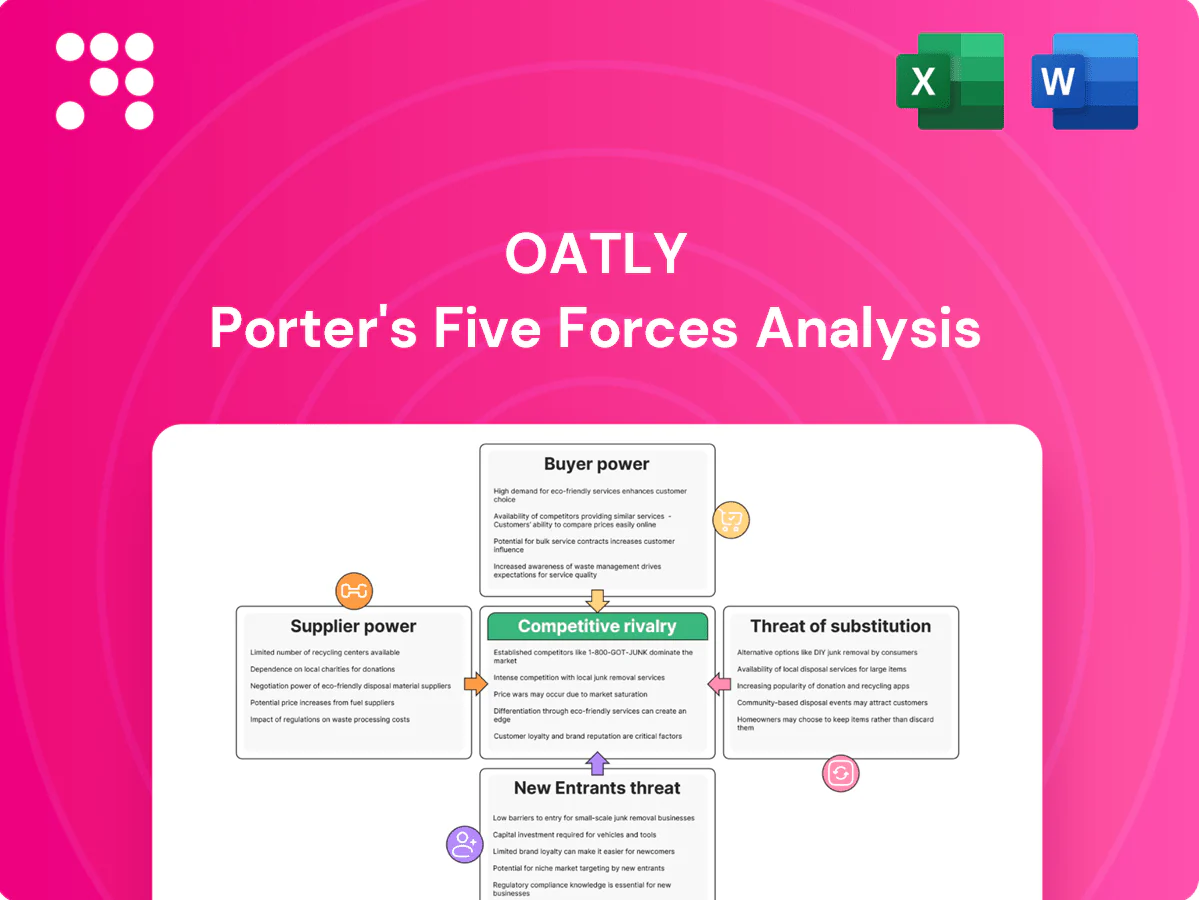
Oatly Porter's Five Forces Analysis

From Overview to Strategy Blueprint
Oatly faces intense rivalry from established dairy and plant-based brands, high substitute threat from alternative milks, moderate new entrant risk, constrained supplier power due to commodity oats, and mixed buyer leverage from retailers versus loyal consumers. This preview is just the beginning. The full analysis provides a complete strategic snapshot with force-by-force ratings, visuals, and business implications tailored to Oatly.
Suppliers Bargaining Power

Concentrated oat sourcing
Concentrated oat sourcing means food-grade oats meeting protein and beta-glucan specs come from a limited subset of growers and regions, and weather variability plus crop rotation cycles can sharply tighten supply; global oat production was about 23 million tonnes in 2022 (FAO), highlighting a finite raw base. This concentration elevates price volatility and gives leverage to qualified growers, which Oatly tempers with multi-year contracts and agronomy programs to stabilize volumes and quality.
Co-packers and aseptic capacity
Oatly depends on specialized aseptic processing and filling lines with regional capacity often >80% utilization, giving co-packers leverage to raise prices and prioritize slots during peaks. Lead times for adding new aseptic lines typically run 12–18 months, reinforcing supplier power. Co-packer premiums and slot constraints can dent margins against Oatly’s 2023 revenue of about $1.16 billion. Vertical integration and multi-sourcing reduce this exposure.

Specialty inputs and enzymes
Key enzymes, stabilizers and flavors for Oatly are concentrated among a handful of global suppliers, with the global industrial enzymes market valued at about $10.1 billion in 2024, giving suppliers leverage. Switching formulas risks noticeable taste and texture shifts, creating implicit switching costs and opening room for supplier-driven minimum order quantities and price escalators. Oatly's dual-qualification of vendors and in-house R&D mitigate dependency and pressure.

Packaging materials volatility
Packaging inputs such as Tetra Pak-style cartons, caps and films are produced by a concentrated supplier set (roughly 3–5 global leaders), making Oatly exposed to energy-sensitive resin and paper pulp price swings that typically pass directly into COGS. Few qualified converters raise supplier clout, while long-term supply agreements and recycled-content programs act as primary hedges against volatility.
- Concentration: 3–5 major suppliers
- Cost pass-through: resin/pulp -> COGS
- Mitigants: long-term contracts
- Mitigants: recycled-content programs
Logistics and commodity inflation
- Freight: container rates normalized by 2024, but spikes persist
- Energy: Brent ~85 USD/bbl in 2024
- Exposure: operations in 20+ markets
- Mitigants: FX hedging and regional production
Supplier power moderate-high: tight oats, packaging concentration and enzyme costs squeeze margins
Supplier power is moderate‑high: limited oat supply (23M t global 2022), concentrated packaging (3–5 global leaders) and specialty enzymes (~$10.1B market 2024) raise price/availability risk; co‑packer capacity >80% utilization and 12–18 month lead times amplify leverage versus Oatly (2023 revenue ~$1.16B). Hedging, multi‑sourcing, long‑term contracts and regional production mitigate exposure.
| Category | Concentration | Key metric | Mitigant |
|---|---|---|---|
| Oats | Regional | 23M t (2022) | Farmer programs |
| Packaging | 3–5 | High | Long contracts |
What is included in the product
 Detailed Word Document
Tailored Porter's Five Forces analysis for Oatly that uncovers key drivers of competition, customer influence, supplier power, and market entry risks affecting its pricing and profitability. Identifies disruptive substitutes, emerging threats, and strategic defenses incumbents can use—delivered in a fully editable format for reports, investor materials, or strategy decks.

 Customizable Excel Spreadsheet
Clear one-sheet Porter's Five Forces for Oatly that visualizes competitive pressures and actionable relief points—perfect for quick decisions and slide-ready board materials.
Customers Bargaining Power

Retail chains wield scale
Large retail chains control shelf space and promotions—top four US grocers accounted for roughly 55% of grocery sales in 2024—giving them leverage over brands like Oatly. Their scale enables aggressive pricing, slotting fees (commonly $10,000–$250,000 per SKU) and private-label pushes (private label ~18% of US grocery sales in 2024). Delisting risk forces concessions, while joint business planning and promotional funding (typically 2–4% of supplier revenue) partially align incentives.
Foodservice gatekeepers
Cafés and coffee chains, led by operators like Starbucks with ~34,000 stores in 2024, decide which alt-milks are steamed and featured, giving baristas gatekeeper influence over consumer choice. Barista performance is critical, yet switching is easy if taste or price disappoints, pressuring Oatly on quality and margin. Concentrated accounts amplify buyer leverage, while training programs and espresso-equipment partnerships increase stickiness and reduce churn.

Low consumer switching costs
Shoppers can move among oat, almond, soy and private label with minimal friction, and price promotions quickly shift volume—retail scans in 2024 show promo-driven share swings of up to 15% in plant-based milk subcategories. This erodes pricing power for branded SKUs, pressuring margins (Oatly reported roughly $596m revenue in 2023 and continued promotional pressure into 2024). Loyalty is sustained largely via taste, nutrition and sustainability messaging.

Price transparency
Price transparency: highly comparable SKUs and constant promos make price gaps obvious, forcing Oatly to defend margins as shoppers spot cheaper substitutes instantly.
E-commerce amplifies comparison and substitute switching, driving buyers to demand EDLP or promo funding from suppliers to secure shelf and digital placement.
Oatly mitigates through value packs and clear tiering to protect mix and retain premium positioning while supporting retail promo economics.
- SKU parity pressure
- e-commerce comparison
- EDLP/promo demands
- value-packs tiering
Private label alternatives
Retailer and café leverage, private-label pressure force oat-milk makers into premium tactics
Large retailers (top 4 = ~55% US grocery sales in 2024) and cafés (Starbucks ~34,000 stores in 2024) exert strong leverage via slotting fees ($10,000–$250,000/SKU) and placement; private-label penetration (18% grocery; PL oat milk 20–30% cheaper) compresses Oatly margins (revenue ~$596m in 2023). Price transparency and e-commerce amplify switching; Oatly counters with tiering, exclusives and fortification.
| Metric | Value |
|---|---|
| Top‑4 grocers | ~55% (2024) |
| Starbucks stores | ~34,000 (2024) |
| Oatly revenue | $596m (2023) |
| PL price gap | 20–30% lower |
Full Version Awaits
Oatly Porter's Five Forces Analysis
This preview shows the exact Oatly Porter’s Five Forces analysis you’ll receive immediately after purchase—no surprises, no placeholders. It provides a concise assessment of supplier power, buyer power, competitive rivalry, threat of substitutes, and barriers to entry, fully formatted and ready to use. Upon payment you’ll get instant access to this same document for download and application.

From Overview to Strategy Blueprint
Oatly faces intense rivalry from established dairy and plant-based brands, high substitute threat from alternative milks, moderate new entrant risk, constrained supplier power due to commodity oats, and mixed buyer leverage from retailers versus loyal consumers. This preview is just the beginning. The full analysis provides a complete strategic snapshot with force-by-force ratings, visuals, and business implications tailored to Oatly.
Suppliers Bargaining Power
Concentrated oat sourcing
Concentrated oat sourcing means food-grade oats meeting protein and beta-glucan specs come from a limited subset of growers and regions, and weather variability plus crop rotation cycles can sharply tighten supply; global oat production was about 23 million tonnes in 2022 (FAO), highlighting a finite raw base. This concentration elevates price volatility and gives leverage to qualified growers, which Oatly tempers with multi-year contracts and agronomy programs to stabilize volumes and quality.
Co-packers and aseptic capacity
Oatly depends on specialized aseptic processing and filling lines with regional capacity often >80% utilization, giving co-packers leverage to raise prices and prioritize slots during peaks. Lead times for adding new aseptic lines typically run 12–18 months, reinforcing supplier power. Co-packer premiums and slot constraints can dent margins against Oatly’s 2023 revenue of about $1.16 billion. Vertical integration and multi-sourcing reduce this exposure.
Specialty inputs and enzymes
Key enzymes, stabilizers and flavors for Oatly are concentrated among a handful of global suppliers, with the global industrial enzymes market valued at about $10.1 billion in 2024, giving suppliers leverage. Switching formulas risks noticeable taste and texture shifts, creating implicit switching costs and opening room for supplier-driven minimum order quantities and price escalators. Oatly's dual-qualification of vendors and in-house R&D mitigate dependency and pressure.
Packaging materials volatility
Packaging inputs such as Tetra Pak-style cartons, caps and films are produced by a concentrated supplier set (roughly 3–5 global leaders), making Oatly exposed to energy-sensitive resin and paper pulp price swings that typically pass directly into COGS. Few qualified converters raise supplier clout, while long-term supply agreements and recycled-content programs act as primary hedges against volatility.
- Concentration: 3–5 major suppliers
- Cost pass-through: resin/pulp -> COGS
- Mitigants: long-term contracts
- Mitigants: recycled-content programs
Logistics and commodity inflation
- Freight: container rates normalized by 2024, but spikes persist
- Energy: Brent ~85 USD/bbl in 2024
- Exposure: operations in 20+ markets
- Mitigants: FX hedging and regional production
Supplier power moderate-high: tight oats, packaging concentration and enzyme costs squeeze margins
Supplier power is moderate‑high: limited oat supply (23M t global 2022), concentrated packaging (3–5 global leaders) and specialty enzymes (~$10.1B market 2024) raise price/availability risk; co‑packer capacity >80% utilization and 12–18 month lead times amplify leverage versus Oatly (2023 revenue ~$1.16B). Hedging, multi‑sourcing, long‑term contracts and regional production mitigate exposure.
| Category | Concentration | Key metric | Mitigant |
|---|---|---|---|
| Oats | Regional | 23M t (2022) | Farmer programs |
| Packaging | 3–5 | High | Long contracts |
What is included in the product
Detailed Word Document
Tailored Porter's Five Forces analysis for Oatly that uncovers key drivers of competition, customer influence, supplier power, and market entry risks affecting its pricing and profitability. Identifies disruptive substitutes, emerging threats, and strategic defenses incumbents can use—delivered in a fully editable format for reports, investor materials, or strategy decks.
Customizable Excel Spreadsheet
Clear one-sheet Porter's Five Forces for Oatly that visualizes competitive pressures and actionable relief points—perfect for quick decisions and slide-ready board materials.
Customers Bargaining Power
Retail chains wield scale
Large retail chains control shelf space and promotions—top four US grocers accounted for roughly 55% of grocery sales in 2024—giving them leverage over brands like Oatly. Their scale enables aggressive pricing, slotting fees (commonly $10,000–$250,000 per SKU) and private-label pushes (private label ~18% of US grocery sales in 2024). Delisting risk forces concessions, while joint business planning and promotional funding (typically 2–4% of supplier revenue) partially align incentives.
Foodservice gatekeepers
Cafés and coffee chains, led by operators like Starbucks with ~34,000 stores in 2024, decide which alt-milks are steamed and featured, giving baristas gatekeeper influence over consumer choice. Barista performance is critical, yet switching is easy if taste or price disappoints, pressuring Oatly on quality and margin. Concentrated accounts amplify buyer leverage, while training programs and espresso-equipment partnerships increase stickiness and reduce churn.
Low consumer switching costs
Shoppers can move among oat, almond, soy and private label with minimal friction, and price promotions quickly shift volume—retail scans in 2024 show promo-driven share swings of up to 15% in plant-based milk subcategories. This erodes pricing power for branded SKUs, pressuring margins (Oatly reported roughly $596m revenue in 2023 and continued promotional pressure into 2024). Loyalty is sustained largely via taste, nutrition and sustainability messaging.
Price transparency
Price transparency: highly comparable SKUs and constant promos make price gaps obvious, forcing Oatly to defend margins as shoppers spot cheaper substitutes instantly.
E-commerce amplifies comparison and substitute switching, driving buyers to demand EDLP or promo funding from suppliers to secure shelf and digital placement.
Oatly mitigates through value packs and clear tiering to protect mix and retain premium positioning while supporting retail promo economics.
- SKU parity pressure
- e-commerce comparison
- EDLP/promo demands
- value-packs tiering
Private label alternatives
Retailer and café leverage, private-label pressure force oat-milk makers into premium tactics
Large retailers (top 4 = ~55% US grocery sales in 2024) and cafés (Starbucks ~34,000 stores in 2024) exert strong leverage via slotting fees ($10,000–$250,000/SKU) and placement; private-label penetration (18% grocery; PL oat milk 20–30% cheaper) compresses Oatly margins (revenue ~$596m in 2023). Price transparency and e-commerce amplify switching; Oatly counters with tiering, exclusives and fortification.
| Metric | Value |
|---|---|
| Top‑4 grocers | ~55% (2024) |
| Starbucks stores | ~34,000 (2024) |
| Oatly revenue | $596m (2023) |
| PL price gap | 20–30% lower |
Full Version Awaits
Oatly Porter's Five Forces Analysis
This preview shows the exact Oatly Porter’s Five Forces analysis you’ll receive immediately after purchase—no surprises, no placeholders. It provides a concise assessment of supplier power, buyer power, competitive rivalry, threat of substitutes, and barriers to entry, fully formatted and ready to use. Upon payment you’ll get instant access to this same document for download and application.
Original: $10.00
-65%$10.00
$3.50Description
From Overview to Strategy Blueprint
Oatly faces intense rivalry from established dairy and plant-based brands, high substitute threat from alternative milks, moderate new entrant risk, constrained supplier power due to commodity oats, and mixed buyer leverage from retailers versus loyal consumers. This preview is just the beginning. The full analysis provides a complete strategic snapshot with force-by-force ratings, visuals, and business implications tailored to Oatly.
Suppliers Bargaining Power
Concentrated oat sourcing
Concentrated oat sourcing means food-grade oats meeting protein and beta-glucan specs come from a limited subset of growers and regions, and weather variability plus crop rotation cycles can sharply tighten supply; global oat production was about 23 million tonnes in 2022 (FAO), highlighting a finite raw base. This concentration elevates price volatility and gives leverage to qualified growers, which Oatly tempers with multi-year contracts and agronomy programs to stabilize volumes and quality.
Co-packers and aseptic capacity
Oatly depends on specialized aseptic processing and filling lines with regional capacity often >80% utilization, giving co-packers leverage to raise prices and prioritize slots during peaks. Lead times for adding new aseptic lines typically run 12–18 months, reinforcing supplier power. Co-packer premiums and slot constraints can dent margins against Oatly’s 2023 revenue of about $1.16 billion. Vertical integration and multi-sourcing reduce this exposure.
Specialty inputs and enzymes
Key enzymes, stabilizers and flavors for Oatly are concentrated among a handful of global suppliers, with the global industrial enzymes market valued at about $10.1 billion in 2024, giving suppliers leverage. Switching formulas risks noticeable taste and texture shifts, creating implicit switching costs and opening room for supplier-driven minimum order quantities and price escalators. Oatly's dual-qualification of vendors and in-house R&D mitigate dependency and pressure.
Packaging materials volatility
Packaging inputs such as Tetra Pak-style cartons, caps and films are produced by a concentrated supplier set (roughly 3–5 global leaders), making Oatly exposed to energy-sensitive resin and paper pulp price swings that typically pass directly into COGS. Few qualified converters raise supplier clout, while long-term supply agreements and recycled-content programs act as primary hedges against volatility.
- Concentration: 3–5 major suppliers
- Cost pass-through: resin/pulp -> COGS
- Mitigants: long-term contracts
- Mitigants: recycled-content programs
Logistics and commodity inflation
- Freight: container rates normalized by 2024, but spikes persist
- Energy: Brent ~85 USD/bbl in 2024
- Exposure: operations in 20+ markets
- Mitigants: FX hedging and regional production
Supplier power moderate-high: tight oats, packaging concentration and enzyme costs squeeze margins
Supplier power is moderate‑high: limited oat supply (23M t global 2022), concentrated packaging (3–5 global leaders) and specialty enzymes (~$10.1B market 2024) raise price/availability risk; co‑packer capacity >80% utilization and 12–18 month lead times amplify leverage versus Oatly (2023 revenue ~$1.16B). Hedging, multi‑sourcing, long‑term contracts and regional production mitigate exposure.
| Category | Concentration | Key metric | Mitigant |
|---|---|---|---|
| Oats | Regional | 23M t (2022) | Farmer programs |
| Packaging | 3–5 | High | Long contracts |
What is included in the product
Detailed Word Document
Tailored Porter's Five Forces analysis for Oatly that uncovers key drivers of competition, customer influence, supplier power, and market entry risks affecting its pricing and profitability. Identifies disruptive substitutes, emerging threats, and strategic defenses incumbents can use—delivered in a fully editable format for reports, investor materials, or strategy decks.
Customizable Excel Spreadsheet
Clear one-sheet Porter's Five Forces for Oatly that visualizes competitive pressures and actionable relief points—perfect for quick decisions and slide-ready board materials.
Customers Bargaining Power
Retail chains wield scale
Large retail chains control shelf space and promotions—top four US grocers accounted for roughly 55% of grocery sales in 2024—giving them leverage over brands like Oatly. Their scale enables aggressive pricing, slotting fees (commonly $10,000–$250,000 per SKU) and private-label pushes (private label ~18% of US grocery sales in 2024). Delisting risk forces concessions, while joint business planning and promotional funding (typically 2–4% of supplier revenue) partially align incentives.
Foodservice gatekeepers
Cafés and coffee chains, led by operators like Starbucks with ~34,000 stores in 2024, decide which alt-milks are steamed and featured, giving baristas gatekeeper influence over consumer choice. Barista performance is critical, yet switching is easy if taste or price disappoints, pressuring Oatly on quality and margin. Concentrated accounts amplify buyer leverage, while training programs and espresso-equipment partnerships increase stickiness and reduce churn.
Low consumer switching costs
Shoppers can move among oat, almond, soy and private label with minimal friction, and price promotions quickly shift volume—retail scans in 2024 show promo-driven share swings of up to 15% in plant-based milk subcategories. This erodes pricing power for branded SKUs, pressuring margins (Oatly reported roughly $596m revenue in 2023 and continued promotional pressure into 2024). Loyalty is sustained largely via taste, nutrition and sustainability messaging.
Price transparency
Price transparency: highly comparable SKUs and constant promos make price gaps obvious, forcing Oatly to defend margins as shoppers spot cheaper substitutes instantly.
E-commerce amplifies comparison and substitute switching, driving buyers to demand EDLP or promo funding from suppliers to secure shelf and digital placement.
Oatly mitigates through value packs and clear tiering to protect mix and retain premium positioning while supporting retail promo economics.
- SKU parity pressure
- e-commerce comparison
- EDLP/promo demands
- value-packs tiering
Private label alternatives
Retailer and café leverage, private-label pressure force oat-milk makers into premium tactics
Large retailers (top 4 = ~55% US grocery sales in 2024) and cafés (Starbucks ~34,000 stores in 2024) exert strong leverage via slotting fees ($10,000–$250,000/SKU) and placement; private-label penetration (18% grocery; PL oat milk 20–30% cheaper) compresses Oatly margins (revenue ~$596m in 2023). Price transparency and e-commerce amplify switching; Oatly counters with tiering, exclusives and fortification.
| Metric | Value |
|---|---|
| Top‑4 grocers | ~55% (2024) |
| Starbucks stores | ~34,000 (2024) |
| Oatly revenue | $596m (2023) |
| PL price gap | 20–30% lower |
Full Version Awaits
Oatly Porter's Five Forces Analysis
This preview shows the exact Oatly Porter’s Five Forces analysis you’ll receive immediately after purchase—no surprises, no placeholders. It provides a concise assessment of supplier power, buyer power, competitive rivalry, threat of substitutes, and barriers to entry, fully formatted and ready to use. Upon payment you’ll get instant access to this same document for download and application.











