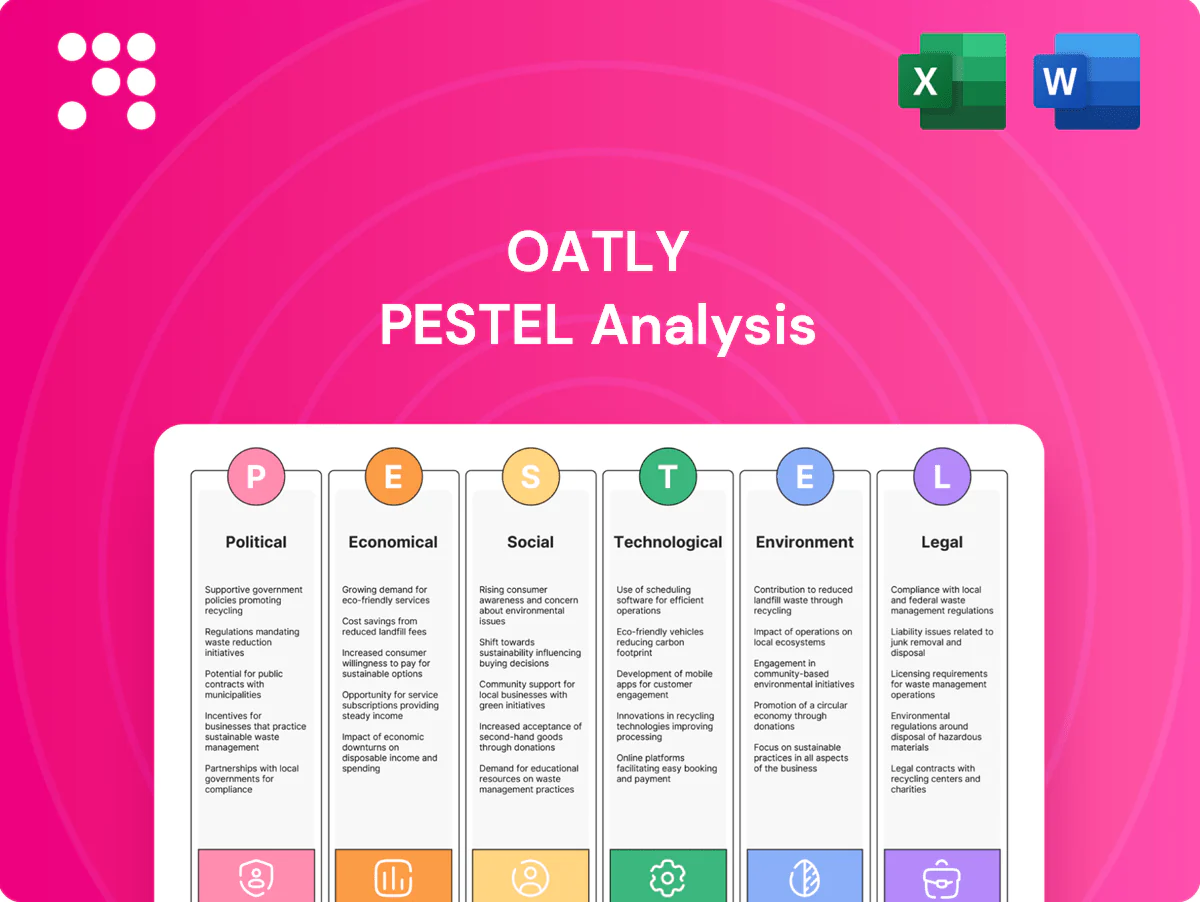
Oatly PESTLE Analysis

Skip the Research. Get the Strategy.
Oatly's PESTLE reveals how regulatory pressure, shifting consumer values, economic volatility and tech-driven supply changes shape its growth prospects. This concise briefing highlights the key risks and opportunities investors and strategists need now. Purchase the full PESTLE for the complete, actionable analysis.
Political factors

Agri subsidies and policy tilt
Government subsidies such as the EU’s CAP (€387bn budget for 2021–27) have historically advantaged dairy and livestock, skewing price parity versus oat-based alternatives. Policy shifts—evidenced by EU Farm to Fork targets and growing 2024 support for sustainable diets—could redirect funds toward plant-based crops. Oatly must engage policymakers and build advocacy coalitions to secure incentives and reduce competitive disadvantages.
Labeling and standards politics
Political debates over use of dairy terms directly affect Oatly’s market access and consumer clarity; the global plant-based milk market reached about $27 billion in 2023 with ~8% CAGR, so labeling disputes matter commercially. National and regional guidelines vary (several EU states impose restrictions), and rules can shift under political pressure. Oatly needs adaptive labeling strategies and proactive lobbying to protect shelf access. Harmonization would lower compliance costs across markets.

Trade tariffs and market access
Tariffs on inputs, packaging or finished goods directly raise landed costs and force price adjustments; in 2024 global average applied tariffs hovered around 3% according to WTO, while specific food and packaging duties can reach double digits. Geopolitical tensions (eg, Russia–Ukraine spillovers in 2024) disrupted Black Sea and rail corridors, complicating cross-border supply of oats and equipment. Localizing production and diversified sourcing across regions reduces exposure to trade shocks and political risk.

Public procurement and nutrition policy
School and institutional meal standards shape plant-based uptake: the US National School Lunch Program served about 29.6 million children daily (FY2023), so inclusion of dairy alternatives in public programs raises baseline demand. Guidelines targeting lower saturated fat and GHGs favor Oatly’s oat-based products, and pilots in hospitals/schools can convert to multi-year procurement contracts.
- Public reach: NSLP ~29.6M/day (FY2023)
- Procurement scale: public food buying can represent ~14% GDP in OECD states
- Policy wins: lower-sat-fat/GHG guidelines increase Oatly demand
- Pilots → long-term contracts
Climate commitments and incentives
National net-zero commitments (over 120 countries targeting net-zero by 2050) are expanding incentives for low-carbon foods; rising carbon prices (EU ETS ~€80–100/t in 2024–25) and green procurement policies favor plant-based categories. Oatly can access climate-focused grants and tax credits (eg, US IRA ~$369bn energy/climate funding) and strengthen eligibility with transparent LCA disclosure.
- Net-zero: >120 countries
- Carbon price: EU ETS ~€80–100/t (2024–25)
- IRA climate funding: ~$369bn
- LCA transparency: improves grant/tender success
EU subsidies, carbon pricing and $27bn plant-based market reshape dairy-to-plant shift
Subsidies like the EU CAP (€387bn 2021–27) have historically tilted prices toward dairy; Farm to Fork and 2024 sustainable diet funding could shift support to crops for Oatly. Labeling and term disputes affect access in key markets while plant-based milk was ~$27bn in 2023. Trade tariffs (~3% avg in 2024) and geopolitical supply shocks raise costs; public procurement (NSLP ~29.6M/day) and carbon pricing (EU ETS €80–100/t 2024–25) create incentives.
| Metric | Value |
|---|---|
| EU CAP | €387bn (2021–27) |
| Plant-based market | $27bn (2023) |
| NSLP | 29.6M/day (FY2023) |
| EU ETS price | €80–100/t (2024–25) |
What is included in the product
 Detailed Word Document
Explores how macro-environmental factors uniquely affect Oatly across Political, Economic, Social, Technological, Environmental and Legal dimensions, with data-backed trends and forward-looking insights tailored to the plant-based dairy sector and regional regulatory dynamics; designed for executives and investors and formatted for immediate inclusion in plans and decks.

 Customizable Excel Spreadsheet
Condensed Oatly PESTLE highlights regulatory shifts, supply-chain risks, and consumer trends in a visually segmented, shareable summary to streamline strategy discussions and presentations.
Economic factors

Input costs and oat markets
Volatility in oat prices driven by weather, yields and competing crop acreage squeezes Oatly margins as raw-oat input remains a major cost driver. Energy and enzyme prices further push COGS, especially during processing-intensive periods. Long-term supply contracts and hedging programs are used to stabilize input costs. Agronomic partnerships with growers enhance yield stability and supply resilience.
Inflation and consumer trade-down
Rising inflation pressured consumers to trade down—US CPI was 3.4% year‑over‑year in Dec 2024—making private‑label gains more likely; premium plant‑based pricing shows clear elasticity and can dent volumes. Oatly must optimize pack sizes and promotional mixes to defend share and improve frequency. Introducing value tiers and larger economy SKUs can capture budget‑conscious shoppers without full price erosion.

Currency and global footprint
FX swings materially affect import costs and reported results; movements like a 10% SEK/USD shift can change consolidated revenue by single-digit percentage points. Oatly's local production in Sweden, the Netherlands, the US and China provides natural hedges that cut import exposure. Pricing must mirror currency realities without diluting premium positioning, while financial hedging (forward contracts, collars) stabilizes 12-month planning.

Category growth and saturation
Plant-based milk growth is moderating in mature markets while expanding in emerging ones; Oatly reported net revenue of about USD 1.05 billion in 2023, underscoring scale but slower unit growth in some regions. Share gains depend on taste, nutrition and wider availability; Oatly can prioritize underpenetrated channels and geographies and expand into adjacent categories to diversify revenue.
- Market: mature vs emerging growth
- Drivers: taste, nutrition, availability
- Strategy: channels & geographies
- Revenue mix: adjacent-category innovation
Retail power and margins
Consolidated retailers and e-commerce platforms exert strong pricing and slotting pressure—top four US grocery chains control roughly 60% of shelf access and Amazon holds about 40% of US e-commerce, compressing Oatly’s trade margins. Promotional intensity drives velocity but erodes profitability; heavy promo weeks materially lower realized margins. Strengthening DTC and foodservice reduces channel dependence, while data-sharing agreements with retailers improve ROI on trade spend through targeted assortment and promo optimization.
- Retail concentration ~60% (top4)
- Amazon e‑commerce share ~40%
- DTC/foodservice diversify margins
- Data-sharing raises trade ROI
EU subsidies, carbon pricing and $27bn plant-based market reshape dairy-to-plant shift
Oat price and energy volatility raise COGS; agronomic contracts and hedges mitigate risk. US CPI 3.4% Dec 2024 pressured premium mix, driving private‑label share. FX swings (eg 10% SEK/USD) affect reported revenue—Oatly net revenue ~USD 1.05bn in 2023. Retail concentration (~60% top4 US; Amazon ~40% e‑commerce) amplifies promo pressure and margin squeeze.
| Metric | Value |
|---|---|
| Oatly revenue (2023) | USD 1.05bn |
| US CPI (Dec 2024) | 3.4% YoY |
| Top4 US grocery share | ~60% |
| Amazon US e‑commerce share | ~40% |
Preview the Actual Deliverable
Oatly PESTLE Analysis
This Oatly PESTLE Analysis preview is the exact document you’ll receive after purchase—fully formatted, professional, and ready to use. The layout, content, and structure shown are identical to the downloadable file, with no placeholders or surprises. Buy confidently and get this finished report instantly.

Skip the Research. Get the Strategy.
Oatly's PESTLE reveals how regulatory pressure, shifting consumer values, economic volatility and tech-driven supply changes shape its growth prospects. This concise briefing highlights the key risks and opportunities investors and strategists need now. Purchase the full PESTLE for the complete, actionable analysis.
Political factors
Agri subsidies and policy tilt
Government subsidies such as the EU’s CAP (€387bn budget for 2021–27) have historically advantaged dairy and livestock, skewing price parity versus oat-based alternatives. Policy shifts—evidenced by EU Farm to Fork targets and growing 2024 support for sustainable diets—could redirect funds toward plant-based crops. Oatly must engage policymakers and build advocacy coalitions to secure incentives and reduce competitive disadvantages.
Labeling and standards politics
Political debates over use of dairy terms directly affect Oatly’s market access and consumer clarity; the global plant-based milk market reached about $27 billion in 2023 with ~8% CAGR, so labeling disputes matter commercially. National and regional guidelines vary (several EU states impose restrictions), and rules can shift under political pressure. Oatly needs adaptive labeling strategies and proactive lobbying to protect shelf access. Harmonization would lower compliance costs across markets.
Trade tariffs and market access
Tariffs on inputs, packaging or finished goods directly raise landed costs and force price adjustments; in 2024 global average applied tariffs hovered around 3% according to WTO, while specific food and packaging duties can reach double digits. Geopolitical tensions (eg, Russia–Ukraine spillovers in 2024) disrupted Black Sea and rail corridors, complicating cross-border supply of oats and equipment. Localizing production and diversified sourcing across regions reduces exposure to trade shocks and political risk.
Public procurement and nutrition policy
School and institutional meal standards shape plant-based uptake: the US National School Lunch Program served about 29.6 million children daily (FY2023), so inclusion of dairy alternatives in public programs raises baseline demand. Guidelines targeting lower saturated fat and GHGs favor Oatly’s oat-based products, and pilots in hospitals/schools can convert to multi-year procurement contracts.
- Public reach: NSLP ~29.6M/day (FY2023)
- Procurement scale: public food buying can represent ~14% GDP in OECD states
- Policy wins: lower-sat-fat/GHG guidelines increase Oatly demand
- Pilots → long-term contracts
Climate commitments and incentives
National net-zero commitments (over 120 countries targeting net-zero by 2050) are expanding incentives for low-carbon foods; rising carbon prices (EU ETS ~€80–100/t in 2024–25) and green procurement policies favor plant-based categories. Oatly can access climate-focused grants and tax credits (eg, US IRA ~$369bn energy/climate funding) and strengthen eligibility with transparent LCA disclosure.
- Net-zero: >120 countries
- Carbon price: EU ETS ~€80–100/t (2024–25)
- IRA climate funding: ~$369bn
- LCA transparency: improves grant/tender success
EU subsidies, carbon pricing and $27bn plant-based market reshape dairy-to-plant shift
Subsidies like the EU CAP (€387bn 2021–27) have historically tilted prices toward dairy; Farm to Fork and 2024 sustainable diet funding could shift support to crops for Oatly. Labeling and term disputes affect access in key markets while plant-based milk was ~$27bn in 2023. Trade tariffs (~3% avg in 2024) and geopolitical supply shocks raise costs; public procurement (NSLP ~29.6M/day) and carbon pricing (EU ETS €80–100/t 2024–25) create incentives.
| Metric | Value |
|---|---|
| EU CAP | €387bn (2021–27) |
| Plant-based market | $27bn (2023) |
| NSLP | 29.6M/day (FY2023) |
| EU ETS price | €80–100/t (2024–25) |
What is included in the product
Detailed Word Document
Explores how macro-environmental factors uniquely affect Oatly across Political, Economic, Social, Technological, Environmental and Legal dimensions, with data-backed trends and forward-looking insights tailored to the plant-based dairy sector and regional regulatory dynamics; designed for executives and investors and formatted for immediate inclusion in plans and decks.
Customizable Excel Spreadsheet
Condensed Oatly PESTLE highlights regulatory shifts, supply-chain risks, and consumer trends in a visually segmented, shareable summary to streamline strategy discussions and presentations.
Economic factors
Input costs and oat markets
Volatility in oat prices driven by weather, yields and competing crop acreage squeezes Oatly margins as raw-oat input remains a major cost driver. Energy and enzyme prices further push COGS, especially during processing-intensive periods. Long-term supply contracts and hedging programs are used to stabilize input costs. Agronomic partnerships with growers enhance yield stability and supply resilience.
Inflation and consumer trade-down
Rising inflation pressured consumers to trade down—US CPI was 3.4% year‑over‑year in Dec 2024—making private‑label gains more likely; premium plant‑based pricing shows clear elasticity and can dent volumes. Oatly must optimize pack sizes and promotional mixes to defend share and improve frequency. Introducing value tiers and larger economy SKUs can capture budget‑conscious shoppers without full price erosion.
Currency and global footprint
FX swings materially affect import costs and reported results; movements like a 10% SEK/USD shift can change consolidated revenue by single-digit percentage points. Oatly's local production in Sweden, the Netherlands, the US and China provides natural hedges that cut import exposure. Pricing must mirror currency realities without diluting premium positioning, while financial hedging (forward contracts, collars) stabilizes 12-month planning.
Category growth and saturation
Plant-based milk growth is moderating in mature markets while expanding in emerging ones; Oatly reported net revenue of about USD 1.05 billion in 2023, underscoring scale but slower unit growth in some regions. Share gains depend on taste, nutrition and wider availability; Oatly can prioritize underpenetrated channels and geographies and expand into adjacent categories to diversify revenue.
- Market: mature vs emerging growth
- Drivers: taste, nutrition, availability
- Strategy: channels & geographies
- Revenue mix: adjacent-category innovation
Retail power and margins
Consolidated retailers and e-commerce platforms exert strong pricing and slotting pressure—top four US grocery chains control roughly 60% of shelf access and Amazon holds about 40% of US e-commerce, compressing Oatly’s trade margins. Promotional intensity drives velocity but erodes profitability; heavy promo weeks materially lower realized margins. Strengthening DTC and foodservice reduces channel dependence, while data-sharing agreements with retailers improve ROI on trade spend through targeted assortment and promo optimization.
- Retail concentration ~60% (top4)
- Amazon e‑commerce share ~40%
- DTC/foodservice diversify margins
- Data-sharing raises trade ROI
EU subsidies, carbon pricing and $27bn plant-based market reshape dairy-to-plant shift
Oat price and energy volatility raise COGS; agronomic contracts and hedges mitigate risk. US CPI 3.4% Dec 2024 pressured premium mix, driving private‑label share. FX swings (eg 10% SEK/USD) affect reported revenue—Oatly net revenue ~USD 1.05bn in 2023. Retail concentration (~60% top4 US; Amazon ~40% e‑commerce) amplifies promo pressure and margin squeeze.
| Metric | Value |
|---|---|
| Oatly revenue (2023) | USD 1.05bn |
| US CPI (Dec 2024) | 3.4% YoY |
| Top4 US grocery share | ~60% |
| Amazon US e‑commerce share | ~40% |
Preview the Actual Deliverable
Oatly PESTLE Analysis
This Oatly PESTLE Analysis preview is the exact document you’ll receive after purchase—fully formatted, professional, and ready to use. The layout, content, and structure shown are identical to the downloadable file, with no placeholders or surprises. Buy confidently and get this finished report instantly.
Description
Skip the Research. Get the Strategy.
Oatly's PESTLE reveals how regulatory pressure, shifting consumer values, economic volatility and tech-driven supply changes shape its growth prospects. This concise briefing highlights the key risks and opportunities investors and strategists need now. Purchase the full PESTLE for the complete, actionable analysis.
Political factors
Agri subsidies and policy tilt
Government subsidies such as the EU’s CAP (€387bn budget for 2021–27) have historically advantaged dairy and livestock, skewing price parity versus oat-based alternatives. Policy shifts—evidenced by EU Farm to Fork targets and growing 2024 support for sustainable diets—could redirect funds toward plant-based crops. Oatly must engage policymakers and build advocacy coalitions to secure incentives and reduce competitive disadvantages.
Labeling and standards politics
Political debates over use of dairy terms directly affect Oatly’s market access and consumer clarity; the global plant-based milk market reached about $27 billion in 2023 with ~8% CAGR, so labeling disputes matter commercially. National and regional guidelines vary (several EU states impose restrictions), and rules can shift under political pressure. Oatly needs adaptive labeling strategies and proactive lobbying to protect shelf access. Harmonization would lower compliance costs across markets.
Trade tariffs and market access
Tariffs on inputs, packaging or finished goods directly raise landed costs and force price adjustments; in 2024 global average applied tariffs hovered around 3% according to WTO, while specific food and packaging duties can reach double digits. Geopolitical tensions (eg, Russia–Ukraine spillovers in 2024) disrupted Black Sea and rail corridors, complicating cross-border supply of oats and equipment. Localizing production and diversified sourcing across regions reduces exposure to trade shocks and political risk.
Public procurement and nutrition policy
School and institutional meal standards shape plant-based uptake: the US National School Lunch Program served about 29.6 million children daily (FY2023), so inclusion of dairy alternatives in public programs raises baseline demand. Guidelines targeting lower saturated fat and GHGs favor Oatly’s oat-based products, and pilots in hospitals/schools can convert to multi-year procurement contracts.
- Public reach: NSLP ~29.6M/day (FY2023)
- Procurement scale: public food buying can represent ~14% GDP in OECD states
- Policy wins: lower-sat-fat/GHG guidelines increase Oatly demand
- Pilots → long-term contracts
Climate commitments and incentives
National net-zero commitments (over 120 countries targeting net-zero by 2050) are expanding incentives for low-carbon foods; rising carbon prices (EU ETS ~€80–100/t in 2024–25) and green procurement policies favor plant-based categories. Oatly can access climate-focused grants and tax credits (eg, US IRA ~$369bn energy/climate funding) and strengthen eligibility with transparent LCA disclosure.
- Net-zero: >120 countries
- Carbon price: EU ETS ~€80–100/t (2024–25)
- IRA climate funding: ~$369bn
- LCA transparency: improves grant/tender success
EU subsidies, carbon pricing and $27bn plant-based market reshape dairy-to-plant shift
Subsidies like the EU CAP (€387bn 2021–27) have historically tilted prices toward dairy; Farm to Fork and 2024 sustainable diet funding could shift support to crops for Oatly. Labeling and term disputes affect access in key markets while plant-based milk was ~$27bn in 2023. Trade tariffs (~3% avg in 2024) and geopolitical supply shocks raise costs; public procurement (NSLP ~29.6M/day) and carbon pricing (EU ETS €80–100/t 2024–25) create incentives.
| Metric | Value |
|---|---|
| EU CAP | €387bn (2021–27) |
| Plant-based market | $27bn (2023) |
| NSLP | 29.6M/day (FY2023) |
| EU ETS price | €80–100/t (2024–25) |
What is included in the product
Detailed Word Document
Explores how macro-environmental factors uniquely affect Oatly across Political, Economic, Social, Technological, Environmental and Legal dimensions, with data-backed trends and forward-looking insights tailored to the plant-based dairy sector and regional regulatory dynamics; designed for executives and investors and formatted for immediate inclusion in plans and decks.
Customizable Excel Spreadsheet
Condensed Oatly PESTLE highlights regulatory shifts, supply-chain risks, and consumer trends in a visually segmented, shareable summary to streamline strategy discussions and presentations.
Economic factors
Input costs and oat markets
Volatility in oat prices driven by weather, yields and competing crop acreage squeezes Oatly margins as raw-oat input remains a major cost driver. Energy and enzyme prices further push COGS, especially during processing-intensive periods. Long-term supply contracts and hedging programs are used to stabilize input costs. Agronomic partnerships with growers enhance yield stability and supply resilience.
Inflation and consumer trade-down
Rising inflation pressured consumers to trade down—US CPI was 3.4% year‑over‑year in Dec 2024—making private‑label gains more likely; premium plant‑based pricing shows clear elasticity and can dent volumes. Oatly must optimize pack sizes and promotional mixes to defend share and improve frequency. Introducing value tiers and larger economy SKUs can capture budget‑conscious shoppers without full price erosion.
Currency and global footprint
FX swings materially affect import costs and reported results; movements like a 10% SEK/USD shift can change consolidated revenue by single-digit percentage points. Oatly's local production in Sweden, the Netherlands, the US and China provides natural hedges that cut import exposure. Pricing must mirror currency realities without diluting premium positioning, while financial hedging (forward contracts, collars) stabilizes 12-month planning.
Category growth and saturation
Plant-based milk growth is moderating in mature markets while expanding in emerging ones; Oatly reported net revenue of about USD 1.05 billion in 2023, underscoring scale but slower unit growth in some regions. Share gains depend on taste, nutrition and wider availability; Oatly can prioritize underpenetrated channels and geographies and expand into adjacent categories to diversify revenue.
- Market: mature vs emerging growth
- Drivers: taste, nutrition, availability
- Strategy: channels & geographies
- Revenue mix: adjacent-category innovation
Retail power and margins
Consolidated retailers and e-commerce platforms exert strong pricing and slotting pressure—top four US grocery chains control roughly 60% of shelf access and Amazon holds about 40% of US e-commerce, compressing Oatly’s trade margins. Promotional intensity drives velocity but erodes profitability; heavy promo weeks materially lower realized margins. Strengthening DTC and foodservice reduces channel dependence, while data-sharing agreements with retailers improve ROI on trade spend through targeted assortment and promo optimization.
- Retail concentration ~60% (top4)
- Amazon e‑commerce share ~40%
- DTC/foodservice diversify margins
- Data-sharing raises trade ROI
EU subsidies, carbon pricing and $27bn plant-based market reshape dairy-to-plant shift
Oat price and energy volatility raise COGS; agronomic contracts and hedges mitigate risk. US CPI 3.4% Dec 2024 pressured premium mix, driving private‑label share. FX swings (eg 10% SEK/USD) affect reported revenue—Oatly net revenue ~USD 1.05bn in 2023. Retail concentration (~60% top4 US; Amazon ~40% e‑commerce) amplifies promo pressure and margin squeeze.
| Metric | Value |
|---|---|
| Oatly revenue (2023) | USD 1.05bn |
| US CPI (Dec 2024) | 3.4% YoY |
| Top4 US grocery share | ~60% |
| Amazon US e‑commerce share | ~40% |
Preview the Actual Deliverable
Oatly PESTLE Analysis
This Oatly PESTLE Analysis preview is the exact document you’ll receive after purchase—fully formatted, professional, and ready to use. The layout, content, and structure shown are identical to the downloadable file, with no placeholders or surprises. Buy confidently and get this finished report instantly.











