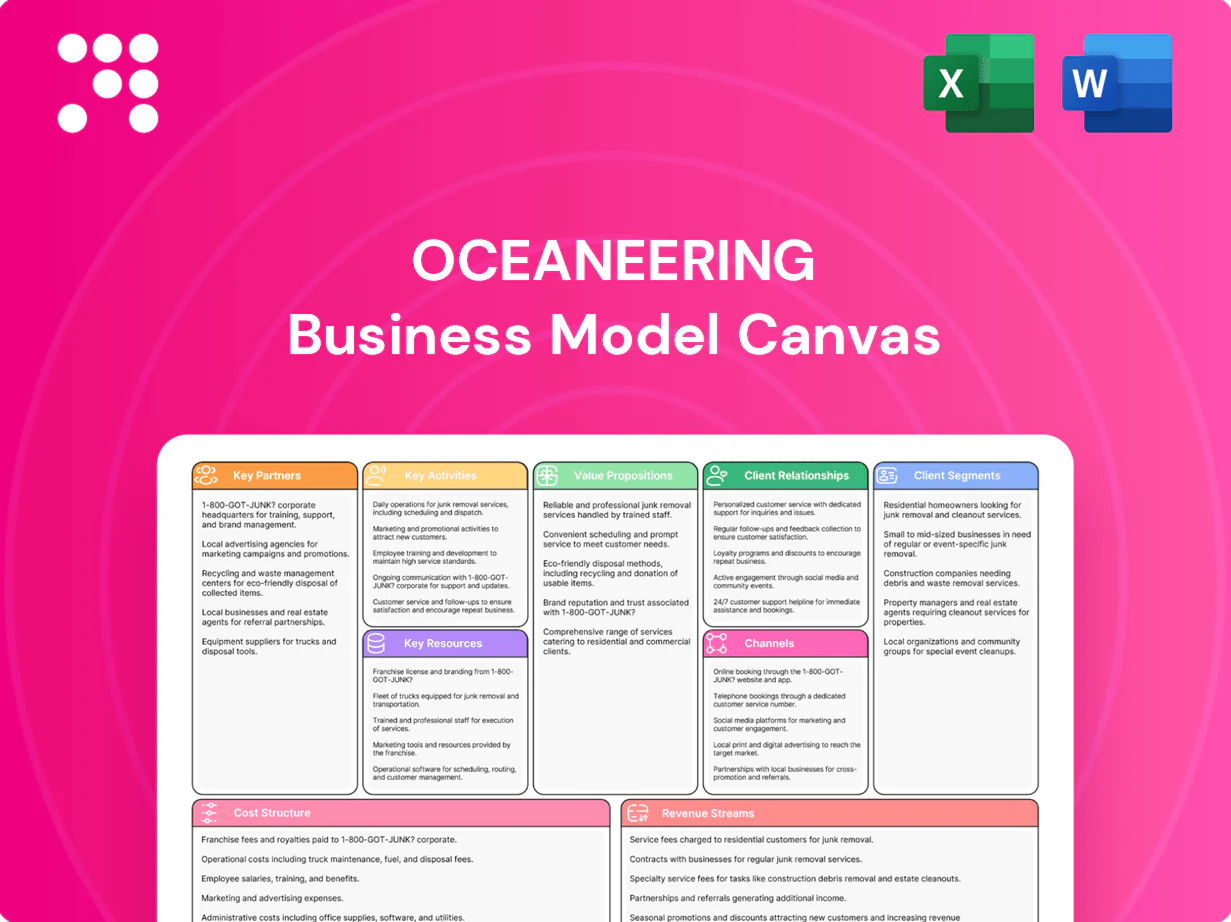
Oceaneering Business Model Canvas

Strategic Business Model Canvas for Subsea Services, Engineered Systems and Robotics
Unlock the full strategic blueprint behind Oceaneering’s Business Model Canvas and discover how it creates value across subsea services, engineered systems, and robotics. This concise, actionable canvas maps customer segments, revenue streams, key partners, and cost drivers. Ideal for investors, consultants, and founders seeking competitive insight. Purchase the full editable Word/Excel canvas to apply these lessons to your strategy.
Partnerships

Energy operators and EPC contractors
Partnering with supermajors, NOCs, independents and EPCs secures multi-year subsea projects (commonly 3–7 years) and locked scopes in 2024 to stabilize backlog and cashflow.
These relationships align engineering scopes, installation windows and risk-sharing models, ensuring ROV availability, umbilical specifications and interface standards are met.
Close joint planning in 2024 reduced downtime and schedule overruns, improving field economics and uptime targets.
Marine vessel owners and shipyards
Alliances with vessel providers and shipyards secure deck space, launch-and-recovery systems and mobilization slots; access to specialized DP vessels—with the global deepwater DP fleet exceeding 200 vessels in 2024—is critical for deepwater campaigns. Shipyard partners enable newbuilds, retrofits and rapid turnarounds, ensuring schedule certainty and operational readiness.

Technology and sensor OEMs
Integrate sonars, manipulators, cameras and autonomy stacks from leading OEMs to deliver certified, plug-and-play offshore systems; as of 2024 IEC 60945 remains the primary marine equipment standard for compatibility and certification. Co-development with OEMs accelerates robotics, inspection and digital workflow innovation and aligns shared roadmaps to keep solutions future-proof. Compatibility and certification materially reduce offshore integration risk and downtime.

Defense and government agencies
Oceaneering partners with defense and government agencies to co-develop mission systems, maritime security solutions and joint research programs, leveraging FY2024 DoD budgets of about 858 billion USD for funding pathways. These partnerships grant access to specialized requirements and security-cleared facilities; joint oversight maintains compliance and clearances while operational feedback drives ruggedization and reliability improvements.
- Co-development of mission systems
- Access to DoD funding pathways (~USD 858B FY2024)
- Joint oversight for compliance and clearances
- Feedback loops improve ruggedization & reliability
Universities and research institutes
Oceaneering partners with universities and research institutes to advance subsea robotics, novel materials, and AI for autonomy, translating lab discoveries into deployable systems; joint labs and internships build a pipeline of specialized talent while structured IP frameworks enable commercialization and licensing of breakthroughs; coordinated field trials validate concepts under real-world ocean conditions to de-risk adoption and accelerate scale-up.
- Joint labs: co-funded research and shared facilities
- Internships: talent pipeline for engineers and data scientists
- IP frameworks: licensing and spin-out pathways
- Field trials: sea trials to validate technology readiness
Alliances secure 3–7yr subsea contracts, DP access and DoD-backed scale-up
Strategic alliances with supermajors, NOCs, independents and EPCs secure multi-year subsea contracts (typically 3–7 years) and stabilize 2024 backlog and cashflow. Vessel and shipyard partners guarantee DP vessel access—global deepwater DP fleet >200 vessels in 2024—for mobilization and uptime. OEM integrations ensure IEC 60945 compliance and reduced offshore integration risk. Defense, academia and OEM co-development taps FY2024 DoD funding (~USD 858B) and accelerates tech scale-up.
| Partnership | 2024 Metric |
|---|---|
| Contract terms | 3–7 yrs |
| Deepwater DP fleet | >200 vessels |
| DoD budget | ~USD 858B |
| Standards | IEC 60945 |
What is included in the product
 Detailed Word Document
A comprehensive Business Model Canvas for Oceaneering outlining customer segments, channels, value propositions, revenue streams, key partners, activities, resources, cost structure and customer relationships with narrative insights and competitive advantages; includes linked SWOT analysis and practical use for presentations, investor discussions and strategic decision-making.

 Customizable Excel Spreadsheet
High-level, editable Business Model Canvas for Oceaneering that condenses complex offshore and subsea capabilities into a one-page snapshot, saving hours of structuring while making strategy shareable and actionable for teams and boardrooms.
Activities

ROV operations and subsea services
Deploy, pilot, and maintain work-class and observation ROV fleets worldwide, supporting IMR, drilling support, and construction assistance with integrated tooling and sensors; Oceaneering reported 2024 revenue of about $1.6 billion, underpinning fleet investments. Standardize procedures to maximize safety, uptime, and data quality, and optimize campaign planning to cut vessel hours and costs by double-digit percentages versus ad hoc operations.
Design and manufacturing of subsea hardware
Oceaneering engineers and fabricates umbilicals, subsea connection systems and specialty tooling, applying DfM and DfR to withstand deepwater depths beyond 1,500–3,000 m and pressures >150–300 bar and aggressive corrosion. Rigorous FAT and SIT protocols are executed before offshore deployment to meet industry reliability targets above 99%. Production is scaled to support major field developments often valued at >$1 billion.

Asset integrity and inspection analytics
Deliver NDT, cathodic protection surveys and structural assessments using advanced sensors and ROVs, feeding high-resolution video and point clouds into AI pipelines for automated anomaly detection. Processed outputs convert directly into prioritized workpacks and retrofit scopes, improving intervention planning; global NDT services market reached about USD 18.3 billion in 2024. Track condition trends via dashboards and KPIs to extend asset life and reduce unplanned downtime.

Robotics and autonomy R&D
Develop manipulation, machine vision, and navigation algorithms focused on resident and uncrewed systems to cut vessel mobilization; integrate digital twins for mission planning and simulation while piloting concepts that reduce offshore crew and transit needs; protect innovations via patents and trade secrets to secure competitive advantage in 2024 markets.
- Develop algorithms
- Pilot resident/uncrewed concepts
- Digital twin integration
- IP protection: patents/trade secrets
Program management and HSE excellence
Coordinate multi-discipline teams across engineering, logistics, and field operations to deliver projects on spec and on time, enforce HSE systems that meet client and regulatory standards, manage schedules, risks, and change orders with rigorous controls, and drive continuous improvement by integrating lessons learned into project cycles.
- Program coordination
- HSE compliance
- Schedule & risk control
- Continuous improvement
Global ROV IMR ops: $1.6B, to 3,000 m, >99% reliability
Operate and maintain global work-class and observation ROV fleets for IMR, drilling support and construction; 2024 revenue ~$1.6B funds fleet and campaign optimization yielding double-digit vessel-hour savings. Engineer umbilicals, subsea connectors and tooling for 1,500–3,000 m depths and >150–300 bar, with FAT/SIT and >99% reliability targets. Deliver NDT, CP and structural surveys feeding AI pipelines; global NDT market ~USD 18.3B in 2024.
| Metric | 2024 |
|---|---|
| Revenue | $1.6B |
| NDT market | $18.3B |
| Design depth | 1,500–3,000 m |
| Reliability target | >99% |
Full Version Awaits
Business Model Canvas
The document you're previewing here is the actual Oceaneering Business Model Canvas you'll receive after purchase; it’s not a mockup. When you complete your order you'll get this same professional, fully editable file—structured and formatted identically—available to download in Word and Excel.

Strategic Business Model Canvas for Subsea Services, Engineered Systems and Robotics
Unlock the full strategic blueprint behind Oceaneering’s Business Model Canvas and discover how it creates value across subsea services, engineered systems, and robotics. This concise, actionable canvas maps customer segments, revenue streams, key partners, and cost drivers. Ideal for investors, consultants, and founders seeking competitive insight. Purchase the full editable Word/Excel canvas to apply these lessons to your strategy.
Partnerships
Energy operators and EPC contractors
Partnering with supermajors, NOCs, independents and EPCs secures multi-year subsea projects (commonly 3–7 years) and locked scopes in 2024 to stabilize backlog and cashflow.
These relationships align engineering scopes, installation windows and risk-sharing models, ensuring ROV availability, umbilical specifications and interface standards are met.
Close joint planning in 2024 reduced downtime and schedule overruns, improving field economics and uptime targets.
Marine vessel owners and shipyards
Alliances with vessel providers and shipyards secure deck space, launch-and-recovery systems and mobilization slots; access to specialized DP vessels—with the global deepwater DP fleet exceeding 200 vessels in 2024—is critical for deepwater campaigns. Shipyard partners enable newbuilds, retrofits and rapid turnarounds, ensuring schedule certainty and operational readiness.
Technology and sensor OEMs
Integrate sonars, manipulators, cameras and autonomy stacks from leading OEMs to deliver certified, plug-and-play offshore systems; as of 2024 IEC 60945 remains the primary marine equipment standard for compatibility and certification. Co-development with OEMs accelerates robotics, inspection and digital workflow innovation and aligns shared roadmaps to keep solutions future-proof. Compatibility and certification materially reduce offshore integration risk and downtime.
Defense and government agencies
Oceaneering partners with defense and government agencies to co-develop mission systems, maritime security solutions and joint research programs, leveraging FY2024 DoD budgets of about 858 billion USD for funding pathways. These partnerships grant access to specialized requirements and security-cleared facilities; joint oversight maintains compliance and clearances while operational feedback drives ruggedization and reliability improvements.
- Co-development of mission systems
- Access to DoD funding pathways (~USD 858B FY2024)
- Joint oversight for compliance and clearances
- Feedback loops improve ruggedization & reliability
Universities and research institutes
Oceaneering partners with universities and research institutes to advance subsea robotics, novel materials, and AI for autonomy, translating lab discoveries into deployable systems; joint labs and internships build a pipeline of specialized talent while structured IP frameworks enable commercialization and licensing of breakthroughs; coordinated field trials validate concepts under real-world ocean conditions to de-risk adoption and accelerate scale-up.
- Joint labs: co-funded research and shared facilities
- Internships: talent pipeline for engineers and data scientists
- IP frameworks: licensing and spin-out pathways
- Field trials: sea trials to validate technology readiness
Alliances secure 3–7yr subsea contracts, DP access and DoD-backed scale-up
Strategic alliances with supermajors, NOCs, independents and EPCs secure multi-year subsea contracts (typically 3–7 years) and stabilize 2024 backlog and cashflow. Vessel and shipyard partners guarantee DP vessel access—global deepwater DP fleet >200 vessels in 2024—for mobilization and uptime. OEM integrations ensure IEC 60945 compliance and reduced offshore integration risk. Defense, academia and OEM co-development taps FY2024 DoD funding (~USD 858B) and accelerates tech scale-up.
| Partnership | 2024 Metric |
|---|---|
| Contract terms | 3–7 yrs |
| Deepwater DP fleet | >200 vessels |
| DoD budget | ~USD 858B |
| Standards | IEC 60945 |
What is included in the product
Detailed Word Document
A comprehensive Business Model Canvas for Oceaneering outlining customer segments, channels, value propositions, revenue streams, key partners, activities, resources, cost structure and customer relationships with narrative insights and competitive advantages; includes linked SWOT analysis and practical use for presentations, investor discussions and strategic decision-making.
Customizable Excel Spreadsheet
High-level, editable Business Model Canvas for Oceaneering that condenses complex offshore and subsea capabilities into a one-page snapshot, saving hours of structuring while making strategy shareable and actionable for teams and boardrooms.
Activities
ROV operations and subsea services
Deploy, pilot, and maintain work-class and observation ROV fleets worldwide, supporting IMR, drilling support, and construction assistance with integrated tooling and sensors; Oceaneering reported 2024 revenue of about $1.6 billion, underpinning fleet investments. Standardize procedures to maximize safety, uptime, and data quality, and optimize campaign planning to cut vessel hours and costs by double-digit percentages versus ad hoc operations.
Design and manufacturing of subsea hardware
Oceaneering engineers and fabricates umbilicals, subsea connection systems and specialty tooling, applying DfM and DfR to withstand deepwater depths beyond 1,500–3,000 m and pressures >150–300 bar and aggressive corrosion. Rigorous FAT and SIT protocols are executed before offshore deployment to meet industry reliability targets above 99%. Production is scaled to support major field developments often valued at >$1 billion.
Asset integrity and inspection analytics
Deliver NDT, cathodic protection surveys and structural assessments using advanced sensors and ROVs, feeding high-resolution video and point clouds into AI pipelines for automated anomaly detection. Processed outputs convert directly into prioritized workpacks and retrofit scopes, improving intervention planning; global NDT services market reached about USD 18.3 billion in 2024. Track condition trends via dashboards and KPIs to extend asset life and reduce unplanned downtime.
Robotics and autonomy R&D
Develop manipulation, machine vision, and navigation algorithms focused on resident and uncrewed systems to cut vessel mobilization; integrate digital twins for mission planning and simulation while piloting concepts that reduce offshore crew and transit needs; protect innovations via patents and trade secrets to secure competitive advantage in 2024 markets.
- Develop algorithms
- Pilot resident/uncrewed concepts
- Digital twin integration
- IP protection: patents/trade secrets
Program management and HSE excellence
Coordinate multi-discipline teams across engineering, logistics, and field operations to deliver projects on spec and on time, enforce HSE systems that meet client and regulatory standards, manage schedules, risks, and change orders with rigorous controls, and drive continuous improvement by integrating lessons learned into project cycles.
- Program coordination
- HSE compliance
- Schedule & risk control
- Continuous improvement
Global ROV IMR ops: $1.6B, to 3,000 m, >99% reliability
Operate and maintain global work-class and observation ROV fleets for IMR, drilling support and construction; 2024 revenue ~$1.6B funds fleet and campaign optimization yielding double-digit vessel-hour savings. Engineer umbilicals, subsea connectors and tooling for 1,500–3,000 m depths and >150–300 bar, with FAT/SIT and >99% reliability targets. Deliver NDT, CP and structural surveys feeding AI pipelines; global NDT market ~USD 18.3B in 2024.
| Metric | 2024 |
|---|---|
| Revenue | $1.6B |
| NDT market | $18.3B |
| Design depth | 1,500–3,000 m |
| Reliability target | >99% |
Full Version Awaits
Business Model Canvas
The document you're previewing here is the actual Oceaneering Business Model Canvas you'll receive after purchase; it’s not a mockup. When you complete your order you'll get this same professional, fully editable file—structured and formatted identically—available to download in Word and Excel.
Original: $10.00
-65%$10.00
$3.50Description
Strategic Business Model Canvas for Subsea Services, Engineered Systems and Robotics
Unlock the full strategic blueprint behind Oceaneering’s Business Model Canvas and discover how it creates value across subsea services, engineered systems, and robotics. This concise, actionable canvas maps customer segments, revenue streams, key partners, and cost drivers. Ideal for investors, consultants, and founders seeking competitive insight. Purchase the full editable Word/Excel canvas to apply these lessons to your strategy.
Partnerships
Energy operators and EPC contractors
Partnering with supermajors, NOCs, independents and EPCs secures multi-year subsea projects (commonly 3–7 years) and locked scopes in 2024 to stabilize backlog and cashflow.
These relationships align engineering scopes, installation windows and risk-sharing models, ensuring ROV availability, umbilical specifications and interface standards are met.
Close joint planning in 2024 reduced downtime and schedule overruns, improving field economics and uptime targets.
Marine vessel owners and shipyards
Alliances with vessel providers and shipyards secure deck space, launch-and-recovery systems and mobilization slots; access to specialized DP vessels—with the global deepwater DP fleet exceeding 200 vessels in 2024—is critical for deepwater campaigns. Shipyard partners enable newbuilds, retrofits and rapid turnarounds, ensuring schedule certainty and operational readiness.
Technology and sensor OEMs
Integrate sonars, manipulators, cameras and autonomy stacks from leading OEMs to deliver certified, plug-and-play offshore systems; as of 2024 IEC 60945 remains the primary marine equipment standard for compatibility and certification. Co-development with OEMs accelerates robotics, inspection and digital workflow innovation and aligns shared roadmaps to keep solutions future-proof. Compatibility and certification materially reduce offshore integration risk and downtime.
Defense and government agencies
Oceaneering partners with defense and government agencies to co-develop mission systems, maritime security solutions and joint research programs, leveraging FY2024 DoD budgets of about 858 billion USD for funding pathways. These partnerships grant access to specialized requirements and security-cleared facilities; joint oversight maintains compliance and clearances while operational feedback drives ruggedization and reliability improvements.
- Co-development of mission systems
- Access to DoD funding pathways (~USD 858B FY2024)
- Joint oversight for compliance and clearances
- Feedback loops improve ruggedization & reliability
Universities and research institutes
Oceaneering partners with universities and research institutes to advance subsea robotics, novel materials, and AI for autonomy, translating lab discoveries into deployable systems; joint labs and internships build a pipeline of specialized talent while structured IP frameworks enable commercialization and licensing of breakthroughs; coordinated field trials validate concepts under real-world ocean conditions to de-risk adoption and accelerate scale-up.
- Joint labs: co-funded research and shared facilities
- Internships: talent pipeline for engineers and data scientists
- IP frameworks: licensing and spin-out pathways
- Field trials: sea trials to validate technology readiness
Alliances secure 3–7yr subsea contracts, DP access and DoD-backed scale-up
Strategic alliances with supermajors, NOCs, independents and EPCs secure multi-year subsea contracts (typically 3–7 years) and stabilize 2024 backlog and cashflow. Vessel and shipyard partners guarantee DP vessel access—global deepwater DP fleet >200 vessels in 2024—for mobilization and uptime. OEM integrations ensure IEC 60945 compliance and reduced offshore integration risk. Defense, academia and OEM co-development taps FY2024 DoD funding (~USD 858B) and accelerates tech scale-up.
| Partnership | 2024 Metric |
|---|---|
| Contract terms | 3–7 yrs |
| Deepwater DP fleet | >200 vessels |
| DoD budget | ~USD 858B |
| Standards | IEC 60945 |
What is included in the product
Detailed Word Document
A comprehensive Business Model Canvas for Oceaneering outlining customer segments, channels, value propositions, revenue streams, key partners, activities, resources, cost structure and customer relationships with narrative insights and competitive advantages; includes linked SWOT analysis and practical use for presentations, investor discussions and strategic decision-making.
Customizable Excel Spreadsheet
High-level, editable Business Model Canvas for Oceaneering that condenses complex offshore and subsea capabilities into a one-page snapshot, saving hours of structuring while making strategy shareable and actionable for teams and boardrooms.
Activities
ROV operations and subsea services
Deploy, pilot, and maintain work-class and observation ROV fleets worldwide, supporting IMR, drilling support, and construction assistance with integrated tooling and sensors; Oceaneering reported 2024 revenue of about $1.6 billion, underpinning fleet investments. Standardize procedures to maximize safety, uptime, and data quality, and optimize campaign planning to cut vessel hours and costs by double-digit percentages versus ad hoc operations.
Design and manufacturing of subsea hardware
Oceaneering engineers and fabricates umbilicals, subsea connection systems and specialty tooling, applying DfM and DfR to withstand deepwater depths beyond 1,500–3,000 m and pressures >150–300 bar and aggressive corrosion. Rigorous FAT and SIT protocols are executed before offshore deployment to meet industry reliability targets above 99%. Production is scaled to support major field developments often valued at >$1 billion.
Asset integrity and inspection analytics
Deliver NDT, cathodic protection surveys and structural assessments using advanced sensors and ROVs, feeding high-resolution video and point clouds into AI pipelines for automated anomaly detection. Processed outputs convert directly into prioritized workpacks and retrofit scopes, improving intervention planning; global NDT services market reached about USD 18.3 billion in 2024. Track condition trends via dashboards and KPIs to extend asset life and reduce unplanned downtime.
Robotics and autonomy R&D
Develop manipulation, machine vision, and navigation algorithms focused on resident and uncrewed systems to cut vessel mobilization; integrate digital twins for mission planning and simulation while piloting concepts that reduce offshore crew and transit needs; protect innovations via patents and trade secrets to secure competitive advantage in 2024 markets.
- Develop algorithms
- Pilot resident/uncrewed concepts
- Digital twin integration
- IP protection: patents/trade secrets
Program management and HSE excellence
Coordinate multi-discipline teams across engineering, logistics, and field operations to deliver projects on spec and on time, enforce HSE systems that meet client and regulatory standards, manage schedules, risks, and change orders with rigorous controls, and drive continuous improvement by integrating lessons learned into project cycles.
- Program coordination
- HSE compliance
- Schedule & risk control
- Continuous improvement
Global ROV IMR ops: $1.6B, to 3,000 m, >99% reliability
Operate and maintain global work-class and observation ROV fleets for IMR, drilling support and construction; 2024 revenue ~$1.6B funds fleet and campaign optimization yielding double-digit vessel-hour savings. Engineer umbilicals, subsea connectors and tooling for 1,500–3,000 m depths and >150–300 bar, with FAT/SIT and >99% reliability targets. Deliver NDT, CP and structural surveys feeding AI pipelines; global NDT market ~USD 18.3B in 2024.
| Metric | 2024 |
|---|---|
| Revenue | $1.6B |
| NDT market | $18.3B |
| Design depth | 1,500–3,000 m |
| Reliability target | >99% |
Full Version Awaits
Business Model Canvas
The document you're previewing here is the actual Oceaneering Business Model Canvas you'll receive after purchase; it’s not a mockup. When you complete your order you'll get this same professional, fully editable file—structured and formatted identically—available to download in Word and Excel.











