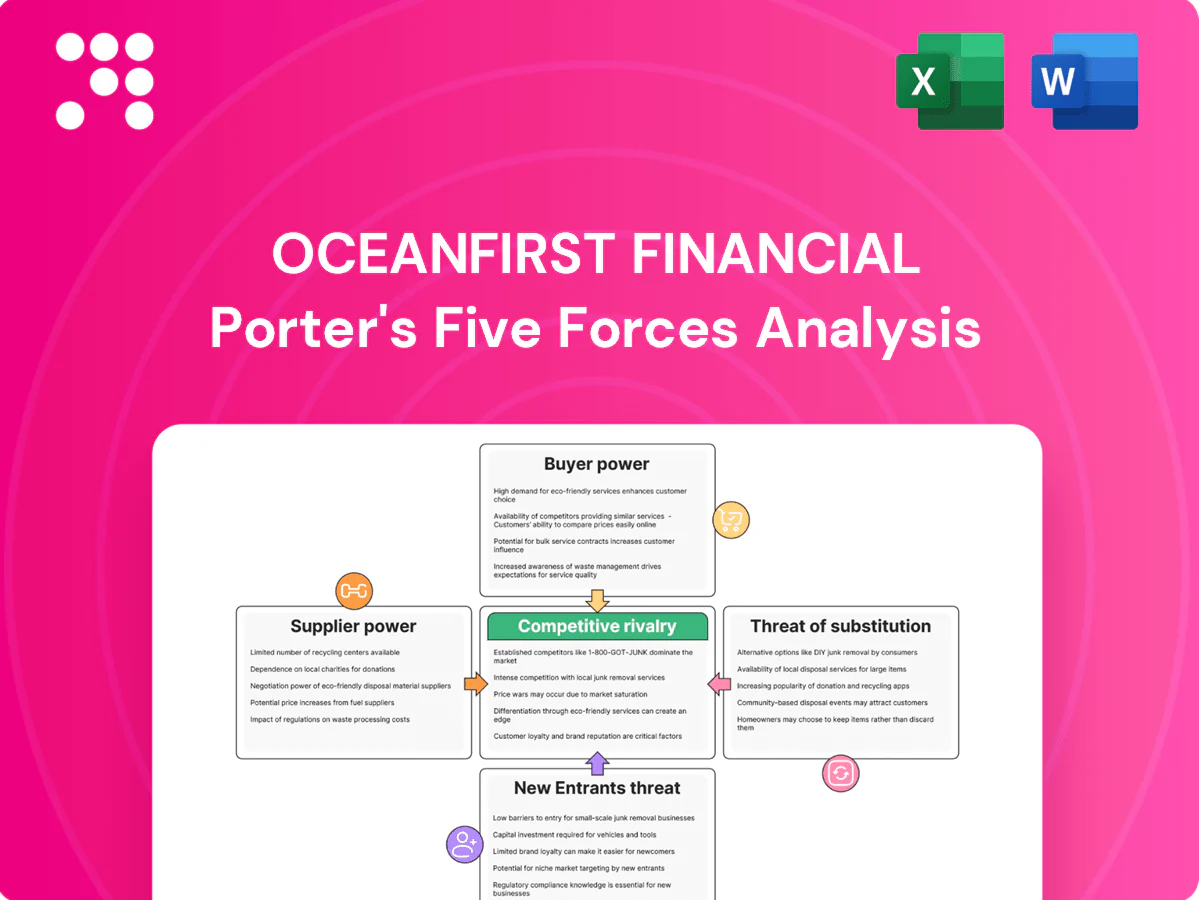
OceanFirst Financial Porter's Five Forces Analysis

A Must-Have Tool for Decision-Makers
OceanFirst Financial faces moderate buyer power, regional concentration risks, and margin pressure from interest-rate volatility while digital challengers and regulatory compliance shape competitive intensity. Its branch network and community brand provide strengths but limit scale versus national banks. This brief snapshot only scratches the surface. Unlock the full Porter's Five Forces Analysis to explore OceanFirst Financial’s competitive dynamics, market pressures, and strategic advantages in detail.
Suppliers Bargaining Power

Concentration of core tech vendors
OceanFirst relies on a concentrated set of core banking processors, cloud and cybersecurity vendors, which in 2024 increased supplier leverage by raising switching costs and contractual lock-ins. Complex integrations and regulatory requirements tied to these vendors limit operational flexibility and elevate remediation costs. The bank offsets this through multi-vendor sourcing and scale-based procurement to temper supplier pricing power.
Funding mix: depositors vs wholesale
Depositors are OceanFirst’s primary funding suppliers but become price sensitive in a higher-rate environment, pushing up deposit betas; reliance on FHLB lines, brokered CDs and correspondent funding increases exposure to wholesale repricing and market squeezes. A diversified, stable core-deposit base limits supplier power, while surge pricing for time deposits amplifies it. Active ALM and granular pricing analytics can rebalance the mix and contain funding costs.

Talent as a critical input
Skilled bankers, commercial lenders and risk/compliance staff are scarce in key metros, increasing suppliers' leverage for OceanFirst; U.S. unemployment averaged about 3.7% in 2024, reflecting tight labor markets. Regulatory complexity raises the premium for experienced hires, lifting compensation and retention costs and squeezing margins. Investment in strong culture and clear career pathways has lowered voluntary turnover in banking peers by mid-single digits in 2024, helping mitigate risk.

Payment and card networks
Payment networks and processors dictate interchange and network fees and technical standards banks must accept to access rails; Visa and Mastercard handled roughly 80% of U.S. card volume in 2024, with average credit card interchange around 1.8–2.5% and network fees ~$0.10–$0.30 per transaction, giving suppliers clear leverage over economics and roadmaps.
- Limited alternatives: high supplier concentration
- Fee pressure: 1.8–2.5% interchange (2024)
- Smaller banks: less negotiating clout
- Aggregation: can cut costs ~10–30%
Regulatory and compliance infrastructure
Compliance tools, audit services, and regtech vendors are essential for OceanFirst to meet supervisory expectations, with validated models and audit trails increasing supplier leverage.
Switching vendors is costly due to data migration, control revalidation, and loss of examiner continuity, while proactive vendor risk management and diversified suppliers can limit overreliance.
- Compliance tools: critical for exam readiness
- Validated models: elevate vendor influence
- Switching costs: data, controls, examiner continuity
- Vendor risk management: constrains dependence
Vendor power, tight labor & funding risk squeeze margins; cards ~80%
Supplier power for OceanFirst is elevated: core vendors create high switching costs; card networks ~80% volume (2024) with 1.8–2.5% interchange; tight labor market (U.S. unemployment 3.7% in 2024) raises compensation; FHLB/brokered funding increases wholesale repricing risk.
| Metric | 2024 | Impact |
|---|---|---|
| Card share | ~80% | High fee leverage |
| Interchange | 1.8–2.5% | Costs |
| Unemployment | 3.7% | Labor pressure |
What is included in the product
 Detailed Word Document
Concise Porter's Five Forces analysis for OceanFirst Financial that assesses competitive rivalry, buyer/supplier power, threat of entrants and substitutes, and highlights disruptive trends and entry barriers affecting profitability.

 Customizable Excel Spreadsheet
A concise, one-sheet Porter's Five Forces for OceanFirst Financial that visualizes competitive pressure and lets you customize force levels as market data shifts—clean, slide-ready output with no macros so non-finance users can adapt inputs, duplicate scenarios, and drop the chart straight into reports or dashboards for faster, confident decisions.
Customers Bargaining Power

Rate-sensitive deposit customers
Households and SMEs compare yields across banks and digital platforms; in rising-rate cycles—with the federal funds target at 5.25–5.50% in late 2024—migration to higher-yield accounts intensified, increasing sensitivity to deposit pricing for OceanFirst. Low switching costs amplify customer bargaining power, while loyalty programs and bundled services can materially reduce churn.
Commercial borrowers with alternatives
Middle-market and CRE borrowers can shop terms across community, regional, and nonbank lenders, with nonbank originations comprising roughly 40% of CRE deals in 2024, intensifying competition. Competing offers compress spreads, tighten covenants, and erode fees, forcing OceanFirst to defend margins. Deep relationships and cross-sell of deposits and treasury services can blunt some pressure, but disciplined risk-adjusted pricing remains critical.

Digital expectations and convenience
Customers now expect seamless mobile experiences, faster payments and 24/7 service, with 2024 surveys finding about 70% of consumers favoring mobile-first banking and instant onboarding. Visible gaps versus fintech UX raise their leverage to demand better features or switch providers, pressuring pricing and retention. Transparent fees and instant account opening are table stakes; continuous app enhancement narrows the gap and reduces churn.

Treasury management and business services
Businesses can negotiate fees on cash management, payments and merchant services, reducing buyer leverage; by 2024 many corporates favor fee transparency and API-based pricing. Standardized APIs and file formats make switching easier, though tailored treasury solutions create stickiness; SLA quality and onboarding speed remain key differentiators for OceanFirst.
- Negotiation: fee compression
- Switching: standardized APIs
- Stickiness: customized solutions
- Diff: SLA quality & onboarding speed
Affluent clients’ multi-banking behavior
Affluent clients routinely multi-bank, increasing bargaining power as ticket size and account portability rise, pressuring fees and yield; advisory and wealth management can anchor primary relationships and reduce attrition, while segmented pricing and white-glove service measurably improve retention among high-balance households.
- Multi-banking increases customer leverage
- Ticket size correlates with portability and bargaining power
- Advisory/wealth offerings anchor relationships
- Segmented pricing + white-glove service boost retention
Customers leverage pricing, UX pressure as Fed at 5.25–5.50%, nonbank CRE ~40%, mobile-first ~70%
Customers have elevated bargaining power: deposit sensitivity rose as rates reached a 5.25–5.50% fed funds target (late 2024), nonbank CRE held ~40% of originations, and ~70% of consumers preferred mobile-first banking in 2024, pressuring pricing, fees and UX; cross-sell and premium services partially offset churn.
| Metric | 2024 | Impact |
|---|---|---|
| Fed funds | 5.25–5.50% | ↑ deposit flight |
| Nonbank CRE share | ~40% | ↑ competition |
| Mobile-first consumers | ~70% | ↑ UX demand |
Same Document Delivered
OceanFirst Financial Porter's Five Forces Analysis
This preview shows the exact OceanFirst Financial Porter’s Five Forces analysis you’ll receive immediately after purchase—no placeholders or mockups. The file is fully formatted, comprehensive, and ready for download and use the moment you buy. What you see here is precisely the final document you’ll get.

A Must-Have Tool for Decision-Makers
OceanFirst Financial faces moderate buyer power, regional concentration risks, and margin pressure from interest-rate volatility while digital challengers and regulatory compliance shape competitive intensity. Its branch network and community brand provide strengths but limit scale versus national banks. This brief snapshot only scratches the surface. Unlock the full Porter's Five Forces Analysis to explore OceanFirst Financial’s competitive dynamics, market pressures, and strategic advantages in detail.
Suppliers Bargaining Power
Concentration of core tech vendors
OceanFirst relies on a concentrated set of core banking processors, cloud and cybersecurity vendors, which in 2024 increased supplier leverage by raising switching costs and contractual lock-ins. Complex integrations and regulatory requirements tied to these vendors limit operational flexibility and elevate remediation costs. The bank offsets this through multi-vendor sourcing and scale-based procurement to temper supplier pricing power.
Funding mix: depositors vs wholesale
Depositors are OceanFirst’s primary funding suppliers but become price sensitive in a higher-rate environment, pushing up deposit betas; reliance on FHLB lines, brokered CDs and correspondent funding increases exposure to wholesale repricing and market squeezes. A diversified, stable core-deposit base limits supplier power, while surge pricing for time deposits amplifies it. Active ALM and granular pricing analytics can rebalance the mix and contain funding costs.
Talent as a critical input
Skilled bankers, commercial lenders and risk/compliance staff are scarce in key metros, increasing suppliers' leverage for OceanFirst; U.S. unemployment averaged about 3.7% in 2024, reflecting tight labor markets. Regulatory complexity raises the premium for experienced hires, lifting compensation and retention costs and squeezing margins. Investment in strong culture and clear career pathways has lowered voluntary turnover in banking peers by mid-single digits in 2024, helping mitigate risk.
Payment and card networks
Payment networks and processors dictate interchange and network fees and technical standards banks must accept to access rails; Visa and Mastercard handled roughly 80% of U.S. card volume in 2024, with average credit card interchange around 1.8–2.5% and network fees ~$0.10–$0.30 per transaction, giving suppliers clear leverage over economics and roadmaps.
- Limited alternatives: high supplier concentration
- Fee pressure: 1.8–2.5% interchange (2024)
- Smaller banks: less negotiating clout
- Aggregation: can cut costs ~10–30%
Regulatory and compliance infrastructure
Compliance tools, audit services, and regtech vendors are essential for OceanFirst to meet supervisory expectations, with validated models and audit trails increasing supplier leverage.
Switching vendors is costly due to data migration, control revalidation, and loss of examiner continuity, while proactive vendor risk management and diversified suppliers can limit overreliance.
- Compliance tools: critical for exam readiness
- Validated models: elevate vendor influence
- Switching costs: data, controls, examiner continuity
- Vendor risk management: constrains dependence
Vendor power, tight labor & funding risk squeeze margins; cards ~80%
Supplier power for OceanFirst is elevated: core vendors create high switching costs; card networks ~80% volume (2024) with 1.8–2.5% interchange; tight labor market (U.S. unemployment 3.7% in 2024) raises compensation; FHLB/brokered funding increases wholesale repricing risk.
| Metric | 2024 | Impact |
|---|---|---|
| Card share | ~80% | High fee leverage |
| Interchange | 1.8–2.5% | Costs |
| Unemployment | 3.7% | Labor pressure |
What is included in the product
Detailed Word Document
Concise Porter's Five Forces analysis for OceanFirst Financial that assesses competitive rivalry, buyer/supplier power, threat of entrants and substitutes, and highlights disruptive trends and entry barriers affecting profitability.
Customizable Excel Spreadsheet
A concise, one-sheet Porter's Five Forces for OceanFirst Financial that visualizes competitive pressure and lets you customize force levels as market data shifts—clean, slide-ready output with no macros so non-finance users can adapt inputs, duplicate scenarios, and drop the chart straight into reports or dashboards for faster, confident decisions.
Customers Bargaining Power
Rate-sensitive deposit customers
Households and SMEs compare yields across banks and digital platforms; in rising-rate cycles—with the federal funds target at 5.25–5.50% in late 2024—migration to higher-yield accounts intensified, increasing sensitivity to deposit pricing for OceanFirst. Low switching costs amplify customer bargaining power, while loyalty programs and bundled services can materially reduce churn.
Commercial borrowers with alternatives
Middle-market and CRE borrowers can shop terms across community, regional, and nonbank lenders, with nonbank originations comprising roughly 40% of CRE deals in 2024, intensifying competition. Competing offers compress spreads, tighten covenants, and erode fees, forcing OceanFirst to defend margins. Deep relationships and cross-sell of deposits and treasury services can blunt some pressure, but disciplined risk-adjusted pricing remains critical.
Digital expectations and convenience
Customers now expect seamless mobile experiences, faster payments and 24/7 service, with 2024 surveys finding about 70% of consumers favoring mobile-first banking and instant onboarding. Visible gaps versus fintech UX raise their leverage to demand better features or switch providers, pressuring pricing and retention. Transparent fees and instant account opening are table stakes; continuous app enhancement narrows the gap and reduces churn.
Treasury management and business services
Businesses can negotiate fees on cash management, payments and merchant services, reducing buyer leverage; by 2024 many corporates favor fee transparency and API-based pricing. Standardized APIs and file formats make switching easier, though tailored treasury solutions create stickiness; SLA quality and onboarding speed remain key differentiators for OceanFirst.
- Negotiation: fee compression
- Switching: standardized APIs
- Stickiness: customized solutions
- Diff: SLA quality & onboarding speed
Affluent clients’ multi-banking behavior
Affluent clients routinely multi-bank, increasing bargaining power as ticket size and account portability rise, pressuring fees and yield; advisory and wealth management can anchor primary relationships and reduce attrition, while segmented pricing and white-glove service measurably improve retention among high-balance households.
- Multi-banking increases customer leverage
- Ticket size correlates with portability and bargaining power
- Advisory/wealth offerings anchor relationships
- Segmented pricing + white-glove service boost retention
Customers leverage pricing, UX pressure as Fed at 5.25–5.50%, nonbank CRE ~40%, mobile-first ~70%
Customers have elevated bargaining power: deposit sensitivity rose as rates reached a 5.25–5.50% fed funds target (late 2024), nonbank CRE held ~40% of originations, and ~70% of consumers preferred mobile-first banking in 2024, pressuring pricing, fees and UX; cross-sell and premium services partially offset churn.
| Metric | 2024 | Impact |
|---|---|---|
| Fed funds | 5.25–5.50% | ↑ deposit flight |
| Nonbank CRE share | ~40% | ↑ competition |
| Mobile-first consumers | ~70% | ↑ UX demand |
Same Document Delivered
OceanFirst Financial Porter's Five Forces Analysis
This preview shows the exact OceanFirst Financial Porter’s Five Forces analysis you’ll receive immediately after purchase—no placeholders or mockups. The file is fully formatted, comprehensive, and ready for download and use the moment you buy. What you see here is precisely the final document you’ll get.
Original: $10.00
-65%$10.00
$3.50Description
A Must-Have Tool for Decision-Makers
OceanFirst Financial faces moderate buyer power, regional concentration risks, and margin pressure from interest-rate volatility while digital challengers and regulatory compliance shape competitive intensity. Its branch network and community brand provide strengths but limit scale versus national banks. This brief snapshot only scratches the surface. Unlock the full Porter's Five Forces Analysis to explore OceanFirst Financial’s competitive dynamics, market pressures, and strategic advantages in detail.
Suppliers Bargaining Power
Concentration of core tech vendors
OceanFirst relies on a concentrated set of core banking processors, cloud and cybersecurity vendors, which in 2024 increased supplier leverage by raising switching costs and contractual lock-ins. Complex integrations and regulatory requirements tied to these vendors limit operational flexibility and elevate remediation costs. The bank offsets this through multi-vendor sourcing and scale-based procurement to temper supplier pricing power.
Funding mix: depositors vs wholesale
Depositors are OceanFirst’s primary funding suppliers but become price sensitive in a higher-rate environment, pushing up deposit betas; reliance on FHLB lines, brokered CDs and correspondent funding increases exposure to wholesale repricing and market squeezes. A diversified, stable core-deposit base limits supplier power, while surge pricing for time deposits amplifies it. Active ALM and granular pricing analytics can rebalance the mix and contain funding costs.
Talent as a critical input
Skilled bankers, commercial lenders and risk/compliance staff are scarce in key metros, increasing suppliers' leverage for OceanFirst; U.S. unemployment averaged about 3.7% in 2024, reflecting tight labor markets. Regulatory complexity raises the premium for experienced hires, lifting compensation and retention costs and squeezing margins. Investment in strong culture and clear career pathways has lowered voluntary turnover in banking peers by mid-single digits in 2024, helping mitigate risk.
Payment and card networks
Payment networks and processors dictate interchange and network fees and technical standards banks must accept to access rails; Visa and Mastercard handled roughly 80% of U.S. card volume in 2024, with average credit card interchange around 1.8–2.5% and network fees ~$0.10–$0.30 per transaction, giving suppliers clear leverage over economics and roadmaps.
- Limited alternatives: high supplier concentration
- Fee pressure: 1.8–2.5% interchange (2024)
- Smaller banks: less negotiating clout
- Aggregation: can cut costs ~10–30%
Regulatory and compliance infrastructure
Compliance tools, audit services, and regtech vendors are essential for OceanFirst to meet supervisory expectations, with validated models and audit trails increasing supplier leverage.
Switching vendors is costly due to data migration, control revalidation, and loss of examiner continuity, while proactive vendor risk management and diversified suppliers can limit overreliance.
- Compliance tools: critical for exam readiness
- Validated models: elevate vendor influence
- Switching costs: data, controls, examiner continuity
- Vendor risk management: constrains dependence
Vendor power, tight labor & funding risk squeeze margins; cards ~80%
Supplier power for OceanFirst is elevated: core vendors create high switching costs; card networks ~80% volume (2024) with 1.8–2.5% interchange; tight labor market (U.S. unemployment 3.7% in 2024) raises compensation; FHLB/brokered funding increases wholesale repricing risk.
| Metric | 2024 | Impact |
|---|---|---|
| Card share | ~80% | High fee leverage |
| Interchange | 1.8–2.5% | Costs |
| Unemployment | 3.7% | Labor pressure |
What is included in the product
Detailed Word Document
Concise Porter's Five Forces analysis for OceanFirst Financial that assesses competitive rivalry, buyer/supplier power, threat of entrants and substitutes, and highlights disruptive trends and entry barriers affecting profitability.
Customizable Excel Spreadsheet
A concise, one-sheet Porter's Five Forces for OceanFirst Financial that visualizes competitive pressure and lets you customize force levels as market data shifts—clean, slide-ready output with no macros so non-finance users can adapt inputs, duplicate scenarios, and drop the chart straight into reports or dashboards for faster, confident decisions.
Customers Bargaining Power
Rate-sensitive deposit customers
Households and SMEs compare yields across banks and digital platforms; in rising-rate cycles—with the federal funds target at 5.25–5.50% in late 2024—migration to higher-yield accounts intensified, increasing sensitivity to deposit pricing for OceanFirst. Low switching costs amplify customer bargaining power, while loyalty programs and bundled services can materially reduce churn.
Commercial borrowers with alternatives
Middle-market and CRE borrowers can shop terms across community, regional, and nonbank lenders, with nonbank originations comprising roughly 40% of CRE deals in 2024, intensifying competition. Competing offers compress spreads, tighten covenants, and erode fees, forcing OceanFirst to defend margins. Deep relationships and cross-sell of deposits and treasury services can blunt some pressure, but disciplined risk-adjusted pricing remains critical.
Digital expectations and convenience
Customers now expect seamless mobile experiences, faster payments and 24/7 service, with 2024 surveys finding about 70% of consumers favoring mobile-first banking and instant onboarding. Visible gaps versus fintech UX raise their leverage to demand better features or switch providers, pressuring pricing and retention. Transparent fees and instant account opening are table stakes; continuous app enhancement narrows the gap and reduces churn.
Treasury management and business services
Businesses can negotiate fees on cash management, payments and merchant services, reducing buyer leverage; by 2024 many corporates favor fee transparency and API-based pricing. Standardized APIs and file formats make switching easier, though tailored treasury solutions create stickiness; SLA quality and onboarding speed remain key differentiators for OceanFirst.
- Negotiation: fee compression
- Switching: standardized APIs
- Stickiness: customized solutions
- Diff: SLA quality & onboarding speed
Affluent clients’ multi-banking behavior
Affluent clients routinely multi-bank, increasing bargaining power as ticket size and account portability rise, pressuring fees and yield; advisory and wealth management can anchor primary relationships and reduce attrition, while segmented pricing and white-glove service measurably improve retention among high-balance households.
- Multi-banking increases customer leverage
- Ticket size correlates with portability and bargaining power
- Advisory/wealth offerings anchor relationships
- Segmented pricing + white-glove service boost retention
Customers leverage pricing, UX pressure as Fed at 5.25–5.50%, nonbank CRE ~40%, mobile-first ~70%
Customers have elevated bargaining power: deposit sensitivity rose as rates reached a 5.25–5.50% fed funds target (late 2024), nonbank CRE held ~40% of originations, and ~70% of consumers preferred mobile-first banking in 2024, pressuring pricing, fees and UX; cross-sell and premium services partially offset churn.
| Metric | 2024 | Impact |
|---|---|---|
| Fed funds | 5.25–5.50% | ↑ deposit flight |
| Nonbank CRE share | ~40% | ↑ competition |
| Mobile-first consumers | ~70% | ↑ UX demand |
Same Document Delivered
OceanFirst Financial Porter's Five Forces Analysis
This preview shows the exact OceanFirst Financial Porter’s Five Forces analysis you’ll receive immediately after purchase—no placeholders or mockups. The file is fully formatted, comprehensive, and ready for download and use the moment you buy. What you see here is precisely the final document you’ll get.











