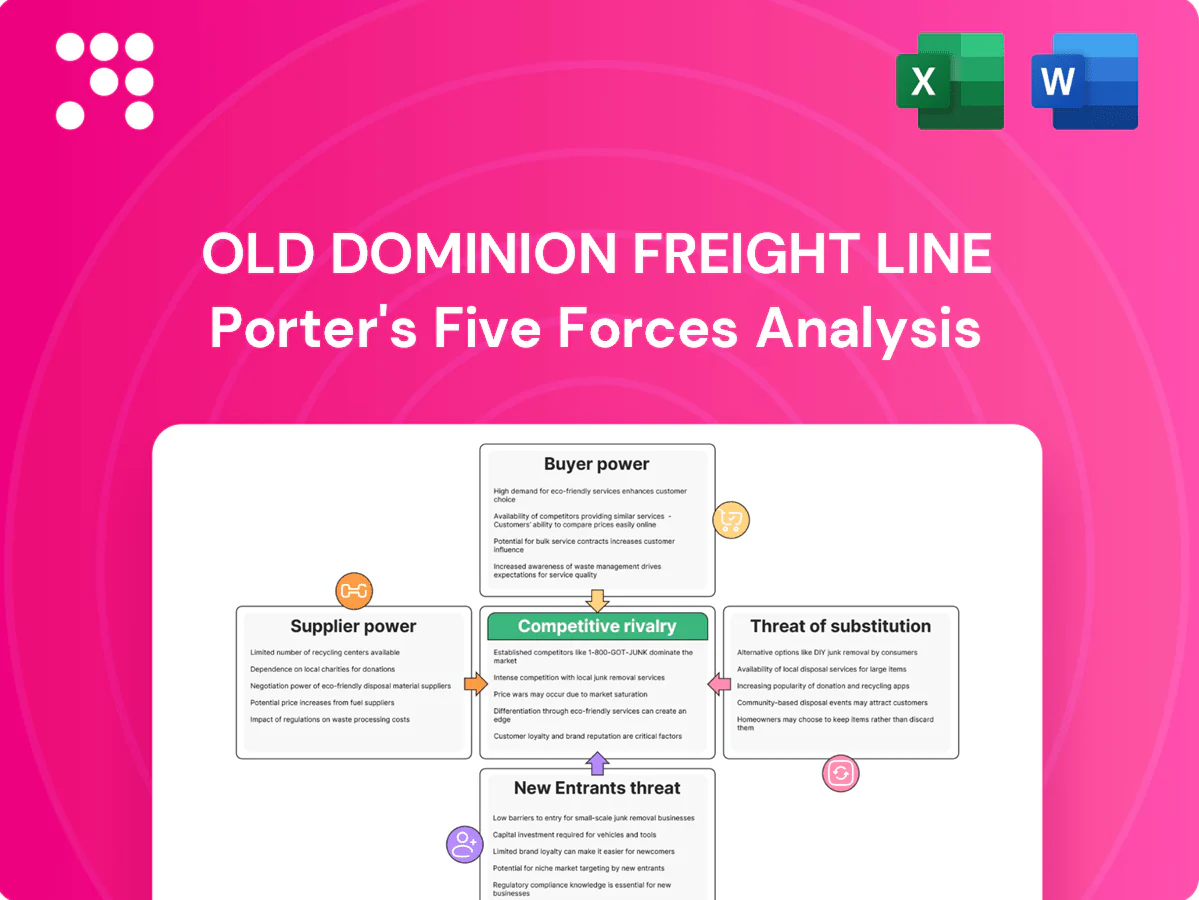
Old Dominion Freight Line Porter's Five Forces Analysis

A Must-Have Tool for Decision-Makers
Old Dominion Freight Line faces intense price competition, moderate supplier leverage, and growing buyer expectations amid rising fuel and labor costs; barriers to entry remain high but tech-enabled disruptors are a looming threat. This brief snapshot only scratches the surface—unlock the full Porter's Five Forces Analysis for actionable, force-by-force insights to inform strategy and investment decisions.
Suppliers Bargaining Power

Fuel and equipment concentration
Diesel suppliers and major truck OEMs (Paccar, Daimler, Volvo) control roughly 75–80% of the North American Class 8 market, giving them significant pricing leverage over carriers like Old Dominion. Fuel volatility (U.S. average diesel ~$3.90/gal in 2024) passes through with a lag, compressing margins between spot fuel swings and surcharge adjustments. Proprietary parts and bundled maintenance contracts further lock carriers into higher lifecycle costs. Long-term sourcing agreements and hedges reduce but do not eliminate exposure to supplier pricing power.
Labor availability and wage pressure
Drivers, mechanics and dockworkers are scarce, with U.S. heavy and tractor-trailer truck driver employment around 1.6 million (BLS May 2024), pushing hourly wages up roughly 6% YoY and raising benefit demands; even as a non-union carrier Old Dominion faces this supplier-like labor leverage. Training and retention programs reduce churn but scale slowly, and wage inflation can outpace freight rate resets in downturns, pressuring margins.

Terminal real estate and leases
Strategic cross-dock terminals in dense markets are scarce, giving landlords strong leverage over Old Dominion; ODFL operates over 250 service centers, concentrating demand in key corridors. Zoning and permitting bottlenecks keep alternative sites limited, and long lease terms commonly used in logistics fix occupancy costs while curbing operational flexibility. During expansion cycles, industrial rents in top U.S. freight corridors have spiked, with vacancy staying below 5% in 2024, amplifying landlord bargaining power.

Technology and telematics vendors
Routing, TMS, ELD and telematics vendors create switching frictions for ODFL: US ELD compliance ~99% and the global TMS market ~$10B in 2024 concentrate dependence on a few platforms; average TMS implementations run ~$150k, so vendor price hikes or feature gating can raise operating costs and margin pressure.
- High switching cost
- Concentrated platforms
- Implementation ≈$150k
- SaaS price pressure (~7%/yr)
- APIs modularity reduces risk but needs capex
Maintenance, tires, and parts suppliers
Specialized components and tires faced cyclical shortages in 2024, pushing lead times to as much as 8–12 weeks and lifting replacement costs; Old Dominion reported roughly $6.8B revenue and a fleet near 23,000 tractors in 2024, exposing downtime risk. Volume purchasing and rebate programs blunt supplier power, while in-house maintenance capacity lowers external dependence but raises fixed labor and facility costs.
- Supply strain: 8–12 week lead times (2024)
- Scale: ~23,000 tractors (ODFL 2024)
- Financial: ~$6.8B revenue (2024)
- Mitigation: rebates + in-house maintenance (higher fixed costs)
Supply chain squeeze: OEMs 75–80%, diesel $3.90/gal, wages +6%
Suppliers exert moderate-to-high power: Class 8 OEMs control ~75–80% market, diesel averaged ~$3.90/gal (2024) and drivers (~1.6M) pushed wages +6% YoY, squeezing margins despite hedges, rebates and in-house maintenance; TMS/ELD vendor lock-in (TMS market ~$10B) and 8–12 week parts lead times raise switching and downtime costs for ODFL (23k tractors, $6.8B rev 2024).
| Metric | 2024 |
|---|---|
| OEM share | 75–80% |
| Diesel | $3.90/gal |
| Drivers | 1.6M / +6% wages |
What is included in the product
 Detailed Word Document
Tailored exclusively for Old Dominion Freight Line, this Porter’s Five Forces analysis uncovers competitive drivers, supplier and buyer power, threat of entrants and substitutes, and disruptive risks, providing strategic insight for pricing, positioning, and incumbent defenses.

 Customizable Excel Spreadsheet
A concise one-sheet Porter's Five Forces for Old Dominion Freight Line that highlights competitive pressures and neutralizes analysis pain points—easy to update for rate shifts, regulation changes, or capacity fluctuations and ready to drop into decks or dashboards.
Customers Bargaining Power

Large shippers and RFP leverage
Enterprise manufacturers and retailers run annual RFP cycles that in 2024 intensified price and terms pressure on carriers, with top shippers leveraging dense, lane-level volumes to extract concessions. Volume density gives buyers lane-specific bargaining power, forcing carriers like Old Dominion to defend share through strict service KPIs and targeted discounts. Rising consolidation via 3PLs — which aggregated a majority of outsourced freight flows in 2024 — further amplified buyer negotiating leverage.
Low switching costs across LTLs
Low switching costs let shippers easily dual-source among top LTL carriers; in 2024 Old Dominion remained one of the leading U.S. LTL providers, facilitating modest onboarding across peers. Standardized pallets, NMFC classing and EDI connectivity reduce friction and enable swift carrier swaps. Accessorials and service guarantees provide short-term differentiation but are largely replicable, keeping prices and service under constant pressure.

Service sensitivity and performance KPIs
On-time delivery, low damage rates and speedy claim resolution are primary selection drivers for shippers; in 2024 buyers increasingly tied contracts to these KPIs and benchmark carriers quarterly to extract concessions. Superior reliability lets Old Dominion command a pricing premium, but market tests show that persistent KPI lapses prompt rapid share shifts to rivals. Buyers monitor KPIs closely and reallocate volume within weeks when metrics slip.

Economic cycles and demand elasticity
In downturns shippers push harder on rates and terms, forcing carriers like Old Dominion (revenue $12.8B in FY2024) to defend margins; in tight-capacity periods buyer power moderates but never vanishes as spot rates and contract leverage shift. Surcharges and dynamic pricing (fuel and accessorials) blunt demand elasticity, while contract structures aim to smooth volatility but are renegotiated frequently.
- Downturn pressure on rates
- Moderated buyer power in tight capacity
- Surcharges/dynamic pricing reduce elasticity
- Contracts smooth volatility but are often renegotiated
Mode-mix and consolidation options
Customers can shift freight into parcel, TL, or intermodal when rates change, increasing leverage over carriers; the global 3PL market surpassed $1 trillion in 2024, enabling brokers to bundle and pressure pricing.
- Mode flexibility raises buyer leverage
- 3PLs/brokers bundle to extract better rates
- Consolidation programs cut LTL touches, lowering spend
Buyers wield lane-level leverage in 2024; 3PL consolidation amplifies bargaining power
Buyers hold strong lane-level leverage in 2024, using dense volumes and annual RFPs to extract concessions; low switching costs and replicable services keep price pressure high. Superior KPIs let Old Dominion (revenue $12.8B FY2024) earn premiums, but 3PL consolidation (global 3PL market >$1T in 2024) amplifies buyer bargaining power.
| Metric | 2024 |
|---|---|
| Old Dominion revenue | $12.8B |
| Global 3PL market | >$1T |
| Buyer leverage drivers | Lane density, low switching costs, mode flexibility |
Same Document Delivered
Old Dominion Freight Line Porter's Five Forces Analysis
This Porter's Five Forces analysis of Old Dominion Freight Line delivers a concise assessment of competitive rivalry, supplier and buyer power, threat of entrants and substitutes, and industry dynamics. This preview is the exact, fully formatted document you will receive immediately after purchase. No placeholders or samples—ready for download and use.

A Must-Have Tool for Decision-Makers
Old Dominion Freight Line faces intense price competition, moderate supplier leverage, and growing buyer expectations amid rising fuel and labor costs; barriers to entry remain high but tech-enabled disruptors are a looming threat. This brief snapshot only scratches the surface—unlock the full Porter's Five Forces Analysis for actionable, force-by-force insights to inform strategy and investment decisions.
Suppliers Bargaining Power
Fuel and equipment concentration
Diesel suppliers and major truck OEMs (Paccar, Daimler, Volvo) control roughly 75–80% of the North American Class 8 market, giving them significant pricing leverage over carriers like Old Dominion. Fuel volatility (U.S. average diesel ~$3.90/gal in 2024) passes through with a lag, compressing margins between spot fuel swings and surcharge adjustments. Proprietary parts and bundled maintenance contracts further lock carriers into higher lifecycle costs. Long-term sourcing agreements and hedges reduce but do not eliminate exposure to supplier pricing power.
Labor availability and wage pressure
Drivers, mechanics and dockworkers are scarce, with U.S. heavy and tractor-trailer truck driver employment around 1.6 million (BLS May 2024), pushing hourly wages up roughly 6% YoY and raising benefit demands; even as a non-union carrier Old Dominion faces this supplier-like labor leverage. Training and retention programs reduce churn but scale slowly, and wage inflation can outpace freight rate resets in downturns, pressuring margins.
Terminal real estate and leases
Strategic cross-dock terminals in dense markets are scarce, giving landlords strong leverage over Old Dominion; ODFL operates over 250 service centers, concentrating demand in key corridors. Zoning and permitting bottlenecks keep alternative sites limited, and long lease terms commonly used in logistics fix occupancy costs while curbing operational flexibility. During expansion cycles, industrial rents in top U.S. freight corridors have spiked, with vacancy staying below 5% in 2024, amplifying landlord bargaining power.
Technology and telematics vendors
Routing, TMS, ELD and telematics vendors create switching frictions for ODFL: US ELD compliance ~99% and the global TMS market ~$10B in 2024 concentrate dependence on a few platforms; average TMS implementations run ~$150k, so vendor price hikes or feature gating can raise operating costs and margin pressure.
- High switching cost
- Concentrated platforms
- Implementation ≈$150k
- SaaS price pressure (~7%/yr)
- APIs modularity reduces risk but needs capex
Maintenance, tires, and parts suppliers
Specialized components and tires faced cyclical shortages in 2024, pushing lead times to as much as 8–12 weeks and lifting replacement costs; Old Dominion reported roughly $6.8B revenue and a fleet near 23,000 tractors in 2024, exposing downtime risk. Volume purchasing and rebate programs blunt supplier power, while in-house maintenance capacity lowers external dependence but raises fixed labor and facility costs.
- Supply strain: 8–12 week lead times (2024)
- Scale: ~23,000 tractors (ODFL 2024)
- Financial: ~$6.8B revenue (2024)
- Mitigation: rebates + in-house maintenance (higher fixed costs)
Supply chain squeeze: OEMs 75–80%, diesel $3.90/gal, wages +6%
Suppliers exert moderate-to-high power: Class 8 OEMs control ~75–80% market, diesel averaged ~$3.90/gal (2024) and drivers (~1.6M) pushed wages +6% YoY, squeezing margins despite hedges, rebates and in-house maintenance; TMS/ELD vendor lock-in (TMS market ~$10B) and 8–12 week parts lead times raise switching and downtime costs for ODFL (23k tractors, $6.8B rev 2024).
| Metric | 2024 |
|---|---|
| OEM share | 75–80% |
| Diesel | $3.90/gal |
| Drivers | 1.6M / +6% wages |
What is included in the product
Detailed Word Document
Tailored exclusively for Old Dominion Freight Line, this Porter’s Five Forces analysis uncovers competitive drivers, supplier and buyer power, threat of entrants and substitutes, and disruptive risks, providing strategic insight for pricing, positioning, and incumbent defenses.
Customizable Excel Spreadsheet
A concise one-sheet Porter's Five Forces for Old Dominion Freight Line that highlights competitive pressures and neutralizes analysis pain points—easy to update for rate shifts, regulation changes, or capacity fluctuations and ready to drop into decks or dashboards.
Customers Bargaining Power
Large shippers and RFP leverage
Enterprise manufacturers and retailers run annual RFP cycles that in 2024 intensified price and terms pressure on carriers, with top shippers leveraging dense, lane-level volumes to extract concessions. Volume density gives buyers lane-specific bargaining power, forcing carriers like Old Dominion to defend share through strict service KPIs and targeted discounts. Rising consolidation via 3PLs — which aggregated a majority of outsourced freight flows in 2024 — further amplified buyer negotiating leverage.
Low switching costs across LTLs
Low switching costs let shippers easily dual-source among top LTL carriers; in 2024 Old Dominion remained one of the leading U.S. LTL providers, facilitating modest onboarding across peers. Standardized pallets, NMFC classing and EDI connectivity reduce friction and enable swift carrier swaps. Accessorials and service guarantees provide short-term differentiation but are largely replicable, keeping prices and service under constant pressure.
Service sensitivity and performance KPIs
On-time delivery, low damage rates and speedy claim resolution are primary selection drivers for shippers; in 2024 buyers increasingly tied contracts to these KPIs and benchmark carriers quarterly to extract concessions. Superior reliability lets Old Dominion command a pricing premium, but market tests show that persistent KPI lapses prompt rapid share shifts to rivals. Buyers monitor KPIs closely and reallocate volume within weeks when metrics slip.
Economic cycles and demand elasticity
In downturns shippers push harder on rates and terms, forcing carriers like Old Dominion (revenue $12.8B in FY2024) to defend margins; in tight-capacity periods buyer power moderates but never vanishes as spot rates and contract leverage shift. Surcharges and dynamic pricing (fuel and accessorials) blunt demand elasticity, while contract structures aim to smooth volatility but are renegotiated frequently.
- Downturn pressure on rates
- Moderated buyer power in tight capacity
- Surcharges/dynamic pricing reduce elasticity
- Contracts smooth volatility but are often renegotiated
Mode-mix and consolidation options
Customers can shift freight into parcel, TL, or intermodal when rates change, increasing leverage over carriers; the global 3PL market surpassed $1 trillion in 2024, enabling brokers to bundle and pressure pricing.
- Mode flexibility raises buyer leverage
- 3PLs/brokers bundle to extract better rates
- Consolidation programs cut LTL touches, lowering spend
Buyers wield lane-level leverage in 2024; 3PL consolidation amplifies bargaining power
Buyers hold strong lane-level leverage in 2024, using dense volumes and annual RFPs to extract concessions; low switching costs and replicable services keep price pressure high. Superior KPIs let Old Dominion (revenue $12.8B FY2024) earn premiums, but 3PL consolidation (global 3PL market >$1T in 2024) amplifies buyer bargaining power.
| Metric | 2024 |
|---|---|
| Old Dominion revenue | $12.8B |
| Global 3PL market | >$1T |
| Buyer leverage drivers | Lane density, low switching costs, mode flexibility |
Same Document Delivered
Old Dominion Freight Line Porter's Five Forces Analysis
This Porter's Five Forces analysis of Old Dominion Freight Line delivers a concise assessment of competitive rivalry, supplier and buyer power, threat of entrants and substitutes, and industry dynamics. This preview is the exact, fully formatted document you will receive immediately after purchase. No placeholders or samples—ready for download and use.
Original: $10.00
-65%$10.00
$3.50Description
A Must-Have Tool for Decision-Makers
Old Dominion Freight Line faces intense price competition, moderate supplier leverage, and growing buyer expectations amid rising fuel and labor costs; barriers to entry remain high but tech-enabled disruptors are a looming threat. This brief snapshot only scratches the surface—unlock the full Porter's Five Forces Analysis for actionable, force-by-force insights to inform strategy and investment decisions.
Suppliers Bargaining Power
Fuel and equipment concentration
Diesel suppliers and major truck OEMs (Paccar, Daimler, Volvo) control roughly 75–80% of the North American Class 8 market, giving them significant pricing leverage over carriers like Old Dominion. Fuel volatility (U.S. average diesel ~$3.90/gal in 2024) passes through with a lag, compressing margins between spot fuel swings and surcharge adjustments. Proprietary parts and bundled maintenance contracts further lock carriers into higher lifecycle costs. Long-term sourcing agreements and hedges reduce but do not eliminate exposure to supplier pricing power.
Labor availability and wage pressure
Drivers, mechanics and dockworkers are scarce, with U.S. heavy and tractor-trailer truck driver employment around 1.6 million (BLS May 2024), pushing hourly wages up roughly 6% YoY and raising benefit demands; even as a non-union carrier Old Dominion faces this supplier-like labor leverage. Training and retention programs reduce churn but scale slowly, and wage inflation can outpace freight rate resets in downturns, pressuring margins.
Terminal real estate and leases
Strategic cross-dock terminals in dense markets are scarce, giving landlords strong leverage over Old Dominion; ODFL operates over 250 service centers, concentrating demand in key corridors. Zoning and permitting bottlenecks keep alternative sites limited, and long lease terms commonly used in logistics fix occupancy costs while curbing operational flexibility. During expansion cycles, industrial rents in top U.S. freight corridors have spiked, with vacancy staying below 5% in 2024, amplifying landlord bargaining power.
Technology and telematics vendors
Routing, TMS, ELD and telematics vendors create switching frictions for ODFL: US ELD compliance ~99% and the global TMS market ~$10B in 2024 concentrate dependence on a few platforms; average TMS implementations run ~$150k, so vendor price hikes or feature gating can raise operating costs and margin pressure.
- High switching cost
- Concentrated platforms
- Implementation ≈$150k
- SaaS price pressure (~7%/yr)
- APIs modularity reduces risk but needs capex
Maintenance, tires, and parts suppliers
Specialized components and tires faced cyclical shortages in 2024, pushing lead times to as much as 8–12 weeks and lifting replacement costs; Old Dominion reported roughly $6.8B revenue and a fleet near 23,000 tractors in 2024, exposing downtime risk. Volume purchasing and rebate programs blunt supplier power, while in-house maintenance capacity lowers external dependence but raises fixed labor and facility costs.
- Supply strain: 8–12 week lead times (2024)
- Scale: ~23,000 tractors (ODFL 2024)
- Financial: ~$6.8B revenue (2024)
- Mitigation: rebates + in-house maintenance (higher fixed costs)
Supply chain squeeze: OEMs 75–80%, diesel $3.90/gal, wages +6%
Suppliers exert moderate-to-high power: Class 8 OEMs control ~75–80% market, diesel averaged ~$3.90/gal (2024) and drivers (~1.6M) pushed wages +6% YoY, squeezing margins despite hedges, rebates and in-house maintenance; TMS/ELD vendor lock-in (TMS market ~$10B) and 8–12 week parts lead times raise switching and downtime costs for ODFL (23k tractors, $6.8B rev 2024).
| Metric | 2024 |
|---|---|
| OEM share | 75–80% |
| Diesel | $3.90/gal |
| Drivers | 1.6M / +6% wages |
What is included in the product
Detailed Word Document
Tailored exclusively for Old Dominion Freight Line, this Porter’s Five Forces analysis uncovers competitive drivers, supplier and buyer power, threat of entrants and substitutes, and disruptive risks, providing strategic insight for pricing, positioning, and incumbent defenses.
Customizable Excel Spreadsheet
A concise one-sheet Porter's Five Forces for Old Dominion Freight Line that highlights competitive pressures and neutralizes analysis pain points—easy to update for rate shifts, regulation changes, or capacity fluctuations and ready to drop into decks or dashboards.
Customers Bargaining Power
Large shippers and RFP leverage
Enterprise manufacturers and retailers run annual RFP cycles that in 2024 intensified price and terms pressure on carriers, with top shippers leveraging dense, lane-level volumes to extract concessions. Volume density gives buyers lane-specific bargaining power, forcing carriers like Old Dominion to defend share through strict service KPIs and targeted discounts. Rising consolidation via 3PLs — which aggregated a majority of outsourced freight flows in 2024 — further amplified buyer negotiating leverage.
Low switching costs across LTLs
Low switching costs let shippers easily dual-source among top LTL carriers; in 2024 Old Dominion remained one of the leading U.S. LTL providers, facilitating modest onboarding across peers. Standardized pallets, NMFC classing and EDI connectivity reduce friction and enable swift carrier swaps. Accessorials and service guarantees provide short-term differentiation but are largely replicable, keeping prices and service under constant pressure.
Service sensitivity and performance KPIs
On-time delivery, low damage rates and speedy claim resolution are primary selection drivers for shippers; in 2024 buyers increasingly tied contracts to these KPIs and benchmark carriers quarterly to extract concessions. Superior reliability lets Old Dominion command a pricing premium, but market tests show that persistent KPI lapses prompt rapid share shifts to rivals. Buyers monitor KPIs closely and reallocate volume within weeks when metrics slip.
Economic cycles and demand elasticity
In downturns shippers push harder on rates and terms, forcing carriers like Old Dominion (revenue $12.8B in FY2024) to defend margins; in tight-capacity periods buyer power moderates but never vanishes as spot rates and contract leverage shift. Surcharges and dynamic pricing (fuel and accessorials) blunt demand elasticity, while contract structures aim to smooth volatility but are renegotiated frequently.
- Downturn pressure on rates
- Moderated buyer power in tight capacity
- Surcharges/dynamic pricing reduce elasticity
- Contracts smooth volatility but are often renegotiated
Mode-mix and consolidation options
Customers can shift freight into parcel, TL, or intermodal when rates change, increasing leverage over carriers; the global 3PL market surpassed $1 trillion in 2024, enabling brokers to bundle and pressure pricing.
- Mode flexibility raises buyer leverage
- 3PLs/brokers bundle to extract better rates
- Consolidation programs cut LTL touches, lowering spend
Buyers wield lane-level leverage in 2024; 3PL consolidation amplifies bargaining power
Buyers hold strong lane-level leverage in 2024, using dense volumes and annual RFPs to extract concessions; low switching costs and replicable services keep price pressure high. Superior KPIs let Old Dominion (revenue $12.8B FY2024) earn premiums, but 3PL consolidation (global 3PL market >$1T in 2024) amplifies buyer bargaining power.
| Metric | 2024 |
|---|---|
| Old Dominion revenue | $12.8B |
| Global 3PL market | >$1T |
| Buyer leverage drivers | Lane density, low switching costs, mode flexibility |
Same Document Delivered
Old Dominion Freight Line Porter's Five Forces Analysis
This Porter's Five Forces analysis of Old Dominion Freight Line delivers a concise assessment of competitive rivalry, supplier and buyer power, threat of entrants and substitutes, and industry dynamics. This preview is the exact, fully formatted document you will receive immediately after purchase. No placeholders or samples—ready for download and use.











