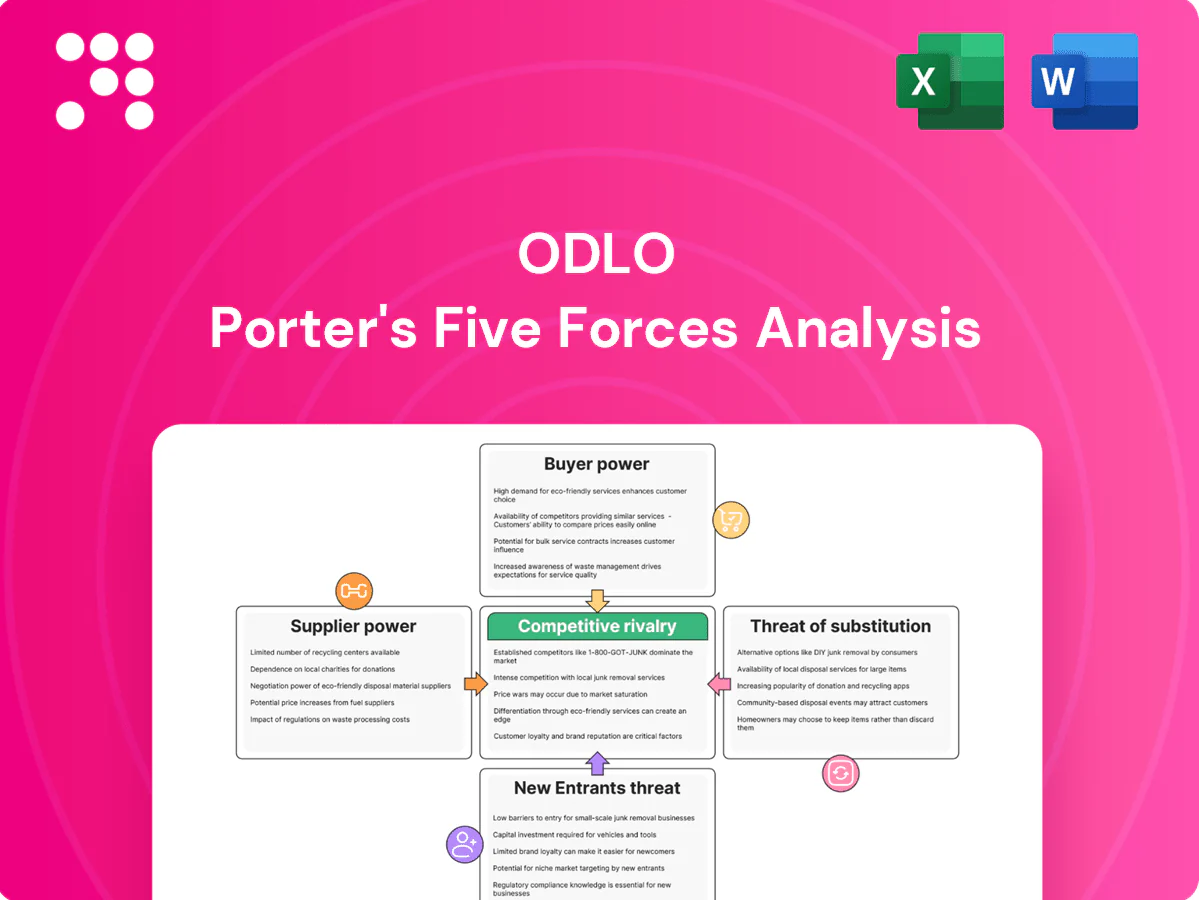
Odlo Porter's Five Forces Analysis

Elevate Your Analysis with the Complete Porter's Five Forces Analysis
Odlo faces moderate buyer power, evolving supplier dynamics, and steady rivalry in performance apparel, while threats from new entrants and substitutes hinge on brand strength and innovation. Our snapshot highlights strategic pressure points and growth levers for Odlo. This brief snapshot only scratches the surface. Unlock the full Porter's Five Forces Analysis to explore Odlo’s competitive dynamics, market pressures, and strategic advantages in detail.
Suppliers Bargaining Power

Specialized technical fabrics
Odlo depends on specialized mills for merino blends, recycled poly and membrane laminates, concentrating sourcing and giving suppliers leverage on pricing and lead times; the global technical textiles market was roughly USD 200 billion in 2023, underscoring supplier market power. Dual-sourcing and material standardization reduce risk but niche specs often prevent it, so any mill disruption can delay seasonal drops and capsule launches.
Compliance and sustainability requirements
Odlo’s requirements for Oeko-Tex, Bluesign and GOTS certification, full material traceability and chemical compliance significantly narrow its vendor pool. Fewer compliant suppliers gain bargaining power and can command price premiums, though long-term contracts and volume commitments let Odlo trade price for reliability. The EU CSRD rollout in 2024, covering about 50,000 companies, further concentrates compliant capacity.

Manufacturing capabilities and MOQs
Performance sewing, bonding and seamless knitting rely on skilled factories with MOQs commonly in the 3,000–10,000 units per style range, concentrating supply among few specialists. Factories prioritize larger, steady orders, squeezing smaller or variable runs on price and timing. Peak Q3–Q4 capacity constraints often force earlier commitments or cost premiums, while strategic vendor calendars (scheduled buys, rolling forecasts) can rebalance negotiating power.

Geographic concentration and logistics
Clustered sourcing in Asia leaves Odlo exposed to 2024 freight volatility, FX swings and geopolitical risk; apparel sourcing from Asia remained over 60% in 2024, amplifying supplier leverage when shipping delays or energy price spikes occur. Nearshoring lowers transit risk but can raise unit costs by 10–20% versus Asia. Diversifying lanes and tighter Incoterms (FCA/CIF shifts) partially offsets exposure.
- Risk: concentrated Asia sourcing >60% (2024)
- Impact: shipping/energy spikes shift leverage to suppliers
- Trade-off: nearshoring +10–20% unit cost
- Mitigation: diversify lanes; revise Incoterms
Input cost pass-through
Oil-linked polyester, wool and energy swings feed directly into yarn and fabric costs; Brent crude averaged about $86/barrel in 2024, keeping polyester-linked input prices elevated and passing through to mills and brands.
Suppliers frequently apply surcharges or revise quotes—Odlo faces quarterly input-price resets—so long-term contracts and hedging are used to dampen peaks but trade off procurement flexibility.
Design-to-cost and fabric platforming reduce exposure, preserving margin; industry benchmarks show material cost control can improve gross margin by a few percentage points.
- raw-material exposure: polyester oil linkage (Brent ~$86/bbl in 2024)
- pricing cadence: supplier surcharges, frequent quote adjustments
- mitigation: long-term contracts/hedging reduce volatility but limit agility
- product strategy: design-to-cost and fabric platforms protect margins
Supply-chain squeeze: Asia >60%, Brent ~$86, nearshoring +10-20%
Odlo faces high supplier power from concentrated technical-mill sourcing (Asia >60% in 2024), niche certified materials and MOQs (3k–10k), producing price and lead-time leverage. Energy/oil linkage (Brent ~$86/bbl in 2024) and freight/FX volatility drive surcharges and quarterly resets, mitigated by long-term contracts, hedging and design-to-cost platforms. Nearshoring cuts transit risk but ups unit cost ~10–20%.
| Metric | Value (2024) |
|---|---|
| Asia sourcing | >60% |
| Brent crude | ~$86/bbl |
| MOQ per style | 3,000–10,000 |
| Nearshoring cost premium | 10–20% |
What is included in the product
 Detailed Word Document
Concise Porter's Five Forces assessment for Odlo, uncovering competitive intensity, buyer/supplier leverage, entry barriers, substitutes and disruptive threats with industry data and actionable strategic insights.

 Customizable Excel Spreadsheet
Odlo Porter's Five Forces condenses competitive pressure into a single, editable one-sheet—ideal for quick strategic decisions and slide-ready summaries.
Customers Bargaining Power

Abundant brand alternatives
Consumers can switch among many performance and outdoor brands with minimal friction, fueling price sensitivity and feature-by-feature comparison; the global sportswear/outdoor segment reached an estimated $420–430 billion in 2024, intensifying competition. Differentiation through superior fit, technical innovation and sustainability storytelling is critical to curb churn. Loyalty programs and community engagement—shown to lift retention—can lower price elasticity and reduce switching.
Wholesale vs DTC mix
Large retail partners use scale to extract discounts, MDF and extended payment terms, often representing the bulk of wholesale leverage; in 2024 retail consolidation left top accounts controlling an estimated majority of shelf space. DTC grants Odlo better margin control and first-party customer data but raises delivery and service expectations. Channel conflict forces consistent regional pricing, while balanced allocations limit overreliance on any single buyer group.

Information transparency
Information transparency gives customers leverage: online reviews and detailed tech specs let buyers assess Odlo items quickly, with 78% of apparel shoppers in 2024 citing reviews as purchase drivers. Price scrapers and rivals' frequent promos (often 10–25% discounts) anchor perceived fair prices, forcing Odlo to justify premiums with measurable performance metrics and lab-backed claims. Clear sizing, care, and durability data cut returns and churn.

Product standardization in base layers
Base layers face commoditization as functional features converge, pressuring margins while buyers increasingly demand bundle deals and multi-pack discounts; the global activewear market grew about 5% to roughly $420B in 2024, raising competition for wallet share. Continuous innovation in thermoregulation, odor control, and circular materials preserves premium pricing, while distinct fits and design aesthetics create perceived uniqueness and reduce direct price competition.
- Commoditization risk: feature convergence
- Buyer leverage: multi-pack/bundle demand
- Pricing defense: thermoregulation, odor control, circular materials
- Differentiation: fit and design aesthetics
Return policies and service expectations
Generous e-commerce returns shift significant costs to brands, with apparel online return rates around 20–30% in 2024 and return management often eating 5–15% of gross margins. Customers now view free shipping and returns as a hygiene factor (about 73% expect free returns in 2024), while superior post-purchase support and warranties can justify 10–15% price premiums and boost retention. Operational excellence—automated try-on guidance, tighter fraud controls, and reverse-logistics efficiency—can cut return-related costs materially.
- Return rate: 20–30% (apparel, 2024)
- Free-returns expectation: ~73% (2024)
- Price premium for service: 10–15%
- Return-cost impact: 5–15% of gross margin
78% review-led shoppers; returns and free-returns squeeze pricing
Customers hold strong leverage: easy brand switching and review-driven buying (78% cite reviews) force price/feature comparison; retail consolidation grants big accounts discount power. High online returns (20–30%) and free-return expectations (~73%) increase cost pressure, while 10–25% promo anchors and 10–15% service premium shape pricing strategy.
| Metric | 2024 |
|---|---|
| Global sportswear market | $420–430B |
| Buyers citing reviews | 78% |
| Apparel online returns | 20–30% |
| Free-return expectation | ~73% |
| Promo discount range | 10–25% |
| Service price premium | 10–15% |
What You See Is What You Get
Odlo Porter's Five Forces Analysis
This preview shows the exact Odlo Porter's Five Forces Analysis you'll receive immediately after purchase—no surprises, no placeholders. The document displayed is the full, professionally formatted analysis ready for download and use the moment you buy. You're looking at the actual deliverable; once payment completes, you'll get instant access to this identical file.

Elevate Your Analysis with the Complete Porter's Five Forces Analysis
Odlo faces moderate buyer power, evolving supplier dynamics, and steady rivalry in performance apparel, while threats from new entrants and substitutes hinge on brand strength and innovation. Our snapshot highlights strategic pressure points and growth levers for Odlo. This brief snapshot only scratches the surface. Unlock the full Porter's Five Forces Analysis to explore Odlo’s competitive dynamics, market pressures, and strategic advantages in detail.
Suppliers Bargaining Power
Specialized technical fabrics
Odlo depends on specialized mills for merino blends, recycled poly and membrane laminates, concentrating sourcing and giving suppliers leverage on pricing and lead times; the global technical textiles market was roughly USD 200 billion in 2023, underscoring supplier market power. Dual-sourcing and material standardization reduce risk but niche specs often prevent it, so any mill disruption can delay seasonal drops and capsule launches.
Compliance and sustainability requirements
Odlo’s requirements for Oeko-Tex, Bluesign and GOTS certification, full material traceability and chemical compliance significantly narrow its vendor pool. Fewer compliant suppliers gain bargaining power and can command price premiums, though long-term contracts and volume commitments let Odlo trade price for reliability. The EU CSRD rollout in 2024, covering about 50,000 companies, further concentrates compliant capacity.
Manufacturing capabilities and MOQs
Performance sewing, bonding and seamless knitting rely on skilled factories with MOQs commonly in the 3,000–10,000 units per style range, concentrating supply among few specialists. Factories prioritize larger, steady orders, squeezing smaller or variable runs on price and timing. Peak Q3–Q4 capacity constraints often force earlier commitments or cost premiums, while strategic vendor calendars (scheduled buys, rolling forecasts) can rebalance negotiating power.
Geographic concentration and logistics
Clustered sourcing in Asia leaves Odlo exposed to 2024 freight volatility, FX swings and geopolitical risk; apparel sourcing from Asia remained over 60% in 2024, amplifying supplier leverage when shipping delays or energy price spikes occur. Nearshoring lowers transit risk but can raise unit costs by 10–20% versus Asia. Diversifying lanes and tighter Incoterms (FCA/CIF shifts) partially offsets exposure.
- Risk: concentrated Asia sourcing >60% (2024)
- Impact: shipping/energy spikes shift leverage to suppliers
- Trade-off: nearshoring +10–20% unit cost
- Mitigation: diversify lanes; revise Incoterms
Input cost pass-through
Oil-linked polyester, wool and energy swings feed directly into yarn and fabric costs; Brent crude averaged about $86/barrel in 2024, keeping polyester-linked input prices elevated and passing through to mills and brands.
Suppliers frequently apply surcharges or revise quotes—Odlo faces quarterly input-price resets—so long-term contracts and hedging are used to dampen peaks but trade off procurement flexibility.
Design-to-cost and fabric platforming reduce exposure, preserving margin; industry benchmarks show material cost control can improve gross margin by a few percentage points.
- raw-material exposure: polyester oil linkage (Brent ~$86/bbl in 2024)
- pricing cadence: supplier surcharges, frequent quote adjustments
- mitigation: long-term contracts/hedging reduce volatility but limit agility
- product strategy: design-to-cost and fabric platforms protect margins
Supply-chain squeeze: Asia >60%, Brent ~$86, nearshoring +10-20%
Odlo faces high supplier power from concentrated technical-mill sourcing (Asia >60% in 2024), niche certified materials and MOQs (3k–10k), producing price and lead-time leverage. Energy/oil linkage (Brent ~$86/bbl in 2024) and freight/FX volatility drive surcharges and quarterly resets, mitigated by long-term contracts, hedging and design-to-cost platforms. Nearshoring cuts transit risk but ups unit cost ~10–20%.
| Metric | Value (2024) |
|---|---|
| Asia sourcing | >60% |
| Brent crude | ~$86/bbl |
| MOQ per style | 3,000–10,000 |
| Nearshoring cost premium | 10–20% |
What is included in the product
Detailed Word Document
Concise Porter's Five Forces assessment for Odlo, uncovering competitive intensity, buyer/supplier leverage, entry barriers, substitutes and disruptive threats with industry data and actionable strategic insights.
Customizable Excel Spreadsheet
Odlo Porter's Five Forces condenses competitive pressure into a single, editable one-sheet—ideal for quick strategic decisions and slide-ready summaries.
Customers Bargaining Power
Abundant brand alternatives
Consumers can switch among many performance and outdoor brands with minimal friction, fueling price sensitivity and feature-by-feature comparison; the global sportswear/outdoor segment reached an estimated $420–430 billion in 2024, intensifying competition. Differentiation through superior fit, technical innovation and sustainability storytelling is critical to curb churn. Loyalty programs and community engagement—shown to lift retention—can lower price elasticity and reduce switching.
Wholesale vs DTC mix
Large retail partners use scale to extract discounts, MDF and extended payment terms, often representing the bulk of wholesale leverage; in 2024 retail consolidation left top accounts controlling an estimated majority of shelf space. DTC grants Odlo better margin control and first-party customer data but raises delivery and service expectations. Channel conflict forces consistent regional pricing, while balanced allocations limit overreliance on any single buyer group.
Information transparency
Information transparency gives customers leverage: online reviews and detailed tech specs let buyers assess Odlo items quickly, with 78% of apparel shoppers in 2024 citing reviews as purchase drivers. Price scrapers and rivals' frequent promos (often 10–25% discounts) anchor perceived fair prices, forcing Odlo to justify premiums with measurable performance metrics and lab-backed claims. Clear sizing, care, and durability data cut returns and churn.
Product standardization in base layers
Base layers face commoditization as functional features converge, pressuring margins while buyers increasingly demand bundle deals and multi-pack discounts; the global activewear market grew about 5% to roughly $420B in 2024, raising competition for wallet share. Continuous innovation in thermoregulation, odor control, and circular materials preserves premium pricing, while distinct fits and design aesthetics create perceived uniqueness and reduce direct price competition.
- Commoditization risk: feature convergence
- Buyer leverage: multi-pack/bundle demand
- Pricing defense: thermoregulation, odor control, circular materials
- Differentiation: fit and design aesthetics
Return policies and service expectations
Generous e-commerce returns shift significant costs to brands, with apparel online return rates around 20–30% in 2024 and return management often eating 5–15% of gross margins. Customers now view free shipping and returns as a hygiene factor (about 73% expect free returns in 2024), while superior post-purchase support and warranties can justify 10–15% price premiums and boost retention. Operational excellence—automated try-on guidance, tighter fraud controls, and reverse-logistics efficiency—can cut return-related costs materially.
- Return rate: 20–30% (apparel, 2024)
- Free-returns expectation: ~73% (2024)
- Price premium for service: 10–15%
- Return-cost impact: 5–15% of gross margin
78% review-led shoppers; returns and free-returns squeeze pricing
Customers hold strong leverage: easy brand switching and review-driven buying (78% cite reviews) force price/feature comparison; retail consolidation grants big accounts discount power. High online returns (20–30%) and free-return expectations (~73%) increase cost pressure, while 10–25% promo anchors and 10–15% service premium shape pricing strategy.
| Metric | 2024 |
|---|---|
| Global sportswear market | $420–430B |
| Buyers citing reviews | 78% |
| Apparel online returns | 20–30% |
| Free-return expectation | ~73% |
| Promo discount range | 10–25% |
| Service price premium | 10–15% |
What You See Is What You Get
Odlo Porter's Five Forces Analysis
This preview shows the exact Odlo Porter's Five Forces Analysis you'll receive immediately after purchase—no surprises, no placeholders. The document displayed is the full, professionally formatted analysis ready for download and use the moment you buy. You're looking at the actual deliverable; once payment completes, you'll get instant access to this identical file.
Description
Elevate Your Analysis with the Complete Porter's Five Forces Analysis
Odlo faces moderate buyer power, evolving supplier dynamics, and steady rivalry in performance apparel, while threats from new entrants and substitutes hinge on brand strength and innovation. Our snapshot highlights strategic pressure points and growth levers for Odlo. This brief snapshot only scratches the surface. Unlock the full Porter's Five Forces Analysis to explore Odlo’s competitive dynamics, market pressures, and strategic advantages in detail.
Suppliers Bargaining Power
Specialized technical fabrics
Odlo depends on specialized mills for merino blends, recycled poly and membrane laminates, concentrating sourcing and giving suppliers leverage on pricing and lead times; the global technical textiles market was roughly USD 200 billion in 2023, underscoring supplier market power. Dual-sourcing and material standardization reduce risk but niche specs often prevent it, so any mill disruption can delay seasonal drops and capsule launches.
Compliance and sustainability requirements
Odlo’s requirements for Oeko-Tex, Bluesign and GOTS certification, full material traceability and chemical compliance significantly narrow its vendor pool. Fewer compliant suppliers gain bargaining power and can command price premiums, though long-term contracts and volume commitments let Odlo trade price for reliability. The EU CSRD rollout in 2024, covering about 50,000 companies, further concentrates compliant capacity.
Manufacturing capabilities and MOQs
Performance sewing, bonding and seamless knitting rely on skilled factories with MOQs commonly in the 3,000–10,000 units per style range, concentrating supply among few specialists. Factories prioritize larger, steady orders, squeezing smaller or variable runs on price and timing. Peak Q3–Q4 capacity constraints often force earlier commitments or cost premiums, while strategic vendor calendars (scheduled buys, rolling forecasts) can rebalance negotiating power.
Geographic concentration and logistics
Clustered sourcing in Asia leaves Odlo exposed to 2024 freight volatility, FX swings and geopolitical risk; apparel sourcing from Asia remained over 60% in 2024, amplifying supplier leverage when shipping delays or energy price spikes occur. Nearshoring lowers transit risk but can raise unit costs by 10–20% versus Asia. Diversifying lanes and tighter Incoterms (FCA/CIF shifts) partially offsets exposure.
- Risk: concentrated Asia sourcing >60% (2024)
- Impact: shipping/energy spikes shift leverage to suppliers
- Trade-off: nearshoring +10–20% unit cost
- Mitigation: diversify lanes; revise Incoterms
Input cost pass-through
Oil-linked polyester, wool and energy swings feed directly into yarn and fabric costs; Brent crude averaged about $86/barrel in 2024, keeping polyester-linked input prices elevated and passing through to mills and brands.
Suppliers frequently apply surcharges or revise quotes—Odlo faces quarterly input-price resets—so long-term contracts and hedging are used to dampen peaks but trade off procurement flexibility.
Design-to-cost and fabric platforming reduce exposure, preserving margin; industry benchmarks show material cost control can improve gross margin by a few percentage points.
- raw-material exposure: polyester oil linkage (Brent ~$86/bbl in 2024)
- pricing cadence: supplier surcharges, frequent quote adjustments
- mitigation: long-term contracts/hedging reduce volatility but limit agility
- product strategy: design-to-cost and fabric platforms protect margins
Supply-chain squeeze: Asia >60%, Brent ~$86, nearshoring +10-20%
Odlo faces high supplier power from concentrated technical-mill sourcing (Asia >60% in 2024), niche certified materials and MOQs (3k–10k), producing price and lead-time leverage. Energy/oil linkage (Brent ~$86/bbl in 2024) and freight/FX volatility drive surcharges and quarterly resets, mitigated by long-term contracts, hedging and design-to-cost platforms. Nearshoring cuts transit risk but ups unit cost ~10–20%.
| Metric | Value (2024) |
|---|---|
| Asia sourcing | >60% |
| Brent crude | ~$86/bbl |
| MOQ per style | 3,000–10,000 |
| Nearshoring cost premium | 10–20% |
What is included in the product
Detailed Word Document
Concise Porter's Five Forces assessment for Odlo, uncovering competitive intensity, buyer/supplier leverage, entry barriers, substitutes and disruptive threats with industry data and actionable strategic insights.
Customizable Excel Spreadsheet
Odlo Porter's Five Forces condenses competitive pressure into a single, editable one-sheet—ideal for quick strategic decisions and slide-ready summaries.
Customers Bargaining Power
Abundant brand alternatives
Consumers can switch among many performance and outdoor brands with minimal friction, fueling price sensitivity and feature-by-feature comparison; the global sportswear/outdoor segment reached an estimated $420–430 billion in 2024, intensifying competition. Differentiation through superior fit, technical innovation and sustainability storytelling is critical to curb churn. Loyalty programs and community engagement—shown to lift retention—can lower price elasticity and reduce switching.
Wholesale vs DTC mix
Large retail partners use scale to extract discounts, MDF and extended payment terms, often representing the bulk of wholesale leverage; in 2024 retail consolidation left top accounts controlling an estimated majority of shelf space. DTC grants Odlo better margin control and first-party customer data but raises delivery and service expectations. Channel conflict forces consistent regional pricing, while balanced allocations limit overreliance on any single buyer group.
Information transparency
Information transparency gives customers leverage: online reviews and detailed tech specs let buyers assess Odlo items quickly, with 78% of apparel shoppers in 2024 citing reviews as purchase drivers. Price scrapers and rivals' frequent promos (often 10–25% discounts) anchor perceived fair prices, forcing Odlo to justify premiums with measurable performance metrics and lab-backed claims. Clear sizing, care, and durability data cut returns and churn.
Product standardization in base layers
Base layers face commoditization as functional features converge, pressuring margins while buyers increasingly demand bundle deals and multi-pack discounts; the global activewear market grew about 5% to roughly $420B in 2024, raising competition for wallet share. Continuous innovation in thermoregulation, odor control, and circular materials preserves premium pricing, while distinct fits and design aesthetics create perceived uniqueness and reduce direct price competition.
- Commoditization risk: feature convergence
- Buyer leverage: multi-pack/bundle demand
- Pricing defense: thermoregulation, odor control, circular materials
- Differentiation: fit and design aesthetics
Return policies and service expectations
Generous e-commerce returns shift significant costs to brands, with apparel online return rates around 20–30% in 2024 and return management often eating 5–15% of gross margins. Customers now view free shipping and returns as a hygiene factor (about 73% expect free returns in 2024), while superior post-purchase support and warranties can justify 10–15% price premiums and boost retention. Operational excellence—automated try-on guidance, tighter fraud controls, and reverse-logistics efficiency—can cut return-related costs materially.
- Return rate: 20–30% (apparel, 2024)
- Free-returns expectation: ~73% (2024)
- Price premium for service: 10–15%
- Return-cost impact: 5–15% of gross margin
78% review-led shoppers; returns and free-returns squeeze pricing
Customers hold strong leverage: easy brand switching and review-driven buying (78% cite reviews) force price/feature comparison; retail consolidation grants big accounts discount power. High online returns (20–30%) and free-return expectations (~73%) increase cost pressure, while 10–25% promo anchors and 10–15% service premium shape pricing strategy.
| Metric | 2024 |
|---|---|
| Global sportswear market | $420–430B |
| Buyers citing reviews | 78% |
| Apparel online returns | 20–30% |
| Free-return expectation | ~73% |
| Promo discount range | 10–25% |
| Service price premium | 10–15% |
What You See Is What You Get
Odlo Porter's Five Forces Analysis
This preview shows the exact Odlo Porter's Five Forces Analysis you'll receive immediately after purchase—no surprises, no placeholders. The document displayed is the full, professionally formatted analysis ready for download and use the moment you buy. You're looking at the actual deliverable; once payment completes, you'll get instant access to this identical file.











