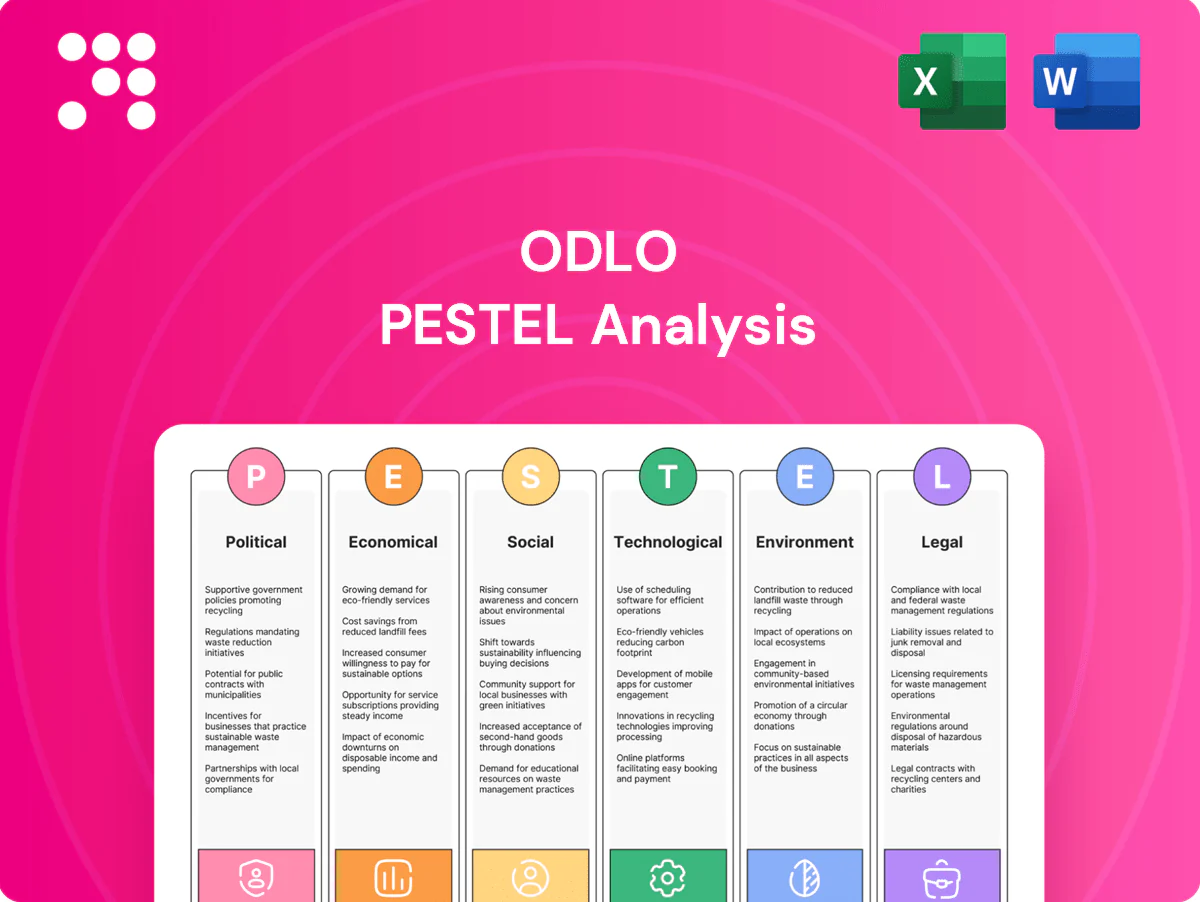
Odlo PESTLE Analysis

Plan Smarter. Present Sharper. Compete Stronger.
Discover how political shifts, economic trends, social preferences, technological advances, legal changes and environmental pressures are shaping Odlo’s future in our concise PESTLE overview. This snapshot highlights key risks and opportunities you need to know. Purchase the full PESTLE analysis to access detailed, actionable intelligence and ready-to-use charts for strategy or investment decisions.
Political factors

Trade policy volatility
Trade policy volatility—shifting tariffs and agreements disrupt fabric and finished-goods flows across Europe, Asia and North America; EU-China goods trade reached about €698bn in 2023, so any escalation can raise landed costs and lead times. Odlo must diversify sourcing, use bonded warehouses and localize suppliers to reduce exposure to abrupt policy shifts.
EU industrial and sustainability agendas
EU policy drives circularity and eco-design for textiles through the Circular Economy Action Plan, the 2022 Textiles Strategy and the Ecodesign for Sustainable Products Regulation proposal. Access to funds such as Horizon Europe (€95.5bn 2021–27) and NextGenerationEU (~€800bn) can subsidize recycling tech and low‑impact manufacturing. Compliance raises short‑term costs but strengthens brand equity and, with the EU targeting a 55% GHG reduction by 2030, early alignment positions Odlo as a preferred partner for public‑private initiatives.

Geopolitical supply-chain risk
Instability in fiber-producing regions (polyamide, elastane) and transit chokepoints disrupt procurement; China supplies roughly 60% of global synthetic fiber capacity and the Suez Canal handles about 12% of world trade, so regional shocks can bottleneck inputs.
Sanctions and export controls on advanced materials in the 2020s have narrowed supplier pools for specialty fabrics and coatings, pressuring lead times and costs.
Odlo needs multi-region sourcing, dual tooling and nearshoring critical SKUs to shorten lead times and safeguard peak-season availability.

Public health and sport promotion
Government programs promoting physical activity raise demand for performance apparel; WHO reports 25% of adults were insufficiently active in 2016 and targets a 15% relative reduction in inactivity by 2030, creating policy-driven market growth opportunities. Partnerships with national federations boost visibility and credibility, while budget cuts or event cancellations (eg COVID-19 era disruptions) can suppress category growth. Odlo can align limited-edition capsules and campaigns with policy-backed events like national fitness weeks to capture uplift.
- Policy tailwinds: WHO target 15% reduction by 2030
- Visibility: national federations enhance brand trust
- Risk: funding cuts/events cancellations reduce demand
- Action: align capsules with official sport/public health events
Customs and origin rules
Rules of origin under FTAs determine duty rates for complex multi-country production and can cut apparel duties to 0% (eg EU–Vietnam EVFTA phased most garment tariffs to 0% by 2023); documentation errors routinely trigger customs penalties and clearance delays (commonly adding 2–5 days per shipment), so Odlo must keep robust traceability and broker relationships to optimize routing and cost-to-serve.
- FTA duty cuts: 0% (EVFTA 2023)
- Typical clearance delay from docs errors: 2–5 days
- Critical actions: traceability, compliant docs, strong brokers
Tariffs, sanctions and China supply concentration raise costs as EU green rules spur demand
Political risks: tariff volatility (EU–China goods €698bn 2023) and sanctions raise landed costs; EU ecodesign rules and funds (Horizon Europe €95.5bn; NextGenerationEU ~€800bn) drive compliance investments; supply concentration (China ~60% synthetic fiber capacity; Suez ~12% trade) and export controls threaten lead times; WHO target 15% inactivity reduction by 2030 creates demand upside.
| Metric | Value |
|---|---|
| EU–China trade (2023) | €698bn |
| Horizon Europe (2021–27) | €95.5bn |
| NextGenerationEU | ~€800bn |
| China synthetic capacity | ~60% |
| Suez share of trade | ~12% |
| WHO inactivity target | -15% by 2030 |
What is included in the product
 Detailed Word Document
Explores how macro-environmental forces uniquely affect Odlo across Political, Economic, Social, Technological, Environmental and Legal dimensions, with data-backed trends, specific subpoints and forward-looking insights to support executives, investors and strategists in identifying risks, opportunities and actionable scenarios.

 Customizable Excel Spreadsheet
A concise, visually segmented PESTLE summary for Odlo that’s easily dropped into presentations, editable for regional/context notes, and shareable across teams to streamline risk discussions and strategic planning.
Economic factors

Consumer spending cycles
Discretionary apparel demand closely follows real income and confidence; the global apparel market was about USD 1.9 trillion in 2024, making income shocks material to Odlo’s volumes. Recessions drive trade-downs and longer replacement cycles, shifting sales toward off-price channels (off-price ~24% of US apparel in 2023) and boosting outlet inventory turns. Premium, durable value propositions reduce churn and protect ASPs. Growing DTC penetration (~20% of apparel sales by 2023) gives Odlo a lever to manage price elasticity and margin mix.
FX fluctuations
Currency swings among CHF, EUR and USD materially affect Odlo’s sourcing costs and translated revenues, with the CHF strengthening roughly 6–9% vs EUR during 2021–2024, pressuring margins on Euro-priced production. Hedging policies cut margin volatility but typically cost firms ~0.5–1.0% of exposure annually, adding to operating expense. Pricing corridors by market limit frequent ticket changes while natural hedges from matching cost and revenue currencies can offset roughly 30–50% of FX exposure.

Input and logistics costs
Oil-derived fibers and transport rates drive COGS—Brent crude averaged about $86/bbl in 2024, keeping polyester feedstock elevated, while Merino wool (AWEX EMI ~A$10/kg in 2024) raises raw-material spend. Energy and labor inflation squeeze mills and cut-sew partners; Odlo can use indexed supply contracts and optimize modal mix, and SKU simplification cuts material waste and complexity.

Channel mix and DTC growth
Shift from wholesale to e-commerce boosts gross margin and control but raises customer acquisition costs and fulfillment spend; global apparel e-commerce penetration reached ~28% in 2024 (eMarketer), increasing digital competition and CAC pressure. Heavy marketplace reliance imposes fee pressure (marketplace referral fees commonly 15–20%) and greater price transparency. Odlo leverages owned digital channels, community engagement, and subscription programs to defend margins, while omnichannel inventory visibility improves sell-through and reduces markdowns.
- Channel shift: higher GM but ↑CAC/fulfillment
- Marketplace: fees 15–20% and price transparency
- Odlo strengths: owned digital, community, subscriptions
- Omnichannel: inventory visibility → better sell-through
Seasonality and inventory risk
Odlo’s winter-sport exposure concentrates revenue into short windows, increasing markdown risk when winters trend warmer; WMO provisional data for 2024 shows global temperatures ≈1.36°C above preindustrial, heightening off-season inventory pressure. Agile in-season replenishment and NOS basics stabilize cash flow, while strict preorder discipline with retailers lowers obsolescence.
- Seasonal concentration: peak Q4–Q1 sales
- Climate signal: 2024 ≈1.36°C above preindustrial (WMO)
- Mitigants: in-season replenishment, NOS
- Retail levers: disciplined preorders to cut obsolescence
Tariffs, sanctions and China supply concentration raise costs as EU green rules spur demand
Apparel market ~USD 1.9T (2024); discretionary demand tied to real incomes, recession risk drives off-price growth. DTC ~20%–28% mix increases margin control but raises CAC; e‑commerce penetration ~28% (2024). CHF strengthened ~6–9% vs EUR (2021–24) pressuring margins; Brent ~$86/bbl (2024) lifts polyester costs.
| Metric | 2024 value |
|---|---|
| Global apparel | USD 1.9T |
| E‑commerce | 28% |
| Brent | $86/bbl |
What You See Is What You Get
Odlo PESTLE Analysis
The preview shown here is the exact Odlo PESTLE Analysis document you’ll receive after purchase—fully formatted and ready to use. The layout, content, and structure visible are identical to the downloadable file. No placeholders or teasers—this is the finished, professionally structured report you’ll get instantly after checkout.

Plan Smarter. Present Sharper. Compete Stronger.
Discover how political shifts, economic trends, social preferences, technological advances, legal changes and environmental pressures are shaping Odlo’s future in our concise PESTLE overview. This snapshot highlights key risks and opportunities you need to know. Purchase the full PESTLE analysis to access detailed, actionable intelligence and ready-to-use charts for strategy or investment decisions.
Political factors
Trade policy volatility
Trade policy volatility—shifting tariffs and agreements disrupt fabric and finished-goods flows across Europe, Asia and North America; EU-China goods trade reached about €698bn in 2023, so any escalation can raise landed costs and lead times. Odlo must diversify sourcing, use bonded warehouses and localize suppliers to reduce exposure to abrupt policy shifts.
EU industrial and sustainability agendas
EU policy drives circularity and eco-design for textiles through the Circular Economy Action Plan, the 2022 Textiles Strategy and the Ecodesign for Sustainable Products Regulation proposal. Access to funds such as Horizon Europe (€95.5bn 2021–27) and NextGenerationEU (~€800bn) can subsidize recycling tech and low‑impact manufacturing. Compliance raises short‑term costs but strengthens brand equity and, with the EU targeting a 55% GHG reduction by 2030, early alignment positions Odlo as a preferred partner for public‑private initiatives.
Geopolitical supply-chain risk
Instability in fiber-producing regions (polyamide, elastane) and transit chokepoints disrupt procurement; China supplies roughly 60% of global synthetic fiber capacity and the Suez Canal handles about 12% of world trade, so regional shocks can bottleneck inputs.
Sanctions and export controls on advanced materials in the 2020s have narrowed supplier pools for specialty fabrics and coatings, pressuring lead times and costs.
Odlo needs multi-region sourcing, dual tooling and nearshoring critical SKUs to shorten lead times and safeguard peak-season availability.
Public health and sport promotion
Government programs promoting physical activity raise demand for performance apparel; WHO reports 25% of adults were insufficiently active in 2016 and targets a 15% relative reduction in inactivity by 2030, creating policy-driven market growth opportunities. Partnerships with national federations boost visibility and credibility, while budget cuts or event cancellations (eg COVID-19 era disruptions) can suppress category growth. Odlo can align limited-edition capsules and campaigns with policy-backed events like national fitness weeks to capture uplift.
- Policy tailwinds: WHO target 15% reduction by 2030
- Visibility: national federations enhance brand trust
- Risk: funding cuts/events cancellations reduce demand
- Action: align capsules with official sport/public health events
Customs and origin rules
Rules of origin under FTAs determine duty rates for complex multi-country production and can cut apparel duties to 0% (eg EU–Vietnam EVFTA phased most garment tariffs to 0% by 2023); documentation errors routinely trigger customs penalties and clearance delays (commonly adding 2–5 days per shipment), so Odlo must keep robust traceability and broker relationships to optimize routing and cost-to-serve.
- FTA duty cuts: 0% (EVFTA 2023)
- Typical clearance delay from docs errors: 2–5 days
- Critical actions: traceability, compliant docs, strong brokers
Tariffs, sanctions and China supply concentration raise costs as EU green rules spur demand
Political risks: tariff volatility (EU–China goods €698bn 2023) and sanctions raise landed costs; EU ecodesign rules and funds (Horizon Europe €95.5bn; NextGenerationEU ~€800bn) drive compliance investments; supply concentration (China ~60% synthetic fiber capacity; Suez ~12% trade) and export controls threaten lead times; WHO target 15% inactivity reduction by 2030 creates demand upside.
| Metric | Value |
|---|---|
| EU–China trade (2023) | €698bn |
| Horizon Europe (2021–27) | €95.5bn |
| NextGenerationEU | ~€800bn |
| China synthetic capacity | ~60% |
| Suez share of trade | ~12% |
| WHO inactivity target | -15% by 2030 |
What is included in the product
Detailed Word Document
Explores how macro-environmental forces uniquely affect Odlo across Political, Economic, Social, Technological, Environmental and Legal dimensions, with data-backed trends, specific subpoints and forward-looking insights to support executives, investors and strategists in identifying risks, opportunities and actionable scenarios.
Customizable Excel Spreadsheet
A concise, visually segmented PESTLE summary for Odlo that’s easily dropped into presentations, editable for regional/context notes, and shareable across teams to streamline risk discussions and strategic planning.
Economic factors
Consumer spending cycles
Discretionary apparel demand closely follows real income and confidence; the global apparel market was about USD 1.9 trillion in 2024, making income shocks material to Odlo’s volumes. Recessions drive trade-downs and longer replacement cycles, shifting sales toward off-price channels (off-price ~24% of US apparel in 2023) and boosting outlet inventory turns. Premium, durable value propositions reduce churn and protect ASPs. Growing DTC penetration (~20% of apparel sales by 2023) gives Odlo a lever to manage price elasticity and margin mix.
FX fluctuations
Currency swings among CHF, EUR and USD materially affect Odlo’s sourcing costs and translated revenues, with the CHF strengthening roughly 6–9% vs EUR during 2021–2024, pressuring margins on Euro-priced production. Hedging policies cut margin volatility but typically cost firms ~0.5–1.0% of exposure annually, adding to operating expense. Pricing corridors by market limit frequent ticket changes while natural hedges from matching cost and revenue currencies can offset roughly 30–50% of FX exposure.
Input and logistics costs
Oil-derived fibers and transport rates drive COGS—Brent crude averaged about $86/bbl in 2024, keeping polyester feedstock elevated, while Merino wool (AWEX EMI ~A$10/kg in 2024) raises raw-material spend. Energy and labor inflation squeeze mills and cut-sew partners; Odlo can use indexed supply contracts and optimize modal mix, and SKU simplification cuts material waste and complexity.
Channel mix and DTC growth
Shift from wholesale to e-commerce boosts gross margin and control but raises customer acquisition costs and fulfillment spend; global apparel e-commerce penetration reached ~28% in 2024 (eMarketer), increasing digital competition and CAC pressure. Heavy marketplace reliance imposes fee pressure (marketplace referral fees commonly 15–20%) and greater price transparency. Odlo leverages owned digital channels, community engagement, and subscription programs to defend margins, while omnichannel inventory visibility improves sell-through and reduces markdowns.
- Channel shift: higher GM but ↑CAC/fulfillment
- Marketplace: fees 15–20% and price transparency
- Odlo strengths: owned digital, community, subscriptions
- Omnichannel: inventory visibility → better sell-through
Seasonality and inventory risk
Odlo’s winter-sport exposure concentrates revenue into short windows, increasing markdown risk when winters trend warmer; WMO provisional data for 2024 shows global temperatures ≈1.36°C above preindustrial, heightening off-season inventory pressure. Agile in-season replenishment and NOS basics stabilize cash flow, while strict preorder discipline with retailers lowers obsolescence.
- Seasonal concentration: peak Q4–Q1 sales
- Climate signal: 2024 ≈1.36°C above preindustrial (WMO)
- Mitigants: in-season replenishment, NOS
- Retail levers: disciplined preorders to cut obsolescence
Tariffs, sanctions and China supply concentration raise costs as EU green rules spur demand
Apparel market ~USD 1.9T (2024); discretionary demand tied to real incomes, recession risk drives off-price growth. DTC ~20%–28% mix increases margin control but raises CAC; e‑commerce penetration ~28% (2024). CHF strengthened ~6–9% vs EUR (2021–24) pressuring margins; Brent ~$86/bbl (2024) lifts polyester costs.
| Metric | 2024 value |
|---|---|
| Global apparel | USD 1.9T |
| E‑commerce | 28% |
| Brent | $86/bbl |
What You See Is What You Get
Odlo PESTLE Analysis
The preview shown here is the exact Odlo PESTLE Analysis document you’ll receive after purchase—fully formatted and ready to use. The layout, content, and structure visible are identical to the downloadable file. No placeholders or teasers—this is the finished, professionally structured report you’ll get instantly after checkout.
Description
Plan Smarter. Present Sharper. Compete Stronger.
Discover how political shifts, economic trends, social preferences, technological advances, legal changes and environmental pressures are shaping Odlo’s future in our concise PESTLE overview. This snapshot highlights key risks and opportunities you need to know. Purchase the full PESTLE analysis to access detailed, actionable intelligence and ready-to-use charts for strategy or investment decisions.
Political factors
Trade policy volatility
Trade policy volatility—shifting tariffs and agreements disrupt fabric and finished-goods flows across Europe, Asia and North America; EU-China goods trade reached about €698bn in 2023, so any escalation can raise landed costs and lead times. Odlo must diversify sourcing, use bonded warehouses and localize suppliers to reduce exposure to abrupt policy shifts.
EU industrial and sustainability agendas
EU policy drives circularity and eco-design for textiles through the Circular Economy Action Plan, the 2022 Textiles Strategy and the Ecodesign for Sustainable Products Regulation proposal. Access to funds such as Horizon Europe (€95.5bn 2021–27) and NextGenerationEU (~€800bn) can subsidize recycling tech and low‑impact manufacturing. Compliance raises short‑term costs but strengthens brand equity and, with the EU targeting a 55% GHG reduction by 2030, early alignment positions Odlo as a preferred partner for public‑private initiatives.
Geopolitical supply-chain risk
Instability in fiber-producing regions (polyamide, elastane) and transit chokepoints disrupt procurement; China supplies roughly 60% of global synthetic fiber capacity and the Suez Canal handles about 12% of world trade, so regional shocks can bottleneck inputs.
Sanctions and export controls on advanced materials in the 2020s have narrowed supplier pools for specialty fabrics and coatings, pressuring lead times and costs.
Odlo needs multi-region sourcing, dual tooling and nearshoring critical SKUs to shorten lead times and safeguard peak-season availability.
Public health and sport promotion
Government programs promoting physical activity raise demand for performance apparel; WHO reports 25% of adults were insufficiently active in 2016 and targets a 15% relative reduction in inactivity by 2030, creating policy-driven market growth opportunities. Partnerships with national federations boost visibility and credibility, while budget cuts or event cancellations (eg COVID-19 era disruptions) can suppress category growth. Odlo can align limited-edition capsules and campaigns with policy-backed events like national fitness weeks to capture uplift.
- Policy tailwinds: WHO target 15% reduction by 2030
- Visibility: national federations enhance brand trust
- Risk: funding cuts/events cancellations reduce demand
- Action: align capsules with official sport/public health events
Customs and origin rules
Rules of origin under FTAs determine duty rates for complex multi-country production and can cut apparel duties to 0% (eg EU–Vietnam EVFTA phased most garment tariffs to 0% by 2023); documentation errors routinely trigger customs penalties and clearance delays (commonly adding 2–5 days per shipment), so Odlo must keep robust traceability and broker relationships to optimize routing and cost-to-serve.
- FTA duty cuts: 0% (EVFTA 2023)
- Typical clearance delay from docs errors: 2–5 days
- Critical actions: traceability, compliant docs, strong brokers
Tariffs, sanctions and China supply concentration raise costs as EU green rules spur demand
Political risks: tariff volatility (EU–China goods €698bn 2023) and sanctions raise landed costs; EU ecodesign rules and funds (Horizon Europe €95.5bn; NextGenerationEU ~€800bn) drive compliance investments; supply concentration (China ~60% synthetic fiber capacity; Suez ~12% trade) and export controls threaten lead times; WHO target 15% inactivity reduction by 2030 creates demand upside.
| Metric | Value |
|---|---|
| EU–China trade (2023) | €698bn |
| Horizon Europe (2021–27) | €95.5bn |
| NextGenerationEU | ~€800bn |
| China synthetic capacity | ~60% |
| Suez share of trade | ~12% |
| WHO inactivity target | -15% by 2030 |
What is included in the product
Detailed Word Document
Explores how macro-environmental forces uniquely affect Odlo across Political, Economic, Social, Technological, Environmental and Legal dimensions, with data-backed trends, specific subpoints and forward-looking insights to support executives, investors and strategists in identifying risks, opportunities and actionable scenarios.
Customizable Excel Spreadsheet
A concise, visually segmented PESTLE summary for Odlo that’s easily dropped into presentations, editable for regional/context notes, and shareable across teams to streamline risk discussions and strategic planning.
Economic factors
Consumer spending cycles
Discretionary apparel demand closely follows real income and confidence; the global apparel market was about USD 1.9 trillion in 2024, making income shocks material to Odlo’s volumes. Recessions drive trade-downs and longer replacement cycles, shifting sales toward off-price channels (off-price ~24% of US apparel in 2023) and boosting outlet inventory turns. Premium, durable value propositions reduce churn and protect ASPs. Growing DTC penetration (~20% of apparel sales by 2023) gives Odlo a lever to manage price elasticity and margin mix.
FX fluctuations
Currency swings among CHF, EUR and USD materially affect Odlo’s sourcing costs and translated revenues, with the CHF strengthening roughly 6–9% vs EUR during 2021–2024, pressuring margins on Euro-priced production. Hedging policies cut margin volatility but typically cost firms ~0.5–1.0% of exposure annually, adding to operating expense. Pricing corridors by market limit frequent ticket changes while natural hedges from matching cost and revenue currencies can offset roughly 30–50% of FX exposure.
Input and logistics costs
Oil-derived fibers and transport rates drive COGS—Brent crude averaged about $86/bbl in 2024, keeping polyester feedstock elevated, while Merino wool (AWEX EMI ~A$10/kg in 2024) raises raw-material spend. Energy and labor inflation squeeze mills and cut-sew partners; Odlo can use indexed supply contracts and optimize modal mix, and SKU simplification cuts material waste and complexity.
Channel mix and DTC growth
Shift from wholesale to e-commerce boosts gross margin and control but raises customer acquisition costs and fulfillment spend; global apparel e-commerce penetration reached ~28% in 2024 (eMarketer), increasing digital competition and CAC pressure. Heavy marketplace reliance imposes fee pressure (marketplace referral fees commonly 15–20%) and greater price transparency. Odlo leverages owned digital channels, community engagement, and subscription programs to defend margins, while omnichannel inventory visibility improves sell-through and reduces markdowns.
- Channel shift: higher GM but ↑CAC/fulfillment
- Marketplace: fees 15–20% and price transparency
- Odlo strengths: owned digital, community, subscriptions
- Omnichannel: inventory visibility → better sell-through
Seasonality and inventory risk
Odlo’s winter-sport exposure concentrates revenue into short windows, increasing markdown risk when winters trend warmer; WMO provisional data for 2024 shows global temperatures ≈1.36°C above preindustrial, heightening off-season inventory pressure. Agile in-season replenishment and NOS basics stabilize cash flow, while strict preorder discipline with retailers lowers obsolescence.
- Seasonal concentration: peak Q4–Q1 sales
- Climate signal: 2024 ≈1.36°C above preindustrial (WMO)
- Mitigants: in-season replenishment, NOS
- Retail levers: disciplined preorders to cut obsolescence
Tariffs, sanctions and China supply concentration raise costs as EU green rules spur demand
Apparel market ~USD 1.9T (2024); discretionary demand tied to real incomes, recession risk drives off-price growth. DTC ~20%–28% mix increases margin control but raises CAC; e‑commerce penetration ~28% (2024). CHF strengthened ~6–9% vs EUR (2021–24) pressuring margins; Brent ~$86/bbl (2024) lifts polyester costs.
| Metric | 2024 value |
|---|---|
| Global apparel | USD 1.9T |
| E‑commerce | 28% |
| Brent | $86/bbl |
What You See Is What You Get
Odlo PESTLE Analysis
The preview shown here is the exact Odlo PESTLE Analysis document you’ll receive after purchase—fully formatted and ready to use. The layout, content, and structure visible are identical to the downloadable file. No placeholders or teasers—this is the finished, professionally structured report you’ll get instantly after checkout.











