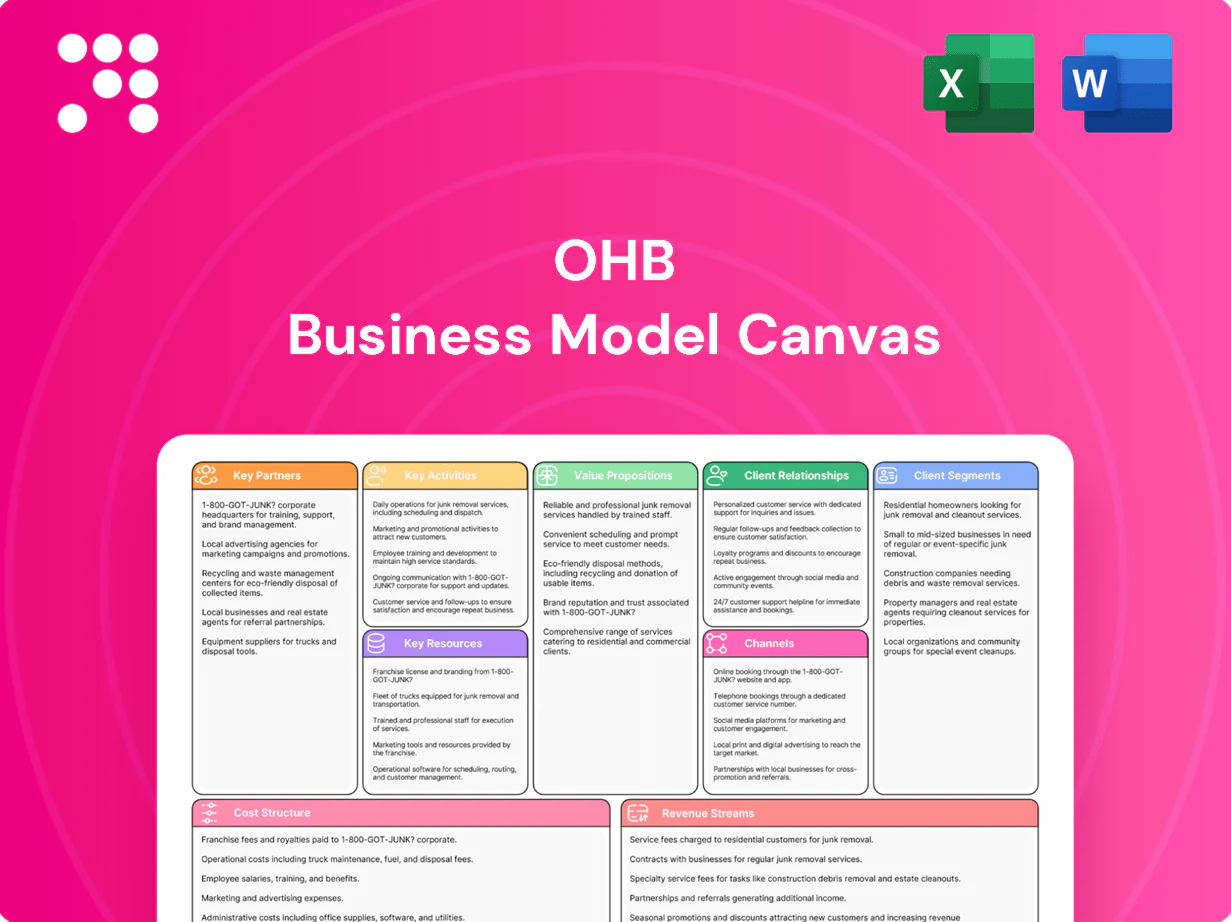
OHB Business Model Canvas

Concise Business Model Canvas: Core Value, Partners & Revenue Levers
Unlock OHB's strategic playbook with our concise Business Model Canvas—three-to-five sentence overview revealing core value propositions, key partners, and revenue levers. Download the full, editable Word & Excel canvas for a section-by-section breakdown to benchmark, plan, or pitch with confidence.
Partnerships

ESA, European Commission, and EUSPA
ESA, the European Commission and EUSPA provide OHB with flagship programs, funding and mission mandates across navigation, EO and security, anchored in the EU Space Programme budget of €14.88 billion for 2021–2027. These partnerships secure multi-year backlogs and technology roadmaps, enabling co-development structures that lower program risk. Compliance with EU space policy reinforces European strategic autonomy and standards alignment.
National space agencies (DLR, ASI, CNES, etc.)
National agencies such as DLR, ASI and CNES sponsor missions, demonstrators and payloads that feed into larger European programs, notably the EU Space Programme budget of €14.9bn (2021–27). They provide testbeds, co-financing and national infrastructure access, shortening development cycles. Bilateral agreements build niche capabilities and mission heritage, expanding OHB’s client base. This network diversifies revenue and reduces dependency on single tenders.

Launch providers (Arianespace, Vega, SpaceX)
Launch partnerships with Arianespace, Vega and SpaceX secure slots, mission assurance and rideshare options across microsat to large payloads; SpaceX conducted the most global launches in 2024, while Ariane 6’s maiden flight remained slated for 2024/25. Coordinated integration schedules and standardized technical interfaces reduce AIT delays and cost overruns. Multi-provider flexibility mitigates single-provider risk and supports firm time-to-orbit commitments.

Subsystem and component suppliers
Trusted suppliers for payloads, propulsion, power, avionics, and structures underpin OHB’s mission performance and reliability, with long-term contracts stabilizing pricing and supply and shortening lead-time volatility. Qualified vendor lists and pre-approved parts reduce programmatic risk and certification cycles, while co-engineering arrangements improve integration efficiency and lower systems-level costs.
- Trusted suppliers: performance & reliability
- Long-term agreements: pricing & supply stability
- Qualified vendors: lower risk, faster certification
- Co-engineering: improved integration, cost reduction
Universities and research institutes
Academic partners supply frontier research, payload concepts and talent pipelines; joint projects with universities de-risk early-stage tech and help secure Horizon Europe grants from the €95.5bn 2021–27 programme, accelerating access to funding.
- TRL acceleration via university labs and testbeds
- Publication/heritage boosts bid competitiveness
- Talent pipeline reduces recruitment cost
ESA and EU mandates plus Horizon and national support anchor multi-year space funding
ESA/EU/EUSPA secure multi-year mandates and access to the €14.88bn EU Space Programme (2021–27), anchoring OHB’s backlog and co-development funding. National agencies (DLR, ASI, CNES) provide testbeds, co-financing and mission heritage; Horizon Europe (€95.5bn 2021–27) funds academic tech de-risking. Launch suppliers (Arianespace, Vega, SpaceX) and trusted vendors stabilize schedules, cost and certification.
| Partner | Role | Relevant 2021–27 funding |
|---|---|---|
| ESA/EU/EUSPA | Program mandates, funding | €14.88bn |
| Horizon Europe | R&D grants, universities | €95.5bn |
What is included in the product
 Detailed Word Document
A comprehensive, pre-written Business Model Canvas tailored to OHB, covering customer segments, channels, value propositions and revenue streams across the 9 classic blocks with real-world operations and strategic plans; includes competitive-advantage analysis, linked SWOT, and polished narratives ideal for presentations, funding or internal strategy validation.

 Customizable Excel Spreadsheet
Condenses OHB’s strategy into a digestible one-page canvas with editable cells, saving hours of formatting while enabling fast, shareable collaboration for boardrooms, teams, and side-by-side comparisons.
Activities

Satellite design, manufacturing, and AIT
End-to-end platform development covers requirements capture through assembly, integration, and testing, following ECSS processes and typically supporting qualification profiles (vibration up to ~14 g rms, thermal-vacuum cycles from about -40 to +60°C). Cleanroom operations maintain ISO 14644 class 7/8 and environmental testing to secure flight readiness. Modular bus architectures enable reuse across LEO and GEO platforms, reducing integration time by up to ~30% in industry benchmarks. Quality gates at design, AIT, and delivery ensure compliance with ECSS and ISO standards.
Mission engineering and systems integration
Mission engineering and systems integration at OHB consolidates system-level architecture, payload integration and cross-partner interface management; concurrent engineering shortens cycles and aligns stakeholders. Rigorous risk, reliability and safety analyses drive design trade-offs, while verification and validation programs underpin acceptance reviews, leveraging EU space programme funding of €14.8bn (2021–27).

Ground segment and operations solutions
Development of control centers, data processing chains and TT&C systems enable operations for constellations of hundreds of satellites, supporting multi-mission scalability. Secure networks and hardened software maintain industry-standard 99.9% availability SLAs to ensure mission continuity. Automation of routine workflows cuts operator task time significantly (studies report up to 40%), lowering OPEX for operations teams.

Program management and regulatory compliance
Program management enforces schedule, budget, and vendor governance across multi-year programs, with export control, cyber, and security standards embedded in all phases to align with ESA/EU procurement norms.
Documentation and audits are maintained to meet ESA/EU requirements, and stakeholder reporting preserves transparency and trust throughout program lifecycles.
- Schedule, budget, vendor governance
- Export control, cyber, security embedded
- Documentation & audits per ESA/EU
- Transparent stakeholder reporting
R&D and technology maturation
R&D and technology maturation at OHB focuses investments in payloads, propulsion, miniaturization and autonomy, advancing prototypes and demonstration missions that raise TRL from 4–5 toward 6–7 to strengthen future bid competitiveness. Strategic partnerships leverage grants such as Horizon Europe (budget €95.5 billion 2021–27) and ESA programmes to offset development costs. Consolidating IP from demonstrators enhances differentiation and margin potential.
- Investments: payloads, propulsion, miniaturization, autonomy
- TRL uplift: demos move tech to TRL 6–7
- Funding leverage: Horizon Europe €95.5bn + ESA
- IP consolidation: higher differentiation and margins
ECSS platform: modular buses cut integration -30%, ops 99.9% availability
End-to-end platform development follows ECSS, supports qualification (~14 g rms, -40 to +60°C) with ISO 14644 class 7/8 cleanrooms; modular buses cut integration time up to 30%. Mission engineering, risk/reliability analyses and V&V align with EU space funding (€14.8bn 2021–27). Operations deliver 99.9% availability; automation can cut operator tasks up to 40%. R&D leverages Horizon Europe (€95.5bn 2021–27) to raise TRLs to 6–7.
| Metric | Value |
|---|---|
| Vibration | ~14 g rms |
| Thermal | -40 to +60°C |
| Cleanroom | ISO 14644 class 7/8 |
| Availability | 99.9% |
| Integration time | -30% |
| Operator task time | -40% |
| EU space funding | €14.8bn (2021–27) |
| Horizon Europe | €95.5bn (2021–27) |
Delivered as Displayed
Business Model Canvas
The OHB Business Model Canvas shown here is the actual deliverable, not a mockup—what you see is a direct snapshot of the final file you’ll receive after purchase. Upon completing your order you’ll get this same document in editable formats, fully formatted and ready to use. No fillers, no surprises—just the exact, complete canvas ready to present or adapt.

Concise Business Model Canvas: Core Value, Partners & Revenue Levers
Unlock OHB's strategic playbook with our concise Business Model Canvas—three-to-five sentence overview revealing core value propositions, key partners, and revenue levers. Download the full, editable Word & Excel canvas for a section-by-section breakdown to benchmark, plan, or pitch with confidence.
Partnerships
ESA, European Commission, and EUSPA
ESA, the European Commission and EUSPA provide OHB with flagship programs, funding and mission mandates across navigation, EO and security, anchored in the EU Space Programme budget of €14.88 billion for 2021–2027. These partnerships secure multi-year backlogs and technology roadmaps, enabling co-development structures that lower program risk. Compliance with EU space policy reinforces European strategic autonomy and standards alignment.
National space agencies (DLR, ASI, CNES, etc.)
National agencies such as DLR, ASI and CNES sponsor missions, demonstrators and payloads that feed into larger European programs, notably the EU Space Programme budget of €14.9bn (2021–27). They provide testbeds, co-financing and national infrastructure access, shortening development cycles. Bilateral agreements build niche capabilities and mission heritage, expanding OHB’s client base. This network diversifies revenue and reduces dependency on single tenders.
Launch providers (Arianespace, Vega, SpaceX)
Launch partnerships with Arianespace, Vega and SpaceX secure slots, mission assurance and rideshare options across microsat to large payloads; SpaceX conducted the most global launches in 2024, while Ariane 6’s maiden flight remained slated for 2024/25. Coordinated integration schedules and standardized technical interfaces reduce AIT delays and cost overruns. Multi-provider flexibility mitigates single-provider risk and supports firm time-to-orbit commitments.
Subsystem and component suppliers
Trusted suppliers for payloads, propulsion, power, avionics, and structures underpin OHB’s mission performance and reliability, with long-term contracts stabilizing pricing and supply and shortening lead-time volatility. Qualified vendor lists and pre-approved parts reduce programmatic risk and certification cycles, while co-engineering arrangements improve integration efficiency and lower systems-level costs.
- Trusted suppliers: performance & reliability
- Long-term agreements: pricing & supply stability
- Qualified vendors: lower risk, faster certification
- Co-engineering: improved integration, cost reduction
Universities and research institutes
Academic partners supply frontier research, payload concepts and talent pipelines; joint projects with universities de-risk early-stage tech and help secure Horizon Europe grants from the €95.5bn 2021–27 programme, accelerating access to funding.
- TRL acceleration via university labs and testbeds
- Publication/heritage boosts bid competitiveness
- Talent pipeline reduces recruitment cost
ESA and EU mandates plus Horizon and national support anchor multi-year space funding
ESA/EU/EUSPA secure multi-year mandates and access to the €14.88bn EU Space Programme (2021–27), anchoring OHB’s backlog and co-development funding. National agencies (DLR, ASI, CNES) provide testbeds, co-financing and mission heritage; Horizon Europe (€95.5bn 2021–27) funds academic tech de-risking. Launch suppliers (Arianespace, Vega, SpaceX) and trusted vendors stabilize schedules, cost and certification.
| Partner | Role | Relevant 2021–27 funding |
|---|---|---|
| ESA/EU/EUSPA | Program mandates, funding | €14.88bn |
| Horizon Europe | R&D grants, universities | €95.5bn |
What is included in the product
Detailed Word Document
A comprehensive, pre-written Business Model Canvas tailored to OHB, covering customer segments, channels, value propositions and revenue streams across the 9 classic blocks with real-world operations and strategic plans; includes competitive-advantage analysis, linked SWOT, and polished narratives ideal for presentations, funding or internal strategy validation.
Customizable Excel Spreadsheet
Condenses OHB’s strategy into a digestible one-page canvas with editable cells, saving hours of formatting while enabling fast, shareable collaboration for boardrooms, teams, and side-by-side comparisons.
Activities
Satellite design, manufacturing, and AIT
End-to-end platform development covers requirements capture through assembly, integration, and testing, following ECSS processes and typically supporting qualification profiles (vibration up to ~14 g rms, thermal-vacuum cycles from about -40 to +60°C). Cleanroom operations maintain ISO 14644 class 7/8 and environmental testing to secure flight readiness. Modular bus architectures enable reuse across LEO and GEO platforms, reducing integration time by up to ~30% in industry benchmarks. Quality gates at design, AIT, and delivery ensure compliance with ECSS and ISO standards.
Mission engineering and systems integration
Mission engineering and systems integration at OHB consolidates system-level architecture, payload integration and cross-partner interface management; concurrent engineering shortens cycles and aligns stakeholders. Rigorous risk, reliability and safety analyses drive design trade-offs, while verification and validation programs underpin acceptance reviews, leveraging EU space programme funding of €14.8bn (2021–27).
Ground segment and operations solutions
Development of control centers, data processing chains and TT&C systems enable operations for constellations of hundreds of satellites, supporting multi-mission scalability. Secure networks and hardened software maintain industry-standard 99.9% availability SLAs to ensure mission continuity. Automation of routine workflows cuts operator task time significantly (studies report up to 40%), lowering OPEX for operations teams.
Program management and regulatory compliance
Program management enforces schedule, budget, and vendor governance across multi-year programs, with export control, cyber, and security standards embedded in all phases to align with ESA/EU procurement norms.
Documentation and audits are maintained to meet ESA/EU requirements, and stakeholder reporting preserves transparency and trust throughout program lifecycles.
- Schedule, budget, vendor governance
- Export control, cyber, security embedded
- Documentation & audits per ESA/EU
- Transparent stakeholder reporting
R&D and technology maturation
R&D and technology maturation at OHB focuses investments in payloads, propulsion, miniaturization and autonomy, advancing prototypes and demonstration missions that raise TRL from 4–5 toward 6–7 to strengthen future bid competitiveness. Strategic partnerships leverage grants such as Horizon Europe (budget €95.5 billion 2021–27) and ESA programmes to offset development costs. Consolidating IP from demonstrators enhances differentiation and margin potential.
- Investments: payloads, propulsion, miniaturization, autonomy
- TRL uplift: demos move tech to TRL 6–7
- Funding leverage: Horizon Europe €95.5bn + ESA
- IP consolidation: higher differentiation and margins
ECSS platform: modular buses cut integration -30%, ops 99.9% availability
End-to-end platform development follows ECSS, supports qualification (~14 g rms, -40 to +60°C) with ISO 14644 class 7/8 cleanrooms; modular buses cut integration time up to 30%. Mission engineering, risk/reliability analyses and V&V align with EU space funding (€14.8bn 2021–27). Operations deliver 99.9% availability; automation can cut operator tasks up to 40%. R&D leverages Horizon Europe (€95.5bn 2021–27) to raise TRLs to 6–7.
| Metric | Value |
|---|---|
| Vibration | ~14 g rms |
| Thermal | -40 to +60°C |
| Cleanroom | ISO 14644 class 7/8 |
| Availability | 99.9% |
| Integration time | -30% |
| Operator task time | -40% |
| EU space funding | €14.8bn (2021–27) |
| Horizon Europe | €95.5bn (2021–27) |
Delivered as Displayed
Business Model Canvas
The OHB Business Model Canvas shown here is the actual deliverable, not a mockup—what you see is a direct snapshot of the final file you’ll receive after purchase. Upon completing your order you’ll get this same document in editable formats, fully formatted and ready to use. No fillers, no surprises—just the exact, complete canvas ready to present or adapt.
Description
Concise Business Model Canvas: Core Value, Partners & Revenue Levers
Unlock OHB's strategic playbook with our concise Business Model Canvas—three-to-five sentence overview revealing core value propositions, key partners, and revenue levers. Download the full, editable Word & Excel canvas for a section-by-section breakdown to benchmark, plan, or pitch with confidence.
Partnerships
ESA, European Commission, and EUSPA
ESA, the European Commission and EUSPA provide OHB with flagship programs, funding and mission mandates across navigation, EO and security, anchored in the EU Space Programme budget of €14.88 billion for 2021–2027. These partnerships secure multi-year backlogs and technology roadmaps, enabling co-development structures that lower program risk. Compliance with EU space policy reinforces European strategic autonomy and standards alignment.
National space agencies (DLR, ASI, CNES, etc.)
National agencies such as DLR, ASI and CNES sponsor missions, demonstrators and payloads that feed into larger European programs, notably the EU Space Programme budget of €14.9bn (2021–27). They provide testbeds, co-financing and national infrastructure access, shortening development cycles. Bilateral agreements build niche capabilities and mission heritage, expanding OHB’s client base. This network diversifies revenue and reduces dependency on single tenders.
Launch providers (Arianespace, Vega, SpaceX)
Launch partnerships with Arianespace, Vega and SpaceX secure slots, mission assurance and rideshare options across microsat to large payloads; SpaceX conducted the most global launches in 2024, while Ariane 6’s maiden flight remained slated for 2024/25. Coordinated integration schedules and standardized technical interfaces reduce AIT delays and cost overruns. Multi-provider flexibility mitigates single-provider risk and supports firm time-to-orbit commitments.
Subsystem and component suppliers
Trusted suppliers for payloads, propulsion, power, avionics, and structures underpin OHB’s mission performance and reliability, with long-term contracts stabilizing pricing and supply and shortening lead-time volatility. Qualified vendor lists and pre-approved parts reduce programmatic risk and certification cycles, while co-engineering arrangements improve integration efficiency and lower systems-level costs.
- Trusted suppliers: performance & reliability
- Long-term agreements: pricing & supply stability
- Qualified vendors: lower risk, faster certification
- Co-engineering: improved integration, cost reduction
Universities and research institutes
Academic partners supply frontier research, payload concepts and talent pipelines; joint projects with universities de-risk early-stage tech and help secure Horizon Europe grants from the €95.5bn 2021–27 programme, accelerating access to funding.
- TRL acceleration via university labs and testbeds
- Publication/heritage boosts bid competitiveness
- Talent pipeline reduces recruitment cost
ESA and EU mandates plus Horizon and national support anchor multi-year space funding
ESA/EU/EUSPA secure multi-year mandates and access to the €14.88bn EU Space Programme (2021–27), anchoring OHB’s backlog and co-development funding. National agencies (DLR, ASI, CNES) provide testbeds, co-financing and mission heritage; Horizon Europe (€95.5bn 2021–27) funds academic tech de-risking. Launch suppliers (Arianespace, Vega, SpaceX) and trusted vendors stabilize schedules, cost and certification.
| Partner | Role | Relevant 2021–27 funding |
|---|---|---|
| ESA/EU/EUSPA | Program mandates, funding | €14.88bn |
| Horizon Europe | R&D grants, universities | €95.5bn |
What is included in the product
Detailed Word Document
A comprehensive, pre-written Business Model Canvas tailored to OHB, covering customer segments, channels, value propositions and revenue streams across the 9 classic blocks with real-world operations and strategic plans; includes competitive-advantage analysis, linked SWOT, and polished narratives ideal for presentations, funding or internal strategy validation.
Customizable Excel Spreadsheet
Condenses OHB’s strategy into a digestible one-page canvas with editable cells, saving hours of formatting while enabling fast, shareable collaboration for boardrooms, teams, and side-by-side comparisons.
Activities
Satellite design, manufacturing, and AIT
End-to-end platform development covers requirements capture through assembly, integration, and testing, following ECSS processes and typically supporting qualification profiles (vibration up to ~14 g rms, thermal-vacuum cycles from about -40 to +60°C). Cleanroom operations maintain ISO 14644 class 7/8 and environmental testing to secure flight readiness. Modular bus architectures enable reuse across LEO and GEO platforms, reducing integration time by up to ~30% in industry benchmarks. Quality gates at design, AIT, and delivery ensure compliance with ECSS and ISO standards.
Mission engineering and systems integration
Mission engineering and systems integration at OHB consolidates system-level architecture, payload integration and cross-partner interface management; concurrent engineering shortens cycles and aligns stakeholders. Rigorous risk, reliability and safety analyses drive design trade-offs, while verification and validation programs underpin acceptance reviews, leveraging EU space programme funding of €14.8bn (2021–27).
Ground segment and operations solutions
Development of control centers, data processing chains and TT&C systems enable operations for constellations of hundreds of satellites, supporting multi-mission scalability. Secure networks and hardened software maintain industry-standard 99.9% availability SLAs to ensure mission continuity. Automation of routine workflows cuts operator task time significantly (studies report up to 40%), lowering OPEX for operations teams.
Program management and regulatory compliance
Program management enforces schedule, budget, and vendor governance across multi-year programs, with export control, cyber, and security standards embedded in all phases to align with ESA/EU procurement norms.
Documentation and audits are maintained to meet ESA/EU requirements, and stakeholder reporting preserves transparency and trust throughout program lifecycles.
- Schedule, budget, vendor governance
- Export control, cyber, security embedded
- Documentation & audits per ESA/EU
- Transparent stakeholder reporting
R&D and technology maturation
R&D and technology maturation at OHB focuses investments in payloads, propulsion, miniaturization and autonomy, advancing prototypes and demonstration missions that raise TRL from 4–5 toward 6–7 to strengthen future bid competitiveness. Strategic partnerships leverage grants such as Horizon Europe (budget €95.5 billion 2021–27) and ESA programmes to offset development costs. Consolidating IP from demonstrators enhances differentiation and margin potential.
- Investments: payloads, propulsion, miniaturization, autonomy
- TRL uplift: demos move tech to TRL 6–7
- Funding leverage: Horizon Europe €95.5bn + ESA
- IP consolidation: higher differentiation and margins
ECSS platform: modular buses cut integration -30%, ops 99.9% availability
End-to-end platform development follows ECSS, supports qualification (~14 g rms, -40 to +60°C) with ISO 14644 class 7/8 cleanrooms; modular buses cut integration time up to 30%. Mission engineering, risk/reliability analyses and V&V align with EU space funding (€14.8bn 2021–27). Operations deliver 99.9% availability; automation can cut operator tasks up to 40%. R&D leverages Horizon Europe (€95.5bn 2021–27) to raise TRLs to 6–7.
| Metric | Value |
|---|---|
| Vibration | ~14 g rms |
| Thermal | -40 to +60°C |
| Cleanroom | ISO 14644 class 7/8 |
| Availability | 99.9% |
| Integration time | -30% |
| Operator task time | -40% |
| EU space funding | €14.8bn (2021–27) |
| Horizon Europe | €95.5bn (2021–27) |
Delivered as Displayed
Business Model Canvas
The OHB Business Model Canvas shown here is the actual deliverable, not a mockup—what you see is a direct snapshot of the final file you’ll receive after purchase. Upon completing your order you’ll get this same document in editable formats, fully formatted and ready to use. No fillers, no surprises—just the exact, complete canvas ready to present or adapt.











