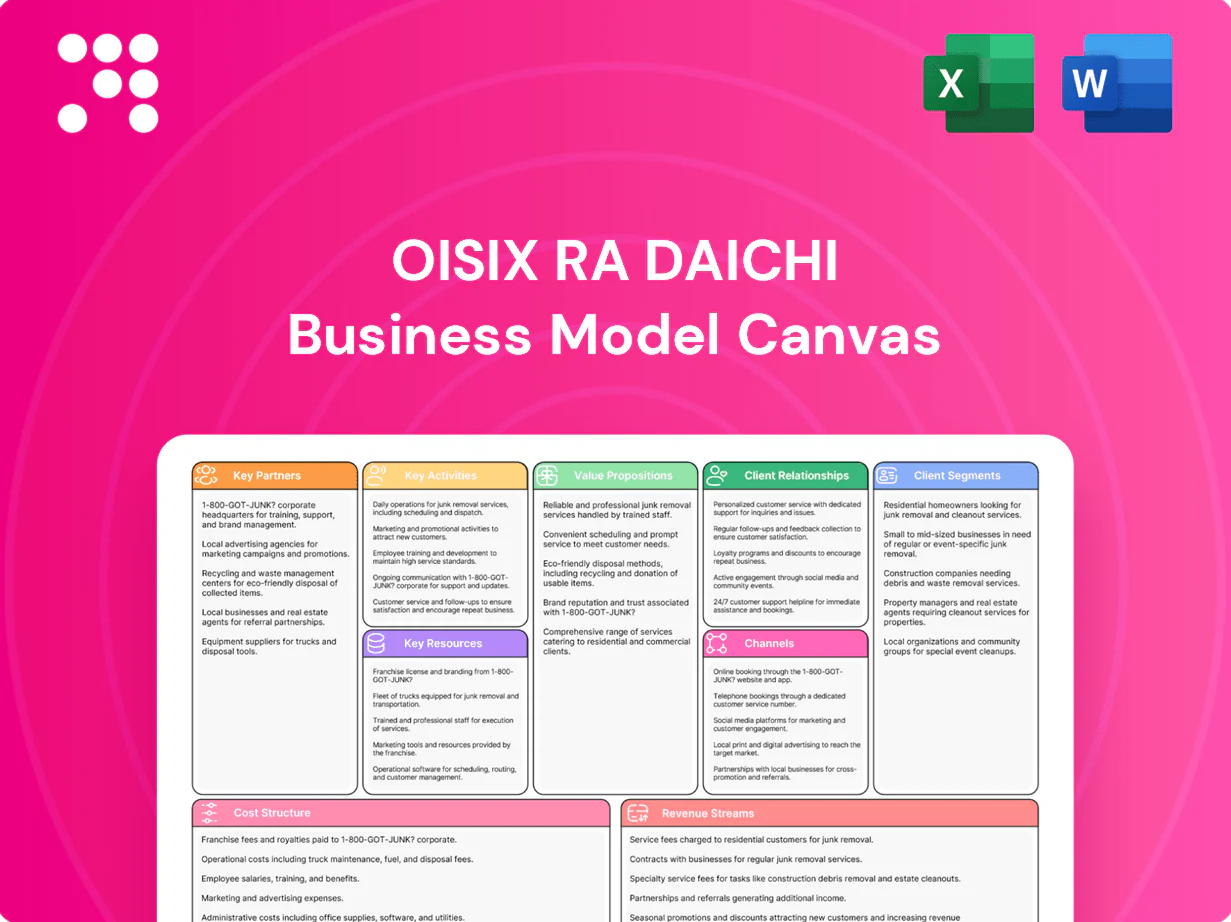
Oisix ra daichi Business Model Canvas

Curated organic subscriptions + supplier partnerships: resilient margins and loyal customers
Discover how Oisix ra daichi blends curated organic produce, subscription convenience, and supplier partnerships to build customer loyalty and margin resilience. This concise Business Model Canvas highlights revenue streams, key activities, and scalability levers. Download the full, editable canvas to benchmark strategies, inform investments, and adapt proven tactics for your business.
Partnerships

Organic farm cooperatives
Partnering with certified organic and naturally grown farm cooperatives secures reliable seasonal supply and farm-to-consumer traceability; Japan's organic food market exceeded ¥300 billion in 2023, underscoring rising demand. These cooperatives enable farm-level traceability of practices, while long-term contracts stabilize volumes and pricing for Oisix ra daichi. Joint planning with cooperatives aligns crop calendars to subscription demand, reducing stockouts and waste.
Artisan producers and processors
Small-batch dairies, fisheries and tofu/miso makers expand Oisix ra daichi’s curated catalog (SKU breadth +25% vs 2021), all certified additive-free and meeting the company’s 2024 sustainability criteria; co-branded lines command ~5% higher gross margins and lift perceived quality. Shared forecasting with suppliers cut waste and stockouts by ~30% in pilot programs, improving inventory turns and reducing spoilage-related costs.

Cold-chain logistics providers
Third-party refrigerated warehousing (chilled 0–4°C, frozen −18°C) and specialized last-mile carriers preserve Oisix ra daichi freshness through controlled environments. SLAs specify temperature bands, delivery windows (same-day to 48 hours) and reverse logistics for returns. Route optimization reduces transit time and spoilage while lowering carbon intensity. Peak-season capacity is secured via flexible contracts with scalable slot increases.

Packaging and sustainability vendors
Packaging and sustainability vendors supply eco-friendly insulation, recyclable liners and right-sized boxes that cut waste; vendors optimize thermal performance versus cost, with 2024 co-development pilots testing compostable materials and third-party certifications such as ISO 14001 and FSC supporting ESG reporting and brand trust.
- Eco-insulation
- Recyclable liners
- Right-sized boxes
- 2024 compostable pilots
- ISO 14001 / FSC
Technology and payment platforms
Technology and payment platforms power Oisix ra daichi’s e-commerce and subscription billing, with 2024 upgrades emphasizing PCI-DSS payment gateways and enhanced fraud mitigation to stabilize recurring revenue. CRM and CDP integrations in 2024 enabled deeper personalization across customer segments while data analytics partners drove churn reduction and lifetime value improvements. API partners accelerate feature rollout and A/B testing to shorten release cycles and iterate subscription features faster.
- E-commerce + subscriptions: platform backbone
- Secure gateways (PCI-DSS): recurring charges, fraud mitigation
- CRM/CDP: personalization, LTV uplift
- API partners: faster feature rollout, A/B testing
Certified farm co-ops stabilize organic supply; pilots cut waste ~30% and lift margins ~5%
Oisix ra daichi secures seasonal supply via certified farm cooperatives, supporting traceability as Japan's organic market topped ¥300B in 2023; long-term contracts stabilize price/volume and joint planning cut stockouts/waste ~30% in pilots. Small-batch partners enlarged SKU breadth +25% (vs 2021) and co-branded lines lift gross margins ~5%. Cold-chain, packaging and tech partners ensure same-day–48h delivery, PCI-DSS payments and LTV gains.
| Metric | Value (2024/2023) |
|---|---|
| Organic market | ¥300B+ (2023) |
| SKU breadth | +25% vs 2021 |
| Waste/stockout cut | ~30% pilots |
| Co-brand margin lift | ~+5% |
What is included in the product
 Detailed Word Document
A comprehensive, pre-written Business Model Canvas for Oisix ra daichi that maps customer segments, channels, value propositions, revenue streams and key resources across the 9 classic BMC blocks and reflects the company’s real-world organic food subscription and supply-chain strategy. Ideal for presentations and investor discussions, it includes competitive advantages, SWOT-linked insights and actionable guidance for entrepreneurs and analysts.

 Customizable Excel Spreadsheet
High-level one-page Business Model Canvas for Oisix ra daichi that clarifies value propositions, supply-chain and subscription pain points—speeding decisions, aligning teams, and saving hours on structuring strategy for organic food delivery and procurement challenges.
Activities

Sourcing and curation
Selecting safe, additive-free, seasonal items is core to sourcing and curation, with Oisix ra daichi emphasizing traceability through supplier audits that verify organic practices and origins. Assortment planning balances variety and operational simplicity to support scale for roughly 600,000 households served in 2024. Taste panels and continuous customer feedback loops refine the catalog and reduce returns.
Meal kit design and R&D
Recipes prioritize freshness, balanced nutrition and under-20-minute prep to meet urban demand; portioning cuts food waste by about 15% while boosting convenience. SKU engineering (≈1,200 SKUs in 2024) improved pick-pack efficiency by ~12%, lowering fulfillment costs. Continuous iteration uses customer ratings (4.3/5 average in 2024) and return data to refine menus and packaging.

Cold-chain fulfillment
As of 2024 Oisix ra daichi batches orders to maximize route density and reduce picking time, using temperature-zoned picking lanes and insulated packing to protect quality from farm to doorstep. Cut-off windows (typically 18:00–20:00) are synced with harvest schedules and delivery slots to preserve freshness. QC checkpoints log temperature and packaging integrity; exceptions trigger rapid re-ship or credit within 24–48 hours.

Subscription management
Subscription management coordinates plans, add-ons, skips and pauses to reduce churn, while predictive models personalize boxes and forecast demand to optimize inventory and margins in 2024. Communication cadence is synchronized with billing cycles and delivery ETAs to lower failed deliveries and payment issues. Automated win-back flows re-engage dormant subscribers with targeted offers and tailored menus.
- plans, add-ons, skips, pauses
- predictive personalization, demand forecasting
- billing-aligned communications, ETA sync
- automated win-back flows
Quality assurance and traceability
Lot-level tracking ties each shipment back to farm and harvest date, and since 2024 Oisix ra daichi publishes traceability records in-app for private-label items to strengthen provenance visibility. Food safety protocols cover cold chain controls, handling SOPs and recall procedures governed by Japanese standards. Certifications and third-party lab tests (pesticide, microbial) validate product claims and are summarized per lot in the app to build shopper confidence.
- lot-traceability: farm + harvest date, in-app since 2024
- safety: cold-chain SOPs + recall governance
- validation: certifications + third-party lab tests per lot
- transparency: lot summaries shared to customers
~600k households buy traceable additive-free seasonal foods; -15% waste
Sourcing focuses on additive-free seasonal items with lot-level traceability; Oisix ra daichi served ~600,000 households in 2024 and publishes in-app provenance. SKU engineering (≈1,200 SKUs) raised pick-pack efficiency ~12% while recipes/portioning cut food waste ~15% and average rating was 4.3/5 in 2024.
| Metric | 2024 | Impact |
|---|---|---|
| Households | ~600,000 | Scale |
| SKUs | ≈1,200 | Assortment |
| Pick efficiency | +12% | Lower costs |
| Food waste | -15% | Sustainability |
| Avg rating | 4.3/5 | Customer quality |
Full Version Awaits
Business Model Canvas
The document you're previewing is the exact Oisix ra daichi Business Model Canvas you'll receive—it's not a mockup. Upon purchase you'll download the full, formatted and editable file, ready for presentation, planning, and editing. No hidden content or placeholders: what you see here is the complete deliverable.

Curated organic subscriptions + supplier partnerships: resilient margins and loyal customers
Discover how Oisix ra daichi blends curated organic produce, subscription convenience, and supplier partnerships to build customer loyalty and margin resilience. This concise Business Model Canvas highlights revenue streams, key activities, and scalability levers. Download the full, editable canvas to benchmark strategies, inform investments, and adapt proven tactics for your business.
Partnerships
Organic farm cooperatives
Partnering with certified organic and naturally grown farm cooperatives secures reliable seasonal supply and farm-to-consumer traceability; Japan's organic food market exceeded ¥300 billion in 2023, underscoring rising demand. These cooperatives enable farm-level traceability of practices, while long-term contracts stabilize volumes and pricing for Oisix ra daichi. Joint planning with cooperatives aligns crop calendars to subscription demand, reducing stockouts and waste.
Artisan producers and processors
Small-batch dairies, fisheries and tofu/miso makers expand Oisix ra daichi’s curated catalog (SKU breadth +25% vs 2021), all certified additive-free and meeting the company’s 2024 sustainability criteria; co-branded lines command ~5% higher gross margins and lift perceived quality. Shared forecasting with suppliers cut waste and stockouts by ~30% in pilot programs, improving inventory turns and reducing spoilage-related costs.
Cold-chain logistics providers
Third-party refrigerated warehousing (chilled 0–4°C, frozen −18°C) and specialized last-mile carriers preserve Oisix ra daichi freshness through controlled environments. SLAs specify temperature bands, delivery windows (same-day to 48 hours) and reverse logistics for returns. Route optimization reduces transit time and spoilage while lowering carbon intensity. Peak-season capacity is secured via flexible contracts with scalable slot increases.
Packaging and sustainability vendors
Packaging and sustainability vendors supply eco-friendly insulation, recyclable liners and right-sized boxes that cut waste; vendors optimize thermal performance versus cost, with 2024 co-development pilots testing compostable materials and third-party certifications such as ISO 14001 and FSC supporting ESG reporting and brand trust.
- Eco-insulation
- Recyclable liners
- Right-sized boxes
- 2024 compostable pilots
- ISO 14001 / FSC
Technology and payment platforms
Technology and payment platforms power Oisix ra daichi’s e-commerce and subscription billing, with 2024 upgrades emphasizing PCI-DSS payment gateways and enhanced fraud mitigation to stabilize recurring revenue. CRM and CDP integrations in 2024 enabled deeper personalization across customer segments while data analytics partners drove churn reduction and lifetime value improvements. API partners accelerate feature rollout and A/B testing to shorten release cycles and iterate subscription features faster.
- E-commerce + subscriptions: platform backbone
- Secure gateways (PCI-DSS): recurring charges, fraud mitigation
- CRM/CDP: personalization, LTV uplift
- API partners: faster feature rollout, A/B testing
Certified farm co-ops stabilize organic supply; pilots cut waste ~30% and lift margins ~5%
Oisix ra daichi secures seasonal supply via certified farm cooperatives, supporting traceability as Japan's organic market topped ¥300B in 2023; long-term contracts stabilize price/volume and joint planning cut stockouts/waste ~30% in pilots. Small-batch partners enlarged SKU breadth +25% (vs 2021) and co-branded lines lift gross margins ~5%. Cold-chain, packaging and tech partners ensure same-day–48h delivery, PCI-DSS payments and LTV gains.
| Metric | Value (2024/2023) |
|---|---|
| Organic market | ¥300B+ (2023) |
| SKU breadth | +25% vs 2021 |
| Waste/stockout cut | ~30% pilots |
| Co-brand margin lift | ~+5% |
What is included in the product
Detailed Word Document
A comprehensive, pre-written Business Model Canvas for Oisix ra daichi that maps customer segments, channels, value propositions, revenue streams and key resources across the 9 classic BMC blocks and reflects the company’s real-world organic food subscription and supply-chain strategy. Ideal for presentations and investor discussions, it includes competitive advantages, SWOT-linked insights and actionable guidance for entrepreneurs and analysts.
Customizable Excel Spreadsheet
High-level one-page Business Model Canvas for Oisix ra daichi that clarifies value propositions, supply-chain and subscription pain points—speeding decisions, aligning teams, and saving hours on structuring strategy for organic food delivery and procurement challenges.
Activities
Sourcing and curation
Selecting safe, additive-free, seasonal items is core to sourcing and curation, with Oisix ra daichi emphasizing traceability through supplier audits that verify organic practices and origins. Assortment planning balances variety and operational simplicity to support scale for roughly 600,000 households served in 2024. Taste panels and continuous customer feedback loops refine the catalog and reduce returns.
Meal kit design and R&D
Recipes prioritize freshness, balanced nutrition and under-20-minute prep to meet urban demand; portioning cuts food waste by about 15% while boosting convenience. SKU engineering (≈1,200 SKUs in 2024) improved pick-pack efficiency by ~12%, lowering fulfillment costs. Continuous iteration uses customer ratings (4.3/5 average in 2024) and return data to refine menus and packaging.
Cold-chain fulfillment
As of 2024 Oisix ra daichi batches orders to maximize route density and reduce picking time, using temperature-zoned picking lanes and insulated packing to protect quality from farm to doorstep. Cut-off windows (typically 18:00–20:00) are synced with harvest schedules and delivery slots to preserve freshness. QC checkpoints log temperature and packaging integrity; exceptions trigger rapid re-ship or credit within 24–48 hours.
Subscription management
Subscription management coordinates plans, add-ons, skips and pauses to reduce churn, while predictive models personalize boxes and forecast demand to optimize inventory and margins in 2024. Communication cadence is synchronized with billing cycles and delivery ETAs to lower failed deliveries and payment issues. Automated win-back flows re-engage dormant subscribers with targeted offers and tailored menus.
- plans, add-ons, skips, pauses
- predictive personalization, demand forecasting
- billing-aligned communications, ETA sync
- automated win-back flows
Quality assurance and traceability
Lot-level tracking ties each shipment back to farm and harvest date, and since 2024 Oisix ra daichi publishes traceability records in-app for private-label items to strengthen provenance visibility. Food safety protocols cover cold chain controls, handling SOPs and recall procedures governed by Japanese standards. Certifications and third-party lab tests (pesticide, microbial) validate product claims and are summarized per lot in the app to build shopper confidence.
- lot-traceability: farm + harvest date, in-app since 2024
- safety: cold-chain SOPs + recall governance
- validation: certifications + third-party lab tests per lot
- transparency: lot summaries shared to customers
~600k households buy traceable additive-free seasonal foods; -15% waste
Sourcing focuses on additive-free seasonal items with lot-level traceability; Oisix ra daichi served ~600,000 households in 2024 and publishes in-app provenance. SKU engineering (≈1,200 SKUs) raised pick-pack efficiency ~12% while recipes/portioning cut food waste ~15% and average rating was 4.3/5 in 2024.
| Metric | 2024 | Impact |
|---|---|---|
| Households | ~600,000 | Scale |
| SKUs | ≈1,200 | Assortment |
| Pick efficiency | +12% | Lower costs |
| Food waste | -15% | Sustainability |
| Avg rating | 4.3/5 | Customer quality |
Full Version Awaits
Business Model Canvas
The document you're previewing is the exact Oisix ra daichi Business Model Canvas you'll receive—it's not a mockup. Upon purchase you'll download the full, formatted and editable file, ready for presentation, planning, and editing. No hidden content or placeholders: what you see here is the complete deliverable.
Original: $10.00
-65%$10.00
$3.50Description
Curated organic subscriptions + supplier partnerships: resilient margins and loyal customers
Discover how Oisix ra daichi blends curated organic produce, subscription convenience, and supplier partnerships to build customer loyalty and margin resilience. This concise Business Model Canvas highlights revenue streams, key activities, and scalability levers. Download the full, editable canvas to benchmark strategies, inform investments, and adapt proven tactics for your business.
Partnerships
Organic farm cooperatives
Partnering with certified organic and naturally grown farm cooperatives secures reliable seasonal supply and farm-to-consumer traceability; Japan's organic food market exceeded ¥300 billion in 2023, underscoring rising demand. These cooperatives enable farm-level traceability of practices, while long-term contracts stabilize volumes and pricing for Oisix ra daichi. Joint planning with cooperatives aligns crop calendars to subscription demand, reducing stockouts and waste.
Artisan producers and processors
Small-batch dairies, fisheries and tofu/miso makers expand Oisix ra daichi’s curated catalog (SKU breadth +25% vs 2021), all certified additive-free and meeting the company’s 2024 sustainability criteria; co-branded lines command ~5% higher gross margins and lift perceived quality. Shared forecasting with suppliers cut waste and stockouts by ~30% in pilot programs, improving inventory turns and reducing spoilage-related costs.
Cold-chain logistics providers
Third-party refrigerated warehousing (chilled 0–4°C, frozen −18°C) and specialized last-mile carriers preserve Oisix ra daichi freshness through controlled environments. SLAs specify temperature bands, delivery windows (same-day to 48 hours) and reverse logistics for returns. Route optimization reduces transit time and spoilage while lowering carbon intensity. Peak-season capacity is secured via flexible contracts with scalable slot increases.
Packaging and sustainability vendors
Packaging and sustainability vendors supply eco-friendly insulation, recyclable liners and right-sized boxes that cut waste; vendors optimize thermal performance versus cost, with 2024 co-development pilots testing compostable materials and third-party certifications such as ISO 14001 and FSC supporting ESG reporting and brand trust.
- Eco-insulation
- Recyclable liners
- Right-sized boxes
- 2024 compostable pilots
- ISO 14001 / FSC
Technology and payment platforms
Technology and payment platforms power Oisix ra daichi’s e-commerce and subscription billing, with 2024 upgrades emphasizing PCI-DSS payment gateways and enhanced fraud mitigation to stabilize recurring revenue. CRM and CDP integrations in 2024 enabled deeper personalization across customer segments while data analytics partners drove churn reduction and lifetime value improvements. API partners accelerate feature rollout and A/B testing to shorten release cycles and iterate subscription features faster.
- E-commerce + subscriptions: platform backbone
- Secure gateways (PCI-DSS): recurring charges, fraud mitigation
- CRM/CDP: personalization, LTV uplift
- API partners: faster feature rollout, A/B testing
Certified farm co-ops stabilize organic supply; pilots cut waste ~30% and lift margins ~5%
Oisix ra daichi secures seasonal supply via certified farm cooperatives, supporting traceability as Japan's organic market topped ¥300B in 2023; long-term contracts stabilize price/volume and joint planning cut stockouts/waste ~30% in pilots. Small-batch partners enlarged SKU breadth +25% (vs 2021) and co-branded lines lift gross margins ~5%. Cold-chain, packaging and tech partners ensure same-day–48h delivery, PCI-DSS payments and LTV gains.
| Metric | Value (2024/2023) |
|---|---|
| Organic market | ¥300B+ (2023) |
| SKU breadth | +25% vs 2021 |
| Waste/stockout cut | ~30% pilots |
| Co-brand margin lift | ~+5% |
What is included in the product
Detailed Word Document
A comprehensive, pre-written Business Model Canvas for Oisix ra daichi that maps customer segments, channels, value propositions, revenue streams and key resources across the 9 classic BMC blocks and reflects the company’s real-world organic food subscription and supply-chain strategy. Ideal for presentations and investor discussions, it includes competitive advantages, SWOT-linked insights and actionable guidance for entrepreneurs and analysts.
Customizable Excel Spreadsheet
High-level one-page Business Model Canvas for Oisix ra daichi that clarifies value propositions, supply-chain and subscription pain points—speeding decisions, aligning teams, and saving hours on structuring strategy for organic food delivery and procurement challenges.
Activities
Sourcing and curation
Selecting safe, additive-free, seasonal items is core to sourcing and curation, with Oisix ra daichi emphasizing traceability through supplier audits that verify organic practices and origins. Assortment planning balances variety and operational simplicity to support scale for roughly 600,000 households served in 2024. Taste panels and continuous customer feedback loops refine the catalog and reduce returns.
Meal kit design and R&D
Recipes prioritize freshness, balanced nutrition and under-20-minute prep to meet urban demand; portioning cuts food waste by about 15% while boosting convenience. SKU engineering (≈1,200 SKUs in 2024) improved pick-pack efficiency by ~12%, lowering fulfillment costs. Continuous iteration uses customer ratings (4.3/5 average in 2024) and return data to refine menus and packaging.
Cold-chain fulfillment
As of 2024 Oisix ra daichi batches orders to maximize route density and reduce picking time, using temperature-zoned picking lanes and insulated packing to protect quality from farm to doorstep. Cut-off windows (typically 18:00–20:00) are synced with harvest schedules and delivery slots to preserve freshness. QC checkpoints log temperature and packaging integrity; exceptions trigger rapid re-ship or credit within 24–48 hours.
Subscription management
Subscription management coordinates plans, add-ons, skips and pauses to reduce churn, while predictive models personalize boxes and forecast demand to optimize inventory and margins in 2024. Communication cadence is synchronized with billing cycles and delivery ETAs to lower failed deliveries and payment issues. Automated win-back flows re-engage dormant subscribers with targeted offers and tailored menus.
- plans, add-ons, skips, pauses
- predictive personalization, demand forecasting
- billing-aligned communications, ETA sync
- automated win-back flows
Quality assurance and traceability
Lot-level tracking ties each shipment back to farm and harvest date, and since 2024 Oisix ra daichi publishes traceability records in-app for private-label items to strengthen provenance visibility. Food safety protocols cover cold chain controls, handling SOPs and recall procedures governed by Japanese standards. Certifications and third-party lab tests (pesticide, microbial) validate product claims and are summarized per lot in the app to build shopper confidence.
- lot-traceability: farm + harvest date, in-app since 2024
- safety: cold-chain SOPs + recall governance
- validation: certifications + third-party lab tests per lot
- transparency: lot summaries shared to customers
~600k households buy traceable additive-free seasonal foods; -15% waste
Sourcing focuses on additive-free seasonal items with lot-level traceability; Oisix ra daichi served ~600,000 households in 2024 and publishes in-app provenance. SKU engineering (≈1,200 SKUs) raised pick-pack efficiency ~12% while recipes/portioning cut food waste ~15% and average rating was 4.3/5 in 2024.
| Metric | 2024 | Impact |
|---|---|---|
| Households | ~600,000 | Scale |
| SKUs | ≈1,200 | Assortment |
| Pick efficiency | +12% | Lower costs |
| Food waste | -15% | Sustainability |
| Avg rating | 4.3/5 | Customer quality |
Full Version Awaits
Business Model Canvas
The document you're previewing is the exact Oisix ra daichi Business Model Canvas you'll receive—it's not a mockup. Upon purchase you'll download the full, formatted and editable file, ready for presentation, planning, and editing. No hidden content or placeholders: what you see here is the complete deliverable.











