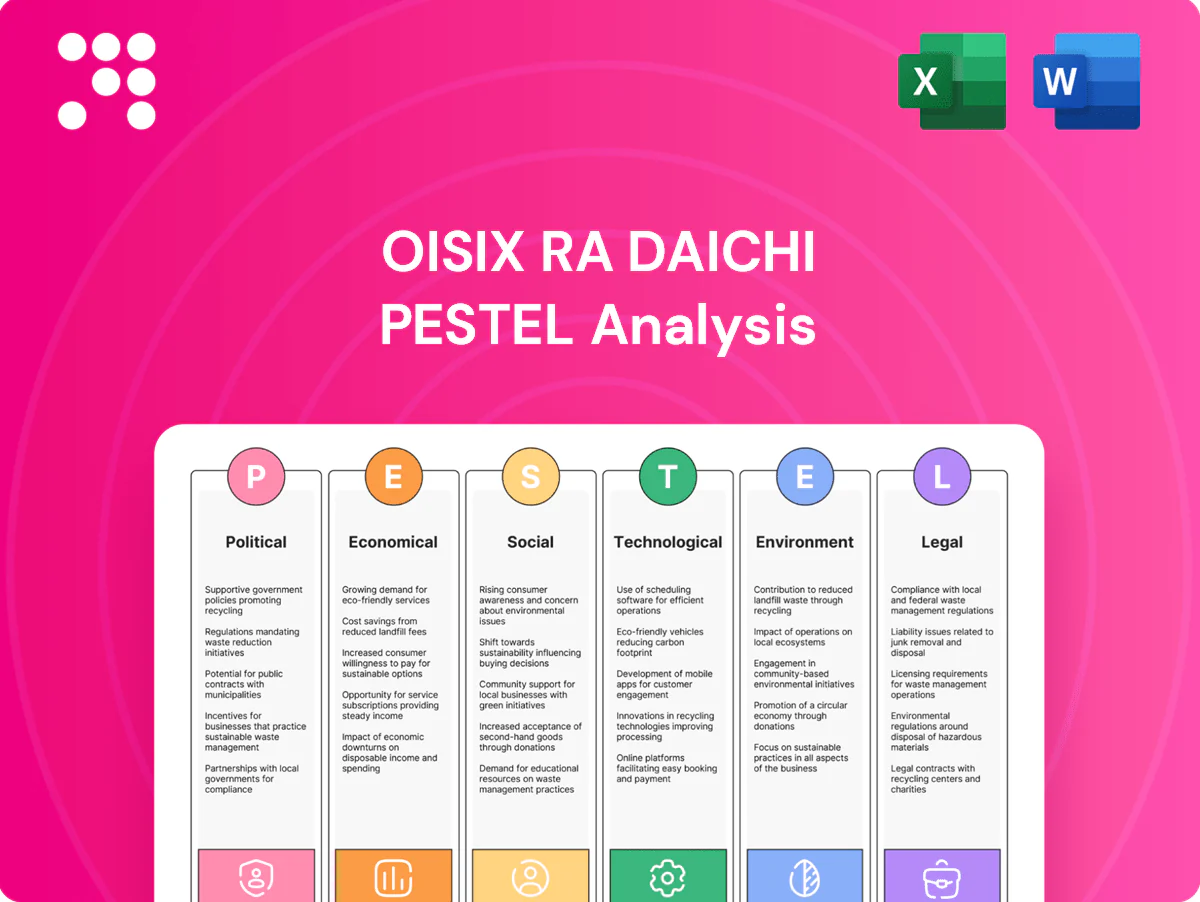
Oisix ra daichi PESTLE Analysis

Skip the Research. Get the Strategy.
Analyze how political, economic and environmental forces shape Oisix ra daichi's strategy and risks. This concise PESTLE snapshot highlights regulatory, consumer and tech trends investors need. Purchase the full PESTLE for a complete, editable, board‑ready report to inform decisions.
Political factors

Food safety and agricultural policy
Japan’s stringent food safety regime and agricultural support programs directly shape Oisix ra daichi’s sourcing and compliance costs. Subsidies and incentives for domestic farmers stabilize supply and foster partnership opportunities. Policy shifts toward raising food self-sufficiency (about 37% on a calorie basis in 2023) favor local procurement. Any tightening of inspection protocols could increase lead times and QA expenses.
Trade policy and import dependencies
Tariff and non-tariff barriers raise costs for Oisix ra daichi when organic inputs unavailable domestically must be sourced abroad, exacerbated by Japan's low food self-sufficiency (38% calories, ~62% import dependency). Changes in FTAs such as CPTPP (11 members) or sanitary rules can shift prices and assortment flexibility. Currency-linked import costs intensify political pressure for protective measures, so diversifying origins cuts exposure to policy shocks.

Rural revitalization initiatives
Government rural revitalization programs boosting farm digitization and D2C channels create direct onboarding opportunities for Oisix ra daichi; aligning with 2024 grant schemes (≈¥100bn national allocations for regional digital projects) can subsidize producer onboarding and traceability upgrades. Political backing for smart agriculture (MAFF-supported pilots in 120+ municipalities by 2024) improves supply resilience. Visibility in public-private pilots strengthens brand legitimacy and opens co-funding for logistics and IoT traceability.

Disaster preparedness and food security
- Inventory buffers: higher working capital
- Priority lanes: regulatory advantage
- Municipal demand: institutional contracts
- Compliance: reduced political risk
Carbon and energy transition policy
Japan’s decarbonization roadmap (net-zero by 2050, 46% GHG cut by 2030 vs 2013) raises expectations for low-emission logistics and higher cold-chain efficiency for Oisix ra daichi; energy-efficient refrigeration can cut operating emissions and exposure to fuel price volatility. Incentives for EV fleets and renewable-powered distribution hubs can lower total cost of ownership and capital barriers, while mandatory climate disclosures are likely to increase reporting workloads; early adopters gain access to policy-aligned funding and PR advantages.
- Net-zero target: 2050
- 2030 target: 46% reduction vs 2013
- Opportunities: EV fleets, renewables at hubs
- Risks: rising disclosure/reporting requirements
Japan food costs: ~37% calorie self-suff. ¥100bn grants shift sourcing
Japan’s strict food-safety regime, subsidies and ~37% calorie self-sufficiency (2023) shape Oisix ra daichi sourcing and compliance costs. CPTPP membership (11) and tariff/non-tariff rules affect import prices and assortment flexibility. 2024 rural digital grants (~¥100bn) and 120+ MAFF pilots lower onboarding costs. Net-zero 2050 / 46% by 2030 raises cold-chain and EV investment needs.
| Metric | Value |
|---|---|
| Food self-sufficiency (calories) | ~37% (2023) |
| CPTPP members | 11 |
| 2024 rural digital grants | ≈¥100bn |
| MAFF pilots | 120+ municipalities (2024) |
| Net-zero / 2030 target | 2050 / −46% vs 2013 |
What is included in the product
 Detailed Word Document
Explores how macro-environmental factors uniquely impact Oisix ra daichi across Political, Economic, Social, Technological, Environmental, and Legal dimensions, with data-backed, forward-looking insights tailored for executives and investors; formatted for direct use in business plans, decks, and strategic scenario planning.

 Customizable Excel Spreadsheet
A concise, PESTLE-segmented summary of Oisix ra daichi that clarifies regulatory, economic, social, technological and environmental risks to quickly pinpoint pain points. Ideal for meetings and strategy sessions, it streamlines decision-making on product, supply-chain and market-entry issues.
Economic factors

Consumer spending and inflation
Stubborn food inflation in 2024–25 (food CPI in Japan averaged about +4% YoY) pressures willingness to pay for Oisix ra daichi’s premium organic SKUs, forcing tougher value messaging. Subscription models smooth demand and contributed ~40% of revenue in specialty grocers globally, but churn rises in downcycles. Value packs and private labels can defend basket size and margins. Passing costs requires clear quality and safety narratives tied to traceability.
Yen volatility and COGS
Yen weakness (around JPY155 per USD in mid-2025) elevates import costs for niche ingredients and packaging—import bills can rise >10% when the yen drops 10%. Hedging programs and supplier currency clauses have limited margin compression for food retailers. Localizing supply chains reduces FX exposure but often raises procurement premiums (roughly 5–15%) and narrows product variety. Transparent pricing during FX swings sustains customer trust.

Last-mile and labor costs
Rising delivery wages and fuel costs have pressured unit economics for Oisix ra daichi, with Japanese courier labor costs up markedly in 2024 and diesel retail prices averaging around 170–180 JPY/L in early 2025, squeezing margins. Subscription-driven route density and optimization can improve drop economics, commonly cutting per-delivery costs by 20–40% in grocery e-commerce pilots. Offering flexible delivery windows lowers failed attempts and re-deliveries—industry pilots report up to ~30% fewer re-deliveries—and partnerships with third-party carriers provide scalable capacity while maintaining performance via tight SLAs and KPI monitoring.

Scale economies and SKU curation
Curated assortments at Oisix ra daichi reduce waste and handling costs versus broad marketplaces by focusing on higher-turn SKUs and streamlined cold-chain flows.
Scale increases procurement power and improves cold-chain utilization, enabling lower unit costs and better gross margins while dynamic SKU rationalization preserves margin on low-velocity items.
Supplier consolidation boosts bargaining power but must be balanced with resilience to avoid supply shocks and maintain product diversity.
- Curated assortments lower waste and handling costs
- Scale improves procurement power and cold-chain utilization
- Dynamic SKU rationalization protects margins on slow movers
- Supplier consolidation trade-off: resilience versus bargaining power
Macroeconomic cycles and premiumization
During expansions health-conscious premium segments expand, with Japan premium organic sales rising alongside a 2021–24 shift to value-added offerings; recessions push consumers toward staples and meal kits offering strong value propositions, with Japan meal-kit demand estimated near ¥200 billion in 2024. Oisix ra daichi mitigates cycle risk via mixed-tier offerings. Loyalty incentives and prepaid bundles stabilize cash flow, with subscriptions often representing a major recurring revenue share.
- Expansion: premium/organic up
- Recession: staples & value meal kits rise
- Hedge: mixed-tier portfolio
- Stability: loyalty + prepaid subs drive recurring cash
Japan food costs: ~37% calorie self-suff. ¥100bn grants shift sourcing
Food inflation ~+4% YoY (2024–25) pressures premium SKUs; clear value/traceability messaging needed. Yen ~155 JPY/USD (mid‑2025) can raise import bills ~10% per 10% FX move; local sourcing trades variety for ~5–15% premium. Subscriptions ~40% revenue smooth demand but churn rises in downturns; Japan meal‑kit market ~¥200bn (2024). Delivery costs (diesel ~170–180 JPY/L early‑2025) squeeze unit economics; route density cuts per‑delivery costs 20–40%.
| Metric | Value |
|---|---|
| Food CPI (2024–25) | +4% YoY |
| Yen (mid‑2025) | ~155 JPY/USD |
| Import FX sensitivity | ≈+10% cost per 10% yen fall |
| Subscriptions | ~40% revenue |
| Meal‑kit market (Japan 2024) | ¥200bn |
| Diesel (early‑2025) | ¥170–180/L |
Preview the Actual Deliverable
Oisix ra daichi PESTLE Analysis
The preview shown here is the exact Oisix ra daichi PESTLE Analysis you’ll receive after purchase—fully formatted, professionally structured, and ready to use. This is the real file with complete political, economic, social, technological, legal, and environmental insights—no placeholders or surprises.

Skip the Research. Get the Strategy.
Analyze how political, economic and environmental forces shape Oisix ra daichi's strategy and risks. This concise PESTLE snapshot highlights regulatory, consumer and tech trends investors need. Purchase the full PESTLE for a complete, editable, board‑ready report to inform decisions.
Political factors
Food safety and agricultural policy
Japan’s stringent food safety regime and agricultural support programs directly shape Oisix ra daichi’s sourcing and compliance costs. Subsidies and incentives for domestic farmers stabilize supply and foster partnership opportunities. Policy shifts toward raising food self-sufficiency (about 37% on a calorie basis in 2023) favor local procurement. Any tightening of inspection protocols could increase lead times and QA expenses.
Trade policy and import dependencies
Tariff and non-tariff barriers raise costs for Oisix ra daichi when organic inputs unavailable domestically must be sourced abroad, exacerbated by Japan's low food self-sufficiency (38% calories, ~62% import dependency). Changes in FTAs such as CPTPP (11 members) or sanitary rules can shift prices and assortment flexibility. Currency-linked import costs intensify political pressure for protective measures, so diversifying origins cuts exposure to policy shocks.
Rural revitalization initiatives
Government rural revitalization programs boosting farm digitization and D2C channels create direct onboarding opportunities for Oisix ra daichi; aligning with 2024 grant schemes (≈¥100bn national allocations for regional digital projects) can subsidize producer onboarding and traceability upgrades. Political backing for smart agriculture (MAFF-supported pilots in 120+ municipalities by 2024) improves supply resilience. Visibility in public-private pilots strengthens brand legitimacy and opens co-funding for logistics and IoT traceability.
Disaster preparedness and food security
- Inventory buffers: higher working capital
- Priority lanes: regulatory advantage
- Municipal demand: institutional contracts
- Compliance: reduced political risk
Carbon and energy transition policy
Japan’s decarbonization roadmap (net-zero by 2050, 46% GHG cut by 2030 vs 2013) raises expectations for low-emission logistics and higher cold-chain efficiency for Oisix ra daichi; energy-efficient refrigeration can cut operating emissions and exposure to fuel price volatility. Incentives for EV fleets and renewable-powered distribution hubs can lower total cost of ownership and capital barriers, while mandatory climate disclosures are likely to increase reporting workloads; early adopters gain access to policy-aligned funding and PR advantages.
- Net-zero target: 2050
- 2030 target: 46% reduction vs 2013
- Opportunities: EV fleets, renewables at hubs
- Risks: rising disclosure/reporting requirements
Japan food costs: ~37% calorie self-suff. ¥100bn grants shift sourcing
Japan’s strict food-safety regime, subsidies and ~37% calorie self-sufficiency (2023) shape Oisix ra daichi sourcing and compliance costs. CPTPP membership (11) and tariff/non-tariff rules affect import prices and assortment flexibility. 2024 rural digital grants (~¥100bn) and 120+ MAFF pilots lower onboarding costs. Net-zero 2050 / 46% by 2030 raises cold-chain and EV investment needs.
| Metric | Value |
|---|---|
| Food self-sufficiency (calories) | ~37% (2023) |
| CPTPP members | 11 |
| 2024 rural digital grants | ≈¥100bn |
| MAFF pilots | 120+ municipalities (2024) |
| Net-zero / 2030 target | 2050 / −46% vs 2013 |
What is included in the product
Detailed Word Document
Explores how macro-environmental factors uniquely impact Oisix ra daichi across Political, Economic, Social, Technological, Environmental, and Legal dimensions, with data-backed, forward-looking insights tailored for executives and investors; formatted for direct use in business plans, decks, and strategic scenario planning.
Customizable Excel Spreadsheet
A concise, PESTLE-segmented summary of Oisix ra daichi that clarifies regulatory, economic, social, technological and environmental risks to quickly pinpoint pain points. Ideal for meetings and strategy sessions, it streamlines decision-making on product, supply-chain and market-entry issues.
Economic factors
Consumer spending and inflation
Stubborn food inflation in 2024–25 (food CPI in Japan averaged about +4% YoY) pressures willingness to pay for Oisix ra daichi’s premium organic SKUs, forcing tougher value messaging. Subscription models smooth demand and contributed ~40% of revenue in specialty grocers globally, but churn rises in downcycles. Value packs and private labels can defend basket size and margins. Passing costs requires clear quality and safety narratives tied to traceability.
Yen volatility and COGS
Yen weakness (around JPY155 per USD in mid-2025) elevates import costs for niche ingredients and packaging—import bills can rise >10% when the yen drops 10%. Hedging programs and supplier currency clauses have limited margin compression for food retailers. Localizing supply chains reduces FX exposure but often raises procurement premiums (roughly 5–15%) and narrows product variety. Transparent pricing during FX swings sustains customer trust.
Last-mile and labor costs
Rising delivery wages and fuel costs have pressured unit economics for Oisix ra daichi, with Japanese courier labor costs up markedly in 2024 and diesel retail prices averaging around 170–180 JPY/L in early 2025, squeezing margins. Subscription-driven route density and optimization can improve drop economics, commonly cutting per-delivery costs by 20–40% in grocery e-commerce pilots. Offering flexible delivery windows lowers failed attempts and re-deliveries—industry pilots report up to ~30% fewer re-deliveries—and partnerships with third-party carriers provide scalable capacity while maintaining performance via tight SLAs and KPI monitoring.
Scale economies and SKU curation
Curated assortments at Oisix ra daichi reduce waste and handling costs versus broad marketplaces by focusing on higher-turn SKUs and streamlined cold-chain flows.
Scale increases procurement power and improves cold-chain utilization, enabling lower unit costs and better gross margins while dynamic SKU rationalization preserves margin on low-velocity items.
Supplier consolidation boosts bargaining power but must be balanced with resilience to avoid supply shocks and maintain product diversity.
- Curated assortments lower waste and handling costs
- Scale improves procurement power and cold-chain utilization
- Dynamic SKU rationalization protects margins on slow movers
- Supplier consolidation trade-off: resilience versus bargaining power
Macroeconomic cycles and premiumization
During expansions health-conscious premium segments expand, with Japan premium organic sales rising alongside a 2021–24 shift to value-added offerings; recessions push consumers toward staples and meal kits offering strong value propositions, with Japan meal-kit demand estimated near ¥200 billion in 2024. Oisix ra daichi mitigates cycle risk via mixed-tier offerings. Loyalty incentives and prepaid bundles stabilize cash flow, with subscriptions often representing a major recurring revenue share.
- Expansion: premium/organic up
- Recession: staples & value meal kits rise
- Hedge: mixed-tier portfolio
- Stability: loyalty + prepaid subs drive recurring cash
Japan food costs: ~37% calorie self-suff. ¥100bn grants shift sourcing
Food inflation ~+4% YoY (2024–25) pressures premium SKUs; clear value/traceability messaging needed. Yen ~155 JPY/USD (mid‑2025) can raise import bills ~10% per 10% FX move; local sourcing trades variety for ~5–15% premium. Subscriptions ~40% revenue smooth demand but churn rises in downturns; Japan meal‑kit market ~¥200bn (2024). Delivery costs (diesel ~170–180 JPY/L early‑2025) squeeze unit economics; route density cuts per‑delivery costs 20–40%.
| Metric | Value |
|---|---|
| Food CPI (2024–25) | +4% YoY |
| Yen (mid‑2025) | ~155 JPY/USD |
| Import FX sensitivity | ≈+10% cost per 10% yen fall |
| Subscriptions | ~40% revenue |
| Meal‑kit market (Japan 2024) | ¥200bn |
| Diesel (early‑2025) | ¥170–180/L |
Preview the Actual Deliverable
Oisix ra daichi PESTLE Analysis
The preview shown here is the exact Oisix ra daichi PESTLE Analysis you’ll receive after purchase—fully formatted, professionally structured, and ready to use. This is the real file with complete political, economic, social, technological, legal, and environmental insights—no placeholders or surprises.
Description
Skip the Research. Get the Strategy.
Analyze how political, economic and environmental forces shape Oisix ra daichi's strategy and risks. This concise PESTLE snapshot highlights regulatory, consumer and tech trends investors need. Purchase the full PESTLE for a complete, editable, board‑ready report to inform decisions.
Political factors
Food safety and agricultural policy
Japan’s stringent food safety regime and agricultural support programs directly shape Oisix ra daichi’s sourcing and compliance costs. Subsidies and incentives for domestic farmers stabilize supply and foster partnership opportunities. Policy shifts toward raising food self-sufficiency (about 37% on a calorie basis in 2023) favor local procurement. Any tightening of inspection protocols could increase lead times and QA expenses.
Trade policy and import dependencies
Tariff and non-tariff barriers raise costs for Oisix ra daichi when organic inputs unavailable domestically must be sourced abroad, exacerbated by Japan's low food self-sufficiency (38% calories, ~62% import dependency). Changes in FTAs such as CPTPP (11 members) or sanitary rules can shift prices and assortment flexibility. Currency-linked import costs intensify political pressure for protective measures, so diversifying origins cuts exposure to policy shocks.
Rural revitalization initiatives
Government rural revitalization programs boosting farm digitization and D2C channels create direct onboarding opportunities for Oisix ra daichi; aligning with 2024 grant schemes (≈¥100bn national allocations for regional digital projects) can subsidize producer onboarding and traceability upgrades. Political backing for smart agriculture (MAFF-supported pilots in 120+ municipalities by 2024) improves supply resilience. Visibility in public-private pilots strengthens brand legitimacy and opens co-funding for logistics and IoT traceability.
Disaster preparedness and food security
- Inventory buffers: higher working capital
- Priority lanes: regulatory advantage
- Municipal demand: institutional contracts
- Compliance: reduced political risk
Carbon and energy transition policy
Japan’s decarbonization roadmap (net-zero by 2050, 46% GHG cut by 2030 vs 2013) raises expectations for low-emission logistics and higher cold-chain efficiency for Oisix ra daichi; energy-efficient refrigeration can cut operating emissions and exposure to fuel price volatility. Incentives for EV fleets and renewable-powered distribution hubs can lower total cost of ownership and capital barriers, while mandatory climate disclosures are likely to increase reporting workloads; early adopters gain access to policy-aligned funding and PR advantages.
- Net-zero target: 2050
- 2030 target: 46% reduction vs 2013
- Opportunities: EV fleets, renewables at hubs
- Risks: rising disclosure/reporting requirements
Japan food costs: ~37% calorie self-suff. ¥100bn grants shift sourcing
Japan’s strict food-safety regime, subsidies and ~37% calorie self-sufficiency (2023) shape Oisix ra daichi sourcing and compliance costs. CPTPP membership (11) and tariff/non-tariff rules affect import prices and assortment flexibility. 2024 rural digital grants (~¥100bn) and 120+ MAFF pilots lower onboarding costs. Net-zero 2050 / 46% by 2030 raises cold-chain and EV investment needs.
| Metric | Value |
|---|---|
| Food self-sufficiency (calories) | ~37% (2023) |
| CPTPP members | 11 |
| 2024 rural digital grants | ≈¥100bn |
| MAFF pilots | 120+ municipalities (2024) |
| Net-zero / 2030 target | 2050 / −46% vs 2013 |
What is included in the product
Detailed Word Document
Explores how macro-environmental factors uniquely impact Oisix ra daichi across Political, Economic, Social, Technological, Environmental, and Legal dimensions, with data-backed, forward-looking insights tailored for executives and investors; formatted for direct use in business plans, decks, and strategic scenario planning.
Customizable Excel Spreadsheet
A concise, PESTLE-segmented summary of Oisix ra daichi that clarifies regulatory, economic, social, technological and environmental risks to quickly pinpoint pain points. Ideal for meetings and strategy sessions, it streamlines decision-making on product, supply-chain and market-entry issues.
Economic factors
Consumer spending and inflation
Stubborn food inflation in 2024–25 (food CPI in Japan averaged about +4% YoY) pressures willingness to pay for Oisix ra daichi’s premium organic SKUs, forcing tougher value messaging. Subscription models smooth demand and contributed ~40% of revenue in specialty grocers globally, but churn rises in downcycles. Value packs and private labels can defend basket size and margins. Passing costs requires clear quality and safety narratives tied to traceability.
Yen volatility and COGS
Yen weakness (around JPY155 per USD in mid-2025) elevates import costs for niche ingredients and packaging—import bills can rise >10% when the yen drops 10%. Hedging programs and supplier currency clauses have limited margin compression for food retailers. Localizing supply chains reduces FX exposure but often raises procurement premiums (roughly 5–15%) and narrows product variety. Transparent pricing during FX swings sustains customer trust.
Last-mile and labor costs
Rising delivery wages and fuel costs have pressured unit economics for Oisix ra daichi, with Japanese courier labor costs up markedly in 2024 and diesel retail prices averaging around 170–180 JPY/L in early 2025, squeezing margins. Subscription-driven route density and optimization can improve drop economics, commonly cutting per-delivery costs by 20–40% in grocery e-commerce pilots. Offering flexible delivery windows lowers failed attempts and re-deliveries—industry pilots report up to ~30% fewer re-deliveries—and partnerships with third-party carriers provide scalable capacity while maintaining performance via tight SLAs and KPI monitoring.
Scale economies and SKU curation
Curated assortments at Oisix ra daichi reduce waste and handling costs versus broad marketplaces by focusing on higher-turn SKUs and streamlined cold-chain flows.
Scale increases procurement power and improves cold-chain utilization, enabling lower unit costs and better gross margins while dynamic SKU rationalization preserves margin on low-velocity items.
Supplier consolidation boosts bargaining power but must be balanced with resilience to avoid supply shocks and maintain product diversity.
- Curated assortments lower waste and handling costs
- Scale improves procurement power and cold-chain utilization
- Dynamic SKU rationalization protects margins on slow movers
- Supplier consolidation trade-off: resilience versus bargaining power
Macroeconomic cycles and premiumization
During expansions health-conscious premium segments expand, with Japan premium organic sales rising alongside a 2021–24 shift to value-added offerings; recessions push consumers toward staples and meal kits offering strong value propositions, with Japan meal-kit demand estimated near ¥200 billion in 2024. Oisix ra daichi mitigates cycle risk via mixed-tier offerings. Loyalty incentives and prepaid bundles stabilize cash flow, with subscriptions often representing a major recurring revenue share.
- Expansion: premium/organic up
- Recession: staples & value meal kits rise
- Hedge: mixed-tier portfolio
- Stability: loyalty + prepaid subs drive recurring cash
Japan food costs: ~37% calorie self-suff. ¥100bn grants shift sourcing
Food inflation ~+4% YoY (2024–25) pressures premium SKUs; clear value/traceability messaging needed. Yen ~155 JPY/USD (mid‑2025) can raise import bills ~10% per 10% FX move; local sourcing trades variety for ~5–15% premium. Subscriptions ~40% revenue smooth demand but churn rises in downturns; Japan meal‑kit market ~¥200bn (2024). Delivery costs (diesel ~170–180 JPY/L early‑2025) squeeze unit economics; route density cuts per‑delivery costs 20–40%.
| Metric | Value |
|---|---|
| Food CPI (2024–25) | +4% YoY |
| Yen (mid‑2025) | ~155 JPY/USD |
| Import FX sensitivity | ≈+10% cost per 10% yen fall |
| Subscriptions | ~40% revenue |
| Meal‑kit market (Japan 2024) | ¥200bn |
| Diesel (early‑2025) | ¥170–180/L |
Preview the Actual Deliverable
Oisix ra daichi PESTLE Analysis
The preview shown here is the exact Oisix ra daichi PESTLE Analysis you’ll receive after purchase—fully formatted, professionally structured, and ready to use. This is the real file with complete political, economic, social, technological, legal, and environmental insights—no placeholders or surprises.











