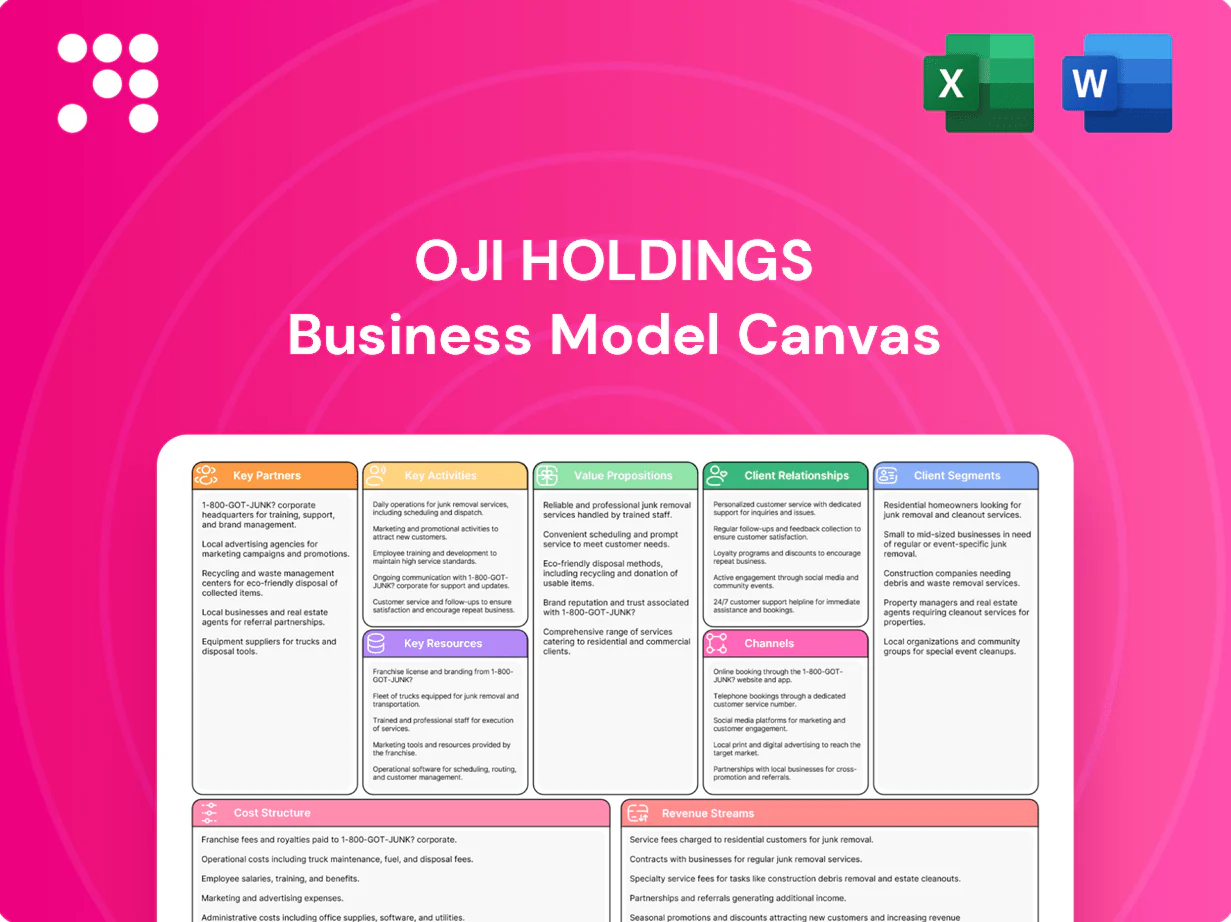
Oji Holdings Business Model Canvas

Business Model Canvas: Strategic Blueprint for a Leading Paper and Packaging Conglomerate
Unlock the full strategic blueprint behind Oji Holdings with our Business Model Canvas. This concise, company-specific canvas maps value propositions, customer segments, key partners, revenue streams and cost structure to reveal growth levers and risks. Purchase the downloadable Word/Excel file to apply these insights to your strategy or investment decisions.
Partnerships

Certified forestry and environmental bodies
Oji partners with FSC, PEFC and local authorities to ensure sustainable forest management, linking its supply chain to globally certified systems that together cover over 520 million hectares of forest as of 2024 (FSC ~220M ha, PEFC ~300M ha).
These partnerships validate chain-of-custody, bolster market access for certified products and inform best practices for biodiversity and social compliance.
Joint audits and continuous improvement programs are used to reduce certification risk and maintain supplier performance.
Chemical, pulp, and fiber suppliers
Reliable inputs like pulp additives, bleaching agents, and specialty fibers are secured via strategic supplier agreements to ensure consistent grade and availability. Co-development with key suppliers targets lower costs, higher performance, and improved environmental footprints through joint R&D and trials. Multi-sourcing across regions mitigates disruption risk, while long-term contracts stabilize pricing and quality for Oji’s production planning.

Equipment OEMs and technology providers
Partnerships with paper machine OEMs, automation firms and maintenance providers drive Oji Holdings efficiency by enabling joint upgrades that lift yield, uptime and energy efficiency—industry pilots report up to 30% fewer unplanned stoppages and ~15% lower energy use. Data-sharing enables predictive maintenance and quality control, while pilot lines and trials accelerate new product commercialization and scale-up.

Recycling firms and municipal collection networks
Alliances with recycling firms and municipal collection networks expand recovered-paper sourcing and improve circularity, leveraging Japan’s paper recycling rate of about 84% (2023–24) to raise feedstock availability. Coordinated sorting standards boost fiber quality, lowering raw-material costs, cutting emissions and stabilizing supply for Oji’s paper and pulp operations.
- Recovered-paper share: improves supply stability
- Sorting standards: higher fiber value
- Community programs: reputation and regulatory compliance
Logistics, warehousing, and energy utilities
Integrated logistics partners enable just-in-time delivery across Japan and APAC, while regional warehousing provides buffer stock capacity for large clients; utilities and biomass suppliers secure stable energy supply and lower operating costs, and coordinated initiatives reduced downstream carbon intensity through fuel-switching and efficiency measures in 2024.
- JIT logistics: regional coverage
- Warehousing: buffer stock for large B2B clients
- Energy: biomass and utility contracts for reliability
- Carbon: collaborative reductions across supply chain in 2024
Securing certified fiber >520M ha, leveraging Japan ~84% recycling
Oji partners with FSC, PEFC and local authorities covering >520M ha (FSC ~220M, PEFC ~300M in 2024) to secure certified fiber and chain-of-custody.
Supplier agreements, multi-sourcing and recycling alliances leverage Japan’s ~84% paper recycling rate (2023–24) to stabilize feedstock and reduce costs.
OEM, logistics and energy partners enable pilots reporting up to 30% fewer stoppages and ~15% lower energy use.
| Partnership | 2024 metric |
|---|---|
| Certification area | >520M ha |
| Japan recycling rate | ~84% |
| Operational pilots | -30% stoppages, -15% energy |
What is included in the product
 Detailed Word Document
A comprehensive Business Model Canvas for Oji Holdings outlining customer segments, channels, value propositions, key activities, partners, resources, cost structure and revenue streams, reflecting real-world operations and competitive advantages. Ideal for presentations, investor discussions and strategic decision-making with SWOT-linked insights across all nine BMC blocks.

 Customizable Excel Spreadsheet
High-level view of Oji Holdings’ business model with editable cells, relieving time spent structuring complex forestry-to-packaging value chains. Shareable layout for fast collaboration, board-ready summaries, and quick comparisons across business units.
Activities

Sustainable forest management
Planning, harvesting, and replanting sustain long-term fiber supply by maintaining rotation cycles and securing standing timber for Oji’s mills. Certification and remote monitoring — Oji reports 100% certification of its domestic planted forests in 2024 — ensure compliance, traceability, and market access. Biodiversity programs and community stewardship lower operational and reputational risk while improving social license. Yield optimization through silviculture and precision forestry reduces unit costs and enhances resilience.
Pulping and papermaking operations
Continuous mill operations at Oji convert fiber into paper and paperboard through 24/7 pulping and papermaking lines, supporting Oji Holdings’ scale (consolidated net sales JPY 1,046.6 billion in FY2023/ended March 2024). Process control systems maintain basis weight, moisture and strength to meet product specs. On-site energy cogeneration improves thermal efficiency and reduces grid dependency. Waste minimization and water-management programs ensure compliance with environmental standards.

Converting and packaging solutions
Finishing, coating, laminating and die-cutting turn base papers into application-ready products, enabling Oji’s packaging lines to deliver custom formats and print-ready substrates. In 2024 Oji leveraged its 151-year legacy (founded 1873) to support rapid changeovers for short runs and high SKU diversity, while robust quality assurance protocols ensure consistent end-use performance and regulatory compliance.

Product development and R&D
Product development and R&D at Oji focus on lightweighting, recyclability and improved barrier performance; labs test fiber blends, coatings and bio-based materials to meet circularity goals. Customer trials in 2024 accelerated commercialization timelines, and rigorous IP management secures differentiated offerings. This drives market-ready sustainable packaging solutions.
- Labs: fiber blends, coatings, bio-based
- Targets: lightweighting, recyclability, barriers
- 2024: accelerated customer trials
- IP: patents protect differentiation
Global sales, marketing, and supply chain
Global sales, marketing, and supply chain at Oji align key account management to match supply with demand, supporting consolidated sales that exceeded ¥1 trillion in FY2023/24; forecasting and inventory planning stabilize lead times and reduce stockouts, while multi-modal logistics optimize cost and service across Asia, Europe and the Americas; regional marketing customizes messaging to end-use segments such as packaging and hygiene.
- Key accounts: alignment of supply–demand
- Forecasting: stabilizes lead times
- Logistics: multi-modal cost/service optimization
- Marketing: regional end-use targeting
Sustainable fiber: 100% certified forests power recyclable lightweight packaging
Planning, harvesting and replanting sustain fiber supply; 100% of domestic planted forests certified in 2024. 24/7 mills convert fiber into paper/paperboard, supporting consolidated net sales JPY 1,046.6 billion (FY2023/24). R&D and customer trials in 2024 accelerated lightweight, recyclable packaging commercialization.
| Activity | 2024 metric |
|---|---|
| Forestry | 100% domestic certification |
| Sales | JPY 1,046.6b (FY2023/24) |
| Mills | 24/7 operations |
Preview Before You Purchase
Business Model Canvas
The document you're previewing is the actual Oji Holdings Business Model Canvas, not a mockup. When you purchase, you'll receive this exact file—fully formatted and complete—ready to edit in Word and Excel. No placeholders, no surprises; what you see is what you’ll download.

Business Model Canvas: Strategic Blueprint for a Leading Paper and Packaging Conglomerate
Unlock the full strategic blueprint behind Oji Holdings with our Business Model Canvas. This concise, company-specific canvas maps value propositions, customer segments, key partners, revenue streams and cost structure to reveal growth levers and risks. Purchase the downloadable Word/Excel file to apply these insights to your strategy or investment decisions.
Partnerships
Certified forestry and environmental bodies
Oji partners with FSC, PEFC and local authorities to ensure sustainable forest management, linking its supply chain to globally certified systems that together cover over 520 million hectares of forest as of 2024 (FSC ~220M ha, PEFC ~300M ha).
These partnerships validate chain-of-custody, bolster market access for certified products and inform best practices for biodiversity and social compliance.
Joint audits and continuous improvement programs are used to reduce certification risk and maintain supplier performance.
Chemical, pulp, and fiber suppliers
Reliable inputs like pulp additives, bleaching agents, and specialty fibers are secured via strategic supplier agreements to ensure consistent grade and availability. Co-development with key suppliers targets lower costs, higher performance, and improved environmental footprints through joint R&D and trials. Multi-sourcing across regions mitigates disruption risk, while long-term contracts stabilize pricing and quality for Oji’s production planning.
Equipment OEMs and technology providers
Partnerships with paper machine OEMs, automation firms and maintenance providers drive Oji Holdings efficiency by enabling joint upgrades that lift yield, uptime and energy efficiency—industry pilots report up to 30% fewer unplanned stoppages and ~15% lower energy use. Data-sharing enables predictive maintenance and quality control, while pilot lines and trials accelerate new product commercialization and scale-up.
Recycling firms and municipal collection networks
Alliances with recycling firms and municipal collection networks expand recovered-paper sourcing and improve circularity, leveraging Japan’s paper recycling rate of about 84% (2023–24) to raise feedstock availability. Coordinated sorting standards boost fiber quality, lowering raw-material costs, cutting emissions and stabilizing supply for Oji’s paper and pulp operations.
- Recovered-paper share: improves supply stability
- Sorting standards: higher fiber value
- Community programs: reputation and regulatory compliance
Logistics, warehousing, and energy utilities
Integrated logistics partners enable just-in-time delivery across Japan and APAC, while regional warehousing provides buffer stock capacity for large clients; utilities and biomass suppliers secure stable energy supply and lower operating costs, and coordinated initiatives reduced downstream carbon intensity through fuel-switching and efficiency measures in 2024.
- JIT logistics: regional coverage
- Warehousing: buffer stock for large B2B clients
- Energy: biomass and utility contracts for reliability
- Carbon: collaborative reductions across supply chain in 2024
Securing certified fiber >520M ha, leveraging Japan ~84% recycling
Oji partners with FSC, PEFC and local authorities covering >520M ha (FSC ~220M, PEFC ~300M in 2024) to secure certified fiber and chain-of-custody.
Supplier agreements, multi-sourcing and recycling alliances leverage Japan’s ~84% paper recycling rate (2023–24) to stabilize feedstock and reduce costs.
OEM, logistics and energy partners enable pilots reporting up to 30% fewer stoppages and ~15% lower energy use.
| Partnership | 2024 metric |
|---|---|
| Certification area | >520M ha |
| Japan recycling rate | ~84% |
| Operational pilots | -30% stoppages, -15% energy |
What is included in the product
Detailed Word Document
A comprehensive Business Model Canvas for Oji Holdings outlining customer segments, channels, value propositions, key activities, partners, resources, cost structure and revenue streams, reflecting real-world operations and competitive advantages. Ideal for presentations, investor discussions and strategic decision-making with SWOT-linked insights across all nine BMC blocks.
Customizable Excel Spreadsheet
High-level view of Oji Holdings’ business model with editable cells, relieving time spent structuring complex forestry-to-packaging value chains. Shareable layout for fast collaboration, board-ready summaries, and quick comparisons across business units.
Activities
Sustainable forest management
Planning, harvesting, and replanting sustain long-term fiber supply by maintaining rotation cycles and securing standing timber for Oji’s mills. Certification and remote monitoring — Oji reports 100% certification of its domestic planted forests in 2024 — ensure compliance, traceability, and market access. Biodiversity programs and community stewardship lower operational and reputational risk while improving social license. Yield optimization through silviculture and precision forestry reduces unit costs and enhances resilience.
Pulping and papermaking operations
Continuous mill operations at Oji convert fiber into paper and paperboard through 24/7 pulping and papermaking lines, supporting Oji Holdings’ scale (consolidated net sales JPY 1,046.6 billion in FY2023/ended March 2024). Process control systems maintain basis weight, moisture and strength to meet product specs. On-site energy cogeneration improves thermal efficiency and reduces grid dependency. Waste minimization and water-management programs ensure compliance with environmental standards.
Converting and packaging solutions
Finishing, coating, laminating and die-cutting turn base papers into application-ready products, enabling Oji’s packaging lines to deliver custom formats and print-ready substrates. In 2024 Oji leveraged its 151-year legacy (founded 1873) to support rapid changeovers for short runs and high SKU diversity, while robust quality assurance protocols ensure consistent end-use performance and regulatory compliance.
Product development and R&D
Product development and R&D at Oji focus on lightweighting, recyclability and improved barrier performance; labs test fiber blends, coatings and bio-based materials to meet circularity goals. Customer trials in 2024 accelerated commercialization timelines, and rigorous IP management secures differentiated offerings. This drives market-ready sustainable packaging solutions.
- Labs: fiber blends, coatings, bio-based
- Targets: lightweighting, recyclability, barriers
- 2024: accelerated customer trials
- IP: patents protect differentiation
Global sales, marketing, and supply chain
Global sales, marketing, and supply chain at Oji align key account management to match supply with demand, supporting consolidated sales that exceeded ¥1 trillion in FY2023/24; forecasting and inventory planning stabilize lead times and reduce stockouts, while multi-modal logistics optimize cost and service across Asia, Europe and the Americas; regional marketing customizes messaging to end-use segments such as packaging and hygiene.
- Key accounts: alignment of supply–demand
- Forecasting: stabilizes lead times
- Logistics: multi-modal cost/service optimization
- Marketing: regional end-use targeting
Sustainable fiber: 100% certified forests power recyclable lightweight packaging
Planning, harvesting and replanting sustain fiber supply; 100% of domestic planted forests certified in 2024. 24/7 mills convert fiber into paper/paperboard, supporting consolidated net sales JPY 1,046.6 billion (FY2023/24). R&D and customer trials in 2024 accelerated lightweight, recyclable packaging commercialization.
| Activity | 2024 metric |
|---|---|
| Forestry | 100% domestic certification |
| Sales | JPY 1,046.6b (FY2023/24) |
| Mills | 24/7 operations |
Preview Before You Purchase
Business Model Canvas
The document you're previewing is the actual Oji Holdings Business Model Canvas, not a mockup. When you purchase, you'll receive this exact file—fully formatted and complete—ready to edit in Word and Excel. No placeholders, no surprises; what you see is what you’ll download.
Description
Business Model Canvas: Strategic Blueprint for a Leading Paper and Packaging Conglomerate
Unlock the full strategic blueprint behind Oji Holdings with our Business Model Canvas. This concise, company-specific canvas maps value propositions, customer segments, key partners, revenue streams and cost structure to reveal growth levers and risks. Purchase the downloadable Word/Excel file to apply these insights to your strategy or investment decisions.
Partnerships
Certified forestry and environmental bodies
Oji partners with FSC, PEFC and local authorities to ensure sustainable forest management, linking its supply chain to globally certified systems that together cover over 520 million hectares of forest as of 2024 (FSC ~220M ha, PEFC ~300M ha).
These partnerships validate chain-of-custody, bolster market access for certified products and inform best practices for biodiversity and social compliance.
Joint audits and continuous improvement programs are used to reduce certification risk and maintain supplier performance.
Chemical, pulp, and fiber suppliers
Reliable inputs like pulp additives, bleaching agents, and specialty fibers are secured via strategic supplier agreements to ensure consistent grade and availability. Co-development with key suppliers targets lower costs, higher performance, and improved environmental footprints through joint R&D and trials. Multi-sourcing across regions mitigates disruption risk, while long-term contracts stabilize pricing and quality for Oji’s production planning.
Equipment OEMs and technology providers
Partnerships with paper machine OEMs, automation firms and maintenance providers drive Oji Holdings efficiency by enabling joint upgrades that lift yield, uptime and energy efficiency—industry pilots report up to 30% fewer unplanned stoppages and ~15% lower energy use. Data-sharing enables predictive maintenance and quality control, while pilot lines and trials accelerate new product commercialization and scale-up.
Recycling firms and municipal collection networks
Alliances with recycling firms and municipal collection networks expand recovered-paper sourcing and improve circularity, leveraging Japan’s paper recycling rate of about 84% (2023–24) to raise feedstock availability. Coordinated sorting standards boost fiber quality, lowering raw-material costs, cutting emissions and stabilizing supply for Oji’s paper and pulp operations.
- Recovered-paper share: improves supply stability
- Sorting standards: higher fiber value
- Community programs: reputation and regulatory compliance
Logistics, warehousing, and energy utilities
Integrated logistics partners enable just-in-time delivery across Japan and APAC, while regional warehousing provides buffer stock capacity for large clients; utilities and biomass suppliers secure stable energy supply and lower operating costs, and coordinated initiatives reduced downstream carbon intensity through fuel-switching and efficiency measures in 2024.
- JIT logistics: regional coverage
- Warehousing: buffer stock for large B2B clients
- Energy: biomass and utility contracts for reliability
- Carbon: collaborative reductions across supply chain in 2024
Securing certified fiber >520M ha, leveraging Japan ~84% recycling
Oji partners with FSC, PEFC and local authorities covering >520M ha (FSC ~220M, PEFC ~300M in 2024) to secure certified fiber and chain-of-custody.
Supplier agreements, multi-sourcing and recycling alliances leverage Japan’s ~84% paper recycling rate (2023–24) to stabilize feedstock and reduce costs.
OEM, logistics and energy partners enable pilots reporting up to 30% fewer stoppages and ~15% lower energy use.
| Partnership | 2024 metric |
|---|---|
| Certification area | >520M ha |
| Japan recycling rate | ~84% |
| Operational pilots | -30% stoppages, -15% energy |
What is included in the product
Detailed Word Document
A comprehensive Business Model Canvas for Oji Holdings outlining customer segments, channels, value propositions, key activities, partners, resources, cost structure and revenue streams, reflecting real-world operations and competitive advantages. Ideal for presentations, investor discussions and strategic decision-making with SWOT-linked insights across all nine BMC blocks.
Customizable Excel Spreadsheet
High-level view of Oji Holdings’ business model with editable cells, relieving time spent structuring complex forestry-to-packaging value chains. Shareable layout for fast collaboration, board-ready summaries, and quick comparisons across business units.
Activities
Sustainable forest management
Planning, harvesting, and replanting sustain long-term fiber supply by maintaining rotation cycles and securing standing timber for Oji’s mills. Certification and remote monitoring — Oji reports 100% certification of its domestic planted forests in 2024 — ensure compliance, traceability, and market access. Biodiversity programs and community stewardship lower operational and reputational risk while improving social license. Yield optimization through silviculture and precision forestry reduces unit costs and enhances resilience.
Pulping and papermaking operations
Continuous mill operations at Oji convert fiber into paper and paperboard through 24/7 pulping and papermaking lines, supporting Oji Holdings’ scale (consolidated net sales JPY 1,046.6 billion in FY2023/ended March 2024). Process control systems maintain basis weight, moisture and strength to meet product specs. On-site energy cogeneration improves thermal efficiency and reduces grid dependency. Waste minimization and water-management programs ensure compliance with environmental standards.
Converting and packaging solutions
Finishing, coating, laminating and die-cutting turn base papers into application-ready products, enabling Oji’s packaging lines to deliver custom formats and print-ready substrates. In 2024 Oji leveraged its 151-year legacy (founded 1873) to support rapid changeovers for short runs and high SKU diversity, while robust quality assurance protocols ensure consistent end-use performance and regulatory compliance.
Product development and R&D
Product development and R&D at Oji focus on lightweighting, recyclability and improved barrier performance; labs test fiber blends, coatings and bio-based materials to meet circularity goals. Customer trials in 2024 accelerated commercialization timelines, and rigorous IP management secures differentiated offerings. This drives market-ready sustainable packaging solutions.
- Labs: fiber blends, coatings, bio-based
- Targets: lightweighting, recyclability, barriers
- 2024: accelerated customer trials
- IP: patents protect differentiation
Global sales, marketing, and supply chain
Global sales, marketing, and supply chain at Oji align key account management to match supply with demand, supporting consolidated sales that exceeded ¥1 trillion in FY2023/24; forecasting and inventory planning stabilize lead times and reduce stockouts, while multi-modal logistics optimize cost and service across Asia, Europe and the Americas; regional marketing customizes messaging to end-use segments such as packaging and hygiene.
- Key accounts: alignment of supply–demand
- Forecasting: stabilizes lead times
- Logistics: multi-modal cost/service optimization
- Marketing: regional end-use targeting
Sustainable fiber: 100% certified forests power recyclable lightweight packaging
Planning, harvesting and replanting sustain fiber supply; 100% of domestic planted forests certified in 2024. 24/7 mills convert fiber into paper/paperboard, supporting consolidated net sales JPY 1,046.6 billion (FY2023/24). R&D and customer trials in 2024 accelerated lightweight, recyclable packaging commercialization.
| Activity | 2024 metric |
|---|---|
| Forestry | 100% domestic certification |
| Sales | JPY 1,046.6b (FY2023/24) |
| Mills | 24/7 operations |
Preview Before You Purchase
Business Model Canvas
The document you're previewing is the actual Oji Holdings Business Model Canvas, not a mockup. When you purchase, you'll receive this exact file—fully formatted and complete—ready to edit in Word and Excel. No placeholders, no surprises; what you see is what you’ll download.











