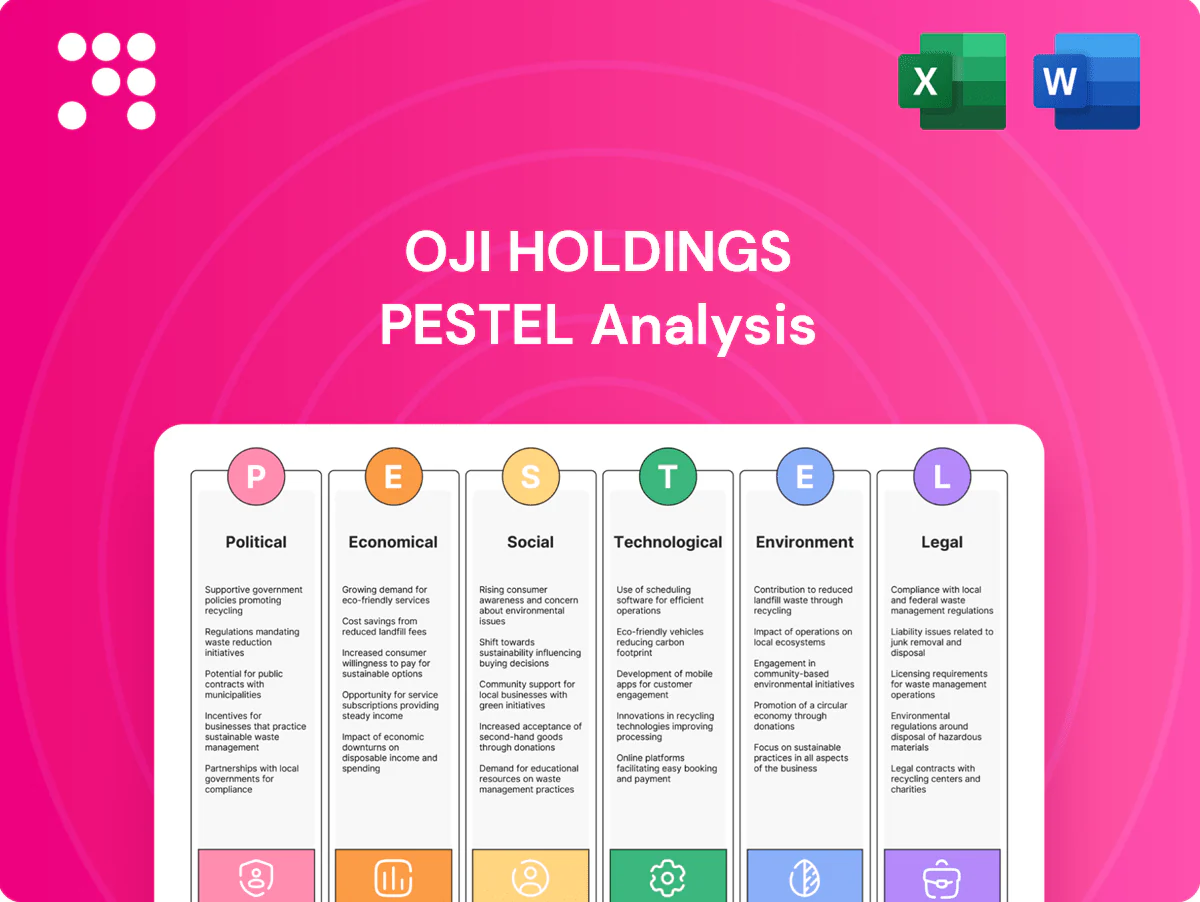
Oji Holdings PESTLE Analysis

Your Shortcut to Market Insight Starts Here
Gain strategic advantage with our PESTLE analysis of Oji Holdings. Uncover political, economic, social, technological, legal and environmental forces shaping its operations and risks. Buy the full report for actionable insights and downloadable, editable files.
Political factors

Trade policy and tariffs
Shifts in tariffs on pulp, paper and packaging directly alter Oji’s export pricing and input sourcing, with Oji reporting consolidated revenue of JPY 1.08 trillion in FY2024 and margin sensitivity to raw pulp cost swings. Asia‑Pacific trade agreements like CPTPP/FTA routes can lower barriers and freight-adjusted costs, while rising protectionism increases duties, delays and working-capital needs. Monitoring WTO rulings and bilateral tariff deals is critical for capacity planning and inventory strategy. Diversifying export markets reduces exposure to sudden policy swings.
Forestry governance and land use
Government rules on forest concessions, replanting obligations and indigenous rights directly shape wood supply security for Oji, especially in countries with tight licensing regimes; Japan’s forest cover is about 68% which underpins domestic raw material policy. Japan’s forestry subsidies and overseas host-country permit and tax rules affect unit costs and compliance risk; Oji reported roughly ¥1.07 trillion in net sales in FY2024, exposing it to these policy shifts. Political pressure for zero-deforestation supply chains is rising globally, increasing compliance costs and traceability requirements. Maintaining strong relationships with local authorities is vital to secure long-term access to concessions and reduce supply disruptions.

Carbon and energy policies
National carbon pricing and ETS (e.g., EU ETS ~€90/t in 2024) and fuel taxes materially change mill energy economics for Oji, raising operating costs and favoring electrification. Japan's GX policies aim for net zero by 2050 and a 46% GHG cut by 2030 (vs 2013), pushing electrification and biomass uptake. Renewable subsidies and GX funds help offset transition capex, but policy volatility raises stranded-asset risk if technology bets misalign.

Geopolitical supply chain risks
Geopolitical shocks—conflicts, sanctions and chokepoint disruptions—threaten Oji’s fiber, chemical inputs and shipping, with events like the 2021 Suez blockage estimated to cost global trade ~9.6 billion USD/day; global wood pulp production ~200 Mt (2023) underscores raw-material exposure. China–US tensions and regional frictions shift demand and sourcing routes, while instability in fiber-rich states can halt plantations; multi-country sourcing and inventory buffers reduce risk.
- Supply chokepoints: Suez/Panama risks
- Trade tensions: China–US demand shifts
- Raw-materials: ~200 Mt pulp market (2023)
- Mitigation: multi-source + inventory buffers
Public procurement and industrial policy
Public procurement—about 12% of global GDP per World Bank—uses recycled-content and eco-label criteria that steer Oji Holdings toward higher-recycled fiber and recyclable packaging; the EU Packaging and Packaging Waste Regulation (2023) increases such pressures. Industrial policy channels billions in grants for green materials and advanced packaging, while local-content rules encourage onshore pulp and packaging investment to qualify for support.
- Recycled-content mandates: EU PPWR 2023
- Public procurement scale: ~12% of global GDP
- Green grants: billions for circular economy
- Local content: drives onshore investment eligibility
Tariff swings and carbon costs tighten exporters' margins and working capital
Tariff shifts, trade deals and protectionism alter Oji’s export pricing and working capital; consolidated revenue JPY 1.08 trillion (FY2024) shows exposure. Carbon/energy policy (EU ETS ~€90/t 2024; Japan net‑zero 2050, −46% by 2030) raises mill costs and electrification capex. Geopolitical and supply risks (global pulp ~200 Mt 2023) push multi‑sourcing and inventory buffers.
| Factor | Key 2023/24 Figures |
|---|---|
| Revenue exposure | JPY 1.08T (FY2024) |
| Carbon price | EU ETS ~€90/t (2024) |
| Pulp market | ~200 Mt (2023) |
| Public procurement | ~12% global GDP |
What is included in the product
 Detailed Word Document
Explores how external macro-environmental factors uniquely affect Oji Holdings across Political, Economic, Social, Technological, Environmental and Legal dimensions; each section is data-backed, region- and industry-specific, and provides forward-looking insights to help executives, consultants and investors identify risks, opportunities and strategic responses.

 Customizable Excel Spreadsheet
A concise, visually segmented PESTLE summary for Oji Holdings that’s easy to drop into presentations or planning sessions, editable for regional or business-line notes and shareable for quick team alignment.
Economic factors

Global pulp and paper price cycles
Commodity pulp prices swung roughly 40% year-on-year between 2023 and 2024, driving volatile margins and inventory revaluations for Oji; downcycles compressed cash flow while 2023–24 upcycles financed capex and M&A. Capacity additions in Latin America and closures in mature markets reshaped supply; agile pricing and hedging remain essential risk tools.
Exchange rates and interest costs
Yen volatility—USD/JPY around 150–155 in 2024–mid‑2025—directly affects Oji’s export competitiveness and the yen translation of overseas earnings; a weak JPY has boosted reported foreign revenues while increasing import costs for energy and chemical inputs. Rising global and domestic rates have pushed borrowing costs for mills and plantations higher, squeezing margins. Active currency and duration hedges are used to stabilize cash flows and protect debt servicing.

Energy and logistics inflation
Power, gas and freight can comprise up to 25% of pulp and paper mill variable costs, making tight energy markets and 2022–24 shipping bottlenecks a margin squeeze for Oji. Long-term PPAs (commonly 10–15 years) and energy-efficiency upgrades dampen price volatility. Network optimization and modal shifts have cut freight surcharges in the sector by roughly 5–10% in recent years.

End-market demand mix
E-commerce expansion (global online retail >US$5.7tn in 2022 and still rising) underpins stronger containerboard demand for Oji, while structural declines in printing/writing paper persist as digital substitution continues. Tissue and hygiene product segments provide defensive, stable volume—Oji's hygiene sales helped offset cyclicality during recent pulp price swings. Higher-margin industrial materials and converted packaging diversify earnings, smoothing revenue volatility across cycles.
- Containerboard tailwinds: e-commerce growth
- Printing/writing: structural decline
- Tissue/hygiene: defensive volumes
- Industrial/converts: higher margins
- Portfolio balance: reduced cyclicality
China and ASEAN growth dynamics
Asia’s rising consumption—driven by a 2024 China GDP gain of 5.2% and ASEAN GDP ~4.8%—boosts regional packaging capacity and pricing, but China’s slower urban property market (new home sales down ~12% in 2024) tempers demand for packaging. ASEAN remains resilient with domestic consumption and rising middle-class penetration, so Oji’s investment in growth markets captures secular volume growth. Localizing production in ASEAN can cut delivered costs by roughly 10–15% and shorten lead times, supporting margin resilience.
- China growth 2024: 5.2%
- China new home sales 2024: −~12%
- ASEAN GDP 2024: ~4.8%
- Local production cost savings: ~10–15%
Tariff swings and carbon costs tighten exporters' margins and working capital
Pulp prices swung ~40% YoY (2023–24) driving margin volatility; USD/JPY ~150–155 (2024–mid‑2025) altered export competitiveness; energy & freight ≈25% of variable costs squeezing margins; Asia demand (China GDP 5.2% 2024, ASEAN ~4.8%) supports containerboard growth.
| Metric | 2024/2025 |
|---|---|
| Pulp price swing | ~40% YoY |
| USD/JPY | 150–155 |
| Energy/freight | ~25% costs |
| China GDP | 5.2% |
Preview Before You Purchase
Oji Holdings PESTLE Analysis
The preview shown here is the exact Oji Holdings PESTLE Analysis you’ll receive after purchase—fully formatted and ready to use. This is the real, finished file with complete content and structure. No placeholders or teasers; what you see is what you’ll download immediately after checkout.

Your Shortcut to Market Insight Starts Here
Gain strategic advantage with our PESTLE analysis of Oji Holdings. Uncover political, economic, social, technological, legal and environmental forces shaping its operations and risks. Buy the full report for actionable insights and downloadable, editable files.
Political factors
Trade policy and tariffs
Shifts in tariffs on pulp, paper and packaging directly alter Oji’s export pricing and input sourcing, with Oji reporting consolidated revenue of JPY 1.08 trillion in FY2024 and margin sensitivity to raw pulp cost swings. Asia‑Pacific trade agreements like CPTPP/FTA routes can lower barriers and freight-adjusted costs, while rising protectionism increases duties, delays and working-capital needs. Monitoring WTO rulings and bilateral tariff deals is critical for capacity planning and inventory strategy. Diversifying export markets reduces exposure to sudden policy swings.
Forestry governance and land use
Government rules on forest concessions, replanting obligations and indigenous rights directly shape wood supply security for Oji, especially in countries with tight licensing regimes; Japan’s forest cover is about 68% which underpins domestic raw material policy. Japan’s forestry subsidies and overseas host-country permit and tax rules affect unit costs and compliance risk; Oji reported roughly ¥1.07 trillion in net sales in FY2024, exposing it to these policy shifts. Political pressure for zero-deforestation supply chains is rising globally, increasing compliance costs and traceability requirements. Maintaining strong relationships with local authorities is vital to secure long-term access to concessions and reduce supply disruptions.
Carbon and energy policies
National carbon pricing and ETS (e.g., EU ETS ~€90/t in 2024) and fuel taxes materially change mill energy economics for Oji, raising operating costs and favoring electrification. Japan's GX policies aim for net zero by 2050 and a 46% GHG cut by 2030 (vs 2013), pushing electrification and biomass uptake. Renewable subsidies and GX funds help offset transition capex, but policy volatility raises stranded-asset risk if technology bets misalign.
Geopolitical supply chain risks
Geopolitical shocks—conflicts, sanctions and chokepoint disruptions—threaten Oji’s fiber, chemical inputs and shipping, with events like the 2021 Suez blockage estimated to cost global trade ~9.6 billion USD/day; global wood pulp production ~200 Mt (2023) underscores raw-material exposure. China–US tensions and regional frictions shift demand and sourcing routes, while instability in fiber-rich states can halt plantations; multi-country sourcing and inventory buffers reduce risk.
- Supply chokepoints: Suez/Panama risks
- Trade tensions: China–US demand shifts
- Raw-materials: ~200 Mt pulp market (2023)
- Mitigation: multi-source + inventory buffers
Public procurement and industrial policy
Public procurement—about 12% of global GDP per World Bank—uses recycled-content and eco-label criteria that steer Oji Holdings toward higher-recycled fiber and recyclable packaging; the EU Packaging and Packaging Waste Regulation (2023) increases such pressures. Industrial policy channels billions in grants for green materials and advanced packaging, while local-content rules encourage onshore pulp and packaging investment to qualify for support.
- Recycled-content mandates: EU PPWR 2023
- Public procurement scale: ~12% of global GDP
- Green grants: billions for circular economy
- Local content: drives onshore investment eligibility
Tariff swings and carbon costs tighten exporters' margins and working capital
Tariff shifts, trade deals and protectionism alter Oji’s export pricing and working capital; consolidated revenue JPY 1.08 trillion (FY2024) shows exposure. Carbon/energy policy (EU ETS ~€90/t 2024; Japan net‑zero 2050, −46% by 2030) raises mill costs and electrification capex. Geopolitical and supply risks (global pulp ~200 Mt 2023) push multi‑sourcing and inventory buffers.
| Factor | Key 2023/24 Figures |
|---|---|
| Revenue exposure | JPY 1.08T (FY2024) |
| Carbon price | EU ETS ~€90/t (2024) |
| Pulp market | ~200 Mt (2023) |
| Public procurement | ~12% global GDP |
What is included in the product
Detailed Word Document
Explores how external macro-environmental factors uniquely affect Oji Holdings across Political, Economic, Social, Technological, Environmental and Legal dimensions; each section is data-backed, region- and industry-specific, and provides forward-looking insights to help executives, consultants and investors identify risks, opportunities and strategic responses.
Customizable Excel Spreadsheet
A concise, visually segmented PESTLE summary for Oji Holdings that’s easy to drop into presentations or planning sessions, editable for regional or business-line notes and shareable for quick team alignment.
Economic factors
Global pulp and paper price cycles
Commodity pulp prices swung roughly 40% year-on-year between 2023 and 2024, driving volatile margins and inventory revaluations for Oji; downcycles compressed cash flow while 2023–24 upcycles financed capex and M&A. Capacity additions in Latin America and closures in mature markets reshaped supply; agile pricing and hedging remain essential risk tools.
Exchange rates and interest costs
Yen volatility—USD/JPY around 150–155 in 2024–mid‑2025—directly affects Oji’s export competitiveness and the yen translation of overseas earnings; a weak JPY has boosted reported foreign revenues while increasing import costs for energy and chemical inputs. Rising global and domestic rates have pushed borrowing costs for mills and plantations higher, squeezing margins. Active currency and duration hedges are used to stabilize cash flows and protect debt servicing.
Energy and logistics inflation
Power, gas and freight can comprise up to 25% of pulp and paper mill variable costs, making tight energy markets and 2022–24 shipping bottlenecks a margin squeeze for Oji. Long-term PPAs (commonly 10–15 years) and energy-efficiency upgrades dampen price volatility. Network optimization and modal shifts have cut freight surcharges in the sector by roughly 5–10% in recent years.
End-market demand mix
E-commerce expansion (global online retail >US$5.7tn in 2022 and still rising) underpins stronger containerboard demand for Oji, while structural declines in printing/writing paper persist as digital substitution continues. Tissue and hygiene product segments provide defensive, stable volume—Oji's hygiene sales helped offset cyclicality during recent pulp price swings. Higher-margin industrial materials and converted packaging diversify earnings, smoothing revenue volatility across cycles.
- Containerboard tailwinds: e-commerce growth
- Printing/writing: structural decline
- Tissue/hygiene: defensive volumes
- Industrial/converts: higher margins
- Portfolio balance: reduced cyclicality
China and ASEAN growth dynamics
Asia’s rising consumption—driven by a 2024 China GDP gain of 5.2% and ASEAN GDP ~4.8%—boosts regional packaging capacity and pricing, but China’s slower urban property market (new home sales down ~12% in 2024) tempers demand for packaging. ASEAN remains resilient with domestic consumption and rising middle-class penetration, so Oji’s investment in growth markets captures secular volume growth. Localizing production in ASEAN can cut delivered costs by roughly 10–15% and shorten lead times, supporting margin resilience.
- China growth 2024: 5.2%
- China new home sales 2024: −~12%
- ASEAN GDP 2024: ~4.8%
- Local production cost savings: ~10–15%
Tariff swings and carbon costs tighten exporters' margins and working capital
Pulp prices swung ~40% YoY (2023–24) driving margin volatility; USD/JPY ~150–155 (2024–mid‑2025) altered export competitiveness; energy & freight ≈25% of variable costs squeezing margins; Asia demand (China GDP 5.2% 2024, ASEAN ~4.8%) supports containerboard growth.
| Metric | 2024/2025 |
|---|---|
| Pulp price swing | ~40% YoY |
| USD/JPY | 150–155 |
| Energy/freight | ~25% costs |
| China GDP | 5.2% |
Preview Before You Purchase
Oji Holdings PESTLE Analysis
The preview shown here is the exact Oji Holdings PESTLE Analysis you’ll receive after purchase—fully formatted and ready to use. This is the real, finished file with complete content and structure. No placeholders or teasers; what you see is what you’ll download immediately after checkout.
Original: $10.00
-65%$10.00
$3.50Description
Your Shortcut to Market Insight Starts Here
Gain strategic advantage with our PESTLE analysis of Oji Holdings. Uncover political, economic, social, technological, legal and environmental forces shaping its operations and risks. Buy the full report for actionable insights and downloadable, editable files.
Political factors
Trade policy and tariffs
Shifts in tariffs on pulp, paper and packaging directly alter Oji’s export pricing and input sourcing, with Oji reporting consolidated revenue of JPY 1.08 trillion in FY2024 and margin sensitivity to raw pulp cost swings. Asia‑Pacific trade agreements like CPTPP/FTA routes can lower barriers and freight-adjusted costs, while rising protectionism increases duties, delays and working-capital needs. Monitoring WTO rulings and bilateral tariff deals is critical for capacity planning and inventory strategy. Diversifying export markets reduces exposure to sudden policy swings.
Forestry governance and land use
Government rules on forest concessions, replanting obligations and indigenous rights directly shape wood supply security for Oji, especially in countries with tight licensing regimes; Japan’s forest cover is about 68% which underpins domestic raw material policy. Japan’s forestry subsidies and overseas host-country permit and tax rules affect unit costs and compliance risk; Oji reported roughly ¥1.07 trillion in net sales in FY2024, exposing it to these policy shifts. Political pressure for zero-deforestation supply chains is rising globally, increasing compliance costs and traceability requirements. Maintaining strong relationships with local authorities is vital to secure long-term access to concessions and reduce supply disruptions.
Carbon and energy policies
National carbon pricing and ETS (e.g., EU ETS ~€90/t in 2024) and fuel taxes materially change mill energy economics for Oji, raising operating costs and favoring electrification. Japan's GX policies aim for net zero by 2050 and a 46% GHG cut by 2030 (vs 2013), pushing electrification and biomass uptake. Renewable subsidies and GX funds help offset transition capex, but policy volatility raises stranded-asset risk if technology bets misalign.
Geopolitical supply chain risks
Geopolitical shocks—conflicts, sanctions and chokepoint disruptions—threaten Oji’s fiber, chemical inputs and shipping, with events like the 2021 Suez blockage estimated to cost global trade ~9.6 billion USD/day; global wood pulp production ~200 Mt (2023) underscores raw-material exposure. China–US tensions and regional frictions shift demand and sourcing routes, while instability in fiber-rich states can halt plantations; multi-country sourcing and inventory buffers reduce risk.
- Supply chokepoints: Suez/Panama risks
- Trade tensions: China–US demand shifts
- Raw-materials: ~200 Mt pulp market (2023)
- Mitigation: multi-source + inventory buffers
Public procurement and industrial policy
Public procurement—about 12% of global GDP per World Bank—uses recycled-content and eco-label criteria that steer Oji Holdings toward higher-recycled fiber and recyclable packaging; the EU Packaging and Packaging Waste Regulation (2023) increases such pressures. Industrial policy channels billions in grants for green materials and advanced packaging, while local-content rules encourage onshore pulp and packaging investment to qualify for support.
- Recycled-content mandates: EU PPWR 2023
- Public procurement scale: ~12% of global GDP
- Green grants: billions for circular economy
- Local content: drives onshore investment eligibility
Tariff swings and carbon costs tighten exporters' margins and working capital
Tariff shifts, trade deals and protectionism alter Oji’s export pricing and working capital; consolidated revenue JPY 1.08 trillion (FY2024) shows exposure. Carbon/energy policy (EU ETS ~€90/t 2024; Japan net‑zero 2050, −46% by 2030) raises mill costs and electrification capex. Geopolitical and supply risks (global pulp ~200 Mt 2023) push multi‑sourcing and inventory buffers.
| Factor | Key 2023/24 Figures |
|---|---|
| Revenue exposure | JPY 1.08T (FY2024) |
| Carbon price | EU ETS ~€90/t (2024) |
| Pulp market | ~200 Mt (2023) |
| Public procurement | ~12% global GDP |
What is included in the product
Detailed Word Document
Explores how external macro-environmental factors uniquely affect Oji Holdings across Political, Economic, Social, Technological, Environmental and Legal dimensions; each section is data-backed, region- and industry-specific, and provides forward-looking insights to help executives, consultants and investors identify risks, opportunities and strategic responses.
Customizable Excel Spreadsheet
A concise, visually segmented PESTLE summary for Oji Holdings that’s easy to drop into presentations or planning sessions, editable for regional or business-line notes and shareable for quick team alignment.
Economic factors
Global pulp and paper price cycles
Commodity pulp prices swung roughly 40% year-on-year between 2023 and 2024, driving volatile margins and inventory revaluations for Oji; downcycles compressed cash flow while 2023–24 upcycles financed capex and M&A. Capacity additions in Latin America and closures in mature markets reshaped supply; agile pricing and hedging remain essential risk tools.
Exchange rates and interest costs
Yen volatility—USD/JPY around 150–155 in 2024–mid‑2025—directly affects Oji’s export competitiveness and the yen translation of overseas earnings; a weak JPY has boosted reported foreign revenues while increasing import costs for energy and chemical inputs. Rising global and domestic rates have pushed borrowing costs for mills and plantations higher, squeezing margins. Active currency and duration hedges are used to stabilize cash flows and protect debt servicing.
Energy and logistics inflation
Power, gas and freight can comprise up to 25% of pulp and paper mill variable costs, making tight energy markets and 2022–24 shipping bottlenecks a margin squeeze for Oji. Long-term PPAs (commonly 10–15 years) and energy-efficiency upgrades dampen price volatility. Network optimization and modal shifts have cut freight surcharges in the sector by roughly 5–10% in recent years.
End-market demand mix
E-commerce expansion (global online retail >US$5.7tn in 2022 and still rising) underpins stronger containerboard demand for Oji, while structural declines in printing/writing paper persist as digital substitution continues. Tissue and hygiene product segments provide defensive, stable volume—Oji's hygiene sales helped offset cyclicality during recent pulp price swings. Higher-margin industrial materials and converted packaging diversify earnings, smoothing revenue volatility across cycles.
- Containerboard tailwinds: e-commerce growth
- Printing/writing: structural decline
- Tissue/hygiene: defensive volumes
- Industrial/converts: higher margins
- Portfolio balance: reduced cyclicality
China and ASEAN growth dynamics
Asia’s rising consumption—driven by a 2024 China GDP gain of 5.2% and ASEAN GDP ~4.8%—boosts regional packaging capacity and pricing, but China’s slower urban property market (new home sales down ~12% in 2024) tempers demand for packaging. ASEAN remains resilient with domestic consumption and rising middle-class penetration, so Oji’s investment in growth markets captures secular volume growth. Localizing production in ASEAN can cut delivered costs by roughly 10–15% and shorten lead times, supporting margin resilience.
- China growth 2024: 5.2%
- China new home sales 2024: −~12%
- ASEAN GDP 2024: ~4.8%
- Local production cost savings: ~10–15%
Tariff swings and carbon costs tighten exporters' margins and working capital
Pulp prices swung ~40% YoY (2023–24) driving margin volatility; USD/JPY ~150–155 (2024–mid‑2025) altered export competitiveness; energy & freight ≈25% of variable costs squeezing margins; Asia demand (China GDP 5.2% 2024, ASEAN ~4.8%) supports containerboard growth.
| Metric | 2024/2025 |
|---|---|
| Pulp price swing | ~40% YoY |
| USD/JPY | 150–155 |
| Energy/freight | ~25% costs |
| China GDP | 5.2% |
Preview Before You Purchase
Oji Holdings PESTLE Analysis
The preview shown here is the exact Oji Holdings PESTLE Analysis you’ll receive after purchase—fully formatted and ready to use. This is the real, finished file with complete content and structure. No placeholders or teasers; what you see is what you’ll download immediately after checkout.











