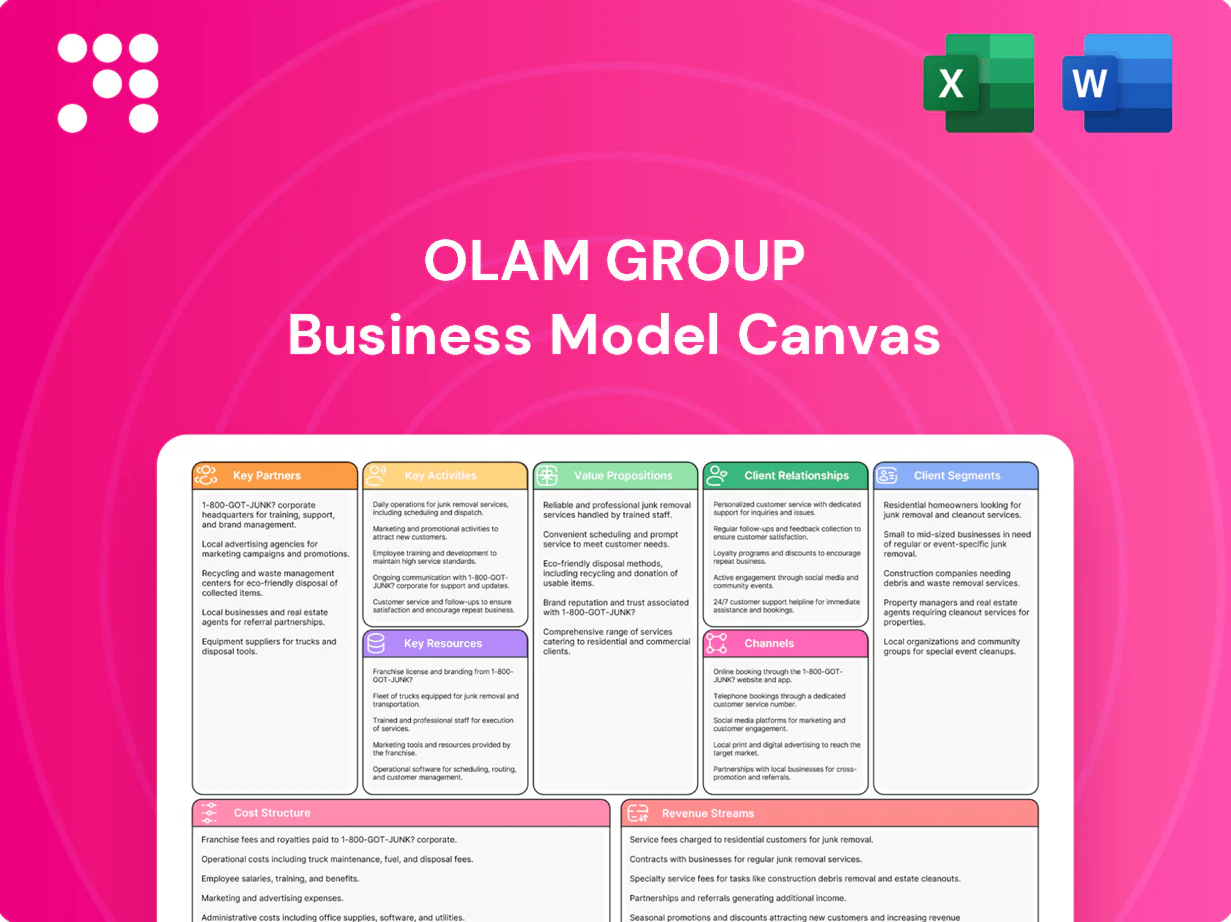
Olam Group Business Model Canvas

Business Model Canvas: agri-value chain strategy, partners, and revenue levers
Unlock Olam Group’s strategic blueprint with a concise Business Model Canvas that maps its value propositions, key partners, and revenue levers. This actionable summary reveals how Olam scales operations across agri-value chains and where growth or margin improvements lie. Download the full editable Canvas in Word and Excel for benchmarking, investor due diligence, or strategic planning.
Partnerships

Farmer and Co-op Networks
Trusted relationships with smallholders and commercial farms secure multi-origin supply; Olam reported working with over 1 million smallholder farmers in 2024 to diversify sourcing. Olam provides agronomy training, inputs and market-linked pricing to raise yields and quality, while multi-year offtake agreements (typically 3–5 years) stabilize farmer income and cut supply volatility. Data-sharing and digital traceability link farm-to-factory batches for compliance and quality control.
Processing and Logistics Allies
Partnerships with toll processors, warehouses, ports and carriers optimize throughput and cost by enabling multimodal flows and cold-chain integrity, with joint KPIs targeting OTIF above 95%, cold-chain uptime around 99% and loss reduction below 2%. Co-location near origins and customers shortens lead times and inventory days, while integrated logistics providers cut handling costs and emissions through shared assets and synchronized scheduling.

Technology and Traceability Providers
Collaboration with agtech, satellite and blockchain firms gives Olam end-to-end visibility and in 2024 expanded digital traceability across core commodity chains. Farm-level digital tools capture data and verify certifications, feeding analytics that improve forecasting, quality control and risk management. APIs link partners for real-time status and immutable audit trails.

Certification and Sustainability Bodies
Alliances with Rainforest Alliance and Fairtrade validate Olam Group’s ethical sourcing; Rainforest Alliance certifies over 5 million hectares globally and Fairtrade supports ~1.9 million farmers and workers (2024). Third-party audits and programmatic partnerships fund reforestation, water projects and livelihood programs, strengthening regulatory and customer trust and helping buyers meet ESG and compliance mandates.
- Cert bodies: Rainforest Alliance, Fairtrade
- Scale: 5M+ ha; ~1.9M producers (2024)
- Benefits: audit credibility, ESG compliance
- Programs: reforestation, water, livelihoods
Financial and Risk Institutions
Banks, trade financiers and insurers underpin Olam Group’s working capital and risk transfer, providing revolving facilities and policy cover that enabled commodity flows through 2024.
Hedging counterparties manage commodity, FX and freight exposures, while development agencies co-fund origin sustainability programs in 2024 and structured finance supports storage, processing and inventory programs.
- Banks: working capital lines (2024)
- Insurers: risk transfer cover (2024)
- Hedging: commodity/FX/freight counterparties (2024)
- Development agencies: co-funded origin projects (2024)
Supply >1M farmers; OTIF>95%; traceable & financed
Olam secures multi-origin supply via >1M smallholders (2024), 3–5yr offtakes and agronomy support, reducing volatility. Logistics partners target OTIF>95%, cold-chain uptime ~99% and losses<2%. Agtech, blockchain and cert bodies (Rainforest Alliance 5M+ ha; Fairtrade ~1.9M producers) deliver traceability and ESG credibility. Banks and hedging counterparties provide working capital and risk cover.
| Partner type | 2024 metric | Purpose |
|---|---|---|
| Smallholders | >1M | Supply stability |
| Logistics | OTIF>95% | Throughput & cold chain |
| Certifiers | 5M+ ha / ~1.9M | ESG & traceability |
| Finance | Working capital lines | Liquidity & risk transfer |
What is included in the product
 Detailed Word Document
A ready-to-use Business Model Canvas for Olam Group mapping nine BMC blocks to its integrated agribusiness and food ingredients platform, global sourcing-to-distribution channels, and sustainability-led value propositions. Ideal for investors and strategists, it includes competitive advantages, risk controls, financing models, and linked SWOT insights.

 Customizable Excel Spreadsheet
High-level, editable one-page snapshot of Olam Group’s business model that quickly identifies core components and relieves pain by saving hours of structuring, enabling team collaboration, fast executive summaries, and easy comparison across scenarios.
Activities

Global Sourcing and Origination
Field teams contract crops, assess quality and manage seasonality across 60+ origins to secure volume and diversity; local presence enabled Olam to source over 20 million tonnes in 2024. Pre-harvest agronomy and training uplift productivity by about 20% (2024 industry studies) and improve compliance. Procurement aligns purchases to demand plans and enforces risk limits, covering >90% of contracted volumes in 2024.
Processing and Value-Addition
Facilities clean, mill, crush, roast, press, and blend to customer specifications across Olam’s processing network in 60+ countries. Robust food safety and QA systems ensure consistency and regulatory compliance across product lines. Product development customises functionality for food, feed, and fiber applications. Continuous improvement programs drive yield uplift and waste reduction through operational efficiencies.

Supply Chain and Logistics Management
End-to-end planning at Olam balances inventory, throughput and service levels to target lean stock and high turnover, driving OTIF improvements to around 95% while containing working capital. Coordination across ocean, rail and road reduces freight spend and delays through multimodal optimization. Digitized tracking cuts loss rates and boosts visibility; contingency routing and alternate corridors mitigate disruptions and preserve supply continuity.

Risk and Commodity Hedging
Active hedging at Olam manages price, basis, FX and counterparty risks through futures, swaps and options; in FY2024 Olam Group reported revenues of USD 32.7bn, underpinning large-scale exposure management. Policy frameworks cap positions and VaR limits, while scenario testing guides procurement and pricing decisions. Insurance programs cover cargo, property and liability across the supply chain.
- Hedging scope: price, basis, FX, counterparty
- Governance: position caps, VaR limits
- Decision tools: scenario testing for procurement/pricing
- Risk transfer: cargo, property, liability insurance
Sustainability and Traceability Programs
Farmer training and certification programs drive responsible sourcing by building capacity in good agricultural practices and compliance, while geo-mapping and field-level data capture create lot-level traceability through Olam's AtSource platform. Regeneration projects restore soil health, water resources and biodiversity across sourcing landscapes, and structured reporting feeds customer ESG disclosures and regulatory compliance.
- Farmer training: certification & compliance
- Geo-mapping: lot-level traceability
- Regeneration: soil, water, biodiversity
- Reporting: customer ESG & regulatory data
Secured 20+ Mt, USD 32.7bn revenue, ~95% OTIF
Field teams secured 20+ million tonnes across 60+ origins in 2024, with pre-harvest agronomy raising yields ~20% and procurement covering >90% of contracted volumes. Processing and QA across 60+ countries supported USD 32.7bn revenue (FY2024) and ~95% OTIF, while multimodal logistics and digitized tracking cut loss rates and working capital. Hedging, VaR limits and insurance mitigated price, FX and counterparty risk.
| Metric | 2024 |
|---|---|
| Volume sourced | 20+ Mt |
| Revenue | USD 32.7bn |
| OTIF | ~95% |
| Contract coverage | >90% |
| Yield uplift (agronomy) | ~20% |
Full Version Awaits
Business Model Canvas
The document you're previewing is the exact Olam Group Business Model Canvas you'll receive after purchase. It's not a sample or mockup—this is the live, fully structured deliverable with the same content, layout, and editable fields. Upon payment you'll get the identical file, ready to download, edit, present, and apply.

Business Model Canvas: agri-value chain strategy, partners, and revenue levers
Unlock Olam Group’s strategic blueprint with a concise Business Model Canvas that maps its value propositions, key partners, and revenue levers. This actionable summary reveals how Olam scales operations across agri-value chains and where growth or margin improvements lie. Download the full editable Canvas in Word and Excel for benchmarking, investor due diligence, or strategic planning.
Partnerships
Farmer and Co-op Networks
Trusted relationships with smallholders and commercial farms secure multi-origin supply; Olam reported working with over 1 million smallholder farmers in 2024 to diversify sourcing. Olam provides agronomy training, inputs and market-linked pricing to raise yields and quality, while multi-year offtake agreements (typically 3–5 years) stabilize farmer income and cut supply volatility. Data-sharing and digital traceability link farm-to-factory batches for compliance and quality control.
Processing and Logistics Allies
Partnerships with toll processors, warehouses, ports and carriers optimize throughput and cost by enabling multimodal flows and cold-chain integrity, with joint KPIs targeting OTIF above 95%, cold-chain uptime around 99% and loss reduction below 2%. Co-location near origins and customers shortens lead times and inventory days, while integrated logistics providers cut handling costs and emissions through shared assets and synchronized scheduling.
Technology and Traceability Providers
Collaboration with agtech, satellite and blockchain firms gives Olam end-to-end visibility and in 2024 expanded digital traceability across core commodity chains. Farm-level digital tools capture data and verify certifications, feeding analytics that improve forecasting, quality control and risk management. APIs link partners for real-time status and immutable audit trails.
Certification and Sustainability Bodies
Alliances with Rainforest Alliance and Fairtrade validate Olam Group’s ethical sourcing; Rainforest Alliance certifies over 5 million hectares globally and Fairtrade supports ~1.9 million farmers and workers (2024). Third-party audits and programmatic partnerships fund reforestation, water projects and livelihood programs, strengthening regulatory and customer trust and helping buyers meet ESG and compliance mandates.
- Cert bodies: Rainforest Alliance, Fairtrade
- Scale: 5M+ ha; ~1.9M producers (2024)
- Benefits: audit credibility, ESG compliance
- Programs: reforestation, water, livelihoods
Financial and Risk Institutions
Banks, trade financiers and insurers underpin Olam Group’s working capital and risk transfer, providing revolving facilities and policy cover that enabled commodity flows through 2024.
Hedging counterparties manage commodity, FX and freight exposures, while development agencies co-fund origin sustainability programs in 2024 and structured finance supports storage, processing and inventory programs.
- Banks: working capital lines (2024)
- Insurers: risk transfer cover (2024)
- Hedging: commodity/FX/freight counterparties (2024)
- Development agencies: co-funded origin projects (2024)
Supply >1M farmers; OTIF>95%; traceable & financed
Olam secures multi-origin supply via >1M smallholders (2024), 3–5yr offtakes and agronomy support, reducing volatility. Logistics partners target OTIF>95%, cold-chain uptime ~99% and losses<2%. Agtech, blockchain and cert bodies (Rainforest Alliance 5M+ ha; Fairtrade ~1.9M producers) deliver traceability and ESG credibility. Banks and hedging counterparties provide working capital and risk cover.
| Partner type | 2024 metric | Purpose |
|---|---|---|
| Smallholders | >1M | Supply stability |
| Logistics | OTIF>95% | Throughput & cold chain |
| Certifiers | 5M+ ha / ~1.9M | ESG & traceability |
| Finance | Working capital lines | Liquidity & risk transfer |
What is included in the product
Detailed Word Document
A ready-to-use Business Model Canvas for Olam Group mapping nine BMC blocks to its integrated agribusiness and food ingredients platform, global sourcing-to-distribution channels, and sustainability-led value propositions. Ideal for investors and strategists, it includes competitive advantages, risk controls, financing models, and linked SWOT insights.
Customizable Excel Spreadsheet
High-level, editable one-page snapshot of Olam Group’s business model that quickly identifies core components and relieves pain by saving hours of structuring, enabling team collaboration, fast executive summaries, and easy comparison across scenarios.
Activities
Global Sourcing and Origination
Field teams contract crops, assess quality and manage seasonality across 60+ origins to secure volume and diversity; local presence enabled Olam to source over 20 million tonnes in 2024. Pre-harvest agronomy and training uplift productivity by about 20% (2024 industry studies) and improve compliance. Procurement aligns purchases to demand plans and enforces risk limits, covering >90% of contracted volumes in 2024.
Processing and Value-Addition
Facilities clean, mill, crush, roast, press, and blend to customer specifications across Olam’s processing network in 60+ countries. Robust food safety and QA systems ensure consistency and regulatory compliance across product lines. Product development customises functionality for food, feed, and fiber applications. Continuous improvement programs drive yield uplift and waste reduction through operational efficiencies.
Supply Chain and Logistics Management
End-to-end planning at Olam balances inventory, throughput and service levels to target lean stock and high turnover, driving OTIF improvements to around 95% while containing working capital. Coordination across ocean, rail and road reduces freight spend and delays through multimodal optimization. Digitized tracking cuts loss rates and boosts visibility; contingency routing and alternate corridors mitigate disruptions and preserve supply continuity.
Risk and Commodity Hedging
Active hedging at Olam manages price, basis, FX and counterparty risks through futures, swaps and options; in FY2024 Olam Group reported revenues of USD 32.7bn, underpinning large-scale exposure management. Policy frameworks cap positions and VaR limits, while scenario testing guides procurement and pricing decisions. Insurance programs cover cargo, property and liability across the supply chain.
- Hedging scope: price, basis, FX, counterparty
- Governance: position caps, VaR limits
- Decision tools: scenario testing for procurement/pricing
- Risk transfer: cargo, property, liability insurance
Sustainability and Traceability Programs
Farmer training and certification programs drive responsible sourcing by building capacity in good agricultural practices and compliance, while geo-mapping and field-level data capture create lot-level traceability through Olam's AtSource platform. Regeneration projects restore soil health, water resources and biodiversity across sourcing landscapes, and structured reporting feeds customer ESG disclosures and regulatory compliance.
- Farmer training: certification & compliance
- Geo-mapping: lot-level traceability
- Regeneration: soil, water, biodiversity
- Reporting: customer ESG & regulatory data
Secured 20+ Mt, USD 32.7bn revenue, ~95% OTIF
Field teams secured 20+ million tonnes across 60+ origins in 2024, with pre-harvest agronomy raising yields ~20% and procurement covering >90% of contracted volumes. Processing and QA across 60+ countries supported USD 32.7bn revenue (FY2024) and ~95% OTIF, while multimodal logistics and digitized tracking cut loss rates and working capital. Hedging, VaR limits and insurance mitigated price, FX and counterparty risk.
| Metric | 2024 |
|---|---|
| Volume sourced | 20+ Mt |
| Revenue | USD 32.7bn |
| OTIF | ~95% |
| Contract coverage | >90% |
| Yield uplift (agronomy) | ~20% |
Full Version Awaits
Business Model Canvas
The document you're previewing is the exact Olam Group Business Model Canvas you'll receive after purchase. It's not a sample or mockup—this is the live, fully structured deliverable with the same content, layout, and editable fields. Upon payment you'll get the identical file, ready to download, edit, present, and apply.
Original: $10.00
-65%$10.00
$3.50Description
Business Model Canvas: agri-value chain strategy, partners, and revenue levers
Unlock Olam Group’s strategic blueprint with a concise Business Model Canvas that maps its value propositions, key partners, and revenue levers. This actionable summary reveals how Olam scales operations across agri-value chains and where growth or margin improvements lie. Download the full editable Canvas in Word and Excel for benchmarking, investor due diligence, or strategic planning.
Partnerships
Farmer and Co-op Networks
Trusted relationships with smallholders and commercial farms secure multi-origin supply; Olam reported working with over 1 million smallholder farmers in 2024 to diversify sourcing. Olam provides agronomy training, inputs and market-linked pricing to raise yields and quality, while multi-year offtake agreements (typically 3–5 years) stabilize farmer income and cut supply volatility. Data-sharing and digital traceability link farm-to-factory batches for compliance and quality control.
Processing and Logistics Allies
Partnerships with toll processors, warehouses, ports and carriers optimize throughput and cost by enabling multimodal flows and cold-chain integrity, with joint KPIs targeting OTIF above 95%, cold-chain uptime around 99% and loss reduction below 2%. Co-location near origins and customers shortens lead times and inventory days, while integrated logistics providers cut handling costs and emissions through shared assets and synchronized scheduling.
Technology and Traceability Providers
Collaboration with agtech, satellite and blockchain firms gives Olam end-to-end visibility and in 2024 expanded digital traceability across core commodity chains. Farm-level digital tools capture data and verify certifications, feeding analytics that improve forecasting, quality control and risk management. APIs link partners for real-time status and immutable audit trails.
Certification and Sustainability Bodies
Alliances with Rainforest Alliance and Fairtrade validate Olam Group’s ethical sourcing; Rainforest Alliance certifies over 5 million hectares globally and Fairtrade supports ~1.9 million farmers and workers (2024). Third-party audits and programmatic partnerships fund reforestation, water projects and livelihood programs, strengthening regulatory and customer trust and helping buyers meet ESG and compliance mandates.
- Cert bodies: Rainforest Alliance, Fairtrade
- Scale: 5M+ ha; ~1.9M producers (2024)
- Benefits: audit credibility, ESG compliance
- Programs: reforestation, water, livelihoods
Financial and Risk Institutions
Banks, trade financiers and insurers underpin Olam Group’s working capital and risk transfer, providing revolving facilities and policy cover that enabled commodity flows through 2024.
Hedging counterparties manage commodity, FX and freight exposures, while development agencies co-fund origin sustainability programs in 2024 and structured finance supports storage, processing and inventory programs.
- Banks: working capital lines (2024)
- Insurers: risk transfer cover (2024)
- Hedging: commodity/FX/freight counterparties (2024)
- Development agencies: co-funded origin projects (2024)
Supply >1M farmers; OTIF>95%; traceable & financed
Olam secures multi-origin supply via >1M smallholders (2024), 3–5yr offtakes and agronomy support, reducing volatility. Logistics partners target OTIF>95%, cold-chain uptime ~99% and losses<2%. Agtech, blockchain and cert bodies (Rainforest Alliance 5M+ ha; Fairtrade ~1.9M producers) deliver traceability and ESG credibility. Banks and hedging counterparties provide working capital and risk cover.
| Partner type | 2024 metric | Purpose |
|---|---|---|
| Smallholders | >1M | Supply stability |
| Logistics | OTIF>95% | Throughput & cold chain |
| Certifiers | 5M+ ha / ~1.9M | ESG & traceability |
| Finance | Working capital lines | Liquidity & risk transfer |
What is included in the product
Detailed Word Document
A ready-to-use Business Model Canvas for Olam Group mapping nine BMC blocks to its integrated agribusiness and food ingredients platform, global sourcing-to-distribution channels, and sustainability-led value propositions. Ideal for investors and strategists, it includes competitive advantages, risk controls, financing models, and linked SWOT insights.
Customizable Excel Spreadsheet
High-level, editable one-page snapshot of Olam Group’s business model that quickly identifies core components and relieves pain by saving hours of structuring, enabling team collaboration, fast executive summaries, and easy comparison across scenarios.
Activities
Global Sourcing and Origination
Field teams contract crops, assess quality and manage seasonality across 60+ origins to secure volume and diversity; local presence enabled Olam to source over 20 million tonnes in 2024. Pre-harvest agronomy and training uplift productivity by about 20% (2024 industry studies) and improve compliance. Procurement aligns purchases to demand plans and enforces risk limits, covering >90% of contracted volumes in 2024.
Processing and Value-Addition
Facilities clean, mill, crush, roast, press, and blend to customer specifications across Olam’s processing network in 60+ countries. Robust food safety and QA systems ensure consistency and regulatory compliance across product lines. Product development customises functionality for food, feed, and fiber applications. Continuous improvement programs drive yield uplift and waste reduction through operational efficiencies.
Supply Chain and Logistics Management
End-to-end planning at Olam balances inventory, throughput and service levels to target lean stock and high turnover, driving OTIF improvements to around 95% while containing working capital. Coordination across ocean, rail and road reduces freight spend and delays through multimodal optimization. Digitized tracking cuts loss rates and boosts visibility; contingency routing and alternate corridors mitigate disruptions and preserve supply continuity.
Risk and Commodity Hedging
Active hedging at Olam manages price, basis, FX and counterparty risks through futures, swaps and options; in FY2024 Olam Group reported revenues of USD 32.7bn, underpinning large-scale exposure management. Policy frameworks cap positions and VaR limits, while scenario testing guides procurement and pricing decisions. Insurance programs cover cargo, property and liability across the supply chain.
- Hedging scope: price, basis, FX, counterparty
- Governance: position caps, VaR limits
- Decision tools: scenario testing for procurement/pricing
- Risk transfer: cargo, property, liability insurance
Sustainability and Traceability Programs
Farmer training and certification programs drive responsible sourcing by building capacity in good agricultural practices and compliance, while geo-mapping and field-level data capture create lot-level traceability through Olam's AtSource platform. Regeneration projects restore soil health, water resources and biodiversity across sourcing landscapes, and structured reporting feeds customer ESG disclosures and regulatory compliance.
- Farmer training: certification & compliance
- Geo-mapping: lot-level traceability
- Regeneration: soil, water, biodiversity
- Reporting: customer ESG & regulatory data
Secured 20+ Mt, USD 32.7bn revenue, ~95% OTIF
Field teams secured 20+ million tonnes across 60+ origins in 2024, with pre-harvest agronomy raising yields ~20% and procurement covering >90% of contracted volumes. Processing and QA across 60+ countries supported USD 32.7bn revenue (FY2024) and ~95% OTIF, while multimodal logistics and digitized tracking cut loss rates and working capital. Hedging, VaR limits and insurance mitigated price, FX and counterparty risk.
| Metric | 2024 |
|---|---|
| Volume sourced | 20+ Mt |
| Revenue | USD 32.7bn |
| OTIF | ~95% |
| Contract coverage | >90% |
| Yield uplift (agronomy) | ~20% |
Full Version Awaits
Business Model Canvas
The document you're previewing is the exact Olam Group Business Model Canvas you'll receive after purchase. It's not a sample or mockup—this is the live, fully structured deliverable with the same content, layout, and editable fields. Upon payment you'll get the identical file, ready to download, edit, present, and apply.











