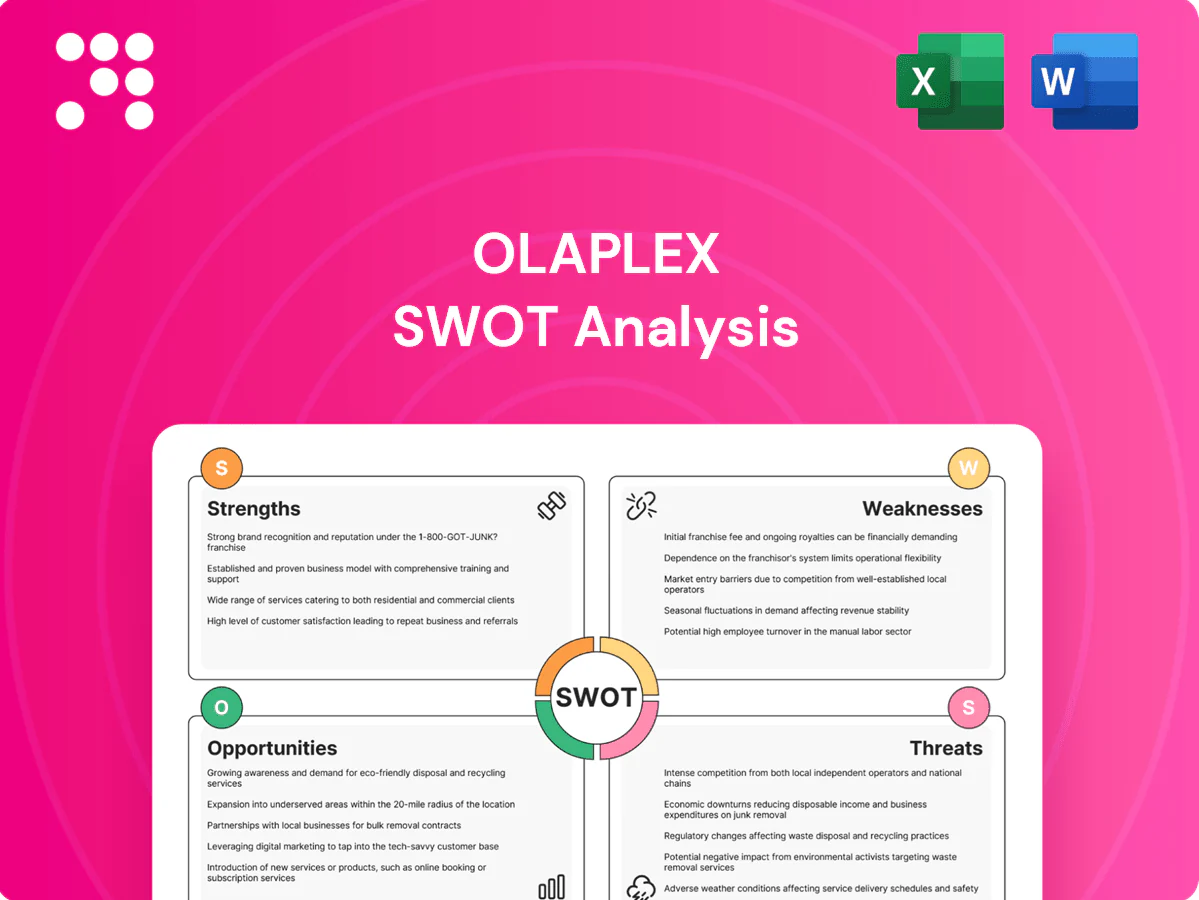
Olaplex SWOT Analysis

Elevate Your Analysis with the Complete SWOT Report
Olaplex’s cutting-edge bond-repair technology and strong salon-professional credibility are driving brand loyalty, yet rising competition and supply-chain pressures pose clear risks. Growth opportunities lie in global retail expansion and R&D into adjacent haircare segments, while margin and regulatory sensitivity warrant close monitoring. Purchase the full SWOT analysis for a research-backed, editable report and Excel matrix to inform strategy, investment, or pitch preparation.
Strengths

Proprietary bond-repair technology
Olaplex core IP targets disulfide bonds, creating clear differentiation from generic conditioners and masks and underpinning salon adoption in 100,000+ salons and availability in 150+ countries. Efficacy is demonstrable in both salon services and at-home regimens, supporting premium pricing and higher ASPs versus category peers. Scientific positioning drives professional endorsements and, together with issued patents and proprietary know-how, slows direct imitation and sustains brand equity.
Strong brand equity with pros and consumers
Stylist adoption created early credibility and word-of-mouth that cascaded into strong retail demand, positioning Olaplex as a salon-origin brand consumers trust.
High awareness in prestige hair care enables efficient new-product launches with lower marketing spend per SKU compared with unknown entrants.
Social proof and before/after content consistently reinforce perceived outcomes, driving higher conversion rates online and in‑store.
The brand name Olaplex is often synonymous with bond-building treatments, simplifying purchase decisions and strengthening repeat sales.

Omnichannel distribution reach
Presence across professional salons, specialty retail, e-commerce and DTC broadens access to millions of consumers worldwide; Olaplex sells in over 50 countries, supporting both local pro networks and mass retail footprints. The channel mix enables targeted in-salon education and scale through national retailers, while retail placements drive repeat purchases. Global distribution diversifies revenue streams and reduces single-market risk. DTC and retail POS/CRM data feed merchandising and replenishment decisions in near real-time.

Premium pricing and attractive margins
Olaplex’s performance positioning supports premium pricing versus mass competitors, with concentrated formulas and repeat usage driving strong unit economics and higher lifetime value per customer. The brand reported gross margins above 70% in recent annual filings, enabling reinvestment in R&D and marketing and cushioning profitability against moderate input-cost volatility. This margin profile supports sustained premium placement and marketing-led growth.
- Premium pricing vs mass
- Concentrated formulas = better unit economics
- Gross margin >70% (recent filings)
- Margins cushion input-cost swings
Focused portfolio with regimen logic
Olaplex’s focused portfolio—treatments, shampoos, conditioners, and stylers—ladders into cohesive routines that drive regimen selling, which management cited as key to growing average basket size and retention during FY2024 when net revenue was roughly $513 million.
Clear step-by-step education improves consumer compliance and efficacy, supporting higher repurchase rates and professional salon demand, while portfolio simplicity reduces operational complexity and inventory risk.
- Regimen cohesion: treatments→shampoos→conditioners→stylers
- FY2024 net revenue: ~$513M
- Benefits: bigger baskets, higher retention, lower inventory complexity
Bond-repair IP fuels salon adoption in 100,000+ salons across 150+ countries
Proprietary bond-repair IP differentiates Olaplex from generic haircare and drives salon endorsement. Adopted in 100,000+ salons and available in 150+ countries, supporting FY2024 net revenue of ~$513M. Premium positioning and concentrated formulas yield gross margins >70%, enabling R&D and marketing reinvestment.
| Metric | Value | Year |
|---|---|---|
| Salons | 100,000+ | 2024 |
| Countries | 150+ | 2024 |
| Net revenue | $513M | FY2024 |
| Gross margin | >70% | FY2024 |
What is included in the product
 Detailed Word Document
Provides a strategic overview of Olaplex’s internal strengths and weaknesses and external opportunities and threats, highlighting brand equity and product innovation as growth drivers while noting supply, regulatory and competitive risks that could impact future performance.

 Customizable Excel Spreadsheet
Provides a concise Olaplex SWOT matrix that quickly surfaces strengths, weaknesses, opportunities and threats to relieve strategic uncertainty and produce stakeholder-ready summaries.
Weaknesses

Reliance on hero products
Olaplex remains heavily dependent on its hero treatments, concentrating a large share of revenue into a few flagship SKUs and elevating single-SKU risk. Perceptions of saturation or weaker product performance can disproportionately depress top-line growth. Close alternatives and private-label salon substitutes can rapidly erode share despite improving but still relatively narrow portfolio depth.
Patent durability and litigation overhang
Olaplex's hair-bond IP faces durability challenges as chemical workarounds and eventual patent expirations can erode exclusivity; Olaplex is publicly traded under ticker OLPX. Legal disputes generate direct costs and strategic distraction for management. Competitors have engineered around proprietary claims, compressing differentiation and keeping investor attention tightly coupled to IP headlines.

Premium price sensitivity
Olaplex premium price points constrain penetration among price-sensitive shoppers despite a global beauty market ≈$550 billion in 2024, limiting volume growth in lower-price tiers. Macroeconomic pressure—US inflation running near 3–4% in 2024—encourages shifts to cheaper alternatives and private labels. Heavy promotional reliance risks diluting equity, since elasticity in non-essential beauty categories is markedly higher than staples.

Demand volatility tied to trends
Consumer interest can spike or fade with social media cycles, where viral content drives sharp sales bursts followed by normalization that complicates forecasting for Olaplex.
Retailer inventory reactions—both overstocking during spikes and rapid de-stocking afterward—amplify demand swings and margin pressure.
Marketing must constantly refresh product education and creative to sustain momentum and avoid reliance on episodic virality.
- Demand volatility tied to trends
- Viral-driven sales bursts → forecasting challenges
- Retailer inventory cycles amplify swings
- Continuous marketing/education required
Channel conflict and gray market risk
Salon professionals may resist if retail discounting undercuts service attach. Unauthorized resellers and diversion erode pricing integrity and margin. Consumers buying through uncontrolled channels get inconsistent brand experience; policing diversion raises cost and operational complexity.
- Salon relations at risk
- Pricing/manufacturing margin pressure
- Increased compliance and policing costs
Flagship SKU reliance, patent risk and premium pricing heighten revenue and inventory volatility
Heavy reliance on flagship SKUs concentrates revenue risk; Olaplex is publicly traded under ticker OLPX. Bond-repair IP faces durability and litigation drag as competitors design around claims. Premium pricing limits penetration despite a global beauty market ≈$550 billion (2024) and US inflation ~3–4% (2024). Viral-driven demand spikes create forecasting and inventory volatility.
| Weakness | Relevant data |
|---|---|
| SKU concentration | High flagship dependence |
| IP & legal | Ongoing disputes; loss of exclusivity risk |
| Price sensitivity | Global market ≈$550B; US inflation ~3–4% (2024) |
| Demand volatility | Viral-driven spikes → inventory swings |
Same Document Delivered
Olaplex SWOT Analysis
This is the actual Olaplex SWOT analysis document you’ll receive upon purchase—no surprises, just professional quality. The preview below is taken directly from the full report you'll get, with the same structure and insights. Purchase unlocks the complete, editable version for immediate download.

Elevate Your Analysis with the Complete SWOT Report
Olaplex’s cutting-edge bond-repair technology and strong salon-professional credibility are driving brand loyalty, yet rising competition and supply-chain pressures pose clear risks. Growth opportunities lie in global retail expansion and R&D into adjacent haircare segments, while margin and regulatory sensitivity warrant close monitoring. Purchase the full SWOT analysis for a research-backed, editable report and Excel matrix to inform strategy, investment, or pitch preparation.
Strengths
Proprietary bond-repair technology
Olaplex core IP targets disulfide bonds, creating clear differentiation from generic conditioners and masks and underpinning salon adoption in 100,000+ salons and availability in 150+ countries. Efficacy is demonstrable in both salon services and at-home regimens, supporting premium pricing and higher ASPs versus category peers. Scientific positioning drives professional endorsements and, together with issued patents and proprietary know-how, slows direct imitation and sustains brand equity.
Strong brand equity with pros and consumers
Stylist adoption created early credibility and word-of-mouth that cascaded into strong retail demand, positioning Olaplex as a salon-origin brand consumers trust.
High awareness in prestige hair care enables efficient new-product launches with lower marketing spend per SKU compared with unknown entrants.
Social proof and before/after content consistently reinforce perceived outcomes, driving higher conversion rates online and in‑store.
The brand name Olaplex is often synonymous with bond-building treatments, simplifying purchase decisions and strengthening repeat sales.
Omnichannel distribution reach
Presence across professional salons, specialty retail, e-commerce and DTC broadens access to millions of consumers worldwide; Olaplex sells in over 50 countries, supporting both local pro networks and mass retail footprints. The channel mix enables targeted in-salon education and scale through national retailers, while retail placements drive repeat purchases. Global distribution diversifies revenue streams and reduces single-market risk. DTC and retail POS/CRM data feed merchandising and replenishment decisions in near real-time.
Premium pricing and attractive margins
Olaplex’s performance positioning supports premium pricing versus mass competitors, with concentrated formulas and repeat usage driving strong unit economics and higher lifetime value per customer. The brand reported gross margins above 70% in recent annual filings, enabling reinvestment in R&D and marketing and cushioning profitability against moderate input-cost volatility. This margin profile supports sustained premium placement and marketing-led growth.
- Premium pricing vs mass
- Concentrated formulas = better unit economics
- Gross margin >70% (recent filings)
- Margins cushion input-cost swings
Focused portfolio with regimen logic
Olaplex’s focused portfolio—treatments, shampoos, conditioners, and stylers—ladders into cohesive routines that drive regimen selling, which management cited as key to growing average basket size and retention during FY2024 when net revenue was roughly $513 million.
Clear step-by-step education improves consumer compliance and efficacy, supporting higher repurchase rates and professional salon demand, while portfolio simplicity reduces operational complexity and inventory risk.
- Regimen cohesion: treatments→shampoos→conditioners→stylers
- FY2024 net revenue: ~$513M
- Benefits: bigger baskets, higher retention, lower inventory complexity
Bond-repair IP fuels salon adoption in 100,000+ salons across 150+ countries
Proprietary bond-repair IP differentiates Olaplex from generic haircare and drives salon endorsement. Adopted in 100,000+ salons and available in 150+ countries, supporting FY2024 net revenue of ~$513M. Premium positioning and concentrated formulas yield gross margins >70%, enabling R&D and marketing reinvestment.
| Metric | Value | Year |
|---|---|---|
| Salons | 100,000+ | 2024 |
| Countries | 150+ | 2024 |
| Net revenue | $513M | FY2024 |
| Gross margin | >70% | FY2024 |
What is included in the product
Detailed Word Document
Provides a strategic overview of Olaplex’s internal strengths and weaknesses and external opportunities and threats, highlighting brand equity and product innovation as growth drivers while noting supply, regulatory and competitive risks that could impact future performance.
Customizable Excel Spreadsheet
Provides a concise Olaplex SWOT matrix that quickly surfaces strengths, weaknesses, opportunities and threats to relieve strategic uncertainty and produce stakeholder-ready summaries.
Weaknesses
Reliance on hero products
Olaplex remains heavily dependent on its hero treatments, concentrating a large share of revenue into a few flagship SKUs and elevating single-SKU risk. Perceptions of saturation or weaker product performance can disproportionately depress top-line growth. Close alternatives and private-label salon substitutes can rapidly erode share despite improving but still relatively narrow portfolio depth.
Patent durability and litigation overhang
Olaplex's hair-bond IP faces durability challenges as chemical workarounds and eventual patent expirations can erode exclusivity; Olaplex is publicly traded under ticker OLPX. Legal disputes generate direct costs and strategic distraction for management. Competitors have engineered around proprietary claims, compressing differentiation and keeping investor attention tightly coupled to IP headlines.
Premium price sensitivity
Olaplex premium price points constrain penetration among price-sensitive shoppers despite a global beauty market ≈$550 billion in 2024, limiting volume growth in lower-price tiers. Macroeconomic pressure—US inflation running near 3–4% in 2024—encourages shifts to cheaper alternatives and private labels. Heavy promotional reliance risks diluting equity, since elasticity in non-essential beauty categories is markedly higher than staples.
Demand volatility tied to trends
Consumer interest can spike or fade with social media cycles, where viral content drives sharp sales bursts followed by normalization that complicates forecasting for Olaplex.
Retailer inventory reactions—both overstocking during spikes and rapid de-stocking afterward—amplify demand swings and margin pressure.
Marketing must constantly refresh product education and creative to sustain momentum and avoid reliance on episodic virality.
- Demand volatility tied to trends
- Viral-driven sales bursts → forecasting challenges
- Retailer inventory cycles amplify swings
- Continuous marketing/education required
Channel conflict and gray market risk
Salon professionals may resist if retail discounting undercuts service attach. Unauthorized resellers and diversion erode pricing integrity and margin. Consumers buying through uncontrolled channels get inconsistent brand experience; policing diversion raises cost and operational complexity.
- Salon relations at risk
- Pricing/manufacturing margin pressure
- Increased compliance and policing costs
Flagship SKU reliance, patent risk and premium pricing heighten revenue and inventory volatility
Heavy reliance on flagship SKUs concentrates revenue risk; Olaplex is publicly traded under ticker OLPX. Bond-repair IP faces durability and litigation drag as competitors design around claims. Premium pricing limits penetration despite a global beauty market ≈$550 billion (2024) and US inflation ~3–4% (2024). Viral-driven demand spikes create forecasting and inventory volatility.
| Weakness | Relevant data |
|---|---|
| SKU concentration | High flagship dependence |
| IP & legal | Ongoing disputes; loss of exclusivity risk |
| Price sensitivity | Global market ≈$550B; US inflation ~3–4% (2024) |
| Demand volatility | Viral-driven spikes → inventory swings |
Same Document Delivered
Olaplex SWOT Analysis
This is the actual Olaplex SWOT analysis document you’ll receive upon purchase—no surprises, just professional quality. The preview below is taken directly from the full report you'll get, with the same structure and insights. Purchase unlocks the complete, editable version for immediate download.
Description
Elevate Your Analysis with the Complete SWOT Report
Olaplex’s cutting-edge bond-repair technology and strong salon-professional credibility are driving brand loyalty, yet rising competition and supply-chain pressures pose clear risks. Growth opportunities lie in global retail expansion and R&D into adjacent haircare segments, while margin and regulatory sensitivity warrant close monitoring. Purchase the full SWOT analysis for a research-backed, editable report and Excel matrix to inform strategy, investment, or pitch preparation.
Strengths
Proprietary bond-repair technology
Olaplex core IP targets disulfide bonds, creating clear differentiation from generic conditioners and masks and underpinning salon adoption in 100,000+ salons and availability in 150+ countries. Efficacy is demonstrable in both salon services and at-home regimens, supporting premium pricing and higher ASPs versus category peers. Scientific positioning drives professional endorsements and, together with issued patents and proprietary know-how, slows direct imitation and sustains brand equity.
Strong brand equity with pros and consumers
Stylist adoption created early credibility and word-of-mouth that cascaded into strong retail demand, positioning Olaplex as a salon-origin brand consumers trust.
High awareness in prestige hair care enables efficient new-product launches with lower marketing spend per SKU compared with unknown entrants.
Social proof and before/after content consistently reinforce perceived outcomes, driving higher conversion rates online and in‑store.
The brand name Olaplex is often synonymous with bond-building treatments, simplifying purchase decisions and strengthening repeat sales.
Omnichannel distribution reach
Presence across professional salons, specialty retail, e-commerce and DTC broadens access to millions of consumers worldwide; Olaplex sells in over 50 countries, supporting both local pro networks and mass retail footprints. The channel mix enables targeted in-salon education and scale through national retailers, while retail placements drive repeat purchases. Global distribution diversifies revenue streams and reduces single-market risk. DTC and retail POS/CRM data feed merchandising and replenishment decisions in near real-time.
Premium pricing and attractive margins
Olaplex’s performance positioning supports premium pricing versus mass competitors, with concentrated formulas and repeat usage driving strong unit economics and higher lifetime value per customer. The brand reported gross margins above 70% in recent annual filings, enabling reinvestment in R&D and marketing and cushioning profitability against moderate input-cost volatility. This margin profile supports sustained premium placement and marketing-led growth.
- Premium pricing vs mass
- Concentrated formulas = better unit economics
- Gross margin >70% (recent filings)
- Margins cushion input-cost swings
Focused portfolio with regimen logic
Olaplex’s focused portfolio—treatments, shampoos, conditioners, and stylers—ladders into cohesive routines that drive regimen selling, which management cited as key to growing average basket size and retention during FY2024 when net revenue was roughly $513 million.
Clear step-by-step education improves consumer compliance and efficacy, supporting higher repurchase rates and professional salon demand, while portfolio simplicity reduces operational complexity and inventory risk.
- Regimen cohesion: treatments→shampoos→conditioners→stylers
- FY2024 net revenue: ~$513M
- Benefits: bigger baskets, higher retention, lower inventory complexity
Bond-repair IP fuels salon adoption in 100,000+ salons across 150+ countries
Proprietary bond-repair IP differentiates Olaplex from generic haircare and drives salon endorsement. Adopted in 100,000+ salons and available in 150+ countries, supporting FY2024 net revenue of ~$513M. Premium positioning and concentrated formulas yield gross margins >70%, enabling R&D and marketing reinvestment.
| Metric | Value | Year |
|---|---|---|
| Salons | 100,000+ | 2024 |
| Countries | 150+ | 2024 |
| Net revenue | $513M | FY2024 |
| Gross margin | >70% | FY2024 |
What is included in the product
Detailed Word Document
Provides a strategic overview of Olaplex’s internal strengths and weaknesses and external opportunities and threats, highlighting brand equity and product innovation as growth drivers while noting supply, regulatory and competitive risks that could impact future performance.
Customizable Excel Spreadsheet
Provides a concise Olaplex SWOT matrix that quickly surfaces strengths, weaknesses, opportunities and threats to relieve strategic uncertainty and produce stakeholder-ready summaries.
Weaknesses
Reliance on hero products
Olaplex remains heavily dependent on its hero treatments, concentrating a large share of revenue into a few flagship SKUs and elevating single-SKU risk. Perceptions of saturation or weaker product performance can disproportionately depress top-line growth. Close alternatives and private-label salon substitutes can rapidly erode share despite improving but still relatively narrow portfolio depth.
Patent durability and litigation overhang
Olaplex's hair-bond IP faces durability challenges as chemical workarounds and eventual patent expirations can erode exclusivity; Olaplex is publicly traded under ticker OLPX. Legal disputes generate direct costs and strategic distraction for management. Competitors have engineered around proprietary claims, compressing differentiation and keeping investor attention tightly coupled to IP headlines.
Premium price sensitivity
Olaplex premium price points constrain penetration among price-sensitive shoppers despite a global beauty market ≈$550 billion in 2024, limiting volume growth in lower-price tiers. Macroeconomic pressure—US inflation running near 3–4% in 2024—encourages shifts to cheaper alternatives and private labels. Heavy promotional reliance risks diluting equity, since elasticity in non-essential beauty categories is markedly higher than staples.
Demand volatility tied to trends
Consumer interest can spike or fade with social media cycles, where viral content drives sharp sales bursts followed by normalization that complicates forecasting for Olaplex.
Retailer inventory reactions—both overstocking during spikes and rapid de-stocking afterward—amplify demand swings and margin pressure.
Marketing must constantly refresh product education and creative to sustain momentum and avoid reliance on episodic virality.
- Demand volatility tied to trends
- Viral-driven sales bursts → forecasting challenges
- Retailer inventory cycles amplify swings
- Continuous marketing/education required
Channel conflict and gray market risk
Salon professionals may resist if retail discounting undercuts service attach. Unauthorized resellers and diversion erode pricing integrity and margin. Consumers buying through uncontrolled channels get inconsistent brand experience; policing diversion raises cost and operational complexity.
- Salon relations at risk
- Pricing/manufacturing margin pressure
- Increased compliance and policing costs
Flagship SKU reliance, patent risk and premium pricing heighten revenue and inventory volatility
Heavy reliance on flagship SKUs concentrates revenue risk; Olaplex is publicly traded under ticker OLPX. Bond-repair IP faces durability and litigation drag as competitors design around claims. Premium pricing limits penetration despite a global beauty market ≈$550 billion (2024) and US inflation ~3–4% (2024). Viral-driven demand spikes create forecasting and inventory volatility.
| Weakness | Relevant data |
|---|---|
| SKU concentration | High flagship dependence |
| IP & legal | Ongoing disputes; loss of exclusivity risk |
| Price sensitivity | Global market ≈$550B; US inflation ~3–4% (2024) |
| Demand volatility | Viral-driven spikes → inventory swings |
Same Document Delivered
Olaplex SWOT Analysis
This is the actual Olaplex SWOT analysis document you’ll receive upon purchase—no surprises, just professional quality. The preview below is taken directly from the full report you'll get, with the same structure and insights. Purchase unlocks the complete, editable version for immediate download.











