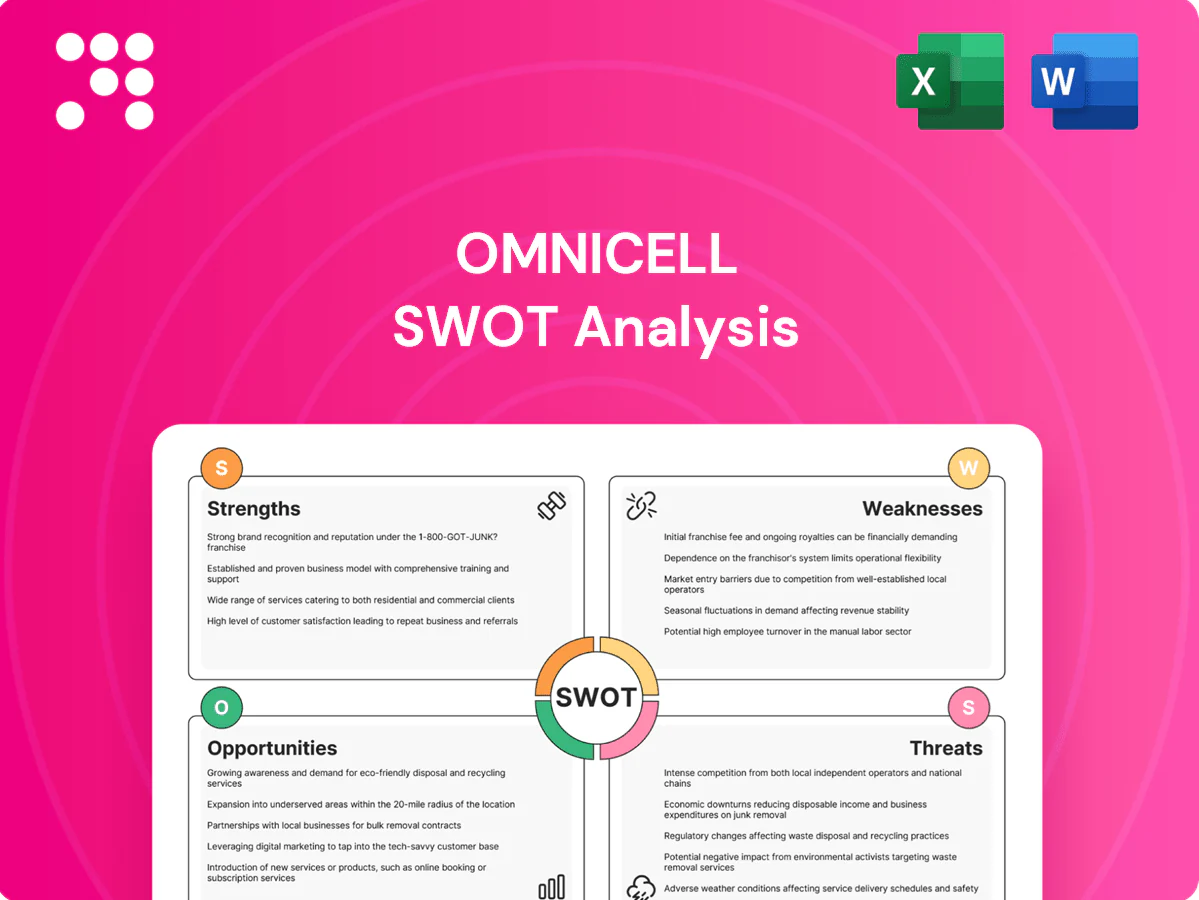
Omnicell SWOT Analysis

Elevate Your Analysis with the Complete SWOT Report
Omnicell’s strengths in automated medication management and growing services portfolio position it well amid healthcare digitization, but margin pressure, regulatory complexity, and competitive medical tech entrants are key risks to monitor. Want the full strategic picture with financial context and actionable recommendations? Purchase the complete SWOT analysis for a professionally formatted Word report and editable Excel model to plan, pitch, or invest with confidence.
Strengths

Integrated automation platform
Omnicell (NASDAQ: OMCL) delivers an integrated automation platform with end-to-end dispensing, inventory, and analytics that creates a cohesive solution across thousands of care sites. A unified stack reduces handoffs and error points, improving medication safety and compliance. Customers gain streamlined workflows and fewer vendors to coordinate, reinforcing differentiation versus point solutions.
Medication safety expertise
Omnicell's core focus on reducing medication errors aligns directly with provider quality metrics and patient outcomes and supports compliance with Joint Commission National Patient Safety Goals and CMS HAC Reduction Program (up to 1% Medicare payment penalty). Safety-first design and workflows translate into measurable risk reduction, with medication-related adverse events estimated to cost health systems about US$42 billion annually (WHO). This value proposition underpins premium pricing and strong customer retention.

Data and analytics capabilities
Omnicell leverages usage data to drive predictive inventory and reduce medication waste—U.S. hospital drug waste is estimated at about 2.6 billion dollars annually—while analytics improve labor efficiency and boost inventory turns by double digits. Insights drive formulary adherence and create ongoing post-installation value that increases customer stickiness. Continuous analytics feed product improvement and feature iteration, shortening upgrade cycles.

Operational ROI for providers
Automation reduces manual tasks, shrinkage and medication misfills, boosting throughput and staff utilization; Omnicell reported FY2024 revenue near $1.15B, underscoring market traction. Demonstrable operational ROI accelerates capital committee approvals and supports upsell of software modules and services, expanding recurring revenue.
- Operational ROI: faster approvals
- Efficiency: higher throughput, better staffing
- Risk reduction: fewer misfills/shrinkage
- Revenue: upsell software/services
High switching costs
Deep workflow integration embeds Omnicell solutions into daily pharmacy operations, making replacement highly disruptive as training, process redesign, and data migration are required. Multi-year contracts and service dependencies further raise friction for switching, supporting stable recurring revenue and improved visibility into future cash flows. These barriers help sustain customer retention and predictable service demand.
- Deep integration: daily operational lock-in
- Implementation costs: training and data migration
- Contractual friction: multi-year agreements
- Financial impact: supports recurring revenue visibility
Integrated medication automation cuts hospital drug waste, boosts recurring software revenue
Omnicell's integrated automation reduces medication errors and vendor sprawl, supporting premium pricing and FY2024 revenue ~US$1.15B with growing recurring software/services. Analytics lower waste (U.S. hospital drug waste ~US$2.6B) and improve inventory turns and labor efficiency. Deep workflow integration plus multi-year contracts drive high retention and predictable cash flows.
| Metric | Value |
|---|---|
| FY2024 Revenue | ~US$1.15B |
| US Hospital Drug Waste | ~US$2.6B |
| Key Strength | High retention, analytics ROI |
What is included in the product
 Detailed Word Document
Provides a concise SWOT analysis of Omnicell, outlining its core strengths, operational weaknesses, market opportunities, and external threats to assess competitive positioning and strategic risks.

 Customizable Excel Spreadsheet
Provides a concise Omnicell SWOT matrix for fast strategic alignment across pharmacy automation and medication management, ideal for executives needing a clear snapshot of competitive strengths, risks, and growth opportunities.
Weaknesses

High upfront capital needs
Hardware-intensive Omnicell deployments require significant capital from hospitals and pharmacies, tightening the sales cycle as many buyers allocate limited capital—Omnicell reported approximately $1.2B in revenue in FY2024, showing exposure to hardware timing. Hospital capital budgets and elongated procurement cycles can delay decisions, and macroeconomic pressures in 2024–25 have led some buyers to defer upgrades, increasing revenue lumpiness.
Complex implementations
Complex implementations: EHR and supply‑chain integrations commonly add 3–6 months and raise technical risk, with go‑live needing focused change management, 4–8 weeks of staff training and validation; delays can erode customer satisfaction and extend cash conversion by weeks, and post‑implementation support often requires multi‑person teams (5–10 FTEs) and significant service spend.

IT interoperability dependence
Value realization depends on clean data and reliable interfaces; with Epic covering roughly one-third of US hospitals, variability across EHRs and legacy systems complicates standardization and testing. Interface maintenance becomes an ongoing cost center—Omnicell reported roughly $1.02B revenue in FY2024, meaning integration costs can materially affect margins. Integration failures can directly undermine clinical and financial outcomes.

Hardware service burden
Automated dispensing devices require continuous maintenance and uptime management; parts, field service, and firmware support add recurrent costs and compress margins. Downtime directly disrupts clinical workflows and patient safety, elevating operational risk and contractual exposure. Service-level penalties and warranty reserves increase balance-sheet volatility for Omnicell.
- Maintenance-intensive hardware
- Higher parts and field-service costs
- Downtime impacts clinical ops
- Exposure to SLA penalties
Sector concentration
Omnicell’s business is heavily concentrated in hospital and pharmacy channels, making revenue sensitive to policy or reimbursement changes and to hospital census swings that can quickly depress demand. US-centric operations limit diversification into adjacent outpatient, LTC or retail segments, constraining resilience. High penetration in mature regions further caps organic growth potential.
- Fiscal 2024 revenue ~1.06B (company filings)
- End-market concentration: hospitals/pharmacies dominate
- Growth constrained by mature-region saturation
Hardware costs, EHR complexity compress margins; FY2024 $1.06B, Epic 33%
Hardware‑heavy model and maintenance costs lengthen sales cycles and compress margins; FY2024 revenue ~$1.06B highlights exposure to hardware timing. Complex EHR integrations (Epic ~33% US hospitals) add 3–6 month implementations and ongoing interface costs. US hospital/pharmacy concentration limits diversification and growth, raising sensitivity to reimbursement and census swings.
| Metric | Value | Impact |
|---|---|---|
| FY2024 revenue | $1.06B | Hardware timing exposure |
| Epic share | ~33% hospitals | Integration complexity |
| Implementation delay | 3–6 months | Extended cash conversion |
What You See Is What You Get
Omnicell SWOT Analysis
This is the actual Omnicell SWOT analysis document you’ll receive upon purchase—no surprises, just professional quality. The preview below is taken directly from the full report; buy to unlock the complete, editable version. You’re viewing a live excerpt of the final file, structured and ready to use immediately after checkout.

Elevate Your Analysis with the Complete SWOT Report
Omnicell’s strengths in automated medication management and growing services portfolio position it well amid healthcare digitization, but margin pressure, regulatory complexity, and competitive medical tech entrants are key risks to monitor. Want the full strategic picture with financial context and actionable recommendations? Purchase the complete SWOT analysis for a professionally formatted Word report and editable Excel model to plan, pitch, or invest with confidence.
Strengths
Integrated automation platform
Omnicell (NASDAQ: OMCL) delivers an integrated automation platform with end-to-end dispensing, inventory, and analytics that creates a cohesive solution across thousands of care sites. A unified stack reduces handoffs and error points, improving medication safety and compliance. Customers gain streamlined workflows and fewer vendors to coordinate, reinforcing differentiation versus point solutions.
Medication safety expertise
Omnicell's core focus on reducing medication errors aligns directly with provider quality metrics and patient outcomes and supports compliance with Joint Commission National Patient Safety Goals and CMS HAC Reduction Program (up to 1% Medicare payment penalty). Safety-first design and workflows translate into measurable risk reduction, with medication-related adverse events estimated to cost health systems about US$42 billion annually (WHO). This value proposition underpins premium pricing and strong customer retention.
Data and analytics capabilities
Omnicell leverages usage data to drive predictive inventory and reduce medication waste—U.S. hospital drug waste is estimated at about 2.6 billion dollars annually—while analytics improve labor efficiency and boost inventory turns by double digits. Insights drive formulary adherence and create ongoing post-installation value that increases customer stickiness. Continuous analytics feed product improvement and feature iteration, shortening upgrade cycles.
Operational ROI for providers
Automation reduces manual tasks, shrinkage and medication misfills, boosting throughput and staff utilization; Omnicell reported FY2024 revenue near $1.15B, underscoring market traction. Demonstrable operational ROI accelerates capital committee approvals and supports upsell of software modules and services, expanding recurring revenue.
- Operational ROI: faster approvals
- Efficiency: higher throughput, better staffing
- Risk reduction: fewer misfills/shrinkage
- Revenue: upsell software/services
High switching costs
Deep workflow integration embeds Omnicell solutions into daily pharmacy operations, making replacement highly disruptive as training, process redesign, and data migration are required. Multi-year contracts and service dependencies further raise friction for switching, supporting stable recurring revenue and improved visibility into future cash flows. These barriers help sustain customer retention and predictable service demand.
- Deep integration: daily operational lock-in
- Implementation costs: training and data migration
- Contractual friction: multi-year agreements
- Financial impact: supports recurring revenue visibility
Integrated medication automation cuts hospital drug waste, boosts recurring software revenue
Omnicell's integrated automation reduces medication errors and vendor sprawl, supporting premium pricing and FY2024 revenue ~US$1.15B with growing recurring software/services. Analytics lower waste (U.S. hospital drug waste ~US$2.6B) and improve inventory turns and labor efficiency. Deep workflow integration plus multi-year contracts drive high retention and predictable cash flows.
| Metric | Value |
|---|---|
| FY2024 Revenue | ~US$1.15B |
| US Hospital Drug Waste | ~US$2.6B |
| Key Strength | High retention, analytics ROI |
What is included in the product
Detailed Word Document
Provides a concise SWOT analysis of Omnicell, outlining its core strengths, operational weaknesses, market opportunities, and external threats to assess competitive positioning and strategic risks.
Customizable Excel Spreadsheet
Provides a concise Omnicell SWOT matrix for fast strategic alignment across pharmacy automation and medication management, ideal for executives needing a clear snapshot of competitive strengths, risks, and growth opportunities.
Weaknesses
High upfront capital needs
Hardware-intensive Omnicell deployments require significant capital from hospitals and pharmacies, tightening the sales cycle as many buyers allocate limited capital—Omnicell reported approximately $1.2B in revenue in FY2024, showing exposure to hardware timing. Hospital capital budgets and elongated procurement cycles can delay decisions, and macroeconomic pressures in 2024–25 have led some buyers to defer upgrades, increasing revenue lumpiness.
Complex implementations
Complex implementations: EHR and supply‑chain integrations commonly add 3–6 months and raise technical risk, with go‑live needing focused change management, 4–8 weeks of staff training and validation; delays can erode customer satisfaction and extend cash conversion by weeks, and post‑implementation support often requires multi‑person teams (5–10 FTEs) and significant service spend.
IT interoperability dependence
Value realization depends on clean data and reliable interfaces; with Epic covering roughly one-third of US hospitals, variability across EHRs and legacy systems complicates standardization and testing. Interface maintenance becomes an ongoing cost center—Omnicell reported roughly $1.02B revenue in FY2024, meaning integration costs can materially affect margins. Integration failures can directly undermine clinical and financial outcomes.
Hardware service burden
Automated dispensing devices require continuous maintenance and uptime management; parts, field service, and firmware support add recurrent costs and compress margins. Downtime directly disrupts clinical workflows and patient safety, elevating operational risk and contractual exposure. Service-level penalties and warranty reserves increase balance-sheet volatility for Omnicell.
- Maintenance-intensive hardware
- Higher parts and field-service costs
- Downtime impacts clinical ops
- Exposure to SLA penalties
Sector concentration
Omnicell’s business is heavily concentrated in hospital and pharmacy channels, making revenue sensitive to policy or reimbursement changes and to hospital census swings that can quickly depress demand. US-centric operations limit diversification into adjacent outpatient, LTC or retail segments, constraining resilience. High penetration in mature regions further caps organic growth potential.
- Fiscal 2024 revenue ~1.06B (company filings)
- End-market concentration: hospitals/pharmacies dominate
- Growth constrained by mature-region saturation
Hardware costs, EHR complexity compress margins; FY2024 $1.06B, Epic 33%
Hardware‑heavy model and maintenance costs lengthen sales cycles and compress margins; FY2024 revenue ~$1.06B highlights exposure to hardware timing. Complex EHR integrations (Epic ~33% US hospitals) add 3–6 month implementations and ongoing interface costs. US hospital/pharmacy concentration limits diversification and growth, raising sensitivity to reimbursement and census swings.
| Metric | Value | Impact |
|---|---|---|
| FY2024 revenue | $1.06B | Hardware timing exposure |
| Epic share | ~33% hospitals | Integration complexity |
| Implementation delay | 3–6 months | Extended cash conversion |
What You See Is What You Get
Omnicell SWOT Analysis
This is the actual Omnicell SWOT analysis document you’ll receive upon purchase—no surprises, just professional quality. The preview below is taken directly from the full report; buy to unlock the complete, editable version. You’re viewing a live excerpt of the final file, structured and ready to use immediately after checkout.
Description
Elevate Your Analysis with the Complete SWOT Report
Omnicell’s strengths in automated medication management and growing services portfolio position it well amid healthcare digitization, but margin pressure, regulatory complexity, and competitive medical tech entrants are key risks to monitor. Want the full strategic picture with financial context and actionable recommendations? Purchase the complete SWOT analysis for a professionally formatted Word report and editable Excel model to plan, pitch, or invest with confidence.
Strengths
Integrated automation platform
Omnicell (NASDAQ: OMCL) delivers an integrated automation platform with end-to-end dispensing, inventory, and analytics that creates a cohesive solution across thousands of care sites. A unified stack reduces handoffs and error points, improving medication safety and compliance. Customers gain streamlined workflows and fewer vendors to coordinate, reinforcing differentiation versus point solutions.
Medication safety expertise
Omnicell's core focus on reducing medication errors aligns directly with provider quality metrics and patient outcomes and supports compliance with Joint Commission National Patient Safety Goals and CMS HAC Reduction Program (up to 1% Medicare payment penalty). Safety-first design and workflows translate into measurable risk reduction, with medication-related adverse events estimated to cost health systems about US$42 billion annually (WHO). This value proposition underpins premium pricing and strong customer retention.
Data and analytics capabilities
Omnicell leverages usage data to drive predictive inventory and reduce medication waste—U.S. hospital drug waste is estimated at about 2.6 billion dollars annually—while analytics improve labor efficiency and boost inventory turns by double digits. Insights drive formulary adherence and create ongoing post-installation value that increases customer stickiness. Continuous analytics feed product improvement and feature iteration, shortening upgrade cycles.
Operational ROI for providers
Automation reduces manual tasks, shrinkage and medication misfills, boosting throughput and staff utilization; Omnicell reported FY2024 revenue near $1.15B, underscoring market traction. Demonstrable operational ROI accelerates capital committee approvals and supports upsell of software modules and services, expanding recurring revenue.
- Operational ROI: faster approvals
- Efficiency: higher throughput, better staffing
- Risk reduction: fewer misfills/shrinkage
- Revenue: upsell software/services
High switching costs
Deep workflow integration embeds Omnicell solutions into daily pharmacy operations, making replacement highly disruptive as training, process redesign, and data migration are required. Multi-year contracts and service dependencies further raise friction for switching, supporting stable recurring revenue and improved visibility into future cash flows. These barriers help sustain customer retention and predictable service demand.
- Deep integration: daily operational lock-in
- Implementation costs: training and data migration
- Contractual friction: multi-year agreements
- Financial impact: supports recurring revenue visibility
Integrated medication automation cuts hospital drug waste, boosts recurring software revenue
Omnicell's integrated automation reduces medication errors and vendor sprawl, supporting premium pricing and FY2024 revenue ~US$1.15B with growing recurring software/services. Analytics lower waste (U.S. hospital drug waste ~US$2.6B) and improve inventory turns and labor efficiency. Deep workflow integration plus multi-year contracts drive high retention and predictable cash flows.
| Metric | Value |
|---|---|
| FY2024 Revenue | ~US$1.15B |
| US Hospital Drug Waste | ~US$2.6B |
| Key Strength | High retention, analytics ROI |
What is included in the product
Detailed Word Document
Provides a concise SWOT analysis of Omnicell, outlining its core strengths, operational weaknesses, market opportunities, and external threats to assess competitive positioning and strategic risks.
Customizable Excel Spreadsheet
Provides a concise Omnicell SWOT matrix for fast strategic alignment across pharmacy automation and medication management, ideal for executives needing a clear snapshot of competitive strengths, risks, and growth opportunities.
Weaknesses
High upfront capital needs
Hardware-intensive Omnicell deployments require significant capital from hospitals and pharmacies, tightening the sales cycle as many buyers allocate limited capital—Omnicell reported approximately $1.2B in revenue in FY2024, showing exposure to hardware timing. Hospital capital budgets and elongated procurement cycles can delay decisions, and macroeconomic pressures in 2024–25 have led some buyers to defer upgrades, increasing revenue lumpiness.
Complex implementations
Complex implementations: EHR and supply‑chain integrations commonly add 3–6 months and raise technical risk, with go‑live needing focused change management, 4–8 weeks of staff training and validation; delays can erode customer satisfaction and extend cash conversion by weeks, and post‑implementation support often requires multi‑person teams (5–10 FTEs) and significant service spend.
IT interoperability dependence
Value realization depends on clean data and reliable interfaces; with Epic covering roughly one-third of US hospitals, variability across EHRs and legacy systems complicates standardization and testing. Interface maintenance becomes an ongoing cost center—Omnicell reported roughly $1.02B revenue in FY2024, meaning integration costs can materially affect margins. Integration failures can directly undermine clinical and financial outcomes.
Hardware service burden
Automated dispensing devices require continuous maintenance and uptime management; parts, field service, and firmware support add recurrent costs and compress margins. Downtime directly disrupts clinical workflows and patient safety, elevating operational risk and contractual exposure. Service-level penalties and warranty reserves increase balance-sheet volatility for Omnicell.
- Maintenance-intensive hardware
- Higher parts and field-service costs
- Downtime impacts clinical ops
- Exposure to SLA penalties
Sector concentration
Omnicell’s business is heavily concentrated in hospital and pharmacy channels, making revenue sensitive to policy or reimbursement changes and to hospital census swings that can quickly depress demand. US-centric operations limit diversification into adjacent outpatient, LTC or retail segments, constraining resilience. High penetration in mature regions further caps organic growth potential.
- Fiscal 2024 revenue ~1.06B (company filings)
- End-market concentration: hospitals/pharmacies dominate
- Growth constrained by mature-region saturation
Hardware costs, EHR complexity compress margins; FY2024 $1.06B, Epic 33%
Hardware‑heavy model and maintenance costs lengthen sales cycles and compress margins; FY2024 revenue ~$1.06B highlights exposure to hardware timing. Complex EHR integrations (Epic ~33% US hospitals) add 3–6 month implementations and ongoing interface costs. US hospital/pharmacy concentration limits diversification and growth, raising sensitivity to reimbursement and census swings.
| Metric | Value | Impact |
|---|---|---|
| FY2024 revenue | $1.06B | Hardware timing exposure |
| Epic share | ~33% hospitals | Integration complexity |
| Implementation delay | 3–6 months | Extended cash conversion |
What You See Is What You Get
Omnicell SWOT Analysis
This is the actual Omnicell SWOT analysis document you’ll receive upon purchase—no surprises, just professional quality. The preview below is taken directly from the full report; buy to unlock the complete, editable version. You’re viewing a live excerpt of the final file, structured and ready to use immediately after checkout.











