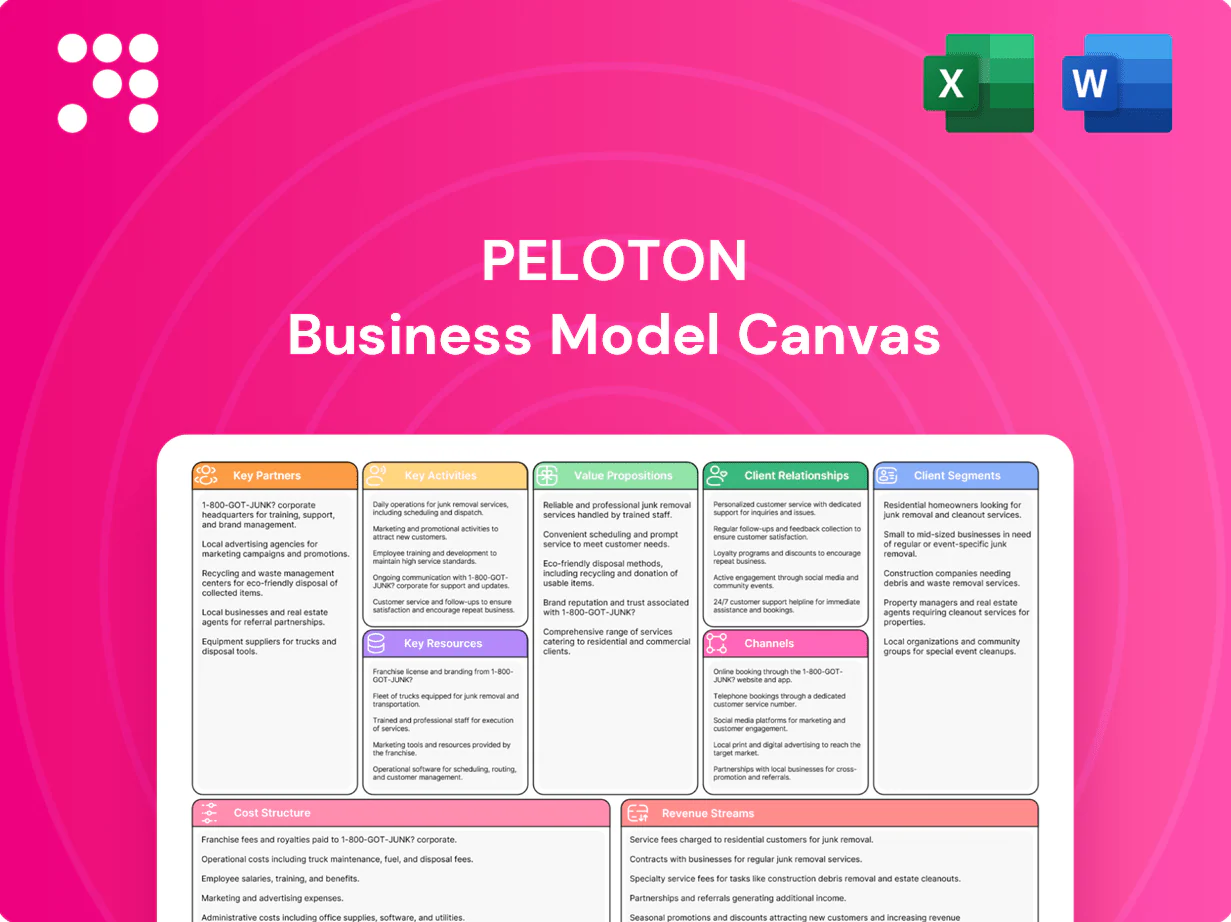
Peloton Business Model Canvas

Connected fitness model: hardware, subscriptions, content and community in one canvas
Unlock Peloton’s Business Model Canvas to see how hardware, subscriptions, content and community converge into a recurring-revenue engine; this concise analysis highlights customer segments, key partnerships, cost structure and growth levers. Ideal for investors, founders and strategists, the full canvas delivers section-by-section insights and ready-to-use Word/Excel templates. Purchase the complete file to benchmark, adapt, and scale proven tactics.
Partnerships

Hardware manufacturers and component suppliers
Hardware manufacturers and component suppliers deliver frames, touchscreens, sensors, drivetrains and logistics-ready packaging at scale, ensuring consistent product quality, safety compliance and tighter cost control. Reliable sourcing and strategic contracts enable new SKUs and tiered pricing while mitigating shortages. Co-development partnerships accelerate iteration cycles and faster feature integration.
Content production studios and music licensors
Licensing deals with major labels including Universal, Sony and Warner enable curated playlists and instructor-driven classes with popular music, supporting Peloton’s reach to 6+ million members. Studio partners deliver HD filming, editing and post-production for seamless on-demand content. Robust rights management permits global distribution and replay across markets, boosting engagement and clear brand differentiation.

Logistics, delivery, and installation providers
White-glove delivery and in-home setup for Peloton’s bulky bikes and treadmills cut customer friction and correlate with higher NPS, supporting Peloton’s installed base of roughly 1.6 million connected fitness subscriptions as of June 30, 2024. Robust reverse logistics enable returns, refurbishment and service swaps, preserving asset value and reducing disposal costs. Regional logistics partners shorten lead times and lower damage rates; last-mile can account for over 50% of delivery costs, so efficiency directly reduces spend and raises customer satisfaction.

Technology and cloud infrastructure providers
Technology and cloud infrastructure providers host Peloton’s live streams, on-demand library, and analytics workloads, supporting reliability and scalability as the platform serves over 6 million members worldwide (2024) and streams millions of classes monthly; payment gateways and identity providers secure transactions and accounts while app-store ecosystems extend reach to mobile and TV platforms, enabling international expansion.
- Cloud streaming: global low-latency delivery
- Security: PCI-compliant gateways, SSO
- Distribution: iOS, Android, tvOS presence
- Scalability: auto-scaling for peak classes
Corporate wellness and commercial fitness partners
Employers, insurers, and hospitality venues subsidize member access and hardware placements, creating bulk deals that convert into recurring enterprise revenue; workplace wellness programs increase adoption and retention while commercial deployments lift brand visibility and utilization; the global corporate wellness market was valued at about $66 billion in 2024, presenting scalable B2B ARR opportunities.
- Employers: enterprise subscriptions and hardware subsidies
- Insurers: risk-sharing & reimbursement models
- Hospitality: on-site placements boosting utilization
Partners power 6M+ members and a $66B corporate wellness market
Manufacturers, suppliers and co-development partners ensure scale, quality and SKU flexibility, reducing shortage risk and cost volatility. Music licensors and studios supply content that supports 6+ million members and millions of classes streamed monthly. Logistics, cloud, payment and enterprise partners enable last-mile, reliability and B2B channels tapping a ~$66B corporate wellness market (2024).
| Partner | Role | 2024 metric |
|---|---|---|
| Licensors/Studios | Content | 6+M members |
| Manufacturing | Hardware supply | 1.6M connected devices |
| Logistics/Cloud | Delivery & streaming | Last-mile & millions classes/mo |
What is included in the product
 Detailed Word Document
A concise, investor-ready Business Model Canvas for Peloton detailing customer segments, channels, value propositions, revenue streams (hardware + recurring subscriptions), key activities, partners, resources, cost structure and metrics across the nine BMC blocks; highlights competitive advantages, risks, and strategic opportunities to support presentations, fundraising and strategic decision-making.

 Customizable Excel Spreadsheet
High-level one-page Business Model Canvas that quickly identifies Peloton’s core components, relieving fragmented strategy and aligning teams for faster decision-making.
Activities

Connected hardware design and quality assurance
Engineering teams design bikes, treadmills and accessories with integrated screens and sensors, supporting Peloton’s connected device ecosystem that contributed to fiscal 2024 revenue of $3.87 billion. Rigorous testing verifies durability, safety and regulatory compliance across global markets. Continuous iteration reduces BOM costs, improves ergonomics and boosts performance. Ongoing firmware updates preserve functionality and drive feature rollouts post-sale.
Content creation and live class production
Instructors and producers deliver live and on-demand workouts across cycling, running, strength, yoga and more, supporting Peloton’s library of over 18,000 classes and a connected subscriber base of over 5 million in 2024. Scheduling, filming and post-production sustain a steady pipeline; usage and heart-rate data shape programming, difficulty tiers and music alignment, while seasonal and themed drops boost re-engagement and retention metrics.

Software development and platform operations
Peloton's apps, OS and UI deliver personalization, leaderboards and progress tracking across over 2.6 million connected subscriptions in 2024, using real-time profiles and algorithmic recommendations to boost engagement. Streaming infrastructure targets sub-300ms latency for live classes and CDN-backed global availability across 30+ countries. Continuous A/B testing and analytics run thousands of experiments annually to improve retention and LTV. Security and compliance (PCI DSS, SOC 2, end-to-end encryption) safeguard user data and payments.

Sales, marketing, and brand partnerships
Performance marketing drives equipment sales and subscription sign-ups, contributing to Peloton's FY2024 revenue of about $2.8B and ~2.6M Connected Fitness subscribers in 2024. Retail showrooms and studios pair hardware and content to boost conversion rates. Instructor and influencer branding amplifies reach across social platforms. Promotions and 0% financing reduce the barrier to entry and lift average order volume.
- Performance marketing — acquisition and ROAS focus
- Retail/studio — in-person hardware+content demos
- Instructor/influencer — organic reach multiplier
- Promos/financing — lower upfront cost, higher AOV
Customer service and lifecycle management
Support manages onboarding, troubleshooting and maintenance scheduling to keep Peloton devices active and reduce downtime; Peloton reported about 6.3 million connected fitness subscribers as of June 2024. Membership management handles billing, upgrades and pauses while community features drive engagement through challenges and social classes. Refurbishment and trade-in programs extend asset life and lower acquisition costs.
- Support: onboarding, repairs
- Membership: billing, upgrades, pauses
- Community: challenges, social features
- Refurb/trade-in: extend device life
Engineering-driven uptime, 18,000+ classes and apps engaging ~2.6M subs
Engineering designs and firmware sustain device uptime and lower BOM; instructors produce 18,000+ classes fueling content-led retention; apps and streaming optimize engagement for ~2.6M connected subscriptions with robust security; marketing, retail and support drive acquisition, conversions and post-sale service supporting fiscal 2024 revenue of $3.87B.
| Metric | 2024 |
|---|---|
| Revenue | $3.87B |
| Classes | 18,000+ |
| Connected subs | ~2.6M |
Delivered as Displayed
Business Model Canvas
The document previewed here is the actual Peloton Business Model Canvas you'll receive—it's not a mockup. When you purchase, you'll get this exact file in full, fully editable and formatted for presentation and analysis. No hidden sections or altered content; the preview reflects the complete structure and strategic detail provided in the final deliverable.

Connected fitness model: hardware, subscriptions, content and community in one canvas
Unlock Peloton’s Business Model Canvas to see how hardware, subscriptions, content and community converge into a recurring-revenue engine; this concise analysis highlights customer segments, key partnerships, cost structure and growth levers. Ideal for investors, founders and strategists, the full canvas delivers section-by-section insights and ready-to-use Word/Excel templates. Purchase the complete file to benchmark, adapt, and scale proven tactics.
Partnerships
Hardware manufacturers and component suppliers
Hardware manufacturers and component suppliers deliver frames, touchscreens, sensors, drivetrains and logistics-ready packaging at scale, ensuring consistent product quality, safety compliance and tighter cost control. Reliable sourcing and strategic contracts enable new SKUs and tiered pricing while mitigating shortages. Co-development partnerships accelerate iteration cycles and faster feature integration.
Content production studios and music licensors
Licensing deals with major labels including Universal, Sony and Warner enable curated playlists and instructor-driven classes with popular music, supporting Peloton’s reach to 6+ million members. Studio partners deliver HD filming, editing and post-production for seamless on-demand content. Robust rights management permits global distribution and replay across markets, boosting engagement and clear brand differentiation.
Logistics, delivery, and installation providers
White-glove delivery and in-home setup for Peloton’s bulky bikes and treadmills cut customer friction and correlate with higher NPS, supporting Peloton’s installed base of roughly 1.6 million connected fitness subscriptions as of June 30, 2024. Robust reverse logistics enable returns, refurbishment and service swaps, preserving asset value and reducing disposal costs. Regional logistics partners shorten lead times and lower damage rates; last-mile can account for over 50% of delivery costs, so efficiency directly reduces spend and raises customer satisfaction.
Technology and cloud infrastructure providers
Technology and cloud infrastructure providers host Peloton’s live streams, on-demand library, and analytics workloads, supporting reliability and scalability as the platform serves over 6 million members worldwide (2024) and streams millions of classes monthly; payment gateways and identity providers secure transactions and accounts while app-store ecosystems extend reach to mobile and TV platforms, enabling international expansion.
- Cloud streaming: global low-latency delivery
- Security: PCI-compliant gateways, SSO
- Distribution: iOS, Android, tvOS presence
- Scalability: auto-scaling for peak classes
Corporate wellness and commercial fitness partners
Employers, insurers, and hospitality venues subsidize member access and hardware placements, creating bulk deals that convert into recurring enterprise revenue; workplace wellness programs increase adoption and retention while commercial deployments lift brand visibility and utilization; the global corporate wellness market was valued at about $66 billion in 2024, presenting scalable B2B ARR opportunities.
- Employers: enterprise subscriptions and hardware subsidies
- Insurers: risk-sharing & reimbursement models
- Hospitality: on-site placements boosting utilization
Partners power 6M+ members and a $66B corporate wellness market
Manufacturers, suppliers and co-development partners ensure scale, quality and SKU flexibility, reducing shortage risk and cost volatility. Music licensors and studios supply content that supports 6+ million members and millions of classes streamed monthly. Logistics, cloud, payment and enterprise partners enable last-mile, reliability and B2B channels tapping a ~$66B corporate wellness market (2024).
| Partner | Role | 2024 metric |
|---|---|---|
| Licensors/Studios | Content | 6+M members |
| Manufacturing | Hardware supply | 1.6M connected devices |
| Logistics/Cloud | Delivery & streaming | Last-mile & millions classes/mo |
What is included in the product
Detailed Word Document
A concise, investor-ready Business Model Canvas for Peloton detailing customer segments, channels, value propositions, revenue streams (hardware + recurring subscriptions), key activities, partners, resources, cost structure and metrics across the nine BMC blocks; highlights competitive advantages, risks, and strategic opportunities to support presentations, fundraising and strategic decision-making.
Customizable Excel Spreadsheet
High-level one-page Business Model Canvas that quickly identifies Peloton’s core components, relieving fragmented strategy and aligning teams for faster decision-making.
Activities
Connected hardware design and quality assurance
Engineering teams design bikes, treadmills and accessories with integrated screens and sensors, supporting Peloton’s connected device ecosystem that contributed to fiscal 2024 revenue of $3.87 billion. Rigorous testing verifies durability, safety and regulatory compliance across global markets. Continuous iteration reduces BOM costs, improves ergonomics and boosts performance. Ongoing firmware updates preserve functionality and drive feature rollouts post-sale.
Content creation and live class production
Instructors and producers deliver live and on-demand workouts across cycling, running, strength, yoga and more, supporting Peloton’s library of over 18,000 classes and a connected subscriber base of over 5 million in 2024. Scheduling, filming and post-production sustain a steady pipeline; usage and heart-rate data shape programming, difficulty tiers and music alignment, while seasonal and themed drops boost re-engagement and retention metrics.
Software development and platform operations
Peloton's apps, OS and UI deliver personalization, leaderboards and progress tracking across over 2.6 million connected subscriptions in 2024, using real-time profiles and algorithmic recommendations to boost engagement. Streaming infrastructure targets sub-300ms latency for live classes and CDN-backed global availability across 30+ countries. Continuous A/B testing and analytics run thousands of experiments annually to improve retention and LTV. Security and compliance (PCI DSS, SOC 2, end-to-end encryption) safeguard user data and payments.
Sales, marketing, and brand partnerships
Performance marketing drives equipment sales and subscription sign-ups, contributing to Peloton's FY2024 revenue of about $2.8B and ~2.6M Connected Fitness subscribers in 2024. Retail showrooms and studios pair hardware and content to boost conversion rates. Instructor and influencer branding amplifies reach across social platforms. Promotions and 0% financing reduce the barrier to entry and lift average order volume.
- Performance marketing — acquisition and ROAS focus
- Retail/studio — in-person hardware+content demos
- Instructor/influencer — organic reach multiplier
- Promos/financing — lower upfront cost, higher AOV
Customer service and lifecycle management
Support manages onboarding, troubleshooting and maintenance scheduling to keep Peloton devices active and reduce downtime; Peloton reported about 6.3 million connected fitness subscribers as of June 2024. Membership management handles billing, upgrades and pauses while community features drive engagement through challenges and social classes. Refurbishment and trade-in programs extend asset life and lower acquisition costs.
- Support: onboarding, repairs
- Membership: billing, upgrades, pauses
- Community: challenges, social features
- Refurb/trade-in: extend device life
Engineering-driven uptime, 18,000+ classes and apps engaging ~2.6M subs
Engineering designs and firmware sustain device uptime and lower BOM; instructors produce 18,000+ classes fueling content-led retention; apps and streaming optimize engagement for ~2.6M connected subscriptions with robust security; marketing, retail and support drive acquisition, conversions and post-sale service supporting fiscal 2024 revenue of $3.87B.
| Metric | 2024 |
|---|---|
| Revenue | $3.87B |
| Classes | 18,000+ |
| Connected subs | ~2.6M |
Delivered as Displayed
Business Model Canvas
The document previewed here is the actual Peloton Business Model Canvas you'll receive—it's not a mockup. When you purchase, you'll get this exact file in full, fully editable and formatted for presentation and analysis. No hidden sections or altered content; the preview reflects the complete structure and strategic detail provided in the final deliverable.
Original: $10.00
-65%$10.00
$3.50Description
Connected fitness model: hardware, subscriptions, content and community in one canvas
Unlock Peloton’s Business Model Canvas to see how hardware, subscriptions, content and community converge into a recurring-revenue engine; this concise analysis highlights customer segments, key partnerships, cost structure and growth levers. Ideal for investors, founders and strategists, the full canvas delivers section-by-section insights and ready-to-use Word/Excel templates. Purchase the complete file to benchmark, adapt, and scale proven tactics.
Partnerships
Hardware manufacturers and component suppliers
Hardware manufacturers and component suppliers deliver frames, touchscreens, sensors, drivetrains and logistics-ready packaging at scale, ensuring consistent product quality, safety compliance and tighter cost control. Reliable sourcing and strategic contracts enable new SKUs and tiered pricing while mitigating shortages. Co-development partnerships accelerate iteration cycles and faster feature integration.
Content production studios and music licensors
Licensing deals with major labels including Universal, Sony and Warner enable curated playlists and instructor-driven classes with popular music, supporting Peloton’s reach to 6+ million members. Studio partners deliver HD filming, editing and post-production for seamless on-demand content. Robust rights management permits global distribution and replay across markets, boosting engagement and clear brand differentiation.
Logistics, delivery, and installation providers
White-glove delivery and in-home setup for Peloton’s bulky bikes and treadmills cut customer friction and correlate with higher NPS, supporting Peloton’s installed base of roughly 1.6 million connected fitness subscriptions as of June 30, 2024. Robust reverse logistics enable returns, refurbishment and service swaps, preserving asset value and reducing disposal costs. Regional logistics partners shorten lead times and lower damage rates; last-mile can account for over 50% of delivery costs, so efficiency directly reduces spend and raises customer satisfaction.
Technology and cloud infrastructure providers
Technology and cloud infrastructure providers host Peloton’s live streams, on-demand library, and analytics workloads, supporting reliability and scalability as the platform serves over 6 million members worldwide (2024) and streams millions of classes monthly; payment gateways and identity providers secure transactions and accounts while app-store ecosystems extend reach to mobile and TV platforms, enabling international expansion.
- Cloud streaming: global low-latency delivery
- Security: PCI-compliant gateways, SSO
- Distribution: iOS, Android, tvOS presence
- Scalability: auto-scaling for peak classes
Corporate wellness and commercial fitness partners
Employers, insurers, and hospitality venues subsidize member access and hardware placements, creating bulk deals that convert into recurring enterprise revenue; workplace wellness programs increase adoption and retention while commercial deployments lift brand visibility and utilization; the global corporate wellness market was valued at about $66 billion in 2024, presenting scalable B2B ARR opportunities.
- Employers: enterprise subscriptions and hardware subsidies
- Insurers: risk-sharing & reimbursement models
- Hospitality: on-site placements boosting utilization
Partners power 6M+ members and a $66B corporate wellness market
Manufacturers, suppliers and co-development partners ensure scale, quality and SKU flexibility, reducing shortage risk and cost volatility. Music licensors and studios supply content that supports 6+ million members and millions of classes streamed monthly. Logistics, cloud, payment and enterprise partners enable last-mile, reliability and B2B channels tapping a ~$66B corporate wellness market (2024).
| Partner | Role | 2024 metric |
|---|---|---|
| Licensors/Studios | Content | 6+M members |
| Manufacturing | Hardware supply | 1.6M connected devices |
| Logistics/Cloud | Delivery & streaming | Last-mile & millions classes/mo |
What is included in the product
Detailed Word Document
A concise, investor-ready Business Model Canvas for Peloton detailing customer segments, channels, value propositions, revenue streams (hardware + recurring subscriptions), key activities, partners, resources, cost structure and metrics across the nine BMC blocks; highlights competitive advantages, risks, and strategic opportunities to support presentations, fundraising and strategic decision-making.
Customizable Excel Spreadsheet
High-level one-page Business Model Canvas that quickly identifies Peloton’s core components, relieving fragmented strategy and aligning teams for faster decision-making.
Activities
Connected hardware design and quality assurance
Engineering teams design bikes, treadmills and accessories with integrated screens and sensors, supporting Peloton’s connected device ecosystem that contributed to fiscal 2024 revenue of $3.87 billion. Rigorous testing verifies durability, safety and regulatory compliance across global markets. Continuous iteration reduces BOM costs, improves ergonomics and boosts performance. Ongoing firmware updates preserve functionality and drive feature rollouts post-sale.
Content creation and live class production
Instructors and producers deliver live and on-demand workouts across cycling, running, strength, yoga and more, supporting Peloton’s library of over 18,000 classes and a connected subscriber base of over 5 million in 2024. Scheduling, filming and post-production sustain a steady pipeline; usage and heart-rate data shape programming, difficulty tiers and music alignment, while seasonal and themed drops boost re-engagement and retention metrics.
Software development and platform operations
Peloton's apps, OS and UI deliver personalization, leaderboards and progress tracking across over 2.6 million connected subscriptions in 2024, using real-time profiles and algorithmic recommendations to boost engagement. Streaming infrastructure targets sub-300ms latency for live classes and CDN-backed global availability across 30+ countries. Continuous A/B testing and analytics run thousands of experiments annually to improve retention and LTV. Security and compliance (PCI DSS, SOC 2, end-to-end encryption) safeguard user data and payments.
Sales, marketing, and brand partnerships
Performance marketing drives equipment sales and subscription sign-ups, contributing to Peloton's FY2024 revenue of about $2.8B and ~2.6M Connected Fitness subscribers in 2024. Retail showrooms and studios pair hardware and content to boost conversion rates. Instructor and influencer branding amplifies reach across social platforms. Promotions and 0% financing reduce the barrier to entry and lift average order volume.
- Performance marketing — acquisition and ROAS focus
- Retail/studio — in-person hardware+content demos
- Instructor/influencer — organic reach multiplier
- Promos/financing — lower upfront cost, higher AOV
Customer service and lifecycle management
Support manages onboarding, troubleshooting and maintenance scheduling to keep Peloton devices active and reduce downtime; Peloton reported about 6.3 million connected fitness subscribers as of June 2024. Membership management handles billing, upgrades and pauses while community features drive engagement through challenges and social classes. Refurbishment and trade-in programs extend asset life and lower acquisition costs.
- Support: onboarding, repairs
- Membership: billing, upgrades, pauses
- Community: challenges, social features
- Refurb/trade-in: extend device life
Engineering-driven uptime, 18,000+ classes and apps engaging ~2.6M subs
Engineering designs and firmware sustain device uptime and lower BOM; instructors produce 18,000+ classes fueling content-led retention; apps and streaming optimize engagement for ~2.6M connected subscriptions with robust security; marketing, retail and support drive acquisition, conversions and post-sale service supporting fiscal 2024 revenue of $3.87B.
| Metric | 2024 |
|---|---|
| Revenue | $3.87B |
| Classes | 18,000+ |
| Connected subs | ~2.6M |
Delivered as Displayed
Business Model Canvas
The document previewed here is the actual Peloton Business Model Canvas you'll receive—it's not a mockup. When you purchase, you'll get this exact file in full, fully editable and formatted for presentation and analysis. No hidden sections or altered content; the preview reflects the complete structure and strategic detail provided in the final deliverable.











