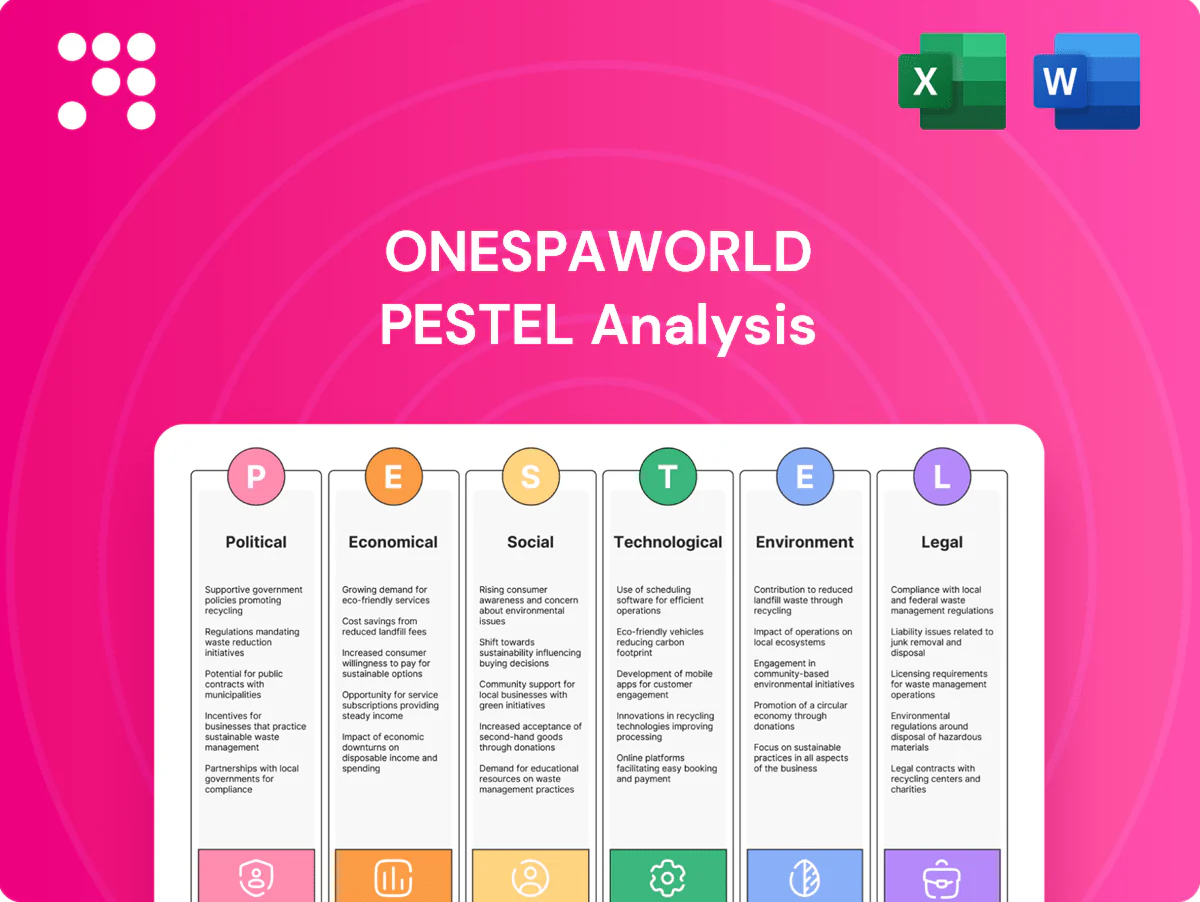
OneSpaWorld PESTLE Analysis

Your Shortcut to Market Insight Starts Here
Unlock decisive external insights with our PESTLE Analysis of OneSpaWorld—three to five focused sentences reveal how political, economic, social, technological, legal and environmental forces shape strategy and risk. Ideal for investors, consultants and execs; buy the full report to get the complete, ready-to-use breakdown instantly.
Political factors

Maritime and port governance
Operating on ships and in resorts exposes OneSpaWorld to diverse maritime and port authority rules, including US cabotage under the Jones Act and local port access permits; CLIA data through 2024 show cruise passenger volumes rebounding to roughly 30 million annually, near pre‑pandemic levels. Policy shifts on port access or fees can force itinerary changes and service reductions. Close alignment with cruise lines is needed to anticipate regulatory moves. Proactive government relations in key homeports such as Miami (≈6.6M cruise passengers in 2023) reduces disruption risk.
Public health policy and readiness
Global and local health directives, such as WHO ending the COVID-19 PHEIC on 5 May 2023 and longstanding CDC Vessel Sanitation Program standards (since 1975), can tighten sanitation, capacity and contact rules for spas and fitness areas. Rapid policy changes require flexible protocols and ongoing staff training to remain compliant. Partnerships with cruise medical teams help standardize responses and visible compliance supports guest confidence and demand.

Geopolitical stability and travel advisories
Regional tensions and travel advisories can force rerouting and suppress destination demand, as the cruise industry regained pre-pandemic capacity in 2023 per CLIA, increasing exposure to itinerary changes. Service mix and staffing must pivot rapidly to altered port calls and guest needs. Diversification across 60+ cruise line partners and 200+ ships mitigates concentration risk. Monitoring diplomatic shifts helps forecast booking and volume volatility.

Tourism promotion and incentives
Coordination with destination marketing organizations amplifies visibility and drives occupancy; tracking policy cycles enables seasonal staffing and inventory planning to match peak arrival windows.
- Policy-driven passenger uplift: CLIA 2023 ~26.9M
- Wellness tourism market ~495B USD (2023)
- Incentives unlock spa-medical bundles
- Track policy cycles for staffing/inventory
Labor mobility and visas
Crew hiring for OneSpaWorld hinges on visa regimes, bilateral agreements and seafarer credentials; BIMCO/ICS forecasts a potential officer shortfall of about 147,500 by 2025, which can lift labor costs and fill delays. Tightening immigration policies in key source markets in 2024 increased onboarding times and cost per hire. Streamlined recruitment pipelines and robust compliance systems tracking visas, rotations and certifications cut delays and risk.
- visa regimes
- bilateral agreements
- seafarer credentials
- compliance tracking
Ports, visas and crew shortages disrupt cruise spa operations and demand
Operating and staffing across ports/resorts exposes OneSpaWorld to maritime rules (Jones Act, port permits), shifting health directives and visa regimes that affect itineraries, demand and labor costs; CLIA 2023 cruise volume 26.9M and Miami ~6.6M (2023) highlight scale. BIMCO/ICS forecasts ~147,500 officer shortfall by 2025, raising hiring costs; wellness market ~495B (2023) offers policy-driven demand upside.
| Metric | Value | Year | Source |
|---|---|---|---|
| Global cruise passengers | 26.9M | 2023 | CLIA |
| Port of Miami passengers | 6.6M | 2023 | Port of Miami |
| Officer shortfall | 147,500 | 2025 | BIMCO/ICS |
| Wellness tourism market | 495B USD | 2023 | Industry estimates |
What is included in the product
 Detailed Word Document
Explores how macro-environmental factors uniquely affect OneSpaWorld across six dimensions—Political, Economic, Social, Technological, Environmental, and Legal—backed by current data and sector trends; it highlights threats, opportunities, and competitive impacts specific to the cruise and spa services market. Designed for executives and investors, the analysis offers forward-looking insights and ready-to-use findings for strategy, scenario planning, and funding materials.

 Customizable Excel Spreadsheet
Concise OneSpaWorld PESTLE summary formatted by category for quick reference in meetings or presentations, easing cross-team alignment and supporting risk discussions during strategic planning.
Economic factors

Consumer discretionary cycles
Wellness and spa spend is highly sensitive to macro confidence and household budgets, so downturns typically shift demand toward shorter treatments and lower-priced add-ons while upswings boost take rates for premium packages, retail attachments and upsells; OneSpaWorld can use dynamic pricing and yield management to smooth utilization and protect margins across the cycle.
Cruise industry capacity and occupancy
OneSpaWorld revenue closely follows cruise line deployment, load factors and sailing days as global cruise capacity recovered to roughly 90–95% of 2019 levels by mid-2024 with passenger volumes about 27–29 million. Newbuilds in 2024–25 expanded onboard treatment rooms and foot traffic, while cancellations or dry-docks compress revenue windows; joint planning with operators aligns staffing and retail stock to capacity.

Inflation and wage pressures
Input cost inflation—US CPI 3.4% in 2024—plus wage growth (average hourly earnings up about 3.6% YoY mid-2025) compress OneSpaWorld margins as product, equipment and labor costs rise; passing prices needs targeted guest value messaging to avoid demand loss. Productivity tools, menu engineering and renegotiated supplier contracts can protect contribution margins and hedge inflation exposure.

Foreign exchange exposure
OneSpaWorlds multi-currency revenues and costs—from operations on over 200 vessels across 17 cruise partners—create measurable FX volatility as USD moves against EUR, GBP and CAD. Natural hedges mitigate some risk when sales and costs align by currency, but residual gaps remain. Active hedging policies and pricing bands are used to reduce earnings swings, and clear FX disclosure enhances investor confidence.
- Multi-currency operations: over 200 vessels, 17 partners
- Natural hedges: partial alignment of currency cash flows
- Risk mitigation: hedging policies + pricing bands
- Governance: transparent FX reporting boosts investor trust
Fuel and itinerary economics
- Fuel share of voyage costs: ~20-30%
- Bunker price change 2024: ~+30% y/y
- Therapist utilization lift via analytics: ~10-15%
- Port-driven spend variance: double-digit % differences by region
Ports, visas and crew shortages disrupt cruise spa operations and demand
Wellness spend is cyclical—cruise recovery to ~90–95% of 2019 and ~28m passengers (2024) drives premium take-rates in upcycles but shifts to lower-priced treatments in downturns; dynamic pricing and yield management smooths revenue. Input inflation (US CPI 3.4% in 2024) and wage rise (~+3.6% mid-2025) squeeze margins; menu engineering and supplier renegotiation mitigate. Multi-currency ops (200+ vessels, 17 partners) and fuel volatility (Brent ~$86/bbl 2024; bunker +30% y/y) add FX and itinerary risk; active hedging and analytics lift therapist utilization ~10-15%.
| Metric | Value |
|---|---|
| Cruise pax (2024) | ~28m |
| Cruise capacity vs 2019 | 90–95% |
| US CPI (2024) | 3.4% |
| Wage growth (mid-2025) | ~+3.6% |
| Brent (2024 avg) | ~$86/bbl |
| Bunker change (2024) | +30% y/y |
| Vessels/partners | 200+, 17 |
Preview the Actual Deliverable
OneSpaWorld PESTLE Analysis
The OneSpaWorld PESTLE Analysis provides a concise, professional assessment of political, economic, social, technological, legal and environmental factors affecting the company. The preview shown here is the exact document you’ll receive after purchase—fully formatted and ready to use. No placeholders or teasers; the content and structure are final and downloadable immediately.

Your Shortcut to Market Insight Starts Here
Unlock decisive external insights with our PESTLE Analysis of OneSpaWorld—three to five focused sentences reveal how political, economic, social, technological, legal and environmental forces shape strategy and risk. Ideal for investors, consultants and execs; buy the full report to get the complete, ready-to-use breakdown instantly.
Political factors
Maritime and port governance
Operating on ships and in resorts exposes OneSpaWorld to diverse maritime and port authority rules, including US cabotage under the Jones Act and local port access permits; CLIA data through 2024 show cruise passenger volumes rebounding to roughly 30 million annually, near pre‑pandemic levels. Policy shifts on port access or fees can force itinerary changes and service reductions. Close alignment with cruise lines is needed to anticipate regulatory moves. Proactive government relations in key homeports such as Miami (≈6.6M cruise passengers in 2023) reduces disruption risk.
Public health policy and readiness
Global and local health directives, such as WHO ending the COVID-19 PHEIC on 5 May 2023 and longstanding CDC Vessel Sanitation Program standards (since 1975), can tighten sanitation, capacity and contact rules for spas and fitness areas. Rapid policy changes require flexible protocols and ongoing staff training to remain compliant. Partnerships with cruise medical teams help standardize responses and visible compliance supports guest confidence and demand.
Geopolitical stability and travel advisories
Regional tensions and travel advisories can force rerouting and suppress destination demand, as the cruise industry regained pre-pandemic capacity in 2023 per CLIA, increasing exposure to itinerary changes. Service mix and staffing must pivot rapidly to altered port calls and guest needs. Diversification across 60+ cruise line partners and 200+ ships mitigates concentration risk. Monitoring diplomatic shifts helps forecast booking and volume volatility.
Tourism promotion and incentives
Coordination with destination marketing organizations amplifies visibility and drives occupancy; tracking policy cycles enables seasonal staffing and inventory planning to match peak arrival windows.
- Policy-driven passenger uplift: CLIA 2023 ~26.9M
- Wellness tourism market ~495B USD (2023)
- Incentives unlock spa-medical bundles
- Track policy cycles for staffing/inventory
Labor mobility and visas
Crew hiring for OneSpaWorld hinges on visa regimes, bilateral agreements and seafarer credentials; BIMCO/ICS forecasts a potential officer shortfall of about 147,500 by 2025, which can lift labor costs and fill delays. Tightening immigration policies in key source markets in 2024 increased onboarding times and cost per hire. Streamlined recruitment pipelines and robust compliance systems tracking visas, rotations and certifications cut delays and risk.
- visa regimes
- bilateral agreements
- seafarer credentials
- compliance tracking
Ports, visas and crew shortages disrupt cruise spa operations and demand
Operating and staffing across ports/resorts exposes OneSpaWorld to maritime rules (Jones Act, port permits), shifting health directives and visa regimes that affect itineraries, demand and labor costs; CLIA 2023 cruise volume 26.9M and Miami ~6.6M (2023) highlight scale. BIMCO/ICS forecasts ~147,500 officer shortfall by 2025, raising hiring costs; wellness market ~495B (2023) offers policy-driven demand upside.
| Metric | Value | Year | Source |
|---|---|---|---|
| Global cruise passengers | 26.9M | 2023 | CLIA |
| Port of Miami passengers | 6.6M | 2023 | Port of Miami |
| Officer shortfall | 147,500 | 2025 | BIMCO/ICS |
| Wellness tourism market | 495B USD | 2023 | Industry estimates |
What is included in the product
Detailed Word Document
Explores how macro-environmental factors uniquely affect OneSpaWorld across six dimensions—Political, Economic, Social, Technological, Environmental, and Legal—backed by current data and sector trends; it highlights threats, opportunities, and competitive impacts specific to the cruise and spa services market. Designed for executives and investors, the analysis offers forward-looking insights and ready-to-use findings for strategy, scenario planning, and funding materials.
Customizable Excel Spreadsheet
Concise OneSpaWorld PESTLE summary formatted by category for quick reference in meetings or presentations, easing cross-team alignment and supporting risk discussions during strategic planning.
Economic factors
Consumer discretionary cycles
Wellness and spa spend is highly sensitive to macro confidence and household budgets, so downturns typically shift demand toward shorter treatments and lower-priced add-ons while upswings boost take rates for premium packages, retail attachments and upsells; OneSpaWorld can use dynamic pricing and yield management to smooth utilization and protect margins across the cycle.
Cruise industry capacity and occupancy
OneSpaWorld revenue closely follows cruise line deployment, load factors and sailing days as global cruise capacity recovered to roughly 90–95% of 2019 levels by mid-2024 with passenger volumes about 27–29 million. Newbuilds in 2024–25 expanded onboard treatment rooms and foot traffic, while cancellations or dry-docks compress revenue windows; joint planning with operators aligns staffing and retail stock to capacity.
Inflation and wage pressures
Input cost inflation—US CPI 3.4% in 2024—plus wage growth (average hourly earnings up about 3.6% YoY mid-2025) compress OneSpaWorld margins as product, equipment and labor costs rise; passing prices needs targeted guest value messaging to avoid demand loss. Productivity tools, menu engineering and renegotiated supplier contracts can protect contribution margins and hedge inflation exposure.
Foreign exchange exposure
OneSpaWorlds multi-currency revenues and costs—from operations on over 200 vessels across 17 cruise partners—create measurable FX volatility as USD moves against EUR, GBP and CAD. Natural hedges mitigate some risk when sales and costs align by currency, but residual gaps remain. Active hedging policies and pricing bands are used to reduce earnings swings, and clear FX disclosure enhances investor confidence.
- Multi-currency operations: over 200 vessels, 17 partners
- Natural hedges: partial alignment of currency cash flows
- Risk mitigation: hedging policies + pricing bands
- Governance: transparent FX reporting boosts investor trust
Fuel and itinerary economics
- Fuel share of voyage costs: ~20-30%
- Bunker price change 2024: ~+30% y/y
- Therapist utilization lift via analytics: ~10-15%
- Port-driven spend variance: double-digit % differences by region
Ports, visas and crew shortages disrupt cruise spa operations and demand
Wellness spend is cyclical—cruise recovery to ~90–95% of 2019 and ~28m passengers (2024) drives premium take-rates in upcycles but shifts to lower-priced treatments in downturns; dynamic pricing and yield management smooths revenue. Input inflation (US CPI 3.4% in 2024) and wage rise (~+3.6% mid-2025) squeeze margins; menu engineering and supplier renegotiation mitigate. Multi-currency ops (200+ vessels, 17 partners) and fuel volatility (Brent ~$86/bbl 2024; bunker +30% y/y) add FX and itinerary risk; active hedging and analytics lift therapist utilization ~10-15%.
| Metric | Value |
|---|---|
| Cruise pax (2024) | ~28m |
| Cruise capacity vs 2019 | 90–95% |
| US CPI (2024) | 3.4% |
| Wage growth (mid-2025) | ~+3.6% |
| Brent (2024 avg) | ~$86/bbl |
| Bunker change (2024) | +30% y/y |
| Vessels/partners | 200+, 17 |
Preview the Actual Deliverable
OneSpaWorld PESTLE Analysis
The OneSpaWorld PESTLE Analysis provides a concise, professional assessment of political, economic, social, technological, legal and environmental factors affecting the company. The preview shown here is the exact document you’ll receive after purchase—fully formatted and ready to use. No placeholders or teasers; the content and structure are final and downloadable immediately.
Original: $10.00
-65%$10.00
$3.50Description
Your Shortcut to Market Insight Starts Here
Unlock decisive external insights with our PESTLE Analysis of OneSpaWorld—three to five focused sentences reveal how political, economic, social, technological, legal and environmental forces shape strategy and risk. Ideal for investors, consultants and execs; buy the full report to get the complete, ready-to-use breakdown instantly.
Political factors
Maritime and port governance
Operating on ships and in resorts exposes OneSpaWorld to diverse maritime and port authority rules, including US cabotage under the Jones Act and local port access permits; CLIA data through 2024 show cruise passenger volumes rebounding to roughly 30 million annually, near pre‑pandemic levels. Policy shifts on port access or fees can force itinerary changes and service reductions. Close alignment with cruise lines is needed to anticipate regulatory moves. Proactive government relations in key homeports such as Miami (≈6.6M cruise passengers in 2023) reduces disruption risk.
Public health policy and readiness
Global and local health directives, such as WHO ending the COVID-19 PHEIC on 5 May 2023 and longstanding CDC Vessel Sanitation Program standards (since 1975), can tighten sanitation, capacity and contact rules for spas and fitness areas. Rapid policy changes require flexible protocols and ongoing staff training to remain compliant. Partnerships with cruise medical teams help standardize responses and visible compliance supports guest confidence and demand.
Geopolitical stability and travel advisories
Regional tensions and travel advisories can force rerouting and suppress destination demand, as the cruise industry regained pre-pandemic capacity in 2023 per CLIA, increasing exposure to itinerary changes. Service mix and staffing must pivot rapidly to altered port calls and guest needs. Diversification across 60+ cruise line partners and 200+ ships mitigates concentration risk. Monitoring diplomatic shifts helps forecast booking and volume volatility.
Tourism promotion and incentives
Coordination with destination marketing organizations amplifies visibility and drives occupancy; tracking policy cycles enables seasonal staffing and inventory planning to match peak arrival windows.
- Policy-driven passenger uplift: CLIA 2023 ~26.9M
- Wellness tourism market ~495B USD (2023)
- Incentives unlock spa-medical bundles
- Track policy cycles for staffing/inventory
Labor mobility and visas
Crew hiring for OneSpaWorld hinges on visa regimes, bilateral agreements and seafarer credentials; BIMCO/ICS forecasts a potential officer shortfall of about 147,500 by 2025, which can lift labor costs and fill delays. Tightening immigration policies in key source markets in 2024 increased onboarding times and cost per hire. Streamlined recruitment pipelines and robust compliance systems tracking visas, rotations and certifications cut delays and risk.
- visa regimes
- bilateral agreements
- seafarer credentials
- compliance tracking
Ports, visas and crew shortages disrupt cruise spa operations and demand
Operating and staffing across ports/resorts exposes OneSpaWorld to maritime rules (Jones Act, port permits), shifting health directives and visa regimes that affect itineraries, demand and labor costs; CLIA 2023 cruise volume 26.9M and Miami ~6.6M (2023) highlight scale. BIMCO/ICS forecasts ~147,500 officer shortfall by 2025, raising hiring costs; wellness market ~495B (2023) offers policy-driven demand upside.
| Metric | Value | Year | Source |
|---|---|---|---|
| Global cruise passengers | 26.9M | 2023 | CLIA |
| Port of Miami passengers | 6.6M | 2023 | Port of Miami |
| Officer shortfall | 147,500 | 2025 | BIMCO/ICS |
| Wellness tourism market | 495B USD | 2023 | Industry estimates |
What is included in the product
Detailed Word Document
Explores how macro-environmental factors uniquely affect OneSpaWorld across six dimensions—Political, Economic, Social, Technological, Environmental, and Legal—backed by current data and sector trends; it highlights threats, opportunities, and competitive impacts specific to the cruise and spa services market. Designed for executives and investors, the analysis offers forward-looking insights and ready-to-use findings for strategy, scenario planning, and funding materials.
Customizable Excel Spreadsheet
Concise OneSpaWorld PESTLE summary formatted by category for quick reference in meetings or presentations, easing cross-team alignment and supporting risk discussions during strategic planning.
Economic factors
Consumer discretionary cycles
Wellness and spa spend is highly sensitive to macro confidence and household budgets, so downturns typically shift demand toward shorter treatments and lower-priced add-ons while upswings boost take rates for premium packages, retail attachments and upsells; OneSpaWorld can use dynamic pricing and yield management to smooth utilization and protect margins across the cycle.
Cruise industry capacity and occupancy
OneSpaWorld revenue closely follows cruise line deployment, load factors and sailing days as global cruise capacity recovered to roughly 90–95% of 2019 levels by mid-2024 with passenger volumes about 27–29 million. Newbuilds in 2024–25 expanded onboard treatment rooms and foot traffic, while cancellations or dry-docks compress revenue windows; joint planning with operators aligns staffing and retail stock to capacity.
Inflation and wage pressures
Input cost inflation—US CPI 3.4% in 2024—plus wage growth (average hourly earnings up about 3.6% YoY mid-2025) compress OneSpaWorld margins as product, equipment and labor costs rise; passing prices needs targeted guest value messaging to avoid demand loss. Productivity tools, menu engineering and renegotiated supplier contracts can protect contribution margins and hedge inflation exposure.
Foreign exchange exposure
OneSpaWorlds multi-currency revenues and costs—from operations on over 200 vessels across 17 cruise partners—create measurable FX volatility as USD moves against EUR, GBP and CAD. Natural hedges mitigate some risk when sales and costs align by currency, but residual gaps remain. Active hedging policies and pricing bands are used to reduce earnings swings, and clear FX disclosure enhances investor confidence.
- Multi-currency operations: over 200 vessels, 17 partners
- Natural hedges: partial alignment of currency cash flows
- Risk mitigation: hedging policies + pricing bands
- Governance: transparent FX reporting boosts investor trust
Fuel and itinerary economics
- Fuel share of voyage costs: ~20-30%
- Bunker price change 2024: ~+30% y/y
- Therapist utilization lift via analytics: ~10-15%
- Port-driven spend variance: double-digit % differences by region
Ports, visas and crew shortages disrupt cruise spa operations and demand
Wellness spend is cyclical—cruise recovery to ~90–95% of 2019 and ~28m passengers (2024) drives premium take-rates in upcycles but shifts to lower-priced treatments in downturns; dynamic pricing and yield management smooths revenue. Input inflation (US CPI 3.4% in 2024) and wage rise (~+3.6% mid-2025) squeeze margins; menu engineering and supplier renegotiation mitigate. Multi-currency ops (200+ vessels, 17 partners) and fuel volatility (Brent ~$86/bbl 2024; bunker +30% y/y) add FX and itinerary risk; active hedging and analytics lift therapist utilization ~10-15%.
| Metric | Value |
|---|---|
| Cruise pax (2024) | ~28m |
| Cruise capacity vs 2019 | 90–95% |
| US CPI (2024) | 3.4% |
| Wage growth (mid-2025) | ~+3.6% |
| Brent (2024 avg) | ~$86/bbl |
| Bunker change (2024) | +30% y/y |
| Vessels/partners | 200+, 17 |
Preview the Actual Deliverable
OneSpaWorld PESTLE Analysis
The OneSpaWorld PESTLE Analysis provides a concise, professional assessment of political, economic, social, technological, legal and environmental factors affecting the company. The preview shown here is the exact document you’ll receive after purchase—fully formatted and ready to use. No placeholders or teasers; the content and structure are final and downloadable immediately.











