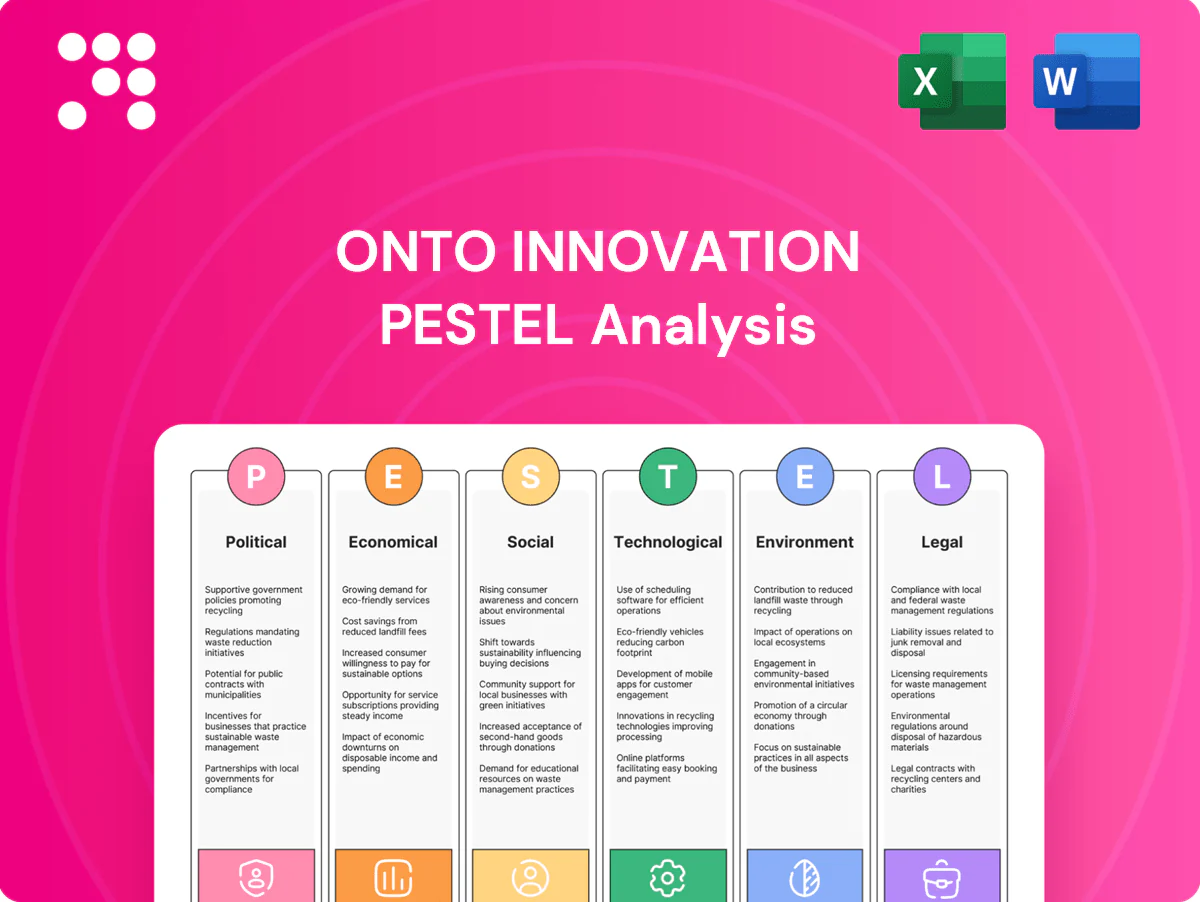
Onto Innovation PESTLE Analysis

Skip the Research. Get the Strategy.
Unlock how political, economic, social, technological, legal and environmental forces are reshaping Onto Innovation's prospects. This concise PESTLE snapshot highlights risks and growth levers. Purchase the full analysis for actionable, board-ready intelligence.
Political factors

US-China export controls
US export restrictions introduced in October 2022 and tightened in 2023 limit sales of advanced semiconductor tools to select Chinese fabs, forcing Onto Innovation to pursue export licenses and face possible denials that cloud backlog visibility. China accounted for roughly 40% of global semiconductor equipment spending in recent years, so policy shifts can materially re-open or curtail access and alter Onto’s revenue mix. Proactive compliance and diversification lower China concentration risk and reduce potential order volatility.
Industrial policy subsidies
CHIPS Acts in the US ($52B) and EU (≈€43B), alongside Japan and Korea allied programs, are catalyzing new fab investments. These incentives expand demand for metrology, inspection, and lithography support tools as fabs scale capacity. Accessing grant-tied projects often requires local content or partnerships, and timely positioning in subsidized nodes and packaging hubs can materially lift order intake.

Geopolitical supply chain resilience
Governments are pushing onshoring and friend‑shoring of critical semiconductor capabilities, evidenced by the US CHIPS Act’s $52 billion and the EU Chips Act package ~€43 billion in public/private support. This redistributes capacity and shifts sales opportunities and service footprints across regions. Multi‑region support and spares logistics become politically salient as Taiwan holds roughly 60–70% of leading‑edge capacity. Aligning with national security priorities can enhance eligibility for strategic program funding and grants.

Trade tariffs and customs
Tariffs on components or finished tools raise unit costs and complicate cross-border shipments; US Section 301 tariffs on certain Chinese goods remain in place at rates up to 25% as of 2024, directly pressuring margins for Onto Innovation. Customs delays can push installation timelines and defer revenue recognition, increasing working capital needs. Strategic sourcing, tariff engineering and use of free‑trade zones or bonded warehouses can mitigate cost and delivery risks.
- Tariff exposure: US Section 301 up to 25% (2024)
- Revenue timing risk: customs delays affect recognition and installations
- Mitigation: tariff engineering and strategic sourcing
- Logistics: free‑trade zones/bonded warehouses improve delivery reliability
Public procurement and standards influence
Export controls, tariffs and Taiwan dominance accelerate semiconductor onshoring
US export controls (tightened 2023) and Section 301 tariffs (up to 25% in 2024) constrain sales to China, which accounted for ~40% of global equipment spend. CHIPS Act ($52.7B), EU ~€43B and allied incentives shift demand to onshore fabs. Taiwan holds ~60–70% leading‑edge capacity, raising geopolitics as demand driver. Compliance, local partnerships and diversification reduce order volatility.
| Metric | Value |
|---|---|
| China share | ~40% |
| US CHIPS | $52.7B |
| EU support | ~€43B |
| Taiwan lead | 60–70% |
What is included in the product
 Detailed Word Document
Explores how macro-environmental factors impact Onto Innovation across Political, Economic, Social, Technological, Environmental, and Legal dimensions, with data-backed insights and forward-looking scenarios to inform executives, investors, and strategists on risks, opportunities, and tactical responses aligned to industry and regional dynamics.

 Customizable Excel Spreadsheet
A concise, visually segmented PESTLE summary for Onto Innovation that streamlines external risk assessment, is easily dropped into presentations or shared across teams, and allows quick annotation for region- or business-specific context during planning sessions.
Economic factors

Semiconductor capex cycles
Onto Innovation’s demand closely tracks wafer-fab equipment cycles: SEMI forecast WFE rising from about $86B in 2024 to ~$107B in 2025, with AI, HPC and automotive fabs helping offset consumer-electronics weakness. Recovery timing drives ONTO bookings and field-service utilization, while active backlog management is critical to navigate troughs and ramps.
Customer concentration and pricing
Large IDMs and foundries such as TSMC and Samsung, plus leading OSATs like ASE and Amkor, wield significant bargaining power over equipment suppliers, forcing volume discounts and competitive bids that can compress margins. Onto Innovation’s differentiated metrology and inspection capabilities enable value-based pricing and higher ASPs for specialized tools. Expansion into advanced packaging equipment diversifies the customer base and reduces single-customer concentration risk.

Currency fluctuations
Global sales and sourcing expose Onto Innovation to USD, EUR, JPY, KRW and TWD volatility, affecting reported results through translation and transactional flows. Exchange movements shift revenue translation and component costs, creating quarter-to-quarter margin pressure. The company’s hedging programs are used to stabilize gross margins against currency swings. Localizing production and costs where revenues are earned reduces currency mismatch and volatility risk.

Supply chain costs and lead times
Component lead times for optics, lasers and precision mechatronics commonly range 12–40 weeks, with SEMI and industry surveys citing averages near 20–30 weeks in 2023–24; materials and logistics inflation raised input costs roughly 5–12% across 2022–24, pressuring COGS and delivery schedules. Dual-sourcing and strategic inventory buffers improve resilience; design-for-supply reduces bottlenecks while preserving performance.
- Lead times: 12–40 weeks
- Input cost increase: ~5–12% (2022–24)
- Mitigations: dual-sourcing, inventory buffers, design-for-supply
Aftermarket and services mix
Aftermarket and services mix: installed-base growth for Onto Innovation in 2024 drove recurring spares, upgrades and service revenues, improving revenue visibility and reducing revenue cyclicality.
Higher service mix strengthened gross margins and cash conversion; outcome-based contracts deepened customer lock-in while remote diagnostics lowered cost-to-serve and reduced fab downtime.
- Installed-base-led recurring revenue: supports predictability
- Services smooth cycles: improves margins
- Outcome-based contracts: stronger customer retention
- Remote diagnostics: lower service cost and faster uptime
Export controls, tariffs and Taiwan dominance accelerate semiconductor onshoring
Onto Innovation’s demand tracks SEMI WFE cycles: SEMI forecast WFE ~$86B in 2024 rising to ~$107B in 2025, with AI/HPC and automotive fabs supporting recovery. Large IDMs/foundries drive pricing pressure, but Onto’s metrology differentiation supports value pricing and higher ASPs. Currency volatility and 12–40 week component lead times (industry avg ~20–30 weeks) plus 2022–24 input cost inflation (~5–12%) shape margins and delivery.
| Metric | Value |
|---|---|
| SEMI WFE | $86B (2024) → $107B (2025) |
| Component lead times | 12–40 weeks (avg ~20–30) |
| Input cost change | +5–12% (2022–24) |
| Currency exposure | USD, EUR, JPY, KRW, TWD |
Preview Before You Purchase
Onto Innovation PESTLE Analysis
The Onto Innovation PESTLE Analysis preview shown here is the exact document you’ll receive after purchase—fully formatted and ready to use. It contains the full political, economic, social, technological, legal, and environmental assessment tailored to Onto Innovation. No placeholders or teasers—this is the final, downloadable file. You’ll receive this exact, professionally structured document at checkout.

Skip the Research. Get the Strategy.
Unlock how political, economic, social, technological, legal and environmental forces are reshaping Onto Innovation's prospects. This concise PESTLE snapshot highlights risks and growth levers. Purchase the full analysis for actionable, board-ready intelligence.
Political factors
US-China export controls
US export restrictions introduced in October 2022 and tightened in 2023 limit sales of advanced semiconductor tools to select Chinese fabs, forcing Onto Innovation to pursue export licenses and face possible denials that cloud backlog visibility. China accounted for roughly 40% of global semiconductor equipment spending in recent years, so policy shifts can materially re-open or curtail access and alter Onto’s revenue mix. Proactive compliance and diversification lower China concentration risk and reduce potential order volatility.
Industrial policy subsidies
CHIPS Acts in the US ($52B) and EU (≈€43B), alongside Japan and Korea allied programs, are catalyzing new fab investments. These incentives expand demand for metrology, inspection, and lithography support tools as fabs scale capacity. Accessing grant-tied projects often requires local content or partnerships, and timely positioning in subsidized nodes and packaging hubs can materially lift order intake.
Geopolitical supply chain resilience
Governments are pushing onshoring and friend‑shoring of critical semiconductor capabilities, evidenced by the US CHIPS Act’s $52 billion and the EU Chips Act package ~€43 billion in public/private support. This redistributes capacity and shifts sales opportunities and service footprints across regions. Multi‑region support and spares logistics become politically salient as Taiwan holds roughly 60–70% of leading‑edge capacity. Aligning with national security priorities can enhance eligibility for strategic program funding and grants.
Trade tariffs and customs
Tariffs on components or finished tools raise unit costs and complicate cross-border shipments; US Section 301 tariffs on certain Chinese goods remain in place at rates up to 25% as of 2024, directly pressuring margins for Onto Innovation. Customs delays can push installation timelines and defer revenue recognition, increasing working capital needs. Strategic sourcing, tariff engineering and use of free‑trade zones or bonded warehouses can mitigate cost and delivery risks.
- Tariff exposure: US Section 301 up to 25% (2024)
- Revenue timing risk: customs delays affect recognition and installations
- Mitigation: tariff engineering and strategic sourcing
- Logistics: free‑trade zones/bonded warehouses improve delivery reliability
Public procurement and standards influence
Export controls, tariffs and Taiwan dominance accelerate semiconductor onshoring
US export controls (tightened 2023) and Section 301 tariffs (up to 25% in 2024) constrain sales to China, which accounted for ~40% of global equipment spend. CHIPS Act ($52.7B), EU ~€43B and allied incentives shift demand to onshore fabs. Taiwan holds ~60–70% leading‑edge capacity, raising geopolitics as demand driver. Compliance, local partnerships and diversification reduce order volatility.
| Metric | Value |
|---|---|
| China share | ~40% |
| US CHIPS | $52.7B |
| EU support | ~€43B |
| Taiwan lead | 60–70% |
What is included in the product
Detailed Word Document
Explores how macro-environmental factors impact Onto Innovation across Political, Economic, Social, Technological, Environmental, and Legal dimensions, with data-backed insights and forward-looking scenarios to inform executives, investors, and strategists on risks, opportunities, and tactical responses aligned to industry and regional dynamics.
Customizable Excel Spreadsheet
A concise, visually segmented PESTLE summary for Onto Innovation that streamlines external risk assessment, is easily dropped into presentations or shared across teams, and allows quick annotation for region- or business-specific context during planning sessions.
Economic factors
Semiconductor capex cycles
Onto Innovation’s demand closely tracks wafer-fab equipment cycles: SEMI forecast WFE rising from about $86B in 2024 to ~$107B in 2025, with AI, HPC and automotive fabs helping offset consumer-electronics weakness. Recovery timing drives ONTO bookings and field-service utilization, while active backlog management is critical to navigate troughs and ramps.
Customer concentration and pricing
Large IDMs and foundries such as TSMC and Samsung, plus leading OSATs like ASE and Amkor, wield significant bargaining power over equipment suppliers, forcing volume discounts and competitive bids that can compress margins. Onto Innovation’s differentiated metrology and inspection capabilities enable value-based pricing and higher ASPs for specialized tools. Expansion into advanced packaging equipment diversifies the customer base and reduces single-customer concentration risk.
Currency fluctuations
Global sales and sourcing expose Onto Innovation to USD, EUR, JPY, KRW and TWD volatility, affecting reported results through translation and transactional flows. Exchange movements shift revenue translation and component costs, creating quarter-to-quarter margin pressure. The company’s hedging programs are used to stabilize gross margins against currency swings. Localizing production and costs where revenues are earned reduces currency mismatch and volatility risk.
Supply chain costs and lead times
Component lead times for optics, lasers and precision mechatronics commonly range 12–40 weeks, with SEMI and industry surveys citing averages near 20–30 weeks in 2023–24; materials and logistics inflation raised input costs roughly 5–12% across 2022–24, pressuring COGS and delivery schedules. Dual-sourcing and strategic inventory buffers improve resilience; design-for-supply reduces bottlenecks while preserving performance.
- Lead times: 12–40 weeks
- Input cost increase: ~5–12% (2022–24)
- Mitigations: dual-sourcing, inventory buffers, design-for-supply
Aftermarket and services mix
Aftermarket and services mix: installed-base growth for Onto Innovation in 2024 drove recurring spares, upgrades and service revenues, improving revenue visibility and reducing revenue cyclicality.
Higher service mix strengthened gross margins and cash conversion; outcome-based contracts deepened customer lock-in while remote diagnostics lowered cost-to-serve and reduced fab downtime.
- Installed-base-led recurring revenue: supports predictability
- Services smooth cycles: improves margins
- Outcome-based contracts: stronger customer retention
- Remote diagnostics: lower service cost and faster uptime
Export controls, tariffs and Taiwan dominance accelerate semiconductor onshoring
Onto Innovation’s demand tracks SEMI WFE cycles: SEMI forecast WFE ~$86B in 2024 rising to ~$107B in 2025, with AI/HPC and automotive fabs supporting recovery. Large IDMs/foundries drive pricing pressure, but Onto’s metrology differentiation supports value pricing and higher ASPs. Currency volatility and 12–40 week component lead times (industry avg ~20–30 weeks) plus 2022–24 input cost inflation (~5–12%) shape margins and delivery.
| Metric | Value |
|---|---|
| SEMI WFE | $86B (2024) → $107B (2025) |
| Component lead times | 12–40 weeks (avg ~20–30) |
| Input cost change | +5–12% (2022–24) |
| Currency exposure | USD, EUR, JPY, KRW, TWD |
Preview Before You Purchase
Onto Innovation PESTLE Analysis
The Onto Innovation PESTLE Analysis preview shown here is the exact document you’ll receive after purchase—fully formatted and ready to use. It contains the full political, economic, social, technological, legal, and environmental assessment tailored to Onto Innovation. No placeholders or teasers—this is the final, downloadable file. You’ll receive this exact, professionally structured document at checkout.
Original: $10.00
-65%$10.00
$3.50Description
Skip the Research. Get the Strategy.
Unlock how political, economic, social, technological, legal and environmental forces are reshaping Onto Innovation's prospects. This concise PESTLE snapshot highlights risks and growth levers. Purchase the full analysis for actionable, board-ready intelligence.
Political factors
US-China export controls
US export restrictions introduced in October 2022 and tightened in 2023 limit sales of advanced semiconductor tools to select Chinese fabs, forcing Onto Innovation to pursue export licenses and face possible denials that cloud backlog visibility. China accounted for roughly 40% of global semiconductor equipment spending in recent years, so policy shifts can materially re-open or curtail access and alter Onto’s revenue mix. Proactive compliance and diversification lower China concentration risk and reduce potential order volatility.
Industrial policy subsidies
CHIPS Acts in the US ($52B) and EU (≈€43B), alongside Japan and Korea allied programs, are catalyzing new fab investments. These incentives expand demand for metrology, inspection, and lithography support tools as fabs scale capacity. Accessing grant-tied projects often requires local content or partnerships, and timely positioning in subsidized nodes and packaging hubs can materially lift order intake.
Geopolitical supply chain resilience
Governments are pushing onshoring and friend‑shoring of critical semiconductor capabilities, evidenced by the US CHIPS Act’s $52 billion and the EU Chips Act package ~€43 billion in public/private support. This redistributes capacity and shifts sales opportunities and service footprints across regions. Multi‑region support and spares logistics become politically salient as Taiwan holds roughly 60–70% of leading‑edge capacity. Aligning with national security priorities can enhance eligibility for strategic program funding and grants.
Trade tariffs and customs
Tariffs on components or finished tools raise unit costs and complicate cross-border shipments; US Section 301 tariffs on certain Chinese goods remain in place at rates up to 25% as of 2024, directly pressuring margins for Onto Innovation. Customs delays can push installation timelines and defer revenue recognition, increasing working capital needs. Strategic sourcing, tariff engineering and use of free‑trade zones or bonded warehouses can mitigate cost and delivery risks.
- Tariff exposure: US Section 301 up to 25% (2024)
- Revenue timing risk: customs delays affect recognition and installations
- Mitigation: tariff engineering and strategic sourcing
- Logistics: free‑trade zones/bonded warehouses improve delivery reliability
Public procurement and standards influence
Export controls, tariffs and Taiwan dominance accelerate semiconductor onshoring
US export controls (tightened 2023) and Section 301 tariffs (up to 25% in 2024) constrain sales to China, which accounted for ~40% of global equipment spend. CHIPS Act ($52.7B), EU ~€43B and allied incentives shift demand to onshore fabs. Taiwan holds ~60–70% leading‑edge capacity, raising geopolitics as demand driver. Compliance, local partnerships and diversification reduce order volatility.
| Metric | Value |
|---|---|
| China share | ~40% |
| US CHIPS | $52.7B |
| EU support | ~€43B |
| Taiwan lead | 60–70% |
What is included in the product
Detailed Word Document
Explores how macro-environmental factors impact Onto Innovation across Political, Economic, Social, Technological, Environmental, and Legal dimensions, with data-backed insights and forward-looking scenarios to inform executives, investors, and strategists on risks, opportunities, and tactical responses aligned to industry and regional dynamics.
Customizable Excel Spreadsheet
A concise, visually segmented PESTLE summary for Onto Innovation that streamlines external risk assessment, is easily dropped into presentations or shared across teams, and allows quick annotation for region- or business-specific context during planning sessions.
Economic factors
Semiconductor capex cycles
Onto Innovation’s demand closely tracks wafer-fab equipment cycles: SEMI forecast WFE rising from about $86B in 2024 to ~$107B in 2025, with AI, HPC and automotive fabs helping offset consumer-electronics weakness. Recovery timing drives ONTO bookings and field-service utilization, while active backlog management is critical to navigate troughs and ramps.
Customer concentration and pricing
Large IDMs and foundries such as TSMC and Samsung, plus leading OSATs like ASE and Amkor, wield significant bargaining power over equipment suppliers, forcing volume discounts and competitive bids that can compress margins. Onto Innovation’s differentiated metrology and inspection capabilities enable value-based pricing and higher ASPs for specialized tools. Expansion into advanced packaging equipment diversifies the customer base and reduces single-customer concentration risk.
Currency fluctuations
Global sales and sourcing expose Onto Innovation to USD, EUR, JPY, KRW and TWD volatility, affecting reported results through translation and transactional flows. Exchange movements shift revenue translation and component costs, creating quarter-to-quarter margin pressure. The company’s hedging programs are used to stabilize gross margins against currency swings. Localizing production and costs where revenues are earned reduces currency mismatch and volatility risk.
Supply chain costs and lead times
Component lead times for optics, lasers and precision mechatronics commonly range 12–40 weeks, with SEMI and industry surveys citing averages near 20–30 weeks in 2023–24; materials and logistics inflation raised input costs roughly 5–12% across 2022–24, pressuring COGS and delivery schedules. Dual-sourcing and strategic inventory buffers improve resilience; design-for-supply reduces bottlenecks while preserving performance.
- Lead times: 12–40 weeks
- Input cost increase: ~5–12% (2022–24)
- Mitigations: dual-sourcing, inventory buffers, design-for-supply
Aftermarket and services mix
Aftermarket and services mix: installed-base growth for Onto Innovation in 2024 drove recurring spares, upgrades and service revenues, improving revenue visibility and reducing revenue cyclicality.
Higher service mix strengthened gross margins and cash conversion; outcome-based contracts deepened customer lock-in while remote diagnostics lowered cost-to-serve and reduced fab downtime.
- Installed-base-led recurring revenue: supports predictability
- Services smooth cycles: improves margins
- Outcome-based contracts: stronger customer retention
- Remote diagnostics: lower service cost and faster uptime
Export controls, tariffs and Taiwan dominance accelerate semiconductor onshoring
Onto Innovation’s demand tracks SEMI WFE cycles: SEMI forecast WFE ~$86B in 2024 rising to ~$107B in 2025, with AI/HPC and automotive fabs supporting recovery. Large IDMs/foundries drive pricing pressure, but Onto’s metrology differentiation supports value pricing and higher ASPs. Currency volatility and 12–40 week component lead times (industry avg ~20–30 weeks) plus 2022–24 input cost inflation (~5–12%) shape margins and delivery.
| Metric | Value |
|---|---|
| SEMI WFE | $86B (2024) → $107B (2025) |
| Component lead times | 12–40 weeks (avg ~20–30) |
| Input cost change | +5–12% (2022–24) |
| Currency exposure | USD, EUR, JPY, KRW, TWD |
Preview Before You Purchase
Onto Innovation PESTLE Analysis
The Onto Innovation PESTLE Analysis preview shown here is the exact document you’ll receive after purchase—fully formatted and ready to use. It contains the full political, economic, social, technological, legal, and environmental assessment tailored to Onto Innovation. No placeholders or teasers—this is the final, downloadable file. You’ll receive this exact, professionally structured document at checkout.











