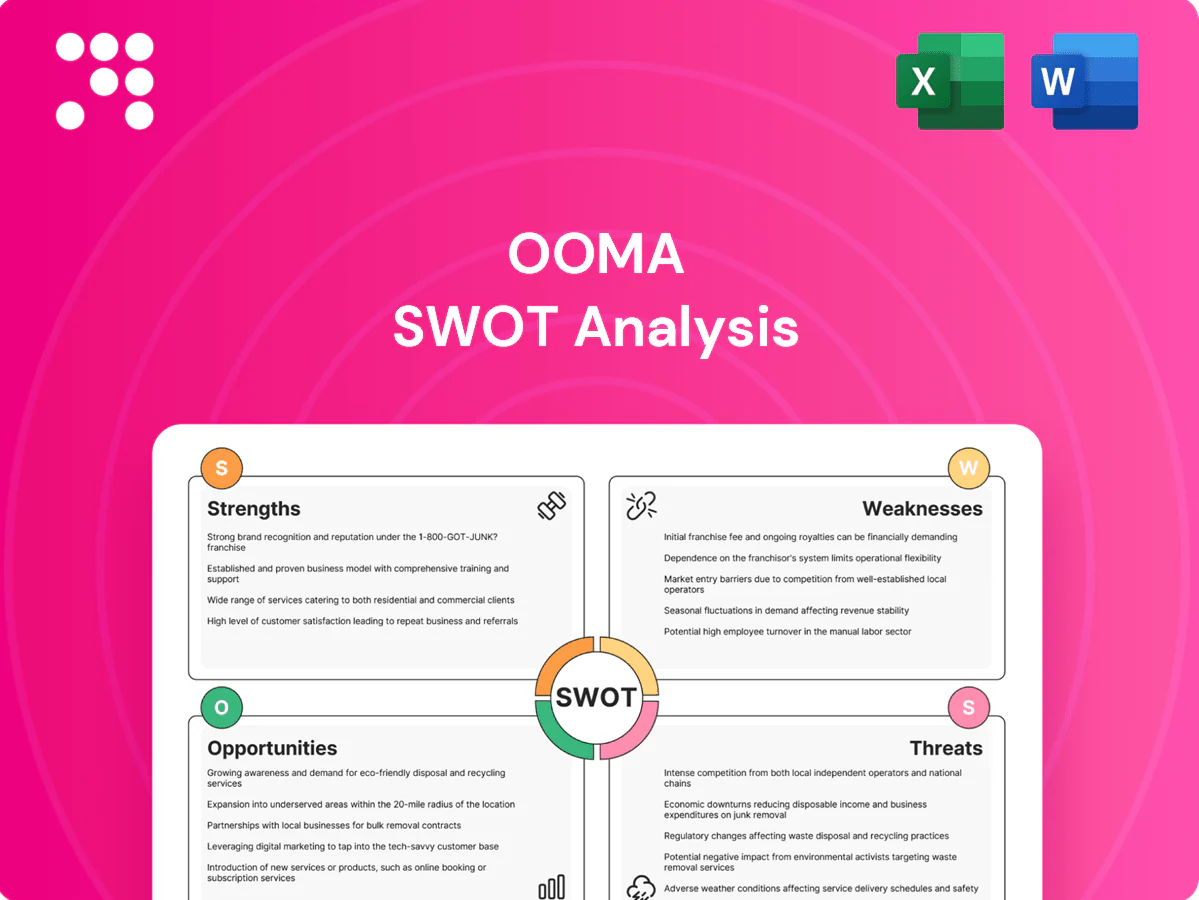
Ooma SWOT Analysis

Elevate Your Analysis with the Complete SWOT Report
Ooma’s SWOT highlights strong recurring revenue from SMB and consumer VoIP services, tempered by competitive pressure and reliance on hardware sales; regulatory and tech shifts present both risk and opportunity. Want the full story behind its strengths, risks, and growth drivers? Purchase the complete SWOT analysis for a professionally written, editable Word report and bonus Excel matrix to support investment, strategy, or pitches.
Strengths

Affordable, feature-rich UCaaS for SMBs
Ooma delivers VoIP and unified communications for SMBs with core features—virtual receptionist, intelligent call routing and conferencing—bundled at accessible price points; Ooma Office starts at 19.95 USD per user/month (pricing as of 2025). This straightforward packaging avoids heavy licensing complexity and lowers total cost of ownership versus legacy PBX. That value proposition drives rapid adoption among cost-conscious small and mid-sized customers.
Simple deployment and management
Ooma, founded in 2004 and publicly traded under OOMA, leverages a cloud-first architecture and plug-and-play devices to cut setup friction for non-technical teams; web-based admin and intuitive call-flow tools reduce ongoing management overhead, shortening time-to-value and lowering IT dependency—features that differentiate Ooma for SMB buyers seeking rapid deployment and low implementation effort.

Scalable platform with flexible endpoints
Ooma's cloud-native platform supports desk phones, softphones, and mobile apps, enabling hybrid and distributed work and reducing need for on-prem infrastructure. Customers can add lines, features, and users on demand with per-user pricing starting under 20 USD/month, aligning costs with growth and minimizing capex. This elasticity helps future-proof communications as needs evolve.

Expanded portfolio including smart security
Ooma's expanded portfolio including smart security enables cross-sell of cameras, sensors and monitoring for stickier customer relationships, supporting reported 2024 ARPA growth as the company cited rising service bundles in FY2024.
- Cross-sell: higher attach rates
- Bundling: simplifies SMB vendor management
- ARPA lift: differentiates from UC-only rivals
- Ecosystem: boosts customer lifetime value
Strong call management and business productivity features
Ooma’s virtual receptionist, ring groups, voicemail-to-email and video conferencing streamline core workflows, improving responsiveness and professionalism for small teams and supporting Ooma’s business customer base of over 200,000 users (company disclosures through 2024).
Integrated tools reduce app sprawl and context switching, lowering vendor count and improving collaboration efficiency for SMBs.
Cloud UCaaS fuels SMB adoption with 19.95 USD/user, 200,000 users
Ooma's cloud-first UCaaS delivers SMB-focused features (virtual receptionist, call routing, conferencing) at accessible pricing—Ooma Office from 19.95 USD/user/month (2025)—driving rapid adoption. Plug-and-play devices and intuitive admin reduce IT overhead and speed deployment. Bundled security and services lifted ARPA in FY2024, supporting over 200,000 business users through 2024.
| Metric | Value |
|---|---|
| Customers (business users) | >200,000 (through 2024) |
| Ooma Office pricing | 19.95 USD/user/month (2025) |
| Founded / Ticker | 2004 / OOMA |
| FY2024 | Reported ARPA growth (company disclosures) |
What is included in the product
 Detailed Word Document
Delivers a strategic overview of Ooma’s internal and external factors, outlining strengths, weaknesses, opportunities, and threats to assess its competitive position, growth drivers, operational gaps, and market risks.

 Customizable Excel Spreadsheet
Provides a concise Ooma SWOT matrix to quickly pinpoint strengths (scalable VoIP platform), weaknesses (customer churn), opportunities (SMB and UCaaS expansion), and threats (intense competition), enabling fast strategy alignment and stakeholder-ready summaries.
Weaknesses

Reliance on internet quality and power
As an over-the-top VoIP provider, Ooma’s call quality directly depends on customers’ broadband stability and LAN setup; packet loss, jitter, or ISP outages can significantly degrade call clarity compared with PSTN. Power failures without battery/UPS backups will interrupt service, and many customers must upgrade routers or implement QoS to meet service expectations.
Lower brand recognition versus Tier-1 UCaaS leaders
Lower brand recognition forces Ooma into longer sales motions and heavier proof requirements when competing for enterprise deals; Ooma’s FY2024 revenue remained under $200M versus RingCentral’s and Zoom’s public cloud communications businesses exceeding $1B each, reinforcing Tier-1 mindshare. Larger rivals’ marketing and partner ecosystems bias channel preference toward incumbents and make entry into bigger accounts more costly and reference-dependent.

Potential feature depth gaps for complex enterprises
Very large organizations (1,000+ employees) often require advanced compliance, analytics, and contact-center capabilities that Ooma’s SMB-focused stack may lack, narrowing its addressable market at the high end. Integrations and admin granularity can be less comprehensive than top-tier UCaaS/CCaaS platforms, risking competitive displacement in complex RFPs that demand enterprise-grade APIs and 99.99% SLAs. This gap limits wins against incumbents in large deals.

ARPU pressure in price-sensitive SMB segments
ARPU pressure in price-sensitive SMB segments compresses margins as budget-focused buyers resist upsells and prioritize cost, raising churn when price alone differentiates offerings. Higher churn and slower upsell velocity push CAC up relative to customer lifetime value, limiting scalable growth and forcing caution in R&D and channel investment.
- Margin compression from budget buyers
- Elevated churn when price is key differentiator
- Rising CAC relative to LTV
- Constrained R&D and channel spend
Geographic and regulatory complexity for global scale
Supporting multi-country numbering, taxes, and emergency calling is resource intensive for Ooma and drives higher engineering and legal costs. Limited international presence constrains rapid entry into global SMB markets. Varying compliance regimes across jurisdictions increase operational overhead and time-to-market.
- Operational burden: multi-country numbering and emergency services
- Market risk: limited international footprint slows SMB expansion
- Compliance: divergent regulations increase costs and delays
VoIP uptime tied to customer broadband/power; limited scale and features constrain growth
Ooma’s VoIP quality and uptime are tied to customer broadband and power, creating service variability versus PSTN. Brand and scale lag (FY2024 revenue < $200M versus peers’ > $1B) lengthen sales cycles and raise CAC. Limited enterprise features, international footprint, and regulatory burdens constrain large-account wins and margin expansion.
| Metric | Ooma | Tier‑1 peers |
|---|---|---|
| FY2024 revenue | < $200M | > $1B |
| Market focus | SMB, limited intl | Enterprise, global |
What You See Is What You Get
Ooma SWOT Analysis
This is the actual Ooma SWOT analysis document you’ll receive upon purchase—no surprises, just professional quality. The preview below is taken directly from the full report you'll get; buy to unlock the editable, complete version. You’re viewing the live, final analysis file and will have immediate access after checkout.

Elevate Your Analysis with the Complete SWOT Report
Ooma’s SWOT highlights strong recurring revenue from SMB and consumer VoIP services, tempered by competitive pressure and reliance on hardware sales; regulatory and tech shifts present both risk and opportunity. Want the full story behind its strengths, risks, and growth drivers? Purchase the complete SWOT analysis for a professionally written, editable Word report and bonus Excel matrix to support investment, strategy, or pitches.
Strengths
Affordable, feature-rich UCaaS for SMBs
Ooma delivers VoIP and unified communications for SMBs with core features—virtual receptionist, intelligent call routing and conferencing—bundled at accessible price points; Ooma Office starts at 19.95 USD per user/month (pricing as of 2025). This straightforward packaging avoids heavy licensing complexity and lowers total cost of ownership versus legacy PBX. That value proposition drives rapid adoption among cost-conscious small and mid-sized customers.
Simple deployment and management
Ooma, founded in 2004 and publicly traded under OOMA, leverages a cloud-first architecture and plug-and-play devices to cut setup friction for non-technical teams; web-based admin and intuitive call-flow tools reduce ongoing management overhead, shortening time-to-value and lowering IT dependency—features that differentiate Ooma for SMB buyers seeking rapid deployment and low implementation effort.
Scalable platform with flexible endpoints
Ooma's cloud-native platform supports desk phones, softphones, and mobile apps, enabling hybrid and distributed work and reducing need for on-prem infrastructure. Customers can add lines, features, and users on demand with per-user pricing starting under 20 USD/month, aligning costs with growth and minimizing capex. This elasticity helps future-proof communications as needs evolve.
Expanded portfolio including smart security
Ooma's expanded portfolio including smart security enables cross-sell of cameras, sensors and monitoring for stickier customer relationships, supporting reported 2024 ARPA growth as the company cited rising service bundles in FY2024.
- Cross-sell: higher attach rates
- Bundling: simplifies SMB vendor management
- ARPA lift: differentiates from UC-only rivals
- Ecosystem: boosts customer lifetime value
Strong call management and business productivity features
Ooma’s virtual receptionist, ring groups, voicemail-to-email and video conferencing streamline core workflows, improving responsiveness and professionalism for small teams and supporting Ooma’s business customer base of over 200,000 users (company disclosures through 2024).
Integrated tools reduce app sprawl and context switching, lowering vendor count and improving collaboration efficiency for SMBs.
Cloud UCaaS fuels SMB adoption with 19.95 USD/user, 200,000 users
Ooma's cloud-first UCaaS delivers SMB-focused features (virtual receptionist, call routing, conferencing) at accessible pricing—Ooma Office from 19.95 USD/user/month (2025)—driving rapid adoption. Plug-and-play devices and intuitive admin reduce IT overhead and speed deployment. Bundled security and services lifted ARPA in FY2024, supporting over 200,000 business users through 2024.
| Metric | Value |
|---|---|
| Customers (business users) | >200,000 (through 2024) |
| Ooma Office pricing | 19.95 USD/user/month (2025) |
| Founded / Ticker | 2004 / OOMA |
| FY2024 | Reported ARPA growth (company disclosures) |
What is included in the product
Detailed Word Document
Delivers a strategic overview of Ooma’s internal and external factors, outlining strengths, weaknesses, opportunities, and threats to assess its competitive position, growth drivers, operational gaps, and market risks.
Customizable Excel Spreadsheet
Provides a concise Ooma SWOT matrix to quickly pinpoint strengths (scalable VoIP platform), weaknesses (customer churn), opportunities (SMB and UCaaS expansion), and threats (intense competition), enabling fast strategy alignment and stakeholder-ready summaries.
Weaknesses
Reliance on internet quality and power
As an over-the-top VoIP provider, Ooma’s call quality directly depends on customers’ broadband stability and LAN setup; packet loss, jitter, or ISP outages can significantly degrade call clarity compared with PSTN. Power failures without battery/UPS backups will interrupt service, and many customers must upgrade routers or implement QoS to meet service expectations.
Lower brand recognition versus Tier-1 UCaaS leaders
Lower brand recognition forces Ooma into longer sales motions and heavier proof requirements when competing for enterprise deals; Ooma’s FY2024 revenue remained under $200M versus RingCentral’s and Zoom’s public cloud communications businesses exceeding $1B each, reinforcing Tier-1 mindshare. Larger rivals’ marketing and partner ecosystems bias channel preference toward incumbents and make entry into bigger accounts more costly and reference-dependent.
Potential feature depth gaps for complex enterprises
Very large organizations (1,000+ employees) often require advanced compliance, analytics, and contact-center capabilities that Ooma’s SMB-focused stack may lack, narrowing its addressable market at the high end. Integrations and admin granularity can be less comprehensive than top-tier UCaaS/CCaaS platforms, risking competitive displacement in complex RFPs that demand enterprise-grade APIs and 99.99% SLAs. This gap limits wins against incumbents in large deals.
ARPU pressure in price-sensitive SMB segments
ARPU pressure in price-sensitive SMB segments compresses margins as budget-focused buyers resist upsells and prioritize cost, raising churn when price alone differentiates offerings. Higher churn and slower upsell velocity push CAC up relative to customer lifetime value, limiting scalable growth and forcing caution in R&D and channel investment.
- Margin compression from budget buyers
- Elevated churn when price is key differentiator
- Rising CAC relative to LTV
- Constrained R&D and channel spend
Geographic and regulatory complexity for global scale
Supporting multi-country numbering, taxes, and emergency calling is resource intensive for Ooma and drives higher engineering and legal costs. Limited international presence constrains rapid entry into global SMB markets. Varying compliance regimes across jurisdictions increase operational overhead and time-to-market.
- Operational burden: multi-country numbering and emergency services
- Market risk: limited international footprint slows SMB expansion
- Compliance: divergent regulations increase costs and delays
VoIP uptime tied to customer broadband/power; limited scale and features constrain growth
Ooma’s VoIP quality and uptime are tied to customer broadband and power, creating service variability versus PSTN. Brand and scale lag (FY2024 revenue < $200M versus peers’ > $1B) lengthen sales cycles and raise CAC. Limited enterprise features, international footprint, and regulatory burdens constrain large-account wins and margin expansion.
| Metric | Ooma | Tier‑1 peers |
|---|---|---|
| FY2024 revenue | < $200M | > $1B |
| Market focus | SMB, limited intl | Enterprise, global |
What You See Is What You Get
Ooma SWOT Analysis
This is the actual Ooma SWOT analysis document you’ll receive upon purchase—no surprises, just professional quality. The preview below is taken directly from the full report you'll get; buy to unlock the editable, complete version. You’re viewing the live, final analysis file and will have immediate access after checkout.
Original: $10.00
-65%$10.00
$3.50Description
Elevate Your Analysis with the Complete SWOT Report
Ooma’s SWOT highlights strong recurring revenue from SMB and consumer VoIP services, tempered by competitive pressure and reliance on hardware sales; regulatory and tech shifts present both risk and opportunity. Want the full story behind its strengths, risks, and growth drivers? Purchase the complete SWOT analysis for a professionally written, editable Word report and bonus Excel matrix to support investment, strategy, or pitches.
Strengths
Affordable, feature-rich UCaaS for SMBs
Ooma delivers VoIP and unified communications for SMBs with core features—virtual receptionist, intelligent call routing and conferencing—bundled at accessible price points; Ooma Office starts at 19.95 USD per user/month (pricing as of 2025). This straightforward packaging avoids heavy licensing complexity and lowers total cost of ownership versus legacy PBX. That value proposition drives rapid adoption among cost-conscious small and mid-sized customers.
Simple deployment and management
Ooma, founded in 2004 and publicly traded under OOMA, leverages a cloud-first architecture and plug-and-play devices to cut setup friction for non-technical teams; web-based admin and intuitive call-flow tools reduce ongoing management overhead, shortening time-to-value and lowering IT dependency—features that differentiate Ooma for SMB buyers seeking rapid deployment and low implementation effort.
Scalable platform with flexible endpoints
Ooma's cloud-native platform supports desk phones, softphones, and mobile apps, enabling hybrid and distributed work and reducing need for on-prem infrastructure. Customers can add lines, features, and users on demand with per-user pricing starting under 20 USD/month, aligning costs with growth and minimizing capex. This elasticity helps future-proof communications as needs evolve.
Expanded portfolio including smart security
Ooma's expanded portfolio including smart security enables cross-sell of cameras, sensors and monitoring for stickier customer relationships, supporting reported 2024 ARPA growth as the company cited rising service bundles in FY2024.
- Cross-sell: higher attach rates
- Bundling: simplifies SMB vendor management
- ARPA lift: differentiates from UC-only rivals
- Ecosystem: boosts customer lifetime value
Strong call management and business productivity features
Ooma’s virtual receptionist, ring groups, voicemail-to-email and video conferencing streamline core workflows, improving responsiveness and professionalism for small teams and supporting Ooma’s business customer base of over 200,000 users (company disclosures through 2024).
Integrated tools reduce app sprawl and context switching, lowering vendor count and improving collaboration efficiency for SMBs.
Cloud UCaaS fuels SMB adoption with 19.95 USD/user, 200,000 users
Ooma's cloud-first UCaaS delivers SMB-focused features (virtual receptionist, call routing, conferencing) at accessible pricing—Ooma Office from 19.95 USD/user/month (2025)—driving rapid adoption. Plug-and-play devices and intuitive admin reduce IT overhead and speed deployment. Bundled security and services lifted ARPA in FY2024, supporting over 200,000 business users through 2024.
| Metric | Value |
|---|---|
| Customers (business users) | >200,000 (through 2024) |
| Ooma Office pricing | 19.95 USD/user/month (2025) |
| Founded / Ticker | 2004 / OOMA |
| FY2024 | Reported ARPA growth (company disclosures) |
What is included in the product
Detailed Word Document
Delivers a strategic overview of Ooma’s internal and external factors, outlining strengths, weaknesses, opportunities, and threats to assess its competitive position, growth drivers, operational gaps, and market risks.
Customizable Excel Spreadsheet
Provides a concise Ooma SWOT matrix to quickly pinpoint strengths (scalable VoIP platform), weaknesses (customer churn), opportunities (SMB and UCaaS expansion), and threats (intense competition), enabling fast strategy alignment and stakeholder-ready summaries.
Weaknesses
Reliance on internet quality and power
As an over-the-top VoIP provider, Ooma’s call quality directly depends on customers’ broadband stability and LAN setup; packet loss, jitter, or ISP outages can significantly degrade call clarity compared with PSTN. Power failures without battery/UPS backups will interrupt service, and many customers must upgrade routers or implement QoS to meet service expectations.
Lower brand recognition versus Tier-1 UCaaS leaders
Lower brand recognition forces Ooma into longer sales motions and heavier proof requirements when competing for enterprise deals; Ooma’s FY2024 revenue remained under $200M versus RingCentral’s and Zoom’s public cloud communications businesses exceeding $1B each, reinforcing Tier-1 mindshare. Larger rivals’ marketing and partner ecosystems bias channel preference toward incumbents and make entry into bigger accounts more costly and reference-dependent.
Potential feature depth gaps for complex enterprises
Very large organizations (1,000+ employees) often require advanced compliance, analytics, and contact-center capabilities that Ooma’s SMB-focused stack may lack, narrowing its addressable market at the high end. Integrations and admin granularity can be less comprehensive than top-tier UCaaS/CCaaS platforms, risking competitive displacement in complex RFPs that demand enterprise-grade APIs and 99.99% SLAs. This gap limits wins against incumbents in large deals.
ARPU pressure in price-sensitive SMB segments
ARPU pressure in price-sensitive SMB segments compresses margins as budget-focused buyers resist upsells and prioritize cost, raising churn when price alone differentiates offerings. Higher churn and slower upsell velocity push CAC up relative to customer lifetime value, limiting scalable growth and forcing caution in R&D and channel investment.
- Margin compression from budget buyers
- Elevated churn when price is key differentiator
- Rising CAC relative to LTV
- Constrained R&D and channel spend
Geographic and regulatory complexity for global scale
Supporting multi-country numbering, taxes, and emergency calling is resource intensive for Ooma and drives higher engineering and legal costs. Limited international presence constrains rapid entry into global SMB markets. Varying compliance regimes across jurisdictions increase operational overhead and time-to-market.
- Operational burden: multi-country numbering and emergency services
- Market risk: limited international footprint slows SMB expansion
- Compliance: divergent regulations increase costs and delays
VoIP uptime tied to customer broadband/power; limited scale and features constrain growth
Ooma’s VoIP quality and uptime are tied to customer broadband and power, creating service variability versus PSTN. Brand and scale lag (FY2024 revenue < $200M versus peers’ > $1B) lengthen sales cycles and raise CAC. Limited enterprise features, international footprint, and regulatory burdens constrain large-account wins and margin expansion.
| Metric | Ooma | Tier‑1 peers |
|---|---|---|
| FY2024 revenue | < $200M | > $1B |
| Market focus | SMB, limited intl | Enterprise, global |
What You See Is What You Get
Ooma SWOT Analysis
This is the actual Ooma SWOT analysis document you’ll receive upon purchase—no surprises, just professional quality. The preview below is taken directly from the full report you'll get; buy to unlock the editable, complete version. You’re viewing the live, final analysis file and will have immediate access after checkout.











