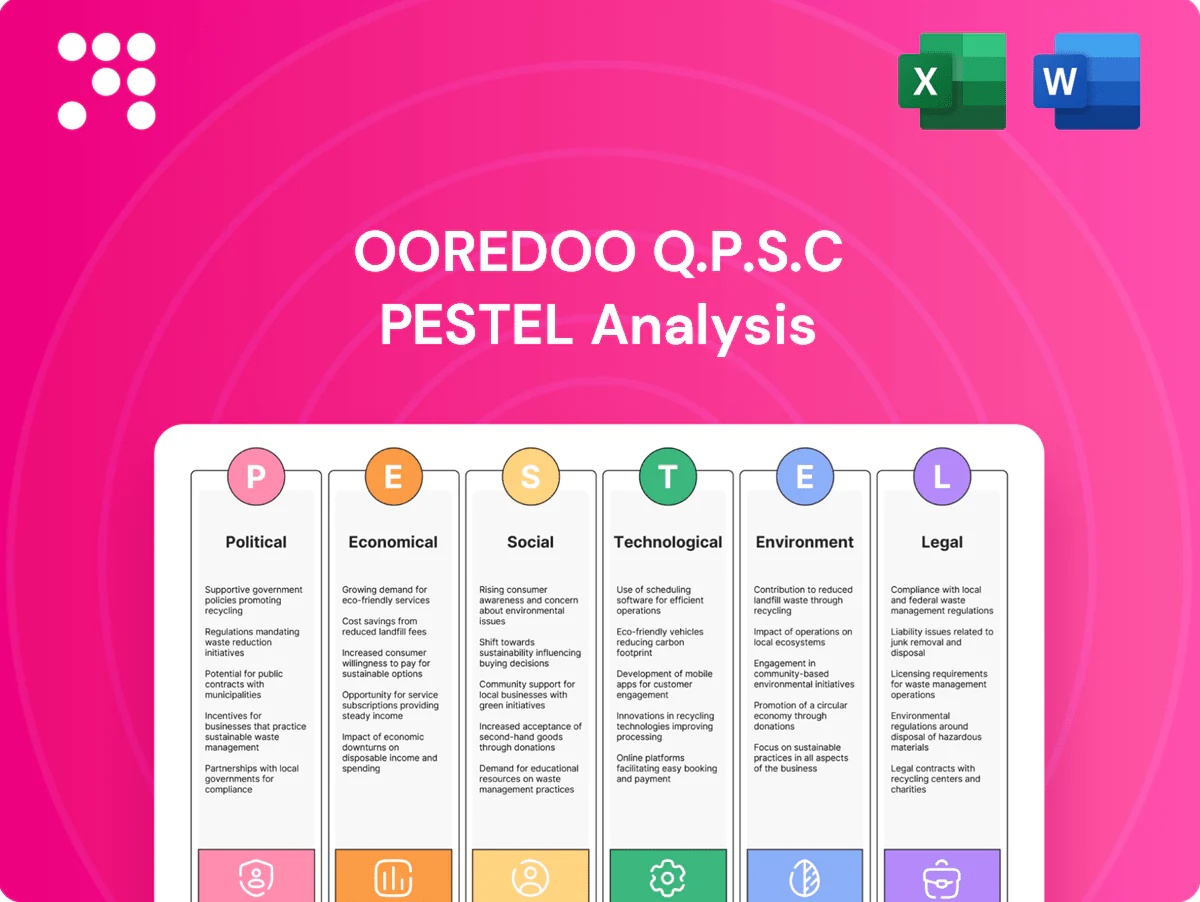
Ooredoo Q.P.S.C PESTLE Analysis

Plan Smarter. Present Sharper. Compete Stronger.
Gain strategic clarity with our PESTLE Analysis of Ooredoo Q.P.S.C—concise insights into political, economic, social, technological, legal and environmental forces shaping its outlook. Ideal for investors and strategists, it highlights risks and growth levers you need to know. Purchase the full report to access the complete, actionable breakdown instantly.
Political factors

State influence and strategic alignment
Operating in Qatar and across 10 state-influenced markets makes policy alignment critical for Ooredoo Q.P.S.C. Government visions such as Qatar National Vision 2030 can accelerate licenses, spectrum access and public-sector contracts. Shifts in national priorities or leadership can reweight capex toward mandated coverage and inclusion goals. Proactive engagement with ministries and regulators sustains competitive advantage.
Spectrum licensing and regulatory stability
Spectrum awards, renewal terms and fees directly shape Ooredoo Q.P.S.C.’s network economics: GCC markets typically grant long-tenor licenses (commonly 15–25 years), supporting multi-year 5G/FTTH ROI, while some North African and Asian markets have more discretionary renewals and ad hoc fees. License uncertainty can add 100–300 basis points to WACC and materially delay rollout and cash returns.

Geopolitical risk and cross-border exposure
Ooredoo, present in 10 markets across MENA and Southeast Asia and serving roughly 120 million customers, faces sanctions risk, regional conflicts and diplomatic rifts that can disrupt revenues and roaming services. Network asset and staff safety plans must cover sudden outages and travel bans; political risk insurance and diversified supply routes (multiple undersea cable and vendor sources) underpin continuity. Robust crisis communications preserves brand trust during disruptions.

Localization and national content policies
- Local hiring/vendor quotas: compliance-driven supply chains
- Data localization: affects cloud strategy and cross-border data flows
- JV structures: reduce entry barriers and share compliance costs
Public–private partnerships and universal service
Governments push coverage in rural and low-ARPU areas via USO mandates or subsidies, forcing Ooredoo Q.P.S.C to balance commercial returns with inclusion; Qatar had about 2.9 million residents in 2024 and near-universal internet penetration (~99%), increasing political pressure for full nationwide broadband access.
- PPPs unlock capital for fiber/backbone and smart-city builds
- Transparent KPIs and audits required for disbursements
- Risk-sharing clauses protect margins while expanding inclusion
10-state telecom footprint, ~120m users; 5G spectrum tenors and license risk reshape returns
Operating across 10 state-influenced markets and ~120m customers, Ooredoo must align with national strategies like Qatar National Vision 2030; Qatar population ~2.9m (2024) and ~99% internet penetration increase political pressure. Spectrum tenors (15–25y) support 5G ROI while license uncertainty can add ~100–300bp to WACC. Localization, sanctions and USO mandates raise capex/OPEX and favor JVs and political-risk insurance.
| Metric | Value |
|---|---|
| Markets/customers | 10 / ~120m |
| Qatar pop (2024) | ~2.9m |
| Internet pen. | ~99% |
| Spectrum tenor | 15–25 years |
| WACC impact | ~100–300 bps |
What is included in the product
 Detailed Word Document
Explores how macro-environmental forces uniquely affect Ooredoo Q.P.S.C across six dimensions—Political, Economic, Social, Technological, Environmental, and Legal—backed by data and current trends to reflect regional market and regulatory dynamics. Designed for executives and investors, it delivers forward-looking insights and ready-to-use findings for planning, risk mitigation, and opportunity capture.

 Customizable Excel Spreadsheet
A concise, visually segmented PESTLE summary for Ooredoo Q.P.S.C that relieves briefing and presentation pain points by being easily editable, shareable and drop‑in ready for slides or strategy packs, enabling quick cross‑team alignment and context‑specific notes for planning sessions.
Economic factors

Macroeconomic cycles and consumer spend
GCC GDP growth of about 3.8% in 2024 (IMF) supports premium ARPU in markets like Qatar, while North Africa (circa 3.0% growth) and parts of Southeast Asia (Indonesia ~5.2% in 2024) remain more price-sensitive. Economic slowdowns typically cut discretionary add-ons first, leaving core voice/data steadier. Bundling and tiered plans help defend revenue and elasticity management is critical in prepaid-heavy segments.
FX volatility and repatriation
Multi-currency revenues across Ooredoo’s c.10 operating markets expose earnings to FX swings and convertibility constraints despite the QAR being pegged to the USD since 2001. Hedging, natural currency offsets between markets and local-currency debt issuance materially reduce translation risk. Dividend planning must respect repatriation rules and capital controls in host countries. Transparent FX disclosure supports investor confidence.

Inflation and cost-of-service
Rising energy, tower lease and device costs have pressured Ooredoo Q.P.S.C EBITDA even as Qatar's CPI rose about 3.1% in 2024, increasing operating expense baselines. Indexed supplier contracts and energy-efficiency investments (e.g., tower solar/back-up optimization) can partially cushion margins. Selective pricing power in postpaid and enterprise segments supports ARPU resilience. Regional procurement scale with vendors reduces unit costs through volume discounts and unified sourcing.

Competitive intensity and ARPU pressure
Competitive intensity in 2024 drove price wars and unlimited-data promotions that compressed ARPU for Ooredoo Q.P.S.C, while network quality, enterprise solutions and digital services improved revenue mix and lifted higher-value customer segments. Advanced churn analytics and targeted loyalty programs have reduced defections and protected core base. Wholesale and MVNO deals monetize spare capacity and diversify revenue streams.
- Price wars/unlimited offers: ARPU pressure
- Network & digital differentiation: higher mix
- Churn analytics/loyalty: retention shield
- Wholesale/MVNO: capacity monetization
Capital expenditure and return profiles
5G, fiber and transport upgrades are capex-heavy with multi-year paybacks; prioritizing high-traffic corridors (urban backbones and stadiums) accelerates cash returns and improves payback profiles.
- Sharing towers/fiber and Open RAN adoption improve IRR and lower unit capex
- Disciplined capex gating tied to regulatory milestones reduces regulatory risk
- Focus on high-ARPU corridors speeds breakeven
10-state telecom footprint, ~120m users; 5G spectrum tenors and license risk reshape returns
GCC growth ~3.8% (IMF 2024) supports premium ARPU in Qatar while North Africa and SEA remain price-sensitive; discretionary spend falls first in slowdowns. Multi-currency exposure across c.10 markets requires hedging and local debt to limit translation risk. Rising CPI (Qatar ~3.1% 2024) and energy costs pressure EBITDA; capex for 5G/fiber is high but targets high-ARPU corridors for faster payback.
| Metric | Value |
|---|---|
| GCC GDP (2024) | 3.8% (IMF) |
| Qatar CPI (2024) | ~3.1% |
| Operating markets | c.10 |
| 5G/fiber capex | Multi-year payback, prioritized corridors |
Preview the Actual Deliverable
Ooredoo Q.P.S.C PESTLE Analysis
The Ooredoo Q.P.S.C PESTLE analysis examines political, economic, social, technological, legal and environmental factors shaping the company’s strategy in Qatar and global markets. It highlights regulatory risks, spectrum policy, digital transformation and macroeconomic headwinds. The preview shown here is the exact document you’ll receive after purchase—fully formatted and ready to use.

Plan Smarter. Present Sharper. Compete Stronger.
Gain strategic clarity with our PESTLE Analysis of Ooredoo Q.P.S.C—concise insights into political, economic, social, technological, legal and environmental forces shaping its outlook. Ideal for investors and strategists, it highlights risks and growth levers you need to know. Purchase the full report to access the complete, actionable breakdown instantly.
Political factors
State influence and strategic alignment
Operating in Qatar and across 10 state-influenced markets makes policy alignment critical for Ooredoo Q.P.S.C. Government visions such as Qatar National Vision 2030 can accelerate licenses, spectrum access and public-sector contracts. Shifts in national priorities or leadership can reweight capex toward mandated coverage and inclusion goals. Proactive engagement with ministries and regulators sustains competitive advantage.
Spectrum licensing and regulatory stability
Spectrum awards, renewal terms and fees directly shape Ooredoo Q.P.S.C.’s network economics: GCC markets typically grant long-tenor licenses (commonly 15–25 years), supporting multi-year 5G/FTTH ROI, while some North African and Asian markets have more discretionary renewals and ad hoc fees. License uncertainty can add 100–300 basis points to WACC and materially delay rollout and cash returns.
Geopolitical risk and cross-border exposure
Ooredoo, present in 10 markets across MENA and Southeast Asia and serving roughly 120 million customers, faces sanctions risk, regional conflicts and diplomatic rifts that can disrupt revenues and roaming services. Network asset and staff safety plans must cover sudden outages and travel bans; political risk insurance and diversified supply routes (multiple undersea cable and vendor sources) underpin continuity. Robust crisis communications preserves brand trust during disruptions.
Localization and national content policies
- Local hiring/vendor quotas: compliance-driven supply chains
- Data localization: affects cloud strategy and cross-border data flows
- JV structures: reduce entry barriers and share compliance costs
Public–private partnerships and universal service
Governments push coverage in rural and low-ARPU areas via USO mandates or subsidies, forcing Ooredoo Q.P.S.C to balance commercial returns with inclusion; Qatar had about 2.9 million residents in 2024 and near-universal internet penetration (~99%), increasing political pressure for full nationwide broadband access.
- PPPs unlock capital for fiber/backbone and smart-city builds
- Transparent KPIs and audits required for disbursements
- Risk-sharing clauses protect margins while expanding inclusion
10-state telecom footprint, ~120m users; 5G spectrum tenors and license risk reshape returns
Operating across 10 state-influenced markets and ~120m customers, Ooredoo must align with national strategies like Qatar National Vision 2030; Qatar population ~2.9m (2024) and ~99% internet penetration increase political pressure. Spectrum tenors (15–25y) support 5G ROI while license uncertainty can add ~100–300bp to WACC. Localization, sanctions and USO mandates raise capex/OPEX and favor JVs and political-risk insurance.
| Metric | Value |
|---|---|
| Markets/customers | 10 / ~120m |
| Qatar pop (2024) | ~2.9m |
| Internet pen. | ~99% |
| Spectrum tenor | 15–25 years |
| WACC impact | ~100–300 bps |
What is included in the product
Detailed Word Document
Explores how macro-environmental forces uniquely affect Ooredoo Q.P.S.C across six dimensions—Political, Economic, Social, Technological, Environmental, and Legal—backed by data and current trends to reflect regional market and regulatory dynamics. Designed for executives and investors, it delivers forward-looking insights and ready-to-use findings for planning, risk mitigation, and opportunity capture.
Customizable Excel Spreadsheet
A concise, visually segmented PESTLE summary for Ooredoo Q.P.S.C that relieves briefing and presentation pain points by being easily editable, shareable and drop‑in ready for slides or strategy packs, enabling quick cross‑team alignment and context‑specific notes for planning sessions.
Economic factors
Macroeconomic cycles and consumer spend
GCC GDP growth of about 3.8% in 2024 (IMF) supports premium ARPU in markets like Qatar, while North Africa (circa 3.0% growth) and parts of Southeast Asia (Indonesia ~5.2% in 2024) remain more price-sensitive. Economic slowdowns typically cut discretionary add-ons first, leaving core voice/data steadier. Bundling and tiered plans help defend revenue and elasticity management is critical in prepaid-heavy segments.
FX volatility and repatriation
Multi-currency revenues across Ooredoo’s c.10 operating markets expose earnings to FX swings and convertibility constraints despite the QAR being pegged to the USD since 2001. Hedging, natural currency offsets between markets and local-currency debt issuance materially reduce translation risk. Dividend planning must respect repatriation rules and capital controls in host countries. Transparent FX disclosure supports investor confidence.
Inflation and cost-of-service
Rising energy, tower lease and device costs have pressured Ooredoo Q.P.S.C EBITDA even as Qatar's CPI rose about 3.1% in 2024, increasing operating expense baselines. Indexed supplier contracts and energy-efficiency investments (e.g., tower solar/back-up optimization) can partially cushion margins. Selective pricing power in postpaid and enterprise segments supports ARPU resilience. Regional procurement scale with vendors reduces unit costs through volume discounts and unified sourcing.
Competitive intensity and ARPU pressure
Competitive intensity in 2024 drove price wars and unlimited-data promotions that compressed ARPU for Ooredoo Q.P.S.C, while network quality, enterprise solutions and digital services improved revenue mix and lifted higher-value customer segments. Advanced churn analytics and targeted loyalty programs have reduced defections and protected core base. Wholesale and MVNO deals monetize spare capacity and diversify revenue streams.
- Price wars/unlimited offers: ARPU pressure
- Network & digital differentiation: higher mix
- Churn analytics/loyalty: retention shield
- Wholesale/MVNO: capacity monetization
Capital expenditure and return profiles
5G, fiber and transport upgrades are capex-heavy with multi-year paybacks; prioritizing high-traffic corridors (urban backbones and stadiums) accelerates cash returns and improves payback profiles.
- Sharing towers/fiber and Open RAN adoption improve IRR and lower unit capex
- Disciplined capex gating tied to regulatory milestones reduces regulatory risk
- Focus on high-ARPU corridors speeds breakeven
10-state telecom footprint, ~120m users; 5G spectrum tenors and license risk reshape returns
GCC growth ~3.8% (IMF 2024) supports premium ARPU in Qatar while North Africa and SEA remain price-sensitive; discretionary spend falls first in slowdowns. Multi-currency exposure across c.10 markets requires hedging and local debt to limit translation risk. Rising CPI (Qatar ~3.1% 2024) and energy costs pressure EBITDA; capex for 5G/fiber is high but targets high-ARPU corridors for faster payback.
| Metric | Value |
|---|---|
| GCC GDP (2024) | 3.8% (IMF) |
| Qatar CPI (2024) | ~3.1% |
| Operating markets | c.10 |
| 5G/fiber capex | Multi-year payback, prioritized corridors |
Preview the Actual Deliverable
Ooredoo Q.P.S.C PESTLE Analysis
The Ooredoo Q.P.S.C PESTLE analysis examines political, economic, social, technological, legal and environmental factors shaping the company’s strategy in Qatar and global markets. It highlights regulatory risks, spectrum policy, digital transformation and macroeconomic headwinds. The preview shown here is the exact document you’ll receive after purchase—fully formatted and ready to use.
Description
Plan Smarter. Present Sharper. Compete Stronger.
Gain strategic clarity with our PESTLE Analysis of Ooredoo Q.P.S.C—concise insights into political, economic, social, technological, legal and environmental forces shaping its outlook. Ideal for investors and strategists, it highlights risks and growth levers you need to know. Purchase the full report to access the complete, actionable breakdown instantly.
Political factors
State influence and strategic alignment
Operating in Qatar and across 10 state-influenced markets makes policy alignment critical for Ooredoo Q.P.S.C. Government visions such as Qatar National Vision 2030 can accelerate licenses, spectrum access and public-sector contracts. Shifts in national priorities or leadership can reweight capex toward mandated coverage and inclusion goals. Proactive engagement with ministries and regulators sustains competitive advantage.
Spectrum licensing and regulatory stability
Spectrum awards, renewal terms and fees directly shape Ooredoo Q.P.S.C.’s network economics: GCC markets typically grant long-tenor licenses (commonly 15–25 years), supporting multi-year 5G/FTTH ROI, while some North African and Asian markets have more discretionary renewals and ad hoc fees. License uncertainty can add 100–300 basis points to WACC and materially delay rollout and cash returns.
Geopolitical risk and cross-border exposure
Ooredoo, present in 10 markets across MENA and Southeast Asia and serving roughly 120 million customers, faces sanctions risk, regional conflicts and diplomatic rifts that can disrupt revenues and roaming services. Network asset and staff safety plans must cover sudden outages and travel bans; political risk insurance and diversified supply routes (multiple undersea cable and vendor sources) underpin continuity. Robust crisis communications preserves brand trust during disruptions.
Localization and national content policies
- Local hiring/vendor quotas: compliance-driven supply chains
- Data localization: affects cloud strategy and cross-border data flows
- JV structures: reduce entry barriers and share compliance costs
Public–private partnerships and universal service
Governments push coverage in rural and low-ARPU areas via USO mandates or subsidies, forcing Ooredoo Q.P.S.C to balance commercial returns with inclusion; Qatar had about 2.9 million residents in 2024 and near-universal internet penetration (~99%), increasing political pressure for full nationwide broadband access.
- PPPs unlock capital for fiber/backbone and smart-city builds
- Transparent KPIs and audits required for disbursements
- Risk-sharing clauses protect margins while expanding inclusion
10-state telecom footprint, ~120m users; 5G spectrum tenors and license risk reshape returns
Operating across 10 state-influenced markets and ~120m customers, Ooredoo must align with national strategies like Qatar National Vision 2030; Qatar population ~2.9m (2024) and ~99% internet penetration increase political pressure. Spectrum tenors (15–25y) support 5G ROI while license uncertainty can add ~100–300bp to WACC. Localization, sanctions and USO mandates raise capex/OPEX and favor JVs and political-risk insurance.
| Metric | Value |
|---|---|
| Markets/customers | 10 / ~120m |
| Qatar pop (2024) | ~2.9m |
| Internet pen. | ~99% |
| Spectrum tenor | 15–25 years |
| WACC impact | ~100–300 bps |
What is included in the product
Detailed Word Document
Explores how macro-environmental forces uniquely affect Ooredoo Q.P.S.C across six dimensions—Political, Economic, Social, Technological, Environmental, and Legal—backed by data and current trends to reflect regional market and regulatory dynamics. Designed for executives and investors, it delivers forward-looking insights and ready-to-use findings for planning, risk mitigation, and opportunity capture.
Customizable Excel Spreadsheet
A concise, visually segmented PESTLE summary for Ooredoo Q.P.S.C that relieves briefing and presentation pain points by being easily editable, shareable and drop‑in ready for slides or strategy packs, enabling quick cross‑team alignment and context‑specific notes for planning sessions.
Economic factors
Macroeconomic cycles and consumer spend
GCC GDP growth of about 3.8% in 2024 (IMF) supports premium ARPU in markets like Qatar, while North Africa (circa 3.0% growth) and parts of Southeast Asia (Indonesia ~5.2% in 2024) remain more price-sensitive. Economic slowdowns typically cut discretionary add-ons first, leaving core voice/data steadier. Bundling and tiered plans help defend revenue and elasticity management is critical in prepaid-heavy segments.
FX volatility and repatriation
Multi-currency revenues across Ooredoo’s c.10 operating markets expose earnings to FX swings and convertibility constraints despite the QAR being pegged to the USD since 2001. Hedging, natural currency offsets between markets and local-currency debt issuance materially reduce translation risk. Dividend planning must respect repatriation rules and capital controls in host countries. Transparent FX disclosure supports investor confidence.
Inflation and cost-of-service
Rising energy, tower lease and device costs have pressured Ooredoo Q.P.S.C EBITDA even as Qatar's CPI rose about 3.1% in 2024, increasing operating expense baselines. Indexed supplier contracts and energy-efficiency investments (e.g., tower solar/back-up optimization) can partially cushion margins. Selective pricing power in postpaid and enterprise segments supports ARPU resilience. Regional procurement scale with vendors reduces unit costs through volume discounts and unified sourcing.
Competitive intensity and ARPU pressure
Competitive intensity in 2024 drove price wars and unlimited-data promotions that compressed ARPU for Ooredoo Q.P.S.C, while network quality, enterprise solutions and digital services improved revenue mix and lifted higher-value customer segments. Advanced churn analytics and targeted loyalty programs have reduced defections and protected core base. Wholesale and MVNO deals monetize spare capacity and diversify revenue streams.
- Price wars/unlimited offers: ARPU pressure
- Network & digital differentiation: higher mix
- Churn analytics/loyalty: retention shield
- Wholesale/MVNO: capacity monetization
Capital expenditure and return profiles
5G, fiber and transport upgrades are capex-heavy with multi-year paybacks; prioritizing high-traffic corridors (urban backbones and stadiums) accelerates cash returns and improves payback profiles.
- Sharing towers/fiber and Open RAN adoption improve IRR and lower unit capex
- Disciplined capex gating tied to regulatory milestones reduces regulatory risk
- Focus on high-ARPU corridors speeds breakeven
10-state telecom footprint, ~120m users; 5G spectrum tenors and license risk reshape returns
GCC growth ~3.8% (IMF 2024) supports premium ARPU in Qatar while North Africa and SEA remain price-sensitive; discretionary spend falls first in slowdowns. Multi-currency exposure across c.10 markets requires hedging and local debt to limit translation risk. Rising CPI (Qatar ~3.1% 2024) and energy costs pressure EBITDA; capex for 5G/fiber is high but targets high-ARPU corridors for faster payback.
| Metric | Value |
|---|---|
| GCC GDP (2024) | 3.8% (IMF) |
| Qatar CPI (2024) | ~3.1% |
| Operating markets | c.10 |
| 5G/fiber capex | Multi-year payback, prioritized corridors |
Preview the Actual Deliverable
Ooredoo Q.P.S.C PESTLE Analysis
The Ooredoo Q.P.S.C PESTLE analysis examines political, economic, social, technological, legal and environmental factors shaping the company’s strategy in Qatar and global markets. It highlights regulatory risks, spectrum policy, digital transformation and macroeconomic headwinds. The preview shown here is the exact document you’ll receive after purchase—fully formatted and ready to use.











