Openjobmetis SWOT Analysis

Your Strategic Toolkit Starts Here
Openjobmetis SWOT snapshot highlights its staffing-market strengths, regulatory risks, and growth levers—ideal for quick evaluation. Purchase the full SWOT analysis to access a research-backed, investor-ready Word report plus an editable Excel matrix for strategy and pitches. Unlock detailed insights to plan, present, and invest with confidence.
Strengths

Extensive Italian branch network
Openjobmetis operates over 100 branches across Italy, giving wide physical coverage that improves local candidate sourcing and enables rapid client response. Proximity to regional markets fosters strong relationships with SMEs and large enterprises, supporting repeat business. High branch density allows sector-specific recruiters and boosts brand visibility and trust.
Diversified sector exposure
Serving manufacturing, services, retail and logistics smooths demand volatility across cycles and reduced dependency on any single sector; Italy hosted over 1 million temporary workers in 2023, underscoring market breadth. Cross-selling candidates and services across these verticals boosts placement rates and average revenue per client. This portfolio breadth supports revenue resilience versus sector-specific peers.

Full-service HR solutions
Offering temporary, permanent and HR services gives Openjobmetis a one-stop value proposition, with payroll, compliance and workforce management support reducing client operational burden. This bundled model raises switching costs and improves retention, enabling premium pricing on integrated solutions. The suite also drives cross-sell opportunities across talent segments and service tiers.

Strong compliance and regulatory know-how
Openjobmetis leverages deep compliance expertise to navigate Italy’s complex labor laws, where fixed-term and agency work still account for roughly 12% of employment (Eurostat 2024), reducing client legal exposure and administrative burden. Robust regulatory know-how differentiates it from smaller rivals less able to absorb compliance costs, cutting dispute-related downtime. This capability preserves margins by avoiding fines and contract reversals that commonly erode temporary staffing profits.
- advantage: compliance reduces client risk
- differentiator: outpaces smaller competitors
- impact: protects margins by avoiding fines/disputes
Recognized domestic brand
Recognized domestic brand: listed on Borsa Italiana (ticker OJM) and long-established in Italy, Openjobmetis' brand credibility improves trust with candidates and employers, increasing lead conversion and referral flow while helping attract senior recruiters and corporate clients; its reputation supports pricing power in core regions.
- Credibility: listed on Borsa Italiana (OJM)
- Conversion: stronger lead-to-hire rates
- Talent: attracts high-quality recruiters
- Pricing: supports premium rates in core Italian markets
Pan-Italy staffing leader: > 100 branches, > 1,000,000 temps, 12% share
Extensive network: >100 branches across Italy enables local sourcing and fast client response. Market scale: Italy had >1,000,000 temporary workers in 2023 and agency/fixed-term work ~12% of employment (Eurostat 2024). Diversified services: temporary, permanent and HR solutions raise switching costs and boost cross-sell. Public listing (Borsa Italiana, OJM) enhances credibility and pricing power.
| Metric | Value |
|---|---|
| Branches | >100 |
| Temporary workers (Italy, 2023) | >1,000,000 |
| Agency/fixed-term share (Eurostat, 2024) | ~12% |
| Listing | Borsa Italiana (OJM) |
What is included in the product
 Detailed Word Document
Provides a concise SWOT analysis of Openjobmetis, highlighting internal capabilities and operational weaknesses alongside market opportunities and external threats to inform strategic decision-making.

 Customizable Excel Spreadsheet
Provides a focused SWOT matrix tailored to Openjobmetis for rapid strategic clarity and stakeholder-ready slides; editable format lets teams quickly update strengths, weaknesses, opportunities and threats as staffing market conditions change.
Weaknesses

High reliance on Italian market
Openjobmetis generates virtually all of its revenue in Italy, with company disclosures in 2024 indicating near-100% domestic exposure, tying performance closely to Italian GDP and labor-market cycles. Limited international diversification increases vulnerability to domestic shocks and regional slowdowns can rapidly reduce order volumes. This concentration constrains scalability and competitiveness versus multinational staffing peers.
Low-margin, volume-driven model
Staffing typically operates on thin spreads — the temporary employment industry posts EBITDA margins commonly around 2–6%, pressuring profitability for Openjobmetis. Intense price competition in Italy has compressed gross margins in recent years, making scale efficiencies essential but hard to sustain. A 1–2 percentage-point dip in utilization or slight mispricing can materially erode earnings given the low-margin model.

Cyclical demand sensitivity
Temporary staffing volumes closely follow business confidence and hiring cycles, with Eurostat reporting a 2024 EU temporary employment rate of 11.5%, making Openjobmetis vulnerable to cyclical swings. Downturns prompt rapid assignment reductions that hit billed hours and margin. Fixed branch and staffing costs pressure earnings during slow periods. Accurate forecasting is therefore critical but inherently challenging in volatile 2024–25 markets.

Working capital intensity
Staffing model requires paying temporary workers before client invoices are collected, creating cash-flow volatility and higher short-term financing needs; in weak demand periods days sales outstanding can lengthen materially, increasing interest expenses and balance-sheet risk.
- Working capital intensive
- DSO volatility raises financing cost
- Higher interest and leverage risk
Technology and data gaps vs leaders
Global rivals deploy AI matching and self-serve tools that can cut time-to-fill by up to 30% and lift candidate engagement; Openjobmetis' lag in automation and analytics limits dynamic pricing and capacity forecasting, raising recruiter workload and aligning with industry findings that weaker tech correlates with 15-25% higher recruiter turnover.
- AI investment gap vs leaders — slower automation adoption
- Time-to-fill penalty — up to 30% slower
- Analytics shortfall — impaired pricing & capacity planning
- Operational impact — increased recruiter load, 15-25% higher turnover risk
Italy ~100% revenue; EBITDA 2-6%, hiring lag 30%
Nearly 100% Italy revenue exposure in 2024 ties results to Italian GDP; EBITDA margins remain thin at ~2–6% pressuring profitability. Temporary employment rate 11.5% (EU 2024) amplifies cyclicality; DSO volatility raises financing and leverage risk. Tech gap: time-to-fill up to 30% slower and 15–25% higher recruiter turnover versus AI-enabled peers.
| Metric | 2024/25 |
|---|---|
| Domestic revenue | ~100% |
| EBITDA margin | 2–6% |
| EU temp rate | 11.5% |
| Time-to-fill penalty | up to 30% |
| Recruiter turnover risk | 15–25% |
What You See Is What You Get
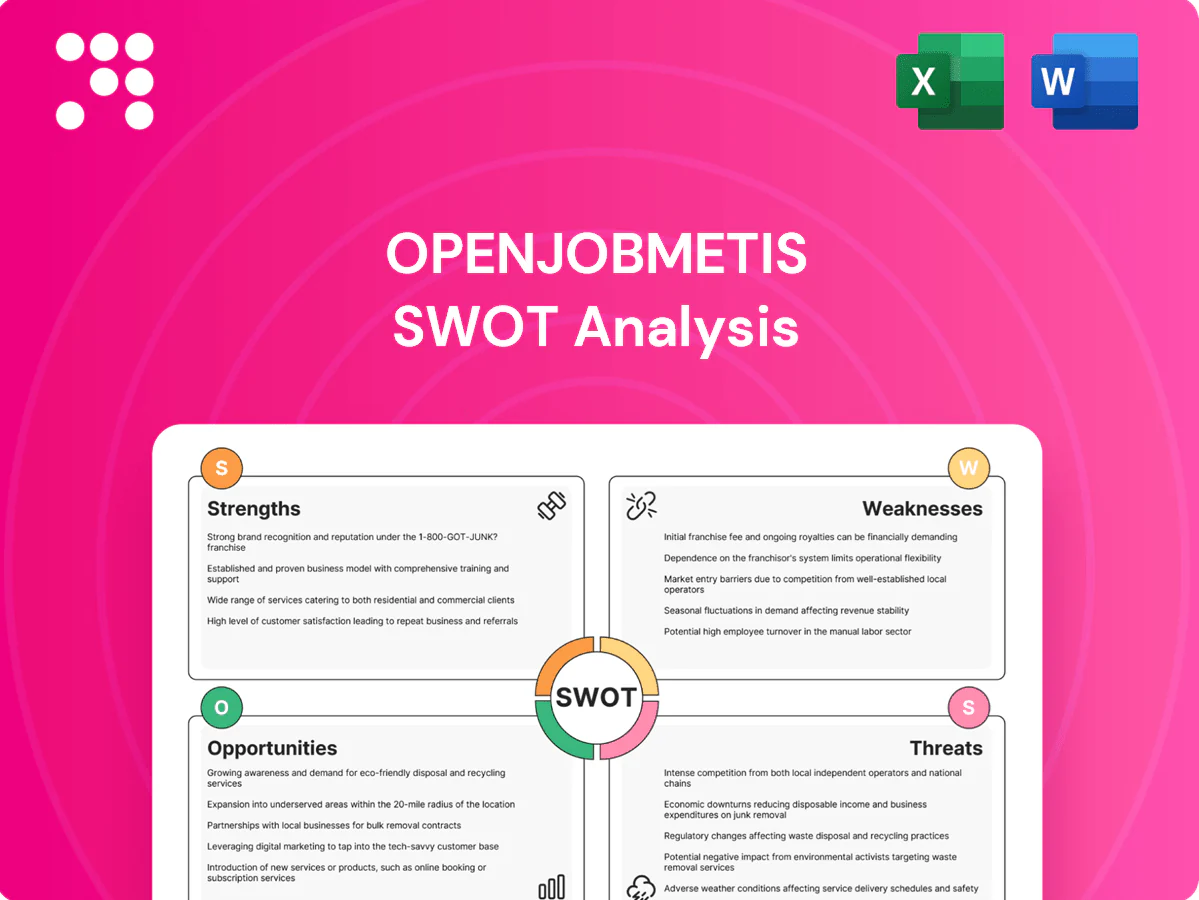
Openjobmetis SWOT Analysis
This is the actual Openjobmetis SWOT analysis document you’ll receive upon purchase—no surprises, just professional quality. The preview below is taken directly from the full report and reflects the complete, structured analysis. Buy now to unlock the editable, in-depth version ready for download.

Your Strategic Toolkit Starts Here
Openjobmetis SWOT snapshot highlights its staffing-market strengths, regulatory risks, and growth levers—ideal for quick evaluation. Purchase the full SWOT analysis to access a research-backed, investor-ready Word report plus an editable Excel matrix for strategy and pitches. Unlock detailed insights to plan, present, and invest with confidence.
Strengths
Extensive Italian branch network
Openjobmetis operates over 100 branches across Italy, giving wide physical coverage that improves local candidate sourcing and enables rapid client response. Proximity to regional markets fosters strong relationships with SMEs and large enterprises, supporting repeat business. High branch density allows sector-specific recruiters and boosts brand visibility and trust.
Diversified sector exposure
Serving manufacturing, services, retail and logistics smooths demand volatility across cycles and reduced dependency on any single sector; Italy hosted over 1 million temporary workers in 2023, underscoring market breadth. Cross-selling candidates and services across these verticals boosts placement rates and average revenue per client. This portfolio breadth supports revenue resilience versus sector-specific peers.
Full-service HR solutions
Offering temporary, permanent and HR services gives Openjobmetis a one-stop value proposition, with payroll, compliance and workforce management support reducing client operational burden. This bundled model raises switching costs and improves retention, enabling premium pricing on integrated solutions. The suite also drives cross-sell opportunities across talent segments and service tiers.
Strong compliance and regulatory know-how
Openjobmetis leverages deep compliance expertise to navigate Italy’s complex labor laws, where fixed-term and agency work still account for roughly 12% of employment (Eurostat 2024), reducing client legal exposure and administrative burden. Robust regulatory know-how differentiates it from smaller rivals less able to absorb compliance costs, cutting dispute-related downtime. This capability preserves margins by avoiding fines and contract reversals that commonly erode temporary staffing profits.
- advantage: compliance reduces client risk
- differentiator: outpaces smaller competitors
- impact: protects margins by avoiding fines/disputes
Recognized domestic brand
Recognized domestic brand: listed on Borsa Italiana (ticker OJM) and long-established in Italy, Openjobmetis' brand credibility improves trust with candidates and employers, increasing lead conversion and referral flow while helping attract senior recruiters and corporate clients; its reputation supports pricing power in core regions.
- Credibility: listed on Borsa Italiana (OJM)
- Conversion: stronger lead-to-hire rates
- Talent: attracts high-quality recruiters
- Pricing: supports premium rates in core Italian markets
Pan-Italy staffing leader: > 100 branches, > 1,000,000 temps, 12% share
Extensive network: >100 branches across Italy enables local sourcing and fast client response. Market scale: Italy had >1,000,000 temporary workers in 2023 and agency/fixed-term work ~12% of employment (Eurostat 2024). Diversified services: temporary, permanent and HR solutions raise switching costs and boost cross-sell. Public listing (Borsa Italiana, OJM) enhances credibility and pricing power.
| Metric | Value |
|---|---|
| Branches | >100 |
| Temporary workers (Italy, 2023) | >1,000,000 |
| Agency/fixed-term share (Eurostat, 2024) | ~12% |
| Listing | Borsa Italiana (OJM) |
What is included in the product
Detailed Word Document
Provides a concise SWOT analysis of Openjobmetis, highlighting internal capabilities and operational weaknesses alongside market opportunities and external threats to inform strategic decision-making.
Customizable Excel Spreadsheet
Provides a focused SWOT matrix tailored to Openjobmetis for rapid strategic clarity and stakeholder-ready slides; editable format lets teams quickly update strengths, weaknesses, opportunities and threats as staffing market conditions change.
Weaknesses
High reliance on Italian market
Openjobmetis generates virtually all of its revenue in Italy, with company disclosures in 2024 indicating near-100% domestic exposure, tying performance closely to Italian GDP and labor-market cycles. Limited international diversification increases vulnerability to domestic shocks and regional slowdowns can rapidly reduce order volumes. This concentration constrains scalability and competitiveness versus multinational staffing peers.
Low-margin, volume-driven model
Staffing typically operates on thin spreads — the temporary employment industry posts EBITDA margins commonly around 2–6%, pressuring profitability for Openjobmetis. Intense price competition in Italy has compressed gross margins in recent years, making scale efficiencies essential but hard to sustain. A 1–2 percentage-point dip in utilization or slight mispricing can materially erode earnings given the low-margin model.
Cyclical demand sensitivity
Temporary staffing volumes closely follow business confidence and hiring cycles, with Eurostat reporting a 2024 EU temporary employment rate of 11.5%, making Openjobmetis vulnerable to cyclical swings. Downturns prompt rapid assignment reductions that hit billed hours and margin. Fixed branch and staffing costs pressure earnings during slow periods. Accurate forecasting is therefore critical but inherently challenging in volatile 2024–25 markets.
Working capital intensity
Staffing model requires paying temporary workers before client invoices are collected, creating cash-flow volatility and higher short-term financing needs; in weak demand periods days sales outstanding can lengthen materially, increasing interest expenses and balance-sheet risk.
- Working capital intensive
- DSO volatility raises financing cost
- Higher interest and leverage risk
Technology and data gaps vs leaders
Global rivals deploy AI matching and self-serve tools that can cut time-to-fill by up to 30% and lift candidate engagement; Openjobmetis' lag in automation and analytics limits dynamic pricing and capacity forecasting, raising recruiter workload and aligning with industry findings that weaker tech correlates with 15-25% higher recruiter turnover.
- AI investment gap vs leaders — slower automation adoption
- Time-to-fill penalty — up to 30% slower
- Analytics shortfall — impaired pricing & capacity planning
- Operational impact — increased recruiter load, 15-25% higher turnover risk
Italy ~100% revenue; EBITDA 2-6%, hiring lag 30%
Nearly 100% Italy revenue exposure in 2024 ties results to Italian GDP; EBITDA margins remain thin at ~2–6% pressuring profitability. Temporary employment rate 11.5% (EU 2024) amplifies cyclicality; DSO volatility raises financing and leverage risk. Tech gap: time-to-fill up to 30% slower and 15–25% higher recruiter turnover versus AI-enabled peers.
| Metric | 2024/25 |
|---|---|
| Domestic revenue | ~100% |
| EBITDA margin | 2–6% |
| EU temp rate | 11.5% |
| Time-to-fill penalty | up to 30% |
| Recruiter turnover risk | 15–25% |
What You See Is What You Get
Openjobmetis SWOT Analysis
This is the actual Openjobmetis SWOT analysis document you’ll receive upon purchase—no surprises, just professional quality. The preview below is taken directly from the full report and reflects the complete, structured analysis. Buy now to unlock the editable, in-depth version ready for download.
Description
Your Strategic Toolkit Starts Here
Openjobmetis SWOT snapshot highlights its staffing-market strengths, regulatory risks, and growth levers—ideal for quick evaluation. Purchase the full SWOT analysis to access a research-backed, investor-ready Word report plus an editable Excel matrix for strategy and pitches. Unlock detailed insights to plan, present, and invest with confidence.
Strengths
Extensive Italian branch network
Openjobmetis operates over 100 branches across Italy, giving wide physical coverage that improves local candidate sourcing and enables rapid client response. Proximity to regional markets fosters strong relationships with SMEs and large enterprises, supporting repeat business. High branch density allows sector-specific recruiters and boosts brand visibility and trust.
Diversified sector exposure
Serving manufacturing, services, retail and logistics smooths demand volatility across cycles and reduced dependency on any single sector; Italy hosted over 1 million temporary workers in 2023, underscoring market breadth. Cross-selling candidates and services across these verticals boosts placement rates and average revenue per client. This portfolio breadth supports revenue resilience versus sector-specific peers.
Full-service HR solutions
Offering temporary, permanent and HR services gives Openjobmetis a one-stop value proposition, with payroll, compliance and workforce management support reducing client operational burden. This bundled model raises switching costs and improves retention, enabling premium pricing on integrated solutions. The suite also drives cross-sell opportunities across talent segments and service tiers.
Strong compliance and regulatory know-how
Openjobmetis leverages deep compliance expertise to navigate Italy’s complex labor laws, where fixed-term and agency work still account for roughly 12% of employment (Eurostat 2024), reducing client legal exposure and administrative burden. Robust regulatory know-how differentiates it from smaller rivals less able to absorb compliance costs, cutting dispute-related downtime. This capability preserves margins by avoiding fines and contract reversals that commonly erode temporary staffing profits.
- advantage: compliance reduces client risk
- differentiator: outpaces smaller competitors
- impact: protects margins by avoiding fines/disputes
Recognized domestic brand
Recognized domestic brand: listed on Borsa Italiana (ticker OJM) and long-established in Italy, Openjobmetis' brand credibility improves trust with candidates and employers, increasing lead conversion and referral flow while helping attract senior recruiters and corporate clients; its reputation supports pricing power in core regions.
- Credibility: listed on Borsa Italiana (OJM)
- Conversion: stronger lead-to-hire rates
- Talent: attracts high-quality recruiters
- Pricing: supports premium rates in core Italian markets
Pan-Italy staffing leader: > 100 branches, > 1,000,000 temps, 12% share
Extensive network: >100 branches across Italy enables local sourcing and fast client response. Market scale: Italy had >1,000,000 temporary workers in 2023 and agency/fixed-term work ~12% of employment (Eurostat 2024). Diversified services: temporary, permanent and HR solutions raise switching costs and boost cross-sell. Public listing (Borsa Italiana, OJM) enhances credibility and pricing power.
| Metric | Value |
|---|---|
| Branches | >100 |
| Temporary workers (Italy, 2023) | >1,000,000 |
| Agency/fixed-term share (Eurostat, 2024) | ~12% |
| Listing | Borsa Italiana (OJM) |
What is included in the product
Detailed Word Document
Provides a concise SWOT analysis of Openjobmetis, highlighting internal capabilities and operational weaknesses alongside market opportunities and external threats to inform strategic decision-making.
Customizable Excel Spreadsheet
Provides a focused SWOT matrix tailored to Openjobmetis for rapid strategic clarity and stakeholder-ready slides; editable format lets teams quickly update strengths, weaknesses, opportunities and threats as staffing market conditions change.
Weaknesses
High reliance on Italian market
Openjobmetis generates virtually all of its revenue in Italy, with company disclosures in 2024 indicating near-100% domestic exposure, tying performance closely to Italian GDP and labor-market cycles. Limited international diversification increases vulnerability to domestic shocks and regional slowdowns can rapidly reduce order volumes. This concentration constrains scalability and competitiveness versus multinational staffing peers.
Low-margin, volume-driven model
Staffing typically operates on thin spreads — the temporary employment industry posts EBITDA margins commonly around 2–6%, pressuring profitability for Openjobmetis. Intense price competition in Italy has compressed gross margins in recent years, making scale efficiencies essential but hard to sustain. A 1–2 percentage-point dip in utilization or slight mispricing can materially erode earnings given the low-margin model.
Cyclical demand sensitivity
Temporary staffing volumes closely follow business confidence and hiring cycles, with Eurostat reporting a 2024 EU temporary employment rate of 11.5%, making Openjobmetis vulnerable to cyclical swings. Downturns prompt rapid assignment reductions that hit billed hours and margin. Fixed branch and staffing costs pressure earnings during slow periods. Accurate forecasting is therefore critical but inherently challenging in volatile 2024–25 markets.
Working capital intensity
Staffing model requires paying temporary workers before client invoices are collected, creating cash-flow volatility and higher short-term financing needs; in weak demand periods days sales outstanding can lengthen materially, increasing interest expenses and balance-sheet risk.
- Working capital intensive
- DSO volatility raises financing cost
- Higher interest and leverage risk
Technology and data gaps vs leaders
Global rivals deploy AI matching and self-serve tools that can cut time-to-fill by up to 30% and lift candidate engagement; Openjobmetis' lag in automation and analytics limits dynamic pricing and capacity forecasting, raising recruiter workload and aligning with industry findings that weaker tech correlates with 15-25% higher recruiter turnover.
- AI investment gap vs leaders — slower automation adoption
- Time-to-fill penalty — up to 30% slower
- Analytics shortfall — impaired pricing & capacity planning
- Operational impact — increased recruiter load, 15-25% higher turnover risk
Italy ~100% revenue; EBITDA 2-6%, hiring lag 30%
Nearly 100% Italy revenue exposure in 2024 ties results to Italian GDP; EBITDA margins remain thin at ~2–6% pressuring profitability. Temporary employment rate 11.5% (EU 2024) amplifies cyclicality; DSO volatility raises financing and leverage risk. Tech gap: time-to-fill up to 30% slower and 15–25% higher recruiter turnover versus AI-enabled peers.
| Metric | 2024/25 |
|---|---|
| Domestic revenue | ~100% |
| EBITDA margin | 2–6% |
| EU temp rate | 11.5% |
| Time-to-fill penalty | up to 30% |
| Recruiter turnover risk | 15–25% |
What You See Is What You Get
Openjobmetis SWOT Analysis
This is the actual Openjobmetis SWOT analysis document you’ll receive upon purchase—no surprises, just professional quality. The preview below is taken directly from the full report and reflects the complete, structured analysis. Buy now to unlock the editable, in-depth version ready for download.











