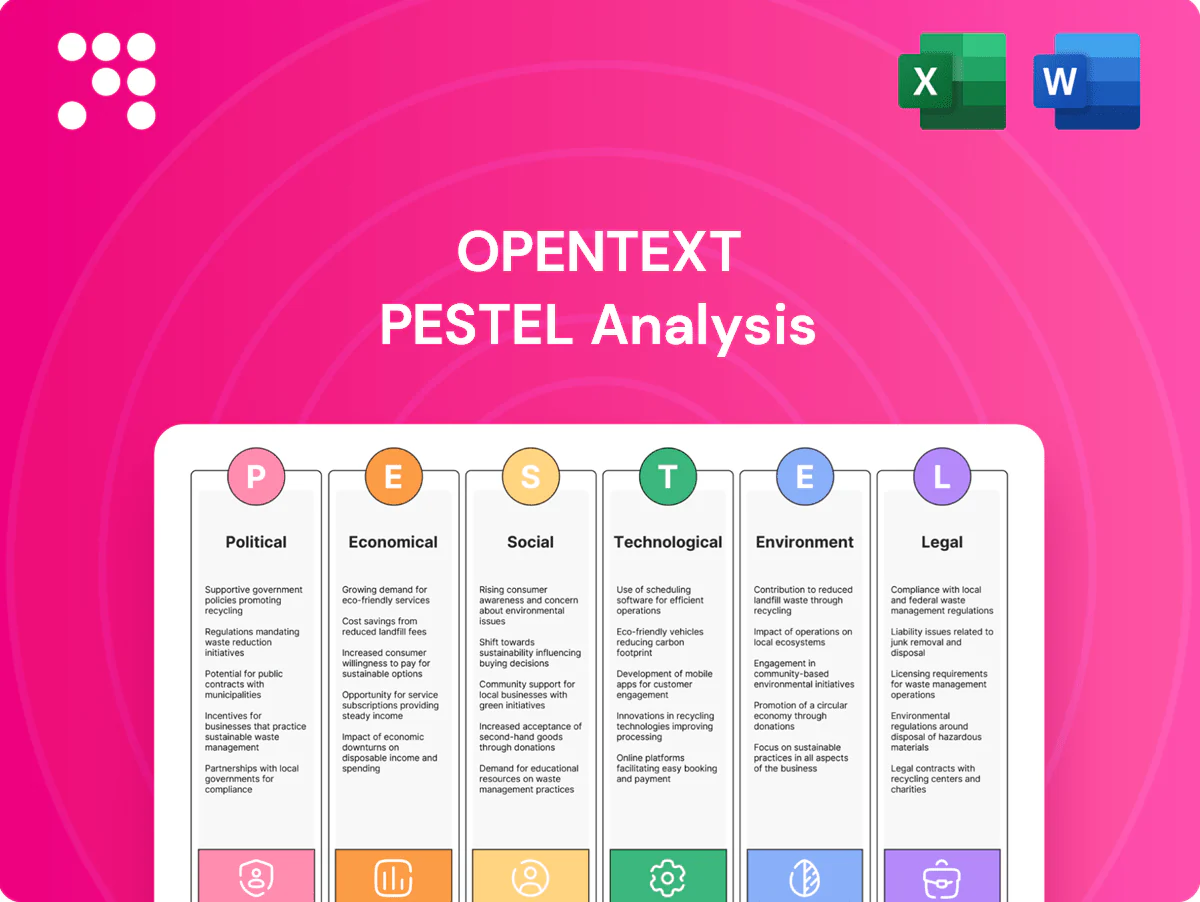
OpenText PESTLE Analysis

Make Smarter Strategic Decisions with a Complete PESTEL View
Unlock strategic clarity with our PESTLE Analysis of OpenText—three to five expert-backed sentences won’t do it justice, so get the full report to see how political, economic, and technological forces shape its future. Ideal for investors and strategists, the full version delivers actionable insights and editable files. Purchase now for immediate, board-ready intelligence.
Political factors

Data sovereignty and localization pressures
Governments increasingly mandate local data residency—notably Russia’s 2015 local storage law and China’s 2021 PIPL and Data Security Law—forcing OpenText to host and process content regionally. Compliance drives demand for region-specific clouds and managed services and adds measurable cost and architectural complexity in multi-jurisdiction deployments. Strategic data-zone architecture becomes a competitive necessity for secure, compliant offerings.
Public sector digital agendas and procurement
National and provincial modernization programs drive demand in records, security, and citizen experience, with public procurement representing about 12% of GDP in many countries, creating sizable addressable markets. Long sales cycles, certification hurdles and price sensitivity compress margins, while preferred-vendor lists and domestic-content rules can redirect awards. Strong partner ecosystems measurably improve bid competitiveness and win rates.

Geopolitics, sanctions, and export controls
Geopolitical tensions disrupt cross-border services, supply chains, and market access for OpenText, as sanctions against Russia, Belarus and others—issued by over 40 countries since 2022—limit customer segments and channel partners. Tightened US/EU export controls in 2023–24 raised licensing scrutiny for encryption, AI and cybersecurity products. Scenario planning and compliant rerouting are essential to protect revenue continuity.

Cross-border data transfer frameworks
Mechanisms such as the 2021 Standard Contractual Clauses and the 2023 EU–US Data Privacy Framework govern international data flows; sudden changes in EU adequacy rulings can force rapid re-architecting of data pipelines and contract amendments. OpenText, serving about 14,000 customers, must provide configurable data residency and end-to-end transfer safeguards; legal volatility favors vendors with mature privacy engineering and automated compliance controls.
- 2021 SCCs; 2023 EU–US DPF
- ~14,000 OpenText customers
- Configurable residency + transfer safeguards required
- Legal volatility benefits strong privacy engineering
Government incentives for AI and digital
National AI strategies and tax credits in major markets subsidize R&D and client adoption, with grant and pilot programs accelerating EIM use cases in regulated sectors such as healthcare and finance. Policy focus on cybersecurity resilience elevates demand for EIM plus security bundles as regulators tighten controls. Funding cycles commonly concentrate demand into specific fiscal windows, creating procurement spikes.
- National strategies: tax credits and grants drive R&D and adoption
- Regulated pilots: accelerate real-world EIM deployments
- Cyber resilience: boosts combined EIM+security sales
- Funding cycles: create fiscal-window procurement spikes
Data residency, procurement rules and sanctions reshape regional enterprise deployments
Governments' data residency laws (e.g., Russia 2015, China PIPL/DSL 2021) force regionally hosted OpenText deployments, raising costs and architecture complexity. Public procurement (~12% of GDP) and 14,000 customers create sizable but lumpy opportunities; certification and domestic-content rules compress margins. Sanctions by >40 countries since 2022 and 2023–24 export controls disrupt access; 2021 SCCs and 2023 EU–US DPF shape cross-border flows.
| Metric | Value |
|---|---|
| OpenText customers | ~14,000 |
| Public procurement | ~12% GDP |
| Sanctioning countries since 2022 | >40 |
What is included in the product
 Detailed Word Document
Explores how external macro-environmental factors uniquely affect OpenText across six dimensions—Political, Economic, Social, Technological, Environmental, and Legal—and links each to industry and regional dynamics.

 Customizable Excel Spreadsheet
A concise, visually segmented PESTLE summary of OpenText that can be dropped into presentations, edited with region- or business-line notes, and easily shared across teams to streamline risk discussions and strategic planning.
Economic factors

Enterprise IT spending cycles
Macro slowdowns have pushed CIOs to delay large transformations, boosting demand for ROI-proven automation; Gartner estimated global IT spending near US$4.8 trillion in 2024, tightening discretionary projects. When growth resumes, deferred spend can convert into multi-year platform deals and backlog acceleration. Heightened budget scrutiny elevates TCO and payback metrics as procurement prioritizes measurable savings. OpenText’s mix of mission-critical workloads and recurring offerings helps buffer this cyclicality.
Currency volatility and global mix
OpenText’s revenue mix is heavily weighted to USD and EUR while a significant portion of operating costs remain CAD-denominated, creating material FX translation risk; USD/CAD moved roughly 12% between Jan 2023 and Dec 2024 (Bank of Canada). Hedging programs mitigate but cannot fully neutralize large swings. Pricing and invoicing in local currencies have stabilized bookings in key regions. Diverse regional exposure reduces single-market shocks.

Shift to subscription and cloud OpEx
Clients increasingly prefer predictable OpEx over CapEx licenses, with industry data showing over 70% of enterprise software purchases were subscription-based by 2024; for OpenText this smooths recurring revenue while deferring upfront cash and recognition. SaaS land-and-expand can raise customer lifetime value, with subscription gross retention rates commonly above 90%. Rising FinOps adoption—about 80% of firms had formal cloud cost programs in 2024—forces OpenText to offer transparent usage and tight cost controls.

M&A integration and synergy realization
Large deals such as the ~US$6bn Micro Focus acquisition (2023) expand scale, cross-sell potential and predictable maintenance cash flows but bring integration risk across product overlap, support models and culture. Realizing cost synergies without impairing R&D-driven innovation is critical; clear portfolio rationalization protects customer satisfaction and recurring revenue.
- Notable deals: Micro Focus ~US$6bn (2023), Carbonite US$1.42bn (2019)
- Risks: product overlap, support-model mismatch, cultural integration
- Priority: capture synergies while safeguarding R&D and customer sat
Labor costs and inflation
Nearshore/offshore delivery can mitigate costs but increases coordination and quality control overhead; pricing power depends on mission-criticality and product differentiation, and automation of services delivery (Gartner: automation can cut delivery labor up to 30%) helps preserve margins.
- Wage inflation: US avg hourly earnings +4.1% YoY (Dec 2024, BLS)
- Mitigation: nearshore/offshore reduces direct pay costs but adds coordination
- Pricing: tied to mission-critical differentiation
- Margin defense: automation can cut delivery labor costs up to 30% (Gartner)
Data residency, procurement rules and sanctions reshape regional enterprise deployments
Macro slowdown tightened IT spend (Gartner US$4.8T 2024) delaying projects but creating backlog upside when recovery hits. FX risk high after ~12% USD/CAD swing (2023–2024, Bank of Canada); hedges help but not fully. Subscription mix >70% (2024) boosts recurring revenue; wage inflation (US avg +4.1% Dec 2024, BLS) raises ops costs. Micro Focus deal ~US$6bn (2023) adds scale and integration risk.
| Metric | Value |
|---|---|
| Global IT spend 2024 | US$4.8T |
| USD/CAD move (2023–24) | ~12% |
| Subscription share | >70% (2024) |
| US wage inflation | +4.1% (Dec 2024) |
| Major M&A | Micro Focus ~US$6bn (2023) |
Same Document Delivered
OpenText PESTLE Analysis
The preview of this OpenText PESTLE Analysis is the exact document you’ll receive after purchase—fully formatted and ready to use. The content, layout, and structure shown here are the final version with no placeholders or teasers. After payment you’ll be able to download this identical, professionally structured file immediately.

Make Smarter Strategic Decisions with a Complete PESTEL View
Unlock strategic clarity with our PESTLE Analysis of OpenText—three to five expert-backed sentences won’t do it justice, so get the full report to see how political, economic, and technological forces shape its future. Ideal for investors and strategists, the full version delivers actionable insights and editable files. Purchase now for immediate, board-ready intelligence.
Political factors
Data sovereignty and localization pressures
Governments increasingly mandate local data residency—notably Russia’s 2015 local storage law and China’s 2021 PIPL and Data Security Law—forcing OpenText to host and process content regionally. Compliance drives demand for region-specific clouds and managed services and adds measurable cost and architectural complexity in multi-jurisdiction deployments. Strategic data-zone architecture becomes a competitive necessity for secure, compliant offerings.
Public sector digital agendas and procurement
National and provincial modernization programs drive demand in records, security, and citizen experience, with public procurement representing about 12% of GDP in many countries, creating sizable addressable markets. Long sales cycles, certification hurdles and price sensitivity compress margins, while preferred-vendor lists and domestic-content rules can redirect awards. Strong partner ecosystems measurably improve bid competitiveness and win rates.
Geopolitics, sanctions, and export controls
Geopolitical tensions disrupt cross-border services, supply chains, and market access for OpenText, as sanctions against Russia, Belarus and others—issued by over 40 countries since 2022—limit customer segments and channel partners. Tightened US/EU export controls in 2023–24 raised licensing scrutiny for encryption, AI and cybersecurity products. Scenario planning and compliant rerouting are essential to protect revenue continuity.
Cross-border data transfer frameworks
Mechanisms such as the 2021 Standard Contractual Clauses and the 2023 EU–US Data Privacy Framework govern international data flows; sudden changes in EU adequacy rulings can force rapid re-architecting of data pipelines and contract amendments. OpenText, serving about 14,000 customers, must provide configurable data residency and end-to-end transfer safeguards; legal volatility favors vendors with mature privacy engineering and automated compliance controls.
- 2021 SCCs; 2023 EU–US DPF
- ~14,000 OpenText customers
- Configurable residency + transfer safeguards required
- Legal volatility benefits strong privacy engineering
Government incentives for AI and digital
National AI strategies and tax credits in major markets subsidize R&D and client adoption, with grant and pilot programs accelerating EIM use cases in regulated sectors such as healthcare and finance. Policy focus on cybersecurity resilience elevates demand for EIM plus security bundles as regulators tighten controls. Funding cycles commonly concentrate demand into specific fiscal windows, creating procurement spikes.
- National strategies: tax credits and grants drive R&D and adoption
- Regulated pilots: accelerate real-world EIM deployments
- Cyber resilience: boosts combined EIM+security sales
- Funding cycles: create fiscal-window procurement spikes
Data residency, procurement rules and sanctions reshape regional enterprise deployments
Governments' data residency laws (e.g., Russia 2015, China PIPL/DSL 2021) force regionally hosted OpenText deployments, raising costs and architecture complexity. Public procurement (~12% of GDP) and 14,000 customers create sizable but lumpy opportunities; certification and domestic-content rules compress margins. Sanctions by >40 countries since 2022 and 2023–24 export controls disrupt access; 2021 SCCs and 2023 EU–US DPF shape cross-border flows.
| Metric | Value |
|---|---|
| OpenText customers | ~14,000 |
| Public procurement | ~12% GDP |
| Sanctioning countries since 2022 | >40 |
What is included in the product
Detailed Word Document
Explores how external macro-environmental factors uniquely affect OpenText across six dimensions—Political, Economic, Social, Technological, Environmental, and Legal—and links each to industry and regional dynamics.
Customizable Excel Spreadsheet
A concise, visually segmented PESTLE summary of OpenText that can be dropped into presentations, edited with region- or business-line notes, and easily shared across teams to streamline risk discussions and strategic planning.
Economic factors
Enterprise IT spending cycles
Macro slowdowns have pushed CIOs to delay large transformations, boosting demand for ROI-proven automation; Gartner estimated global IT spending near US$4.8 trillion in 2024, tightening discretionary projects. When growth resumes, deferred spend can convert into multi-year platform deals and backlog acceleration. Heightened budget scrutiny elevates TCO and payback metrics as procurement prioritizes measurable savings. OpenText’s mix of mission-critical workloads and recurring offerings helps buffer this cyclicality.
Currency volatility and global mix
OpenText’s revenue mix is heavily weighted to USD and EUR while a significant portion of operating costs remain CAD-denominated, creating material FX translation risk; USD/CAD moved roughly 12% between Jan 2023 and Dec 2024 (Bank of Canada). Hedging programs mitigate but cannot fully neutralize large swings. Pricing and invoicing in local currencies have stabilized bookings in key regions. Diverse regional exposure reduces single-market shocks.
Shift to subscription and cloud OpEx
Clients increasingly prefer predictable OpEx over CapEx licenses, with industry data showing over 70% of enterprise software purchases were subscription-based by 2024; for OpenText this smooths recurring revenue while deferring upfront cash and recognition. SaaS land-and-expand can raise customer lifetime value, with subscription gross retention rates commonly above 90%. Rising FinOps adoption—about 80% of firms had formal cloud cost programs in 2024—forces OpenText to offer transparent usage and tight cost controls.
M&A integration and synergy realization
Large deals such as the ~US$6bn Micro Focus acquisition (2023) expand scale, cross-sell potential and predictable maintenance cash flows but bring integration risk across product overlap, support models and culture. Realizing cost synergies without impairing R&D-driven innovation is critical; clear portfolio rationalization protects customer satisfaction and recurring revenue.
- Notable deals: Micro Focus ~US$6bn (2023), Carbonite US$1.42bn (2019)
- Risks: product overlap, support-model mismatch, cultural integration
- Priority: capture synergies while safeguarding R&D and customer sat
Labor costs and inflation
Nearshore/offshore delivery can mitigate costs but increases coordination and quality control overhead; pricing power depends on mission-criticality and product differentiation, and automation of services delivery (Gartner: automation can cut delivery labor up to 30%) helps preserve margins.
- Wage inflation: US avg hourly earnings +4.1% YoY (Dec 2024, BLS)
- Mitigation: nearshore/offshore reduces direct pay costs but adds coordination
- Pricing: tied to mission-critical differentiation
- Margin defense: automation can cut delivery labor costs up to 30% (Gartner)
Data residency, procurement rules and sanctions reshape regional enterprise deployments
Macro slowdown tightened IT spend (Gartner US$4.8T 2024) delaying projects but creating backlog upside when recovery hits. FX risk high after ~12% USD/CAD swing (2023–2024, Bank of Canada); hedges help but not fully. Subscription mix >70% (2024) boosts recurring revenue; wage inflation (US avg +4.1% Dec 2024, BLS) raises ops costs. Micro Focus deal ~US$6bn (2023) adds scale and integration risk.
| Metric | Value |
|---|---|
| Global IT spend 2024 | US$4.8T |
| USD/CAD move (2023–24) | ~12% |
| Subscription share | >70% (2024) |
| US wage inflation | +4.1% (Dec 2024) |
| Major M&A | Micro Focus ~US$6bn (2023) |
Same Document Delivered
OpenText PESTLE Analysis
The preview of this OpenText PESTLE Analysis is the exact document you’ll receive after purchase—fully formatted and ready to use. The content, layout, and structure shown here are the final version with no placeholders or teasers. After payment you’ll be able to download this identical, professionally structured file immediately.
Original: $10.00
-65%$10.00
$3.50Description
Make Smarter Strategic Decisions with a Complete PESTEL View
Unlock strategic clarity with our PESTLE Analysis of OpenText—three to five expert-backed sentences won’t do it justice, so get the full report to see how political, economic, and technological forces shape its future. Ideal for investors and strategists, the full version delivers actionable insights and editable files. Purchase now for immediate, board-ready intelligence.
Political factors
Data sovereignty and localization pressures
Governments increasingly mandate local data residency—notably Russia’s 2015 local storage law and China’s 2021 PIPL and Data Security Law—forcing OpenText to host and process content regionally. Compliance drives demand for region-specific clouds and managed services and adds measurable cost and architectural complexity in multi-jurisdiction deployments. Strategic data-zone architecture becomes a competitive necessity for secure, compliant offerings.
Public sector digital agendas and procurement
National and provincial modernization programs drive demand in records, security, and citizen experience, with public procurement representing about 12% of GDP in many countries, creating sizable addressable markets. Long sales cycles, certification hurdles and price sensitivity compress margins, while preferred-vendor lists and domestic-content rules can redirect awards. Strong partner ecosystems measurably improve bid competitiveness and win rates.
Geopolitics, sanctions, and export controls
Geopolitical tensions disrupt cross-border services, supply chains, and market access for OpenText, as sanctions against Russia, Belarus and others—issued by over 40 countries since 2022—limit customer segments and channel partners. Tightened US/EU export controls in 2023–24 raised licensing scrutiny for encryption, AI and cybersecurity products. Scenario planning and compliant rerouting are essential to protect revenue continuity.
Cross-border data transfer frameworks
Mechanisms such as the 2021 Standard Contractual Clauses and the 2023 EU–US Data Privacy Framework govern international data flows; sudden changes in EU adequacy rulings can force rapid re-architecting of data pipelines and contract amendments. OpenText, serving about 14,000 customers, must provide configurable data residency and end-to-end transfer safeguards; legal volatility favors vendors with mature privacy engineering and automated compliance controls.
- 2021 SCCs; 2023 EU–US DPF
- ~14,000 OpenText customers
- Configurable residency + transfer safeguards required
- Legal volatility benefits strong privacy engineering
Government incentives for AI and digital
National AI strategies and tax credits in major markets subsidize R&D and client adoption, with grant and pilot programs accelerating EIM use cases in regulated sectors such as healthcare and finance. Policy focus on cybersecurity resilience elevates demand for EIM plus security bundles as regulators tighten controls. Funding cycles commonly concentrate demand into specific fiscal windows, creating procurement spikes.
- National strategies: tax credits and grants drive R&D and adoption
- Regulated pilots: accelerate real-world EIM deployments
- Cyber resilience: boosts combined EIM+security sales
- Funding cycles: create fiscal-window procurement spikes
Data residency, procurement rules and sanctions reshape regional enterprise deployments
Governments' data residency laws (e.g., Russia 2015, China PIPL/DSL 2021) force regionally hosted OpenText deployments, raising costs and architecture complexity. Public procurement (~12% of GDP) and 14,000 customers create sizable but lumpy opportunities; certification and domestic-content rules compress margins. Sanctions by >40 countries since 2022 and 2023–24 export controls disrupt access; 2021 SCCs and 2023 EU–US DPF shape cross-border flows.
| Metric | Value |
|---|---|
| OpenText customers | ~14,000 |
| Public procurement | ~12% GDP |
| Sanctioning countries since 2022 | >40 |
What is included in the product
Detailed Word Document
Explores how external macro-environmental factors uniquely affect OpenText across six dimensions—Political, Economic, Social, Technological, Environmental, and Legal—and links each to industry and regional dynamics.
Customizable Excel Spreadsheet
A concise, visually segmented PESTLE summary of OpenText that can be dropped into presentations, edited with region- or business-line notes, and easily shared across teams to streamline risk discussions and strategic planning.
Economic factors
Enterprise IT spending cycles
Macro slowdowns have pushed CIOs to delay large transformations, boosting demand for ROI-proven automation; Gartner estimated global IT spending near US$4.8 trillion in 2024, tightening discretionary projects. When growth resumes, deferred spend can convert into multi-year platform deals and backlog acceleration. Heightened budget scrutiny elevates TCO and payback metrics as procurement prioritizes measurable savings. OpenText’s mix of mission-critical workloads and recurring offerings helps buffer this cyclicality.
Currency volatility and global mix
OpenText’s revenue mix is heavily weighted to USD and EUR while a significant portion of operating costs remain CAD-denominated, creating material FX translation risk; USD/CAD moved roughly 12% between Jan 2023 and Dec 2024 (Bank of Canada). Hedging programs mitigate but cannot fully neutralize large swings. Pricing and invoicing in local currencies have stabilized bookings in key regions. Diverse regional exposure reduces single-market shocks.
Shift to subscription and cloud OpEx
Clients increasingly prefer predictable OpEx over CapEx licenses, with industry data showing over 70% of enterprise software purchases were subscription-based by 2024; for OpenText this smooths recurring revenue while deferring upfront cash and recognition. SaaS land-and-expand can raise customer lifetime value, with subscription gross retention rates commonly above 90%. Rising FinOps adoption—about 80% of firms had formal cloud cost programs in 2024—forces OpenText to offer transparent usage and tight cost controls.
M&A integration and synergy realization
Large deals such as the ~US$6bn Micro Focus acquisition (2023) expand scale, cross-sell potential and predictable maintenance cash flows but bring integration risk across product overlap, support models and culture. Realizing cost synergies without impairing R&D-driven innovation is critical; clear portfolio rationalization protects customer satisfaction and recurring revenue.
- Notable deals: Micro Focus ~US$6bn (2023), Carbonite US$1.42bn (2019)
- Risks: product overlap, support-model mismatch, cultural integration
- Priority: capture synergies while safeguarding R&D and customer sat
Labor costs and inflation
Nearshore/offshore delivery can mitigate costs but increases coordination and quality control overhead; pricing power depends on mission-criticality and product differentiation, and automation of services delivery (Gartner: automation can cut delivery labor up to 30%) helps preserve margins.
- Wage inflation: US avg hourly earnings +4.1% YoY (Dec 2024, BLS)
- Mitigation: nearshore/offshore reduces direct pay costs but adds coordination
- Pricing: tied to mission-critical differentiation
- Margin defense: automation can cut delivery labor costs up to 30% (Gartner)
Data residency, procurement rules and sanctions reshape regional enterprise deployments
Macro slowdown tightened IT spend (Gartner US$4.8T 2024) delaying projects but creating backlog upside when recovery hits. FX risk high after ~12% USD/CAD swing (2023–2024, Bank of Canada); hedges help but not fully. Subscription mix >70% (2024) boosts recurring revenue; wage inflation (US avg +4.1% Dec 2024, BLS) raises ops costs. Micro Focus deal ~US$6bn (2023) adds scale and integration risk.
| Metric | Value |
|---|---|
| Global IT spend 2024 | US$4.8T |
| USD/CAD move (2023–24) | ~12% |
| Subscription share | >70% (2024) |
| US wage inflation | +4.1% (Dec 2024) |
| Major M&A | Micro Focus ~US$6bn (2023) |
Same Document Delivered
OpenText PESTLE Analysis
The preview of this OpenText PESTLE Analysis is the exact document you’ll receive after purchase—fully formatted and ready to use. The content, layout, and structure shown here are the final version with no placeholders or teasers. After payment you’ll be able to download this identical, professionally structured file immediately.











