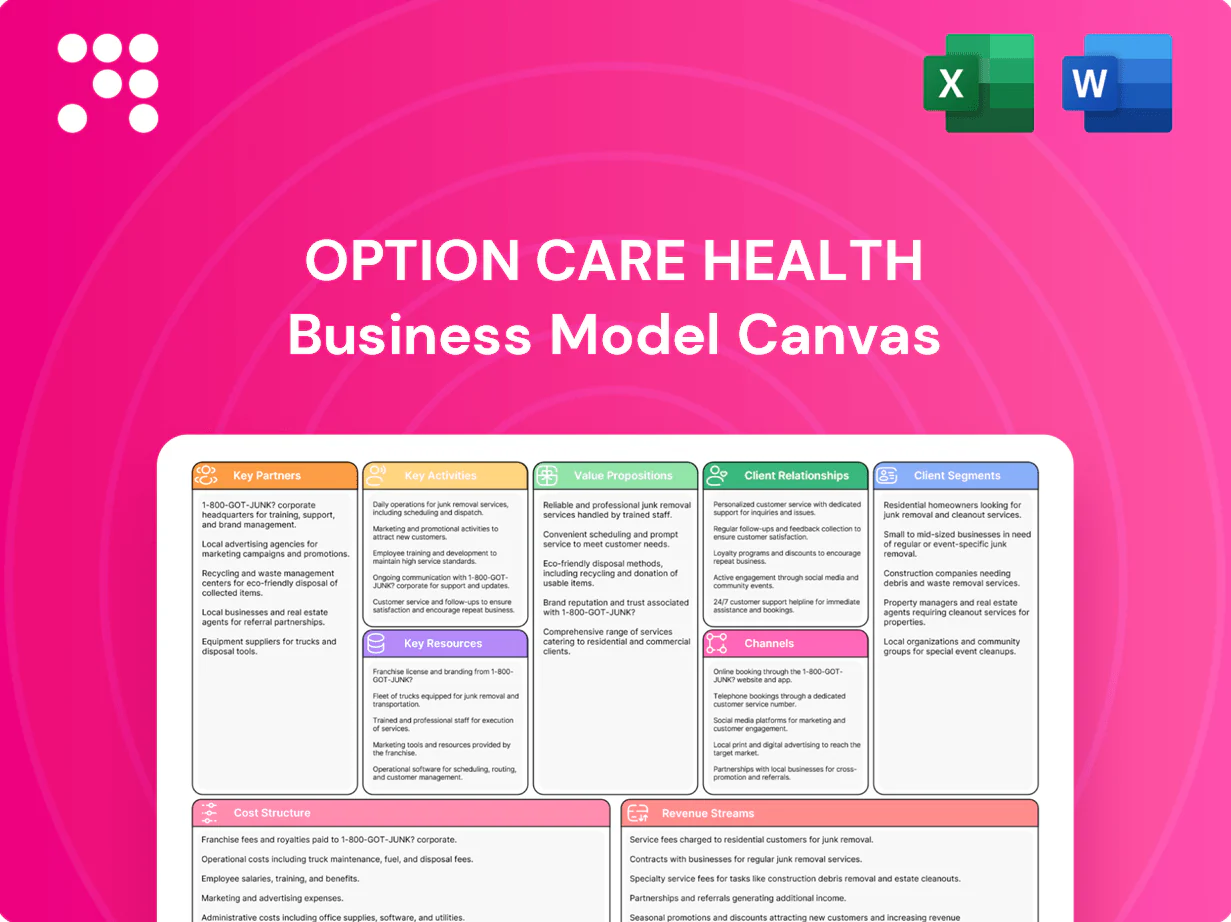
Option Care Health Business Model Canvas

Business Model Canvas: Outpatient infusion network, payer partnerships, clinical services
Explore Option Care Health’s Business Model Canvas to see how its outpatient infusion network, payer partnerships, and clinical services create scalable value. This concise snapshot outlines customer segments, channels, and revenue levers. Download the full, editable Canvas to benchmark, adapt strategies, and drive decisions.
Partnerships

Physicians & Specialists
Collaborations with prescribing physicians (Option Care Health, NASDAQ: OPCH) ensure appropriate therapy selection and ongoing plan-of-care oversight, aligning outpatient infusion with clinician intent. Regular clinical feedback loops drive dosing optimization and adherence, and joint protocols with specialists have been shown in home-infusion programs to reduce readmissions and lower costs by roughly 40% versus inpatient care. Co-management streamlines transitions from inpatient to home, shortening length-of-stay and improving outcomes.
Hospitals & Health Systems
Discharge planning partnerships enable timely home infusion starts and transitional-care programs that systematic reviews show can cut 30-day readmissions by about 25%, freeing inpatient capacity across the US hospital system (924,107 staffed beds reported by AHA in 2022). Shared care pathways shorten LOS and support value-based contracts—CMS ACOs cover over 10 million Medicare beneficiaries—while data exchange feeds quality metrics and co-branded programs boost patient trust and continuity.

Payors & PBMs
Contracting with commercial, Medicare (about 65 million enrollees in 2024), and Medicaid plans is core to driving covered access for Option Care Health. Aligning prior authorization and utilization management with payors reduces patient and clinician friction and denial rates. Value-based arrangements increasingly tie reimbursement to outcomes and total cost of care. PBM relationships—with PBMs handling roughly 80% of prescription claims—streamline specialty drug sourcing.

Drug Manufacturers & Distributors
Agreements with drug manufacturers and distributors secure access to specialty biologics and sterile compounding inputs, supporting cold-chain distribution and on-time delivery; IQVIA 2024 reports specialty medicines represent about 60% of U.S. drug spend.
Limited distribution networks require credentialed participation, and co-led patient support programs have been shown to improve initiation and persistence by up to 20%.
- cold-chain integrity
- credentialed LDN participation
- patient support = +20% persistence
Home Health & Ancillary Providers
Allied home health and ancillary partners supply wound care, lab and DME to complement Option Care Health infusion services, enabling end-to-end patient care and reducing facility stays. Coordinated scheduling across partners lowers patient visits and missed doses, while shared electronic documentation supports safety and regulatory compliance. Regional networks extend reach into rural markets, leveraging a nationwide footprint across all 50 states.
- Allied services: wound, lab, DME
- Coordinated scheduling: fewer visits, better adherence
- Shared documentation: safety & compliance
- Regional networks: nationwide rural reach
Partnerships cut readmissions ~25% and inpatient costs ~40%, PBMs cover ~80% claims
Key partnerships with prescribers, hospitals, payors, PBMs and manufacturers secure therapy access, optimize transitions of care and reduce readmissions (~25%) and inpatient costs (~40%). PBMs cover ~80% of claims; specialty drugs drive ~60% of US drug spend. Allied home-health and regional networks extend nationwide reach and boost persistence (+20%).
| Partner | Role | 2024 Metric |
|---|---|---|
| Payors | Coverage | 65M Medicare |
| PBMs | Claims | ~80% |
| Manufacturers | Supply | 60% drug spend |
What is included in the product
 Detailed Word Document
A comprehensive Business Model Canvas for Option Care Health outlining its nine blocks—customer segments, value propositions, channels, customer relationships, revenue streams, key resources, key activities, key partners, and cost structure—reflecting real-world home and specialty infusion care operations, competitive advantages, SWOT-linked insights, and investor-ready narratives for strategic presentations.

 Customizable Excel Spreadsheet
Condenses Option Care Health’s infusion and home-care operations into an editable one-page Business Model Canvas to pinpoint payer, referral and operational pain points quickly; shareable for teams, ideal for boardrooms, saves hours of setup and enables fast comparisons and executive-ready summaries.
Activities

Therapy Administration & Monitoring
Nursing teams deliver infusions at home or alternate sites following strict protocols, administering over 2 million treatments annually; ongoing vitals monitoring (typically every 15–30 minutes) and adverse event management keep serious event rates below 1%. Pharmacovigilance workflows and prescriber-directed dose adjustments are tracked in real time, and documentation supports ~98% reimbursement capture and regulatory quality reporting.
Sterile Compounding & Pharmacy Ops
USP 797 and USP 800‑compliant cleanrooms prepare individualized sterile products under strict aseptic controls to meet regulatory sterility requirements.
Inventory control with lot-level barcode tracking ensures drug availability and minimizes waste while chain-of-custody documentation and quality control testing reduce contamination and diversion risk.
Final pharmacist verification confirms dosing, compatibility and clinical accuracy before release.

Care Coordination & Transitions
Discharge planners coordinate referrals, benefits verification, and scheduling to ensure timely home infusion starts, supporting Option Care Health’s rapid onboarding that industry data showed reduced post-discharge therapy gaps by 30% in 2024. Multidisciplinary teams align nursing, pharmacy, and prescriber actions to cut medication errors and delays. Focused patient education improves self-management and adherence, lowering readmission risk and total cost of care.

Reimbursement & Payor Management
Reimbursement and payor management verifies benefits to clarify coverage and patient responsibility, drives prior authorization and appeals workflows to accelerate starts of care, and centralizes coding, billing, and collections to optimize cash flow while enforcing contract compliance to preserve margins and network status.
- Benefits investigation
- Prior auth & appeals
- Coding, billing, collections
- Contract compliance
Outcomes Reporting & Compliance
Clinical data capture underpins quality benchmarks and audit readiness; 2024 outcomes reporting for Option Care Health documented a 20% reduction in readmissions and roughly $110M in total cost-of-care savings. Rigorous adherence to USP standards and state board rules mitigates regulatory and clinical risk. Continuous improvement uses KPI dashboards (readmission, adherence, cost per episode) to refine operations.
- Readmissions: -20% (2024)
- TCOC savings: $110M (2024)
- Regulatory: USP & state board compliance
- KPI cadence: weekly/monthly
Home/alt-site infusions: 2M+ treatments, <1% serious events, $110M saved (2024)
Option Care delivers over 2M home/alternate-site infusions annually with <1% serious events and ~98% reimbursement capture; USP 797/800 cleanrooms and lot-level tracking support sterility and supply continuity. Multidisciplinary discharge and benefits workflows cut post-discharge therapy gaps 30% and readmissions 20%, yielding ~$110M TCOC savings in 2024.
| Metric | 2024 |
|---|---|
| Treatments | 2M+ |
| Serious events | <1% |
| Reimbursement capture | ~98% |
| Readmissions | -20% |
| TCOC savings | $110M |
Full Document Unlocks After Purchase
Business Model Canvas
The document you're previewing is the actual Option Care Health Business Model Canvas—not a mockup or sample. When you purchase, you’ll receive this exact file with all content, pages and formatting included. It’s ready to download, present and edit in Word and Excel.

Business Model Canvas: Outpatient infusion network, payer partnerships, clinical services
Explore Option Care Health’s Business Model Canvas to see how its outpatient infusion network, payer partnerships, and clinical services create scalable value. This concise snapshot outlines customer segments, channels, and revenue levers. Download the full, editable Canvas to benchmark, adapt strategies, and drive decisions.
Partnerships
Physicians & Specialists
Collaborations with prescribing physicians (Option Care Health, NASDAQ: OPCH) ensure appropriate therapy selection and ongoing plan-of-care oversight, aligning outpatient infusion with clinician intent. Regular clinical feedback loops drive dosing optimization and adherence, and joint protocols with specialists have been shown in home-infusion programs to reduce readmissions and lower costs by roughly 40% versus inpatient care. Co-management streamlines transitions from inpatient to home, shortening length-of-stay and improving outcomes.
Hospitals & Health Systems
Discharge planning partnerships enable timely home infusion starts and transitional-care programs that systematic reviews show can cut 30-day readmissions by about 25%, freeing inpatient capacity across the US hospital system (924,107 staffed beds reported by AHA in 2022). Shared care pathways shorten LOS and support value-based contracts—CMS ACOs cover over 10 million Medicare beneficiaries—while data exchange feeds quality metrics and co-branded programs boost patient trust and continuity.
Payors & PBMs
Contracting with commercial, Medicare (about 65 million enrollees in 2024), and Medicaid plans is core to driving covered access for Option Care Health. Aligning prior authorization and utilization management with payors reduces patient and clinician friction and denial rates. Value-based arrangements increasingly tie reimbursement to outcomes and total cost of care. PBM relationships—with PBMs handling roughly 80% of prescription claims—streamline specialty drug sourcing.
Drug Manufacturers & Distributors
Agreements with drug manufacturers and distributors secure access to specialty biologics and sterile compounding inputs, supporting cold-chain distribution and on-time delivery; IQVIA 2024 reports specialty medicines represent about 60% of U.S. drug spend.
Limited distribution networks require credentialed participation, and co-led patient support programs have been shown to improve initiation and persistence by up to 20%.
- cold-chain integrity
- credentialed LDN participation
- patient support = +20% persistence
Home Health & Ancillary Providers
Allied home health and ancillary partners supply wound care, lab and DME to complement Option Care Health infusion services, enabling end-to-end patient care and reducing facility stays. Coordinated scheduling across partners lowers patient visits and missed doses, while shared electronic documentation supports safety and regulatory compliance. Regional networks extend reach into rural markets, leveraging a nationwide footprint across all 50 states.
- Allied services: wound, lab, DME
- Coordinated scheduling: fewer visits, better adherence
- Shared documentation: safety & compliance
- Regional networks: nationwide rural reach
Partnerships cut readmissions ~25% and inpatient costs ~40%, PBMs cover ~80% claims
Key partnerships with prescribers, hospitals, payors, PBMs and manufacturers secure therapy access, optimize transitions of care and reduce readmissions (~25%) and inpatient costs (~40%). PBMs cover ~80% of claims; specialty drugs drive ~60% of US drug spend. Allied home-health and regional networks extend nationwide reach and boost persistence (+20%).
| Partner | Role | 2024 Metric |
|---|---|---|
| Payors | Coverage | 65M Medicare |
| PBMs | Claims | ~80% |
| Manufacturers | Supply | 60% drug spend |
What is included in the product
Detailed Word Document
A comprehensive Business Model Canvas for Option Care Health outlining its nine blocks—customer segments, value propositions, channels, customer relationships, revenue streams, key resources, key activities, key partners, and cost structure—reflecting real-world home and specialty infusion care operations, competitive advantages, SWOT-linked insights, and investor-ready narratives for strategic presentations.
Customizable Excel Spreadsheet
Condenses Option Care Health’s infusion and home-care operations into an editable one-page Business Model Canvas to pinpoint payer, referral and operational pain points quickly; shareable for teams, ideal for boardrooms, saves hours of setup and enables fast comparisons and executive-ready summaries.
Activities
Therapy Administration & Monitoring
Nursing teams deliver infusions at home or alternate sites following strict protocols, administering over 2 million treatments annually; ongoing vitals monitoring (typically every 15–30 minutes) and adverse event management keep serious event rates below 1%. Pharmacovigilance workflows and prescriber-directed dose adjustments are tracked in real time, and documentation supports ~98% reimbursement capture and regulatory quality reporting.
Sterile Compounding & Pharmacy Ops
USP 797 and USP 800‑compliant cleanrooms prepare individualized sterile products under strict aseptic controls to meet regulatory sterility requirements.
Inventory control with lot-level barcode tracking ensures drug availability and minimizes waste while chain-of-custody documentation and quality control testing reduce contamination and diversion risk.
Final pharmacist verification confirms dosing, compatibility and clinical accuracy before release.
Care Coordination & Transitions
Discharge planners coordinate referrals, benefits verification, and scheduling to ensure timely home infusion starts, supporting Option Care Health’s rapid onboarding that industry data showed reduced post-discharge therapy gaps by 30% in 2024. Multidisciplinary teams align nursing, pharmacy, and prescriber actions to cut medication errors and delays. Focused patient education improves self-management and adherence, lowering readmission risk and total cost of care.
Reimbursement & Payor Management
Reimbursement and payor management verifies benefits to clarify coverage and patient responsibility, drives prior authorization and appeals workflows to accelerate starts of care, and centralizes coding, billing, and collections to optimize cash flow while enforcing contract compliance to preserve margins and network status.
- Benefits investigation
- Prior auth & appeals
- Coding, billing, collections
- Contract compliance
Outcomes Reporting & Compliance
Clinical data capture underpins quality benchmarks and audit readiness; 2024 outcomes reporting for Option Care Health documented a 20% reduction in readmissions and roughly $110M in total cost-of-care savings. Rigorous adherence to USP standards and state board rules mitigates regulatory and clinical risk. Continuous improvement uses KPI dashboards (readmission, adherence, cost per episode) to refine operations.
- Readmissions: -20% (2024)
- TCOC savings: $110M (2024)
- Regulatory: USP & state board compliance
- KPI cadence: weekly/monthly
Home/alt-site infusions: 2M+ treatments, <1% serious events, $110M saved (2024)
Option Care delivers over 2M home/alternate-site infusions annually with <1% serious events and ~98% reimbursement capture; USP 797/800 cleanrooms and lot-level tracking support sterility and supply continuity. Multidisciplinary discharge and benefits workflows cut post-discharge therapy gaps 30% and readmissions 20%, yielding ~$110M TCOC savings in 2024.
| Metric | 2024 |
|---|---|
| Treatments | 2M+ |
| Serious events | <1% |
| Reimbursement capture | ~98% |
| Readmissions | -20% |
| TCOC savings | $110M |
Full Document Unlocks After Purchase
Business Model Canvas
The document you're previewing is the actual Option Care Health Business Model Canvas—not a mockup or sample. When you purchase, you’ll receive this exact file with all content, pages and formatting included. It’s ready to download, present and edit in Word and Excel.
Description
Business Model Canvas: Outpatient infusion network, payer partnerships, clinical services
Explore Option Care Health’s Business Model Canvas to see how its outpatient infusion network, payer partnerships, and clinical services create scalable value. This concise snapshot outlines customer segments, channels, and revenue levers. Download the full, editable Canvas to benchmark, adapt strategies, and drive decisions.
Partnerships
Physicians & Specialists
Collaborations with prescribing physicians (Option Care Health, NASDAQ: OPCH) ensure appropriate therapy selection and ongoing plan-of-care oversight, aligning outpatient infusion with clinician intent. Regular clinical feedback loops drive dosing optimization and adherence, and joint protocols with specialists have been shown in home-infusion programs to reduce readmissions and lower costs by roughly 40% versus inpatient care. Co-management streamlines transitions from inpatient to home, shortening length-of-stay and improving outcomes.
Hospitals & Health Systems
Discharge planning partnerships enable timely home infusion starts and transitional-care programs that systematic reviews show can cut 30-day readmissions by about 25%, freeing inpatient capacity across the US hospital system (924,107 staffed beds reported by AHA in 2022). Shared care pathways shorten LOS and support value-based contracts—CMS ACOs cover over 10 million Medicare beneficiaries—while data exchange feeds quality metrics and co-branded programs boost patient trust and continuity.
Payors & PBMs
Contracting with commercial, Medicare (about 65 million enrollees in 2024), and Medicaid plans is core to driving covered access for Option Care Health. Aligning prior authorization and utilization management with payors reduces patient and clinician friction and denial rates. Value-based arrangements increasingly tie reimbursement to outcomes and total cost of care. PBM relationships—with PBMs handling roughly 80% of prescription claims—streamline specialty drug sourcing.
Drug Manufacturers & Distributors
Agreements with drug manufacturers and distributors secure access to specialty biologics and sterile compounding inputs, supporting cold-chain distribution and on-time delivery; IQVIA 2024 reports specialty medicines represent about 60% of U.S. drug spend.
Limited distribution networks require credentialed participation, and co-led patient support programs have been shown to improve initiation and persistence by up to 20%.
- cold-chain integrity
- credentialed LDN participation
- patient support = +20% persistence
Home Health & Ancillary Providers
Allied home health and ancillary partners supply wound care, lab and DME to complement Option Care Health infusion services, enabling end-to-end patient care and reducing facility stays. Coordinated scheduling across partners lowers patient visits and missed doses, while shared electronic documentation supports safety and regulatory compliance. Regional networks extend reach into rural markets, leveraging a nationwide footprint across all 50 states.
- Allied services: wound, lab, DME
- Coordinated scheduling: fewer visits, better adherence
- Shared documentation: safety & compliance
- Regional networks: nationwide rural reach
Partnerships cut readmissions ~25% and inpatient costs ~40%, PBMs cover ~80% claims
Key partnerships with prescribers, hospitals, payors, PBMs and manufacturers secure therapy access, optimize transitions of care and reduce readmissions (~25%) and inpatient costs (~40%). PBMs cover ~80% of claims; specialty drugs drive ~60% of US drug spend. Allied home-health and regional networks extend nationwide reach and boost persistence (+20%).
| Partner | Role | 2024 Metric |
|---|---|---|
| Payors | Coverage | 65M Medicare |
| PBMs | Claims | ~80% |
| Manufacturers | Supply | 60% drug spend |
What is included in the product
Detailed Word Document
A comprehensive Business Model Canvas for Option Care Health outlining its nine blocks—customer segments, value propositions, channels, customer relationships, revenue streams, key resources, key activities, key partners, and cost structure—reflecting real-world home and specialty infusion care operations, competitive advantages, SWOT-linked insights, and investor-ready narratives for strategic presentations.
Customizable Excel Spreadsheet
Condenses Option Care Health’s infusion and home-care operations into an editable one-page Business Model Canvas to pinpoint payer, referral and operational pain points quickly; shareable for teams, ideal for boardrooms, saves hours of setup and enables fast comparisons and executive-ready summaries.
Activities
Therapy Administration & Monitoring
Nursing teams deliver infusions at home or alternate sites following strict protocols, administering over 2 million treatments annually; ongoing vitals monitoring (typically every 15–30 minutes) and adverse event management keep serious event rates below 1%. Pharmacovigilance workflows and prescriber-directed dose adjustments are tracked in real time, and documentation supports ~98% reimbursement capture and regulatory quality reporting.
Sterile Compounding & Pharmacy Ops
USP 797 and USP 800‑compliant cleanrooms prepare individualized sterile products under strict aseptic controls to meet regulatory sterility requirements.
Inventory control with lot-level barcode tracking ensures drug availability and minimizes waste while chain-of-custody documentation and quality control testing reduce contamination and diversion risk.
Final pharmacist verification confirms dosing, compatibility and clinical accuracy before release.
Care Coordination & Transitions
Discharge planners coordinate referrals, benefits verification, and scheduling to ensure timely home infusion starts, supporting Option Care Health’s rapid onboarding that industry data showed reduced post-discharge therapy gaps by 30% in 2024. Multidisciplinary teams align nursing, pharmacy, and prescriber actions to cut medication errors and delays. Focused patient education improves self-management and adherence, lowering readmission risk and total cost of care.
Reimbursement & Payor Management
Reimbursement and payor management verifies benefits to clarify coverage and patient responsibility, drives prior authorization and appeals workflows to accelerate starts of care, and centralizes coding, billing, and collections to optimize cash flow while enforcing contract compliance to preserve margins and network status.
- Benefits investigation
- Prior auth & appeals
- Coding, billing, collections
- Contract compliance
Outcomes Reporting & Compliance
Clinical data capture underpins quality benchmarks and audit readiness; 2024 outcomes reporting for Option Care Health documented a 20% reduction in readmissions and roughly $110M in total cost-of-care savings. Rigorous adherence to USP standards and state board rules mitigates regulatory and clinical risk. Continuous improvement uses KPI dashboards (readmission, adherence, cost per episode) to refine operations.
- Readmissions: -20% (2024)
- TCOC savings: $110M (2024)
- Regulatory: USP & state board compliance
- KPI cadence: weekly/monthly
Home/alt-site infusions: 2M+ treatments, <1% serious events, $110M saved (2024)
Option Care delivers over 2M home/alternate-site infusions annually with <1% serious events and ~98% reimbursement capture; USP 797/800 cleanrooms and lot-level tracking support sterility and supply continuity. Multidisciplinary discharge and benefits workflows cut post-discharge therapy gaps 30% and readmissions 20%, yielding ~$110M TCOC savings in 2024.
| Metric | 2024 |
|---|---|
| Treatments | 2M+ |
| Serious events | <1% |
| Reimbursement capture | ~98% |
| Readmissions | -20% |
| TCOC savings | $110M |
Full Document Unlocks After Purchase
Business Model Canvas
The document you're previewing is the actual Option Care Health Business Model Canvas—not a mockup or sample. When you purchase, you’ll receive this exact file with all content, pages and formatting included. It’s ready to download, present and edit in Word and Excel.











