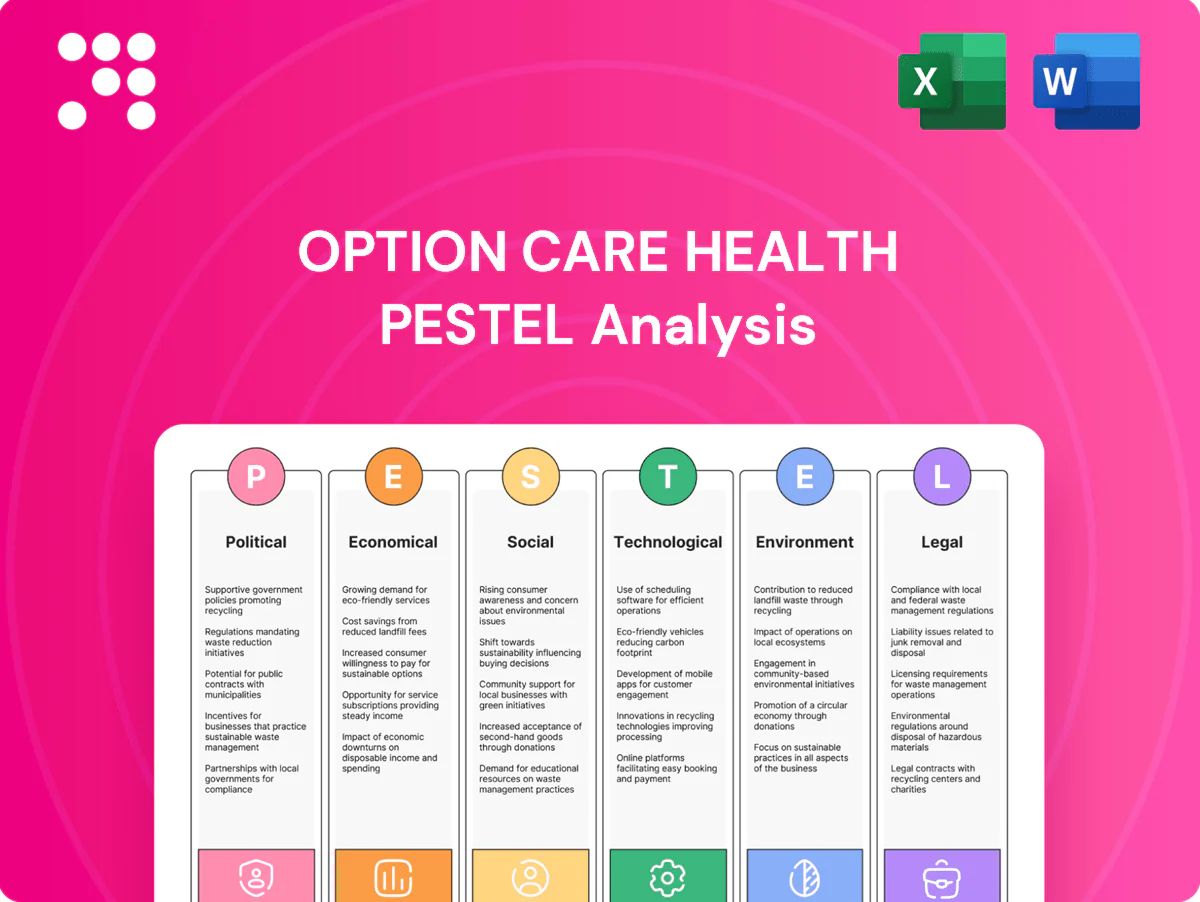
Option Care Health PESTLE Analysis

Make Smarter Strategic Decisions with a Complete PESTEL View
Explore how regulatory shifts, reimbursement dynamics, and emerging healthcare technologies are shaping Option Care Health’s strategic outlook in our concise PESTLE snapshot. Ideal for investors and strategists, this briefing highlights key risks and growth levers. Purchase the full PESTLE for actionable, exportable insights and immediate download.
Political factors

Medicare and Medicaid policy direction
Public payer policies set reimbursement for home infusion drugs, supplies and nursing; Medicare and Medicaid together account for roughly 40% of US health spending (CMS NHE 2022). Shifts in CMS rules on home infusion services, DME and Part B vs Part D coverage can materially alter OCH margins. State Medicaid expansions and 2024 waiver activity are expanding alternate-site funding. Political appetite for home-based care is accelerating site-of-care shifts.
Healthcare reform and value-based agendas
Bi-partisan cost-containment and outcomes focus favors home and alternate-site infusion, as CMS and private payers expand value-based purchasing and bundled payments that can reward lower-cost, high-quality infusion care. CMMI, which has tested more than 50 alternative payment models since 2010, continued new pilots in 2024 that may open hospital-to-home referral channels. Sudden CMS program or rule changes in 2024 have produced measurable revenue volatility across the infusion sector.

Drug pricing and specialty pharmacy scrutiny
Legislative efforts like the Inflation Reduction Act, which enables Medicare price negotiations starting in 2026, and ongoing congressional PBM probes drive lower acquisition costs and tighter reimbursement spreads for Option Care Health; specialty drugs now represent ≈50% of US drug spend, so negotiated cuts and rebate reforms can materially compress margins on infusion biologics, reshape formulary access and reduce patient affordability.

Workforce and immigration policy
Nursing and pharmacist supply for Option Care Health hinges on immigration and licensing reciprocity: H-1B cap remains 85,000 (FY2025) and the Nurse Licensure Compact covers 39 states (2025), shaping staffing flexibility; tight 2024 labor markets lifted average hourly earnings about 4.1% (BLS), raising wage pressure and risking service capacity; targeted workforce development grants can offset home care clinician shortfalls.
- H-1B cap 85,000 (FY2025)
- Nurse Licensure Compact 39 states (2025)
- Avg hourly earnings +4.1% (2024, BLS)
- Workforce grants mitigate home care clinician shortages
Emergency preparedness and public health funding
Federal and state investments—including the ARP’s $12.7 billion HCBS boost—have expanded home-care readiness and infrastructure for pandemics and disasters. Telehealth and emergency home-service waivers used during the PHE broadened access and face legislative moves toward permanence. Stockpiling and distribution programs (eg, SNS logistics) directly affect infusion drug availability; ongoing bipartisan funding is critical.
- ARP $12.7B HCBS funding
- Telehealth waivers → potential permanent policy
- Stockpile/distribution affect infusion supply
- Reliant on bipartisan budgetary support
CMS rules, Medicare drug negotiation and H-1B caps tighten home infusion margins
Medicare/Medicaid ≈40% of US health spend (CMS NHE 2022) so CMS rule shifts on home infusion materially affect OCH margins. IRA-driven Medicare drug negotiation (starts 2026) and PBM reforms tighten reimbursement on specialty biologics (~50% drug spend). Workforce constraints: H-1B cap 85,000 FY2025; Nurse Licensure Compact 39 states (2025).
| Factor | Key data |
|---|---|
| Payer share | Medicare/Medicaid ≈40% |
| Drug spend | Specialty ≈50% |
| Workforce | H-1B 85,000; NLC 39 states |
What is included in the product
 Detailed Word Document
Explores how macro-environmental forces across Political, Economic, Social, Technological, Environmental, and Legal dimensions uniquely affect Option Care Health, providing data-backed insights into regulatory shifts, reimbursement trends, patient demographics, digital care innovation, sustainability pressures, and compliance risks; tailored for executives and investors to spot opportunities, mitigate threats, and inform strategic planning.

 Customizable Excel Spreadsheet
A concise, visually segmented PESTLE summary for Option Care Health that clarifies regulatory, reimbursement, and technological risks and opportunities—ideal for quick inclusion in presentations or team briefings to streamline decision-making and reduce analysis time.
Economic factors

Reimbursement rates and payer mix
Profitability hinges on negotiated commercial payer rates versus lower government program rates, with Medicare/Medicaid often paying 20–40% less than commercial contracts. A shift toward Medicare/Medicaid can lower average revenue per case while boosting volume and utilization. Contracting leverage for Option Care Health rests on demonstrated clinical outcomes and the companys national network breadth. Rate compression (~3–5% annual pressure industry-wide) remains an ongoing structural headwind.
Specialty drug cost inflation
Rising prices for biologics and sterile injectables elevate Option Care Healths working capital needs and credit exposure as inventory cost per patient climbs. These cost trends pressure patient adherence and increase demand for copay assistance, with specialty medicines accounting for over 50% of U.S. drug spend in 2023–24 (IQVIA). Procurement scale and sourcing strategies become critical to margin stability. Volatility in prices undermines forecasting and cash flow.

Hospital discharge and site-of-care shifts
Health systems are shifting appropriate infusions to lower-cost outpatient and home settings to reduce total cost of care, supporting Option Care Health’s referral pipeline as the US home infusion market reached about $38 billion in 2024. Growth in outpatient and home settings has materially increased referral volumes, while value-based incentives—ACOs covering over 12 million Medicare beneficiaries in 2024—align with home infusion adoption. Cyclical downturns can still delay elective therapies and compress volumes.

Labor costs and productivity
Nursing shortages drive higher wages, overtime, and travel-nurse costs (RN median wage $82,750, BLS May 2023; travel RN pay often $2,000–3,500/week in 2023 reports), pressuring Option Care Health margins.
Route optimization, scheduling tech, and remote monitoring can offset cost pressure; retention and training cut turnover and onboarding expense, improving labor productivity.
Inflation (US CPI ~3.4% in 2024) compresses SG&A leverage unless revenue or efficiency gains outpace rising labor costs.
- Labor-cost inflation
- Travel-nurse premium
- Route/scheduling ROI
- Retention saves onboarding
- Inflation hits SG&A
Capital intensity and supply chain
Capital-intensive needs for cold-chain logistics, infusion pumps and sterile compounding drive recurring capex for Option Care Health and peers, while FDA maintained an active drug-shortage list with over 100 entries in 2024, forcing spot buys at premiums; economies of scale from pharmacy and distribution hubs improve unit economics, and higher borrowing costs matter with US policy rates at 5.25–5.50% in mid-2025.
- Cold-chain and pumps: ongoing capex
- Drug/disposables shortages: spot buys, higher prices
- Scale benefits: lower unit costs via hubs
- Interest rates: 5.25–5.50% raises expansion costs
CMS rules, Medicare drug negotiation and H-1B caps tighten home infusion margins
Reimbursement mix drives margins as Medicare/Medicaid pay ~20–40% less than commercial; home infusion market ~$38B (2024) boosts volume; specialty drugs >50% of US drug spend (2023–24) raising working capital; rates at 5.25–5.50% (mid‑2025) and inflation ~3.4% (2024) increase capex and SG&A pressure.
| Metric | Value |
|---|---|
| Home infusion market | $38B (2024) |
| Specialty drug spend | >50% (2023–24) |
| Policy rates | 5.25–5.50% (mid‑2025) |
| CPI | ~3.4% (2024) |
Preview the Actual Deliverable
Option Care Health PESTLE Analysis
The preview shown here is the exact Option Care Health PESTLE Analysis you’ll receive after purchase—fully formatted and ready to use. The content, layout, and structure visible are the final version with no placeholders or teasers. After checkout you’ll instantly download this same professionally structured file. What you see is exactly what you’ll get.

Make Smarter Strategic Decisions with a Complete PESTEL View
Explore how regulatory shifts, reimbursement dynamics, and emerging healthcare technologies are shaping Option Care Health’s strategic outlook in our concise PESTLE snapshot. Ideal for investors and strategists, this briefing highlights key risks and growth levers. Purchase the full PESTLE for actionable, exportable insights and immediate download.
Political factors
Medicare and Medicaid policy direction
Public payer policies set reimbursement for home infusion drugs, supplies and nursing; Medicare and Medicaid together account for roughly 40% of US health spending (CMS NHE 2022). Shifts in CMS rules on home infusion services, DME and Part B vs Part D coverage can materially alter OCH margins. State Medicaid expansions and 2024 waiver activity are expanding alternate-site funding. Political appetite for home-based care is accelerating site-of-care shifts.
Healthcare reform and value-based agendas
Bi-partisan cost-containment and outcomes focus favors home and alternate-site infusion, as CMS and private payers expand value-based purchasing and bundled payments that can reward lower-cost, high-quality infusion care. CMMI, which has tested more than 50 alternative payment models since 2010, continued new pilots in 2024 that may open hospital-to-home referral channels. Sudden CMS program or rule changes in 2024 have produced measurable revenue volatility across the infusion sector.
Drug pricing and specialty pharmacy scrutiny
Legislative efforts like the Inflation Reduction Act, which enables Medicare price negotiations starting in 2026, and ongoing congressional PBM probes drive lower acquisition costs and tighter reimbursement spreads for Option Care Health; specialty drugs now represent ≈50% of US drug spend, so negotiated cuts and rebate reforms can materially compress margins on infusion biologics, reshape formulary access and reduce patient affordability.
Workforce and immigration policy
Nursing and pharmacist supply for Option Care Health hinges on immigration and licensing reciprocity: H-1B cap remains 85,000 (FY2025) and the Nurse Licensure Compact covers 39 states (2025), shaping staffing flexibility; tight 2024 labor markets lifted average hourly earnings about 4.1% (BLS), raising wage pressure and risking service capacity; targeted workforce development grants can offset home care clinician shortfalls.
- H-1B cap 85,000 (FY2025)
- Nurse Licensure Compact 39 states (2025)
- Avg hourly earnings +4.1% (2024, BLS)
- Workforce grants mitigate home care clinician shortages
Emergency preparedness and public health funding
Federal and state investments—including the ARP’s $12.7 billion HCBS boost—have expanded home-care readiness and infrastructure for pandemics and disasters. Telehealth and emergency home-service waivers used during the PHE broadened access and face legislative moves toward permanence. Stockpiling and distribution programs (eg, SNS logistics) directly affect infusion drug availability; ongoing bipartisan funding is critical.
- ARP $12.7B HCBS funding
- Telehealth waivers → potential permanent policy
- Stockpile/distribution affect infusion supply
- Reliant on bipartisan budgetary support
CMS rules, Medicare drug negotiation and H-1B caps tighten home infusion margins
Medicare/Medicaid ≈40% of US health spend (CMS NHE 2022) so CMS rule shifts on home infusion materially affect OCH margins. IRA-driven Medicare drug negotiation (starts 2026) and PBM reforms tighten reimbursement on specialty biologics (~50% drug spend). Workforce constraints: H-1B cap 85,000 FY2025; Nurse Licensure Compact 39 states (2025).
| Factor | Key data |
|---|---|
| Payer share | Medicare/Medicaid ≈40% |
| Drug spend | Specialty ≈50% |
| Workforce | H-1B 85,000; NLC 39 states |
What is included in the product
Detailed Word Document
Explores how macro-environmental forces across Political, Economic, Social, Technological, Environmental, and Legal dimensions uniquely affect Option Care Health, providing data-backed insights into regulatory shifts, reimbursement trends, patient demographics, digital care innovation, sustainability pressures, and compliance risks; tailored for executives and investors to spot opportunities, mitigate threats, and inform strategic planning.
Customizable Excel Spreadsheet
A concise, visually segmented PESTLE summary for Option Care Health that clarifies regulatory, reimbursement, and technological risks and opportunities—ideal for quick inclusion in presentations or team briefings to streamline decision-making and reduce analysis time.
Economic factors
Reimbursement rates and payer mix
Profitability hinges on negotiated commercial payer rates versus lower government program rates, with Medicare/Medicaid often paying 20–40% less than commercial contracts. A shift toward Medicare/Medicaid can lower average revenue per case while boosting volume and utilization. Contracting leverage for Option Care Health rests on demonstrated clinical outcomes and the companys national network breadth. Rate compression (~3–5% annual pressure industry-wide) remains an ongoing structural headwind.
Specialty drug cost inflation
Rising prices for biologics and sterile injectables elevate Option Care Healths working capital needs and credit exposure as inventory cost per patient climbs. These cost trends pressure patient adherence and increase demand for copay assistance, with specialty medicines accounting for over 50% of U.S. drug spend in 2023–24 (IQVIA). Procurement scale and sourcing strategies become critical to margin stability. Volatility in prices undermines forecasting and cash flow.
Hospital discharge and site-of-care shifts
Health systems are shifting appropriate infusions to lower-cost outpatient and home settings to reduce total cost of care, supporting Option Care Health’s referral pipeline as the US home infusion market reached about $38 billion in 2024. Growth in outpatient and home settings has materially increased referral volumes, while value-based incentives—ACOs covering over 12 million Medicare beneficiaries in 2024—align with home infusion adoption. Cyclical downturns can still delay elective therapies and compress volumes.
Labor costs and productivity
Nursing shortages drive higher wages, overtime, and travel-nurse costs (RN median wage $82,750, BLS May 2023; travel RN pay often $2,000–3,500/week in 2023 reports), pressuring Option Care Health margins.
Route optimization, scheduling tech, and remote monitoring can offset cost pressure; retention and training cut turnover and onboarding expense, improving labor productivity.
Inflation (US CPI ~3.4% in 2024) compresses SG&A leverage unless revenue or efficiency gains outpace rising labor costs.
- Labor-cost inflation
- Travel-nurse premium
- Route/scheduling ROI
- Retention saves onboarding
- Inflation hits SG&A
Capital intensity and supply chain
Capital-intensive needs for cold-chain logistics, infusion pumps and sterile compounding drive recurring capex for Option Care Health and peers, while FDA maintained an active drug-shortage list with over 100 entries in 2024, forcing spot buys at premiums; economies of scale from pharmacy and distribution hubs improve unit economics, and higher borrowing costs matter with US policy rates at 5.25–5.50% in mid-2025.
- Cold-chain and pumps: ongoing capex
- Drug/disposables shortages: spot buys, higher prices
- Scale benefits: lower unit costs via hubs
- Interest rates: 5.25–5.50% raises expansion costs
CMS rules, Medicare drug negotiation and H-1B caps tighten home infusion margins
Reimbursement mix drives margins as Medicare/Medicaid pay ~20–40% less than commercial; home infusion market ~$38B (2024) boosts volume; specialty drugs >50% of US drug spend (2023–24) raising working capital; rates at 5.25–5.50% (mid‑2025) and inflation ~3.4% (2024) increase capex and SG&A pressure.
| Metric | Value |
|---|---|
| Home infusion market | $38B (2024) |
| Specialty drug spend | >50% (2023–24) |
| Policy rates | 5.25–5.50% (mid‑2025) |
| CPI | ~3.4% (2024) |
Preview the Actual Deliverable
Option Care Health PESTLE Analysis
The preview shown here is the exact Option Care Health PESTLE Analysis you’ll receive after purchase—fully formatted and ready to use. The content, layout, and structure visible are the final version with no placeholders or teasers. After checkout you’ll instantly download this same professionally structured file. What you see is exactly what you’ll get.
Description
Make Smarter Strategic Decisions with a Complete PESTEL View
Explore how regulatory shifts, reimbursement dynamics, and emerging healthcare technologies are shaping Option Care Health’s strategic outlook in our concise PESTLE snapshot. Ideal for investors and strategists, this briefing highlights key risks and growth levers. Purchase the full PESTLE for actionable, exportable insights and immediate download.
Political factors
Medicare and Medicaid policy direction
Public payer policies set reimbursement for home infusion drugs, supplies and nursing; Medicare and Medicaid together account for roughly 40% of US health spending (CMS NHE 2022). Shifts in CMS rules on home infusion services, DME and Part B vs Part D coverage can materially alter OCH margins. State Medicaid expansions and 2024 waiver activity are expanding alternate-site funding. Political appetite for home-based care is accelerating site-of-care shifts.
Healthcare reform and value-based agendas
Bi-partisan cost-containment and outcomes focus favors home and alternate-site infusion, as CMS and private payers expand value-based purchasing and bundled payments that can reward lower-cost, high-quality infusion care. CMMI, which has tested more than 50 alternative payment models since 2010, continued new pilots in 2024 that may open hospital-to-home referral channels. Sudden CMS program or rule changes in 2024 have produced measurable revenue volatility across the infusion sector.
Drug pricing and specialty pharmacy scrutiny
Legislative efforts like the Inflation Reduction Act, which enables Medicare price negotiations starting in 2026, and ongoing congressional PBM probes drive lower acquisition costs and tighter reimbursement spreads for Option Care Health; specialty drugs now represent ≈50% of US drug spend, so negotiated cuts and rebate reforms can materially compress margins on infusion biologics, reshape formulary access and reduce patient affordability.
Workforce and immigration policy
Nursing and pharmacist supply for Option Care Health hinges on immigration and licensing reciprocity: H-1B cap remains 85,000 (FY2025) and the Nurse Licensure Compact covers 39 states (2025), shaping staffing flexibility; tight 2024 labor markets lifted average hourly earnings about 4.1% (BLS), raising wage pressure and risking service capacity; targeted workforce development grants can offset home care clinician shortfalls.
- H-1B cap 85,000 (FY2025)
- Nurse Licensure Compact 39 states (2025)
- Avg hourly earnings +4.1% (2024, BLS)
- Workforce grants mitigate home care clinician shortages
Emergency preparedness and public health funding
Federal and state investments—including the ARP’s $12.7 billion HCBS boost—have expanded home-care readiness and infrastructure for pandemics and disasters. Telehealth and emergency home-service waivers used during the PHE broadened access and face legislative moves toward permanence. Stockpiling and distribution programs (eg, SNS logistics) directly affect infusion drug availability; ongoing bipartisan funding is critical.
- ARP $12.7B HCBS funding
- Telehealth waivers → potential permanent policy
- Stockpile/distribution affect infusion supply
- Reliant on bipartisan budgetary support
CMS rules, Medicare drug negotiation and H-1B caps tighten home infusion margins
Medicare/Medicaid ≈40% of US health spend (CMS NHE 2022) so CMS rule shifts on home infusion materially affect OCH margins. IRA-driven Medicare drug negotiation (starts 2026) and PBM reforms tighten reimbursement on specialty biologics (~50% drug spend). Workforce constraints: H-1B cap 85,000 FY2025; Nurse Licensure Compact 39 states (2025).
| Factor | Key data |
|---|---|
| Payer share | Medicare/Medicaid ≈40% |
| Drug spend | Specialty ≈50% |
| Workforce | H-1B 85,000; NLC 39 states |
What is included in the product
Detailed Word Document
Explores how macro-environmental forces across Political, Economic, Social, Technological, Environmental, and Legal dimensions uniquely affect Option Care Health, providing data-backed insights into regulatory shifts, reimbursement trends, patient demographics, digital care innovation, sustainability pressures, and compliance risks; tailored for executives and investors to spot opportunities, mitigate threats, and inform strategic planning.
Customizable Excel Spreadsheet
A concise, visually segmented PESTLE summary for Option Care Health that clarifies regulatory, reimbursement, and technological risks and opportunities—ideal for quick inclusion in presentations or team briefings to streamline decision-making and reduce analysis time.
Economic factors
Reimbursement rates and payer mix
Profitability hinges on negotiated commercial payer rates versus lower government program rates, with Medicare/Medicaid often paying 20–40% less than commercial contracts. A shift toward Medicare/Medicaid can lower average revenue per case while boosting volume and utilization. Contracting leverage for Option Care Health rests on demonstrated clinical outcomes and the companys national network breadth. Rate compression (~3–5% annual pressure industry-wide) remains an ongoing structural headwind.
Specialty drug cost inflation
Rising prices for biologics and sterile injectables elevate Option Care Healths working capital needs and credit exposure as inventory cost per patient climbs. These cost trends pressure patient adherence and increase demand for copay assistance, with specialty medicines accounting for over 50% of U.S. drug spend in 2023–24 (IQVIA). Procurement scale and sourcing strategies become critical to margin stability. Volatility in prices undermines forecasting and cash flow.
Hospital discharge and site-of-care shifts
Health systems are shifting appropriate infusions to lower-cost outpatient and home settings to reduce total cost of care, supporting Option Care Health’s referral pipeline as the US home infusion market reached about $38 billion in 2024. Growth in outpatient and home settings has materially increased referral volumes, while value-based incentives—ACOs covering over 12 million Medicare beneficiaries in 2024—align with home infusion adoption. Cyclical downturns can still delay elective therapies and compress volumes.
Labor costs and productivity
Nursing shortages drive higher wages, overtime, and travel-nurse costs (RN median wage $82,750, BLS May 2023; travel RN pay often $2,000–3,500/week in 2023 reports), pressuring Option Care Health margins.
Route optimization, scheduling tech, and remote monitoring can offset cost pressure; retention and training cut turnover and onboarding expense, improving labor productivity.
Inflation (US CPI ~3.4% in 2024) compresses SG&A leverage unless revenue or efficiency gains outpace rising labor costs.
- Labor-cost inflation
- Travel-nurse premium
- Route/scheduling ROI
- Retention saves onboarding
- Inflation hits SG&A
Capital intensity and supply chain
Capital-intensive needs for cold-chain logistics, infusion pumps and sterile compounding drive recurring capex for Option Care Health and peers, while FDA maintained an active drug-shortage list with over 100 entries in 2024, forcing spot buys at premiums; economies of scale from pharmacy and distribution hubs improve unit economics, and higher borrowing costs matter with US policy rates at 5.25–5.50% in mid-2025.
- Cold-chain and pumps: ongoing capex
- Drug/disposables shortages: spot buys, higher prices
- Scale benefits: lower unit costs via hubs
- Interest rates: 5.25–5.50% raises expansion costs
CMS rules, Medicare drug negotiation and H-1B caps tighten home infusion margins
Reimbursement mix drives margins as Medicare/Medicaid pay ~20–40% less than commercial; home infusion market ~$38B (2024) boosts volume; specialty drugs >50% of US drug spend (2023–24) raising working capital; rates at 5.25–5.50% (mid‑2025) and inflation ~3.4% (2024) increase capex and SG&A pressure.
| Metric | Value |
|---|---|
| Home infusion market | $38B (2024) |
| Specialty drug spend | >50% (2023–24) |
| Policy rates | 5.25–5.50% (mid‑2025) |
| CPI | ~3.4% (2024) |
Preview the Actual Deliverable
Option Care Health PESTLE Analysis
The preview shown here is the exact Option Care Health PESTLE Analysis you’ll receive after purchase—fully formatted and ready to use. The content, layout, and structure visible are the final version with no placeholders or teasers. After checkout you’ll instantly download this same professionally structured file. What you see is exactly what you’ll get.











