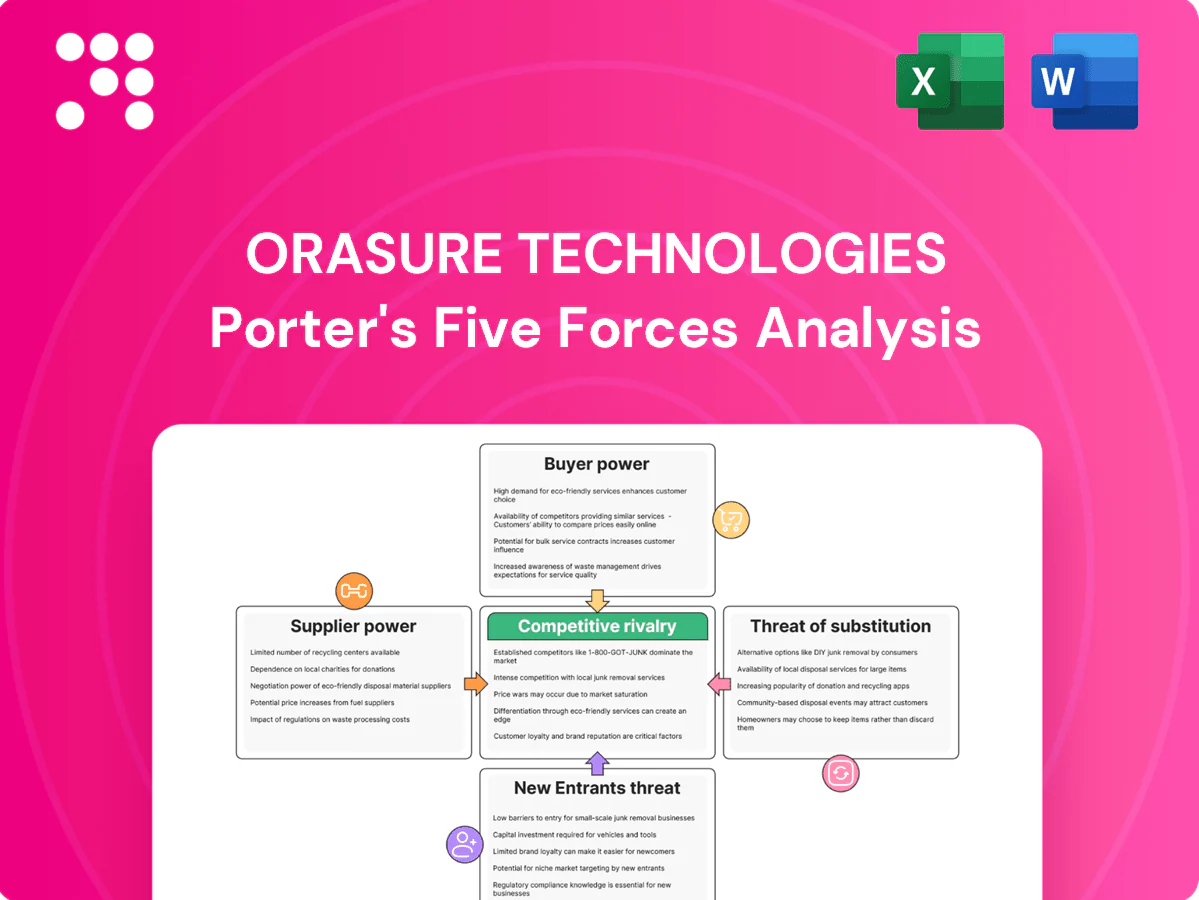
OraSure Technologies Porter's Five Forces Analysis

Don't Miss the Bigger Picture
OraSure Technologies faces moderate buyer power, as customers have some choice in diagnostic solutions, but their switching costs can be a deterrent. The threat of new entrants is also a significant factor, with the potential for innovative technologies to disrupt the market.
The complete report reveals the real forces shaping OraSure Technologies’s industry—from supplier influence to threat of new entrants. Gain actionable insights to drive smarter decision-making.
Suppliers Bargaining Power

Specialized Raw Materials and Reagents
OraSure Technologies' reliance on specialized raw materials and chemical reagents for its diagnostic and sample collection products can create supplier concentration. For instance, the development of advanced molecular sample collection kits or novel rapid diagnostic components often requires unique chemical formulations or highly specific biological materials. This specialization can limit the pool of qualified suppliers, potentially increasing their bargaining power.
The unique nature of certain diagnostic components, especially those critical for molecular sample collection and sophisticated rapid tests, can significantly narrow the field of potential suppliers. If a particular reagent or material is proprietary or requires very specific manufacturing capabilities, OraSure might find itself dependent on a very small number of vendors. This dependency can directly impact OraSure's ability to negotiate favorable pricing and secure consistent supply chains.
This dependency on specialized suppliers can grant them considerable leverage. If alternative sources for these niche materials are scarce or nonexistent, suppliers can exert greater influence over pricing and delivery schedules. For example, a critical enzyme required for a specific diagnostic assay might only be produced by one or two companies globally, giving them substantial pricing power. This was evident in early 2024 when supply chain disruptions for certain rare earth elements, crucial for some advanced sensor technologies, led to price increases of up to 15% for manufacturers relying on them.
Proprietary Technologies and IP
Suppliers who possess unique technologies or intellectual property essential for OraSure's products, like specialized components for diagnostic tests or patented materials for sample collection, wield considerable influence. For instance, if a key chemical reagent is only available from a single supplier with a patent, OraSure's cost for that input is largely dictated by that supplier. This reliance can lead to less favorable pricing or contract terms, impacting OraSure's margins.

Manufacturing In-Sourcing Initiatives
OraSure Technologies' in-sourcing of manufacturing for Sample Management Solutions to its Pennsylvania facility directly addresses supplier bargaining power. This strategic shift aims to reduce dependence on external contract manufacturers, thereby strengthening OraSure's position.
By consolidating production, OraSure gains more control over its supply chain, costs, and delivery schedules. This move is particularly relevant as companies increasingly seek to mitigate supply chain disruptions, a trend amplified in recent years.

Global Supply Chain Vulnerabilities
OraSure Technologies operates within a global diagnostic industry, making its supply chain susceptible to disruptions. Events like geopolitical tensions or shifts in trade policies can impact the availability and cost of essential components. For instance, in 2024, the semiconductor industry, crucial for many diagnostic devices, continued to grapple with supply chain adjustments following earlier global shortages, potentially increasing the bargaining power of suppliers for specialized chips.
These vulnerabilities are amplified when components are sourced from limited geographical areas or face the brunt of tariffs and logistical hurdles. This can lead to increased costs for OraSure. For example, if a key raw material for OraSure's diagnostic kits is primarily produced in a region experiencing political instability or new trade restrictions, suppliers in that region gain significant leverage.
- Increased Supplier Leverage: Disruptions can concentrate supply, giving fewer suppliers more pricing and negotiation power.
- Cost Escalation: Tariffs, shipping delays, and raw material scarcity directly translate to higher input costs for OraSure.
- Mitigation Strategies: OraSure can counter this by diversifying its supplier network and strategically increasing inventory levels for critical components.
Quality and Regulatory Compliance Requirements
Suppliers who can consistently meet OraSure Technologies' demanding quality standards and regulatory compliance requirements for diagnostic products wield significant bargaining power. This is because the medical device industry has high entry barriers, and the inputs are critical for product safety and efficacy.
OraSure must ensure its suppliers adhere to strict industry regulations, such as FDA guidelines. This necessity makes it challenging and costly to switch to new or unproven suppliers, thereby strengthening the position of established, compliant vendors.
- High Barriers to Entry: The specialized nature of materials and manufacturing processes required for diagnostic products creates high barriers for new suppliers, limiting the pool of qualified alternatives.
- Regulatory Stringency: Compliance with bodies like the FDA for components used in medical devices is non-negotiable, meaning suppliers must already possess these certifications, giving them an advantage.
- Critical Input Nature: The performance and reliability of OraSure's diagnostic tests directly depend on the quality of supplier inputs, making substitution difficult without compromising product integrity.
Specialized Suppliers Dictate Terms, Driving Up Diagnostic Component Costs
OraSure Technologies faces significant bargaining power from its suppliers, particularly for specialized reagents and components critical to its diagnostic and sample collection products. The limited availability of these niche materials, often due to proprietary technology or complex manufacturing processes, concentrates power in the hands of a few vendors. This dependency can lead to less favorable pricing and supply terms for OraSure.
For example, in early 2024, supply chain issues for certain rare earth elements, vital for advanced sensor technologies used in diagnostics, saw price increases of up to 15% for manufacturers. This highlights how scarcity and specialized production capabilities empower suppliers. Furthermore, the stringent regulatory environment in the diagnostics industry, requiring adherence to FDA guidelines, creates high barriers to entry for new suppliers, solidifying the leverage of established, compliant vendors. OraSure's strategic move to in-source some manufacturing aims to mitigate this supplier power by increasing internal control over its supply chain.
| Factor | Impact on OraSure | Example/Data Point (2024) |
|---|---|---|
| Specialized Materials Dependency | Increased supplier leverage due to limited alternatives | Price increases of up to 15% for specific rare earth elements impacting diagnostic sensor components. |
| Proprietary Technology/Patents | Suppliers dictate pricing and terms for unique inputs | Reliance on a single patented chemical reagent for a diagnostic assay. |
| Regulatory Compliance | High barriers for new suppliers, favoring established vendors | Need for FDA-compliant components restricts supplier options. |
| Supply Chain Disruptions | Concentrated supply increases supplier negotiation power | Semiconductor industry adjustments impacting availability of specialized chips for diagnostic devices. |
What is included in the product
 Detailed Word Document
This analysis unpacks the competitive forces impacting OraSure Technologies, examining the intensity of rivalry, buyer and supplier power, the threat of new entrants, and the availability of substitutes within the diagnostics market.

 Customizable Excel Spreadsheet
Effortlessly assess competitive intensity with a visual breakdown of supplier and buyer power, perfect for strategic planning.
Customers Bargaining Power

Large Institutional Buyers and Government Agencies
OraSure Technologies serves a significant customer base, including major clinical laboratories, hospitals, and government entities like those managing international HIV initiatives. These large-scale purchasers wield considerable influence, often negotiating for better pricing, advantageous contract conditions, and tailored product offerings.
The bargaining power of these institutional buyers is a key factor. For instance, a significant portion of OraSure's revenue is tied to government funding, and any disruptions, such as the USAID funding freezes experienced in the past, can directly affect international diagnostics sales, highlighting the sensitivity to these large customer relationships.
Direct-to-Consumer Market for OTC Tests
In the direct-to-consumer market for over-the-counter (OTC) diagnostic tests, the bargaining power of individual customers is typically low. However, the collective demand and how consumers perceive a brand significantly influence market dynamics. OraSure's strategy to offer user-friendly, accessible tests targets this market, requiring robust marketing and distribution.

Healthcare Provider Consolidation
The increasing consolidation within the healthcare provider and diagnostic laboratory sectors is a significant factor influencing OraSure Technologies. As these entities grow larger, their combined purchasing power intensifies, enabling them to negotiate more favorable terms and pricing. This trend directly translates into heightened customer bargaining power, potentially pressuring OraSure's profit margins.
For instance, in 2024, the healthcare industry continued its consolidation trajectory, with numerous mergers and acquisitions reported across hospital systems and independent laboratories. This strategic aggregation allows these larger customers to demand better pricing and service agreements from their suppliers, including OraSure. Consequently, OraSure must adopt more sophisticated negotiation tactics and focus on demonstrating superior value to retain and attract these influential clients.

Availability of Competing Products
Customers wield significant bargaining power when a wide array of alternative diagnostic products or sample collection devices are readily available from competitors. This abundance of choice allows customers to easily switch providers if they find better pricing, superior performance, or greater convenience elsewhere. For OraSure Technologies, this is a critical factor. For instance, the company's decision to discontinue its risk assessment product line in 2023 was directly attributed to customer attrition driven by more competitive offerings from rivals, demonstrating the tangible impact of this dynamic on market share and pricing flexibility.
The availability of competing products directly influences OraSure's ability to maintain pricing power and market share. Customers can readily compare OraSure's offerings against those of other companies, such as QuidelOrtho or Thermo Fisher Scientific, in the diagnostics space. This competitive landscape means that if OraSure's products are perceived as less cost-effective or technologically advanced, customers have a low barrier to switching. This pressure can force OraSure to adjust its pricing strategies or invest more heavily in product development to remain competitive.
- Customer Choice: The market for diagnostic tests and sample collection devices is diverse, offering consumers and healthcare providers numerous alternatives to OraSure's products.
- Competitive Landscape: Companies like QuidelOrtho and Thermo Fisher Scientific provide a broad range of diagnostic solutions, intensifying competition for OraSure.
- Switching Costs: For many diagnostic applications, the cost and effort for a customer to switch from OraSure to a competitor are relatively low, enhancing customer bargaining power.
- Market Impact: OraSure’s experience with its risk assessment product line underscores how readily available alternatives can lead to significant customer loss and impact revenue streams.
Shifting Customer Needs and Funding Priorities
Customers in the diagnostics sector are increasingly seeking convenient point-of-care and at-home testing solutions, alongside a growing interest in personalized medicine. This shift directly influences OraSure's product development and market strategy.
Public health funding priorities have a substantial effect on customer spending power. For instance, the significant decline in COVID-19 testing revenue, a major contributor in prior years, underscores this vulnerability. OraSure's revenue from COVID-19 testing products saw a substantial decrease in 2023 compared to its peak, highlighting the impact of shifting public health priorities.
To maintain its competitive edge, OraSure must proactively adapt its product offerings to meet these evolving customer demands. This includes securing new funding streams and diversifying revenue beyond areas subject to fluctuating public health initiatives.
- Evolving Customer Demands: Growing preference for point-of-care, home-based testing, and personalized diagnostics.
- Funding Priority Impact: Declining COVID-19 testing revenue demonstrates sensitivity to public health funding shifts.
- Strategic Imperative: OraSure needs to align its portfolio with new customer needs and secure diverse funding.
Customer Power Squeezes Margins and Drives Adaptation
OraSure Technologies faces substantial customer bargaining power, particularly from large institutional buyers like major labs and government entities, who negotiate for better pricing and terms. The healthcare industry's ongoing consolidation in 2024 further amplifies this power, as larger entities demand more favorable agreements, potentially squeezing OraSure's profit margins. This dynamic is evident in OraSure's need to adapt pricing and demonstrate superior value to retain these influential clients.
The availability of numerous competing diagnostic products and sample collection devices significantly empowers customers, as they can easily switch providers if better value is found elsewhere. OraSure's 2023 decision to discontinue its risk assessment product line due to customer attrition from more competitive offerings illustrates this direct impact. Furthermore, evolving customer demands for convenient point-of-care and home-based testing, coupled with shifts in public health funding like the decline in COVID-19 testing revenue, necessitate strategic adaptation to maintain market position.
Preview the Actual Deliverable
OraSure Technologies Porter's Five Forces Analysis
This preview showcases the comprehensive Porter's Five Forces Analysis for OraSure Technologies, offering a detailed examination of industry competition, buyer power, supplier leverage, new entrant threats, and substitute product risks. The document displayed here is the part of the full version you’ll get—ready for download and use the moment you buy. You can trust that the insights and strategic overview presented are precisely what you will receive, enabling informed decision-making regarding OraSure's market position and competitive landscape.

Don't Miss the Bigger Picture
OraSure Technologies faces moderate buyer power, as customers have some choice in diagnostic solutions, but their switching costs can be a deterrent. The threat of new entrants is also a significant factor, with the potential for innovative technologies to disrupt the market.
The complete report reveals the real forces shaping OraSure Technologies’s industry—from supplier influence to threat of new entrants. Gain actionable insights to drive smarter decision-making.
Suppliers Bargaining Power
Specialized Raw Materials and Reagents
OraSure Technologies' reliance on specialized raw materials and chemical reagents for its diagnostic and sample collection products can create supplier concentration. For instance, the development of advanced molecular sample collection kits or novel rapid diagnostic components often requires unique chemical formulations or highly specific biological materials. This specialization can limit the pool of qualified suppliers, potentially increasing their bargaining power.
The unique nature of certain diagnostic components, especially those critical for molecular sample collection and sophisticated rapid tests, can significantly narrow the field of potential suppliers. If a particular reagent or material is proprietary or requires very specific manufacturing capabilities, OraSure might find itself dependent on a very small number of vendors. This dependency can directly impact OraSure's ability to negotiate favorable pricing and secure consistent supply chains.
This dependency on specialized suppliers can grant them considerable leverage. If alternative sources for these niche materials are scarce or nonexistent, suppliers can exert greater influence over pricing and delivery schedules. For example, a critical enzyme required for a specific diagnostic assay might only be produced by one or two companies globally, giving them substantial pricing power. This was evident in early 2024 when supply chain disruptions for certain rare earth elements, crucial for some advanced sensor technologies, led to price increases of up to 15% for manufacturers relying on them.
Proprietary Technologies and IP
Suppliers who possess unique technologies or intellectual property essential for OraSure's products, like specialized components for diagnostic tests or patented materials for sample collection, wield considerable influence. For instance, if a key chemical reagent is only available from a single supplier with a patent, OraSure's cost for that input is largely dictated by that supplier. This reliance can lead to less favorable pricing or contract terms, impacting OraSure's margins.
Manufacturing In-Sourcing Initiatives
OraSure Technologies' in-sourcing of manufacturing for Sample Management Solutions to its Pennsylvania facility directly addresses supplier bargaining power. This strategic shift aims to reduce dependence on external contract manufacturers, thereby strengthening OraSure's position.
By consolidating production, OraSure gains more control over its supply chain, costs, and delivery schedules. This move is particularly relevant as companies increasingly seek to mitigate supply chain disruptions, a trend amplified in recent years.
Global Supply Chain Vulnerabilities
OraSure Technologies operates within a global diagnostic industry, making its supply chain susceptible to disruptions. Events like geopolitical tensions or shifts in trade policies can impact the availability and cost of essential components. For instance, in 2024, the semiconductor industry, crucial for many diagnostic devices, continued to grapple with supply chain adjustments following earlier global shortages, potentially increasing the bargaining power of suppliers for specialized chips.
These vulnerabilities are amplified when components are sourced from limited geographical areas or face the brunt of tariffs and logistical hurdles. This can lead to increased costs for OraSure. For example, if a key raw material for OraSure's diagnostic kits is primarily produced in a region experiencing political instability or new trade restrictions, suppliers in that region gain significant leverage.
- Increased Supplier Leverage: Disruptions can concentrate supply, giving fewer suppliers more pricing and negotiation power.
- Cost Escalation: Tariffs, shipping delays, and raw material scarcity directly translate to higher input costs for OraSure.
- Mitigation Strategies: OraSure can counter this by diversifying its supplier network and strategically increasing inventory levels for critical components.
Quality and Regulatory Compliance Requirements
Suppliers who can consistently meet OraSure Technologies' demanding quality standards and regulatory compliance requirements for diagnostic products wield significant bargaining power. This is because the medical device industry has high entry barriers, and the inputs are critical for product safety and efficacy.
OraSure must ensure its suppliers adhere to strict industry regulations, such as FDA guidelines. This necessity makes it challenging and costly to switch to new or unproven suppliers, thereby strengthening the position of established, compliant vendors.
- High Barriers to Entry: The specialized nature of materials and manufacturing processes required for diagnostic products creates high barriers for new suppliers, limiting the pool of qualified alternatives.
- Regulatory Stringency: Compliance with bodies like the FDA for components used in medical devices is non-negotiable, meaning suppliers must already possess these certifications, giving them an advantage.
- Critical Input Nature: The performance and reliability of OraSure's diagnostic tests directly depend on the quality of supplier inputs, making substitution difficult without compromising product integrity.
Specialized Suppliers Dictate Terms, Driving Up Diagnostic Component Costs
OraSure Technologies faces significant bargaining power from its suppliers, particularly for specialized reagents and components critical to its diagnostic and sample collection products. The limited availability of these niche materials, often due to proprietary technology or complex manufacturing processes, concentrates power in the hands of a few vendors. This dependency can lead to less favorable pricing and supply terms for OraSure.
For example, in early 2024, supply chain issues for certain rare earth elements, vital for advanced sensor technologies used in diagnostics, saw price increases of up to 15% for manufacturers. This highlights how scarcity and specialized production capabilities empower suppliers. Furthermore, the stringent regulatory environment in the diagnostics industry, requiring adherence to FDA guidelines, creates high barriers to entry for new suppliers, solidifying the leverage of established, compliant vendors. OraSure's strategic move to in-source some manufacturing aims to mitigate this supplier power by increasing internal control over its supply chain.
| Factor | Impact on OraSure | Example/Data Point (2024) |
|---|---|---|
| Specialized Materials Dependency | Increased supplier leverage due to limited alternatives | Price increases of up to 15% for specific rare earth elements impacting diagnostic sensor components. |
| Proprietary Technology/Patents | Suppliers dictate pricing and terms for unique inputs | Reliance on a single patented chemical reagent for a diagnostic assay. |
| Regulatory Compliance | High barriers for new suppliers, favoring established vendors | Need for FDA-compliant components restricts supplier options. |
| Supply Chain Disruptions | Concentrated supply increases supplier negotiation power | Semiconductor industry adjustments impacting availability of specialized chips for diagnostic devices. |
What is included in the product
Detailed Word Document
This analysis unpacks the competitive forces impacting OraSure Technologies, examining the intensity of rivalry, buyer and supplier power, the threat of new entrants, and the availability of substitutes within the diagnostics market.
Customizable Excel Spreadsheet
Effortlessly assess competitive intensity with a visual breakdown of supplier and buyer power, perfect for strategic planning.
Customers Bargaining Power
Large Institutional Buyers and Government Agencies
OraSure Technologies serves a significant customer base, including major clinical laboratories, hospitals, and government entities like those managing international HIV initiatives. These large-scale purchasers wield considerable influence, often negotiating for better pricing, advantageous contract conditions, and tailored product offerings.
The bargaining power of these institutional buyers is a key factor. For instance, a significant portion of OraSure's revenue is tied to government funding, and any disruptions, such as the USAID funding freezes experienced in the past, can directly affect international diagnostics sales, highlighting the sensitivity to these large customer relationships.
Direct-to-Consumer Market for OTC Tests
In the direct-to-consumer market for over-the-counter (OTC) diagnostic tests, the bargaining power of individual customers is typically low. However, the collective demand and how consumers perceive a brand significantly influence market dynamics. OraSure's strategy to offer user-friendly, accessible tests targets this market, requiring robust marketing and distribution.
Healthcare Provider Consolidation
The increasing consolidation within the healthcare provider and diagnostic laboratory sectors is a significant factor influencing OraSure Technologies. As these entities grow larger, their combined purchasing power intensifies, enabling them to negotiate more favorable terms and pricing. This trend directly translates into heightened customer bargaining power, potentially pressuring OraSure's profit margins.
For instance, in 2024, the healthcare industry continued its consolidation trajectory, with numerous mergers and acquisitions reported across hospital systems and independent laboratories. This strategic aggregation allows these larger customers to demand better pricing and service agreements from their suppliers, including OraSure. Consequently, OraSure must adopt more sophisticated negotiation tactics and focus on demonstrating superior value to retain and attract these influential clients.
Availability of Competing Products
Customers wield significant bargaining power when a wide array of alternative diagnostic products or sample collection devices are readily available from competitors. This abundance of choice allows customers to easily switch providers if they find better pricing, superior performance, or greater convenience elsewhere. For OraSure Technologies, this is a critical factor. For instance, the company's decision to discontinue its risk assessment product line in 2023 was directly attributed to customer attrition driven by more competitive offerings from rivals, demonstrating the tangible impact of this dynamic on market share and pricing flexibility.
The availability of competing products directly influences OraSure's ability to maintain pricing power and market share. Customers can readily compare OraSure's offerings against those of other companies, such as QuidelOrtho or Thermo Fisher Scientific, in the diagnostics space. This competitive landscape means that if OraSure's products are perceived as less cost-effective or technologically advanced, customers have a low barrier to switching. This pressure can force OraSure to adjust its pricing strategies or invest more heavily in product development to remain competitive.
- Customer Choice: The market for diagnostic tests and sample collection devices is diverse, offering consumers and healthcare providers numerous alternatives to OraSure's products.
- Competitive Landscape: Companies like QuidelOrtho and Thermo Fisher Scientific provide a broad range of diagnostic solutions, intensifying competition for OraSure.
- Switching Costs: For many diagnostic applications, the cost and effort for a customer to switch from OraSure to a competitor are relatively low, enhancing customer bargaining power.
- Market Impact: OraSure’s experience with its risk assessment product line underscores how readily available alternatives can lead to significant customer loss and impact revenue streams.
Shifting Customer Needs and Funding Priorities
Customers in the diagnostics sector are increasingly seeking convenient point-of-care and at-home testing solutions, alongside a growing interest in personalized medicine. This shift directly influences OraSure's product development and market strategy.
Public health funding priorities have a substantial effect on customer spending power. For instance, the significant decline in COVID-19 testing revenue, a major contributor in prior years, underscores this vulnerability. OraSure's revenue from COVID-19 testing products saw a substantial decrease in 2023 compared to its peak, highlighting the impact of shifting public health priorities.
To maintain its competitive edge, OraSure must proactively adapt its product offerings to meet these evolving customer demands. This includes securing new funding streams and diversifying revenue beyond areas subject to fluctuating public health initiatives.
- Evolving Customer Demands: Growing preference for point-of-care, home-based testing, and personalized diagnostics.
- Funding Priority Impact: Declining COVID-19 testing revenue demonstrates sensitivity to public health funding shifts.
- Strategic Imperative: OraSure needs to align its portfolio with new customer needs and secure diverse funding.
Customer Power Squeezes Margins and Drives Adaptation
OraSure Technologies faces substantial customer bargaining power, particularly from large institutional buyers like major labs and government entities, who negotiate for better pricing and terms. The healthcare industry's ongoing consolidation in 2024 further amplifies this power, as larger entities demand more favorable agreements, potentially squeezing OraSure's profit margins. This dynamic is evident in OraSure's need to adapt pricing and demonstrate superior value to retain these influential clients.
The availability of numerous competing diagnostic products and sample collection devices significantly empowers customers, as they can easily switch providers if better value is found elsewhere. OraSure's 2023 decision to discontinue its risk assessment product line due to customer attrition from more competitive offerings illustrates this direct impact. Furthermore, evolving customer demands for convenient point-of-care and home-based testing, coupled with shifts in public health funding like the decline in COVID-19 testing revenue, necessitate strategic adaptation to maintain market position.
Preview the Actual Deliverable
OraSure Technologies Porter's Five Forces Analysis
This preview showcases the comprehensive Porter's Five Forces Analysis for OraSure Technologies, offering a detailed examination of industry competition, buyer power, supplier leverage, new entrant threats, and substitute product risks. The document displayed here is the part of the full version you’ll get—ready for download and use the moment you buy. You can trust that the insights and strategic overview presented are precisely what you will receive, enabling informed decision-making regarding OraSure's market position and competitive landscape.
Original: $10.00
-65%$10.00
$3.50Description
Don't Miss the Bigger Picture
OraSure Technologies faces moderate buyer power, as customers have some choice in diagnostic solutions, but their switching costs can be a deterrent. The threat of new entrants is also a significant factor, with the potential for innovative technologies to disrupt the market.
The complete report reveals the real forces shaping OraSure Technologies’s industry—from supplier influence to threat of new entrants. Gain actionable insights to drive smarter decision-making.
Suppliers Bargaining Power
Specialized Raw Materials and Reagents
OraSure Technologies' reliance on specialized raw materials and chemical reagents for its diagnostic and sample collection products can create supplier concentration. For instance, the development of advanced molecular sample collection kits or novel rapid diagnostic components often requires unique chemical formulations or highly specific biological materials. This specialization can limit the pool of qualified suppliers, potentially increasing their bargaining power.
The unique nature of certain diagnostic components, especially those critical for molecular sample collection and sophisticated rapid tests, can significantly narrow the field of potential suppliers. If a particular reagent or material is proprietary or requires very specific manufacturing capabilities, OraSure might find itself dependent on a very small number of vendors. This dependency can directly impact OraSure's ability to negotiate favorable pricing and secure consistent supply chains.
This dependency on specialized suppliers can grant them considerable leverage. If alternative sources for these niche materials are scarce or nonexistent, suppliers can exert greater influence over pricing and delivery schedules. For example, a critical enzyme required for a specific diagnostic assay might only be produced by one or two companies globally, giving them substantial pricing power. This was evident in early 2024 when supply chain disruptions for certain rare earth elements, crucial for some advanced sensor technologies, led to price increases of up to 15% for manufacturers relying on them.
Proprietary Technologies and IP
Suppliers who possess unique technologies or intellectual property essential for OraSure's products, like specialized components for diagnostic tests or patented materials for sample collection, wield considerable influence. For instance, if a key chemical reagent is only available from a single supplier with a patent, OraSure's cost for that input is largely dictated by that supplier. This reliance can lead to less favorable pricing or contract terms, impacting OraSure's margins.
Manufacturing In-Sourcing Initiatives
OraSure Technologies' in-sourcing of manufacturing for Sample Management Solutions to its Pennsylvania facility directly addresses supplier bargaining power. This strategic shift aims to reduce dependence on external contract manufacturers, thereby strengthening OraSure's position.
By consolidating production, OraSure gains more control over its supply chain, costs, and delivery schedules. This move is particularly relevant as companies increasingly seek to mitigate supply chain disruptions, a trend amplified in recent years.
Global Supply Chain Vulnerabilities
OraSure Technologies operates within a global diagnostic industry, making its supply chain susceptible to disruptions. Events like geopolitical tensions or shifts in trade policies can impact the availability and cost of essential components. For instance, in 2024, the semiconductor industry, crucial for many diagnostic devices, continued to grapple with supply chain adjustments following earlier global shortages, potentially increasing the bargaining power of suppliers for specialized chips.
These vulnerabilities are amplified when components are sourced from limited geographical areas or face the brunt of tariffs and logistical hurdles. This can lead to increased costs for OraSure. For example, if a key raw material for OraSure's diagnostic kits is primarily produced in a region experiencing political instability or new trade restrictions, suppliers in that region gain significant leverage.
- Increased Supplier Leverage: Disruptions can concentrate supply, giving fewer suppliers more pricing and negotiation power.
- Cost Escalation: Tariffs, shipping delays, and raw material scarcity directly translate to higher input costs for OraSure.
- Mitigation Strategies: OraSure can counter this by diversifying its supplier network and strategically increasing inventory levels for critical components.
Quality and Regulatory Compliance Requirements
Suppliers who can consistently meet OraSure Technologies' demanding quality standards and regulatory compliance requirements for diagnostic products wield significant bargaining power. This is because the medical device industry has high entry barriers, and the inputs are critical for product safety and efficacy.
OraSure must ensure its suppliers adhere to strict industry regulations, such as FDA guidelines. This necessity makes it challenging and costly to switch to new or unproven suppliers, thereby strengthening the position of established, compliant vendors.
- High Barriers to Entry: The specialized nature of materials and manufacturing processes required for diagnostic products creates high barriers for new suppliers, limiting the pool of qualified alternatives.
- Regulatory Stringency: Compliance with bodies like the FDA for components used in medical devices is non-negotiable, meaning suppliers must already possess these certifications, giving them an advantage.
- Critical Input Nature: The performance and reliability of OraSure's diagnostic tests directly depend on the quality of supplier inputs, making substitution difficult without compromising product integrity.
Specialized Suppliers Dictate Terms, Driving Up Diagnostic Component Costs
OraSure Technologies faces significant bargaining power from its suppliers, particularly for specialized reagents and components critical to its diagnostic and sample collection products. The limited availability of these niche materials, often due to proprietary technology or complex manufacturing processes, concentrates power in the hands of a few vendors. This dependency can lead to less favorable pricing and supply terms for OraSure.
For example, in early 2024, supply chain issues for certain rare earth elements, vital for advanced sensor technologies used in diagnostics, saw price increases of up to 15% for manufacturers. This highlights how scarcity and specialized production capabilities empower suppliers. Furthermore, the stringent regulatory environment in the diagnostics industry, requiring adherence to FDA guidelines, creates high barriers to entry for new suppliers, solidifying the leverage of established, compliant vendors. OraSure's strategic move to in-source some manufacturing aims to mitigate this supplier power by increasing internal control over its supply chain.
| Factor | Impact on OraSure | Example/Data Point (2024) |
|---|---|---|
| Specialized Materials Dependency | Increased supplier leverage due to limited alternatives | Price increases of up to 15% for specific rare earth elements impacting diagnostic sensor components. |
| Proprietary Technology/Patents | Suppliers dictate pricing and terms for unique inputs | Reliance on a single patented chemical reagent for a diagnostic assay. |
| Regulatory Compliance | High barriers for new suppliers, favoring established vendors | Need for FDA-compliant components restricts supplier options. |
| Supply Chain Disruptions | Concentrated supply increases supplier negotiation power | Semiconductor industry adjustments impacting availability of specialized chips for diagnostic devices. |
What is included in the product
Detailed Word Document
This analysis unpacks the competitive forces impacting OraSure Technologies, examining the intensity of rivalry, buyer and supplier power, the threat of new entrants, and the availability of substitutes within the diagnostics market.
Customizable Excel Spreadsheet
Effortlessly assess competitive intensity with a visual breakdown of supplier and buyer power, perfect for strategic planning.
Customers Bargaining Power
Large Institutional Buyers and Government Agencies
OraSure Technologies serves a significant customer base, including major clinical laboratories, hospitals, and government entities like those managing international HIV initiatives. These large-scale purchasers wield considerable influence, often negotiating for better pricing, advantageous contract conditions, and tailored product offerings.
The bargaining power of these institutional buyers is a key factor. For instance, a significant portion of OraSure's revenue is tied to government funding, and any disruptions, such as the USAID funding freezes experienced in the past, can directly affect international diagnostics sales, highlighting the sensitivity to these large customer relationships.
Direct-to-Consumer Market for OTC Tests
In the direct-to-consumer market for over-the-counter (OTC) diagnostic tests, the bargaining power of individual customers is typically low. However, the collective demand and how consumers perceive a brand significantly influence market dynamics. OraSure's strategy to offer user-friendly, accessible tests targets this market, requiring robust marketing and distribution.
Healthcare Provider Consolidation
The increasing consolidation within the healthcare provider and diagnostic laboratory sectors is a significant factor influencing OraSure Technologies. As these entities grow larger, their combined purchasing power intensifies, enabling them to negotiate more favorable terms and pricing. This trend directly translates into heightened customer bargaining power, potentially pressuring OraSure's profit margins.
For instance, in 2024, the healthcare industry continued its consolidation trajectory, with numerous mergers and acquisitions reported across hospital systems and independent laboratories. This strategic aggregation allows these larger customers to demand better pricing and service agreements from their suppliers, including OraSure. Consequently, OraSure must adopt more sophisticated negotiation tactics and focus on demonstrating superior value to retain and attract these influential clients.
Availability of Competing Products
Customers wield significant bargaining power when a wide array of alternative diagnostic products or sample collection devices are readily available from competitors. This abundance of choice allows customers to easily switch providers if they find better pricing, superior performance, or greater convenience elsewhere. For OraSure Technologies, this is a critical factor. For instance, the company's decision to discontinue its risk assessment product line in 2023 was directly attributed to customer attrition driven by more competitive offerings from rivals, demonstrating the tangible impact of this dynamic on market share and pricing flexibility.
The availability of competing products directly influences OraSure's ability to maintain pricing power and market share. Customers can readily compare OraSure's offerings against those of other companies, such as QuidelOrtho or Thermo Fisher Scientific, in the diagnostics space. This competitive landscape means that if OraSure's products are perceived as less cost-effective or technologically advanced, customers have a low barrier to switching. This pressure can force OraSure to adjust its pricing strategies or invest more heavily in product development to remain competitive.
- Customer Choice: The market for diagnostic tests and sample collection devices is diverse, offering consumers and healthcare providers numerous alternatives to OraSure's products.
- Competitive Landscape: Companies like QuidelOrtho and Thermo Fisher Scientific provide a broad range of diagnostic solutions, intensifying competition for OraSure.
- Switching Costs: For many diagnostic applications, the cost and effort for a customer to switch from OraSure to a competitor are relatively low, enhancing customer bargaining power.
- Market Impact: OraSure’s experience with its risk assessment product line underscores how readily available alternatives can lead to significant customer loss and impact revenue streams.
Shifting Customer Needs and Funding Priorities
Customers in the diagnostics sector are increasingly seeking convenient point-of-care and at-home testing solutions, alongside a growing interest in personalized medicine. This shift directly influences OraSure's product development and market strategy.
Public health funding priorities have a substantial effect on customer spending power. For instance, the significant decline in COVID-19 testing revenue, a major contributor in prior years, underscores this vulnerability. OraSure's revenue from COVID-19 testing products saw a substantial decrease in 2023 compared to its peak, highlighting the impact of shifting public health priorities.
To maintain its competitive edge, OraSure must proactively adapt its product offerings to meet these evolving customer demands. This includes securing new funding streams and diversifying revenue beyond areas subject to fluctuating public health initiatives.
- Evolving Customer Demands: Growing preference for point-of-care, home-based testing, and personalized diagnostics.
- Funding Priority Impact: Declining COVID-19 testing revenue demonstrates sensitivity to public health funding shifts.
- Strategic Imperative: OraSure needs to align its portfolio with new customer needs and secure diverse funding.
Customer Power Squeezes Margins and Drives Adaptation
OraSure Technologies faces substantial customer bargaining power, particularly from large institutional buyers like major labs and government entities, who negotiate for better pricing and terms. The healthcare industry's ongoing consolidation in 2024 further amplifies this power, as larger entities demand more favorable agreements, potentially squeezing OraSure's profit margins. This dynamic is evident in OraSure's need to adapt pricing and demonstrate superior value to retain these influential clients.
The availability of numerous competing diagnostic products and sample collection devices significantly empowers customers, as they can easily switch providers if better value is found elsewhere. OraSure's 2023 decision to discontinue its risk assessment product line due to customer attrition from more competitive offerings illustrates this direct impact. Furthermore, evolving customer demands for convenient point-of-care and home-based testing, coupled with shifts in public health funding like the decline in COVID-19 testing revenue, necessitate strategic adaptation to maintain market position.
Preview the Actual Deliverable
OraSure Technologies Porter's Five Forces Analysis
This preview showcases the comprehensive Porter's Five Forces Analysis for OraSure Technologies, offering a detailed examination of industry competition, buyer power, supplier leverage, new entrant threats, and substitute product risks. The document displayed here is the part of the full version you’ll get—ready for download and use the moment you buy. You can trust that the insights and strategic overview presented are precisely what you will receive, enabling informed decision-making regarding OraSure's market position and competitive landscape.











